


ASTM E342-11(2016)
(Test Method)Standard Test Method for Determination of Chromium Oxide in Chrome Ores by Permanganate Titrimetry
Standard Test Method for Determination of Chromium Oxide in Chrome Ores by Permanganate Titrimetry
SIGNIFICANCE AND USE
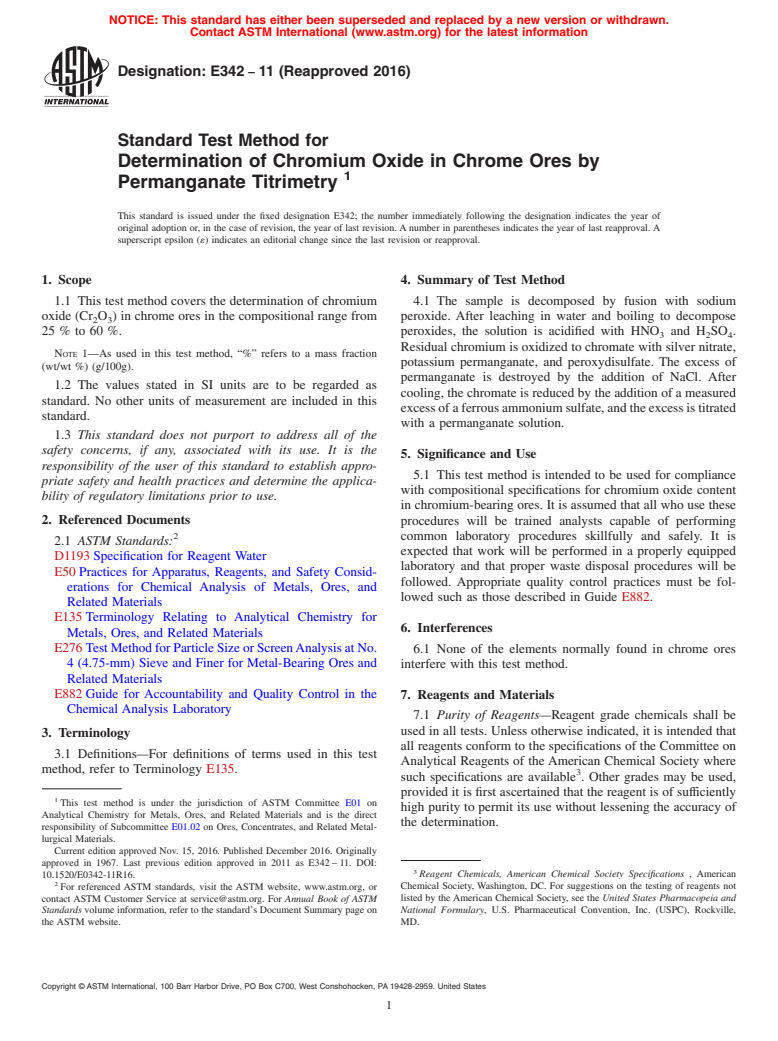
5.1 This test method is intended to be used for compliance with compositional specifications for chromium oxide content in chromium-bearing ores. It is assumed that all who use these procedures will be trained analysts capable of performing common laboratory procedures skillfully and safely. It is expected that work will be performed in a properly equipped laboratory and that proper waste disposal procedures will be followed. Appropriate quality control practices must be followed such as those described in Guide E882.
SCOPE
1.1 This test method covers the determination of chromium oxide (Cr2O3) in chrome ores in the compositional range from 25 % to 60 %.
Note 1: As used in this test method, “%” refers to a mass fraction (wt/wt %) (g/100g).
1.2 The values stated in SI units are to be regarded as standard. No other units of measurement are included in this standard.
1.3 This standard does not purport to address all of the safety concerns, if any, associated with its use. It is the responsibility of the user of this standard to establish appropriate safety and health practices and determine the applicability of regulatory limitations prior to use.
General Information
Buy Standard
Standards Content (Sample)
NOTICE: This standard has either been superseded and replaced by a new version or withdrawn.
Contact ASTM International (www.astm.org) for the latest information
Designation: E342 − 11 (Reapproved 2016)
Standard Test Method for
Determination of Chromium Oxide in Chrome Ores by
Permanganate Titrimetry
This standard is issued under the fixed designation E342; the number immediately following the designation indicates the year of
original adoption or, in the case of revision, the year of last revision. A number in parentheses indicates the year of last reapproval. A
superscript epsilon (´) indicates an editorial change since the last revision or reapproval.
1. Scope 4. Summary of Test Method
1.1 This test method covers the determination of chromium 4.1 The sample is decomposed by fusion with sodium
oxide (Cr O ) in chrome ores in the compositional range from peroxide. After leaching in water and boiling to decompose
2 3
25 % to 60 %. peroxides, the solution is acidified with HNO and H SO .
3 2 4
Residual chromium is oxidized to chromate with silver nitrate,
NOTE 1—As used in this test method, “%” refers to a mass fraction
potassium permanganate, and peroxydisulfate. The excess of
(wt/wt %) (g/100g).
permanganate is destroyed by the addition of NaCl. After
1.2 The values stated in SI units are to be regarded as
cooling, the chromate is reduced by the addition of a measured
standard. No other units of measurement are included in this
excess of a ferrous ammonium sulfate, and the excess is titrated
standard.
with a permanganate solution.
1.3 This standard does not purport to address all of the
safety concerns, if any, associated with its use. It is the
5. Significance and Use
responsibility of the user of this standard to establish appro-
5.1 This test method is intended to be used for compliance
priate safety and health practices and determine the applica-
with compositional specifications for chromium oxide content
bility of regulatory limitations prior to use.
in chromium-bearing ores. It is assumed that all who use these
2. Referenced Documents procedures will be trained analysts capable of performing
2 common laboratory procedures skillfully and safely. It is
2.1 ASTM Standards:
expected that work will be performed in a properly equipped
D1193 Specification for Reagent Water
laboratory and that proper waste disposal procedures will be
E50 Practices for Apparatus, Reagents, and Safety Consid-
followed. Appropriate quality control practices must be fol-
erations for Chemical Analysis of Metals, Ores, and
lowed such as those described in Guide E882.
Related Materials
E135 Terminology Relating to Analytical Chemistry for
6. Interferences
Metals, Ores, and Related Materials
E276 Test Method for Particle Size or Screen Analysis at No. 6.1 None of the elements normally found in chrome ores
4 (4.75-mm) Sieve and Finer for Metal-Bearing Ores and interfere with this test method.
Related Materials
E882 Guide for Accountability and Quality Control in the
7. Reagents and Materials
Chemical Analysis Laboratory
7.1 Purity of Reagents—Reagent grade chemicals shall be
used in all tests. Unless otherwise indicated, it is intended that
3. Terminology
all reagents conform to the specifications of the Committee on
3.1 Definitions—For definitions of terms used in this test
Analytical Reagents of the American Chemical Society where
method, refer to Terminology E135.
such specifications are available . Other grades may be used,
provided it is first ascertained that the reagent is of sufficiently
This test method is under the jurisdiction of ASTM Committee E01 on
high purity to permit its use without lessening the accuracy of
Analytical Chemistry for Metals, Ores, and Related Materials and is the direct
the determination.
responsibility of Subcommittee E01.02 on Ores, Concentrates, and Related Metal-
lurgical Materials.
Current edition approved Nov. 15, 2016. Published December 2016. Originally
approved in 1967. Last previous edition approved in 2011 as E342 – 11. DOI:
10.1520/E0342-11R16. Reagent Chemicals, American Chemical Society Specifications , American
For referenced ASTM standards, visit the ASTM website, www.astm.org, or Chemical Society, Washington, DC. For suggestions on the testing of reagents not
contact ASTM Customer Service at service@astm.org. For Annual Book of ASTM listed by the American Chemical Society, see the United States Pharmacopeia and
Standards volume information, refer to the standard’s Document Summary page on National Formulary, U.S. Pharmaceutical Convention, Inc. (USPC), Rockville,
the ASTM website. MD.
Copyright © ASTM International, 100 Barr Harbor Drive, PO Box C700, West Conshohocken, PA 19428-2959. United States
E342 − 11 (2016)
7.2 Purity of Water—Unless otherwise indicated, references 10.2 Cover the crucible with an iron or nickel cover and
to water shall be understood to mean reagent water conforming carefully fuse the contents at 600 °C to 700 °C, preferably in
to Type I or II of Specification D1193. Type III or IV may be an electric muffle furnace. After the mix has melted, fuse for
used if they effect no measurable change in the blank or several minutes at a low red heat while giving a slight rotary
sample. motion to the crucible to ensure complete decomposition.
NOTE 2—Ordinary iron crucibles that may contain significant amounts
7.3 Ammonium Peroxydisulfate Solution (250 g/L)—
of chromium should be avoided. Crucibles made of ingot iron are
Dissolve 25 g of ammonium persulfate (ammonium peroxy-
satisfactory.
disulfate) ((NH ) S O ) in water, and dilute to 100 mL.
NOTE 3—Only about 5 g of Na O is required if about 0.2 g of very fine
4 2 2 8
2 2
pulverized sugar charcoal is mixed with the Na O . After heating for about
Prepare fresh as needed. 2 2
30 s, ignition of the charcoal takes place, and the crucible will suddenly
7.4 Ferrous Ammonium Sulfate Solution (0.2 N)—Dissolve
become a dull red on the outside. The total time required to complete the
78.4 g of ferrous ammonium sulfate (FeSO (NH ) SO ·6H O) fusion is about 2 min. By shortening the time for fusion and contact with
4 4 2 4 2
the flux, the life of the crucible is extended.
in 1 L of cool H SO (5 + 95). Because the ferrous ammonium
2 4
sulfate solution gradually weakens in reducing power, it is
10.3 Place the
...
This document is not an ASTM standard and is intended only to provide the user of an ASTM standard an indication of what changes have been made to the previous version. Because
it may not be technically possible to adequately depict all changes accurately, ASTM recommends that users consult prior editions as appropriate. In all cases only the current version
of the standard as published by ASTM is to be considered the official document.
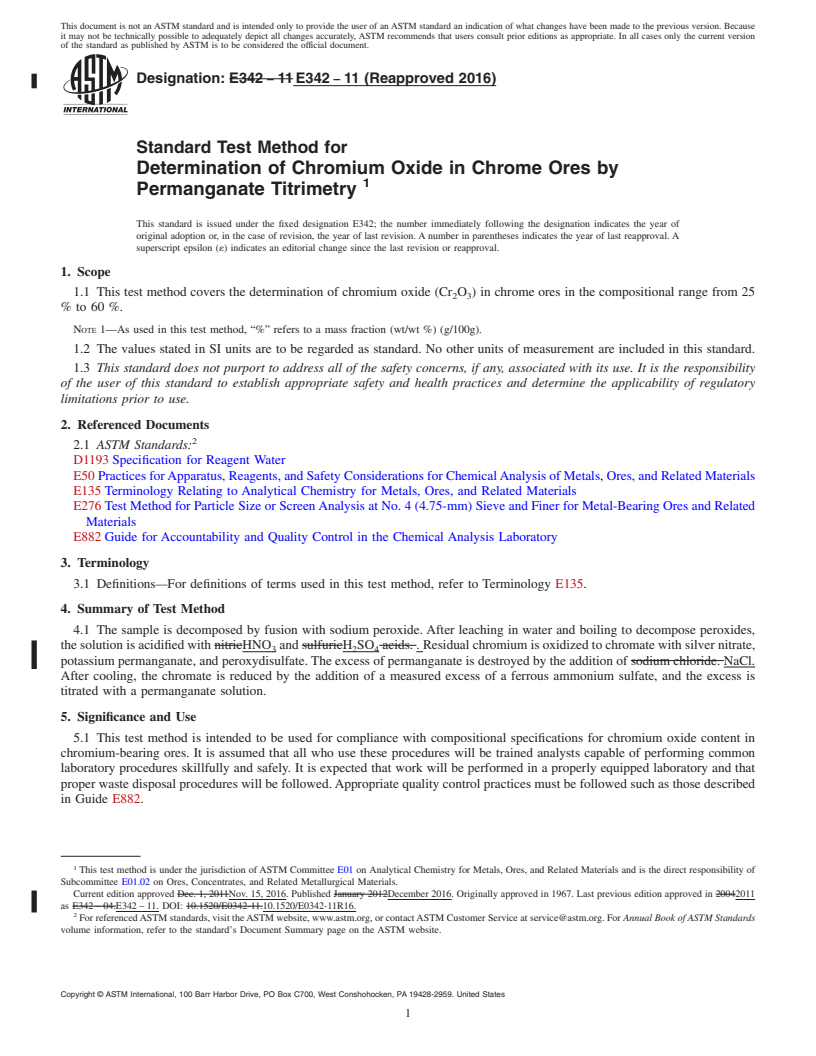
Designation: E342 − 11 E342 − 11 (Reapproved 2016)
Standard Test Method for
Determination of Chromium Oxide in Chrome Ores by
Permanganate Titrimetry
This standard is issued under the fixed designation E342; the number immediately following the designation indicates the year of
original adoption or, in the case of revision, the year of last revision. A number in parentheses indicates the year of last reapproval. A
superscript epsilon (´) indicates an editorial change since the last revision or reapproval.
1. Scope
1.1 This test method covers the determination of chromium oxide (Cr O ) in chrome ores in the compositional range from 25
2 3
% to 60 %.
NOTE 1—As used in this test method, “%” refers to a mass fraction (wt/wt %) (g/100g).
1.2 The values stated in SI units are to be regarded as standard. No other units of measurement are included in this standard.
1.3 This standard does not purport to address all of the safety concerns, if any, associated with its use. It is the responsibility
of the user of this standard to establish appropriate safety and health practices and determine the applicability of regulatory
limitations prior to use.
2. Referenced Documents
2.1 ASTM Standards:
D1193 Specification for Reagent Water
E50 Practices for Apparatus, Reagents, and Safety Considerations for Chemical Analysis of Metals, Ores, and Related Materials
E135 Terminology Relating to Analytical Chemistry for Metals, Ores, and Related Materials
E276 Test Method for Particle Size or Screen Analysis at No. 4 (4.75-mm) Sieve and Finer for Metal-Bearing Ores and Related
Materials
E882 Guide for Accountability and Quality Control in the Chemical Analysis Laboratory
3. Terminology
3.1 Definitions—For definitions of terms used in this test method, refer to Terminology E135.
4. Summary of Test Method
4.1 The sample is decomposed by fusion with sodium peroxide. After leaching in water and boiling to decompose peroxides,
the solution is acidified with nitricHNO and sulfuricH SO acids. . Residual chromium is oxidized to chromate with silver nitrate,
3 2 4
potassium permanganate, and peroxydisulfate. The excess of permanganate is destroyed by the addition of sodium chloride. NaCl.
After cooling, the chromate is reduced by the addition of a measured excess of a ferrous ammonium sulfate, and the excess is
titrated with a permanganate solution.
5. Significance and Use
5.1 This test method is intended to be used for compliance with compositional specifications for chromium oxide content in
chromium-bearing ores. It is assumed that all who use these procedures will be trained analysts capable of performing common
laboratory procedures skillfully and safely. It is expected that work will be performed in a properly equipped laboratory and that
proper waste disposal procedures will be followed. Appropriate quality control practices must be followed such as those described
in Guide E882.
This test method is under the jurisdiction of ASTM Committee E01 on Analytical Chemistry for Metals, Ores, and Related Materials and is the direct responsibility of
Subcommittee E01.02 on Ores, Concentrates, and Related Metallurgical Materials.
Current edition approved Dec. 1, 2011Nov. 15, 2016. Published January 2012December 2016. Originally approved in 1967. Last previous edition approved in 20042011
as E342 – 04.E342 – 11. DOI: 10.1520/E0342-11.10.1520/E0342-11R16.
For referenced ASTM standards, visit the ASTM website, www.astm.org, or contact ASTM Customer Service at service@astm.org. For Annual Book of ASTM Standards
volume information, refer to the standard’s Document Summary page on the ASTM website.
Copyright © ASTM International, 100 Barr Harbor Drive, PO Box C700, West Conshohocken, PA 19428-2959. United States
E342 − 11 (2016)
6. Interferences
6.1 None of the elements normally found in chrome ores interfere with this test method.
7. Reagents and Materials
7.1 Purity of Reagents—Reagent grade chemicals shall be used in all tests. Unless otherwise indicated, it is intended that all
reagents conform to the specifications of the Committee on Analytical Reagents of the American Chemical Society where such
specifications are available . Other grades may be used, provided it is first ascertained that the reagent is of sufficiently high purity
to permit its use without lessening the accuracy of the determination.
7.2 Purity of Water—Unless otherwise indicated, references to water shall be understood to mean reagent water conforming to
Type I or II of Specification D1193. Type III or IV may be used if they effect no measurable change in the blank or sample.
7.3 Ammonium Peroxydisulfate Solution (250 g/L)—Dissolve 25 g of ammonium persulfate (ammonium peroxydisulfate)
((NH ) S O ) in water, and dilute to 100 mL. Prepare fresh as needed.
4 2 2 8
7.4 Ferrous Ammonium Sulfate Solution (0.2 N)—Dissolve 78.4 g of ferrous ammonium sulfate (FeSO (NH ) SO ·6H O) in
4 4 2 4 2
1 L of cool H SO (5 + 95). Because the ferrous ammonium sulfate solution gradually weakens in reducing power, it is necessary
2 4
to standardize the ferrous ammonium sulfate solution daily or at the same time that the chrome ore is analyzed. To standardize,
transfer 100 mL of FeSO (NH ) SO ·6H O to a 600-mL beaker, dilute to 300 mL with cold H SO (5 + 95), add 2 mL of H PO
4 4 2 4 2 2 4 3 4
and 2 drops of ortho-phenanthroline ferrous sulfate (ferroin). Titrate immediately with 0.2 N KMnO solution (7.97.8) to a faint,
permanent pink color.
7.5 Ferrous Sulfate Solution (0.025 M)—Dissolve 6.95 g of ferrous sulfate (FeSO ·7H O) in 500 mL of water and dilute to 1
4 2
L.
7.6 Ortho-Phenanthroline Ferrous Sulfate Indicator Solution—(0.025 M)—Dissolve 1.485 g of 1,10-phenanthroline monohy-
drate in 100 mL of ferrous sulfate solution (FeSO ·7H O) prepared in 7.5.
4 2
7.7 Phosphoric Acid (specific gravity 1.69 g/mL)—Concentrated phosphoric acid (H PO ).
3 4
7.7 Potassium Permanganate Solution (20 g/L)—Dissolve 20 g of potassium permanganate (KMnO ) in water and dilute to 1
L.
7.8 Potassium Permanganate Solution (0.2 N)—Dissolve 6.4 g of KMnO in 1 L of water. Standardize against a National
Institute of Standards and Technology Reference Material for sodium oxalate (Na C O ) or equivalent.
2 2 4
7.9 Silver Nitrate Solution (8 g/L)—Dissolve 8 g of silver nitrate (AgNO ) in wate
...
Questions, Comments and Discussion
Ask us and Technical Secretary will try to provide an answer. You can facilitate discussion about the standard in here.