


ASTM B495-10(2017)
(Specification)Standard Specification for Zirconium and Zirconium Alloy Ingots
Standard Specification for Zirconium and Zirconium Alloy Ingots
ABSTRACT
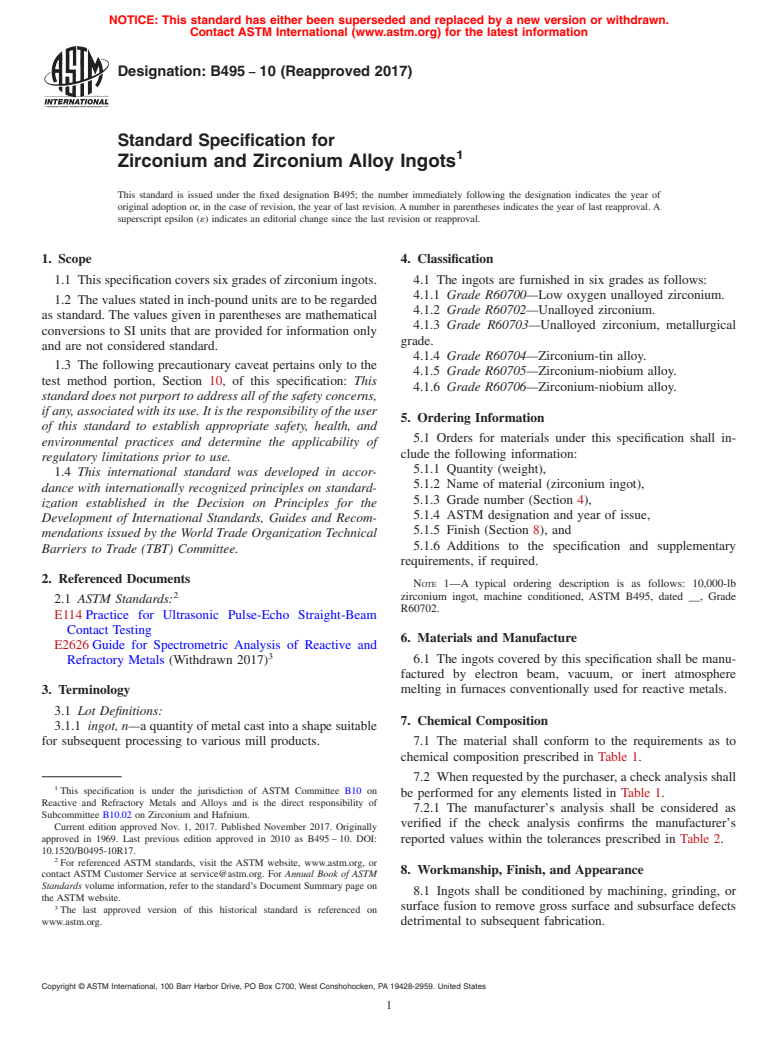
This specification covers the six grades of zirconium and zirconium alloy ingots: Grade R60700, Grade R60702, Grade R60703, Grade R60704, Grade R60705, and Grade R60706. These materials shall be manufactured by electron beam, vacuum, or inert atmosphere melting in furnaces. The material shall form to the required chemical composition of zirconium, hafnium, iron, chromium, tin, hydrogen, nitrogen, carbon, niobium, and oxygen. Check analysis shall be performed. The following test methods shall be done: ultrasonic test and chemical test.
SCOPE
1.1 This specification covers six grades of zirconium ingots.
1.2 The values stated in inch-pound units are to be regarded as standard. The values given in parentheses are mathematical conversions to SI units that are provided for information only and are not considered standard.
1.3 The following precautionary caveat pertains only to the test method portion, Section 10, of this specification: This standard does not purport to address all of the safety concerns, if any, associated with its use. It is the responsibility of the user of this standard to establish appropriate safety, health, and environmental practices and determine the applicability of regulatory limitations prior to use.
1.4 This international standard was developed in accordance with internationally recognized principles on standardization established in the Decision on Principles for the Development of International Standards, Guides and Recommendations issued by the World Trade Organization Technical Barriers to Trade (TBT) Committee.
General Information
Buy Standard
Standards Content (Sample)
NOTICE: This standard has either been superseded and replaced by a new version or withdrawn.
Contact ASTM International (www.astm.org) for the latest information
Designation:B495 −10 (Reapproved 2017)
Standard Specification for
Zirconium and Zirconium Alloy Ingots
This standard is issued under the fixed designation B495; the number immediately following the designation indicates the year of
original adoption or, in the case of revision, the year of last revision. A number in parentheses indicates the year of last reapproval. A
superscript epsilon (´) indicates an editorial change since the last revision or reapproval.
1. Scope 4. Classification
1.1 This specification covers six grades of zirconium ingots. 4.1 The ingots are furnished in six grades as follows:
4.1.1 Grade R60700—Low oxygen unalloyed zirconium.
1.2 The values stated in inch-pound units are to be regarded
4.1.2 Grade R60702—Unalloyed zirconium.
as standard. The values given in parentheses are mathematical
4.1.3 Grade R60703—Unalloyed zirconium, metallurgical
conversions to SI units that are provided for information only
grade.
and are not considered standard.
4.1.4 Grade R60704—Zirconium-tin alloy.
1.3 The following precautionary caveat pertains only to the
4.1.5 Grade R60705—Zirconium-niobium alloy.
test method portion, Section 10, of this specification: This
4.1.6 Grade R60706—Zirconium-niobium alloy.
standard does not purport to address all of the safety concerns,
if any, associated with its use. It is the responsibility of the user
5. Ordering Information
of this standard to establish appropriate safety, health, and
5.1 Orders for materials under this specification shall in-
environmental practices and determine the applicability of
clude the following information:
regulatory limitations prior to use.
5.1.1 Quantity (weight),
1.4 This international standard was developed in accor-
5.1.2 Name of material (zirconium ingot),
dance with internationally recognized principles on standard-
5.1.3 Grade number (Section 4),
ization established in the Decision on Principles for the
5.1.4 ASTM designation and year of issue,
Development of International Standards, Guides and Recom-
5.1.5 Finish (Section 8), and
mendations issued by the World Trade Organization Technical
5.1.6 Additions to the specification and supplementary
Barriers to Trade (TBT) Committee.
requirements, if required.
2. Referenced Documents
NOTE 1—A typical ordering description is as follows: 10,000-lb
zirconium ingot, machine conditioned, ASTM B495, dated __, Grade
2.1 ASTM Standards:
R60702.
E114 Practice for Ultrasonic Pulse-Echo Straight-Beam
Contact Testing
6. Materials and Manufacture
E2626 Guide for Spectrometric Analysis of Reactive and
6.1 The ingots covered by this specification shall be manu-
Refractory Metals (Withdrawn 2017)
factured by electron beam, vacuum, or inert atmosphere
melting in furnaces conventionally used for reactive metals.
3. Terminology
3.1 Lot Definitions:
7. Chemical Composition
3.1.1 ingot, n—a quantity of metal cast into a shape suitable
for subsequent processing to various mill products. 7.1 The material shall conform to the requirements as to
chemical composition prescribed in Table 1.
7.2 When requested by the purchaser, a check analysis shall
This specification is under the jurisdiction of ASTM Committee B10 on
be performed for any elements listed in Table 1.
Reactive and Refractory Metals and Alloys and is the direct responsibility of
7.2.1 The manufacturer’s analysis shall be considered as
Subcommittee B10.02 on Zirconium and Hafnium.
verified if the check analysis confirms the manufacturer’s
Current edition approved Nov. 1, 2017. Published November 2017. Originally
approved in 1969. Last previous edition approved in 2010 as B495 – 10. DOI:
reported values within the tolerances prescribed in Table 2.
10.1520/B0495-10R17.
For referenced ASTM standards, visit the ASTM website, www.astm.org, or
8. Workmanship, Finish, and Appearance
contact ASTM Customer Service at service@astm.org. For Annual Book of ASTM
Standards volume information, refer to the standard’s Document Summary page on
8.1 Ingots shall be conditioned by machining, grinding, or
the ASTM website.
surface fusion to remove gross surface and subsurface defects
The last approved version of this historical standard is referenced on
www.astm.org. detrimental to subsequent fabrication.
Copyright © ASTM International, 100 Barr Harbor Drive, PO Box C700, West Conshohocken, PA 19428-2959. United States
B495−10 (2017)
A
TABLE 1 Chemical Requirements
Composition, %
Element UNS Grade Designation
R60700 R60702 R60703 R60704 R60705 R60706
Zirconium + hafnium, 99.2 99.2 98.0 97.5 95.5 95.5
min
Hafnium, max 4.5 4.5 4.5 4.5 4.5 4.5
Iron + chromium 0.2 max 0.2 max . 0.2 to 0.4 0.2 max 0.2 max
Tin . . . 1.00 to 2.00 . .
Hydrogen, max 0.004 0.004 . 0.005 0.005 0.005
Nitrogen, max 0.020 0.020 . 0.025 0.025 0.025
Carbon, max 0.05 0.05 . 0.05 0.05 0.05
Niobium . . . . 2.0 to 3.0 2.0 to 3.0
Oxygen, max 0.10 0.16 . 0.18 0.18 0.16
A
By agreement between the purchaser and the manufacturer, analysis may be acquired and limits established for elements and compounds not specified in the table of
chemical compositions.
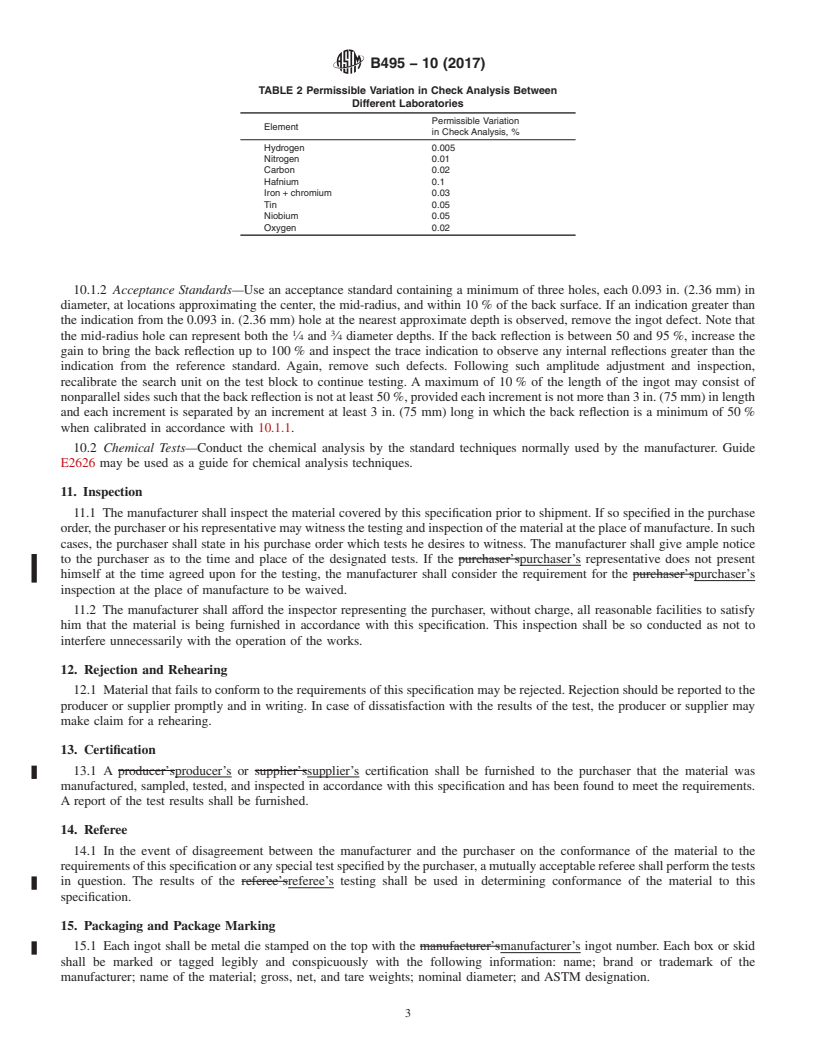
TABLE 2 Permissible Variation in Check Analysis Between
10.1.1 Standardization—Conduct the test in accordance
Different Laboratories
with Practice E114. The search unit shall be a longitudinal
Permissible Variation 1
beam transducer, operated at a frequency of 2 ⁄4 MHz using a
Element
in Check Analysis, %
suitable couplant with the piece being tested. Standardize the
Hydrogen 0.005
search unit on a test block, setting the back-reflection equal to
Nitrogen 0.01
Carbon 0.02 100 %. The test block shall be of the same approximate
Hafnium 0.1
diameter and surface condition as the ingot. Standardization is
Iron + chromium 0.03
required before the inspection begins on the ingot. Make two
Tin 0.05
traverses along the length of the cylindrical ingot surface 90°
Niobium 0.05
Oxygen 0.02
apart.
10.1.2 Acceptance Standards—Use an acceptance standard
containing a minimum of three holes, each 0.093 in. (2.36 mm)
in diameter, at locations approximating the center, the mid-
8.2 After conditioning has been completed, no abrupt
radius, and within 10 % of the back surface. If an indication
changes in diameter or local depressions that will impair
greater than the indication from the 0.093 in. (2.36 mm) hole at
subsequent fabrication shall be permitted. T
...
This document is not an ASTM standard and is intended only to provide the user of an ASTM standard an indication of what changes have been made to the previous version. Because
it may not be technically possible to adequately depict all changes accurately, ASTM recommends that users consult prior editions as appropriate. In all cases only the current version
of the standard as published by ASTM is to be considered the official document.
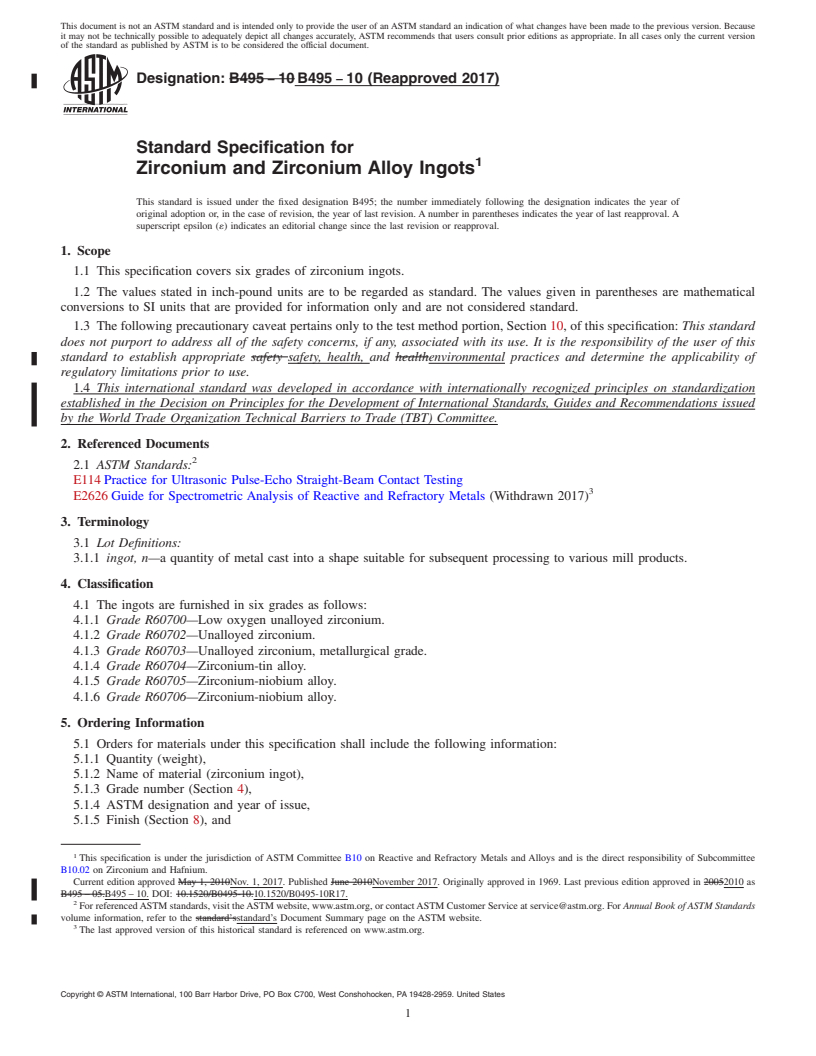
Designation: B495 − 10 B495 − 10 (Reapproved 2017)
Standard Specification for
Zirconium and Zirconium Alloy Ingots
This standard is issued under the fixed designation B495; the number immediately following the designation indicates the year of
original adoption or, in the case of revision, the year of last revision. A number in parentheses indicates the year of last reapproval. A
superscript epsilon (´) indicates an editorial change since the last revision or reapproval.
1. Scope
1.1 This specification covers six grades of zirconium ingots.
1.2 The values stated in inch-pound units are to be regarded as standard. The values given in parentheses are mathematical
conversions to SI units that are provided for information only and are not considered standard.
1.3 The following precautionary caveat pertains only to the test method portion, Section 10, of this specification: This standard
does not purport to address all of the safety concerns, if any, associated with its use. It is the responsibility of the user of this
standard to establish appropriate safety safety, health, and healthenvironmental practices and determine the applicability of
regulatory limitations prior to use.
1.4 This international standard was developed in accordance with internationally recognized principles on standardization
established in the Decision on Principles for the Development of International Standards, Guides and Recommendations issued
by the World Trade Organization Technical Barriers to Trade (TBT) Committee.
2. Referenced Documents
2.1 ASTM Standards:
E114 Practice for Ultrasonic Pulse-Echo Straight-Beam Contact Testing
E2626 Guide for Spectrometric Analysis of Reactive and Refractory Metals (Withdrawn 2017)
3. Terminology
3.1 Lot Definitions:
3.1.1 ingot, n—a quantity of metal cast into a shape suitable for subsequent processing to various mill products.
4. Classification
4.1 The ingots are furnished in six grades as follows:
4.1.1 Grade R60700—Low oxygen unalloyed zirconium.
4.1.2 Grade R60702—Unalloyed zirconium.
4.1.3 Grade R60703—Unalloyed zirconium, metallurgical grade.
4.1.4 Grade R60704—Zirconium-tin alloy.
4.1.5 Grade R60705—Zirconium-niobium alloy.
4.1.6 Grade R60706—Zirconium-niobium alloy.
5. Ordering Information
5.1 Orders for materials under this specification shall include the following information:
5.1.1 Quantity (weight),
5.1.2 Name of material (zirconium ingot),
5.1.3 Grade number (Section 4),
5.1.4 ASTM designation and year of issue,
5.1.5 Finish (Section 8), and
This specification is under the jurisdiction of ASTM Committee B10 on Reactive and Refractory Metals and Alloys and is the direct responsibility of Subcommittee
B10.02 on Zirconium and Hafnium.
Current edition approved May 1, 2010Nov. 1, 2017. Published June 2010November 2017. Originally approved in 1969. Last previous edition approved in 20052010 as
B495 – 05.B495 – 10. DOI: 10.1520/B0495-10.10.1520/B0495-10R17.
For referenced ASTM standards, visit the ASTM website, www.astm.org, or contact ASTM Customer Service at service@astm.org. For Annual Book of ASTM Standards
volume information, refer to the standard’sstandard’s Document Summary page on the ASTM website.
The last approved version of this historical standard is referenced on www.astm.org.
Copyright © ASTM International, 100 Barr Harbor Drive, PO Box C700, West Conshohocken, PA 19428-2959. United States
B495 − 10 (2017)
5.1.6 Additions to the specification and supplementary requirements, if required.
NOTE 1—A typical ordering description is as follows: 10,000-lb zirconium ingot, machine conditioned, ASTM B495, dated __, Grade R60702.
6. Materials and Manufacture
6.1 The ingots covered by this specification shall be manufactured by electron beam, vacuum, or inert atmosphere melting in
furnaces conventionally used for reactive metals.
7. Chemical Composition
7.1 The material shall conform to the requirements as to chemical composition prescribed in Table 1.
7.2 When requested by the purchaser, a check analysis shall be performed for any elements listed in Table 1.
7.2.1 The manufacturer’s analysis shall be considered as verified if the check analysis confirms the manufacturer’s reported
values within the tolerances prescribed in Table 2.
8. Workmanship, Finish, and Appearance
8.1 Ingots shall be conditioned by machining, grinding, or surface fusion to remove gross surface and subsurface defects
detrimental to subsequent fabrication.
8.2 After conditioning has been completed, no abrupt changes in diameter or local depressions that will impair subsequent
fabrication shall be permitted. The difference between the maximum and minimum radii of the conditioned ingot shall not exceed
20 % of the maximum radius, except within 6 in. (150 mm) of the ends of the ingot where rounding is permissible. Lands, grooves,
and local depressions shall be blended to a maximum angle of 30° to the axis of the ingot. Each end of the ingot shall be chamfered
or radiused. The minimum chamfer or radius shall be ⁄2 in. (12 mm).
9. Number of Tests and Retests
9.1 At least one sample from the top, middle, and bottom of each ingot shall be analyzed chemically.
9.2 An ultrasonic test shall be conducted on each ingot.
9.3 Retests:
9.3.1 If any sample or specimen exhibits obvious contamination, improper preparation, or flaws disqualifying it as a
representative sample, it should be discarded and a new sample or specimen substituted.
9.3.2 If the results of any test are not in conformance with the requirements of this specification, the ingot may be retested at
the option of the manufacturer. The ingot shall be acceptable if results of all retests following the initial test conform to this
specification.
10. Test Methods
10.1 Ultrasonic Test—Inspect the ingots ultrasonically by the methods described in 10.1.1 and 10.1.2 unless otherwise agreed
upon between the manufacturer and the purchaser.
10.1.1 Standardization—Conduct the test in accordance with Practice E114. The search unit shall be a longitudinal beam
transducer, operated at a frequency of 2 ⁄4 MHz using a suitable couplant with the piece being tested. Standardize the search unit
on a test block, setting the back-reflection equal to 100 %. The test block shall be of the same approximate diameter and surface
condition as the ingot. Standardization is required before the inspec
...
Questions, Comments and Discussion
Ask us and Technical Secretary will try to provide an answer. You can facilitate discussion about the standard in here.