

ASTM F2176-17
(Specification)Standard Specification for Mechanical Couplings Used on Polyethylene Conduit, Duct and Innerduct
General Information
- Abstract
ABSTRACT
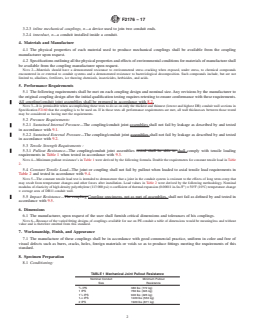
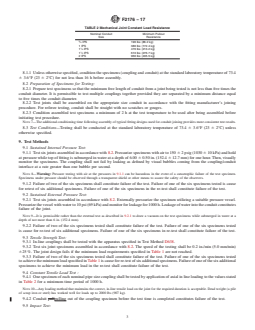
This specification establishes requirements for the qualification of mechanical couplings of particular range of sizes that connect to particular types of polyethylene conduit, duct and innerduct. The couplings covered by this specification are typically designed to join between conduit ends (in-line coupling). The same coupling-to-conduit joint design may be used as a part of other coupling joint designs that telescope, or connect to bulkheads, or other adapter fitting designs. The requirements of this standard apply only to the coupling-to-conduit joint design. The performance requirements of other coupling joint designs are not a part of this standard. The couplings shall conform to the specified pressure and tensile strength requirements.
SCOPE
1.1 This specification establishes requirements for material, performance, workmanship and test methods for the qualification of 2 in. and smaller mechanical couplings that connect to SDR 13.5, DR 15.5, Schedule 40 and Schedule 80 polyethylene conduit, duct and innerduct covered by Specification F2160. Throughout this standard, “conduit” refers to “conduit, duct or innerduct” manufactured in accordance with Specification F2160.
Note 1: F2176 fittings are not applicable to True-sized and ID-controlled conduit per F2160.
1.2 The values stated in inch-pound units are to be regarded as standard. The values given in parentheses are mathematical conversions to SI units that are provided for information only and are not considered standard.
1.3 The couplings covered by this specification are typically designed to join between conduit ends (in-line coupling). The same coupling-to-conduit joint design may be used as a part of other coupling joint designs that telescope, or connect to bulkheads, or other adapter fitting designs. The requirements of this standard apply only to the coupling-to-conduit joint design. The performance requirements of other coupling joint designs are not a part of this standard.
1.4 The following safety hazards caveat pertains only to the test methods portion, Section 9 of this specification.
This standard does not purport to address all of the safety concerns, if any, associated with its use. It is the responsibility of the user of this standard to establish appropriate safety, health, and environmental practices and determine the applicability of regulatory limitations prior to use.
1.5 This international standard was developed in accordance with internationally recognized principles on standardization established in the Decision on Principles for the Development of International Standards, Guides and Recommendations issued by the World Trade Organization Technical Barriers to Trade (TBT) Committee.
- Status
- Published
- Publication Date
- 31-Aug-2017
- Technical Committee
- F17 - Plastic Piping Systems
- Drafting Committee
- F17.10 - Fittings
Buy Documents

ASTM F2176-17 - Standard Specification for Mechanical Couplings Used on Polyethylene Conduit, Duct and Innerduct

REDLINE ASTM F2176-17 - Standard Specification for Mechanical Couplings Used on Polyethylene Conduit, Duct and Innerduct
Overview
ASTM F2176-17: Standard Specification for Mechanical Couplings Used on Polyethylene Conduit, Duct, and Innerduct provides comprehensive requirements and test methods for qualifying mechanical couplings. These couplings are purpose-built to connect ends of polyethylene (PE) conduit, duct, and innerduct according to ASTM F2160 specifications, with a nominal size up to 2 inches. This standard addresses the minimum material, performance, workmanship, and test method requirements, ensuring reliable coupling-to-conduit joint performance in PE conduit systems. It is used extensively in telecommunications, electrical, and utility infrastructure where consistent, leak-resistant, and durable connections are essential.
Key Topics
Material and Manufacture
- Couplings must be manufactured using materials with documented resistance to environmental stress cracking and chemical degradation.
- Manufacturers must be able to provide physical properties and environmental effects of the materials upon request.
Performance Requirements
- Tested for pressure resistance (both internal and external), tensile strength (pullout resistance), constant load resistance, and impact resistance.
- Joints must demonstrate long-term durability and resist failure under typical operating and environmental conditions.
Workmanship and Appearance
- Finished couplings are required to be free of visual defects, such as burrs, cracks, or foreign materials, and uniform in color.
Test Methods and Quality Assurance
- Detailed procedures for conducting internal and external pressure tests, tensile loading tests, and impact resistance, all at specified temperature conditions.
- Repeatability and reliability of results are ensured through specific re-test criteria for borderline cases.
- Product marking and documentation are mandatory, including the manufacturer’s details, conduit size, and the ASTM F2176 designation.
Applications
This standard is highly relevant for installers, manufacturers, inspectors, and specifiers working with high-density polyethylene (HDPE) conduit systems in diverse sectors:
- Telecommunications: Ensures secure, leak-resistant joints in buried optical fiber or copper cable installations, minimizing signal loss and mechanical failures.
- Power Distribution: Applied in the assembly of underground power cables, ensuring couplings maintain pressure integrity and mechanical strength under load and thermal variation.
- Utility Infrastructure: Used in gas, water, and municipal systems where PE conduit provides corrosion-resistant, long-life solutions.
- Industrial and Commercial Construction: Facilitates modular and durable conduit layouts that simplify repairs, upgrades, and expansions.
Mechanical couplings covered by this standard are primarily in-line connectors, but the specification also supports telescoping, bulkhead, and adapter fitting designs as long as the primary coupling-to-conduit joint conforms to the requirements.
Related Standards
Integration and compliance with related ASTM standards is critical for project success:
- ASTM F2160: Specification for Solid Wall High Density Polyethylene (HDPE) Conduit Based on Controlled Outside Diameter (OD)
- ASTM D638: Test Method for Tensile Properties of Plastics
- ASTM D2444: Test Method for Impact Resistance of Thermoplastic Pipe and Fittings
- ASTM D1600: Terminology for Abbreviated Terms Relating to Plastics
- ASTM F412: Terminology Relating to Plastic Piping Systems
These associated standards support comprehensive evaluation and interoperability in plastic piping and conduit systems.
Keywords: ASTM F2176, mechanical couplings, polyethylene conduit, HDPE duct, innerduct, conduit fittings, performance requirements, tensile strength, pressure resistance, ASTM standards, utility conduit, telecommunications, power distribution, duct connectors
Relations
- Effective Date
- 01-Sep-2017
- Effective Date
- 01-Apr-2020
- Effective Date
- 01-Jan-2019
- Refers
ASTM D1600-18 - Standard Terminology for Abbreviated Terms Relating to Plastics (Withdrawn 2024) - Effective Date
- 01-Jan-2018
- Effective Date
- 15-Nov-2017
- Effective Date
- 01-Aug-2017
- Effective Date
- 01-Feb-2017
- Effective Date
- 15-Nov-2016
- Effective Date
- 01-Aug-2016
- Effective Date
- 01-Jun-2015
- Effective Date
- 01-Feb-2014
- Effective Date
- 15-Apr-2013
- Effective Date
- 15-Feb-2013
- Effective Date
- 01-Apr-2012
- Effective Date
- 01-Aug-2010
Buy Documents
ASTM F2176-17 - Standard Specification for Mechanical Couplings Used on Polyethylene Conduit, Duct and Innerduct
REDLINE ASTM F2176-17 - Standard Specification for Mechanical Couplings Used on Polyethylene Conduit, Duct and Innerduct
Get Certified
Connect with accredited certification bodies for this standard

IMQ S.p.A. (Certification)
Italian electrical product certification.

SLG Prüf- und Zertifizierungs GmbH
German testing and certification body.

UL Solutions
Global safety science company with testing, inspection and certification.
Sponsored listings
Frequently Asked Questions
ASTM F2176-17 is a technical specification published by ASTM International. Its full title is "Standard Specification for Mechanical Couplings Used on Polyethylene Conduit, Duct and Innerduct". This standard covers: ABSTRACT This specification establishes requirements for the qualification of mechanical couplings of particular range of sizes that connect to particular types of polyethylene conduit, duct and innerduct. The couplings covered by this specification are typically designed to join between conduit ends (in-line coupling). The same coupling-to-conduit joint design may be used as a part of other coupling joint designs that telescope, or connect to bulkheads, or other adapter fitting designs. The requirements of this standard apply only to the coupling-to-conduit joint design. The performance requirements of other coupling joint designs are not a part of this standard. The couplings shall conform to the specified pressure and tensile strength requirements. SCOPE 1.1 This specification establishes requirements for material, performance, workmanship and test methods for the qualification of 2 in. and smaller mechanical couplings that connect to SDR 13.5, DR 15.5, Schedule 40 and Schedule 80 polyethylene conduit, duct and innerduct covered by Specification F2160. Throughout this standard, “conduit” refers to “conduit, duct or innerduct” manufactured in accordance with Specification F2160. Note 1: F2176 fittings are not applicable to True-sized and ID-controlled conduit per F2160. 1.2 The values stated in inch-pound units are to be regarded as standard. The values given in parentheses are mathematical conversions to SI units that are provided for information only and are not considered standard. 1.3 The couplings covered by this specification are typically designed to join between conduit ends (in-line coupling). The same coupling-to-conduit joint design may be used as a part of other coupling joint designs that telescope, or connect to bulkheads, or other adapter fitting designs. The requirements of this standard apply only to the coupling-to-conduit joint design. The performance requirements of other coupling joint designs are not a part of this standard. 1.4 The following safety hazards caveat pertains only to the test methods portion, Section 9 of this specification. This standard does not purport to address all of the safety concerns, if any, associated with its use. It is the responsibility of the user of this standard to establish appropriate safety, health, and environmental practices and determine the applicability of regulatory limitations prior to use. 1.5 This international standard was developed in accordance with internationally recognized principles on standardization established in the Decision on Principles for the Development of International Standards, Guides and Recommendations issued by the World Trade Organization Technical Barriers to Trade (TBT) Committee.
ABSTRACT This specification establishes requirements for the qualification of mechanical couplings of particular range of sizes that connect to particular types of polyethylene conduit, duct and innerduct. The couplings covered by this specification are typically designed to join between conduit ends (in-line coupling). The same coupling-to-conduit joint design may be used as a part of other coupling joint designs that telescope, or connect to bulkheads, or other adapter fitting designs. The requirements of this standard apply only to the coupling-to-conduit joint design. The performance requirements of other coupling joint designs are not a part of this standard. The couplings shall conform to the specified pressure and tensile strength requirements. SCOPE 1.1 This specification establishes requirements for material, performance, workmanship and test methods for the qualification of 2 in. and smaller mechanical couplings that connect to SDR 13.5, DR 15.5, Schedule 40 and Schedule 80 polyethylene conduit, duct and innerduct covered by Specification F2160. Throughout this standard, “conduit” refers to “conduit, duct or innerduct” manufactured in accordance with Specification F2160. Note 1: F2176 fittings are not applicable to True-sized and ID-controlled conduit per F2160. 1.2 The values stated in inch-pound units are to be regarded as standard. The values given in parentheses are mathematical conversions to SI units that are provided for information only and are not considered standard. 1.3 The couplings covered by this specification are typically designed to join between conduit ends (in-line coupling). The same coupling-to-conduit joint design may be used as a part of other coupling joint designs that telescope, or connect to bulkheads, or other adapter fitting designs. The requirements of this standard apply only to the coupling-to-conduit joint design. The performance requirements of other coupling joint designs are not a part of this standard. 1.4 The following safety hazards caveat pertains only to the test methods portion, Section 9 of this specification. This standard does not purport to address all of the safety concerns, if any, associated with its use. It is the responsibility of the user of this standard to establish appropriate safety, health, and environmental practices and determine the applicability of regulatory limitations prior to use. 1.5 This international standard was developed in accordance with internationally recognized principles on standardization established in the Decision on Principles for the Development of International Standards, Guides and Recommendations issued by the World Trade Organization Technical Barriers to Trade (TBT) Committee.
ASTM F2176-17 is classified under the following ICS (International Classification for Standards) categories: 29.120.10 - Conduits for electrical purposes. The ICS classification helps identify the subject area and facilitates finding related standards.
ASTM F2176-17 has the following relationships with other standards: It is inter standard links to ASTM F2176-02(2009), ASTM F412-20, ASTM F412-19, ASTM D1600-18, ASTM D2444-17, ASTM F412-17a, ASTM F412-17, ASTM F412-16a, ASTM F412-16, ASTM F412-15, ASTM D1600-14, ASTM D1600-13, ASTM F412-13, ASTM F412-12, ASTM D2444-99(2010). Understanding these relationships helps ensure you are using the most current and applicable version of the standard.
ASTM F2176-17 is available in PDF format for immediate download after purchase. The document can be added to your cart and obtained through the secure checkout process. Digital delivery ensures instant access to the complete standard document.
Standards Content (Sample)
This international standard was developed in accordance with internationally recognized principles on standardization established in the Decision on Principles for the
Development of International Standards, Guides and Recommendations issued by the World Trade Organization Technical Barriers to Trade (TBT) Committee.
Designation:F2176 −17 An American National Standard
Standard Specification for
Mechanical Couplings Used on Polyethylene Conduit, Duct
and Innerduct
This standard is issued under the fixed designation F2176; the number immediately following the designation indicates the year of
original adoption or, in the case of revision, the year of last revision.Anumber in parentheses indicates the year of last reapproval.A
superscript epsilon (´) indicates an editorial change since the last revision or reapproval.
1. Scope* 2. Referenced Documents
1.1 This specification establishes requirements for material, 2.1 ASTM Standards:
performance, workmanship and test methods for the qualifica- D638Test Method for Tensile Properties of Plastics
tion of 2 in. and smaller mechanical couplings that connect to D1600TerminologyforAbbreviatedTermsRelatingtoPlas-
SDR 13.5, DR 15.5, Schedule 40 and Schedule 80 polyethyl- tics
ene conduit, duct and innerduct covered by Specification D2444Test Method for Determination of the Impact Resis-
F2160. Throughout this standard, “conduit” refers to “conduit, tance of Thermoplastic Pipe and Fittings by Means of a
duct or innerduct” manufactured in accordance with Specifi- Tup (Falling Weight)
cation F2160. F412Terminology Relating to Plastic Piping Systems
F2160Specification for Solid Wall High Density Polyethyl-
NOTE 1—F2176 fittings are not applicable to True-sized and ID-
ene (HDPE) Conduit Based on Controlled Outside Diam-
controlled conduit per F2160.
eter (OD)
1.2 The values stated in inch-pound units are to be regarded
as standard. The values given in parentheses are mathematical
3. Terminology
conversions to SI units that are provided for information only
3.1 Definitions are in accordance with Terminology F412
and are not considered standard.
and abbreviations are in accordance with Terminology D1600,
1.3 Thecouplingscoveredbythisspecificationaretypically
unless otherwise specified.
designed to join between conduit ends (in-line coupling). The
3.2 Definitions of Terms Specific to This Standard:
same coupling-to-conduit joint design may be used as a part of
3.2.1 coupling joint, n—the connection between the cou-
other coupling joint designs that telescope, or connect to
pling and a conduit end.
bulkheads,orotheradapterfittingdesigns.Therequirementsof
3.2.2 duct, n—a conduit (see Terminology F412, conduit).
this standard apply only to the coupling-to-conduit joint
design. The performance requirements of other coupling joint 3.2.3 inline mechanical couplings, n—a device used to join
designs are not a part of this standard.
two conduit ends.
1.4 The following safety hazards caveat pertains only to the 3.2.4 innerduct, n—a conduit installed inside a conduit.
test methods portion, Section 9 of this specification.This
4. Materials and Manufacture
standard does not purport to address all of the safety concerns,
if any, associated with its use. It is the responsibility of the user
4.1 Thephysicalpropertiesofeachmaterialusedtoproduce
of this standard to establish appropriate safety, health, and
mechanical couplings shall be available from the coupling
environmental practices and determine the applicability of
manufacturer upon request.
regulatory limitations prior to use.
4.2 Specifications outlining all the physical properties and
1.5 This international standard was developed in accor-
effects of environmental conditions for materials of manufac-
dance with internationally recognized principles on standard-
ture shall be available from the coupling manufacturer upon
ization established in the Decision on Principles for the
request.
Development of International Standards, Guides and Recom-
NOTE 2—Materials should have a demonstrated resistance to environ-
mendations issued by the World Trade Organization Technical
mental stress cracking when exposed, under stress, to chemical com-
Barriers to Trade (TBT) Committee. pounds encountered in or external to conduit systems and a demonstrated
resistancetobacteriologicaldecomposition.Suchcompoundsinclude,but
This specification is under the jurisdiction ofASTM Committee F17 on Plastic
Piping Systems and is the direct responsibility of Subcommittee F17.10 on Fittings. For referenced ASTM standards, visit the ASTM website, www.astm.org, or
Current edition approved Sept. 1, 2017. Published September 2017. Originally contact ASTM Customer Service at service@astm.org. For Annual Book of ASTM
approved 2002. Last previous edition approved in 2009 as F2176–02(2009). DOI: Standards volume information, refer to the standard’s Document Summary page on
10.1520/F2176-17. the ASTM website.
*A Summary of Changes section appears at the end of this standard
Copyright © ASTM International, 100 Barr Harbor Drive, PO Box C700, West Conshohocken, PA 19428-2959. United States
F2176−17
are not limited to, alkalines, fertilizers, ice thawing chemicals, TABLE 2 Mechanical Joint Constant Load Resistance
insecticides, herbicides, and acids.
Nominal Conduit Minimum Pullout
Size Resistance
5. Performance Requirements
⁄4 IPS 190 lbs (86.2 kg)
1 IPS 380 lbs (172.4 kg)
5.1 The following requirements shall be met on each cou-
1 ⁄4 IPS 470 lbs (213.2 kg)
pling design and nominal size.Any revisions by the manufac-
1 ⁄2 IPS 610 lbs (276.7 kg)
turer to the original coupling design after the initial qualifica-
2 IPS 960 lbs (435.5 kg)
tiontestingrequiresretestingtoensureconformancewiththese
requirements. All coupling/conduit joint assemblies shall be
prepared in accordance with 8.2.
free of visual defects such as burrs, cracks, holes, foreign
NOTE 3—It is permissible when accomplishing these tests to do so on
only the thickest and thinnest (lowest and highest DR) conduit wall materials or voids so as to produce fittings meeting the
sections in Specification F2160 that the coupling is to be used on. If in
requirements of this standard.
those tests all performance requirements are met, all wall thicknesses
between those tested may be considered as having met the requirements.
8. Specimen Preparation
5.2 Pressure Requirements:
8.1 Conditioning:
5.2.1 Sustained Internal Pressure—The coupling/conduit
8.1.1 Unless otherwise specified, condition the specimens
joint assemblies shall not fail by leakage as described by and
(coupling and conduit) at the standard laboratory temperature
tested in accordance with 9.1.
of 73.4 6 3.6°F (23 6 2°C) for not less than 16 h before
5.2.2 Sustained External Pressure—The coupling/conduit
assembly.
joint assemblies shall not fail by leakage as described by and
8.2 Preparation of Specimens for Testing:
tested in accordance with 9.2.
8.2.1 Prepare test specimens so that the minimum free
5.3 Tensile Strength Requirements :
length of conduit from a joint being tested is not less than five
5.3.1 Pullout Resistance—The coupling/conduit joint as-
times the conduit diameter. It is permissible to test multiple
semblies shall comply with tensile loading requirements in
couplings together provided they are separated by a minimum
Table 1 when tested in accordance with 9.3.
distance equal to five times the conduit diameter.
NOTE 4—Minimum pullout resistance’s in Table 1 were derived by the
8.2.2 Test joints shall be assembled on the appropriate size
following formula. Double the requirements for constant tensile load in
conduit in accordance with the fitting manufacturer’s joining
Table 2.
procedure.Forrefereetesting,conduitshallbestraightwithno
5.4 Constant Tensile Load—The joint or coupling shall not
scratches or gouges.
fail by pullout when loaded to axial tensile load requirements
8.2.3 Conditionassembledtestspecimensaminimumof2h
in Table 2 and tested in accordance with 9.4.
at the test temperature to be used after being assembled before
NOTE 5—The constant tensile load test is intended to demonstrate
...
This document is not an ASTM standard and is intended only to provide the user of an ASTM standard an indication of what changes have been made to the previous version. Because
it may not be technically possible to adequately depict all changes accurately, ASTM recommends that users consult prior editions as appropriate. In all cases only the current version
of the standard as published by ASTM is to be considered the official document.
Designation: F2176 − 02 (Reapproved 2009) F2176 − 17 An American National Standard
Standard Specification for
Mechanical Couplings Used on Polyethylene Conduit, Duct
and Innerduct
This standard is issued under the fixed designation F2176; the number immediately following the designation indicates the year of
original adoption or, in the case of revision, the year of last revision. A number in parentheses indicates the year of last reapproval. A
superscript epsilon (´) indicates an editorial change since the last revision or reapproval.
1. Scope Scope*
1.1 This specification establishes requirements for material, performance, workmanship and test methods for the qualification
of 2 in. and smaller mechanical couplings that connect to DR 15.5 and lower SDR 13.5, DR 15.5, Schedule 40 and Schedule 80
polyethylene conduit, duct and innerduct covered by Specification F2160. Throughout this standard, “conduit” refers to “conduit,
duct or innerduct” manufactured in accordance with Specification F2160.
NOTE 1—F2176 fittings are not applicable to True-sized and ID-controlled conduit per F2160.
1.2 The values stated in inch-pound units are to be regarded as standard. The values given in parentheses are mathematical
conversions to SI units that are provided for information only and are not considered standard.
1.3 The couplings covered by this specification are typically designed to join between conduit ends (in-line coupling). The same
coupling-to-conduit joint design may be used as a part of other coupling joint designs that telescope, or connect to bulkheads, or
other adapter fitting designs. The requirements of this standard apply only to the coupling-to-conduit joint design. The performance
requirements of other coupling joint designs are not a part of this standard.
1.4 The following safety hazards caveat pertains only to the test methods portion, Section 9 of this specification.The following
safety hazards caveat pertains only to the test methods portion, Section 9 of this specification.This standard does not purport to
address all of the safety concerns, if any, associated with its use. It is the responsibility of the user of this standard to establish
appropriate safety safety, health, and healthenvironmental practices and determine the applicability of regulatory requirement-
slimitations prior to use.
1.5 This international standard was developed in accordance with internationally recognized principles on standardization
established in the Decision on Principles for the Development of International Standards, Guides and Recommendations issued
by the World Trade Organization Technical Barriers to Trade (TBT) Committee.
2. Referenced Documents
2.1 ASTM Standards:
D638 Test Method for Tensile Properties of Plastics
D1600 Terminology for Abbreviated Terms Relating to Plastics
D2444 Test Method for Determination of the Impact Resistance of Thermoplastic Pipe and Fittings by Means of a Tup (Falling
Weight)
F412 Terminology Relating to Plastic Piping Systems
F2160 Specification for Solid Wall High Density Polyethylene (HDPE) Conduit Based on Controlled Outside Diameter (OD)
3. Terminology
3.1 Definitions are in accordance with Terminology F412 and abbreviations are in accordance with Terminology D1600, unless
otherwise specified.
3.2 Definitions of Terms Specific to This Standard:
3.2.1 coupling joint, n—the connection between the coupling and a conduit end.
3.2.2 duct, n—a conduit (see Terminology F412, conduit).
This specification is under the jurisdiction of ASTM Committee F17 on Plastic Piping Systems and is the direct responsibility of Subcommittee F17.10 on Fittings.
Current edition approved March 1, 2009Sept. 1, 2017. Published March 2009September 2017. Originally approved 2002. Last previous edition approved in 20022009 as
F2176F2176–02(2009).–02. DOI: 10.1520/F2176-02R09.10.1520/F2176-17.
For referenced ASTM standards, visit the ASTM website, www.astm.org, or contact ASTM Customer Service at service@astm.org. For Annual Book of ASTM Standards
volume information, refer to the standard’s Document Summary page on the ASTM website.
*A Summary of Changes section appears at the end of this standard
Copyright © ASTM International, 100 Barr Harbor Drive, PO Box C700, West Conshohocken, PA 19428-2959. United States
F2176 − 17
3.2.3 inline mechanical couplings, n—a device used to join two conduit ends.
3.2.4 innerduct, n—a conduit installed inside a conduit.
4. Materials and Manufacture
4.1 The physical properties of each material used to produce mechanical couplings shall be available from the coupling
manufacturer upon request.
4.2 Specifications outlining all the physical properties and effects of environmental conditions for materials of manufacture shall
be available from the coupling manufacturer upon request.
NOTE 2—Materials should have a demonstrated resistance to environmental stress cracking when exposed, under stress, to chemical compounds
encountered in or external to conduit systems and a demonstrated resistance to bacteriological decomposition. Such compounds include, but are not
limited to, alkalines, fertilizers, ice thawing chemicals, insecticides, herbicides, and acids.
5. Performance Requirements
5.1 The following requirements shall be met on each coupling design and nominal size. Any revisions by the manufacturer to
the original coupling design after the initial qualification testing requires retesting to ensure conformance with these requirements.
All coupling/conduit joint assemblies shall be prepared in accordance with 8.2.
NOTE 3—It is permissible when accomplishing these tests to do so on only the thickest and thinnest (lowest and highest DR) conduit wall sections in
Specification F2160 that the coupling is to be used on. If in those tests all performance requirements are met, all wall thicknesses between those tested
may be considered as having met the requirements.
5.2 Pressure Requirements:
5.2.1 Sustained Internal Pressure—The coupling/conduit joint assemblies shall not fail by leakage as described by and tested
in accordance with 9.1.
5.2.2 Sustained External Pressure—The coupling/conduit joint assemblies shall not fail by leakage as described by and tested
in accordance with 9.2.
5.3 Tensile Strength Requirements :
5.3.1 Pullout Resistance—The coupling/conduit joint assemblies tested shall be able to shall comply with tensile loading
requirements in Table 1 when tested in accordance with 9.3.
NOTE 4—Minimum pullout resistance’s in Table 1 were derived by the following formula. Double the requirements for constant tensile load in Table
2.
5.4 Constant Tensile Load—The joint or coupling shall not fail by pullout when loaded to axial tensile load requirements in
Table 2 and tested in accordance with 9.4.
NOTE 5—The constant tensile load test is intended to demonstrate that a joint in the conduit system is resistant to the effects of long term creep that
may result from temperature changes and other forces after installation. Load values in Table 2 were derived by the following methodology. Nominal
modulus of elasticity of high density polyethylene (113 000 psi) × coefficient of thermal expansion (0.00011 in./in./F°) × 50°F (10°C) temperature change
× average area of DR11 conduit wall.
5.5 Impact Resistance—The coupling Coupling specimens, not as part of assemblies, shall not fail as defined by and tested in
accordance with 9.5.
6. Dimensions
6.1 The manufacturer, upon request of the user shall furnish critical dimensions and tolerances of his couplings.
NOTE 6—Because of the varied fitting designs of couplings available for use on PE conduit a table of dimensions would be meaningless and without
value and is therefore omitted from this standard.
7. Workmanship, Finish, and Appearance
7.1 The manufacture of these couplings shall be in accordance with good commercial practice, uniform in color and free of
visual defects such as burrs, cracks, holes, foreign materials or voids so as to produce fittings meeting the requirements of this
standar
...