


ASTM D5828-97(2018)
(Test Method)Standard Test Method for Compatibility of Supplemental Coolant Additives (SCAs) and Engine Coolant Concentrates
Standard Test Method for Compatibility of Supplemental Coolant Additives (SCAs) and Engine Coolant Concentrates
SIGNIFICANCE AND USE
5.1 This test was developed to mimic the formation of insolubles observed in some heavy-duty diesel cooling systems during the mid 1980s. It measures the compatibility of SCA and coolant concentrate solutions according to their tendency to form insolubles in service.3 Such insoluble materials may accumulate within a cooling system, restrict heat transfer through radiator cores, and contribute to the damage of components such as water pumps.
SCOPE
1.1 This test method covers determination of the compatibility of commercial SCA and commercial ethylene and propylene glycol engine coolant concentrates. This test method focuses on the solubility of specific chemical species formed in the engine coolant. The short duration of the test (24 h), among other restrictions, makes the test method of limited use for sorting out a variety of chemical compatibility problems in which a component of the SCA may react with a component of the coolant additive package. The test as currently written also does not deal with the issue of hard water compatibility, in which a component of the coolant or SCA additive package reacts with the hardness (Ca and Mg) to form a precipitate.
1.2 The values stated in SI units are to be regarded as standard. The values given in parentheses are mathematical conversions to inch-pound units that are provided for information only and are not considered standard.
1.3 This standard does not purport to address all of the safety concerns, if any, associated with its use. It is the responsibility of the user of this standard to establish appropriate safety, health, and environmental practices and determine the applicability of regulatory limitations prior to use.
1.4 This international standard was developed in accordance with internationally recognized principles on standardization established in the Decision on Principles for the Development of International Standards, Guides and Recommendations issued by the World Trade Organization Technical Barriers to Trade (TBT) Committee.
General Information
Buy Standard
Standards Content (Sample)
NOTICE: This standard has either been superseded and replaced by a new version or withdrawn.
Contact ASTM International (www.astm.org) for the latest information
Designation: D5828 − 97 (Reapproved 2018)
Standard Test Method for
Compatibility of Supplemental Coolant Additives (SCAs) and
Engine Coolant Concentrates
This standard is issued under the fixed designation D5828; the number immediately following the designation indicates the year of
original adoption or, in the case of revision, the year of last revision. A number in parentheses indicates the year of last reapproval. A
superscript epsilon (´) indicates an editorial change since the last revision or reapproval.
INTRODUCTION
Supplemental coolant additives (SCAs) are used to impart special properties, usually resistance to
cavitation corrosion, to engine coolants used in diesel engines with replaceable cylinder liner sleeves.
Engines with this design require additives that are not normally found in commercial engine coolant
concentrates.
1. Scope 2. Referenced Documents
1.1 This test method covers determination of the compat- 2.1 ASTM Standards:
ibility of commercial SCA and commercial ethylene and E691 Practice for Conducting an Interlaboratory Study to
propylene glycol engine coolant concentrates. This test method Determine the Precision of a Test Method
focuses on the solubility of specific chemical species formed in D1193 Specification for Reagent Water
the engine coolant. The short duration of the test (24 h), among D1796 Test Method for Water and Sediment in Fuel Oils by
other restrictions, makes the test method of limited use for the Centrifuge Method (Laboratory Procedure)
sorting out a variety of chemical compatibility problems in D3585 Specification for ASTM Reference Fluid for Coolant
which a component of the SCA may react with a component of Tests
the coolant additive package. The test as currently written also
3. Terminology
does not deal with the issue of hard water compatibility, in
which a component of the coolant or SCA additive package
3.1 Definitions of Terms Specific to This Standard:
reacts with the hardness (Ca and Mg) to form a precipitate. 3.1.1 engine coolant concentrate—an undiluted ethylene or
propylene glycol containing additives and only a small amount
1.2 The values stated in SI units are to be regarded as
of water, usually less than 5 %.
standard. The values given in parentheses are mathematical
conversions to inch-pound units that are provided for informa- 3.1.2 reference engine coolant concentrate—a standard ma-
terial prepared according to the formulary given in Annex A2
tion only and are not considered standard.
of this test method. This material should not be confused with
1.3 This standard does not purport to address all of the
reference coolant in accordance with Specification D3585.
safety concerns, if any, associated with its use. It is the
responsibility of the user of this standard to establish appro- 3.1.3 reference supplemental coolant additive (SCA)—a
standard SCA prepared according to the formulary given in
priate safety, health, and environmental practices and deter-
mine the applicability of regulatory limitations prior to use. Annex A1 of this test method.
1.4 This international standard was developed in accor-
3.1.4 supplemental coolant additive—a liquid or solid ma-
dance with internationally recognized principles on standard-
terial that is added to a coolant at a specified concentration.
ization established in the Decision on Principles for the
4. Summary of Test Method
Development of International Standards, Guides and Recom-
mendations issued by the World Trade Organization Technical
4.1 A mixture of engine coolant concentrate and deionized
Barriers to Trade (TBT) Committee.
water containing approximately twice the recommended con-
centration of SCA is heated to 88 °C (190 °F) for 24 h. The
solution is centrifuged after returning to ambient temperature,
This test method is under the jurisdiction of ASTM Committee D15 on Engine
Coolants and Related Fluids and is the direct responsibility of Subcommittee D15.11
on Heavy Duty Coolants. For referenced ASTM standards, visit the ASTM website, www.astm.org, or
Current edition approved Sept. 1, 2018. Published September 2018. Originally contact ASTM Customer Service at service@astm.org. For Annual Book of ASTM
ɛ1
approved in 1995. Last previous edition approved in 2011 as D5828–97 (2011) . Standards volume information, refer to the standard’s Document Summary page on
DOI: 10.1520/D5828–97R18. the ASTM website.
Copyright © ASTM International, 100 Barr Harbor Drive, PO Box C700, West Conshohocken, PA 19428-2959. United States
D5828 − 97 (2018)
and the amount of insoluble material is determined volumetri- 7.2 Coolant Concentrate, and SCA for evaluation.
cally and compared to the amount of insolubles obtained with
7.3 Reference SCA, and coolant concentrate solutions (see
a mixture of standard reference SCA and reference engine
Annex A1 and Annex A2).
coolant.
7.4 Deionized Water, in accordance with Specification
5. Significance and Use
D1193.
5.1 This test was developed to mimic the formation of
7.5 Nichrome Wire, or stainless steel wire.
insolubles observed in some heavy-duty diesel cooling systems
7.6 Filter Paper, Whatman No. 4 or equivalent.
during the mid 1980s. It measures the compatibility of SCA
and coolant concentrate solutions according to their tendency
7.7 Plastic Containers, to store solutions. Polyethylene or
to form insolubles in service. Such insoluble materials may
polypropylene containers with screw caps are satisfactory.
accumulate within a cooling system, restrict heat transfer
7.8 Acetone. Warning— Acetone is flammable.
through radiator cores, and contribute to the damage of
components such as water pumps.
7.9 Isopropyl Alcohol.
6. Apparatus
8. Procedure
6.1 Two-pan General Laboratory Balance, 1- to 2-kg ca-
8.1 Compatibility testing of SCA shall be conducted using a
pacity.
ratio of 60 parts of coolant concentrate to 40 parts of a
6.2 Centrifuge Tube, 100-mL capacity in accordance with
water-SCA mixture. The level of SCA in the total 60:40
Test Method D1796.
mixture will be approximately twice the SCA manufacturer’s
recommended concentration.
6.3 Centrifuge, capable of maintaining 500 rcf, with trun-
nions and specimen holders suitable for the tube described in
8.2 Fill a 100-mL centrifuge tube to the 60-mL mark with
6.2.
coolant concentrate.
6.4 Constant Temperature Oil Bath, or equivalent, capable
8.3 Determine the volume of water to be added based on the
of maintaining the test temperature at 88 °C (190 °F), within
physical state and the recommended concentration of SCA to
61 °C (2 °F).
be evaluated. Add this volume of water to the centrifuge tube
6.5 Condenser Tube, glass, approximately 5-mm outside
using a graduated cylinder. For example, if the SCA is a liquid
diameter by 3-mm inside diameter by 300-mm long.
to be added at the recommended concentration of 3 % by
volume, twice the recommended concentration is 6 % or 6 mL.
6.6 Rubber Stoppers, to fit the centrifuge tube with a single
The volume of water to be added is 34 mL. This is 100 mL
hole for the glass condenser tube.
(volume of the centrifuge tube) less 60 mL (volume of coolant
6.7 Rubber Stoppers, as above but without a hole.
concentrate required) less 6 mL (volume of SCA required).
6.8 Graduated Cylinder, 100-mL capacity to deliver.
NOTE 1—Using hard water will greatly influence the amount of solubles
6.9 Pipette, to deliver volumes from 1 to 10 mL in 1-mL
formed. Testing the purity of the water with a conductivity meter is
increments. recommended.
NOTE 2—If the SCA is a solid, prepare a sufficient volume of a
6.10 Analytical Balance, for preparing reference materials
concentrated solution of the SCA in deionized water.
and capable of weighing within an accuracy of 60.2 mg or
8.4 Pipette the required volume of SCA into the mixture of
better.
coolant concentrate and water. The sequence of mixing must be
as follows: coolant concentrate, water, SCA solution. Cap with
7. Reagents and Materials
a solid rubber stopper and agitate thoroughly.
7.1 Purity of Reagents—Regent grade chemicals shall be
used in all tests. Unless otherwise indicated, it is intended that
NOTE 3—Glycol and water mixtures exhibit a volume contraction due
all reagents conform to the specifications of the Committee on to the partial molal volume effect. The final volume of the mixture should
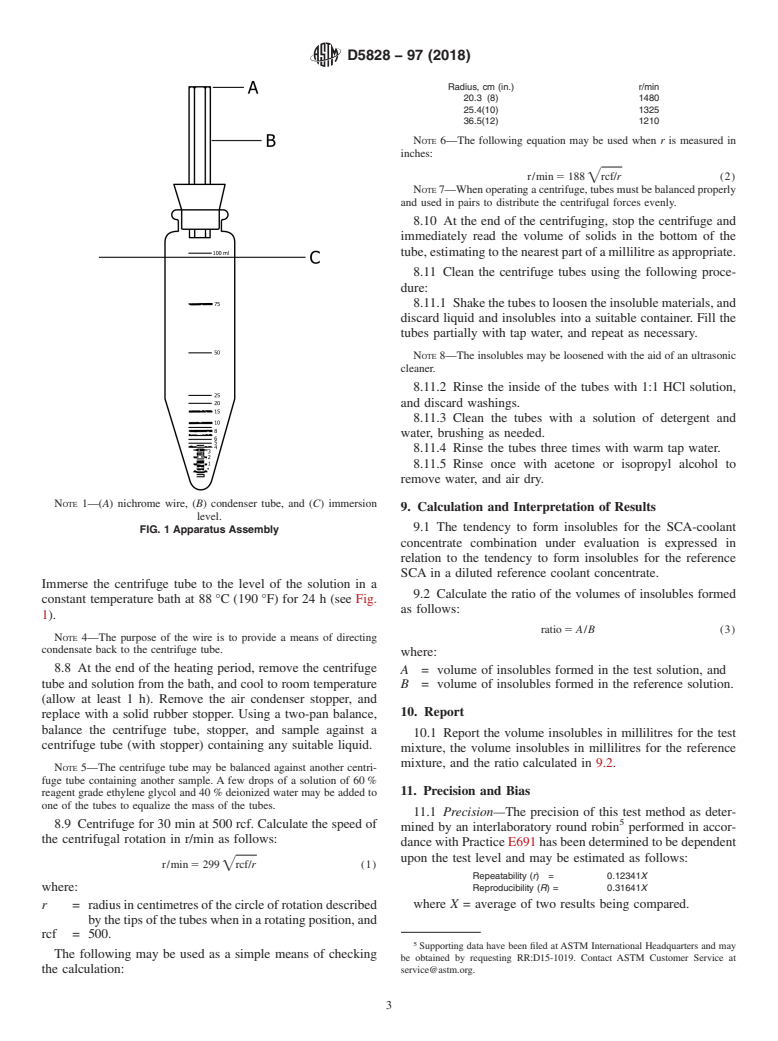
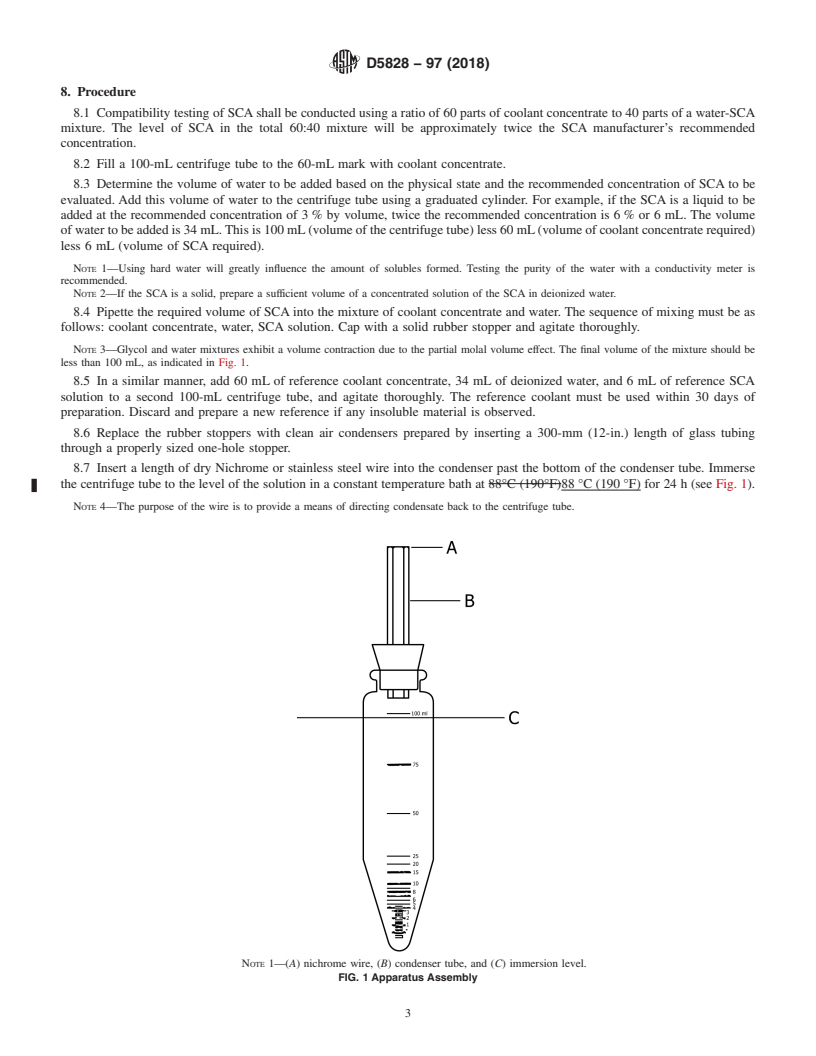
be less than 100 mL, as indicated in Fig. 1.
Analytical Reagents of the American Chemical Society where
such specifications are available. Other grades may be used,
8.5 In a similar manner, add 60 mL of reference coolant
provided it is first ascertained that the reagent is of sufficiently
concentrate, 34 mL of deionized water, and 6 mL of reference
high purity to permit its use without lessening the accuracy of
SCA solution to a second 100-mL centrifuge tube, and agitate
the determination.
thoroughly. The reference coolant must be used within 30 days
of preparation. Discard and prepare a new reference if any
insoluble material is observed.
Hercamp and Hudgens, “Silicate Gelation in Heavy-Duty Engine Cooling
Systems,” Paper No. 852327, Society of Automotive Engineers, December 1985.
8.6 Replace the rubber stoppers with clean air condensers
Reagant Chemicals, American Chemical Society Specifications, American
prepared by inserting a 300-mm (12-in.) length of glass tubing
Chemical Society, Washington, DC. For suggestions on the testing of reagents not
through a properly sized one-hole stopper.
listed by th
...
This document is not an ASTM standard and is intended only to provide the user of an ASTM standard an indication of what changes have been made to the previous version. Because
it may not be technically possible to adequately depict all changes accurately, ASTM recommends that users consult prior editions as appropriate. In all cases only the current version
of the standard as published by ASTM is to be considered the official document.
´1
Designation: D5828 − 97 (Reapproved 2011) D5828 − 97 (Reapproved 2018)
Standard Test Method for
Compatibility of Supplemental Coolant Additives (SCAs) and
Engine Coolant Concentrates
This standard is issued under the fixed designation D5828; the number immediately following the designation indicates the year of
original adoption or, in the case of revision, the year of last revision. A number in parentheses indicates the year of last reapproval. A
superscript epsilon (´) indicates an editorial change since the last revision or reapproval.
ε NOTE—Editorial corrections to Section 7 were made in June 2011.
INTRODUCTION
Supplemental coolant additives (SCAs) are used to impart special properties, usually resistance to
cavitation corrosion, to engine coolants used in diesel engines with replaceable cylinder liner sleeves.
Engines with this design require additives that are not normally found in commercial engine coolant
concentrates.
1. Scope
1.1 This test method covers determination of the compatibility of commercial SCA and commercial ethylene and propylene
glycol engine coolant concentrates. This test method focuses on the solubility of specific chemical species formed in the engine
coolant. The short duration of the test (24 h), among other restrictions, makes the test method of limited use for sorting out a variety
of chemical compatibility problems in which a component of the SCA may react with a component of the coolant additive package.
The test as currently written also does not deal with the issue of hard water compatibility, in which a component of the coolant
or SCA additive package reacts with the hardness (Ca and Mg) to form a precipitate.
1.2 The values stated in SI units are to be regarded as the standard. The values given in parentheses are for information
only.mathematical conversions to inch-pound units that are provided for information only and are not considered standard.
1.3 This standard does not purport to address all of the safety concerns, if any, associated with its use. It is the responsibility
of the user of this standard to establish appropriate safety safety, health, and healthenvironmental practices and determine the
applicability of regulatory limitations prior to use.
1.4 This international standard was developed in accordance with internationally recognized principles on standardization
established in the Decision on Principles for the Development of International Standards, Guides and Recommendations issued
by the World Trade Organization Technical Barriers to Trade (TBT) Committee.
2. Referenced Documents
2.1 ASTM Standards:
E691 Practice for Conducting an Interlaboratory Study to Determine the Precision of a Test Method
D1193 Specification for Reagent Water
D1796 Test Method for Water and Sediment in Fuel Oils by the Centrifuge Method (Laboratory Procedure)
D3585 Specification for ASTM Reference Fluid for Coolant Tests
3. Terminology
3.1 Definitions of Terms Specific to This Standard:
3.1.1 engine coolant concentrate—an undiluted ethylene or propylene glycol containing additives and only a small amount of
water, usually less than 5 %.
This test method is under the jurisdiction of ASTM Committee D15 on Engine Coolants and Related Fluids and is the direct responsibility of Subcommittee D15.11 on
Heavy Duty Coolants.
Current edition approved Jan. 1, 2011Sept. 1, 2018. Published June 2011September 2018. Originally published asapproved in D5828 – 95.1995. Last previous edition
ɛ1
approved in 20022011 as D5828 ––97 (2011) 97 (2002). DOI: 10.1520/D5828-97R11E01. DOI: 10.1520/D5828–97R18.
For referenced ASTM standards, visit the ASTM website, www.astm.org, or contact ASTM Customer Service at service@astm.org. For Annual Book of ASTM Standards
volume information, refer to the standard’s Document Summary page on the ASTM website.
Copyright © ASTM International, 100 Barr Harbor Drive, PO Box C700, West Conshohocken, PA 19428-2959. United States
D5828 − 97 (2018)
3.1.2 reference engine coolant concentrate—a standard material prepared according to the formulary given in Annex A2 of this
test method. This material should not be confused with reference coolant in accordance with Specification D3585.
3.1.3 reference supplemental coolant additive (SCA)—a standard SCA prepared according to the formulary given in Annex A1
of this test method.
3.1.4 supplemental coolant additive—a liquid or solid material that is added to a coolant at a specified concentration.
4. Summary of Test Method
4.1 A mixture of engine coolant concentrate and deionized water containing approximately twice the recommended
concentration of SCA is heated to 88°C (190°F)88 °C (190 °F) for 24 h. The solution is centrifuged after returning to ambient
temperature, and the amount of insoluble material is determined volumetrically and compared to the amount of insolubles obtained
with a mixture of standard reference SCA and reference engine coolant.
5. Significance and Use
5.1 This test was developed to mimic the formation of insolubles observed in some heavy-duty diesel cooling systems during
the mid 1980s. It measures the compatibility of SCA and coolant concentrate solutions according to their tendency to form
insolubles in service. Such insoluble materials may accumulate within a cooling system, restrict heat transfer through radiator
cores, and contribute to the damage of components such as water pumps.
6. Apparatus
6.1 Two-pan General Laboratory Balance, 11- to 2-kg capacity.
6.2 Centrifuge Tube, 100-mL capacity in accordance with Test Method D1796.
6.3 Centrifuge, capable of maintaining 500 rcf, with trunnions and specimen holders suitable for the tube described in 6.2.
6.4 Constant Temperature Oil Bath, or equivalent, capable of maintaining the test temperature at 88°C (190°F), within 61°C
(2°F).88 °C (190 °F), within 61 °C (2 °F).
6.5 Condenser Tube, glass, approximately 5-mm outside diameter by 3-mm inside diameter by 300-mm long.
6.6 Rubber Stoppers, to fit the centrifuge tube with a single hole for the glass condenser tube.
6.7 Rubber Stoppers, as above but without a hole.
6.8 Graduated Cylinder, 100-mL capacity to deliver.
6.9 Pipette, to deliver volumes from 1 to 10 mL in 1-mL increments.
6.10 Analytical Balance, for preparing reference materials and capable of weighing within an accuracy of 60.2 mg or better.
7. Reagents and Materials
7.1 Purity of Reagents—Regent grade chemicals shall be used in all tests. Unless otherwise indicated, it is intended that all
reagents conform to the specifications of the Committee on Analytical Reagents of the American Chemical Society where such
specifications are available. Other grades may be used, provided it is first ascertained that the reagent is of sufficiently high purity
to permit its use without lessening the accuracy of the determination.
7.2 Coolant Concentrate, and SCA for evaluation.
7.3 Reference SCA, and coolant concentrate solutions (see Annex A1 and Annex A2).
7.4 Deionized Water, in accordance with Specification D1193.
7.5 Nichrome Wire, or stainless steel wire.
7.6 Filter Paper, Whatman No. 4 or equivalent.
7.7 Plastic Containers, to store solutions. Polyethylene or polypropylene containers with screw caps are satisfactory.
7.8 Acetone. Warning— Acetone is flammableWARNING.: Acetone is flammable.
7.9 Isopropyl Alcohol.
Hercamp and Hudgens, “Silicate Gelation in Heavy-Duty Engine Cooling Systems,” Paper No. 852327, Society of Automotive Engineers, December 1985.
Reagant Chemicals, American Chemical Society Specifications, American Chemical Society, Washington, DC. For suggestions on the testing of reagents not listed by
the American Chemical Society, see Analar Standards for Laboratory Chemicals, BDH Ltd., Poole, Dorset, U.K., and the United States Pharmacopeia and National
Formulary, U.S. Pharmacopeial Convention, Inc. (USPC), Rockville, MD.
D5828 − 97 (2018)
8. Procedure
8.1 Compatibility testing of SCA shall be conducted using a ratio of 60 parts of coolant concentrate to 40 parts of a water-SCA
mixture. The level of SCA in the total 60:40 mixture will be approximately twice the SCA manufacturer’s recommended
concentration.
8.2 Fill a 100-mL centrifuge tube to the 60-mL mark with coolant concentrate.
8.3 Determine the volume of water to be added based on the physical state and the recommended concentration of SCA to be
evaluated. Add this volume of water to the centrifuge tube using a graduated cylinder. For example, if the SCA is a liquid to be
added at the recommended concentration of 3 % by volume, twice the recommended concentration is 6 % or 6 mL. The volume
of water to be added is 34 mL. This is 100 mL (volume of the centrifuge tube) less 60 mL (volume of coolant concentrate required)
less 6 mL (volume of SCA required).
NOTE 1—Using hard water will greatly influence the amount of solubles formed. Testing the purity of the water with a conductivity meter is
recommended.
NOTE 2—If the SCA is a solid, prepare a sufficient volume of a concentrated solution of the SCA in deionized water.
8.4 Pipette the required volume of SCA into the mixture of coolant concentrate and water. The sequence of mixing must be as
follows: coolant concentrate, water, SCA solution. Cap with a solid rubber stopper and agitate thoroughly.
NOTE 3—Glycol and water mixtures exhibit a volume contraction due to the partial molal volume effect. The final volume of the mixture should be
less th
...
Questions, Comments and Discussion
Ask us and Technical Secretary will try to provide an answer. You can facilitate discussion about the standard in here.