

ASTM F402-18
(Practice)Standard Practice for Safe Handling of Solvent Cements, Primers, and Cleaners Used for Joining Thermoplastic Pipe and Fittings
General Information
- Abstract
ABSTRACT
This practice covers procedures for safe handling of solvent cements, primers, and cleaners used in joining thermoplastic pipe and fittings. The procedures are general ones and include safeguards against hazards of fire and precautions for protection of personnel from breathing of vapors and contact with skin or eyes. A number of the solvents contained in cements, primers, and cleaners are classified as airborne contaminants and flammable and combustible liquids. Avoid prolonged breathing of solvent vapors. Keep containers of cements, primers, and cleaners tightly closed except when the product is being used. Proper eye protection and the use of chemical goggles or face shields is advisable where the possibility of splashing exists in handling these products. Wear proper gloves impervious to and unaffected by the solvents when contact with the skin is likely.
SCOPE
1.1 This practice covers procedures for safe handling of solvent cements, primers, and cleaners used in joining thermoplastic pipe and fittings. The procedures are general ones and include safeguards against hazards of fire and precautions for protection of personnel from breathing of vapors and contact with skin or eyes.
1.2 The word cleaner, when used in this practice, refers to chemical cleaners.
1.3 This standard does not purport to address all of the safety concerns, if any, associated with its use. It is the responsibility of the user of this standard to establish appropriate safety, health, and environmental practices and determine the applicability of regulatory limitations prior to use.
1.4 This international standard was developed in accordance with internationally recognized principles on standardization established in the Decision on Principles for the Development of International Standards, Guides and Recommendations issued by the World Trade Organization Technical Barriers to Trade (TBT) Committee.
- Status
- Published
- Publication Date
- 31-Jul-2018
- Technical Committee
- F17 - Plastic Piping Systems
- Drafting Committee
- F17.20 - Joining
Buy Documents
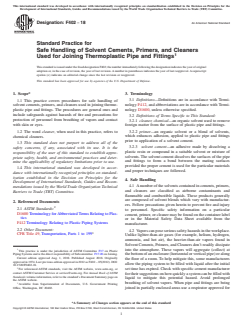


ASTM F402-18 - Standard Practice for Safe Handling of Solvent Cements, Primers, and Cleaners Used for Joining Thermoplastic Pipe and Fittings
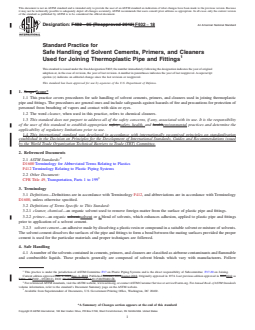
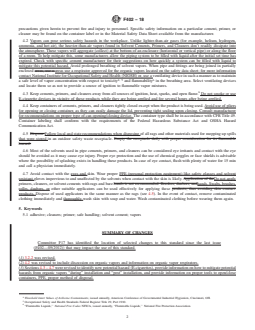


REDLINE ASTM F402-18 - Standard Practice for Safe Handling of Solvent Cements, Primers, and Cleaners Used for Joining Thermoplastic Pipe and Fittings
Overview
ASTM F402-18 is an international standard published by ASTM International, providing a comprehensive set of guidelines for the safe handling of solvent cements, primers, and chemical cleaners used in joining thermoplastic pipe and fittings. The document establishes general procedures and safety measures to protect personnel from hazards associated with these materials, such as fire risks, inhalation of vapors, and skin or eye contact. As many of the solvents involved are classed as airborne contaminants and flammable or combustible liquids, compliance with ASTM F402-18 is critical for occupational safety, health, fire prevention, and regulatory compliance in various piping system installation and maintenance environments.
Key Topics
- Fire and Explosion Prevention
- Store and handle solvent cements, primers, and cleaners away from all sources of ignition, including open flames, sparks, and hot surfaces.
- Do not smoke or use E-cigarette devices near these products during and after application.
- Vapor and Fume Control
- Avoid prolonged breathing of solvent vapors, which can accumulate near the floor or in enclosed spaces.
- Use proper ventilation, local exhaust, or approved organic vapor respirators when working in confined or poorly ventilated areas.
- Personal Protective Equipment (PPE)
- Wear suitable eye protection such as chemical goggles or face shields to prevent splashes.
- Use gloves made of materials resistant to the solvents, and avoid direct skin contact.
- Proper Container Management
- Keep containers tightly closed when not in use.
- Handle containers carefully to prevent damage to lids and ensure secure sealing.
- Follow local regulations for labeling and container types.
- Safe Application Techniques
- Apply products with appropriate tools such as brushes, daubers, or swabs - never with bare hands.
- Dispose of contaminated applicators and cleaning materials safely, following local and state guidelines.
- Emergency Response Measures
- In case of eye contact, flush immediately with water and seek medical attention.
- Wash exposed skin promptly with soap and water and remove contaminated clothing.
Applications
The safe handling procedures in ASTM F402-18 are essential across industries that use thermoplastic piping systems, including:
- Plumbing installations for residential, commercial, or industrial buildings.
- Water supply and distribution systems where solvents are used to join pipes and fittings.
- Chemical processing facilities utilizing thermoplastic pipelines.
- HVAC and fire suppression systems that depend on strong, solvent-cemented joints for integrity.
- Maintenance and repairs where solvent cements and cleaners are required for effective system upgrades or modifications.
Proper implementation of ASTM F402-18 minimizes the risk of workplace injury, exposure to harmful chemicals, and fire or environmental hazards-and helps organizations comply with occupational health and safety regulations.
Related Standards
To ensure comprehensive safety and technical compliance when handling and applying solvent cements, primers, and cleaners for thermoplastic pipe systems, consider referencing:
- ASTM D1600 - Terminology for Abbreviated Terms Relating to Plastics
- ASTM F412 - Terminology Relating to Plastic Piping Systems
- CFR Title 49, Transportation, Parts 1 to 199 - Regulation regarding transportation and handling of hazardous materials
- Federal Hazardous Substance Act
- OSHA Hazard Communication Act
These documents provide additional definitions, terminology, and regulatory frameworks that support safe practices in line with ASTM F402-18 requirements for solvent-based materials used in plastic piping systems.
By adhering to ASTM F402-18 and its referenced standards, organizations ensure best practices in worker protection, environmental safety, and reliable joining of thermoplastic pipe and fittings.
Relations
- Effective Date
- 01-Apr-2020
- Effective Date
- 01-Jan-2019
- Refers
ASTM D1600-18 - Standard Terminology for Abbreviated Terms Relating to Plastics (Withdrawn 2024) - Effective Date
- 01-Jan-2018
- Effective Date
- 01-Aug-2017
- Effective Date
- 01-Feb-2017
- Effective Date
- 15-Nov-2016
- Effective Date
- 01-Aug-2016
- Effective Date
- 01-Jun-2015
- Effective Date
- 01-Feb-2014
- Effective Date
- 15-Apr-2013
- Effective Date
- 15-Feb-2013
- Effective Date
- 01-Apr-2012
- Effective Date
- 01-May-2009
- Effective Date
- 01-Mar-2008
- Effective Date
- 15-Dec-2007
Buy Documents
ASTM F402-18 - Standard Practice for Safe Handling of Solvent Cements, Primers, and Cleaners Used for Joining Thermoplastic Pipe and Fittings
REDLINE ASTM F402-18 - Standard Practice for Safe Handling of Solvent Cements, Primers, and Cleaners Used for Joining Thermoplastic Pipe and Fittings
Get Certified
Connect with accredited certification bodies for this standard

Institut za varilstvo d.o.o. (Welding Institute)
Slovenia's leading welding institute since 1952. ISO 3834, EN 1090, pressure equipment certification, NDT personnel, welder qualification. Only IIW Au
Sponsored listings
Frequently Asked Questions
ASTM F402-18 is a standard published by ASTM International. Its full title is "Standard Practice for Safe Handling of Solvent Cements, Primers, and Cleaners Used for Joining Thermoplastic Pipe and Fittings". This standard covers: ABSTRACT This practice covers procedures for safe handling of solvent cements, primers, and cleaners used in joining thermoplastic pipe and fittings. The procedures are general ones and include safeguards against hazards of fire and precautions for protection of personnel from breathing of vapors and contact with skin or eyes. A number of the solvents contained in cements, primers, and cleaners are classified as airborne contaminants and flammable and combustible liquids. Avoid prolonged breathing of solvent vapors. Keep containers of cements, primers, and cleaners tightly closed except when the product is being used. Proper eye protection and the use of chemical goggles or face shields is advisable where the possibility of splashing exists in handling these products. Wear proper gloves impervious to and unaffected by the solvents when contact with the skin is likely. SCOPE 1.1 This practice covers procedures for safe handling of solvent cements, primers, and cleaners used in joining thermoplastic pipe and fittings. The procedures are general ones and include safeguards against hazards of fire and precautions for protection of personnel from breathing of vapors and contact with skin or eyes. 1.2 The word cleaner, when used in this practice, refers to chemical cleaners. 1.3 This standard does not purport to address all of the safety concerns, if any, associated with its use. It is the responsibility of the user of this standard to establish appropriate safety, health, and environmental practices and determine the applicability of regulatory limitations prior to use. 1.4 This international standard was developed in accordance with internationally recognized principles on standardization established in the Decision on Principles for the Development of International Standards, Guides and Recommendations issued by the World Trade Organization Technical Barriers to Trade (TBT) Committee.
ABSTRACT This practice covers procedures for safe handling of solvent cements, primers, and cleaners used in joining thermoplastic pipe and fittings. The procedures are general ones and include safeguards against hazards of fire and precautions for protection of personnel from breathing of vapors and contact with skin or eyes. A number of the solvents contained in cements, primers, and cleaners are classified as airborne contaminants and flammable and combustible liquids. Avoid prolonged breathing of solvent vapors. Keep containers of cements, primers, and cleaners tightly closed except when the product is being used. Proper eye protection and the use of chemical goggles or face shields is advisable where the possibility of splashing exists in handling these products. Wear proper gloves impervious to and unaffected by the solvents when contact with the skin is likely. SCOPE 1.1 This practice covers procedures for safe handling of solvent cements, primers, and cleaners used in joining thermoplastic pipe and fittings. The procedures are general ones and include safeguards against hazards of fire and precautions for protection of personnel from breathing of vapors and contact with skin or eyes. 1.2 The word cleaner, when used in this practice, refers to chemical cleaners. 1.3 This standard does not purport to address all of the safety concerns, if any, associated with its use. It is the responsibility of the user of this standard to establish appropriate safety, health, and environmental practices and determine the applicability of regulatory limitations prior to use. 1.4 This international standard was developed in accordance with internationally recognized principles on standardization established in the Decision on Principles for the Development of International Standards, Guides and Recommendations issued by the World Trade Organization Technical Barriers to Trade (TBT) Committee.
ASTM F402-18 is classified under the following ICS (International Classification for Standards) categories: 23.040.20 - Plastics pipes; 23.040.45 - Plastics fittings. The ICS classification helps identify the subject area and facilitates finding related standards.
ASTM F402-18 has the following relationships with other standards: It is inter standard links to ASTM F412-20, ASTM F412-19, ASTM D1600-18, ASTM F412-17a, ASTM F412-17, ASTM F412-16a, ASTM F412-16, ASTM F412-15, ASTM D1600-14, ASTM D1600-13, ASTM F412-13, ASTM F412-12, ASTM F412-09, ASTM D1600-08, ASTM F412-07. Understanding these relationships helps ensure you are using the most current and applicable version of the standard.
ASTM F402-18 is available in PDF format for immediate download after purchase. The document can be added to your cart and obtained through the secure checkout process. Digital delivery ensures instant access to the complete standard document.
Standards Content (Sample)
This international standard was developed in accordance with internationally recognized principles on standardization established in the Decision on Principles for the
Development of International Standards, Guides and Recommendations issued by the World Trade Organization Technical Barriers to Trade (TBT) Committee.
Designation: F402 − 18 An American National Standard
Standard Practice for
Safe Handling of Solvent Cements, Primers, and Cleaners
Used for Joining Thermoplastic Pipe and Fittings
ThisstandardisissuedunderthefixeddesignationF402;thenumberimmediatelyfollowingthedesignationindicatestheyearoforiginal
adoption or, in the case of revision, the year of last revision.Anumber in parentheses indicates the year of last reapproval.Asuperscript
epsilon (´) indicates an editorial change since the last revision or reapproval.
This standard has been approved for use by agencies of the U.S. Department of Defense.
1. Scope* 3. Terminology
3.1 Definitions—Definitions are in accordance with Termi-
1.1 This practice covers procedures for safe handling of
nology F412, and abbreviations are in accordance with Termi-
solvent cements, primers, and cleaners used in joining thermo-
nology D1600, unless otherwise specified.
plastic pipe and fittings. The procedures are general ones and
include safeguards against hazards of fire and precautions for
3.2 Definitions of Terms Specific to This Standard:
protection of personnel from breathing of vapors and contact
3.2.1 cleaner, chemical—an organic solvent used to remove
with skin or eyes.
foreign matter from the surface of plastic pipe and fittings.
3.2.2 primer—an organic solvent or a blend of solvents,
1.2 The word cleaner, when used in this practice, refers to
chemical cleaners. which enhances adhesion, applied to plastic pipe and fittings
prior to application of a solvent cement.
1.3 This standard does not purport to address all of the
3.2.3 solvent cement—an adhesive made by dissolving a
safety concerns, if any, associated with its use. It is the
plastic resin or compound in a suitable solvent or mixture of
responsibility of the user of this standard to establish appro-
solvents. The solvent cement dissolves the surfaces of the pipe
priate safety, health, and environmental practices and deter-
and fittings to form a bond between the mating surfaces
mine the applicability of regulatory limitations prior to use.
provided the proper cement is used for the particular materials
1.4 This international standard was developed in accor-
and proper techniques are followed.
dance with internationally recognized principles on standard-
ization established in the Decision on Principles for the
4. Safe Handling
Development of International Standards, Guides and Recom-
4.1 Anumber of the solvents contained in cements, primers,
mendations issued by the World Trade Organization Technical
and cleaners are classified as airborne contaminants and
Barriers to Trade (TBT) Committee.
flammable and combustible liquids. These products generally
are composed of solvent blends which vary with manufactur-
2. Referenced Documents
ers. Follow precautions given herein to prevent fire and injury
2.1 ASTM Standards:
to personnel. Specific safety information on a particular
D1600 Terminology forAbbreviatedTerms Relating to Plas-
cement, primer, or cleaner may be found on the container label
tics
or in the Material Safety Data Sheet available from the
F412 Terminology Relating to Plastic Piping Systems
manufacturer.
2.2 Other Document:
4.2 Vaporscanposeserioussafetyhazardsintheworkplace.
CFR Title 49, Transportation, Parts 1 to 199
Unlike lighter-than-air gases (for example, helium, hydrogen,
ammonia, and hot air), the heavier-than-air vapors found in
Solvent Cements, Primers, and Cleaners don’t readily dissipate
1 into the atmosphere. These vapors will aggregate (collect) at
This practice is under the jurisdiction of ASTM Committee F17 on Plastic
Piping Systems and is the direct responsibility of Subcommittee F17.20 on Joining.
thebottomofanenclosure(horizontalorverticalpipe)oralong
Current edition approved Aug. 1, 2018. Published August 2018. Originally
the floor of a room. To help mitigate this, some manufacturers
approvedin1974.Lastpreviouseditionapprovedin2012asF402 – 05(2012).DOI:
allow the piping system to be filled with liquid after the initial
10.1520/F0402-18.
set time has expired. Check with specific cement manufacturer
For referenced ASTM standards, visit the ASTM website, www.astm.org, or
contact ASTM Customer Service at service@astm.org. For Annual Book of ASTM
fortheirsuggestionsonhowquicklyasystemcanbefilledwith
Standards volume information, refer to the standard’s Document Summary page on
liquid to mitigate this potential hazard. Avoid prolonged
the ASTM website.
breathing of solvent vapors. When pipe and fittings are being
Available from Superintendent of Documents, U.S. Government Printing
Office, Washington, DC 20402. joined in partially enclosed areas use a respirator approved for
*A Summary of Changes section appears at the end of this standard
Copyright © ASTM International, 100 Barr Harbor Drive, PO Box C700, West
...
This document is not an ASTM standard and is intended only to provide the user of an ASTM standard an indication of what changes have been made to the previous version. Because
it may not be technically possible to adequately depict all changes accurately, ASTM recommends that users consult prior editions as appropriate. In all cases only the current version
of the standard as published by ASTM is to be considered the official document.
Designation: F402 − 05 (Reapproved 2012) F402 − 18 An American National Standard
Standard Practice for
Safe Handling of Solvent Cements, Primers, and Cleaners
Used for Joining Thermoplastic Pipe and Fittings
This standard is issued under the fixed designation F402; the number immediately following the designation indicates the year of original
adoption or, in the case of revision, the year of last revision. A number in parentheses indicates the year of last reapproval. A superscript
epsilon (´) indicates an editorial change since the last revision or reapproval.
This standard has been approved for use by agencies of the U.S. Department of Defense.
1. Scope Scope*
1.1 This practice covers procedures for safe handling of solvent cements, primers, and cleaners used in joining thermoplastic
pipe and fittings. The procedures are general ones and include safeguards against hazards of fire and precautions for protection of
personnel from breathing of vapors and contact with skin or eyes.
1.2 The word cleaner, when used in this practice, refers to chemical cleaners.
1.3 This standard does not purport to address all of the safety concerns, if any, associated with its use. It is the responsibility
of the user of this standard to establish appropriate safety safety, health, and healthenvironmental practices and determine the
applicability of regulatory limitations prior to use.
1.4 This international standard was developed in accordance with internationally recognized principles on standardization
established in the Decision on Principles for the Development of International Standards, Guides and Recommendations issued
by the World Trade Organization Technical Barriers to Trade (TBT) Committee.
2. Referenced Documents
2.1 ASTM Standards:
D1600 Terminology for Abbreviated Terms Relating to Plastics
F412 Terminology Relating to Plastic Piping Systems
2.2 Other Document:
CFR Title 49, Transportation, Parts 1 to 199
3. Terminology
3.1 Definitions—Definitions are in accordance with Terminology F412, and abbreviations are in accordance with Terminology
D1600, unless otherwise specified.
3.2 Definitions of Terms Specific to This Standard:
3.2.1 cleaner, chemical—an organic solvent used to remove foreign matter from the surface of plastic pipe and fittings.
3.2.2 primer—an organic solvent,solvent or a blend of solvents, which enhances adhesion, applied to plastic pipe and fittings
prior to application of a solvent cement.
3.2.3 solvent cement—an adhesive made by dissolving a plastic resin or compound in a suitable solvent or mixture of solvents.
The solvent cement dissolves the surfaces of the pipe and fittings to form a bond between the mating surfaces provided the proper
cement is used for the particular materials and proper techniques are followed.
4. Safe Handling
4.1 A number of the solvents contained in cements, primers, and cleaners are classified as airborne contaminants and flammable
and combustible liquids. These products generally are composed of solvent blends which vary with manufacturers. Follow
This practice is under the jurisdiction of ASTM Committee F17 on Plastic Piping Systems and is the direct responsibility of Subcommittee F17.20 on Joining.
Current edition approved Feb. 1, 2012Aug. 1, 2018. Published February 2012August 2018. Originally approved in 1974. Last previous edition approved in 20052012 as
F402 – 05.F402 – 05(2012). DOI: 10.1520/F0402-05R12.10.1520/F0402-08.
For referenced ASTM standards, visit the ASTM website, www.astm.org, or contact ASTM Customer Service at service@astm.org. For Annual Book of ASTM Standards
volume information, refer to the standard’s Document Summary page on the ASTM website.
Available from Superintendent of Documents, U.S. Government Printing Office, Washington, DC 20402.
*A Summary of Changes section appears at the end of this standard
Copyright © ASTM International, 100 Barr Harbor Drive, PO Box C700, West Conshohocken, PA 19428-2959. United States
F402 − 18
precautions given herein to prevent fire and injury to personnel. Specific safety information on a particular cement, primer, or
cleaner may be found on the container label or in the Material Safety Data Sheet available from the manufacturer.
4.2 Vapors can pose serious safety hazards in the workplace. Unlike lighter-than-air gases (for example, helium, hydrogen,
ammonia, and hot air), the heavier-than-air vapors found in Solvent Cements, Primers, and Cleaners don’t readily dissipate into
the atmosphere. These vapors will aggregate (collect) at the bottom of an enclosure (horizontal or vertical pipe) or along the floor
of a room. To help mitigate this, some manufacturers allow the piping system to be filled with liquid after the initial set time has
expired. Check with specific cement manufacturer for their suggestions on how quickly a system can be filled with liquid to
mitigate this potential hazard. Avoid prolonged breathing of solvent vapors
...