

ASTM A592/A592M-10(2020)
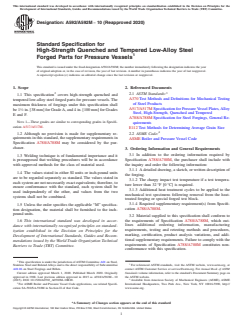
(Specification)Standard Specification for High-Strength Quenched and Tempered Low-Alloy Steel Forged Parts for Pressure Vessels
General Information
- Abstract
ABSTRACT
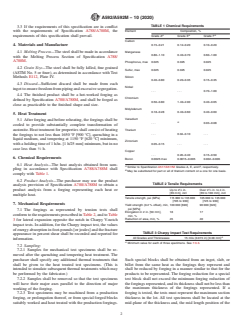
ASTM A592/A592M-04 covers the standard specification for high-strength quenched and tempered low-alloy steel forged fittings and parts used for pressure vessels. The steel shall be made by a melting process and shall be fully killed and fine grained. After forging and before reheating, the forgings shall be cooled to provide substantially complete transformation of austenite. Samples for mechanical test specimens shall be removed after the quenching and tempering heat treatment. The test specimens may be machined from a production forging or from special forged blocks suitably worked and heat treated with the production forgings. Such special blocks shall be obtained from an ingot, slab, or billet from the same heat as the forgings they represent and shall be reduced by forging in a manner similar to that for the products to be represented. The specimens shall undergo tension and Charpy V-notch impact tests.
SCOPE
1.1 This specification2 covers high-strength quenched and tempered low-alloy steel forged parts for pressure vessels. The maximum thickness of forgings under this specification shall be 11/2 in. [38 mm] for Grade A, and 4 in. [100 mm] for Grades E and F.
Note 1: These grades are similar to corresponding grades in Specification A517/A517M.
1.2 Although no provision is made for supplementary requirements in this standard, the supplementary requirements in Specification A788/A788M may be considered by the purchaser.
1.3 Welding technique is of fundamental importance and it is presupposed that welding procedures will be in accordance with approved methods for the class of material used.
1.4 The values stated in either SI units or inch-pound units are to be regarded separately as standard. The values stated in each system are not necessarily exact equivalents; therefore, to ensure conformance with the standard, each system shall be used independently of the other, and values from the two systems shall not be combined.
1.5 Unless the order specifies the applicable “M” specification designation, the material shall be furnished to the inch-pound units.
1.6 This international standard was developed in accordance with internationally recognized principles on standardization established in the Decision on Principles for the Development of International Standards, Guides and Recommendations issued by the World Trade Organization Technical Barriers to Trade (TBT) Committee.
- Status
- Published
- Publication Date
- 29-Feb-2020
- Technical Committee
- A01 - Steel, Stainless Steel and Related Alloys
- Drafting Committee
- A01.06 - Steel Forgings and Billets


Overview
ASTM A592/A592M-10(2020) is the international standard specification developed by ASTM for high-strength quenched and tempered low-alloy steel forged parts used in pressure vessels. This standard defines the chemical, mechanical, and manufacturing requirements to ensure the reliability and integrity of forged fittings and parts in critical pressure vessel applications. Developed according to the principles of the World Trade Organization’s Technical Barriers to Trade (TBT) Committee, ASTM A592/A592M-10(2020) enhances global safety, consistency, and material compatibility in pressure vessel manufacturing.
Key Topics
- Material Grades and Thicknesses: The standard covers multiple grades (A, E, and F) with defined maximum thickness limits:
- Grade A: up to 1 1/2 in. (38 mm)
- Grades E and F: up to 4 in. (100 mm)
- Chemical Composition: Specifies tight limits on elements such as carbon, manganese, phosphorus, sulfur, silicon, chromium, molybdenum, nickel, and others to achieve required mechanical properties and corrosion resistance.
- Heat Treatment: Mandates a process of quenching and tempering to ensure high strength and toughness. Forgings must be heated, quenched in a liquid medium, and tempered at a specified minimum temperature.
- Mechanical Testing: Requirements include tensile tests, Charpy V-notch impact tests, and grain size evaluation to ensure the material exhibits sufficient strength, ductility, and toughness for pressure-containing service.
- Sampling and Testing Protocols: Detailed guidelines for the extraction of test specimens, representative testing of production runs, and conditions for retesting are included.
- Repair Welding: Permitted only at the purchaser's discretion and must follow established ASME Boiler and Pressure Vessel Code procedures.
- Dual Units: Values are provided in both SI and inch-pound units; only one system should be used for a given application.
Applications
ASTM A592/A592M-10(2020) is widely used in industries requiring high-pressure vessel integrity and safety, including:
- Oil and Gas: Forged steel parts in pressurized storage tanks, separators, and reactors.
- Chemical Processing: Components in reactors, heat exchangers, and autoclaves subject to extreme pressures and cyclic loading.
- Power Generation: Pressure-retaining parts used in boilers, steam drums, and related equipment.
- Petrochemical: High-performance fittings and forged parts for hydraulic and process systems within refinery and processing plants.
This standard provides assurance that forged components will meet the rigorous demands of high-pressure environments, maintaining predictable performance, reducing the risk of material failure, and supporting regulatory compliance.
Related Standards
For comprehensive compliance and compatibility, ASTM A592/A592M-10(2020) references several related industry standards:
- ASTM A517/A517M: Specification for pressure vessel plates, high-strength, quenched and tempered alloy steel, closely related to Grades A, E, and F.
- ASTM A788/A788M: General requirements for steel forgings, outlining essential manufacturing controls and supplementary requirements.
- ASTM A370: Standard test methods and definitions for conducting mechanical testing of steel products.
- ASTM E112: Standard test methods for determining the average grain size in steel.
- ASME Boiler and Pressure Vessel Code: For requirements regarding fabrication and repair welding procedures.
These related documents provide additional context and detail for users aiming to optimize material specification, design, and manufacturing of pressure vessel components.
Keywords: ASTM A592, quenched and tempered steel, forged parts, pressure vessel steel, high-strength low-alloy steel, mechanical testing, oil & gas equipment, chemical processing vessels, ASME pressure vessels, steel forgings standards.
Relations
- Effective Date
- 01-Mar-2020
- Effective Date
- 01-Mar-2024
- Effective Date
- 01-Nov-2023
- Effective Date
- 01-Jul-2019
- Effective Date
- 01-May-2019
- Effective Date
- 01-Nov-2018
- Effective Date
- 01-Sep-2018
- Effective Date
- 01-Mar-2018
- Refers
ASTM A370-17a - Standard Test Methods and Definitions for Mechanical Testing of Steel Products - Effective Date
- 15-Nov-2017
- Effective Date
- 01-Nov-2017
- Effective Date
- 01-May-2017
- Effective Date
- 01-Jan-2017
- Effective Date
- 01-Dec-2016
- Effective Date
- 01-Nov-2015
- Effective Date
- 01-May-2015
Get Certified
Connect with accredited certification bodies for this standard

Institut za varilstvo d.o.o. (Welding Institute)
Slovenia's leading welding institute since 1952. ISO 3834, EN 1090, pressure equipment certification, NDT personnel, welder qualification. Only IIW Au
Sponsored listings
Frequently Asked Questions
ASTM A592/A592M-10(2020) is a technical specification published by ASTM International. Its full title is "Standard Specification for High-Strength Quenched and Tempered Low-Alloy Steel Forged Parts for Pressure Vessels". This standard covers: ABSTRACT ASTM A592/A592M-04 covers the standard specification for high-strength quenched and tempered low-alloy steel forged fittings and parts used for pressure vessels. The steel shall be made by a melting process and shall be fully killed and fine grained. After forging and before reheating, the forgings shall be cooled to provide substantially complete transformation of austenite. Samples for mechanical test specimens shall be removed after the quenching and tempering heat treatment. The test specimens may be machined from a production forging or from special forged blocks suitably worked and heat treated with the production forgings. Such special blocks shall be obtained from an ingot, slab, or billet from the same heat as the forgings they represent and shall be reduced by forging in a manner similar to that for the products to be represented. The specimens shall undergo tension and Charpy V-notch impact tests. SCOPE 1.1 This specification2 covers high-strength quenched and tempered low-alloy steel forged parts for pressure vessels. The maximum thickness of forgings under this specification shall be 11/2 in. [38 mm] for Grade A, and 4 in. [100 mm] for Grades E and F. Note 1: These grades are similar to corresponding grades in Specification A517/A517M. 1.2 Although no provision is made for supplementary requirements in this standard, the supplementary requirements in Specification A788/A788M may be considered by the purchaser. 1.3 Welding technique is of fundamental importance and it is presupposed that welding procedures will be in accordance with approved methods for the class of material used. 1.4 The values stated in either SI units or inch-pound units are to be regarded separately as standard. The values stated in each system are not necessarily exact equivalents; therefore, to ensure conformance with the standard, each system shall be used independently of the other, and values from the two systems shall not be combined. 1.5 Unless the order specifies the applicable “M” specification designation, the material shall be furnished to the inch-pound units. 1.6 This international standard was developed in accordance with internationally recognized principles on standardization established in the Decision on Principles for the Development of International Standards, Guides and Recommendations issued by the World Trade Organization Technical Barriers to Trade (TBT) Committee.
ABSTRACT ASTM A592/A592M-04 covers the standard specification for high-strength quenched and tempered low-alloy steel forged fittings and parts used for pressure vessels. The steel shall be made by a melting process and shall be fully killed and fine grained. After forging and before reheating, the forgings shall be cooled to provide substantially complete transformation of austenite. Samples for mechanical test specimens shall be removed after the quenching and tempering heat treatment. The test specimens may be machined from a production forging or from special forged blocks suitably worked and heat treated with the production forgings. Such special blocks shall be obtained from an ingot, slab, or billet from the same heat as the forgings they represent and shall be reduced by forging in a manner similar to that for the products to be represented. The specimens shall undergo tension and Charpy V-notch impact tests. SCOPE 1.1 This specification2 covers high-strength quenched and tempered low-alloy steel forged parts for pressure vessels. The maximum thickness of forgings under this specification shall be 11/2 in. [38 mm] for Grade A, and 4 in. [100 mm] for Grades E and F. Note 1: These grades are similar to corresponding grades in Specification A517/A517M. 1.2 Although no provision is made for supplementary requirements in this standard, the supplementary requirements in Specification A788/A788M may be considered by the purchaser. 1.3 Welding technique is of fundamental importance and it is presupposed that welding procedures will be in accordance with approved methods for the class of material used. 1.4 The values stated in either SI units or inch-pound units are to be regarded separately as standard. The values stated in each system are not necessarily exact equivalents; therefore, to ensure conformance with the standard, each system shall be used independently of the other, and values from the two systems shall not be combined. 1.5 Unless the order specifies the applicable “M” specification designation, the material shall be furnished to the inch-pound units. 1.6 This international standard was developed in accordance with internationally recognized principles on standardization established in the Decision on Principles for the Development of International Standards, Guides and Recommendations issued by the World Trade Organization Technical Barriers to Trade (TBT) Committee.
ASTM A592/A592M-10(2020) is classified under the following ICS (International Classification for Standards) categories: 23.060.01 - Valves in general. The ICS classification helps identify the subject area and facilitates finding related standards.
ASTM A592/A592M-10(2020) has the following relationships with other standards: It is inter standard links to ASTM A592/A592M-10(2015), ASTM A370-24, ASTM A517/A517M-17(2023), ASTM A370-19, ASTM A788/A788M-19, ASTM A788/A788M-18b, ASTM A788/A788M-18a, ASTM A788/A788M-18, ASTM A370-17a, ASTM A788/A788M-17a, ASTM A788/A788M-17, ASTM A370-17, ASTM A788/A788M-16a, ASTM A370-15, ASTM A788/A788M-15. Understanding these relationships helps ensure you are using the most current and applicable version of the standard.
ASTM A592/A592M-10(2020) is available in PDF format for immediate download after purchase. The document can be added to your cart and obtained through the secure checkout process. Digital delivery ensures instant access to the complete standard document.
Standards Content (Sample)
This international standard was developed in accordance with internationally recognized principles on standardization established in the Decision on Principles for the
Development of International Standards, Guides and Recommendations issued by the World Trade Organization Technical Barriers to Trade (TBT) Committee.
Designation:A592/A592M −10 (Reapproved 2020)
Standard Specification for
High-Strength Quenched and Tempered Low-Alloy Steel
Forged Parts for Pressure Vessels
This standard is issued under the fixed designationA592/A592M; the number immediately following the designation indicates the year
of original adoption or, in the case of revision, the year of last revision. A number in parentheses indicates the year of last reapproval.
A superscript epsilon (´) indicates an editorial change since the last revision or reapproval.
1. Scope 2. Referenced Documents
2.1 ASTM Standards:
1.1 This specification covers high-strength quenched and
A370 Test Methods and Definitions for Mechanical Testing
tempered low-alloy steel forged parts for pressure vessels. The
of Steel Products
maximum thickness of forgings under this specification shall
A517/A517M Specification for PressureVessel Plates,Alloy
be 1 ⁄2 in. [38 mm] for GradeA, and 4 in. [100 mm] for Grades
Steel, High-Strength, Quenched and Tempered
E and F.
A788/A788M Specification for Steel Forgings, General Re-
NOTE 1—These grades are similar to corresponding grades in Specifi-
quirements
cation A517/A517M.
E112 Test Methods for Determining Average Grain Size
1.2 Although no provision is made for supplementary re-
2.2 ASME Code:
quirements in this standard, the supplementary requirements in
ASME Boiler and Pressure Vessel Code
Specification A788/A788M may be considered by the pur-
chaser.
3. Ordering Information and General Requirements
1.3 Welding technique is of fundamental importance and it 3.1 In addition to the ordering information required by
Specification A788/A788M, the purchaser shall include with
is presupposed that welding procedures will be in accordance
the inquiry and order the following information:
with approved methods for the class of material used.
3.1.1 Adetailed drawing, a sketch, or written description of
1.4 The values stated in either SI units or inch-pound units
the forging.
are to be regarded separately as standard. The values stated in
3.1.2 The charpy impact test temperature if a test tempera-
each system are not necessarily exact equivalents; therefore, to
ture lower than 32 °F [0 °C] is required.
ensure conformance with the standard, each system shall be
3.1.3 Additional heat treatment cycles to be applied to the
used independently of the other, and values from the two
mechanical test specimens following removal from the heat-
systems shall not be combined.
treated forging or special forged test block.
3.1.4 Required supplementary requirement(s) from Specifi-
1.5 Unless the order specifies the applicable “M” specifica-
cation A788/A788M.
tion designation, the material shall be furnished to the inch-
pound units.
3.2 Material supplied to this specification shall conform to
the requirements of Specification A788/A788M, which out-
1.6 This international standard was developed in accor-
lines additional ordering information, manufacturing
dance with internationally recognized principles on standard-
requirements, testing and retesting methods and procedures,
ization established in the Decision on Principles for the
marking, certification, product analysis variations, and addi-
Development of International Standards, Guides and Recom-
tional supplementary requirements. Failure to comply with the
mendations issued by the World Trade Organization Technical
requirements of Specification A788/A788M constitutes non-
Barriers to Trade (TBT) Committee.
conformance with this specification.
This specification is under the jurisdiction of ASTM Committee A01 on Steel,
Stainless Steel and Related Alloys and is the direct responsibility of Subcommittee For referenced ASTM standards, visit the ASTM website, www.astm.org, or
A01.06 on Steel Forgings and Billets. contact ASTM Customer Service at service@astm.org. For Annual Book of ASTM
Current edition approved March 1, 2020. Published March 2020. Originally Standards volume information, refer to the standard’s Document Summary page on
approved in 1968. Last previous edition approved in 2015 as A592/A592M – 10 the ASTM website.
(2015). DOI: 10.1520/A0592_A0592M–10R20. Available from American Society of Mechanical Engineers (ASME), ASME
For ASME Boiler and Pressure Vessel Code applications, see related Specifi- International Headquarters, Two Park Ave., New York, NY 10016-5990, http://
cation SA-592/SA-592M in Section II of that Code. www.asme.org.
*A Summary of Changes section appears at the end of this standard
Copyright © ASTM International, 100 Barr Harbor Drive, PO Box C700, West Conshohocken, PA 19428-2959. United States
A592/A592M−10 (2020)
TABLE 1 Chemical Requirements
3.3 If the requirements of this specification are in conflict
with the requirements of Specification A788/A788M, the Element Composition, %
A A A
requirements of this specification shall prevail. Grade A Grade E Grade F
Carbon
0.15–0.21 0.12–0.20 0.10–0.20
4. Materials and Manufacture
4.1 MeltingProcess—The steel shall be made in accordance Manganese
0.80–1.10 0.40–0.70 0.60–1.00
with the Melting Process Section of Specification A788/
A788M.
Phosphorus, max 0.025 0.025 0.025
4.2 Grain Size—The steel shall be fully killed, fine grained
Sulfur, max 0.025 0.025 0.025
(ASTM No. 5 or finer), as determined in accordance with Test
Silicon
Methods E112, Plate IV.
0.40–0.80 0.20–0.35 0.15–0.35
4.3 Discard—Sufficient discard shall be made from each
Nickel
ingottoensurefreedomfrompipingandexcessivesegregation.
. . . . . . 0.70–1.00
4.4 The finished product shall be a hot-worked forging as
Chromium
defined by Specification A788/A788M, and shall be forged as
0.50–0.80 1.40–2.00 0.40–0.65
close as practicable to the finished shape and size.
Molybdenum
0.18–0.28 0.40–0.60 0.40–0.60
5. Heat Treatment
Vanadium
5.1 After forging and before reheating, the forgings shall be
B
... 0.03–0.08
cooled to provide substantially complete transformation of
austenite. Heat treatment for properties shall consist of heating
Titanium
. . . 0.04–0.10 . . .
the forgings to not less than 1650 °F [900 °C], quenching in a
liquid medium, and tempering at 1150 °F
...