


ASTM D7637-10(2015)
(Test Method)Standard Test Method for Determination of Glycerin Assay by Titration (Sodium Meta Periodate)
Standard Test Method for Determination of Glycerin Assay by Titration (Sodium Meta Periodate)
SIGNIFICANCE AND USE
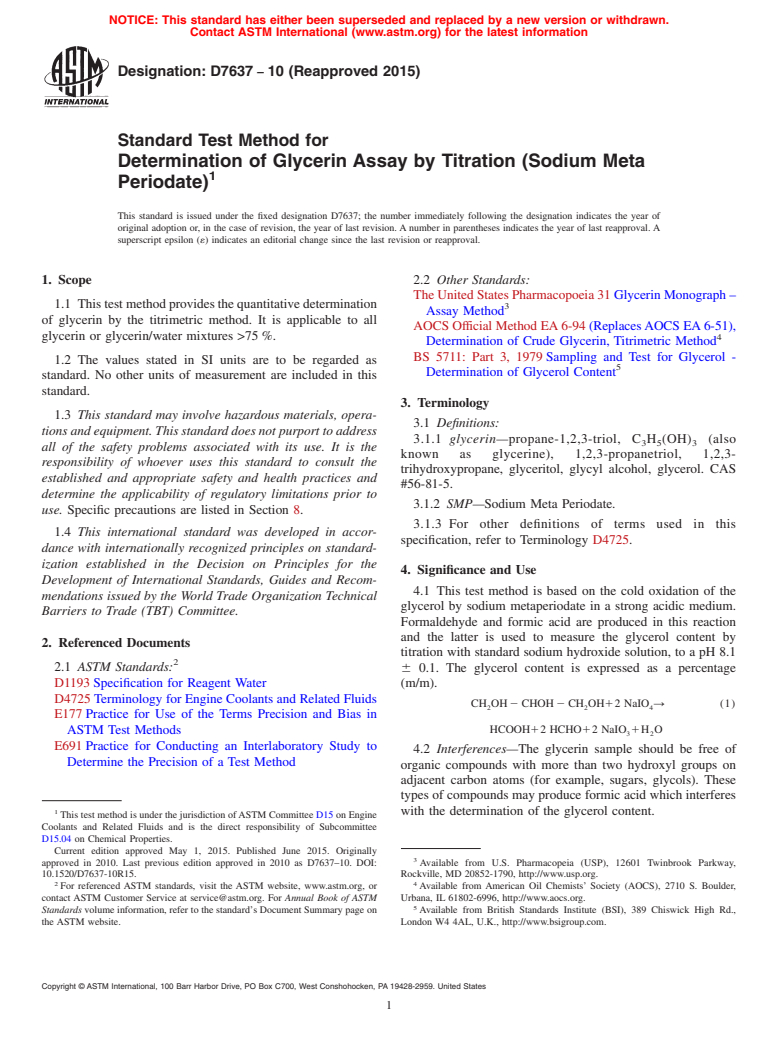
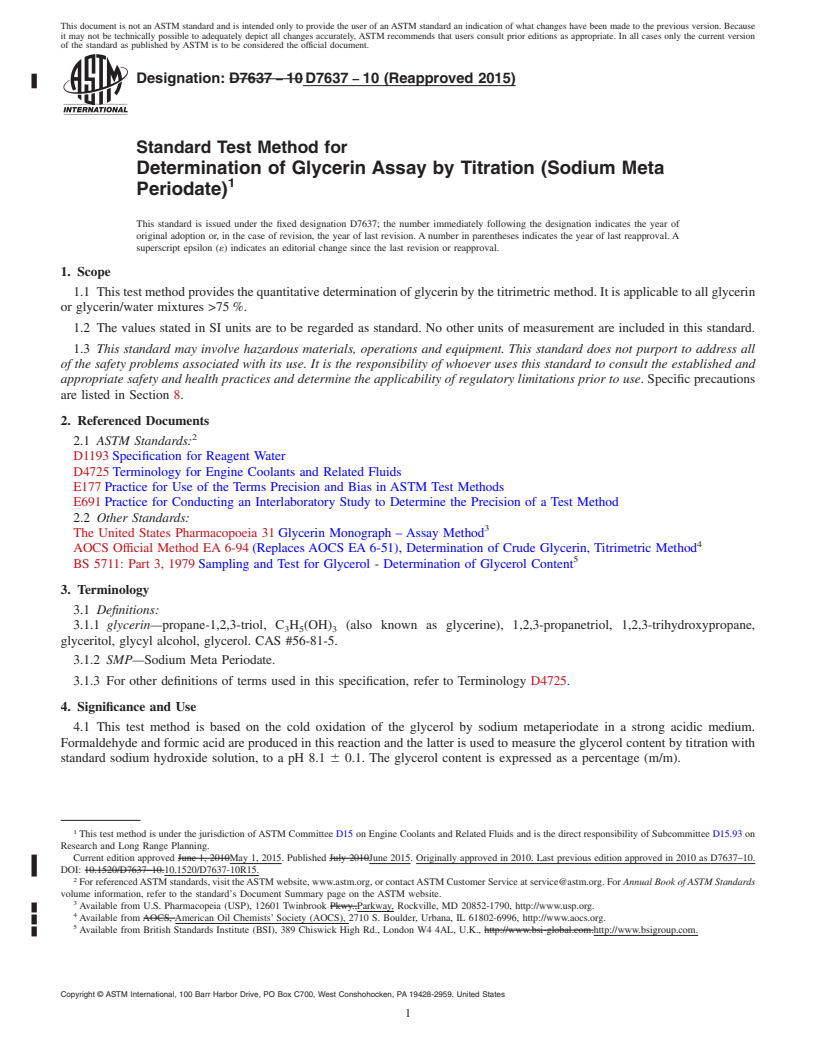
4.1 This test method is based on the cold oxidation of the glycerol by sodium metaperiodate in a strong acidic medium. Formaldehyde and formic acid are produced in this reaction and the latter is used to measure the glycerol content by titration with standard sodium hydroxide solution, to a pH 8.1 ± 0.1. The glycerol content is expressed as a percentage (m/m).
4.2 Interferences—The glycerin sample should be free of organic compounds with more than two hydroxyl groups on adjacent carbon atoms (for example, sugars, glycols). These types of compounds may produce formic acid which interferes with the determination of the glycerol content.
SCOPE
1.1 This test method provides the quantitative determination of glycerin by the titrimetric method. It is applicable to all glycerin or glycerin/water mixtures >75 %.
1.2 The values stated in SI units are to be regarded as standard. No other units of measurement are included in this standard.
1.3 This standard may involve hazardous materials, operations and equipment. This standard does not purport to address all of the safety problems associated with its use. It is the responsibility of whoever uses this standard to consult the established and appropriate safety and health practices and determine the applicability of regulatory limitations prior to use. Specific precautions are listed in Section 8.
General Information
Buy Standard
Standards Content (Sample)
NOTICE: This standard has either been superseded and replaced by a new version or withdrawn.
Contact ASTM International (www.astm.org) for the latest information
Designation: D7637 − 10 (Reapproved 2015)
Standard Test Method for
Determination of Glycerin Assay by Titration (Sodium Meta
Periodate)
This standard is issued under the fixed designation D7637; the number immediately following the designation indicates the year of
original adoption or, in the case of revision, the year of last revision. A number in parentheses indicates the year of last reapproval. A
superscript epsilon (´) indicates an editorial change since the last revision or reapproval.
1. Scope 2.2 Other Standards:
The United States Pharmacopoeia 31 Glycerin Monograph –
1.1 Thistestmethodprovidesthequantitativedetermination
Assay Method
of glycerin by the titrimetric method. It is applicable to all
AOCS Official Method EA6-94 (ReplacesAOCS EA6-51),
glycerin or glycerin/water mixtures >75 %. 4
Determination of Crude Glycerin, Titrimetric Method
BS 5711: Part 3, 1979 Sampling and Test for Glycerol -
1.2 The values stated in SI units are to be regarded as
Determination of Glycerol Content
standard. No other units of measurement are included in this
standard.
3. Terminology
1.3 This standard may involve hazardous materials, opera-
3.1 Definitions:
tions and equipment. This standard does not purport to address
3.1.1 glycerin—propane-1,2,3-triol, C H (OH) (also
3 5 3
all of the safety problems associated with its use. It is the
known as glycerine), 1,2,3-propanetriol, 1,2,3-
responsibility of whoever uses this standard to consult the
trihydroxypropane, glyceritol, glycyl alcohol, glycerol. CAS
established and appropriate safety and health practices and
#56-81-5.
determine the applicability of regulatory limitations prior to
3.1.2 SMP—Sodium Meta Periodate.
use. Specific precautions are listed in Section 8.
3.1.3 For other definitions of terms used in this
1.4 This international standard was developed in accor-
specification, refer to Terminology D4725.
dance with internationally recognized principles on standard-
ization established in the Decision on Principles for the
4. Significance and Use
Development of International Standards, Guides and Recom-
4.1 This test method is based on the cold oxidation of the
mendations issued by the World Trade Organization Technical
glycerol by sodium metaperiodate in a strong acidic medium.
Barriers to Trade (TBT) Committee.
Formaldehyde and formic acid are produced in this reaction
and the latter is used to measure the glycerol content by
2. Referenced Documents
titration with standard sodium hydroxide solution, to a pH 8.1
2.1 ASTM Standards:
6 0.1. The glycerol content is expressed as a percentage
D1193 Specification for Reagent Water (m/m).
D4725 Terminology for Engine Coolants and Related Fluids
CH OH 2 CHOH 2 CH OH12 NaIO→ (1)
2 2 4
E177 Practice for Use of the Terms Precision and Bias in
HCOOH12 HCHO12 NaIO 1H O
ASTM Test Methods
3 2
E691 Practice for Conducting an Interlaboratory Study to
4.2 Interferences—The glycerin sample should be free of
Determine the Precision of a Test Method
organic compounds with more than two hydroxyl groups on
adjacent carbon atoms (for example, sugars, glycols). These
types of compounds may produce formic acid which interferes
1 with the determination of the glycerol content.
This test method is under the jurisdiction ofASTM Committee D15 on Engine
Coolants and Related Fluids and is the direct responsibility of Subcommittee
D15.04 on Chemical Properties.
Current edition approved May 1, 2015. Published June 2015. Originally
approved in 2010. Last previous edition approved in 2010 as D7637–10. DOI: Available from U.S. Pharmacopeia (USP), 12601 Twinbrook Parkway,
10.1520/D7637-10R15. Rockville, MD 20852-1790, http://www.usp.org.
2 4
For referenced ASTM standards, visit the ASTM website, www.astm.org, or Available from American Oil Chemists’ Society (AOCS), 2710 S. Boulder,
contact ASTM Customer Service at service@astm.org. For Annual Book of ASTM Urbana, IL 61802-6996, http://www.aocs.org.
Standards volume information, refer to the standard’s Document Summary page on Available from British Standards Institute (BSI), 389 Chiswick High Rd.,
the ASTM website. London W4 4AL, U.K., http://www.bsigroup.com.
Copyright © ASTM International, 100 Barr Harbor Drive, PO Box C700, West Conshohocken, PA 19428-2959. United States
D7637 − 10 (2015)
5. Apparatus 7.9 Potassium Iodide, aqueous solution—Dissolve 16.5 g of
potassium iodide in water to make 100 mL. Store tightly
5.1 Burette—50 mL“TypeA” unit that can deliver 30 drops
capped in a light-resistant container.
per mL and calibrated to meet the NIST standards.
7.10 Starch Solution—Mix 1g of soluble starch with suffi-
NOTE 1— It is critical that all glassware be “Type A” and thoroughly
cient cold water to make a thin paste. Add 200 mL of boiling
cleaned before use as dirty glassware will impact the analysis results.
water, and boil for 1 min with continuous stirring. Cool, and
5.2 pH meter, fitted with glass electrode.
use only the clear solution.
NOTE 2—The pH meter should be standardized with a minimum of two
NOTE 4—It is recommended that freshly prepared starch solution be
buffer solutions at 10.0 and 7.0. (See 7.12.)
used to ensure a sharper endpoint. Commercially available, stabilized
starch indicator solution may be also used in place of freshly prepared
5.3 Stirrer—preference should be given to a magnetic stir-
starch.
rer. In this case, check that it does not influence the pH meter.
7.11 Bromothymol blue indicator solution—Dissolve 100
mg of bromothymol blue in 100 mL of water to make 100 mL
6. Purity of Reagents and Water
of indicator solution.
6.1 Purity of Reagents—Reagent grade chemicals shall be
7.12 pH Buffers (7.0 6 0.01 and 10.0 6 0.01 at 25°C)
used in all tests. Unless otherwise indicated, it is intended that
needed for pH meter standardization.
all reagents conform to the specifications of the Committee on
7.13 Freshly boiled water, or equivalent. (See 6.2.)
Analytical Reagents of the American Chemical Society where
such specifications are available. Other grades may be used
8. Precautions
provided it is first ascertained that the reagent is of sufficiently
high purity to permit its use without lessening the accuracy of 8.1 Sulfuric acid and sodium hydroxide solutions are cor-
the determination. rosive. Avoid eye and skin contact.
8.2 Please study and be aware of the Material Safety Data
6.2 Purity of Water—Unless indicated otherwise, references
Sheet and correct laboratory performance for the appropriate
to water shall be understood to mean Type II reagent water as
health and safety precautions that may apply to any of the
defined in Specification D1193.
chemicals and equipment prior to use.
NOTE3—Thepresenceofcarbondioxidecanintroduceerrors;therefore
8.3 It is the responsibility of each organization to conduct a
itisadvisabletoprepare500mLofwaterbyboilingfor5minandcooling
to room temperature. Check the pH of the distilled water before use. The
job hazard analysis to assess safety risks and PPE needed for
pHshouldbe7.0 60.1.Ifnot,adjustthepHwith0.1Nsodiumhydroxide
performance of this test method.
(NaOH)or0.1Nhydrogenchloride(HCl),whicheverisappropriate.Store
the freshly boiled and neutralized water in a tightly closed container.
9. Procedure
9.1 Sodium Periodate Solution Suitability Test—Pipet 10
7. Reagents
mL of the prepared sodium periodate solution (Reagent 7.1)
7.1 Sodium Metaperiodate, NaIO , acidic solution—
into a 250-mL volumetric flask, dilute with water to volume,
Dissolve 60 g of sodium metaperiodate in sufficient water
and mix.
containing120mLof0.1Nsulfuricacidtomake1000mL. Do
9.2 Weigh approximately 550 mg of glycerin into flask.
not heat to dissolve the periodate. If the solution is not clear,
Dissolvethesamplein50mLofwaterandpipette50mLofthe
pass it through a sintered-glass filter. Store the solution in a
dilutedperiodatesolutionpreparedin9.1.Allowthesolutionto
glass-stoppered, light-resistant container.
stand for 30 min.
7.2 HydrochloricAcid, aqueous solution, approximately 0.1
9.3 Add 5 mL of hydrochloric acid solution (Reagent 7.2)
N.
and 10 mL of potassium iodide solution (Reagent 7.9), and
7.3 Sodium Hydroxide, aqueous solution, approximately
gently swirl to mix. Allow the solution to stand for 5 min.
0.05 N.
9.4 Add 100 mL of water and 3 mL o
...
This document is not an ASTM standard and is intended only to provide the user of an ASTM standard an indication of what changes have been made to the previous version. Because
it may not be technically possible to adequately depict all changes accurately, ASTM recommends that users consult prior editions as appropriate. In all cases only the current version
of the standard as published by ASTM is to be considered the official document.
Designation: D7637 − 10 D7637 − 10 (Reapproved 2015)
Standard Test Method for
Determination of Glycerin Assay by Titration (Sodium Meta
Periodate)
This standard is issued under the fixed designation D7637; the number immediately following the designation indicates the year of
original adoption or, in the case of revision, the year of last revision. A number in parentheses indicates the year of last reapproval. A
superscript epsilon (´) indicates an editorial change since the last revision or reapproval.
1. Scope
1.1 This test method provides the quantitative determination of glycerin by the titrimetric method. It is applicable to all glycerin
or glycerin/water mixtures >75 %.
1.2 The values stated in SI units are to be regarded as standard. No other units of measurement are included in this standard.
1.3 This standard may involve hazardous materials, operations and equipment. This standard does not purport to address all
of the safety problems associated with its use. It is the responsibility of whoever uses this standard to consult the established and
appropriate safety and health practices and determine the applicability of regulatory limitations prior to use. Specific precautions
are listed in Section 8.
2. Referenced Documents
2.1 ASTM Standards:
D1193 Specification for Reagent Water
D4725 Terminology for Engine Coolants and Related Fluids
E177 Practice for Use of the Terms Precision and Bias in ASTM Test Methods
E691 Practice for Conducting an Interlaboratory Study to Determine the Precision of a Test Method
2.2 Other Standards:
The United States Pharmacopoeia 31 Glycerin Monograph – Assay Method
AOCS Official Method EA 6-94 (Replaces AOCS EA 6-51), Determination of Crude Glycerin, Titrimetric Method
BS 5711: Part 3, 1979 Sampling and Test for Glycerol - Determination of Glycerol Content
3. Terminology
3.1 Definitions:
3.1.1 glycerin—propane-1,2,3-triol, C H (OH) (also known as glycerine), 1,2,3-propanetriol, 1,2,3-trihydroxypropane,
3 5 3
glyceritol, glycyl alcohol, glycerol. CAS #56-81-5.
3.1.2 SMP—Sodium Meta Periodate.
3.1.3 For other definitions of terms used in this specification, refer to Terminology D4725.
4. Significance and Use
4.1 This test method is based on the cold oxidation of the glycerol by sodium metaperiodate in a strong acidic medium.
Formaldehyde and formic acid are produced in this reaction and the latter is used to measure the glycerol content by titration with
standard sodium hydroxide solution, to a pH 8.1 6 0.1. The glycerol content is expressed as a percentage (m/m).
This test method is under the jurisdiction of ASTM Committee D15 on Engine Coolants and Related Fluids and is the direct responsibility of Subcommittee D15.93 on
Research and Long Range Planning.
Current edition approved June 1, 2010May 1, 2015. Published July 2010June 2015. Originally approved in 2010. Last previous edition approved in 2010 as D7637–10.
DOI: 10.1520/D7637–10.10.1520/D7637-10R15.
For referenced ASTM standards, visit the ASTM website, www.astm.org, or contact ASTM Customer Service at service@astm.org. For Annual Book of ASTM Standards
volume information, refer to the standard’s Document Summary page on the ASTM website.
Available from U.S. Pharmacopeia (USP), 12601 Twinbrook Pkwy.,Parkway, Rockville, MD 20852-1790, http://www.usp.org.
Available from AOCS, American Oil Chemists’ Society (AOCS), 2710 S. Boulder, Urbana, IL 61802-6996, http://www.aocs.org.
Available from British Standards Institute (BSI), 389 Chiswick High Rd., London W4 4AL, U.K., http://www.bsi-global.com.http://www.bsigroup.com.
Copyright © ASTM International, 100 Barr Harbor Drive, PO Box C700, West Conshohocken, PA 19428-2959. United States
D7637 − 10 (2015)
CH OH 2 CHOH 2 CH OH12 NaIO → (1)
2 2 4
HCOOH12 HCHO12 NaIO 1H O
3 2
4.2 Interferences—The glycerin sample should be free of organic compounds with more than two hydroxyl groups on adjacent
carbon atoms (for example, sugars, glycols). These types of compounds may produce formic acid which interferes with the
determination of the glycerol content.
5. Apparatus
5.1 Burette—50 mL “Type A” unit that can deliver 30 drops per mL and calibrated to meet the NIST standards.
NOTE 1— It is critical that all glassware be “Type A” and thoroughly cleaned before use as dirty glassware will impact the analysis results.
5.2 pH meter, fitted with glass electrode.
NOTE 2—The pH meter should be standardized with a minimum of two buffer solutions at 10.0 and 7.0. (See 7.12.)
5.3 Stirrer—preference should be given to a magnetic stirrer. In this case, check that it does not influence the pH meter.
6. Purity of Reagents and Water
6.1 Purity of Reagents—Reagent grade chemicals shall be used in all tests. Unless otherwise indicated, it is intended that all
reagents conform to the specifications of the Committee on Analytical Reagents of the American Chemical Society where such
specifications are available. Other grades may be used provided it is first ascertained that the reagent is of sufficiently high purity
to permit its use without lessening the accuracy of the determination.
6.2 Purity of Water—Unless indicated otherwise, references to water shall be understood to mean Type II reagent water as
defined in Specification D1193.
NOTE 3—The presence of carbon dioxide can introduce errors; therefore it is advisable to prepare 500 mL of water by boiling for 5 min and cooling
to room temperature. Check the pH of the distilled water before use. The pH should be 7.0 6 0.1. If not, adjust the pH with 0.1 N sodium hydroxide
(NaOH) or 0.1 N hydrogen chloride (HCl), whichever is appropriate. Store the freshly boiled and neutralized water in a tightly closed container.
7. Reagents
7.1 Sodium Metaperiodate, NaIO , acidic solution—Dissolve 60 g of sodium metaperiodate in sufficient water containing 120
mL of 0.1 N sulfuric acid to make 1000 mL. Do not heat to dissolve the periodate. If the solution is not clear, pass it through a
sintered-glass filter. Store the solution in a glass-stoppered, light-resistant container.
7.2 Hydrochloric Acid, aqueous solution, approximately 0.1 N.
7.3 Sodium Hydroxide, aqueous solution, approximately 0.05 N.
7.4 Sodium Hydroxide, 0.1 N, Standardized —Dissolve four grams of sodium hydroxide (NaOH) in water and dilute to one liter.
Standardize accurately to 60.0001 N. The standardized sodium hydroxide solution should be protected against evaporation and
absorption of carbon dioxide (CO ) from the air.
7.5 Ethylene glycol (1,2-ethanediol, free from glycerol) solution in water. 1:1 (v/v).
7.6 Sulfuric Acid Solution, aqueous solution, approximately 0.1 N.
7.7 Sulfuric Acid Solution, aqueous solution, approximately 0.2 N.
7.8 Sodium Thiosulfate, 0.1 N, aqueous solution.
7.9 Potassium Iodide, aqueous solution—Dissolve 16.5 g of potassium iodide in water to make 100 mL. Store tightly capped
in a light-resistant container.
7.10 Starch Solution—Mix 1g of soluble starch with sufficient cold water to make a thin paste. Add 200 mL of boiling water,
and boil for 1 min with continuous stirring. Cool, and use only the clear solution.
NOTE 4—It is recommended that freshly prepared starch solution be used to ensure a sharper endpoint. Commercially available, stabilized starch
indicator solution may be also used in place of freshly prepared starch.
7.11 Bromothymol blue indicator solution—Dissolve 100 mg of bromothymol blue in 100 mL of water to make 100 mL of
indicator solution.
7.12 pH Buffers (7.0 6 0.01 and 10.0 6 0.01 at 25°C) needed for pH meter standardization.
7.13 Freshly boiled water, or equivalent. (See 6.2.)
8. Precautions
8.1 Sulfuric acid and sodium hydroxide solutions are corrosive. Avoid eye and skin contact.
D7637 − 10 (2015)
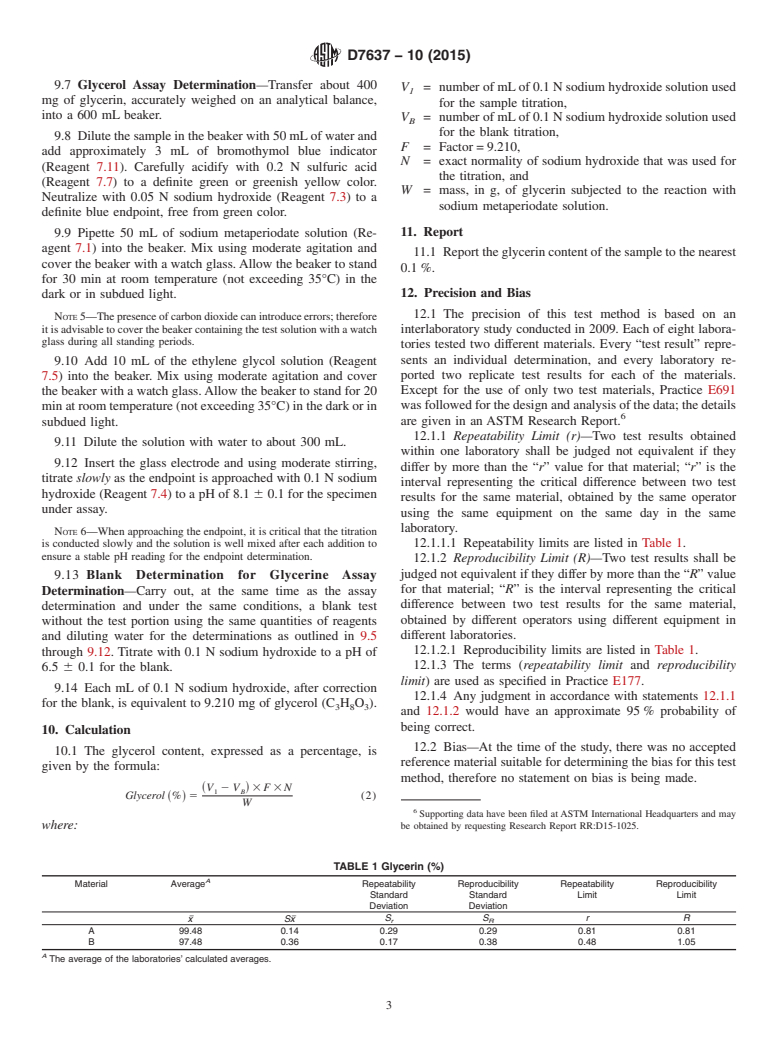
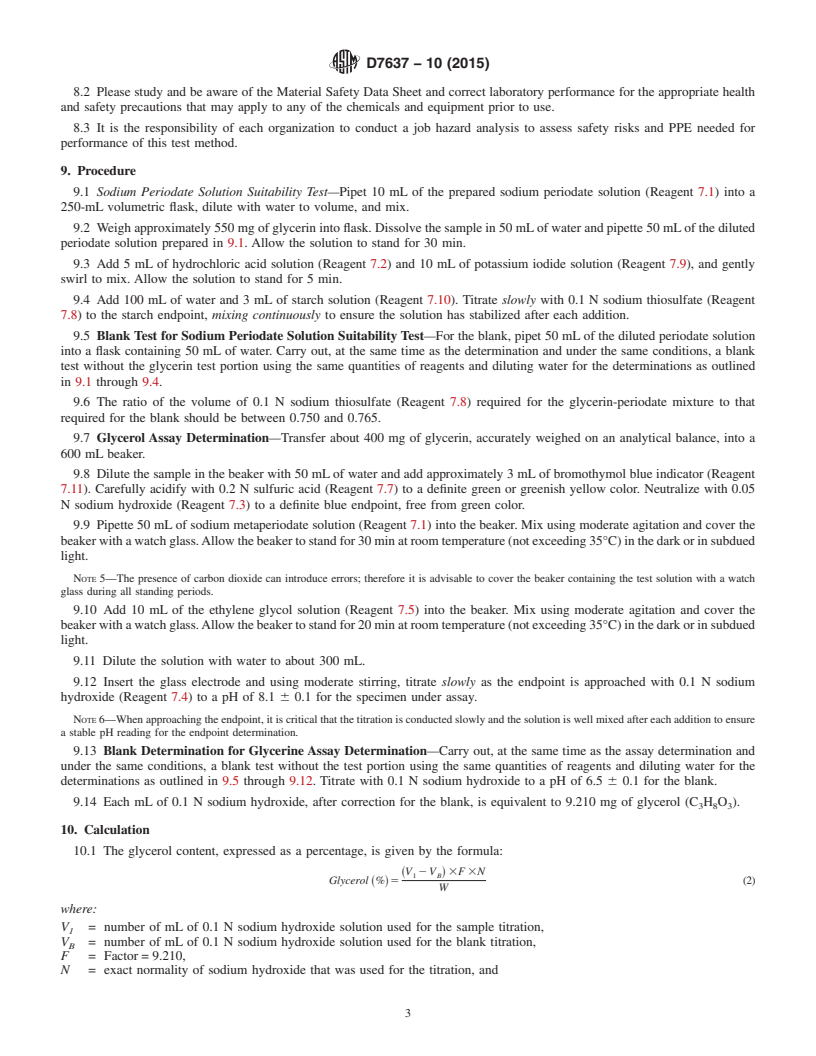
8.2 Please study and be aware of the Material Safety Data Sheet and correct laboratory performance for the appropriate health
and safety precautions that may apply to any of the chemicals and equipment prior to use.
8.3 It is the responsibility of each organization to conduct a job hazard analysis to assess safety risks an
...
Questions, Comments and Discussion
Ask us and Technical Secretary will try to provide an answer. You can facilitate discussion about the standard in here.