

ASTM C91/C91M-23
(Specification)Standard Specification for Masonry Cement
General Information
- Abstract
ABSTRACT
This specification covers three types of masonry cement for use where mortar for masonry is required. Masonry cement shall conform to the applicable physical property requirements prescribed. The masonry cement shall be sampled in accordance with practice C 183. The temperature and relative humidity of the air in the vicinity of the mixing slab and dry materials, molds, base plates, and mixing bowl shall conform to the requirements of test method C 109/C 109M. Determine normal consistency by the Vicat apparatus in accordance with test method C 187. Determine autoclave expansion in accordance with test method C 151. Determine the time of setting by the Gillmore needle method in accordance with test method C 266. Determine the density of the masonry cement in accordance with test method C 188, using kerosene as the liquid. The sand shall be a blend of equal parts by weight of graded standard sand and standard 20-30 sand conforming to specification C 778. The compressive testing procedures for mortars are presented. Water retention shall be determined in accordance with the procedures in test method C 1506.
SCOPE
1.1 This specification covers three types of masonry cement for use where mortar for masonry is required.
1.2 Units—The values stated in either SI units or inch-pound units are to be regarded separately as standard. The values stated in each system may not be exact equivalents; therefore, each system shall be used independently of the other. Combining values from the two systems may result in non-conformance with the standard. Values in SI units shall be obtained by measurement in SI units or by appropriate conversion, using the Rules for Conversion and Rounding given in Standard IEEE/ASTM SI 10, of measurements made in other units. Values are stated in only SI units when inch-pound units are not used in practice.
1.3 The text of this standard refers to notes and footnotes which provide explanatory material. These notes and footnotes (excluding those in tables and figures) shall not be considered as requirements of the standard.
1.4 The following safety hazards caveat pertains only to Sections 15 and 16 of this specification. This standard does not purport to address all of the safety concerns, if any, associated with its use. It is the responsibility of the user of this standard to establish appropriate safety, health, and environmental practices and determine the applicability of regulatory limitations prior to use. (Warning—Fresh hydraulic cementitious mixtures are caustic and may cause chemical burns to skin and tissue upon prolonged exposure.)2
1.5 This international standard was developed in accordance with internationally recognized principles on standardization established in the Decision on Principles for the Development of International Standards, Guides and Recommendations issued by the World Trade Organization Technical Barriers to Trade (TBT) Committee.
- Status
- Published
- Publication Date
- 31-Dec-2022
- Technical Committee
- C01 - Cement
- Drafting Committee
- C01.11 - Masonry Cement

Overview
ASTM C91/C91M-23: Standard Specification for Masonry Cement defines the requirements for three types of masonry cement used in the preparation of mortar for masonry construction. Developed by ASTM International, this standard ensures the quality, consistency, and performance of masonry cement products by specifying physical properties, testing procedures, packaging, and certification protocols. The specification is integral to projects that demand reliable mortar for masonry applications, such as structural brickwork, blockwork, and other masonry units.
Key Topics
Types of Masonry Cement: The standard specifies three types of masonry cement (Type N, Type S, and Type M), each suited for different mortar strengths and applications.
- Type N: General purpose masonry cement, suitable for most above-grade applications.
- Type S: Higher strength cement, recommended for structures requiring greater load-bearing capacity.
- Type M: Highest strength cement for demanding applications.
Physical Property Requirements: Sets minimum standards for:
- Fineness
- Autoclave expansion
- Setting time (initial and maximum)
- Compressive strength at 7 and 28 days
- Air content of mortar
- Water retention value
Testing & Sampling Methods: Reference to established ASTM test methods for:
- Compressive strength (ASTM C109/C109M)
- Autoclave expansion (ASTM C151)
- Setting time (ASTM C266)
- Density (ASTM C188)
- Water retention (ASTM C1506)
- Sampling procedures (ASTM C183)
Unit Systems: Values are provided in both SI and inch-pound units; each system must be used independently to maintain standard conformance.
Certification, Packaging, and Marking: Requirements for shipment identification and manufacturer’s certification to verify compliance.
Applications
ASTM C91/C91M-23 is widely referenced in the construction industry for projects requiring high-quality masonry mortars. The specification’s practical value includes:
- Masonry Construction: Used by architects, engineers, and contractors for both residential and commercial building projects, ensuring mortar consistency and durability.
- Structural Integrity: By mandating high strength and performance metrics, the standard helps guarantee the load-bearing capacity of masonry walls.
- Quality Control: Standardized testing and sampling processes provide assurance for project inspectors and procurement officers.
- Compliance in Procurement: Use of ASTM C91/C91M-23 streamlines bidding and material specification, reducing disputes and ensuring project accountability.
Related Standards
Organizations and professionals implementing ASTM C91/C91M-23 may also reference:
- ASTM C109/C109M: Test Method for Compressive Strength of Hydraulic Cement Mortars
- ASTM C183: Practice for Sampling and Amount of Testing of Hydraulic Cement
- ASTM C187: Test Method for Amount of Water Required for Normal Consistency of Hydraulic Cement Paste
- ASTM C266: Test Method for Time of Setting by Gillmore Needles
- ASTM C270: Specification for Mortar for Unit Masonry
- ASTM C1506: Test Method for Water Retention of Hydraulic Cement-Based Mortars and Plasters
- ASTM C778: Specification for Standard Sand
- IEEE/ASTM SI 10: Rules for the International System of Units (SI)
Conclusion
ASTM C91/C91M-23 provides an essential framework for the specification, testing, and certification of masonry cement. Adherence to this standard supports construction professionals in achieving consistency, safety, and structural reliability for all types of masonry projects. For robust, code-compliant mortar solutions, following ASTM C91/C91M-23 ensures quality from procurement through installation.
Keywords: masonry cement, ASTM C91, mortar specification, masonry standards, cement testing, construction materials, Type N S M cement, building codes, quality control.
Relations
- Effective Date
- 01-Apr-2024
- Effective Date
- 15-Dec-2023
- Effective Date
- 01-Aug-2020
- Effective Date
- 15-Jul-2020
- Effective Date
- 01-Apr-2020
- Effective Date
- 01-Apr-2020
- Effective Date
- 01-Dec-2019
- Effective Date
- 15-Nov-2019
- Effective Date
- 01-Jun-2019
- Effective Date
- 01-May-2019
- Effective Date
- 01-May-2019
- Effective Date
- 01-Feb-2019
- Effective Date
- 01-Dec-2017
- Effective Date
- 01-Aug-2017
- Effective Date
- 15-Dec-2016
Get Certified
Connect with accredited certification bodies for this standard

DIBt (Deutsches Institut für Bautechnik)
German Institute for Building Technology.
DIN CERTCO
DIN Group product certification.

Aboma Certification B.V.
Specialized in construction, metal, and transport sectors.
Sponsored listings
Frequently Asked Questions
ASTM C91/C91M-23 is a technical specification published by ASTM International. Its full title is "Standard Specification for Masonry Cement". This standard covers: ABSTRACT This specification covers three types of masonry cement for use where mortar for masonry is required. Masonry cement shall conform to the applicable physical property requirements prescribed. The masonry cement shall be sampled in accordance with practice C 183. The temperature and relative humidity of the air in the vicinity of the mixing slab and dry materials, molds, base plates, and mixing bowl shall conform to the requirements of test method C 109/C 109M. Determine normal consistency by the Vicat apparatus in accordance with test method C 187. Determine autoclave expansion in accordance with test method C 151. Determine the time of setting by the Gillmore needle method in accordance with test method C 266. Determine the density of the masonry cement in accordance with test method C 188, using kerosene as the liquid. The sand shall be a blend of equal parts by weight of graded standard sand and standard 20-30 sand conforming to specification C 778. The compressive testing procedures for mortars are presented. Water retention shall be determined in accordance with the procedures in test method C 1506. SCOPE 1.1 This specification covers three types of masonry cement for use where mortar for masonry is required. 1.2 Units—The values stated in either SI units or inch-pound units are to be regarded separately as standard. The values stated in each system may not be exact equivalents; therefore, each system shall be used independently of the other. Combining values from the two systems may result in non-conformance with the standard. Values in SI units shall be obtained by measurement in SI units or by appropriate conversion, using the Rules for Conversion and Rounding given in Standard IEEE/ASTM SI 10, of measurements made in other units. Values are stated in only SI units when inch-pound units are not used in practice. 1.3 The text of this standard refers to notes and footnotes which provide explanatory material. These notes and footnotes (excluding those in tables and figures) shall not be considered as requirements of the standard. 1.4 The following safety hazards caveat pertains only to Sections 15 and 16 of this specification. This standard does not purport to address all of the safety concerns, if any, associated with its use. It is the responsibility of the user of this standard to establish appropriate safety, health, and environmental practices and determine the applicability of regulatory limitations prior to use. (Warning—Fresh hydraulic cementitious mixtures are caustic and may cause chemical burns to skin and tissue upon prolonged exposure.)2 1.5 This international standard was developed in accordance with internationally recognized principles on standardization established in the Decision on Principles for the Development of International Standards, Guides and Recommendations issued by the World Trade Organization Technical Barriers to Trade (TBT) Committee.
ABSTRACT This specification covers three types of masonry cement for use where mortar for masonry is required. Masonry cement shall conform to the applicable physical property requirements prescribed. The masonry cement shall be sampled in accordance with practice C 183. The temperature and relative humidity of the air in the vicinity of the mixing slab and dry materials, molds, base plates, and mixing bowl shall conform to the requirements of test method C 109/C 109M. Determine normal consistency by the Vicat apparatus in accordance with test method C 187. Determine autoclave expansion in accordance with test method C 151. Determine the time of setting by the Gillmore needle method in accordance with test method C 266. Determine the density of the masonry cement in accordance with test method C 188, using kerosene as the liquid. The sand shall be a blend of equal parts by weight of graded standard sand and standard 20-30 sand conforming to specification C 778. The compressive testing procedures for mortars are presented. Water retention shall be determined in accordance with the procedures in test method C 1506. SCOPE 1.1 This specification covers three types of masonry cement for use where mortar for masonry is required. 1.2 Units—The values stated in either SI units or inch-pound units are to be regarded separately as standard. The values stated in each system may not be exact equivalents; therefore, each system shall be used independently of the other. Combining values from the two systems may result in non-conformance with the standard. Values in SI units shall be obtained by measurement in SI units or by appropriate conversion, using the Rules for Conversion and Rounding given in Standard IEEE/ASTM SI 10, of measurements made in other units. Values are stated in only SI units when inch-pound units are not used in practice. 1.3 The text of this standard refers to notes and footnotes which provide explanatory material. These notes and footnotes (excluding those in tables and figures) shall not be considered as requirements of the standard. 1.4 The following safety hazards caveat pertains only to Sections 15 and 16 of this specification. This standard does not purport to address all of the safety concerns, if any, associated with its use. It is the responsibility of the user of this standard to establish appropriate safety, health, and environmental practices and determine the applicability of regulatory limitations prior to use. (Warning—Fresh hydraulic cementitious mixtures are caustic and may cause chemical burns to skin and tissue upon prolonged exposure.)2 1.5 This international standard was developed in accordance with internationally recognized principles on standardization established in the Decision on Principles for the Development of International Standards, Guides and Recommendations issued by the World Trade Organization Technical Barriers to Trade (TBT) Committee.
ASTM C91/C91M-23 is classified under the following ICS (International Classification for Standards) categories: 91.100.10 - Cement. Gypsum. Lime. Mortar. The ICS classification helps identify the subject area and facilitates finding related standards.
ASTM C91/C91M-23 has the following relationships with other standards: It is inter standard links to ASTM C219-24, ASTM C109/C109M-23, ASTM C219-20a, ASTM C305-20, ASTM C185-20, ASTM C219-20, ASTM C185-19, ASTM C219-19a, ASTM C219-19, ASTM C270-19a, ASTM C270-19ae1, ASTM C270-19, ASTM C430-17, ASTM C1506-17, ASTM C188-16. Understanding these relationships helps ensure you are using the most current and applicable version of the standard.
ASTM C91/C91M-23 is available in PDF format for immediate download after purchase. The document can be added to your cart and obtained through the secure checkout process. Digital delivery ensures instant access to the complete standard document.
Standards Content (Sample)
This international standard was developed in accordance with internationally recognized principles on standardization established in the Decision on Principles for the
Development of International Standards, Guides and Recommendations issued by the World Trade Organization Technical Barriers to Trade (TBT) Committee.
Designation:C91/C91M −23
Standard Specification for
Masonry Cement
This standard is issued under the fixed designation C91/C91M; the number immediately following the designation indicates the year of
original adoption or, in the case of revision, the year of last revision. A number in parentheses indicates the year of last reapproval. A
superscript epsilon (´) indicates an editorial change since the last revision or reapproval.
This standard has been approved for use by agencies of the U.S. Department of Defense.
1. Scope* 2. Referenced Documents
1.1 This specification covers three types of masonry cement 2.1 ASTM Standards:
for use where mortar for masonry is required. C109/C109M Test Method for Compressive Strength of
Hydraulic Cement Mortars (Using 2-in. or [50 mm] Cube
1.2 Units—The values stated in either SI units or inch-
Specimens)
pound units are to be regarded separately as standard. The
C183/C183M Practice for Sampling and the Amount of
values stated in each system may not be exact equivalents;
Testing of Hydraulic Cement
therefore,eachsystemshallbeusedindependentlyoftheother.
C185 Test Method for Air Content of Hydraulic Cement
Combining values from the two systems may result in non-
Mortar
conformance with the standard. Values in SI units shall be
C187 Test Method for Amount of Water Required for Nor-
obtained by measurement in SI units or by appropriate
mal Consistency of Hydraulic Cement Paste
conversion, using the Rules for Conversion and Rounding
C188 Test Method for Density of Hydraulic Cement
given in Standard IEEE/ASTM SI 10, of measurements made
C219 Terminology Relating to Hydraulic and Other Inor-
in other units. Values are stated in only SI units when
ganic Cements
inch-pound units are not used in practice.
C266 Test Method for Time of Setting of Hydraulic-Cement
1.3 The text of this standard refers to notes and footnotes
Paste by Gillmore Needles
which provide explanatory material. These notes and footnotes
C270 Specification for Mortar for Unit Masonry
(excluding those in tables and figures) shall not be considered
C305 Practice for Mechanical Mixing of Hydraulic Cement
as requirements of the standard.
Pastes and Mortars of Plastic Consistency
1.4 The following safety hazards caveat pertains only to C430 Test Method for Fineness of Hydraulic Cement by the
Sections 15 and 16 of this specification. This standard does not
45-µm (No. 325) Sieve
purport to address all of the safety concerns, if any, associated
C511 Specification for Mixing Rooms, Moist Cabinets,
with its use. It is the responsibility of the user of this standard Moist Rooms, and Water Storage Tanks Used in the
to establish appropriate safety, health, and environmental
Testing of Hydraulic Cements and Concretes
practices and determine the applicability of regulatory limita- C778 Specification for Standard Sand
tions prior to use. (Warning—Fresh hydraulic cementitious
C1506 Test Method for Water Retention of Hydraulic
mixtures are caustic and may cause chemical burns to skin and Cement-Based Mortars and Plasters
tissue upon prolonged exposure.)
IEEE/ASTM SI 10 Standard for Use of the International
1.5 This international standard was developed in accor- System of Units (SI): The Modern Metric System
dance with internationally recognized principles on standard-
3. Terminology
ization established in the Decision on Principles for the
Development of International Standards, Guides and Recom-
3.1 Definitions:
mendations issued by the World Trade Organization Technical
3.1.1 masonry cement, n—a hydraulic cement, primarily
Barriers to Trade (TBT) Committee.
used in masonry and plastering construction, consisting of a
mixture of portland or blended hydraulic cement and plasticiz-
ing materials (such as limestone, hydrated or hydraulic lime)
This specification is under the jurisdiction of ASTM Committee C01 on
together with other materials introduced to enhance one or
Cement and is the direct responsibility of Subcommittee C01.11 on Masonry
Cement.
Current edition approved Jan. 1, 2023. Published January 2023. Originally
approved in 1932. Last previous edition approved in 2018 as C91/C91M – 18. DOI: For referenced ASTM standards, visit the ASTM website, www.astm.org, or
10.1520/C0091_C0091M-23. contact ASTM Customer Service at service@astm.org. For Annual Book of ASTM
Annual Book of ASTM Standards, Vol 04.01. See the section on Safety Standards volume information, refer to the standard’s Document Summary page on
Precautions in the Manual of Cement Testing. the ASTM website.
*A Summary of Changes section appears at the end of this standard
Copyright © ASTM International, 100 Barr Harbor Drive, PO Box C700, West Conshohocken, PA 19428-2959. United States
C91/C91M−23
more properties such as setting time, workability, water 9. Normal Consistency
retention, and durability.
9.1 Determine normal consistency by the Vicat apparatus in
3.1.2 Other terms used in this specification are defined in accordance with Test Method C187.
Terminology C219.
10. Time of Setting
4. Classification
10.1 Determine the time of setting by the Gillmore needle
method in accordance with Test Method C266.
4.1 Type N—For use in preparation of Specification C270
Type N mortar without further addition of cements or hydrated
11. Density
lime, and for use in preparation of Specification C270 Type S
orTypeMmortarwhencementisaddedinaccordancewiththe
11.1 Determine the density of the masonry cement in
requirements of C270.
accordance with Test Method C188, using kerosine as the
liquid. Use the density so determined in the calculation of the
4.2 Type S—For use in preparation of Specification C270
air content of the mortars.
Type S mortar without further addition of cements or hydrated
lime.
12. Blended Sand
4.3 Type M—For use in preparation of Specification C270
12.1 The sand shall be a blend of equal parts by weight of
Type M mortar without further addition of cements or hydrated
graded standard sand and standard 20–30 sand conforming to
lime.
Specification C778.
5. Physical Properties
13. Preparation of Mortar
5.1 Masonry cement shall conform to the applicable re-
13.1 Proportions for Mortar—Mortar for air entrainment,
quirements prescribed in Table 1 for its classification.
compressive strength, and water retention tests shall be pro-
portioned to contain 1620 g of sand and a mass of cement, in
6. Sampling
grams, in accordance with Table 2. The sand shall consist of
6.1 The masonry cement shall be sampled in accordance
810 g of graded standard sand and 810 g of 20–30 standard
with Practice C183/C183M.
sand. The quantity of water, measured in millilitres shall be
such as to produce a flow of 110 6 5 as determined by Test
7. Temperature and Humidity
Method C109/C109M.
7.1 The temperature and relative humidity of the air in the
13.2 Mixing of Mortars—Mixthemortarinaccordancewith
vicinity of the mixing slab and dry materials, molds, base
Practice C305.
plates, and mixing bowl shall conform to the requirements of
Test Method C109/C109M
...
This document is not an ASTM standard and is intended only to provide the user of an ASTM standard an indication of what changes have been made to the previous version. Because
it may not be technically possible to adequately depict all changes accurately, ASTM recommends that users consult prior editions as appropriate. In all cases only the current version
of the standard as published by ASTM is to be considered the official document.
Designation: C91/C91M − 18 C91/C91M − 23
Standard Specification for
Masonry Cement
This standard is issued under the fixed designation C91/C91M; the number immediately following the designation indicates the year of
original adoption or, in the case of revision, the year of last revision. A number in parentheses indicates the year of last reapproval. A
superscript epsilon (´) indicates an editorial change since the last revision or reapproval.
This standard has been approved for use by agencies of the U.S. Department of Defense.
1. Scope Scope*
1.1 This specification covers three types of masonry cement for use where mortar for masonry is required.
1.2 Units—The values stated in either SI units or inch-pound units are to be regarded separately as standard. The values stated in
each system may not be exact equivalents; therefore, each system shall be used independently of the other. Combining values from
the two systems may result in non-conformance with the standard. Values in SI units shall be obtained by measurement in SI units
or by appropriate conversion, using the Rules for Conversion and Rounding given in Standard IEEE/ASTM SI 10, of
measurements made in other units. Values are stated in only SI units when inch-pound units are not used in practice.
1.3 The text of this standard refers to notes and footnotes which provide explanatory material. These notes and footnotes
(excluding those in tables and figures) shall not be considered as requirements of the standard.
1.4 The following safety hazards caveat pertains only to Sections 1615 and 1716 of this specification. This standard does not
purport to address all of the safety concerns, if any, associated with its use. It is the responsibility of the user of this standard to
establish appropriate safety, health, and environmental practices and determine the applicability of regulatory limitations prior
to use. (Warning—Fresh hydraulic cementitious mixtures are caustic and may cause chemical burns to skin and tissue upon
prolonged exposure.Warning—Fresh hydraulic cementitious mixtures are caustic and may cause chemical burns to skin and tissue
upon prolonged exposure.))
1.5 This international standard was developed in accordance with internationally recognized principles on standardization
established in the Decision on Principles for the Development of International Standards, Guides and Recommendations issued
by the World Trade Organization Technical Barriers to Trade (TBT) Committee.
2. Referenced Documents
2.1 ASTM Standards:
C109/C109M Test Method for Compressive Strength of Hydraulic Cement Mortars (Using 2-in. or [50 mm] Cube Specimens)
C151 Test Method for Autoclave Expansion of Hydraulic Cement
C183C183/C183M Practice for Sampling and the Amount of Testing of Hydraulic Cement
C185 Test Method for Air Content of Hydraulic Cement Mortar
C187 Test Method for Amount of Water Required for Normal Consistency of Hydraulic Cement Paste
C188 Test Method for Density of Hydraulic Cement
This specification is under the jurisdiction of ASTM Committee C01 on Cement and is the direct responsibility of Subcommittee C01.11 on Masonry Cement.
Current edition approved March 1, 2018Jan. 1, 2023. Published April 2018January 2023. Originally approved in 1932. Last previous edition approved in 20122018 as
C91/C91M – 12.C91/C91M – 18. DOI: 10.1520/C0091_C0091M-18.10.1520/C0091_C0091M-23.
Annual Book of ASTM Standards, Vol 04.01. See the section on Safety Precautions in the Manual of Cement Testing.
For referenced ASTM standards, visit the ASTM website, www.astm.org, or contact ASTM Customer Service at service@astm.org. For Annual Book of ASTM Standards
volume information, refer to the standard’s Document Summary page on the ASTM website.
*A Summary of Changes section appears at the end of this standard
Copyright © ASTM International, 100 Barr Harbor Drive, PO Box C700, West Conshohocken, PA 19428-2959. United States
C91/C91M − 23
C219 Terminology Relating to Hydraulic and Other Inorganic Cements
C266 Test Method for Time of Setting of Hydraulic-Cement Paste by Gillmore Needles
C270 Specification for Mortar for Unit Masonry
C305 Practice for Mechanical Mixing of Hydraulic Cement Pastes and Mortars of Plastic Consistency
C430 Test Method for Fineness of Hydraulic Cement by the 45-μm (No. 325) Sieve
C511 Specification for Mixing Rooms, Moist Cabinets, Moist Rooms, and Water Storage Tanks Used in the Testing of Hydraulic
Cements and Concretes
C778 Specification for Standard Sand
C1506 Test Method for Water Retention of Hydraulic Cement-Based Mortars and Plasters
IEEE/ASTM SI 10 Standard for Use of the International System of Units (SI): The Modern Metric System
3. Terminology
3.1 Definitions:
3.1.1 masonry cement, n—a hydraulic cement, primarily used in masonry and plastering construction, consisting of a mixture of
portland or blended hydraulic cement and plasticizing materials (such as limestone, hydrated or hydraulic lime) together with other
materials introduced to enhance one or more properties such as setting time, workability, water retention, and durability.
3.1.2 Other terms used in this specification are defined in Terminology C219.
4. Classification
4.1 Type N—For use in preparation of Specification C270 Type N mortar without further addition of cements or hydrated lime,
and for use in preparation of Specification C270 Type S or Type M mortar when cement is added in accordance with the
requirements of C270.
4.2 Type S—For use in preparation of Specification C270 Type S mortar without further addition of cements or hydrated lime.
4.3 Type M—For use in preparation of Specification C270 Type M mortar without further addition of cements or hydrated lime.
5. Physical Properties
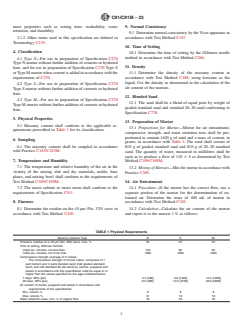
5.1 Masonry cement shall conform to the applicable requirements prescribed in Table 1 for its classification.
6. Sampling
6.1 The masonry cement shall be sampled in accordance with Practice C183C183/C183M.
TABLE 1 Physical Requirements
Masonry Cement Type N S M
Fineness, residue on a 45-μm (No. 325) sieve, max, % 24 24 24
Fineness, residue on a 45 μm (No. 325) sieve, max, % 24 24 24
Autoclave expansion, max, % 1.0 1.0 1.0
Time of setting, Gillmore method:
Initial set, minutes, not less than 120 90 90
Initial set, minutes, not more than 1000 1000 1000
Compressive strength (average of 3 cubes):
The compressive strength of mortar cubes, composed of 1
part cement and 3 parts blended sand (half graded standard
sand, and half standard 20–30 sand) by volume, prepared and
tested in accordance with this specification shall be equal to or
higher than the values specified for the ages indicated below:
7 days, MPa (psi) 3.4 [500] 9.0 [1300] 12.4 [1800]
28 days, MPa (psi) 6.2 [900] 14.5 [2100] 20.0 [2900]
Air content of mortar, prepared and tested in accordance with
requirements of this specification:
Min, volume % 8 8 8
Max, volume % 21 19 19
Water retention value, min, % of original flow 70 70 70
C91/C91M − 23
7. Temperature and Humidity
7.1 The temperature and relative humidity of the air in the vicinity of the mixing slab and dry materials, molds, base plates, and
mixing bowl shall conform to the requirements of Test Method C109/C109M.
7.2 The moist cabinet or moist room shall conform to the requirements of Specification C511.
8. Fineness
8.1 Determine the residue on the 45-μm45 μm (No. 325) sieve in accordance with Test
...