

ASTM D6264/D6264M-23
(Test Method)Standard Test Method for Measuring the Damage Resistance of a Fiber-Reinforced Polymer-Matrix Composite to a Concentrated Quasi-Static Indentation Force
General Information
- Abstract
SIGNIFICANCE AND USE
5.1 Susceptibility to damage from concentrated out-of-plane forces is one of the major design concerns of many structures made of advanced composite laminates. Knowledge of the damage resistance properties of a laminated composite plate is useful for product development and material selection.
5.2 QSI testing can serve the following purposes:
5.2.1 To simulate the force-displacement relationships of impacts governed by boundary conditions (1-7).5 These are typically relatively large-mass low-velocity hard-body impacts on plates with a relatively small unsupported region. Since the test is run slowly in displacement control, the desired damage state can be obtained in a controlled manner. Associating specific damage events with a force during a drop-weight impact test is often difficult due to the oscillations in the force history. In addition, a specific sequence of damage events may be identified during quasi-static loading while the final damage state is only identifiable after a drop-weight impact test.
5.2.2 To provide an estimate of the impact energy required to obtain a similar damage state for drop-weight impact testing if all others parameters are held constant.
5.2.3 To establish quantitatively the effects of stacking sequence, fiber surface treatment, variations in fiber volume fraction, and processing and environmental variables on the damage resistance of a particular composite laminate to a concentrated indentation force.
5.2.4 To compare quantitatively the relative values of the damage resistance parameters for composite materials with different constituents. The damage response parameters can include dent depth, damage dimensions and through-thickness locations, Fmax , Ea, and Emax, as well as the force versus indenter displacement curve.
5.2.5 To impart damage in a specimen for subsequent damage tolerance tests, such as Test Method D7137/D7137M.
5.2.6 To measure the indentation response of the specimen with and without bending us...
SCOPE
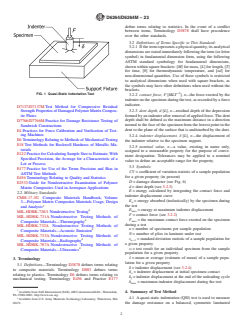
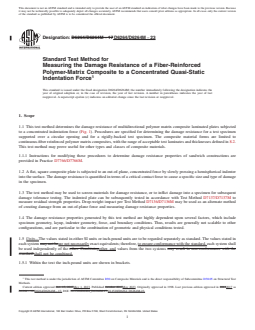
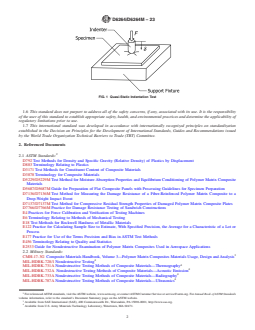
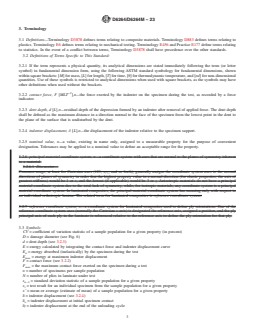
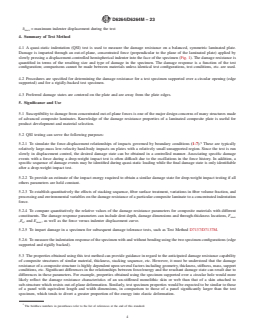
1.1 This test method determines the damage resistance of multidirectional polymer matrix composite laminated plates subjected to a concentrated indentation force (Fig. 1). Procedures are specified for determining the damage resistance for a test specimen supported over a circular opening and for a rigidly-backed test specimen. The composite material forms are limited to continuous-fiber reinforced polymer matrix composites, with the range of acceptable test laminates and thicknesses defined in 8.2. This test method may prove useful for other types and classes of composite materials.
FIG. 1 Quasi-Static Indentation Test
1.1.1 Instructions for modifying these procedures to determine damage resistance properties of sandwich constructions are provided in Practice D7766/D7766M.
1.2 A flat, square composite plate is subjected to an out-of-plane, concentrated force by slowly pressing a hemispherical indenter into the surface. The damage resistance is quantified in terms of a critical contact force to cause a specific size and type of damage in the specimen.
1.3 The test method may be used to screen materials for damage resistance, or to inflict damage into a specimen for subsequent damage tolerance testing. The indented plate can be subsequently tested in accordance with Test Method D7137/D7137M to measure residual strength properties. Drop-weight impact per Test Method D7136/D7136M may be used as an alternate method of creating damage from an out-of-plane force and measuring damage resistance properties.
1.4 The damage resistance properties generated by this test method are highly dependent upon several factors, which include specimen geometry, layup, indenter geometry, force, and boundary conditions. Thus, results are generally not scalable to other configurations, and are particular to the combination of geometric and physical conditions tested.
1.5 Units—The values stated in either SI units or inch-pound u...
- Status
- Published
- Publication Date
- 30-Apr-2023
- Technical Committee
- D30 - Composite Materials
- Drafting Committee
- D30.05 - Structural Test Methods
Buy Documents
ASTM D6264/D6264M-23 - Standard Test Method for Measuring the Damage Resistance of a Fiber-Reinforced Polymer-Matrix Composite to a Concentrated Quasi-Static Indentation Force
REDLINE ASTM D6264/D6264M-23 - Standard Test Method for Measuring the Damage Resistance of a Fiber-Reinforced Polymer-Matrix Composite to a Concentrated Quasi-Static Indentation Force
Overview
ASTM D6264/D6264M-23 is the internationally recognized standard test method for measuring the damage resistance of fiber-reinforced polymer-matrix composite laminates when exposed to a concentrated quasi-static indentation force. Developed by ASTM Committee D30 on Composite Materials, this method evaluates how multidirectional composite plates withstand localized out-of-plane loading, simulating real-world impacts such as those encountered in aerospace, automotive, and civil structures. The standard provides detailed procedures for testing both edge-supported and rigidly-backed composite specimens, helping material engineers and designers assess, compare, and optimize composite materials for durability and impact performance.
Key Topics
- Damage Resistance Testing: This test method focuses on the ability of laminated composite materials to resist damage from concentrated indentation forces. A hemispherical indenter is used to apply force perpendicularly to the specimen surface, and the resulting damage characteristics-such as dent depth and damage dimensions-are measured.
- Simulation of Real-World Impacts: By controlling the rate of indentation, the test mimics low-velocity, high-mass impacts under well-defined boundary conditions, offering insights into the sequence of damage events and force-displacement behavior.
- Quantitative Data for Design: The method quantifies critical parameters such as maximum contact force, absorbed energy, and the dimensions of damage, allowing for detailed comparison of materials based on resistance to localized impact.
- Influence of Laminate Variables: ASTM D6264/D6264M-23 enables the systematic study of how factors like stacking sequence, fiber surface treatment, ply orientation, and environmental conditions affect damage resistance.
- Preparation for Further Testing: Damaged specimens produced by this method are suitable for subsequent tests, such as evaluating residual compressive strength according to ASTM D7137/D7137M.
Applications
- Material Screening and Selection: Engineers and materials scientists use this standard to screen different composite materials and select those best suited for impact resistance in critical applications.
- Product Development and Validation: The test method is an essential tool in developing composite components for industries such as aerospace, automotive, marine, and wind energy, where impact damage can compromise safety and performance.
- Quality Control and Benchmarking: Manufacturers use this standard to benchmark their materials and maintain stringent quality control, ensuring that composite laminates meet required impact resistance criteria.
- Damage Tolerance Studies: The specimens prepared according to ASTM D6264/D6264M-23 serve as reference points for further evaluation, including damage tolerance and residual strength tests.
- Research and Development: Academic and industrial researchers rely on the standardized methodology to produce repeatable, comparable data when studying the effects of new fibers, matrices, or manufacturing processes on composite damage resistance.
Related Standards
- ASTM D7136/D7136M: Measures damage resistance of fiber-reinforced polymer matrix composites using a drop-weight impact event, providing an alternate method of impact testing.
- ASTM D7137/D7137M: Determines the compressive residual strength of polymer matrix composite plates after impact or indentation damage.
- ASTM D5687/D5687M: Guide for preparing flat composite panels for testing, relevant for specimen preparation.
- ASTM D5229/D5229M: Methods for conditioning composites and determining moisture absorption properties.
- ASTM D3171: Test methods for constituent content of composite materials.
- Military Handbooks (MIL-HDBK-728/1, MIL-HDBK-731A, etc.): Provide complementary guidance on non-destructive examination and characterization of composite damage.
Keywords: ASTM D6264, composite impact testing, fiber-reinforced polymer matrix composite, quasi-static indentation, damage resistance, indentation test, composite laminate, material qualification, residual strength, aerospace composites, quality control, material screening.
By adhering to ASTM D6264/D6264M-23, organizations can reliably assess and compare the damage resistance of composite materials, supporting the development of safer, more resilient structures in demanding technical fields.
Relations
- Effective Date
- 01-Feb-2024
- Effective Date
- 01-Nov-2023
- Effective Date
- 01-Apr-2022
- Effective Date
- 01-Mar-2020
- Effective Date
- 01-Jan-2020
- Effective Date
- 15-Oct-2019
- Effective Date
- 01-Aug-2019
- Effective Date
- 15-Apr-2019
- Effective Date
- 15-Apr-2019
- Effective Date
- 01-Feb-2019
- Effective Date
- 01-Dec-2018
- Effective Date
- 01-Nov-2018
- Effective Date
- 01-Jul-2018
- Effective Date
- 01-Apr-2018
- Effective Date
- 01-Oct-2017
Buy Documents
ASTM D6264/D6264M-23 - Standard Test Method for Measuring the Damage Resistance of a Fiber-Reinforced Polymer-Matrix Composite to a Concentrated Quasi-Static Indentation Force
REDLINE ASTM D6264/D6264M-23 - Standard Test Method for Measuring the Damage Resistance of a Fiber-Reinforced Polymer-Matrix Composite to a Concentrated Quasi-Static Indentation Force
Get Certified
Connect with accredited certification bodies for this standard

DIN CERTCO
DIN Group product certification.

Smithers Quality Assessments
US management systems and product certification.
Sponsored listings
Frequently Asked Questions
ASTM D6264/D6264M-23 is a standard published by ASTM International. Its full title is "Standard Test Method for Measuring the Damage Resistance of a Fiber-Reinforced Polymer-Matrix Composite to a Concentrated Quasi-Static Indentation Force". This standard covers: SIGNIFICANCE AND USE 5.1 Susceptibility to damage from concentrated out-of-plane forces is one of the major design concerns of many structures made of advanced composite laminates. Knowledge of the damage resistance properties of a laminated composite plate is useful for product development and material selection. 5.2 QSI testing can serve the following purposes: 5.2.1 To simulate the force-displacement relationships of impacts governed by boundary conditions (1-7).5 These are typically relatively large-mass low-velocity hard-body impacts on plates with a relatively small unsupported region. Since the test is run slowly in displacement control, the desired damage state can be obtained in a controlled manner. Associating specific damage events with a force during a drop-weight impact test is often difficult due to the oscillations in the force history. In addition, a specific sequence of damage events may be identified during quasi-static loading while the final damage state is only identifiable after a drop-weight impact test. 5.2.2 To provide an estimate of the impact energy required to obtain a similar damage state for drop-weight impact testing if all others parameters are held constant. 5.2.3 To establish quantitatively the effects of stacking sequence, fiber surface treatment, variations in fiber volume fraction, and processing and environmental variables on the damage resistance of a particular composite laminate to a concentrated indentation force. 5.2.4 To compare quantitatively the relative values of the damage resistance parameters for composite materials with different constituents. The damage response parameters can include dent depth, damage dimensions and through-thickness locations, Fmax , Ea, and Emax, as well as the force versus indenter displacement curve. 5.2.5 To impart damage in a specimen for subsequent damage tolerance tests, such as Test Method D7137/D7137M. 5.2.6 To measure the indentation response of the specimen with and without bending us... SCOPE 1.1 This test method determines the damage resistance of multidirectional polymer matrix composite laminated plates subjected to a concentrated indentation force (Fig. 1). Procedures are specified for determining the damage resistance for a test specimen supported over a circular opening and for a rigidly-backed test specimen. The composite material forms are limited to continuous-fiber reinforced polymer matrix composites, with the range of acceptable test laminates and thicknesses defined in 8.2. This test method may prove useful for other types and classes of composite materials. FIG. 1 Quasi-Static Indentation Test 1.1.1 Instructions for modifying these procedures to determine damage resistance properties of sandwich constructions are provided in Practice D7766/D7766M. 1.2 A flat, square composite plate is subjected to an out-of-plane, concentrated force by slowly pressing a hemispherical indenter into the surface. The damage resistance is quantified in terms of a critical contact force to cause a specific size and type of damage in the specimen. 1.3 The test method may be used to screen materials for damage resistance, or to inflict damage into a specimen for subsequent damage tolerance testing. The indented plate can be subsequently tested in accordance with Test Method D7137/D7137M to measure residual strength properties. Drop-weight impact per Test Method D7136/D7136M may be used as an alternate method of creating damage from an out-of-plane force and measuring damage resistance properties. 1.4 The damage resistance properties generated by this test method are highly dependent upon several factors, which include specimen geometry, layup, indenter geometry, force, and boundary conditions. Thus, results are generally not scalable to other configurations, and are particular to the combination of geometric and physical conditions tested. 1.5 Units—The values stated in either SI units or inch-pound u...
SIGNIFICANCE AND USE 5.1 Susceptibility to damage from concentrated out-of-plane forces is one of the major design concerns of many structures made of advanced composite laminates. Knowledge of the damage resistance properties of a laminated composite plate is useful for product development and material selection. 5.2 QSI testing can serve the following purposes: 5.2.1 To simulate the force-displacement relationships of impacts governed by boundary conditions (1-7).5 These are typically relatively large-mass low-velocity hard-body impacts on plates with a relatively small unsupported region. Since the test is run slowly in displacement control, the desired damage state can be obtained in a controlled manner. Associating specific damage events with a force during a drop-weight impact test is often difficult due to the oscillations in the force history. In addition, a specific sequence of damage events may be identified during quasi-static loading while the final damage state is only identifiable after a drop-weight impact test. 5.2.2 To provide an estimate of the impact energy required to obtain a similar damage state for drop-weight impact testing if all others parameters are held constant. 5.2.3 To establish quantitatively the effects of stacking sequence, fiber surface treatment, variations in fiber volume fraction, and processing and environmental variables on the damage resistance of a particular composite laminate to a concentrated indentation force. 5.2.4 To compare quantitatively the relative values of the damage resistance parameters for composite materials with different constituents. The damage response parameters can include dent depth, damage dimensions and through-thickness locations, Fmax , Ea, and Emax, as well as the force versus indenter displacement curve. 5.2.5 To impart damage in a specimen for subsequent damage tolerance tests, such as Test Method D7137/D7137M. 5.2.6 To measure the indentation response of the specimen with and without bending us... SCOPE 1.1 This test method determines the damage resistance of multidirectional polymer matrix composite laminated plates subjected to a concentrated indentation force (Fig. 1). Procedures are specified for determining the damage resistance for a test specimen supported over a circular opening and for a rigidly-backed test specimen. The composite material forms are limited to continuous-fiber reinforced polymer matrix composites, with the range of acceptable test laminates and thicknesses defined in 8.2. This test method may prove useful for other types and classes of composite materials. FIG. 1 Quasi-Static Indentation Test 1.1.1 Instructions for modifying these procedures to determine damage resistance properties of sandwich constructions are provided in Practice D7766/D7766M. 1.2 A flat, square composite plate is subjected to an out-of-plane, concentrated force by slowly pressing a hemispherical indenter into the surface. The damage resistance is quantified in terms of a critical contact force to cause a specific size and type of damage in the specimen. 1.3 The test method may be used to screen materials for damage resistance, or to inflict damage into a specimen for subsequent damage tolerance testing. The indented plate can be subsequently tested in accordance with Test Method D7137/D7137M to measure residual strength properties. Drop-weight impact per Test Method D7136/D7136M may be used as an alternate method of creating damage from an out-of-plane force and measuring damage resistance properties. 1.4 The damage resistance properties generated by this test method are highly dependent upon several factors, which include specimen geometry, layup, indenter geometry, force, and boundary conditions. Thus, results are generally not scalable to other configurations, and are particular to the combination of geometric and physical conditions tested. 1.5 Units—The values stated in either SI units or inch-pound u...
ASTM D6264/D6264M-23 is classified under the following ICS (International Classification for Standards) categories: 83.120 - Reinforced plastics. The ICS classification helps identify the subject area and facilitates finding related standards.
ASTM D6264/D6264M-23 has the following relationships with other standards: It is inter standard links to ASTM D883-24, ASTM D883-23, ASTM E456-13a(2022)e1, ASTM D5229/D5229M-20, ASTM D883-20, ASTM D3878-19a, ASTM D883-19c, ASTM D883-19a, ASTM D3878-19, ASTM D883-19, ASTM D883-18a, ASTM D883-18, ASTM E18-18, ASTM D3878-18, ASTM E456-13A(2017)e3. Understanding these relationships helps ensure you are using the most current and applicable version of the standard.
ASTM D6264/D6264M-23 is available in PDF format for immediate download after purchase. The document can be added to your cart and obtained through the secure checkout process. Digital delivery ensures instant access to the complete standard document.
Standards Content (Sample)
This international standard was developed in accordance with internationally recognized principles on standardization established in the Decision on Principles for the
Development of International Standards, Guides and Recommendations issued by the World Trade Organization Technical Barriers to Trade (TBT) Committee.
Designation: D6264/D6264M − 23
Standard Test Method for
Measuring the Damage Resistance of a Fiber-Reinforced
Polymer-Matrix Composite to a Concentrated Quasi-Static
Indentation Force
This standard is issued under the fixed designation D6264/D6264M; the number immediately following the designation indicates the
year of original adoption or, in the case of revision, the year of last revision. A number in parentheses indicates the year of last
reapproval. A superscript epsilon (´) indicates an editorial change since the last revision or reapproval.
1. Scope 1.5 Units—The values stated in either SI units or inch-
pound units are to be regarded separately as standard. The
1.1 This test method determines the damage resistance of
values stated in each system are not necessarily exact equiva-
multidirectional polymer matrix composite laminated plates
lents; therefore, to ensure conformance with the standard, each
subjected to a concentrated indentation force (Fig. 1). Proce-
system shall be used independently of the other, and values
dures are specified for determining the damage resistance for a
from the two systems shall not be combined.
test specimen supported over a circular opening and for a
1.5.1 Within the text the inch-pound units are shown in
rigidly-backed test specimen. The composite material forms
brackets.
are limited to continuous-fiber reinforced polymer matrix
1.6 This standard does not purport to address all of the
composites, with the range of acceptable test laminates and
safety concerns, if any, associated with its use. It is the
thicknesses defined in 8.2. This test method may prove useful
responsibility of the user of this standard to establish appro-
for other types and classes of composite materials.
priate safety, health, and environmental practices and deter-
1.1.1 Instructions for modifying these procedures to deter-
mine the applicability of regulatory limitations prior to use.
mine damage resistance properties of sandwich constructions
1.7 This international standard was developed in accor-
are provided in Practice D7766/D7766M.
dance with internationally recognized principles on standard-
1.2 A flat, square composite plate is subjected to an out-of-
ization established in the Decision on Principles for the
plane, concentrated force by slowly pressing a hemispherical
Development of International Standards, Guides and Recom-
indenter into the surface. The damage resistance is quantified
mendations issued by the World Trade Organization Technical
in terms of a critical contact force to cause a specific size and
Barriers to Trade (TBT) Committee.
type of damage in the specimen.
2. Referenced Documents
1.3 The test method may be used to screen materials for
damage resistance, or to inflict damage into a specimen for
2.1 ASTM Standards:
subsequent damage tolerance testing. The indented plate can be
D792 Test Methods for Density and Specific Gravity (Rela-
subsequently tested in accordance with Test Method D7137/
tive Density) of Plastics by Displacement
D7137M to measure residual strength properties. Drop-weight
D883 Terminology Relating to Plastics
impact per Test Method D7136/D7136M may be used as an
D3171 Test Methods for Constituent Content of Composite
alternate method of creating damage from an out-of-plane
Materials
force and measuring damage resistance properties.
D3878 Terminology for Composite Materials
D5229/D5229M Test Method for Moisture Absorption Prop-
1.4 The damage resistance properties generated by this test
erties and Equilibrium Conditioning of Polymer Matrix
method are highly dependent upon several factors, which
Composite Materials
include specimen geometry, layup, indenter geometry, force,
D5687/D5687M Guide for Preparation of Flat Composite
and boundary conditions. Thus, results are generally not
Panels with Processing Guidelines for Specimen Prepara-
scalable to other configurations, and are particular to the
tion
combination of geometric and physical conditions tested.
D7136/D7136M Test Method for Measuring the Damage
Resistance of a Fiber-Reinforced Polymer Matrix Com-
posite to a Drop-Weight Impact Event
This test method is under the jurisdiction of ASTM Committee D30 on
Composite Materials and is the direct responsibility of Subcommittee D30.05 on
Structural Test Methods. For referenced ASTM standards, visit the ASTM website, www.astm.org, or
Current edition approved May 1, 2023. Published May 2023. Originally contact ASTM Customer Service at service@astm.org. For Annual Book of ASTM
approved in 1998. Last previous edition approved in 2017 as D6264/D6264M – 17. Standards volume information, refer to the standard’s Document Summary page on
DOI: 10.1520/D6264_D6264M-23. the ASTM website.
Copyright © ASTM International, 100 Barr Harbor Drive, PO Box C700, West Conshohocken, PA 19428-2959. United States
D6264/D6264M − 23
define terms relating to statistics. In the event of a conflict
between terms, Terminology D3878 shall have precedence
over the other standards.
3.2 Definitions of Terms Specific to This Standard:
3.2.1 If the term represents a physical quantity, its analytical
dimensions are stated immediately following the term (or letter
symbol) in fundamental dimension form, using the following
ASTM standard symbology for fundamental dimensions,
shown within square brackets: [M] for mass, [L] for length, [T]
for time, [θ] for thermodynamic temperature, and [nd] for
non-dimensional quantities. Use of these symbols is restricted
to analytical dimensions when used with square brackets, as
the symbols may have other definitions when used without the
brackets.
−2
FIG. 1 Quasi-Static Indentation Test
3.2.2 contact force, F [MLT ], n—the force exerted by the
indenter on the specimen during the test, as recorded by a force
indicator.
D7137/D7137M Test Method for Compressive Residual
3.2.3 dent depth, d [L], n—residual depth of the depression
Strength Properties of Damaged Polymer Matrix Compos-
formed by an indenter after removal of applied force. The dent
ite Plates
depth shall be defined as the maximum distance in a direction
D7766/D7766M Practice for Damage Resistance Testing of
normal to the face of the specimen from the lowest point in the
Sandwich Constructions
dent to the plane of the surface that is undisturbed by the dent.
E4 Practices for Force Calibration and Verification of Test-
ing Machines
3.2.4 indenter displacement, δ [L], n—the displacement of
E6 Terminology Relating to Methods of Mechanical Testing
the indenter relative to the specimen support.
E18 Test Methods for Rockwell Hardness of Metallic Ma-
3.2.5 nominal value, n—a value, existing in name only,
terials
assigned to a measurable property for the purpose of conve-
E122 Practice for Calculating Sample Size to Estimate, With
nient designation. Tolerances may be applied to a nominal
Specified Precision, the Average for a Characteristic of a
value to define an acceptable range for the property.
Lot or Process
3.3 Symbols:
E177 Practice for Use of the Terms Precision and Bias in
CV = coefficient of variation statistic of a sample population
ASTM Test Methods
for a given property (in percent)
E456 Terminology Relating to Quality and Statistics
D = damage diameter (see Fig. 6)
E2533 Guide for Nondestructive Examination of Polymer
d = dent depth (see 3.2.3)
Matrix Composites Used in Aerospace Applications
E = energy calculated by integrating the contact force and
2.2 Military Standards:
indenter displacement curve
CMH-17-3G Composite Materials Handbook, Volume
E = energy absorbed (inelastically) by the specimen during
a
3—Polymer Matrix Composites Materials Usage, Design
3 the test
and Analysis
4 E = energy at maximum indenter displacement
max
MIL-HDBK-728/1 Nondestructive Testing
F = contact force (see 3.2.2)
MIL-HDBK-731A Nondestructive Testing Methods of
4 F = the maximum contact force exerted on the specimen
max
Composite Materials—Thermography
during a test
MIL-HDBK-732A Nondestructive Testing Methods of
4 n = number of specimens per sample population
Composite Materials—Acoustic Emission
N = number of plies in laminate under test
MIL-HDBK-733A Nondestructive Testing Methods of
s = standard deviation statistic of a sample population for
n−1
Composite Materials—Radiography
a given property
MIL-HDBK-787A Nondestructive Testing Methods of
x = test result for an individual specimen from the sample
i
Composite Materials—Ultrasonics
population for a given property
x¯ = mean or average (estimate of mean) of a sample popu-
3. Terminology
lation for a given property
3.1 Definitions—Terminology D3878 defines terms relating
δ = indenter displacement (see 3.2.4)
to composite materials. Terminology D883 defines terms
δ = indenter displacement at initial specimen contact
o
relating to plastics. Terminology E6 defines terms relating to
δ = indenter displacement at the end of the unloading cycle
f
mechanical testing. Terminology E456 and Practice E177
δ = maximum indenter displacement during the test
max
Available from SAE International (SAE), 400 Commonwealth Dr., Warrendale, 4. Summary of Test Method
PA 15096-0001, http://www.sae.org.
4.1 A quasi-static indentation (QSI) test is used to measure
Available from U.S. Army Materials Technology Laboratory, Watertown, MA
02471. the damage resistance on a balanced, symmetric laminated
D6264/D6264M − 23
plate. Damage is imparted through an out-of-plane, concen- capability of composite structures of similar material,
trated force (perpendicular to the plane of the laminated plate) thickness, stacking sequence, etc. However, it must be under-
applied by slowly pressing a displacement-controlled hemi- stood that the damage resistance of a composite structure is
spherical indenter into the face of the specimen (Fig. 1). The highly dependent upon several factors including geometry,
damage resistance is quantified in terms of the resulting size thickness, stiffness, mass, support conditions, etc. Significant
and type of damage in the specimen. The damage response is differences in the relationships between force/energy and the
a function of the test configuration; comparisons cannot be resultant damage state can result due to differences in these
made between materials unless identical test configurations, parameters. For example, properties obtained using the speci-
test conditions, etc. are used. men supported over a circular hole would more likely reflect
the damage resistance characteristics of an un-stiffened mono-
4.2 Procedures are specified for determining the damage
lithic skin or web than that of a skin attached to sub-structure
resistance for a test specimen supported over a circular opening
which resists out-of-plane deformation. Similarly, test speci-
(edge supported) and for a rigidly-backed test specimen.
men properties would be expected to be similar to those of a
4.3 Preferred damage states are centered on the plate and are
panel with equivalent length and width dimensions, in com-
away from the plate edges.
parison to those of a panel significantly larger than the test
specimen, which tends to divert a greater proportion of the
5. Significance and Use
energy into elastic deformation.
5.1 Susceptibility to damage from concentrated out-of-plane
5.4 The standard indenter geometry has a blunt, hemispheri-
forces is one of the major design concerns of many structures
cal tip. Historically, for the standard laminate configuration,
made of advanced composite laminates. Knowledge of the
this indenter geometry has generated a larger amount of
damage resistance properties of a laminated composite plate is
internal damage for a given amount of external damage than is
useful for product development and material selection.
typically observed for similar indenters using sharp tips.
5.2 QSI testing can serve the following purposes:
Alternative indenter geometries may be appropriate depending
5.2.1 To simulate the force-displacement relationships of
upon the damage resistance characteristics being examined.
impacts governed by boundary conditions (1-7). These are
For example, the use of sharp tip geometries may be appropri-
typically relatively large-mass low-velocity hard-body impacts
ate for certain damage visibility and penetration resistance
on plates with a relatively small unsupported region. Since the
assessments.
test is run slowly in displacement control, the desired damage
5.5 Some testing organizations may desire to use this test
state can be obtained in a controlled manner. Associating
method in conjunction with Test Method D7137/D7137M to
specific damage events with a force during a drop-weight
assess the compression residual strength of specimens contain-
impact test is often difficult due to the oscillations in the force
ing a specific damage state, such as a defined dent depth,
history. In addition, a specific sequence of damage events may
damage geometry, etc. In this case, the testing organization
be identified during quasi-static loading while the final damage
should subject several specimens to multiple energy or force
state is only identifiable after a drop-weight impact test.
levels using this test method. A relationship between energy or
5.2.2 To provide an estimate of the impact energy required
force and the desired damage parameter can then be developed.
to obtain a similar damage state for drop-weight impact testing
Subsequent QSI and compression residual strength tests can
if all others parameters are held constant.
then be performed using specimens indented at an interpolated
5.2.3 To establish quantitatively the effects of stacking
energy or force level that is expected to produce the desired
sequence, fiber surface treatment, variations in fiber volume
damage state.
fraction, and processing and environmental variables on the
6. Interferences
damage resistance of a particular composite laminate to a
concentrated indentation force.
6.1 This test may be useful in simulating the force-
5.2.4 To compare quantitatively the relative values of the
displacement relationships of large-mass low-velocity hard-
damage resistance parameters for composite materials with
body impacts on small plates. However, this test method does
different constituents. The damage response parameters can
not address wave propagation and vibrations in the specimen,
include dent depth, damage dimensions and through-thickness
time-dependent material behavior, or inertia-dominated impact
locations, F , E , and E , as well as the force versus
max a max events.
indenter displacement curve.
6.2 The response of a laminated plate specimen to an
5.2.5 To impart damage in a specimen for subsequent
out-of-plane force is dependent upon many factors, such as
damage tolerance tests, such as Test Method D7137/D7137M.
laminate thickness, ply thickness, stacking sequence,
5.2.6 To measure the indentation response of the specimen
environment, geometry, indenter tip geometry, and boundary
with and without bending using the two specimen configura-
conditions. Consequently, comparisons cannot be made be-
tions (edge supported and rigidly backed).
tween materials unless identical test configurations, test
5.3 The properties obtained using this test method can
conditions, and laminate configurations are used. Therefore, all
provide guidance in regard to the anticipated damage resistance
deviations from the standard test configuration shall be re-
ported in the results.
6.3 Material and Specimen Preparation—Poor material fab-
The boldface numbers in parentheses refer to the list of references at the end of
this standard. rication practices, lack of control of fiber alignment, and
D6264/D6264M − 23
damage induced by improper specimen machining are known the specimen, excluding the circular opening. The thickness of
causes of high material data scatter in composites in general. the plate shall be a minimum of 25 mm [1.0 in.] and greater
Important aspects of plate specimen preparation that contribute than the expected maximum indenter displacement. A typical
to data scatter include thickness variation, out-of-plane support fixture is shown in Figs. 2 and 3.
curvature, surface roughness, and failure to maintain the 7.2.2 Rigidly-Backed Configuration—The specimen shall be
dimensions specified in 8.2. placed directly on the flat rigid support that is mounted in the
lower head of the testing machine. For this configuration, the
6.4 Specimen Geometry and Indentation Location—The
support shall be made from steel with a minimum thickness of
size, shape, thickness, and stacking sequence of the plate, along
12.7 mm [0.5 in.].
with the indentation location, can affect the specimen defor-
mation and damage formation behavior of the specimens 7.3 Testing Machine—The testing machine shall be in con-
formance with Practices E4 and shall satisfy the following
significantly. The degree of laminate orthotropy can strongly
affect the damage formation. Results can be affected if the requirements:
7.3.1 Testing Machine Configuration—The testing machine
indentation force is not applied perpendicular to the plane of
the laminated plate. shall have both an essentially stationary head and a movable
head. A short loading train shall be used with a flat platen on
6.5 Support Fixture Characteristics—Results are affected
the lower head and a grip on the upper head.
by the support fixture geometry, material, and bending rigidity.
7.3.2 Grips—The top head of the testing machine shall carry
6.6 Non-Destructive Inspection—Non-destructive inspec-
a grip to hold the indenter such that the direction of load
tion (NDI) results are affected by the particular method
applied to the specimen is coincident with the axis of travel.
utilized, the inherent variability of the NDI method, the
The grip shall apply sufficient pressure to prevent slippage of
experience of the operator, etc.
the indenter. The lower head shall have a means of attaching a
flat platen.
6.7 The dent depth may “relax” or reduce with time or upon
7.3.3 Flat Platen—The test machine shall be mounted with
exposure to different environmental conditions.
a fixed (as opposed to spherical seat) flat platen on the lower
6.8 Non-laminated, 3-D fiber-reinforced composites may
head to support the specimen or test fixture. The support
form damage through different mechanisms than laminates.
surface shall be normal to the axis of travel of the testing
machine head and have a large enough surface to support
7. Apparatus
completely the specimen or test fixture. A convenient means of
7.1 Micrometers and Calipers—A micrometer with a 4 mm providing this surface is through the use of a metal “T” in
which the lower part of the “T” is clamped in the lower grips
to 8 mm [0.16 in. to 0.32 in.] nominal diameter ball-interface
or a flat anvil interface shall be used to measure the specimen and the top part of the “T” provides the support surface. The
lower platen may be marked to help center the test fixture
thickness. A ball interface is recommended for thickness
measurements when at least one surface is irregular (for between the platens. If the rigidly-backed configuration is to be
example, a coarse peel ply surface which is neither smooth nor used, this support shall be made from steel with a minimum
thickness of 13 mm [0.5 in.].
flat). A micrometer or caliper with a flat anvil interface shall be
used for measuring length, width, other machined surface
dimensions, and damage dimensions. The use of alternative
measurement devices is permitted if specified (or agreed to) by
the test requestor and reported by the testing laboratory. The
accuracy of the instrument(s) shall be suitable for reading to
within 1 % of the specimen dimensions. For typical specimen
geometries, an instrument with an accuracy of 60.0025 mm
[60.0001 in.] is adequate for thickness measurements, while
an instrument with an accuracy of 60.025 mm [60.001 in.] is
adequate for measurement of length, width, other machined
surface dimensions, and damage dimensions.
7.2 Support Fixtures—The damage resistance may be deter-
mined for a specimen that is edge supported or rigidly backed.
For both configurations, the specimen’s face shall be held
normal to the axis of the indenter.
7.2.1 Edge Supported Configuration—The fixture shall con-
sist of a single plate with a 125.0 mm 6 3.0 mm [5.00 in. 6
0.10 in.] diameter opening made from a structural metal such
as aluminum or steel. The face of the plate shall be flat to
within 0.1 mm [0.005 in.] in the area which contacts the test
specimen. The top rim of the opening shall be rounded with a
radius of 0.75 mm 6 0.25 mm [0.03 in. 6 0.01 in.]. The plate
shall be sufficiently large to support the entire lower surface of FIG. 2 Typical Fixture with Open Hole (Inch-Pound Version)
D6264/D6264M − 23
7.6 Environmental Test Chamber—An environmental test
chamber is required for test environments other than ambient
testing laboratory conditions. This chamber shall be capable of
maintaining the test specimen at the required test environment
during the mechanical test. The test temperature shall be
maintained within 63 °C [65 °F] of the required temperature.
The relative humidity level controlled within the test chamber
shall be defined by the test requestor.
7.7 Data Acquisition Equipment—Equipment capable of
recording force and crosshead displacement is required.
7.8 Dent Depth Indicator—The dent depth can be measured
using a dial depth gage, a depth gage micrometer, a tripod-
mounted depth gage, or a properly calibrated displacement
transducer. The measuring probe shall have a spherical tip with
a maximum radius of curvature of 8.0 mm [0.35 in.]. An
instrument with an accuracy of 625 μm [60.001 in.] is
desirable for depth measurement.
8. Sampling and Test Specimens
8.1 Sampling—Test at least five specimens per test condi-
tion unless valid results can be gained through the use of fewer
specimens, as in the case of a designed experiment. For
FIG. 3 Typical Fixture with Open Hole (SI Version)
statistically significant data the procedures outlined in Practice
E122 should be consulted. The method of sampling shall be
reported.
7.3.4 Drive Mechanism—The testing machine drive mecha-
nism shall be capable of imparting to the movable head a
8.2 Geometry:
controlled velocity with respect to the stationary head. The
8.2.1 Stacking Sequence—The reference coordinate system
velocity of the movable head shall be capable of being
shall coincide with the specimen edges. For comparison
regulated as specified in 11.6.
screening of the damage resistance of different materials, the
7.3.5 Force Indicator—The testing machine force-sensing
standard specimen thickness shall be 4.0 mm to 6.0 mm
device shall be capable of indicating the total force being
[0.16 in. to 0.24 in.] and the laminate defined as follows:
carried by the test specimen. This device shall be essentially
8.2.1.1 Unidirectional Tape—Laminate construction shall
free from inertia-lag at the specified rate of testing and shall
consist of unidirectional plies with a stacking sequence of
indicate the force with accuracy over the force range(s) of
[45/0/−45/90] where N is a whole number. The recom-
NS
interest of within 61 % of the indicated value.
mended layups for various nominal cured ply thicknesses are
7.3.6 Crosshead Displacement Indicator—The testing ma-
provided in Table 1.
chine shall be capable of monitoring and recording the cross-
8.2.1.2 Woven Fabric—Laminate construction shall consist
head displacement (stroke) with a precision of at least 61 %.
of fabric plies with a stacking sequence of [(+45/-45)/(0/90)]
NS
If machine and fixture compliance is significant, it is accept-
where N is a whole number. The designations (+45/-45) and
able to measure the displacement of the movable head using a
(0/90) represent a single layer of woven fabric with the warp
LVDT or similar device with 61 % precision on displacement.
and weft fibers oriented at the specified angles. Fabric lami-
nates containing satin-type weaves shall have symmetric warp
7.4 Indenter—The indenter shall have a smooth hemispheri-
surfaces, unless otherwise specified and noted in the report.
cal tip with a diameter of 13.0 mm 6 0.3 mm [0.50 in. 6
The recommended layups for various nominal cured ply
0.01 in.] and a hardness of 60 HRC to 62 HRC as specified in
thicknesses are provided in Table 2.
Test Methods E18. Alternate tip geometries may be used to
study relationships between visible damage geometry (for
example, dent depth, dent diameter) and the internal damage
state. If a different indenter is used as part of the testing, the
TABLE 1 Recommended Layups for Various Nominal Cured Ply
shape and dimensions shall be noted. Thicknesses, Unidirectional Tap
...
This document is not an ASTM standard and is intended only to provide the user of an ASTM standard an indication of what changes have been made to the previous version. Because
it may not be technically possible to adequately depict all changes accurately, ASTM recommends that users consult prior editions as appropriate. In all cases only the current version
of the standard as published by ASTM is to be considered the official document.
Designation: D6264/D6264M − 17 D6264/D6264M − 23
Standard Test Method for
Measuring the Damage Resistance of a Fiber-Reinforced
Polymer-Matrix Composite to a Concentrated Quasi-Static
Indentation Force
This standard is issued under the fixed designation D6264/D6264M; the number immediately following the designation indicates the
year of original adoption or, in the case of revision, the year of last revision. A number in parentheses indicates the year of last
reapproval. A superscript epsilon (´) indicates an editorial change since the last revision or reapproval.
1. Scope
1.1 This test method determines the damage resistance of multidirectional polymer matrix composite laminated plates subjected
to a concentrated indentation force (Fig. 1). Procedures are specified for determining the damage resistance for a test specimen
supported over a circular opening and for a rigidly-backed test specimen. The composite material forms are limited to
continuous-fiber reinforced polymer matrix composites, with the range of acceptable test laminates and thicknesses defined in 8.2.
This test method may prove useful for other types and classes of composite materials.
1.1.1 Instructions for modifying these procedures to determine damage resistance properties of sandwich constructions are
provided in Practice D7766/D7766M.
1.2 A flat, square composite plate is subjected to an out-of-plane, concentrated force by slowly pressing a hemispherical indenter
into the surface. The damage resistance is quantified in terms of a critical contact force to cause a specific size and type of damage
in the specimen.
1.3 The test method may be used to screen materials for damage resistance, or to inflict damage into a specimen for subsequent
damage tolerance testing. The indented plate can be subsequently tested in accordance with Test Method D7137/D7137M to
measure residual strength properties. Drop-weight impact per Test Method D7136/D7136M may be used as an alternate method
of creating damage from an out-of-plane force and measuring damage resistance properties.
1.4 The damage resistance properties generated by this test method are highly dependent upon several factors, which include
specimen geometry, layup, indenter geometry, force, and boundary conditions. Thus, results are generally not scalable to other
configurations, and are particular to the combination of geometric and physical conditions tested.
1.5 Units—The values stated in either SI units or inch-pound units are to be regarded separately as standard. The values stated in
each system may not beare not necessarily exact equivalents; therefore, to ensure conformance with the standard, each system shall
be used independently of the other. Combiningother, and values from the two systems may result in non-conformance with the
standard.shall not be combined.
1.5.1 Within the text the inch-pound units are shown in brackets.
This test method is under the jurisdiction of ASTM Committee D30 on Composite Materials and is the direct responsibility of Subcommittee D30.05 on Structural Test
Methods.
Current edition approved Oct. 15, 2017May 1, 2023. Published October 2017May 2023. Originally approved in 1998. Last previous edition approved in 20122017 as
D6264 – 12.D6264/D6264M – 17. DOI: 10.1520/D6264_D6264M-17.10.1520/D6264_D6264M-23.
Copyright © ASTM International, 100 Barr Harbor Drive, PO Box C700, West Conshohocken, PA 19428-2959. United States
D6264/D6264M − 23
FIG. 1 Quasi-Static Indentation Test
1.6 This standard does not purport to address all of the safety concerns, if any, associated with its use. It is the responsibility
of the user of this standard to establish appropriate safety, health, and environmental practices and determine the applicability of
regulatory limitations prior to use.
1.7 This international standard was developed in accordance with internationally recognized principles on standardization
established in the Decision on Principles for the Development of International Standards, Guides and Recommendations issued
by the World Trade Organization Technical Barriers to Trade (TBT) Committee.
2. Referenced Documents
2.1 ASTM Standards:
D792 Test Methods for Density and Specific Gravity (Relative Density) of Plastics by Displacement
D883 Terminology Relating to Plastics
D3171 Test Methods for Constituent Content of Composite Materials
D3878 Terminology for Composite Materials
D5229/D5229M Test Method for Moisture Absorption Properties and Equilibrium Conditioning of Polymer Matrix Composite
Materials
D5687/D5687M Guide for Preparation of Flat Composite Panels with Processing Guidelines for Specimen Preparation
D7136/D7136M Test Method for Measuring the Damage Resistance of a Fiber-Reinforced Polymer Matrix Composite to a
Drop-Weight Impact Event
D7137/D7137M Test Method for Compressive Residual Strength Properties of Damaged Polymer Matrix Composite Plates
D7766/D7766M Practice for Damage Resistance Testing of Sandwich Constructions
E4 Practices for Force Calibration and Verification of Testing Machines
E6 Terminology Relating to Methods of Mechanical Testing
E18 Test Methods for Rockwell Hardness of Metallic Materials
E122 Practice for Calculating Sample Size to Estimate, With Specified Precision, the Average for a Characteristic of a Lot or
Process
E177 Practice for Use of the Terms Precision and Bias in ASTM Test Methods
E456 Terminology Relating to Quality and Statistics
E2533 Guide for Nondestructive Examination of Polymer Matrix Composites Used in Aerospace Applications
2.2 Military Standards:
CMH-17-3G Composite Materials Handbook, Volume 3—Polymer Matrix Composites Materials Usage, Design and Analysis
MIL-HDBK-728/1 Nondestructive Testing
MIL-HDBK-731A Nondestructive Testing Methods of Composite Materials—Thermography
MIL-HDBK-732A Nondestructive Testing Methods of Composite Materials—Acoustic Emission
MIL-HDBK-733A Nondestructive Testing Methods of Composite Materials—Radiography
MIL-HDBK-787A Nondestructive Testing Methods of Composite Materials—Ultrasonics
For referenced ASTM standards, visit the ASTM website, www.astm.org, or contact ASTM Customer Service at service@astm.org. For Annual Book of ASTM Standards
volume information, refer to the standard’s Document Summary page on the ASTM website.
Available from SAE International (SAE), 400 Commonwealth Dr., Warrendale, PA 15096-0001, http://www.sae.org.
Available from U.S. Army Materials Technology Laboratory, Watertown, MA 02471.
D6264/D6264M − 23
3. Terminology
3.1 Definitions—Terminology D3878 defines terms relating to composite materials. Terminology D883 defines terms relating to
plastics. Terminology E6 defines terms relating to mechanical testing. Terminology E456 and Practice E177 define terms relating
to statistics. In the event of a conflict between terms, Terminology D3878 shall have precedence over the other standards.
3.2 Definitions of Terms Specific to This Standard:
3.2.1 If the term represents a physical quantity, its analytical dimensions are stated immediately following the term (or letter
symbol) in fundamental dimension form, using the following ASTM standard symbology for fundamental dimensions, shown
within square brackets: [M] for mass, [L] for length, [T] for time, [θ] for thermodynamic temperature, and [nd] for non-dimensional
quantities. Use of these symbols is restricted to analytical dimensions when used with square brackets, as the symbols may have
other definitions when used without the brackets.
−2
3.2.2 contact force, F [MLT ],n—the force exerted by the indenter on the specimen during the test, as recorded by a force
indicator.
3.2.3 dent depth, d [L],n—residual depth of the depression formed by an indenter after removal of applied force. The dent depth
shall be defined as the maximum distance in a direction normal to the face of the specimen from the lowest point in the dent to
the plane of the surface that is undisturbed by the dent.
3.2.4 indenter displacement, δ [L],n—the displacement of the indenter relative to the specimen support.
3.2.5 nominal value, n—a value, existing in name only, assigned to a measurable property for the purpose of convenient
designation. Tolerances may be applied to a nominal value to define an acceptable range for the property.
3.2.6 principal material coordinate system, n—a coordinate system with axes that are normal to the planes of symmetry inherent
to a material.
3.2.6.1 Discussion—
Common usage, at least for Cartesian axes (123, xyz, and so forth), generally assigns the coordinate system axes to the normal
directions of planes of symmetry in order that the highest property value in a normal direction (for elastic properties, the axis of
greatest stiffness) would be 1 or x, and the lowest (if applicable) would be 3 or z. Anisotropic materials do not have a principal
material coordinate system due to the total lack of symmetry, while, for isotropic materials, any coordinate system is a principal
material coordinate system. In laminated composites, the principal material coordinate system has meaning only with respect to
an individual orthotropic lamina. The related term for laminated composites is reference coordinate system.
3.2.7 reference coordinate system, n—a coordinate system for laminated composites used to define ply orientations. One of the
reference coordinate system axes (normally the Cartesian x-axis) is designated the reference axis, assigned a position, and the ply
principal axis of each ply in the laminate is referenced relative to the reference axis to define the ply orientation for that ply.
3.3 Symbols:
CV = coefficient of variation statistic of a sample population for a given property (in percent)
D = damage diameter (see Fig. 6)
d = dent depth (see 3.2.3)
E = energy calculated by integrating the contact force and indenter displacement curve
E = energy absorbed (inelastically) by the specimen during the test
a
E = energy at maximum indenter displacement
max
F = contact force (see 3.2.2)
F = the maximum contact force exerted on the specimen during a test
max
n = number of specimens per sample population
N = number of plies in laminate under test
s = standard deviation statistic of a sample population for a given property
n−1
x = test result for an individual specimen from the sample population for a given property
i
x¯ = mean or average (estimate of mean) of a sample population for a given property
δ = indenter displacement (see 3.2.4)
δ = indenter displacement at initial specimen contact
o
δ = indenter displacement at the end of the unloading cycle
f
D6264/D6264M − 23
δ = maximum indenter displacement during the test
max
4. Summary of Test Method
4.1 A quasi-static indentation (QSI) test is used to measure the damage resistance on a balanced, symmetric laminated plate.
Damage is imparted through an out-of-plane, concentrated force (perpendicular to the plane of the laminated plate) applied by
slowly pressing a displacement-controlled hemispherical indenter into the face of the specimen (Fig. 1). The damage resistance is
quantified in terms of the resulting size and type of damage in the specimen. The damage response is a function of the test
configuration; comparisons cannot be made between materials unless identical test configurations, test conditions, etc. are used.
4.2 Procedures are specified for determining the damage resistance for a test specimen supported over a circular opening (edge
supported) and for a rigidly-backed test specimen.
4.3 Preferred damage states are centered on the plate and are away from the plate edges.
5. Significance and Use
5.1 Susceptibility to damage from concentrated out-of-plane forces is one of the major design concerns of many structures made
of advanced composite laminates. Knowledge of the damage resistance properties of a laminated composite plate is useful for
product development and material selection.
5.2 QSI testing can serve the following purposes:
5.2.1 To simulate the force-displacement relationships of impacts governed by boundary conditions (1-7). These are typically
relatively large-mass low-velocity hard-body impacts on plates with a relatively small unsupported region. Since the test is run
slowly in displacement control, the desired damage state can be obtained in a controlled manner. Associating specific damage
events with a force during a drop-weight impact test is often difficult due to the oscillations in the force history. In addition, a
specific sequence of damage events may be identified during quasi-static loading while the final damage state is only identifiable
after a drop-weight impact test.
5.2.2 To provide an estimate of the impact energy required to obtain a similar damage state for drop-weight impact testing if all
others parameters are held constant.
5.2.3 To establish quantitatively the effects of stacking sequence, fiber surface treatment, variations in fiber volume fraction, and
processing and environmental variables on the damage resistance of a particular composite laminate to a concentrated indentation
force.
5.2.4 To compare quantitatively the relative values of the damage resistance parameters for composite materials with different
constituents. The damage response parameters can include dent depth, damage dimensions and through-thickness locations, F
max
,E , and E , as well as the force versus indenter displacement curve.
a max
5.2.5 To impart damage in a specimen for subsequent damage tolerance tests, such as Test Method D7137/D7137M.
5.2.6 To measure the indentation response of the specimen with and without bending using the two specimen configurations (edge
supported and rigidly backed).
5.3 The properties obtained using this test method can provide guidance in regard to the anticipated damage resistance capability
of composite structures of similar material, thickness, stacking sequence, etc. However, it must be understood that the damage
resistance of a composite structure is highly dependent upon several factors including geometry, thickness, stiffness, mass, support
conditions, etc. Significant differences in the relationships between force/energy and the resultant damage state can result due to
differences in these parameters. For example, properties obtained using the specimen supported over a circular hole would more
likely reflect the damage resistance characteristics of an un-stiffened monolithic skin or web than that of a skin attached to
sub-structure which resists out-of-plane deformation. Similarly, test specimen properties would be expected to be similar to those
of a panel with equivalent length and width dimensions, in comparison to those of a panel significantly larger than the test
specimen, which tends to divert a greater proportion of the energy into elastic deformation.
The boldface numbers in parentheses refer to the list of references at the end of this standard.
D6264/D6264M − 23
5.4 The standard indenter geometry has a blunt, hemispherical tip. Historically, for the standard laminate configuration, this
indenter geometry has generated a larger amount of internal damage for a given amount of external damage than is typically
observed for similar indenters using sharp tips. Alternative indenter geometries may be appropriate depending upon the damage
resistance characteristics being examined. For example, the use of sharp tip geometries may be appropriate for certain damage
visibility and penetration resistance assessments.
5.5 Some testing organizations may desire to use this test method in conjunction with Test Method D7137/D7137M to assess the
compression residual strength of specimens containing a specific damage state, such as a defined dent depth, damage geometry,
etc. In this case, the testing organization should subject several specimens to multiple energy or force levels using this test method.
A relationship between energy or force and the desired damage parameter can then be developed. Subsequent QSI and compression
residual strength tests can then be performed using specimens indented at an interpolated energy or force level that is expected to
produce the desired damage state.
6. Interferences
6.1 This test may be useful in simulating the force-displacement relationships of large-mass low-velocity hard-body impacts on
small plates. However, this test method does not address wave propagation and vibrations in the specimen, time-dependent material
behavior, or inertia-dominated impact events.
6.2 The response of a laminated plate specimen to an out-of-plane force is dependent upon many factors, such as laminate
thickness, ply thickness, stacking sequence, environment, geometry, indenter tip geometry, and boundary conditions.
Consequently, comparisons cannot be made between materials unless identical test configurations, test conditions, and laminate
configurations are used. Therefore, all deviations from the standard test configuration shall be reported in the results.
6.3 Material and Specimen Preparation—Poor material fabrication practices, lack of control of fiber alignment, and damage
induced by improper specimen machining are known causes of high material data scatter in composites in general. Important
aspects of plate specimen preparation that contribute to data scatter include thickness variation, out-of-plane curvature, surface
roughness, and failure to maintain the dimensions specified in 8.2.
6.4 Specimen Geometry and Indentation Location—The size, shape, thickness, and stacking sequence of the plate, along with the
indentation location, can affect the specimen deformation and damage formation behavior of the specimens significantly. The
degree of laminate orthotropy can strongly affect the damage formation. Results can be affected if the indentation force is not
applied perpendicular to the plane of the laminated plate.
6.5 Support Fixture Characteristics—Results are affected by the support fixture geometry, material, and bending rigidity.
6.6 Non-Destructive Inspection—Non-destructive inspection (NDI) results are affected by the particular method utilized, the
inherent variability of the NDI method, the experience of the operator, etc.
6.7 The dent depth may “relax” or reduce with time or upon exposure to different environmental conditions.
6.8 Non-laminated, 3-D fiber-reinforced composites may form damage through different mechanisms than laminates.
7. Apparatus
7.1 Micrometers and Calipers—A micrometer with a 4 to 7 mm [0.16 to 0.28 in.] 4 mm to 8 mm [0.16 in. to 0.32 in.] nominal
diameter ball-interface or a flat anvil interface shall be used to measure the specimen thickness. A ball interface is recommended
for thickness measurements when at least one surface is irregular (e.g. a course(for example, a coarse peel ply surface which is
neither smooth nor flat). A micrometer or caliper with a flat anvil interface shall be used for measuring length, width, other
machined surface dimensions, and damage dimensions. The use of alternative measurement devices is permitted if specified (or
agreed to) by the test requestor and reported by the testing laboratory. The accuracy of the instrument(s) shall be suitable for
reading to within 1 % of the specimen dimensions. For typical specimen geometries, an instrument with an accuracy of 60.0025
mm [60.0001 in.] is adequate for thickness measurements, while an instrument with an accuracy of 60.025 mm [60.001 in.] is
adequate for measurement of length, width, other machined surface dimensions, and damage dimensions.
D6264/D6264M − 23
7.2 Support Fixtures—The damage resistance may be determined for a specimen that is edge supported or rigidly backed. For both
configurations, the specimen’s face shall be held normal to the axis of the indenter.
7.2.1 Edge Supported Configuration—The fixture shall consist of a single plate with a 125.0 6 3.0 mm [5.00 6 0.10 in.] 125.0 mm
6 3.0 mm [5.00 in. 6 0.10 in.] diameter opening made from a structural metal such as aluminum or steel. The face of the plate
shall be flat to within 0.1 mm [0.005 in.] in the area which contacts the test specimen. The top rim of the opening shall be rounded
with a radius of 0.75 6 0.25 mm [0.03 6 0.01 in.]. 0.75 mm 6 0.25 mm [0.03 in. 6 0.01 in.]. The plate shall be sufficiently large
to support the entire lower surface of the specimen, excluding the circular opening. The thickness of the plate shall be a minimum
of 25 mm [1.0 in.] and greater than the expected maximum indenter displacement. A typical support fixture is shown in Figs. 2
and 3.
7.2.2 Rigidly-Backed Configuration—The specimen shall be placed directly on the flat rigid support that is mounted in the lower
head of the testing machine. For this configuration, the support shall be made from steel with a minimum thickness of 12.7 mm
[0.5 in.].
7.3 Testing Machine—The testing machine shall be in conformance with Practices E4 and shall satisfy the following requirements:
7.3.1 Testing Machine Configuration—The testing machine shall have both an essentially stationary head and a movable head. A
short loading train shall be used with a flat platen on the lower head and a grip on the upper head.
7.3.2 Grips—The top head of the testing machine shall carry a grip to hold the indenter such that the direction of load applied to
the specimen is coincident with the axis of travel. The grip shall apply sufficient pressure to prevent slippage of the indenter. The
lower head shall have a means of attaching a flat platen.
7.3.3 Flat Platen—The test machine shall be mounted with a fixed (as opposed to spherical seat) flat platen on the lower head to
support the specimen or test fixture. The support surface shall be normal to the axis of travel of the testing machine head and have
a large enough surface to support completely the specimen or test fixture. A convenient means of providing this surface is through
the use of a metal “T” in which the lower part of the “T” is clamped in the lower grips and the top part of the “T” provides the
support surface. The lower platen may be marked to help center the test fixture between the platens. If the rigidly-backed
configuration is to be used, this support shall be made from steel with a minimum thickness of 13 mm [0.5 in.].
7.3.4 Drive Mechanism—The testing machine drive mechanism shall be capable of imparting to the movable head a controlled
velocity with respect to the stationary head. The velocity of the movable head shall be capable of being regulated as specified in
11.6.
FIG. 2 Typical Fixture with Open Hole (Inch-Pound Version)
D6264/D6264M − 23
FIG. 3 Typical Fixture with Open Hole (SI Version)
7.3.5 Force Indicator—The testing machine force-sensing device shall be capable of indicating the total force being carried by the
test specimen. This device shall be essentially free from inertia-lag at the specified rate of testing and shall indicate the force with
accuracy over the force range(s) of interest of within 61 % of the indicated value.
7.3.6 Crosshead Displacement Indicator—The testing machine shall be capable of monitoring and recording the crosshead
displacement (stroke) with a precision of at least 61 %. If machine and fixture compliance is significant, it is acceptable to measure
the displacement of the movable head using a LVDT or similar device with 61 % precision on displacement.
7.4 Indenter—The indenter shall have a smooth hemispherical tip with a diameter of 13.0 6 0.3 mm [0.50 6 0.01 in.] 13.0 mm
6 0.3 mm [0.50 in. 6 0.01 in.] and a hardness of 60 to 62 HRC 60 HRC to 62 HRC as specified in Test Methods E18. Alternate
tip geometries may be used to study relationships between visible damage geometry (e.g., (for example, dent depth, dent diameter)
and the internal damage state. If a different indenter is used as part of the testing, the shape and dimensions shall be noted.
7.5 Conditioning Chamber—When conditioning materials at non-laboratory environments, a temperature-/vapor-
leveltemperature/vapor-level controlled environmental conditioning chamber is required that shall be capable of maintaining the
required temperature to within 63°C [65°F]63 °C [65 °F] and the required relative humidity level to within 63 %. 63 % RH.
Chamber conditions shall be monitored either on an automated continuous basis or on a manual basis at regular intervals.
7.6 Environmental Test Chamber—An environmental test chamber is required for test environments other than ambient testing
laboratory conditions. This chamber shall be capable of maintaining the test specimen at the required test environment during the
mechanical test. The test temperature shall be maintained within 63°C [65°F]63 °C [65 °F] of the required temperature, and the
temperature. The relative humidity level shall be maintained to within 63 % of the required humidity level.controlled within the
test chamber shall be defined by the test requestor.
7.7 Data Acquisition Equipment—Equipment capable of recording force and crosshead displacement is required.
7.8 Dent Depth Indicator—The dent depth can be measured using a dial depth gage, a depth gage micrometer, a tripod-mounted
depth gage, or a properly calibrated displacement transducer. The measuring probe shall have a spherical tip with a maximum
radius of curvature of 8.0 mm [0.35 in.]. An instrument with an accuracy of 625 μm [60.001 in.] is desirable for depth
measurement.
D6264/D6264M − 23
8. Sampling and Test Specimens
8.1 Sampling—Test at least five specimens per test condition unless valid results can be gained through the use of fewer specimens,
as in the case of a designed experiment. For statistically significant data the pro
...