

ASTM C1862-17
(Test Method)Standard Test Method for the Nominal Joint Strength of End-Plug Joints in Advanced Ceramic Tubes at Ambient and Elevated Temperatures
General Information
- Abstract
SIGNIFICANCE AND USE
5.1 Advanced ceramics are candidate materials for high-temperature structural applications requiring high strength along with wear and corrosion resistance. In particular, ceramic tubes are being considered and evaluated as hermetically tight fuel containment tubes for nuclear reactors. These ceramic tubes require end-plugs for containment and structural integrity. The end-plugs are commonly bonded with high-temperature adhesives into the tubes. The strength and durability of the test specimen joint are critical engineering factors, and the joint strength has to be determined across the full range of operating temperatures and conditions. The test method has to determine the breaking force, the nominal joint strength, the nominal burst pressure, and the failure mode for a given tube/plug/adhesive configuration.
5.2 The EPPO test provides information on the strength and the deformation of test specimen joints under applied shear, tensile, and mixed-mode stresses (with different plug geometries) at various temperatures and after environmental conditioning.
5.3 The end-plug test specimen geometry is a direct analog of the functional plug-tube application and is the most direct way of testing the tubular joint for the purposes of development, evaluation, and comparative studies involving adhesives and bonded products, including manufacturing quality control. This test method is a more realistic test for the intended geometry than the current shear test of ceramic joints (Test Method C1469), which uses an asymmetric four-point shear test on a flat adhesive face joint.
5.4 The EPPO test method may be used for joining method development and selection, adhesive comparison and screening, and quality assurance. This test method is not recommended for adhesive property determination, design data generation, material model verification/validation, or combinations thereof.
SCOPE
1.1 This test method covers the determination of the push-out force, nominal joint strength, and nominal burst pressure of bonded ceramic end-plugs in advanced ceramic cylindrical tubes (monolithic and composite) at ambient and elevated temperatures (see 4.2). The test method is broad in scope and end-plugs may have a variety of different configurations, joint types, and geometries. It is expected that the most common type of joints tested are adhesively bonded end-plugs that use organic adhesives, metals, glass sealants, and ceramic adhesives (sintered powders, sol-gel, polymer-derived ceramics) as the bonding material between the end-plug and the tube. This test method describes the test capabilities and limitations, the test apparatus, test specimen geometries and preparation methods, test procedures (modes, rates, mounting, alignment, testing methods, data collection, and fracture analysis), calculation methods, and reporting procedures.
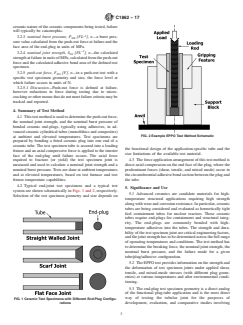
1.2 In this end-plug push-out (EPPO) test method, test specimens are prepared by bonding a fitted ceramic plug into one end of a ceramic tube. The test specimen tube is secured into a gripping fixture and test apparatus, and an axial compressive force is applied to the interior face of the plug to push it out of the tube. (See 4.2.) The axial force required to fracture (or permanently deform) the joined test specimen is measured and used to calculate a nominal joint strength and a nominal burst pressure. Tests are performed at ambient or elevated temperatures, or both, based on the temperature capabilities of the test furnace and the test apparatus.
1.3 This test method is applicable to end-plug test specimens with a wide range of configurations and sizes. The test method does not define a standardized test specimen geometry, because the purpose of the test is to determine the nominal joint strength and nominal burst pressure of an application-specific plug-tube design. The test specimen should be similar in size and configuration with the intended application and product desig...
- Status
- Published
- Publication Date
- 30-Jun-2017
- Technical Committee
- C28 - Advanced Ceramics
- Drafting Committee
- C28.01 - Mechanical Properties and Performance
Overview
ASTM C1862-17 defines a standard test method for determining the nominal joint strength of end-plug joints in advanced ceramic tubes under both ambient and elevated temperatures. Developed by ASTM Committee C28, this method is essential for evaluating the mechanical integrity of adhesively bonded end-plugs in monolithic and composite advanced ceramic tubes, which are often used in challenging environments such as nuclear reactors. The method focuses on measuring push-out force, nominal joint strength, and nominal burst pressure, making it crucial for quality assurance, adhesive selection, and comparative performance assessment of bonded ceramic tubular assemblies.
Key Topics
- Nominal Joint Strength: The method quantifies the strength at failure as a critical parameter for comparing adhesives and plug configurations. The value reflects the joint's performance under direct loading and is calculated based on the push-out force and bond area.
- Push-Out Test (EPPO): End-plug push-out (EPPO) tests are used to simulate operating conditions by applying axial compressive force to the plug, determining the force required for plug displacement or fracture.
- Environmental and Temperature Effects: Tests are conducted at ambient and elevated temperatures to reflect the intended application environment. The method accounts for the effects of temperature on adhesive performance and joint durability.
- Versatile Specimen Geometry: Rather than mandating a standardized specimen, the method covers a broad range of end-plug and tube designs, encouraging use of application-specific geometries to ensure relevant results.
- Failure Modes: Detailed consideration is given to various failure types, including adhesive, cohesive, and tube or plug fracture, ensuring comprehensive joint evaluation.
Applications
This standard offers practical value in several engineering and manufacturing contexts:
- Nuclear Reactor Components: Ceramic tubes with sealed, bonded end-plugs are considered for use in hermetically tight fuel containment, where reliability is essential.
- High-Temperature Structural Ceramics: Advanced ceramic tubes used in high-temperature, corrosive, or abrasive environments require dependable joints, making this test method vital for developmental evaluation.
- Comparative Adhesive Assessment: Manufacturers can compare adhesives, such as organic, glass, metal, or ceramic-based bonding materials, under true application-relevant loading scenarios.
- Joining Method Development: The test enables optimization and validation of end-plug joining procedures, supporting the advancement of fabrication processes for advanced ceramic assemblies.
- Quality Control: By directly reflecting in-service stresses, the results provide a realistic means for manufacturing quality assurance and screening of bonded tubular products.
Related Standards
For a comprehensive approach to testing and evaluating ceramic joints and adhesives, the following ASTM and related standards are referenced within or often used alongside ASTM C1862-17:
- ASTM C1469 - Shear Strength of Joints of Advanced Ceramics at Ambient Temperature
- ASTM C1145 - Terminology of Advanced Ceramics
- ASTM C1322 - Fractography and Fracture Origins in Advanced Ceramics
- ASTM D907 - Terminology of Adhesives
- ASTM D4896 - Guide for Use of Adhesive-Bonded Single Lap-Joint Specimen Test Results
- ASTM E4 - Practices for Force Verification of Testing Machines
- ASTM E220/E230 - Calibration and Specification for Thermocouples (for temperature measurement)
- ASTM E1012 - Verification of Testing Frame and Specimen Alignment Under Tensile and Compressive Axial Force Application
Conclusion
ASTM C1862-17 is a vital standard for manufacturers, engineers, and researchers working with advanced ceramic tubes, particularly where joint integrity is critical at high temperatures. It provides a realistic, application-focused test for evaluating the performance and reliability of bonded joints, supporting safety, quality, and innovation in demanding technical fields. Incorporating this method into development and quality control helps ensure the strength and durability of advanced ceramic tube systems in challenging operational environments.
Relations
- Effective Date
- 01-Nov-2023
- Effective Date
- 01-May-2023
- Effective Date
- 01-Jun-2020
- Effective Date
- 01-May-2020
- Effective Date
- 15-Oct-2019
- Effective Date
- 01-Jul-2019
- Effective Date
- 01-Jul-2019
- Effective Date
- 15-Apr-2019
- Effective Date
- 01-Apr-2018
- Effective Date
- 01-Aug-2016
- Effective Date
- 01-May-2016
- Effective Date
- 01-Jul-2015
- Effective Date
- 01-Jul-2015
- Effective Date
- 01-Jun-2014
- Effective Date
- 15-Apr-2014
Frequently Asked Questions
ASTM C1862-17 is a standard published by ASTM International. Its full title is "Standard Test Method for the Nominal Joint Strength of End-Plug Joints in Advanced Ceramic Tubes at Ambient and Elevated Temperatures". This standard covers: SIGNIFICANCE AND USE 5.1 Advanced ceramics are candidate materials for high-temperature structural applications requiring high strength along with wear and corrosion resistance. In particular, ceramic tubes are being considered and evaluated as hermetically tight fuel containment tubes for nuclear reactors. These ceramic tubes require end-plugs for containment and structural integrity. The end-plugs are commonly bonded with high-temperature adhesives into the tubes. The strength and durability of the test specimen joint are critical engineering factors, and the joint strength has to be determined across the full range of operating temperatures and conditions. The test method has to determine the breaking force, the nominal joint strength, the nominal burst pressure, and the failure mode for a given tube/plug/adhesive configuration. 5.2 The EPPO test provides information on the strength and the deformation of test specimen joints under applied shear, tensile, and mixed-mode stresses (with different plug geometries) at various temperatures and after environmental conditioning. 5.3 The end-plug test specimen geometry is a direct analog of the functional plug-tube application and is the most direct way of testing the tubular joint for the purposes of development, evaluation, and comparative studies involving adhesives and bonded products, including manufacturing quality control. This test method is a more realistic test for the intended geometry than the current shear test of ceramic joints (Test Method C1469), which uses an asymmetric four-point shear test on a flat adhesive face joint. 5.4 The EPPO test method may be used for joining method development and selection, adhesive comparison and screening, and quality assurance. This test method is not recommended for adhesive property determination, design data generation, material model verification/validation, or combinations thereof. SCOPE 1.1 This test method covers the determination of the push-out force, nominal joint strength, and nominal burst pressure of bonded ceramic end-plugs in advanced ceramic cylindrical tubes (monolithic and composite) at ambient and elevated temperatures (see 4.2). The test method is broad in scope and end-plugs may have a variety of different configurations, joint types, and geometries. It is expected that the most common type of joints tested are adhesively bonded end-plugs that use organic adhesives, metals, glass sealants, and ceramic adhesives (sintered powders, sol-gel, polymer-derived ceramics) as the bonding material between the end-plug and the tube. This test method describes the test capabilities and limitations, the test apparatus, test specimen geometries and preparation methods, test procedures (modes, rates, mounting, alignment, testing methods, data collection, and fracture analysis), calculation methods, and reporting procedures. 1.2 In this end-plug push-out (EPPO) test method, test specimens are prepared by bonding a fitted ceramic plug into one end of a ceramic tube. The test specimen tube is secured into a gripping fixture and test apparatus, and an axial compressive force is applied to the interior face of the plug to push it out of the tube. (See 4.2.) The axial force required to fracture (or permanently deform) the joined test specimen is measured and used to calculate a nominal joint strength and a nominal burst pressure. Tests are performed at ambient or elevated temperatures, or both, based on the temperature capabilities of the test furnace and the test apparatus. 1.3 This test method is applicable to end-plug test specimens with a wide range of configurations and sizes. The test method does not define a standardized test specimen geometry, because the purpose of the test is to determine the nominal joint strength and nominal burst pressure of an application-specific plug-tube design. The test specimen should be similar in size and configuration with the intended application and product desig...
SIGNIFICANCE AND USE 5.1 Advanced ceramics are candidate materials for high-temperature structural applications requiring high strength along with wear and corrosion resistance. In particular, ceramic tubes are being considered and evaluated as hermetically tight fuel containment tubes for nuclear reactors. These ceramic tubes require end-plugs for containment and structural integrity. The end-plugs are commonly bonded with high-temperature adhesives into the tubes. The strength and durability of the test specimen joint are critical engineering factors, and the joint strength has to be determined across the full range of operating temperatures and conditions. The test method has to determine the breaking force, the nominal joint strength, the nominal burst pressure, and the failure mode for a given tube/plug/adhesive configuration. 5.2 The EPPO test provides information on the strength and the deformation of test specimen joints under applied shear, tensile, and mixed-mode stresses (with different plug geometries) at various temperatures and after environmental conditioning. 5.3 The end-plug test specimen geometry is a direct analog of the functional plug-tube application and is the most direct way of testing the tubular joint for the purposes of development, evaluation, and comparative studies involving adhesives and bonded products, including manufacturing quality control. This test method is a more realistic test for the intended geometry than the current shear test of ceramic joints (Test Method C1469), which uses an asymmetric four-point shear test on a flat adhesive face joint. 5.4 The EPPO test method may be used for joining method development and selection, adhesive comparison and screening, and quality assurance. This test method is not recommended for adhesive property determination, design data generation, material model verification/validation, or combinations thereof. SCOPE 1.1 This test method covers the determination of the push-out force, nominal joint strength, and nominal burst pressure of bonded ceramic end-plugs in advanced ceramic cylindrical tubes (monolithic and composite) at ambient and elevated temperatures (see 4.2). The test method is broad in scope and end-plugs may have a variety of different configurations, joint types, and geometries. It is expected that the most common type of joints tested are adhesively bonded end-plugs that use organic adhesives, metals, glass sealants, and ceramic adhesives (sintered powders, sol-gel, polymer-derived ceramics) as the bonding material between the end-plug and the tube. This test method describes the test capabilities and limitations, the test apparatus, test specimen geometries and preparation methods, test procedures (modes, rates, mounting, alignment, testing methods, data collection, and fracture analysis), calculation methods, and reporting procedures. 1.2 In this end-plug push-out (EPPO) test method, test specimens are prepared by bonding a fitted ceramic plug into one end of a ceramic tube. The test specimen tube is secured into a gripping fixture and test apparatus, and an axial compressive force is applied to the interior face of the plug to push it out of the tube. (See 4.2.) The axial force required to fracture (or permanently deform) the joined test specimen is measured and used to calculate a nominal joint strength and a nominal burst pressure. Tests are performed at ambient or elevated temperatures, or both, based on the temperature capabilities of the test furnace and the test apparatus. 1.3 This test method is applicable to end-plug test specimens with a wide range of configurations and sizes. The test method does not define a standardized test specimen geometry, because the purpose of the test is to determine the nominal joint strength and nominal burst pressure of an application-specific plug-tube design. The test specimen should be similar in size and configuration with the intended application and product desig...
ASTM C1862-17 is classified under the following ICS (International Classification for Standards) categories: 81.060.30 - Advanced ceramics. The ICS classification helps identify the subject area and facilitates finding related standards.
ASTM C1862-17 has the following relationships with other standards: It is inter standard links to ASTM E230/E230M-23a, ASTM E230/E230M-23, ASTM E251-20a, ASTM E251-20, ASTM D3878-19a, ASTM C1145-19, ASTM C1322-15(2019), ASTM D3878-19, ASTM D3878-18, ASTM D3878-16, ASTM D4896-01(2016), ASTM D3878-15, ASTM C1322-15, ASTM E4-14, ASTM E251-92(2014). Understanding these relationships helps ensure you are using the most current and applicable version of the standard.
ASTM C1862-17 is available in PDF format for immediate download after purchase. The document can be added to your cart and obtained through the secure checkout process. Digital delivery ensures instant access to the complete standard document.
Standards Content (Sample)
This international standard was developed in accordance with internationally recognized principles on standardization established in the Decision on Principles for the
Development of International Standards, Guides and Recommendations issued by the World Trade Organization Technical Barriers to Trade (TBT) Committee.
Designation: C1862 − 17
Standard Test Method for the
Nominal Joint Strength of End-Plug Joints in Advanced
Ceramic Tubes at Ambient and Elevated Temperatures
This standard is issued under the fixed designation C1862; the number immediately following the designation indicates the year of
original adoption or, in the case of revision, the year of last revision. A number in parentheses indicates the year of last reapproval. A
superscript epsilon (´) indicates an editorial change since the last revision or reapproval.
1. Scope 1.4 Calculations in this test method include a nominal joint
strength which is specific to the adhesives, adherends,
1.1 This test method covers the determination of the push-
configuration, size, and geometry of the test specimen. The
outforce,nominaljointstrength,andnominalburstpressureof
nominal joint strength has value as a comparative test for
bonded ceramic end-plugs in advanced ceramic cylindrical
different adhesives and plug configurations in the intended
tubes (monolithic and composite) at ambient and elevated
application geometry. When using nominal joint strength for
temperatures (see 4.2). The test method is broad in scope and
comparison purposes, only values obtained using identical
end-plugs may have a variety of different configurations, joint
geometries should be compared due to potential differences in
types, and geometries. It is expected that the most common
induced stress states (shear versus tensile versus mixed mode).
type of joints tested are adhesively bonded end-plugs that use
Thejointstrengthcalculatedinthistestmaydifferwidelyfrom
organic adhesives, metals, glass sealants, and ceramic adhe-
the true shear or tensile strength (or both) of the adhesive due
sives (sintered powders, sol-gel, polymer-derived ceramics) as
to mixed-mode stress states and stress concentration effects.
the bonding material between the end-plug and the tube. This
(True adhesive shear and tensile strengths are material proper-
test method describes the test capabilities and limitations, the
test apparatus, test specimen geometries and preparation ties independent of the joint geometry.)
methods, test procedures (modes, rates, mounting, alignment,
1.5 In this test, a longitudinal failure stress is being calcu-
testing methods, data collection, and fracture analysis), calcu-
lated and reported. This longitudinal failure stress acts as an
lation methods, and reporting procedures.
engineering corollary to the burst pressure value measured
1.2 In this end-plug push-out (EPPO) test method, test
from a hydrostatic pressure test, which is a more difficult and
specimens are prepared by bonding a fitted ceramic plug into
complex test procedure. Thus this longitudinal failure stress is
one end of a ceramic tube. The test specimen tube is secured
recorded as a nominal burst pressure. As a general rule, the
into a gripping fixture and test apparatus, and an axial
absolute magnitude of the nominal burst pressure measured in
compressive force is applied to the interior face of the plug to
this EPPO test is different than the absolute magnitude of a
push it out of the tube. (See 4.2.) The axial force required to
burst pressure from a hydrostatic burst pressure test, because
fracture (or permanently deform) the joined test specimen is
the EPPO test does not induce the hoop stresses commonly
measured and used to calculate a nominal joint strength and a
observed in a hydrostatic pressure test.
nominal burst pressure. Tests are performed at ambient or
1.6 The use of this test method at elevated temperatures is
elevated temperatures, or both, based on the temperature
limited by the temperature capabilities of the loading fixtures,
capabilities of the test furnace and the test apparatus.
thegrippingmethod(adhesive,mechanicalclamping,etc.),and
1.3 This test method is applicable to end-plug test speci-
the furnace temperature limitations.
mens with a wide range of configurations and sizes. The test
method does not define a standardized test specimen geometry,
1.7 Values expressed in this test method are in accordance
becausethepurposeofthetestistodeterminethenominaljoint
withtheInternationalSystemofUnits(SI)andIEEE/ASTMSI
strength and nominal burst pressure of an application-specific
10.
plug-tube design. The test specimen should be similar in size
1.8 This standard does not purport to address all of the
and configuration with the intended application and product
safety concerns, if any, associated with its use. It is the
design.
responsibility of the user of this standard to establish appro-
priate safety and health practices and determine the applica-
bility of regulatory limitations prior to use.
This test method is under the jurisdiction of ASTM Committee C28 on
Advanced Ceramics and is the direct responsibility of Subcommittee C28.01 on
1.9 This international standard was developed in accor-
Mechanical Properties and Performance.
dance with internationally recognized principles on standard-
Current edition approved July 1, 2017. Published July 2017. Originally approved
in 2017. DOI: 10.1520/C1862-17. ization established in the Decision on Principles for the
Copyright © ASTM International, 100 Barr Harbor Drive, PO Box C700, West Conshohocken, PA 19428-2959. United States
C1862 − 17
Development of International Standards, Guides and Recom- 3.1.3 adhesion failure, n—rupture of an adhesive bond in
mendations issued by the World Trade Organization Technical which the separation appears visually to be at the adhesive/
Barriers to Trade (TBT) Committee. adherend interface. (D907)
3.1.4 adhesive, n—a substance capable of holding materials
2. Referenced Documents
together by surface attachment. (D907)
2.1 ASTM Standards:
3.1.4.1 Discussion—‘Adhesive’ is a general term and in-
C1145 Terminology of Advanced Ceramics
cludes among others cement, glue, mucilage, and paste. All of
C1322 Practice for Fractography and Characterization of
these terms are loosely used interchangeably. Various descrip-
Fracture Origins in Advanced Ceramics
tive adjectives are applied to the term ‘adhesive’ to indicate
C1469 Test Method for Shear Strength of Joints of Ad-
certain characteristics as follows: (1) physical form, that is,
vanced Ceramics at Ambient Temperature
liquid adhesive, tape adhesive, etc.; (2) chemical type, that is,
D907 Terminology of Adhesives
silicate adhesive, resin adhesive, etc.; (3) materials bonded,
D3878 Terminology for Composite Materials
that is, paper adhesive, metal-plastic adhesive, can label
D4896 Guide for Use ofAdhesive-Bonded Single Lap-Joint
adhesive,etc.;(4)conditionofuse,thatis,hotsettingadhesive,
Specimen Test Results
room temperature setting adhesive, etc.
E4 Practices for Force Verification of Testing Machines
3.1.5 advanced ceramic, n—a highly engineered, high
E6 Terminology Relating to Methods of Mechanical Testing
performance, predominately nonmetallic, inorganic, ceramic
E105 Practice for Probability Sampling of Materials
material having specific functional attributes. (C1145)
E122 Practice for Calculating Sample Size to Estimate,With
3.1.6 ceramic matrix composite, n—material consisting of
Specified Precision, the Average for a Characteristic of a
two or more materials (insoluble in one another), in which the
Lot or Process
major, continuous component (matrix component) is a ceramic
E220 Test Method for Calibration of Thermocouples By
while the secondary component(s) may be ceramic, glass/
Comparison Techniques
ceramic, glass, metal, or organic in nature. These components
E230/E230M Specification for Temperature-Electromotive
are combined on macroscale to form a useful engineering
Force (emf) Tables for Standardized Thermocouples
material possessing certain properties or behavior not pos-
E251 Test Methods for Performance Characteristics of Me-
sessed by the individual constituents. (C1145)
tallic Bonded Resistance Strain Gages
E337 Test Method for Measuring Humidity with a Psy-
3.1.7 cohesive failure, n—rupture of a bonded assembly in
chrometer (the Measurement of Wet- and Dry-Bulb Tem-
which the separation appears visually to be in the adhesive or
peratures)
the adherend. (D907)
E1012 Practice for Verification of Testing Frame and Speci-
–2
3.1.8 elastic stress limit, [FL ], n—the greatest stress
men Alignment Under Tensile and Compressive Axial
which a material is capable of sustaining without any perma-
Force Application
nent strain remaining upon complete release of the stress, in
IEEE/ASTM SI 10 American National Standard for Metric
units of MPa. (E6)
Practice
3.1.9 joining, n—controlled formation of chemical or me-
3. Terminology chanical bond, or both, between similar or dissimilar materials.
(C1469)
3.1 Definitions:
–2
3.1.1 The definitions of terms relating to strength testing 3.1.10 shearstress,[FL ],n—thestresscomponenttangen-
appearing in Terminology E6 apply to the terms used in this tial to the plane on which the forces act. (E6)
test method. The definitions of terms relating to advanced –2
3.1.11 true shear strength, [FL ], n—the maximum uni-
ceramics appearing in Terminology C1145 apply to the terms
form shear stress which a material is capable of sustaining in
used in this test method. The definitions of terms relating to
the absence of all normal stresses. (D4896)
fiber-reinforced composites appearing in Terminology D3878
3.2 Definitions of Terms Specific to This Standard:
apply to the terms used in this test method. The definitions of
3.2.1 collet(s), n—a sleeve placed on a shaft or tube and
terms relating to adhesives in Terminology D907 apply to the
tightened so as to grip the shaft or tube.
terms used in this test method. Pertinent definitions as listed in
3.2.1.1 Discussion—Colletsmaycomeinavarietyofforms.
Practice E1012, Terminology C1145, Terminology D3878,
A common example is a split conical collet which features a
Terminology D907, and Terminology E6 are shown in the
cone-shaped segmented sleeve that is tightened with a tapered
following with the appropriate source given in parentheses.
collar.
Key terms are given below.
3.1.2 adherend, n—a body held to another body by an
3.2.2 failure, n—an arbitrary point beyond which a material
adhesive. (D907)
or system ceases to be functional for its intended use.
3.2.2.1 Discussion—Failure strength is commonly defined
by the force parameter (force, moment, torque, stress, etc.)
For referenced ASTM standards, visit the ASTM website, www.astm.org, or
appliedtoatestspecimenthatproducesbrittlefractureandloss
contact ASTM Customer Service at service@astm.org. For Annual Book of ASTM
of load-carrying capability or permanent deformation beyond a
Standards volume information, refer to the standard’s Document Summary page on
the ASTM website. specified limit such as the elastic stress limit. Due to the
C1862 − 17
ceramic nature of the ceramic components being tested, failure
will typically be catastrophic.
–2
3.2.3 nominal burst pressure, P [FL ], n—a burst pres-
NB
sure value calculated from the push-out force at failure and the
face area of the end-plug in units of MPa.
–2
3.2.4 nominal joint strength, S [FL ], n—the calculated
NJ
strengthatfailureinunitsofMPa,calculatedfromthepush-out
force and the calculated adhesive bond area of the defined test
specimen.
3.2.5 push-out force, F [F], n—in a push-out test with a
PO
specific test specimen geometry and size, the force level at
which failure occurs in units of N.
3.2.5.1 Discussion—Push-out force is defined at failure,
however reductions in force during testing due to micro-
crackingorothermeansthatdonotmeetfailurecriteriamaybe
tracked and reported.
4. Summary of Test Method
4.1 Thistestmethodisusedtodeterminethepush-outforce,
the nominal joint strength, and the nominal burst pressure of
bonded ceramic end-plugs, typically using adhesives, in ad-
vanced ceramic cylindrical tubes (monolithics and composites)
at ambient and elevated temperatures. Test specimens are FIG. 2 Example EPPO Test Method Schematic
prepared by bonding a fitted ceramic plug into one end of a
ceramic tube. The test specimen tube is secured into a loading
the functional design of the application-specific tube and the
fixture and an axial compressive force is applied to the interior
size limitations of the available test material.
face of the end-plug until failure occurs. The axial force
required to fracture (or yield) the test specimen joint is 4.3 The force application arrangement of this test method is
measured and used to calculate a nominal joint strength and a direct axial compression on the end face of the plug, where the
nominal burst pressure.Tests are done at ambient temperatures predominant forces (shear, tensile, and mixed mode) occur in
and at elevated temperatures, based on test furnace and test thecircumferentialadhesivebondsectionbetweentheplugand
fixture temperature capabilities. the tube.
4.2 Typical end-joint test specimens and a typical test
5. Significance and Use
system are shown schematically in Figs. 1 and 2, respectively.
5.1 Advanced ceramics are candidate materials for high-
Selection of the test specimen geometry and size depends on
temperature structural applications requiring high strength
alongwithwearandcorrosionresistance.Inparticular,ceramic
tubes are being considered and evaluated as hermetically tight
fuel containment tubes for nuclear reactors. These ceramic
tubes require end-plugs for containment and structural integ-
rity. The end-plugs are commonly bonded with high-
temperature adhesives into the tubes. The strength and dura-
bility of the test specimen joint are critical engineering factors,
andthejointstrengthhastobedeterminedacrossthefullrange
of operating temperatures and conditions. The test method has
to determine the breaking force, the nominal joint strength, the
nominal burst pressure, and the failure mode for a given
tube/plug/adhesive configuration.
5.2 The EPPO test provides information on the strength and
the deformation of test specimen joints under applied shear,
tensile, and mixed-mode stresses (with different plug geom-
etries) at various temperatures and after environmental condi-
tioning.
5.3 The end-plug test specimen geometry is a direct analog
of the functional plug-tube application and is the most direct
way of testing the tubular joint for the purposes of
FIG. 1 Ceramic Test Specimens with Different End-Plug Configu-
rations development, evaluation, and comparative studies involving
C1862 − 17
adhesives and bonded products, including manufacturing qual- the grip section and failure occurs in the end-plug section, not
ity control. This test method is a more realistic test for the in the grip section of the test specimen. Grip failure is more
intended geometry than the current shear test of ceramic joints likely at elevated temperatures, because of degradation of the
(Test Method C1469), which uses an asymmetric four-point grip adhesive at elevated temperatures and because of differ-
shear test on a flat adhesive face joint. ential thermal expansion stresses between the grip fixture and
the test specimen.
5.4 The EPPO test method may be used for joining method
development and selection, adhesive comparison and 6.6 The adhesive properties may change with temperature
screening, and quality assurance. This test method is not and with time, either under test specimen conditioning or in
recommendedforadhesivepropertydetermination,designdata aggressive test environments. In particular, ceramic and glass
generation, material model verification/validation, or combina- adhesives often fail by slow crack growth under moisture or
tions thereof. elevated temperature conditions (or both), which may produce
a different flaw population and microstructure, a change in
6. Interferences
failure mechanisms, or a combination thereof.
6.1 The EPPO test in its basic form is a variation of the
6.7 At elevated testing temperatures, differential thermal
common single-lap joint shear test geometry, based on the
stresses caused by different thermal expansion coefficients
rotation of a single-plane lap joint to form a cylindrical lap
between the end-plug, the adhesive, and the adherend often
joint. So the complexities of the single-lap joint (as described
introduce additional stresses that may produce premature
in Guide D4896) are carried over to the EPPO test.
adhesive failure.
6.2 As described in Guide D4896, many factors (geometric,
7. Apparatus
adhesive properties, adherend properties, force levels) affect
the stress levels in the adhesive bond section and the failure
7.1 Testing Machine—Test specimens shall be tested in
strength values in a given experimental adhesive bond lap-type
compressive loading with any suitable testing machine pro-
test. All of these factors interact to determine the actual stress
vided that uniform rates of direct loading are maintained. The
levels at different points in the test specimen joint section. For
force-measuring system shall be free of initial lag at the
fullengineeringanalysisofthejointsystemandthetestresults,
loading rates used, and shall be equipped with a means for
allofthesefactorsshouldbecarefullycontrolledandmeasured
retaining readout of the maximum force as well as a force-time
during testing.
or force-displacement record. Machines used for axial com-
6.2.1 The strain and stress conditions in the bond section
pression testing shall conform with and have an accuracy in
mayvaryspatially,basedonvariationsinthebondmorphology
accordance with Practices E4.
and properties and the stress-strain interaction with the adher-
7.1.1 Cross-Head Displacement Measurement—The cross-
ends. Critical factors are adhesive bond length and thickness,
head displacement should be measured as a record of the
adhesive shear and tensile moduli and Poisson’s ratio, adher-
force-time response of the test specimen. Cross-head displace-
endthickness,adherendshearandtensilemoduliandPoisson’s
ment of the test machine shall not be used to define displace-
ratio, and interface surface conditions.
ment or strain in the end-plug test section.
6.2.2 Depending on the type of adhesive and the process
7.1.2 Force-Measurement Devices—The measurement de-
conditions, the adhesive bond may contain residual stresses
vices used in determining the force shall be accurate within
and critical flaws that may affect the experimental strength.
61 % at any force within the selected load range of the testing
This is a particular concern with many of the high-temperature
machine as defined in Practices E4. Force calibration shall be
adhesivescommonlyusedtobondadvancedceramics.Inmany
performed in compression for universal machines.
cases, the residual stresses and critical flaw populations in-
7.2 Test Apparatus Fixture:
crease with larger bond section sizes and bond thicknesses.
7.2.1 General—The test apparatus shall be designed,
6.3 Misalignment in the load system produces bending
fabricated, and assembled so that the compressive force is
stresses in the joint that give erroneous test results. Bending
applied to the test specimen axially, uniformly, and with
stresses develop as a result of misaligned end-plugs in the tube
negligible friction. The test apparatus shall apply an axial
specimens, out-of-tolerance test specimens (straightness and
compressive force to the interior face of the end-plug without
concentricity), out-of-tolerance test specimens and misfit of
inducingexcessivebendingstressesortransverseshearstresses
end-plugs, misalignment of the test specimen in the grip
in the test specimen. Force application should be accomplished
fixture, and misalignment load train components.
with a universal testing machine with appropriate gripping and
6.4 A common variable in adhesives is the different modes loading fixtures. A typical test apparatus consists of a base
plate, a support block, a gripping fixture, and a loading rod. A
of joint failure: elastic-brittle versus ductile-plastic that occur
for different types of adhesives and at different temperatures schematic of a test apparatus is shown in Fig. 2.
for a given adhesive. For each adhesive system and test
NOTE 1—It is not the intent of this test method to require specific
condition, the failure criteria have to be appropriately defined
loading and alignment fixtures for testing. Different test apparatus
to determine the point at which the adhesive functionally fails configurations can be designed and used for testing. The primary
requirement is that the test fixture (as designed and fabricated) securely
under stress.
grips the test specimen and that the force is applied axially and uniformly.
6.5 The gripping mechanism shall be sufficiently strong at
An example of an axial test apparatus for small ceramic tube specimens
the test conditions so that the test specimen is securely held in (10-mm diameter and 50 to 70 mm long) is described in Appendix X1.
C1862 − 17
7.2.2 The test apparatus shall be built with adequate mate- 7.2.6.2 The loading rod may use hemispherical or rounded
rials and sized large enough to contain the test specimen and to features/fixtures or other alignment aides at the top and bottom
support the applied forces without deformation or damage to to maintain axial alignment of the applied force. The flat face
the apparatus at the test temperatures. Flat bearing surfaces on of the hemispherical load plate should sit on the end-plug to
the base plate, the support block, and the grip fixture shall have avoid point contact stresses on the end-plug (see Fig. 3). This
flat and parallel surfaces to within 0.002 m/m. alignment correction may not require a compliant layer.
7.3 Strain Gauges—Strain gages are not used in this test
NOTE 2—At ambient temperatures, the fixture materials are commonly
high-strength, high-hardness steels. At elevated temperatures (>500 °C), methodtomeasureadhesivestrainintheend-plugbondsection
high-nickel alloys or high-strength ceramics (aluminum oxide, silicon
during testing. Strain gages on the test specimen tube may be
carbide) are necessary for strength, hardness, and stability at the test
used to assess bending stresses and strains produced by
temperature. Selected materials need to be compatible with materials
misalignment (12.3.5). If used, strain gages shall be selected
being tested to avoid chemical interactions at high temperatures.
and used per Test Methods E251.
7.2.3 Gripping Fixture—A gripping fixture is necessary to
7.4 Data Acquisition—Applied force and cross-head dis-
secure the test specimen in the test apparatus without slipping
placement as a function of time shall be recorded. Use either
or breakage while force is applied. The gripping fixture also
digital data acquisition systems or analog chart recorders for
aligns the test specimen in the load train. Gripping fixtures for
thispurpose,althoughadigitalrecordisrecommendedforease
tube specimens are grouped into two classes: mechanical grip
of later data analysis. Recording devices shall be accurate to
fixtures (mechanical clamps, collets, and collars) and adhesive
1.0 % of full scale. A minimum data acquisition rate of 10 Hz
bonding into grips. The gripping mechanism should be de-
shall be used, and the acquisition rate shall be fast enough to
signedtoapplyasuniformapressureaspossibleacrossthetest
capture the maximum force within 1 %.
specimen in order to reduce induced stresses in the test
specimen. Additional information on gripping methods can be
7.5 Dimension-Measuring Devices—Micrometers, calipers,
found in Appendix X2. and optical microscopy used for measuring linear dimensions
shall be accurate and precise to at least one-half the smallest
NOTE 3—The brittle nature of advanced ceramics requires a uniform
unit to which the individual dimension is required to be
force application between the grip fixture and the gripped section of the
measured.Fortestingsmalldiameter(<20mm)testspecimens,
test specimen. Line or point contacts and nonuniform forces can produce
stress concentrations and Hertzian stresses, leading to crack initiation and the measuring devices should have an accuracy of 0.01 mm.
fracture of the test specimen in the gripped section. The selection of a
7.6 Elevated Temperature Testing:
gripping method depends on the strength, rigidity, and brittleness of the
7.6.1 General—This test method is applicable to elevated
ceramic tubes. Mechanical grips are an option if they secure the test
specimen without slipping or breakage in the grips at the test conditions.
temperature testing with the use of suitable furnace equipment
If the tubes are small, thin-walled, brittle, and rigid, adhesive gripping
and temperature control and measurement. The test tempera-
methods are typically more successful than mechanical gripping.
ture shall be selected based on the functional temperature
7.2.4 Loading Rod—The loading rod shall be straight, rigid,
requirements of the ceramic application.The furnace may have
and strong enough to apply force directly to the plug face
without bending, deformation, or damage. The loading rod
shall be long enough to reach the bottom of the test specimen
with direct contact to the upper loading anvil. Adequate
precautions shall be taken to avoid/minimize friction between
the loading rod and the interior of the test specimen tube. The
loading rod diameter should be 90 % of the inside diameter of
the tube.
7.2.5 Support Block—The purpose of the support block is to
align and hold the gripping fixture in place.Alignment features
in the support block may use conical or spherical seats to
maintain axial and lateral alignment of the gripping fixture.
7.2.6 Alignment—The test apparatus shall be designed and
constructed to keep extraneous bending stresses and strains
around the circumference of the test specimen at less than
610 % difference from the mean stress around the circumfer-
ence.
NOTE 4—Misalignment bending stresses can develop with nonuniform
testspecimens(variationsintubediameter,concentricity,andstraightness;
non-parallel end-plug faces; see 10.2) and from misalignments in the load
train.
7.2.6.1 A compliant layer such as copper or graphite sheet
may be used between the face/tip of the loading rod and the
interior face of the end-plug to reduce or eliminate stress
concentrations and misalignments. FIG. 3 Loading Rod Schematic Using a Hemispherical Load Plate
C1862 − 17
an air, inert, or vacuum environment, as required. If an inert or Technology (NIST). Recalibration shall be performed with
vacuum chamber is used, and it is necessary to direct the force traceable standards on all equipment on a yearly interval or
through a bellows, fittings, or seal, it shall be verified that whenever accuracy is in doubt.
losses or errors in force measurement do not exceed 1 % of the
8.2 Reference Materials—There are currently no standard
expected failure forces.
reference materials for this type of test.
7.6.2 Furnace Configuration—The furnace system shall be
constructed and have a temperature-control system to maintain
9. Hazards
a constant temperature in the end-plug test section during each
9.1 Precaution—During the conduct of this test method, the
testing period. The variation in temperature with time during
possibility of flying fragments of broken test material is quite
the test shall be no greater than 65°C or 61 % of the test
high.Thebrittlenatureofadvancedceramicsandthereleaseof
temperature, whichever is larger. The furnace system shall be
strain energy contribute to the potential release of uncontrolled
configured so that spatial thermal differences along the length
fragments upon fracture. Means for containment and retention
of the end-plug test section of the test specimen are no greater
of these fragments for safety as well as later fractographic
than 65°C or 61 % of the test temperature (whichever is
reconstruction and analysis is highly recommended. Caution
larger).
should be used during collection of fragments as they may be
NOTE 5—Furnace systems can be configured in a variety of ways to
sharp.
accommodate test specimens, including traditional box furnace designs or
small resistance heating elements in close proximity to the end-plug
9.2 Precaution—Elevated temperature testing often pro-
section. Heating can be done with any suitable heating method (indirect
duces the possibility of fire, burns, and electrical shorts.
electrical resistance heating elements, direct induction, indirect induction
Furnaces shall be properly designed, assembled, and operated
throughasusceptor,radiantlamp,ordirectresistanceinthetestspecimen)
that maintains proper temperature conditions. to minimize those hazards.
7.6.3 Temperature Measurement—The temperature-
9.3 Precaution—Exposed fibers at the edges of fiber-
measurement device for the test specimen shall have a resolu-
reinforcedcompositetestspecimenspresentahazardduetothe
tion of 2 °C or better. If temperature is measured with a
sharpness and brittleness of the ceramic fiber. Inform all
thermocouple, the test specimen temperature shall be moni-
persons required to handle these materials of such conditions
tored with the thermocouple tip located no more than 1 mm
and the proper handling techniques.
from the end-joint section of the test specimen. Either a fully
sheathed or exposed bead junction may be used. If a sheathed
10. Test Specimens, Preparation, and Sampling
tip is used, it shall be verified that negligible error is associated
10.1 Test Specimen Geometry—While EPPO test specimens
with the sheath.
are defined as a joined tube and end-plug, a variety of test
7.6.3.1 Aseparate thermocouple may be used to control the
specimen geometry is acceptable if it meets the gripping,
furnace chamber if necessary, but the test specimen tempera-
fracture location, bending limits, and temperature profile re-
ture shall be the reported temperature of the test.
quirements of this test method.Aminimum length between the
7.6.3.2 The thermocouple(s) shall be calibrated and used in
bottom of the grips and the inner surface of the end-plug shall
accordance with Test Method E220 and Specification E230/
be 25 mm to ensure that fracture is not influenced by
E230M.
grip-induced stresses on the test specimen.
7.6.3.3 The temperature measurement shall be accurate to
within 65 °C. The accuracy shall include the error inherent to
NOTE 6—The exact geometry is dependent on the purpose of the test
the thermocouple as well as any errors in the measuring
and the design configuration and geometry of the end-use component.
Generally, the dimensions (length, diameter, wall thickness, end-plug
instruments.
geometry, etc.) of the end-plug test specimen will reflect the size and
7.6.4 System Equilibrium—The time for the system to reach
dimensionsoftheend-usecomponent,althoughitmightnotbepossibleto
thermal equilibrium at test temperature shall be determined for
test exceedingly large tube-joints due to limits of test equipment. If it is
the test temperature to be used. This shall be performed for
desired to evaluate the effects of geometry and the adhesive processing,
both hot-furnace loading or cold-furnace loading, to support
then the size of the test specimen and resulting bond geometry will be
selected to accurately assess the test variables. In addition, grip methods
test specimen heat-up per 12.4.2.
will influence the final length and design of the test specimen geometry.
7.6.5 Temperature Data Acquisition—At a minimum for
These different test objectives will produce a wide range of test specimen
elevated temperature tests, record temperature as single mea-
diameters and length and preclude the use of a single, standardized test
surements at the initiation and completion of the actual test.
specimen geometry. An example of a test specimen geometry and test
However, temperature may also be recorded continuously, apparatus developed in 2015 for silicon carbide composite tubes for the
nuclear industry is shown in Appendix X1.
similar to force and strain except the record begins at the start
of the heating of the furnace (including ramp-up to test
10.1.1 A major factor in the design of the test specimen is
temperature).
the configurational fit between the end-plug and the tube.
Critical factors are the bond geometry (for example, straight-
8. Calibration and Standardization
wall plug, scarf-joint plug, flat-face plug; see Fig. 1), the bond
8.1 Calibration of equipment (force measurement, strain length and area, and the adhesive bond thickness between the
measurement, thermocouples, etc.) shall be provided by the tube inside diameter (ID) and the plug outside diameter (OD).
supplier against standards traced to a national measurement The test specimen bond geometry may match the bond
institute, such as the National Institute of Standards and configuration of the end-use component.
C1862 − 17
10.1.2 Elevated Temperature Geometry—The geometry of used to assess the alignment and fit of the end-plug and the
the test specimen for elevated temperature testing shall be condition of the adhesive joint (gaps, porosity, thickness
dependent on the type and configuration of the furnace, the uniformity, etc.).
requirements of temperature uniformity, and ambient tempera- 10.3.4 Perform and record all quality evaluation tests and
ture test specimen geometry. the results of any nondestructive evaluations, and include them
in the final report.
NOTE 7—Thermal gradients can introduce additional stress gradients in
test specimens which might already exhibit stress gradients at ambient 10.4 The test specimens shall be properly packaged and
temperatures due to geometric transitions. Therefore, analyze untried test
stored to minimize environmental exposure and bond degrada-
configurations simultaneously for both loading-induced stress gradients
tion caused by moisture, heat, or cold.
and thermally induced temperature gradients to ascertain any adverse
interactions.
10.5 Test specimens may be selected from as-fabricated
components for the purposes of quality control, if the test is
10.2 Dimensional Tolerances—Dimensional tolerances
designed for the as-fabricated geometry. Specimen sampling
shall be defined by the test designer. Dimensional tolerance
from a production lot shall be done per Practice E105.
requirements of the end-use component may act as a guideline.
10.2.1 Tube Geometry—The test designer should define
10.6 Definitions of Valid and Invalid Tests:
dimensional tolerances in consideration of misalignment
10.6.1 Failure Location—A valid test is a test in which
stresses based on variations in OD, ID, straightness, and
failure (fracture or permanent deformation) occurs by adhesive
concentricity of the test specimen tube geometry.
or cohesive failure within the end-plug length of the test
10.2.2 For the test specimen OD, the grip section of the test specimen. Breakage may occur in or run into the tube section
specimen may be finished, smoothed, or turned to produce a
and include partial fracture in the tube section if it is within the
uniform diameter and suitable surface finish for the gripping bond/end-plug length or within 10 % of the OD past the
fixturetoeffectivelysecurethetestspecimen.Machiningofthe
end-plug (Fig. 4). Fracture in the tube away from the end-plug
ceramic should be performed with appropriate media and fluid isconsideredaninvalidtest.Slippage,breakage,orboth,inthe
cooling to minimize surface damage and machining stresses.
grip section produces an invalid test.
Grip section machining may be done before or after end-plug
NOTE 9—Although considered an invalid test, fracture in the tube that
insertion.
is both away from the end-plug and away from the grips provides
10.2.3 Tube/End-Plug Fit—The test designer should define
information on the strength of the tube relative to the strength of the joint
and may be of interest to the end user.
dimensionaltolerancesfortheend-plugandthejointsectionof
the tube that ensure uniform and consistent fit of the end-plug
10.6.2 Alignment Criteria—A valid test occurs when maxi-
in the tube.The parallelism tolerance of the two end-plug faces
mum percent misalignment bending is under 10 % of the
may be defined so that the inner end-plug face is perpendicular
average strain (see 12.3.5 and X3.1). Percent bending over
to the loading rod axis in the test apparatus to within 62°.
10 % is considered a non-valid test.
10.2.4 The test designer shall define and document a quality
10.7 Required Number of Valid Tests—Five(5)testsshallbe
evaluation procedure for the test specimen, defining the critical
a minimum number of valid tests for determining an average.
test specimen parameters (dimensions, tolerances, fit, surface
Ten (10) tests is recommended as a minimum number of valid
condition, etc.), the methods of measurement, and the pass-fail
tests for determining an average with a standard deviation
requirements for the selected parameters.
calculation.Forfullstatisticallysignificantdata,theprocedures
10.3 Joint Processing—Bond material and processing
outlined in Practice E122 should be consulted.
method shall be selected to support the test objectives or to
11. Conditioning
match the end-use application, or both. A joint processing
preparation procedure shall be defined and documented, de-
11.1 Finishedtestspecimensmaybeconditionedatdifferent
scribing the bond material, specimen and bond geometry,
temperatures and environments for defined periods of time to
specimen and end-plug preparation steps, assembly/alignment
assess temperature and environmental effects on the joint
steps, processing methods and conditions, and machining/
strength and durability.Any conditioning treatments should be
finishing steps.
fully defined for time, temperature, and environmental condi-
tions. Test specimens should be weighed, measured for
NOTE 8—The presence of excess joint material on the interior face of
the end-plug can interfere with the alignment of the loading rod and
introducebendingstresses.Stepstominimizejointmaterialontheinterior
face during bonding can be useful for avoiding this issue.
10.3.1 Priortobonding,measure,record,andensurethatthe
dimensions of the specimen tubes and the end-plugs meet
defined dimensional requirements (OD, ID, straightness,
parallelism, etc.).
10.3.2 Prepare all test specimens with bonded end-plugs per
the defined test specimen preparation and adhesive bonding
procedure.
10.3.3 Nondestructive evaluation (radiography, computer-
FIG. 4 Valid Test Section Encompassing the Length of the End-
ized tomography, ultrasonics, thermal imaging, etc.) may be Plug Plus 0.1× the Tube OD
C1862 − 17
dimensions, and visually examined before and after condition- 12.3 Test Specimen Mounting and Alignment:
ing to assess physical changes in the test specimens. 12.3.1 Adhesive Gripping of the Test Specimen—If adhesive
grip bonding is used, the end-plug test specimen(s) should be
12. Procedure
fitted, aligned, and bonded into the gripping fixture per the grip
12.1 Test Specimen Measurement and Examination: adhesive manufacturer’s process instructions. The defined
bonding process (curing, heating, sintering, melting, heat
12.1.1 Measure and record required dimensional specifica-
tions as outlined in 10.2 to within 0.02 mm or 0.05°. treating) shall be followed and controlled to produce a test
specimen securely fitted and aligned in the gripping fixture.
12.1.2 Visually examine the outside surface of the end-plug
and the outside surface of the test specimen for surface (See Appendix X2.)
12.3.2 Mechanical Gripping of the Test Specimen—If me-
variations and anomalies.
12.1.3 Visually examine the interior face of the end-plug for chanical gripping is used, align, fit, and secure the test
specimen into the gripping fixture.
excessadhesivethatinterfereswiththeloadingrod.Recordthe
type and location of any observed anomalies. 12.3.3 The angular alignment of the fitted test specimen in
the gripping fixture may be measured to ensure that the test
12.2 Preparation of the Test Apparatus System:
specimen is aligned and concentric with the gripping fixture to
12.2.1 Based on the expected failure mode of the end-plug
within 62°.
adhesive at the test temperature, define a failure criteria for the
12.3.4 Fit and align the gripping fixture (with the test
test; elastic-brittle fracture for brittle adhesives or the limit of
specimen) and the loading rod into the test apparatus (in the
permanent deformation for ductile-plastic adhesives, or both.
test furnace for elevated temperature testing).
(See Fig. 5.)
12.3.5 Alignment measurements should be conducted at the
12.2.2 The EPPO test is commonly done in displacement
beginning and end of a series of tests, with a measurement at
control. Set a constant cross-head speed so that test specimen
the midpoint of the series recommended whenever the grip
failure occurs within 10 to 60 s. While the required cross-head
fixtures and load train fixtures are changed or installed on a
speed will depend on the test specimen size, the bond
different test machine, whenever a different operator is con-
geometry, and the nominal joint, typical rates for testing are 1
ducting a series of tests, or when damage or misalignment is
to 10 mm/min. Preliminary tests may be necessary to deter-
suspected.
mine the appropriate cross-head speed.
12.3.5.1 The alignment of the test specimen in the test
12.2.2.1 Slower or faster test rates may be used to evaluate
apparatus should be experimentally checked by using a strain-
strain rate effects on the joint strength.
gaged test specimen and checking the strain at four points
12.2.3 Set up and align the testing apparatus in the testing
around the circumference of the specimen tube. (See Appendix
machine.
X3.) The maximum allowable percent misalignment bending
12.2.4 Set up, turn on, and check the universal test machine
among the four strain gages is 10 %, as measured and
control system, the force and strain measurement systems, and
calculated in Appendix X3.
the data acquisition system. Set the defined test mode and test
12.3.5.2 If experimental conditions, time, and cost permit,
rate on the test machine.
alltestspecimensmaybestraingagedforalignmentcheck(see
12.2.5 Measure and record the ambient temperature and
Appendix X3) and checked for misalignment in the initial
relative humidity (Test Method E337) in the laboratory at the
stages of each test. Test specimens that exceed the misalign-
start and end of the test sequence.
ment limit shall be realigned or discarded.
12.2.6 For elevated temperature testing, install, set up, and
12.3.6 Safety shields should be placed around the test
check the operation and control of the furnace system with the
specimen and test fixture to contain and collect fracture
test apparatus installed.
fragments.
12.4 Test Initiation:
12.4.1 The test load train should be preloaded to approxi-
mately 5 % of the expected push-out force to seat the compo-
nents of the test apparatus, remove slack, and check for grip
slippage.
12.4.2 For elevated temperature testing, begin furnace
heat-up and recording of test specimen temperature. The test
specimen shall be heated at a defined heating rate to the
designated test temperature and held at the designated constant
test temperature until the test specimen reaches thermal equi-
librium. During heat-up, the preload shall be adjusted to
maintainconstantforceonthetestspecimenandtocompensate
for thermal expansion stresses.
12.4.3 Start data acquisition and start force application at
the defined displacement rate. Load the test specimen to the
defined failure criteria, as shown by either brittle fracture
FIG. 5 Force Displacement Curves for Elastic-Brittle and Ductile-
Plastic Failure failure or by a predetermined permanent deformation beyond
C1862 − 17
n
the elastic stress limit with increasing compliance or maximum
5 x
S D
( 1 i
force (or both). See Fig. 5.
i
¯
mean 5 X 5 (3)
n
12.5 Test Completion:
n
12.5.1 Record the force at failure (push-out force) and the
¯
~X 2 X!
force-time/displacement data, if available. ( i
i51
standard deviation 5 s.d. 5 (4)
!
12.5.2 Collect and remove any test specimen fragments
n 2 1
from the test apparatus. Remove the test specimen from the
100 s.d.
~ !
gripping fixture. Save the test specimen and the fragments for
percent coefficient of variation 5 CV 5 (5)
¯
X
failure analysis.
12.5.3 Avalidtestisatestinwhichthetestspecimenfailure
where:
occurs in the end-plug section, as described in 10.7.
X = the measured va
...