

ASTM C417-21
(Test Method)Standard Test Method for Thermal Conductivity of Unfired Monolithic Refractories
General Information
- Abstract
SIGNIFICANCE AND USE
3.1 The thermal conductivity of monolithic refractories is a property required for selecting their thermal transmission characteristics. Users select monolithic refractories to provide specified conditions of heat loss and cold face temperature, without exceeding the temperature limitation of the monolithic refractory. This test method establishes placement of thermocouples and positioning of test specimens in the calorimeter.
3.2 This procedure must be used with Test Method C201 and requires a large thermal gradient and steady-state conditions. The results are based upon a mean temperature.
3.3 The data from this test method are suitable for specification acceptance, estimating heat loss and surface temperature, and the design of multi-layer refractory construction.
3.4 The use of these data requires consideration of the actual application environment and conditions.
SCOPE
1.1 This test method supplements Test Method C201, and shall be used in conjunction with that test method for determining the thermal conductivity of unfired monolithic refractories.
1.2 The values stated in inch-pound units are to be regarded as standard. The values given in parentheses are mathematical conversions to SI units that are provided for information only and are not considered standard.
1.3 This standard does not purport to address all of the safety concerns, if any, associated with its use. It is the responsibility of the user of this standard to establish appropriate safety, health, and environmental practices and determine the applicability of regulatory limitations prior to use.
1.4 This international standard was developed in accordance with internationally recognized principles on standardization established in the Decision on Principles for the Development of International Standards, Guides and Recommendations issued by the World Trade Organization Technical Barriers to Trade (TBT) Committee.
- Status
- Published
- Publication Date
- 31-Mar-2021
- Technical Committee
- C08 - Refractories
- Drafting Committee
- C08.02 - Thermal Properties
Buy Documents
ASTM C417-21 - Standard Test Method for Thermal Conductivity of Unfired Monolithic Refractories
REDLINE ASTM C417-21 - Standard Test Method for Thermal Conductivity of Unfired Monolithic Refractories
Overview
ASTM C417-21 is the Standard Test Method for Thermal Conductivity of Unfired Monolithic Refractories. Developed and published by ASTM International, this standard is used to accurately determine the thermal conductivity of various unfired monolithic refractory materials. Understanding thermal conductivity is critical for the selection and design of refractory linings in high-temperature industrial applications, ensuring appropriate heat loss and maintaining safe cold face temperatures without exceeding the refractory’s temperature limits.
As a supplemental test to ASTM C201, this method is essential for users requiring precise thermal transmission data for specification acceptance, heat loss estimation, and design of complex refractory systems. The procedure helps establish proper thermocouple placement and sample positioning, supporting a reliable and repeatable test environment.
Key Topics
- Thermal Conductivity Measurement: Provides a standardized procedure for evaluating the rate of heat transfer through unfired monolithic refractory materials.
- Sample Preparation: Specifies dimensions and methods for preparing test specimens, including castable and plastic refractories, in accordance with relevant ASTM practices.
- Test Apparatus: Requires the use of a calorimeter setup as outlined in ASTM C201, with modifications for the unique characteristics of unfired monolithic refractories.
- Thermocouple Installation: Details the placement and embedding of calibrated thermocouples within the specimens to accurately measure temperature gradients.
- Heating and Testing Procedure: Establishes guidelines for achieving steady-state heat flow, maintaining controlled furnace temperatures, and recording necessary data for accurate thermal conductivity calculations.
- Reporting and Data Use: Outlines requirements for record keeping, result calculation, and the critical importance of considering actual application conditions when interpreting data.
Applications
ASTM C417-21 holds practical value across a range of industries that rely on refractory materials, particularly:
- Material Specification & Selection: Enables end users to select monolithic refractories tailored to the required thermal performance, optimizing both energy efficiency and safety in high-temperature environments.
- Refractory Lining Design: Supports engineering design decisions for multi-layer refractory constructions, helping to ensure adequate insulation, minimal heat loss, and compliance with operational temperature limits.
- Quality Control and Acceptance: Provides a benchmark for specification acceptance and quality assurance, ensuring supplied refractory batches meet the desired thermal properties before installation.
- Heat Loss and Surface Temperature Estimation: Delivers critical data for estimating heat flow and surface temperatures in industrial furnaces, kilns, and other high-temperature processing units.
- Research and Development: Supplies a reproducible methodology useful to material scientists and engineers developing new refractory formulations or improving existing products.
Related Standards
To conduct tests as described in ASTM C417-21, familiarity with several related ASTM standards is beneficial:
- ASTM C201 - Standard Test Method for Thermal Conductivity of Refractories (required as a reference method)
- ASTM C182 - Standard Test Method for Thermal Conductivity of Insulating Firebrick
- ASTM C862 - Practice for Preparing Refractory Concrete Specimens by Casting
- ASTM C1054 - Practice for Pressing and Drying Refractory Plastic and Ramming Mix Specimens
- ASTM E220 - Test Method for Calibration of Thermocouples by Comparison Techniques
These related standards ensure comprehensive adherence to best practices during preparation, testing, and calibration, supporting reliable determination of the thermal conductivity of monolithic refractories.
Keywords: ASTM C417-21, thermal conductivity, unfired monolithic refractories, calorimeter, test method, refractory material selection, high-temperature insulation, heat loss estimation, specification acceptance, refractory lining design.
Relations
- Effective Date
- 01-Apr-2019
- Effective Date
- 01-Oct-2018
- Effective Date
- 01-Nov-2013
- Effective Date
- 01-Sep-2013
- Effective Date
- 01-Sep-2013
- Effective Date
- 01-Apr-2013
- Effective Date
- 01-Mar-2009
- Effective Date
- 01-Mar-2009
- Effective Date
- 01-Mar-2008
- Refers
ASTM E220-07a - Standard Test Method for Calibration of Thermocouples By Comparison Techniques - Effective Date
- 01-Nov-2007
- Refers
ASTM E220-07e1 - Standard Test Method for Calibration of Thermocouples By Comparison Techniques - Effective Date
- 01-May-2007
- Effective Date
- 01-May-2007
- Effective Date
- 01-Sep-2004
- Effective Date
- 01-Sep-2004
- Effective Date
- 10-Apr-2003
Buy Documents
ASTM C417-21 - Standard Test Method for Thermal Conductivity of Unfired Monolithic Refractories
REDLINE ASTM C417-21 - Standard Test Method for Thermal Conductivity of Unfired Monolithic Refractories
Frequently Asked Questions
ASTM C417-21 is a standard published by ASTM International. Its full title is "Standard Test Method for Thermal Conductivity of Unfired Monolithic Refractories". This standard covers: SIGNIFICANCE AND USE 3.1 The thermal conductivity of monolithic refractories is a property required for selecting their thermal transmission characteristics. Users select monolithic refractories to provide specified conditions of heat loss and cold face temperature, without exceeding the temperature limitation of the monolithic refractory. This test method establishes placement of thermocouples and positioning of test specimens in the calorimeter. 3.2 This procedure must be used with Test Method C201 and requires a large thermal gradient and steady-state conditions. The results are based upon a mean temperature. 3.3 The data from this test method are suitable for specification acceptance, estimating heat loss and surface temperature, and the design of multi-layer refractory construction. 3.4 The use of these data requires consideration of the actual application environment and conditions. SCOPE 1.1 This test method supplements Test Method C201, and shall be used in conjunction with that test method for determining the thermal conductivity of unfired monolithic refractories. 1.2 The values stated in inch-pound units are to be regarded as standard. The values given in parentheses are mathematical conversions to SI units that are provided for information only and are not considered standard. 1.3 This standard does not purport to address all of the safety concerns, if any, associated with its use. It is the responsibility of the user of this standard to establish appropriate safety, health, and environmental practices and determine the applicability of regulatory limitations prior to use. 1.4 This international standard was developed in accordance with internationally recognized principles on standardization established in the Decision on Principles for the Development of International Standards, Guides and Recommendations issued by the World Trade Organization Technical Barriers to Trade (TBT) Committee.
SIGNIFICANCE AND USE 3.1 The thermal conductivity of monolithic refractories is a property required for selecting their thermal transmission characteristics. Users select monolithic refractories to provide specified conditions of heat loss and cold face temperature, without exceeding the temperature limitation of the monolithic refractory. This test method establishes placement of thermocouples and positioning of test specimens in the calorimeter. 3.2 This procedure must be used with Test Method C201 and requires a large thermal gradient and steady-state conditions. The results are based upon a mean temperature. 3.3 The data from this test method are suitable for specification acceptance, estimating heat loss and surface temperature, and the design of multi-layer refractory construction. 3.4 The use of these data requires consideration of the actual application environment and conditions. SCOPE 1.1 This test method supplements Test Method C201, and shall be used in conjunction with that test method for determining the thermal conductivity of unfired monolithic refractories. 1.2 The values stated in inch-pound units are to be regarded as standard. The values given in parentheses are mathematical conversions to SI units that are provided for information only and are not considered standard. 1.3 This standard does not purport to address all of the safety concerns, if any, associated with its use. It is the responsibility of the user of this standard to establish appropriate safety, health, and environmental practices and determine the applicability of regulatory limitations prior to use. 1.4 This international standard was developed in accordance with internationally recognized principles on standardization established in the Decision on Principles for the Development of International Standards, Guides and Recommendations issued by the World Trade Organization Technical Barriers to Trade (TBT) Committee.
ASTM C417-21 is classified under the following ICS (International Classification for Standards) categories: 81.080 - Refractories. The ICS classification helps identify the subject area and facilitates finding related standards.
ASTM C417-21 has the following relationships with other standards: It is inter standard links to ASTM C182-19, ASTM C1054-18, ASTM E220-13, ASTM C182-88(2013), ASTM C201-93(2013), ASTM C1054-13, ASTM C201-93(2009), ASTM C182-88(2009), ASTM C862-02(2008), ASTM E220-07a, ASTM E220-07e1, ASTM E220-07, ASTM C201-93(2004), ASTM C182-88(2004), ASTM C1054-03. Understanding these relationships helps ensure you are using the most current and applicable version of the standard.
ASTM C417-21 is available in PDF format for immediate download after purchase. The document can be added to your cart and obtained through the secure checkout process. Digital delivery ensures instant access to the complete standard document.
Standards Content (Sample)
This international standard was developed in accordance with internationally recognized principles on standardization established in the Decision on Principles for the
Development of International Standards, Guides and Recommendations issued by the World Trade Organization Technical Barriers to Trade (TBT) Committee.
Designation:C417 −21
Standard Test Method for
Thermal Conductivity of Unfired Monolithic Refractories
This standard is issued under the fixed designation C417; the number immediately following the designation indicates the year of
original adoption or, in the case of revision, the year of last revision. A number in parentheses indicates the year of last reapproval. A
superscript epsilon (´) indicates an editorial change since the last revision or reapproval.
1. Scope 3. Significance and Use
3.1 The thermal conductivity of monolithic refractories is a
1.1 This test method supplements Test Method C201, and
shall be used in conjunction with that test method for deter- property required for selecting their thermal transmission
characteristics. Users select monolithic refractories to provide
mining the thermal conductivity of unfired monolithic refrac-
tories. specified conditions of heat loss and cold face temperature,
without exceeding the temperature limitation of the monolithic
1.2 The values stated in inch-pound units are to be regarded
refractory. This test method establishes placement of thermo-
as standard. The values given in parentheses are mathematical
couples and positioning of test specimens in the calorimeter.
conversions to SI units that are provided for information only
3.2 This procedure must be used with Test Method C201
and are not considered standard.
and requires a large thermal gradient and steady-state condi-
1.3 This standard does not purport to address all of the
tions. The results are based upon a mean temperature.
safety concerns, if any, associated with its use. It is the
3.3 The data from this test method are suitable for specifi-
responsibility of the user of this standard to establish appro-
priate safety, health, and environmental practices and deter- cation acceptance, estimating heat loss and surface
temperature, and the design of multi-layer refractory construc-
mine the applicability of regulatory limitations prior to use.
tion.
1.4 This international standard was developed in accor-
dance with internationally recognized principles on standard-
3.4 Theuseofthesedatarequiresconsiderationoftheactual
ization established in the Decision on Principles for the
application environment and conditions.
Development of International Standards, Guides and Recom-
mendations issued by the World Trade Organization Technical
4. Apparatus
Barriers to Trade (TBT) Committee.
4.1 The apparatus shall consist of that described in Test
Method C201, modified as in 4.2 of this test method, with the
2. Referenced Documents
addition of thermocouples and refractory fiber paper, as de-
2.1 ASTM Standards:
scribed in Sections 6 and 7.
C182 Test Method for Thermal Conductivity of Insulating
4.2 The furnace shall be modified by drilling a nominal
Firebrick
⁄8-in. (10-mm) diameter hole (Fig. 1) through the insulating
C201 Test Method for Thermal Conductivity of Refractories
firebrick in the furnace wall at each end of the center line of the
C862 Practice for Preparing Refractory Concrete Specimens
18-in. (456-mm) dimension of the furnace cavity. These holes
by Casting
shall be positioned so that the length of the hole will be parallel
C1054 Practice for Pressing and Drying Refractory Plastic
to the calorimeter surface and the bottom of the hole will
and Ramming Mix Specimens
coincide with the surface of the calorimeter. Copper tubing
E220 Test Method for Calibration of Thermocouples By
shallbeplacedwithineachholesothatacompressedairsource
Comparison Techniques
can be attached to one side and flexible leads to a flowmeter
can be attached to the other.
4.3 A compressed air supply and flowmeter for air.
This test method is under the jurisdiction of ASTM Committee C08 on
Refractoriesand is the direct responsibility of Subcommittee C08.02 on Thermal
Properties.
5. Test Specimens
Current edition approved April 1, 2021. Published April 2021. Originally
5.1 Castable Refractories—The test specimens may consist
approved in 1958. Last previous edition approved in 2015 as C417 – 05 (2015).
1 1
DOI: 10.1520/C0417-21.
of either a panel 18 by 13 ⁄2 by 2 ⁄2 in. (456 by 342 by 64 mm),
For referenced ASTM standards, visit the ASTM website, www.astm.org, or
1 1
or an assembly of three straights 9 by 4 ⁄2 by 2 ⁄2 in. (228 by
contact ASTM Customer Service at service@astm.org. For Annual Book of ASTM
1 1
114 by 64 mm) and six soaps 9 by 2 ⁄4 by 2 ⁄2 in. (228 by 57
Standards volume information, refer to the standard’s Document Summary page on
the ASTM website. by 64 mm). These specimens shall be prepared as in one of the
Copyright © ASTM International, 100 Barr Harbor Drive, PO Box C700, West Conshohocken, PA 19428-2959. United States
C417−21
thickness shall not vary more than 60.01 in. (60.3 mm). No
grinding of the finish face is required if care is taken when
removing the excess mix with the strikeoff bar and slicking the
exposed surface with a minimum amount of troweling. Steel
rods (described in Note 1) shall be used in two cavities to
provide the required slots for air entry and exit.
5.2 Plastic Refractories—The test specimens shall be of the
size and number described in 4.1 of Test Method C201, and
shall be prepared in accordance with Practice C1054 and 3.2 of
Test Method C201. The soap specimens shall be prepared by
cutting dry 9-in. (228-mm) straight specimens with a suitable
abrasive cut-off saw. The soap brick adjacent to the 9-in.
(228-mm) face of the guard brick shall be slotted with a
suitable abrasive cut-off saw at the center line of the 9-in.
(228-mm) length to fit over the tubing used for the entrance,
and exhaust of the air and moisture.
5.3 Specimen Curing and Drying—After the specified
curing, the specimens shall be placed in a dryer at 250 °F
(120 °C) for a minimum of 24 h, or until constant mass has
been achieved.
6. Installation of Thermocouples in Test Specimen
6.1 Thermocouples—Calibrated thermocouples shall be
embedded in the test specimen at two points for measuring the
temperature. Use platinum-10 % rhodium⁄platinum, Awg
Gauge 28 (0.320-mm) wire in making the thermocouples.
A—Inlet air
6.2 Installation of Thermocouples:
B—Exhaust air
6.2.1 For castable specimens prepared in accordance with
C—Transite board
D—Group 16 IFB
5.1.1, use the following thermocouple installation procedure.
E—Group 28 IFB
The hot junction of the thermocouples shall be placed in the
F—Group 28 grindings
center of each 18 by 13 ⁄2-in. (456 by 342-mm) face and just
G—Calorimeter assembly
below the surface of the test specimen. Grooves to receive the
H—Copper tubing, nominal ⁄8-in. (10-mm) diameter
wire shall be cut in each 18 by 13 ⁄2-in. (456 by 342-mm) face
I—Center calorimeter
to a depth of ⁄32 in. (0.8 mm) by means of an abrasive wheel
FIG. 1 Furnace Modification
0.02 in. (0.5 mm) in thickness. The layout for the grooves
allows all of the cold-junction ends of the wires to extend from
following methods and in general accordance with the manu-
one end of the specimen. Cut a groove in the center of each 18
facturer’s recommendation for water content and Practice
by 13 ⁄2-in. (456 by 342-mm) face along the 18-in. (456-mm)
C862.
dimension and ending 1 ⁄2 in. (38 mm) from the center point of
5.1.1 Panel Specimens—This test specimen shall be a
1 1 thespecimen.Extendthepathofeachgrooveatanangleof90°
monolithic panel 18 by 13 ⁄2 by 2 ⁄2 in. (456 by 342 by 64 mm)
to one end of the specimen by cutting grooves parallel to the
in size, and shall be prepared in general accordance with
1 1
13 ⁄2-in. (342-mm) edges and 1 ⁄2 in. (3.8 mm) from the center
Practice C862, as outlined in 5.1. The panel shall be cast in a
point of the specimen. Before cementing the thermocouple
steel mold with two steel rods (Note 1) taped in place at the
wires in place, measurements shall be taken to obtain within
center line of the 18-in. (456-mm) length of the mold cavity.
0.01 in. (0.3 mm) the eventual distance between the center
These steel rods form the slot required so that the panel will fit
lines of the thermocouple junctions. This shall be done by
over the tubing used for the entrance and exhaust of air and
measuring the 2 ⁄2-in. (64-mm) dimension of the specimens at
moisture from the furnace (see Fig. 1).
the location for the hot junctions and deducting the distance
NOTE 1—Two ⁄2-in. (13-mm) diameter steel rods 2 in. (51 mm) long
between the center line of each junction in its embedded
should have approximately ⁄32 in. (0.8 mm) removed longitudinally to
position and the surface of the specimen.
provide a flat base.
6.2.2 For castable specimens prepared in accordance with
5.1.2 Straight Specimens—This test specimen shall be three
5.1.2 and plastic refractory specimens prepared in accordance
1 1
9by4 ⁄2 by 2 ⁄2-in. (228 by 114 by 64-mm) straight brick and
with 5.2, use the following thermocouple installation proce-
1 1
six9by2 ⁄4 by 2 ⁄2-in. (228 by 57 by 64-mm) soap brick and
dure. The hot junction of the thermocouples shall be placed in
shallbepreparedinaccordancewithPracticeC862,asoutlined
in 5.1 and 5.1.1, and by cutting as required. The 9 by 4 ⁄2-in.
(228 by 114-mm) face of the three straight brick and the 9 by
Test Method E220 specifies thermocouple calibration procedures for thermo-
2 ⁄4-in. face of the soap brick shall be flat and parallel, and the couples.
C417−21
the center of each 9 by 4 ⁄2-in. (228 by 114-mm) face, and just 7.1.1 For castable specimens prepared in accordance with
below the surface of the test specimen. Grooves to receive the 5.1.1, use the following setup procedure. Two strips of refrac-
wire shall be cut in each 9 by 4 ⁄2-in. (228 by 114-mm) face of
tory fiber paper 18 by ⁄2 by 0.02 in. (456 by 13 by 0.5 mm)
the brick to a depth of ⁄32 in. (0.8 mm) by means of an abrasive
shall be placed along the 18-i
...
This document is not an ASTM standard and is intended only to provide the user of an ASTM standard an indication of what changes have been made to the previous version. Because
it may not be technically possible to adequately depict all changes accurately, ASTM recommends that users consult prior editions as appropriate. In all cases only the current version
of the standard as published by ASTM is to be considered the official document.
Designation: C417 − 05 (Reapproved 2015) C417 − 21
Standard Test Method for
Thermal Conductivity of Unfired Monolithic Refractories
This standard is issued under the fixed designation C417; the number immediately following the designation indicates the year of
original adoption or, in the case of revision, the year of last revision. A number in parentheses indicates the year of last reapproval. A
superscript epsilon (´) indicates an editorial change since the last revision or reapproval.
1. Scope
1.1 This test method supplements Test Method C201, and shall be used in conjunction with that test method for determining the
thermal conductivity of unfired monolithic refractories.
1.2 The values stated in inch-pound units are to be regarded as standard. The values given in parentheses are mathematical
conversions to SI units that are provided for information only and are not considered standard.
1.3 This standard does not purport to address all of the safety concerns, if any, associated with its use. It is the responsibility
of the user of this standard to establish appropriate safety safety, health, and healthenvironmental practices and determine the
applicability of regulatory limitations prior to use.
1.4 This international standard was developed in accordance with internationally recognized principles on standardization
established in the Decision on Principles for the Development of International Standards, Guides and Recommendations issued
by the World Trade Organization Technical Barriers to Trade (TBT) Committee.
2. Referenced Documents
2.1 ASTM Standards:
C182 Test Method for Thermal Conductivity of Insulating Firebrick
C201 Test Method for Thermal Conductivity of Refractories
C862 Practice for Preparing Refractory Concrete Specimens by Casting
C1054 Practice for Pressing and Drying Refractory Plastic and Ramming Mix Specimens
E220 Test Method for Calibration of Thermocouples By Comparison Techniques
3. Significance and Use
3.1 The thermal conductivity of monolithic refractories is a property required for selecting their thermal transmission
characteristics. Users select monolithic refractories to provide specified conditions of heat loss and cold face temperature, without
exceeding the temperature limitation of the monolithic refractory. This test method establishes placement of thermocouples and
positioning of test specimens in the calorimeter.
3.2 This procedure must be used with Test Method C201 and requires a large thermal gradient and steady state steady-state
conditions. The results are based upon a mean temperature.
This test method is under the jurisdiction of ASTM Committee C08 on Refractoriesand is the direct responsibility of Subcommittee C08.02 on Thermal Properties.
Current edition approved Oct. 1, 2015April 1, 2021. Published October 2015April 2021. Originally approved in 1958. Last previous edition approved in 20102015 as
ϵ1
C417 – 05 (2015).(2010) . DOI: 10.1520/C0417-05R15.10.1520/C0417-21.
For referenced ASTM standards, visit the ASTM website, www.astm.org, or contact ASTM Customer Service at service@astm.org. For Annual Book of ASTM Standards
volume information, refer to the standard’s Document Summary page on the ASTM website.
Copyright © ASTM International, 100 Barr Harbor Drive, PO Box C700, West Conshohocken, PA 19428-2959. United States
C417 − 21
3.3 The data from this test method are suitable for specification acceptance, estimating heat loss and surface temperature, and the
design of multi-layer refractory construction.
3.4 The use of these data requires consideration of the actual application environment and conditions.
4. Apparatus
4.1 The apparatus shall be in accordance with consist of that described in Test Method C201, modified as in 4.2 of this test method,
with the addition of thermocouples and refractory fiber paper, as described in Sections 6 and 7.
4.2 The furnace shall be modified by drilling a nominal ⁄8-in. (10-mm) diameter hole (Fig. 1) through the insulating firebrick in
the furnace wall at each end of the center line of the 18-in. (456-mm) dimension of the furnace cavity. These holes shall be
positioned so that the length of the hole will be parallel to the calorimeter surface and the bottom of the hole will coincide with
the surface of the calorimeter. Copper tubing shall be placed within each hole so that a compressed-air compressed air source can
be attached to one side and flexible leads to a flowmeter can be attached to the other.
4.3 A compressed-air compressed air supply and flowmeter for air.
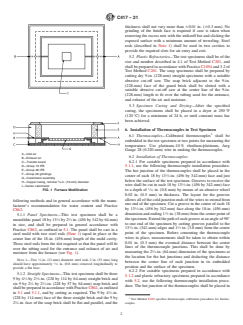
A—Inlet air
B—Exhaust air
C—Transite board
D—Group 16 IFB
E—Group 28 IFB
F—Group 28 grindings
G—Calorimeter assembly
H—Copper tubing, nominal ⁄8-in. (10-mm) diameter
I—Center calorimeter
FIG. 1 Furnace Modification
C417 − 21
5. Test Specimens
1 1
5.1 Castable Refractories—The test specimens may consist of either a panel 18 by 13 ⁄2 by 2 ⁄2 in. (456 by 342 by 64 mm), or
1 1 1 1
an assembly of three straights 9 by 4 ⁄2 by 2 ⁄2 in. (228 by 114 by 64 mm) and six soaps 9 by 2 ⁄4 by 2 ⁄2 in. (228 by 57 by 64
mm). These specimens shall be prepared as in one of the following methods and in general accordance with the manufacturer’s
recommendation for water content and Practice C862.
1 1
5.1.1 Panel Specimens—This test specimen shall be a monolithic panel 18 by 13 ⁄2 by 2 ⁄2 in. (456 by 342 by 64 mm) in size, and
shall be prepared in general accordance with Practice C862, as outlined in 5.1. The panel shall be cast in a steel mold with two
steel rods (Note 1) taped in place at the center line of the 18-in. (456-mm) length of the mold cavity. These steel rods form the
slot required so that the panel will fit over the tubing used for the entrance and exhaust of air and moisture from the furnace (see
Fig. 1).
1 1
NOTE 1—Two ⁄2-in. (13-mm) diameter steel rods 2 in. (51 mm) long should have approximately ⁄32 in. (0.8 mm) removed longitudinally to provide a
flat base.
1 1
5.1.2 Straight Specimens—This test specimen shall be three 9 by 4 ⁄2 by 2 ⁄2-in. (228 by 114 by 64-mm) straight brick and six 9
1 1
by 2 ⁄4 by 2 ⁄2-in. (228 by 57 by 64-mm) soap brick and shall be prepared in accordance with Practice C862, as outlined in 5.1
1 1
and 5.1.1, and by cutting as required. The 9 by 4 ⁄2-in. (228 by 114-mm) face of the three straight brick and the 9 by 2 ⁄4-in. face
of the soap brick shall be flat and parallel, and the thickness shall not vary more than 60.01 in. (60.3 mm). No grinding of the
finish face is required if care is taken when removing the excess mix with the strikeoff bar and slicking the exposed surface with
a minimum amount of troweling. Steel rods (described in Note 1) shall be used in two cavities to provide the required slots for
air entry and exit.
5.2 Plastic Refractories—The test specimens shall be of the size and number described in 4.1 of Test Method C201, and shall be
prepared in accordance with Practice C1054 and 3.2 of Test Method C201. The soap specimens shall be prepared by cutting dry
9-in. (228-mm) straight specimens with a suitable abrasive cut-off saw. The soap brick adjacent to the 9-in. (228-mm) face of the
guard brick shall be slotted with a suitable abrasive cut-off saw at the center line of the 9-in. (228-mm) length to fit over the tubing
used for the entrance, and exhaust of the air and moisture.
5.3 Specimen Curing and Drying—After the specified curing, the specimens shall be placed in a dryer at 250°F (120°C)250 °F
(120 °C) for a minimum of 24 h, or until constant mass has been achieved.
6. Installation of Thermocouples in Test Specimen
6.1 Thermocouples—Embed calibrated Calibrated thermocouples shall be embedded in the test specimen at two points for
measurement ofmeasuring the temperature. Use platinum-10 % rhodium/platinum,rhodium ⁄platinum, Awg Gauge 28 (0.320-mm)
wire in making the thermocouples.
6.2 Installation of Thermocouples:
6.2.1 For castable specimens prepared in accordance with 5.1.1, use the following thermocouple installation procedure. Place the
The hot junction of the thermocouples shall be placed in the center of each 18 by 13 ⁄2-in. (456 by 342-mm) face and just below
the surface of the test specimen. Cut grooves Grooves to receive the wire shall be cut in each 18 by 13 ⁄2-in. (456 by 342-mm)
face to a depth of ⁄32 in. (0.8 mm) by means of an abrasive wheel 0.02 in. (0.5 mm) in thickness. The layout for the grooves allows
all of the cold-junction ends of the wires to extend from one end of the specimen. Cut a groove in the center of each 18 by 13 ⁄2-in.
(456 by 342-mm) face along the 18-in. (456-mm) dimension and ending 1 ⁄2 in. (38 mm) from the center point of the specimen.
Extend the path of each groove at an angle of 90° to one end of the specimen by cutting grooves parallel to the 13 ⁄2-in. (342-mm)
edges and 1 ⁄2 in. (3.8 mm) from the center point of the specimen. Before cementing the thermocouple wires in place, take
measurements to obtain,measurements shall be taken to obtain within 0.01 in. (0.3 mm),mm) the eventual distance between the
center lines of the thermocouple junctions. Do this This shall be done by measuring the 2 ⁄2-in. (64-mm) dimension of the
specimens at the location for the hot junctions and deducting the distance between the center line of each junction in its embedded
position and the surface of the specimen.
6.2.2 For castable specimens prepared in accordance with 5.1.2 and plastic refractory specimens prepared in accordance with 5.2,
Test Method E220 specifies thermocouple calibration procedures for thermocouples.
C417 − 21
use the following thermocouple installation procedure. Place the The hot junction of the thermocouples shall be placed in the center
of each 9 by 4 ⁄2-in. (228 by 114-mm) face, and just below the surface of the test specimen. Cut grooves Grooves to receive the
1 1
wire shall be cut in each 9 by 4 ⁄2-in. (228 by 114-mm) face of the brick to a depth of ⁄32 in. (0.8 mm) by means of an abrasive
wheel 0.02 in. (0.5 mm) in thickness. The layout for the grooves allows all of the cold-junction ends of the wires to extend from
1 1
one end of the brick. Cut a groove in the center of each 9 by 4 ⁄2-in. (228 by 114-mm) face along the 4 ⁄2-in. (114-mm) dimension,
and ending 1 in. (25 mm) from the edge of the specimen. Before cementing the thermocou
...