


ASTM D3535-07a(2013)
(Test Method)Standard Test Method for Resistance to Creep Under Static Loading for Structural Wood Laminating Adhesives Used Under Exterior Exposure Conditions
Standard Test Method for Resistance to Creep Under Static Loading for Structural Wood Laminating Adhesives Used Under Exterior Exposure Conditions
SIGNIFICANCE AND USE
5.1 This test method rates the performance of the adhesive in laminated wood as measured by resistance to creep under static load.
5.2 This test method will normally be used in conjunction with Specification D2559.
SCOPE
1.1 This test method covers adhesives suitable for the bonding of wood, including treated wood, into structural laminated wood products for general construction, for marine use, or for other uses where a high-strength general construction, creep-resistant, waterproof adhesive bond is required.
1.2 The values stated in SI units are to be regarded as the standard. The values given in parentheses are for information only.
1.3 This standard does not purport to address all of the safety concerns, if any, associated with its use. It is the responsibility of the user of this standard to establish appropriate safety and health practices and determine the applicability of regulatory limitations prior to use.
General Information
Standards Content (Sample)
NOTICE: This standard has either been superseded and replaced by a new version or withdrawn.
Contact ASTM International (www.astm.org) for the latest information
Designation: D3535 − 07a (Reapproved 2013)
Standard Test Method for
Resistance to Creep Under Static Loading for Structural
Wood Laminating Adhesives Used Under Exterior Exposure
Conditions
This standard is issued under the fixed designation D3535; the number immediately following the designation indicates the year of
original adoption or, in the case of revision, the year of last revision. A number in parentheses indicates the year of last reapproval. A
superscript epsilon (´) indicates an editorial change since the last revision or reapproval.
1. Scope assemblies of specially selected and prepared wood lamina-
tions securely bonded together with adhesives, with the fol-
1.1 This test method covers adhesives suitable for the
lowing characteristics: (1) the grain of all laminations is
bonding of wood, including treated wood, into structural
approximately parallel longitudinally; and (2) the laminations
laminated wood products for general construction, for marine
may be comprised of pieces end-joined to form any length, of
use, or for other uses where a high-strength general
pieces placed or glued edge-to-edge to make wider ones or of
construction, creep-resistant, waterproof adhesive bond is re-
pieces bent to curved form during gluing. (Synonym glulam)
quired.
ANSI/AITC A190.1 – 2002, American National Standard for
1.2 The values stated in SI units are to be regarded as the
Wood Products—Structural Glued Laminated Timber (Edited
standard. The values given in parentheses are for information
to conform with ASTM format).
only.
3.1.3 For other terms used in this test method, refer to
1.3 This standard does not purport to address all of the
Terminology D907.
safety concerns, if any, associated with its use. It is the
responsibility of the user of this standard to establish appro-
4. Summary of Test Method
priate safety and health practices and determine the applica-
4.1 Gluedlaminationsaresubjectedtoaconstantloadunder
bility of regulatory limitations prior to use.
various combinations of temperature and relative humidity.
The amount of creep is measured.
2. Referenced Documents
2.1 ASTM Standards:
5. Significance and Use
A125 Specification for Steel Springs, Helical, Heat-Treated
5.1 This test method rates the performance of the adhesive
D907 Terminology of Adhesives
in laminated wood as measured by resistance to creep under
D2559 Specification for Adhesives for Bonded Structural
static load.
Wood Products for Use Under Exterior Exposure Condi-
5.2 This test method will normally be used in conjunction
tions
with Specification D2559.
3. Terminology
6. Apparatus
3.1 Definitions:
6.1 Compression-Type Creep Tester, as shown in Fig. 1,
3.1.1 glulam, n—synonym for structural-glued-laminated
required for testing the specimens under the static load. This
timber.
tester consists of:
3.1.2 structural-glued-laminated timber, n—an engineered,
6.1.1 Base Plate,
stress-rated product of a timber laminating plant comprising
6.1.2 Four Tension Rods,
6.1.3 Spacer Plate,
6.1.4 Center Rod,
This test method is under the jurisdiction of ASTM Committee D14 on
Adhesives and is the direct responsibility of Subcommittee D14.30 on Wood
Adhesives.
Current edition approved Oct. 1, 2013. Published October 2013. Originally Springs selected must fit within the space provided [approximately 110-mm
approved in 1976. Last previous edition approved in 2007 as D3535 – 07a. DOI: (4.3-in.) maximum outside diameter and 300-mm (11.8-in.) maximum overall
10.1520/D3535-07AR13. height] and should be of corrosion-resistant material (for example, stainless steel,
For referenced ASTM standards, visit the ASTM website, www.astm.org, or cadmium, or zinc-plated steel), should have a spring constant of 35 000 6 7000
contact ASTM Customer Service at service@astm.org. For Annual Book of ASTM N/m (200 6 40 lbf/in.) and a load when fully compressed (that is at solid height) of
Standards volume information, refer to the standard’s Document Summary page on about 4500 N (approximately 1000 lbf). For additional information, refer to
the ASTM website. Specification A125 for Steel Springs, Helical, Heat Treated.
Copyright © ASTM International, 100 Barr Harbor Drive, PO Box C700, West Conshohocken, PA 19428-2959. United States
D3535 − 07a (2013)
Metric Equivalents
mm in. mm in.
3.18 ⁄8 127 5
3 1
4.77 ⁄16 139.7 5 ⁄2
3 3
9.53 ⁄8 148 5 ⁄4
7 1
11.1 ⁄16 165.1 6 ⁄2
5 1
15.9 ⁄8 267 10 ⁄2
19.1 ⁄4 304.8 12
25.4 1 311.1 12 ⁄4
1 1
38.1 1 ⁄2 336.5 13 ⁄4
1 3
54.0 2 ⁄8 415 16 ⁄8
60.3 2 ⁄8 660.4 26
63.5 2 ⁄2
FIG. 1 Compression-Type Creep Tester
D3535 − 07a (2013)
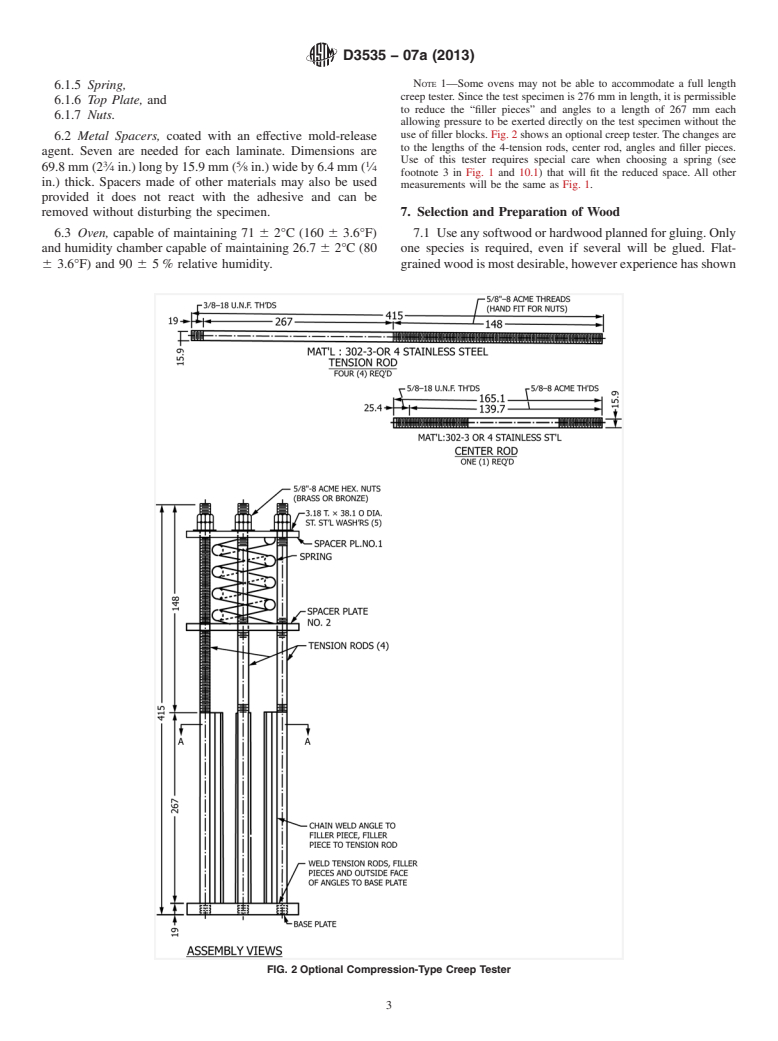
NOTE 1—Some ovens may not be able to accommodate a full length
6.1.5 Spring,
creep tester. Since the test specimen is 276 mm in length, it is permissible
6.1.6 Top Plate, and
to reduce the “filler pieces” and angles to a length of 267 mm each
6.1.7 Nuts.
allowing pressure to be exerted directly on the test specimen without the
use of filler blocks. Fig. 2 shows an optional creep tester. The changes are
6.2 Metal Spacers, coated with an effective mold-release
to the lengths of the 4-tension rods, center rod, angles and filler pieces.
agent. Seven are needed for each laminate. Dimensions are
Use of this tester requires special care when choosing a spring (see
3 5 1
69.8mm(2 ⁄4in.)longby15.9mm( ⁄8in.)wideby6.4mm( ⁄4
footnote 3 in Fig. 1 and 10.1) that will fit the reduced space. All other
in.) thick. Spacers made of other materials may also be used
measurements will be the same as Fig. 1.
provided it does not react with the adhesive and can be
removed without disturbing the specimen. 7. Selection and Preparation of Wood
6.3 Oven, capable of maintaining 71 6 2°C (160 6 3.6°F) 7.1 Useanysoftwoodorhardwoodplannedforgluing.Only
and humidity chamber capable of maintaining 26.7 6 2°C (80 one species is required, even if several will be glued. Flat-
6 3.6°F) and 90 6 5 % relative humidity. grainedwoodismostdesirable,howeverexperiencehasshown
FIG. 2 Optional Compression-Type Creep Tester
D3535 − 07a (2013)
that flat-grained specimens may break in the wood when
loaded. (This test measures only creep. Use Specification
D2559 to measure bondability to all species considered.)
7.2 The wood shall have a slope of grain not steeper than 1
in 15 on any face or any edge.The wood shall contain no knots
larger than 3.18 mm ( ⁄8 in.) in diameter and shall be free of
decay, machining defects (such as chipped grain, dubbed ends,
feed roll polish, coarse knife marks, and feed roll
compression), and any drying defects such as case hardening,
collapse, splits, or checks.
7.3 Condition the wood at 23 6 2°C (73.4 6 3.6°F) and a
relative humidity of 50 to 70 % (preferably 65 %) until a
moisturecontentof8to14 %or,pre
...
Questions, Comments and Discussion
Ask us and Technical Secretary will try to provide an answer. You can facilitate discussion about the standard in here.