

ASTM C736-12(2022)
(Test Method)Standard Test Method for Extension-Recovery and Adhesion of Latex Sealants
General Information
- Abstract
SIGNIFICANCE AND USE
5.1 This test method evaluates the performance of a latex sealant in joints subjected to a limited amount of extension.
SCOPE
1.1 This test method covers a laboratory procedure for the determination of the extension-recovery and adhesion of latex sealants.
1.2 The values stated in SI units are to be regarded as standard. The values given in parentheses after SI units are provided for information only and are not considered standard.
1.3 This standard does not purport to address all of the safety concerns, if any, associated with its use. It is the responsibility of the user of this standard to establish appropriate safety, health, and environmental practices and determine the applicability of regulatory limitations prior to use.
Note 1: A related ISO standard is ISO 7389. Users should compare to determine how the ISO standard differs from this test method.
1.4 This international standard was developed in accordance with internationally recognized principles on standardization established in the Decision on Principles for the Development of International Standards, Guides and Recommendations issued by the World Trade Organization Technical Barriers to Trade (TBT) Committee.
- Status
- Published
- Publication Date
- 31-Dec-2021
- Technical Committee
- C24 - Building Seals and Sealants
- Drafting Committee
- C24.30 - Adhesion


Overview
ASTM C736-12(2022) - Standard Test Method for Extension-Recovery and Adhesion of Latex Sealants establishes a laboratory procedure to evaluate the performance of latex sealants when subjected to extension and tests their ability to recover and adhere to surfaces. Issued by ASTM International, this standard is widely referenced in the building and construction sectors for assessing joint sealant quality. The method is essential for determining both the extension-recovery (elastic recovery) and adhesion of latex-based sealants when used in joints exposed to limited movement.
Key Topics
- Purpose: The primary aim is to determine the extension-recovery and adhesion characteristics of latex sealants under controlled laboratory conditions.
- Test Scope: The standard provides a method where joints between glass and aluminum plate substrates are filled with sealant, aged, extended by 25%, and then allowed to recover. Adhesion to both glass and aluminum is measured after the test.
- Measurement Parameters:
- Percent recovery - the ability of the sealant to return to its original shape after extension.
- Percent adhesive failure - the amount of loss of adhesion to glass and aluminum after specified extension and recovery cycles.
- Specimen Preparation: Specimens are conditioned and tested under specific temperature and humidity settings, and sealants are tested as supplied by the manufacturer.
- SI Units: Standard measurements are in SI units; parenthetical values are for information only.
- Safety Notice: Users must handle the materials and procedure following appropriate safety, health, and environmental guidelines.
Applications
Implementing ASTM C736-12(2022) is valuable across multiple aspects of building construction and manufacturing:
- Sealant Quality Assurance: Manufacturers utilize this standard to test batches of latex sealants for compliance with durability and performance benchmarks before releasing products to the market.
- Product Development: Research and development teams rely on extension-recovery and adhesion data to refine latex sealant formulations for improved performance under joint movement.
- Construction Specifications: Architects and engineers reference this method when specifying sealants for use in buildings where joints are exposed to thermal or structural movement.
- Compliance and Comparison: The standard's results help stakeholders benchmark different latex sealants and ensure they meet project requirements and regulatory expectations.
Related Standards
For a holistic approach to sealant testing and to assure international compatibility, the following standards are relevant:
- ASTM C717: Provides terminology for building seals and sealants, supporting clear communication in testing and specification.
- ASTM C1375: Details suitable substrates for use during the testing of building seals and sealants.
- ISO 7389: International standard outlining the determination of elastic recovery for building construction sealants; users are encouraged to compare the ISO and ASTM standards for any application-specific differences.
Practical Value
Using ASTM C736-12(2022) helps organizations verify the adhesion and recovery capabilities of latex sealants, ensuring effective performance and longevity in real-world joint applications. Adherence to this test method provides confidence in product quality and can prevent premature failures in building envelopes, resulting in cost savings and improved structure durability.
Keywords
latex sealant test, extension-recovery, adhesion of sealants, ASTM C736, sealant performance, joint movement, construction standards, building sealants, quality assurance, elastic recovery
Relations
- Refers
ASTM C1375-00(2020) - Standard Guide for Substrates Used in Testing Building Seals and Sealants - Effective Date
- 01-Jan-2020
- Effective Date
- 01-Mar-2019
- Effective Date
- 01-Mar-2018
- Effective Date
- 01-Nov-2017
- Effective Date
- 01-Jan-2017
- Effective Date
- 15-Nov-2016
- Effective Date
- 01-Sep-2016
- Effective Date
- 01-May-2014
- Effective Date
- 01-Feb-2014
- Refers
ASTM C1375-00(2014) - Standard Guide for Substrates Used in Testing Building Seals and Sealants - Effective Date
- 01-Jan-2014
- Effective Date
- 01-Nov-2013
- Effective Date
- 01-Dec-2012
- Effective Date
- 01-May-2012
- Effective Date
- 15-Jan-2012
- Effective Date
- 01-Mar-2011
Get Certified
Connect with accredited certification bodies for this standard

DIBt (Deutsches Institut für Bautechnik)
German Institute for Building Technology.
DIN CERTCO
DIN Group product certification.

Aboma Certification B.V.
Specialized in construction, metal, and transport sectors.
Sponsored listings
Frequently Asked Questions
ASTM C736-12(2022) is a standard published by ASTM International. Its full title is "Standard Test Method for Extension-Recovery and Adhesion of Latex Sealants". This standard covers: SIGNIFICANCE AND USE 5.1 This test method evaluates the performance of a latex sealant in joints subjected to a limited amount of extension. SCOPE 1.1 This test method covers a laboratory procedure for the determination of the extension-recovery and adhesion of latex sealants. 1.2 The values stated in SI units are to be regarded as standard. The values given in parentheses after SI units are provided for information only and are not considered standard. 1.3 This standard does not purport to address all of the safety concerns, if any, associated with its use. It is the responsibility of the user of this standard to establish appropriate safety, health, and environmental practices and determine the applicability of regulatory limitations prior to use. Note 1: A related ISO standard is ISO 7389. Users should compare to determine how the ISO standard differs from this test method. 1.4 This international standard was developed in accordance with internationally recognized principles on standardization established in the Decision on Principles for the Development of International Standards, Guides and Recommendations issued by the World Trade Organization Technical Barriers to Trade (TBT) Committee.
SIGNIFICANCE AND USE 5.1 This test method evaluates the performance of a latex sealant in joints subjected to a limited amount of extension. SCOPE 1.1 This test method covers a laboratory procedure for the determination of the extension-recovery and adhesion of latex sealants. 1.2 The values stated in SI units are to be regarded as standard. The values given in parentheses after SI units are provided for information only and are not considered standard. 1.3 This standard does not purport to address all of the safety concerns, if any, associated with its use. It is the responsibility of the user of this standard to establish appropriate safety, health, and environmental practices and determine the applicability of regulatory limitations prior to use. Note 1: A related ISO standard is ISO 7389. Users should compare to determine how the ISO standard differs from this test method. 1.4 This international standard was developed in accordance with internationally recognized principles on standardization established in the Decision on Principles for the Development of International Standards, Guides and Recommendations issued by the World Trade Organization Technical Barriers to Trade (TBT) Committee.
ASTM C736-12(2022) is classified under the following ICS (International Classification for Standards) categories: 91.100.50 - Binders. Sealing materials. The ICS classification helps identify the subject area and facilitates finding related standards.
ASTM C736-12(2022) has the following relationships with other standards: It is inter standard links to ASTM C1375-00(2020), ASTM C717-19, ASTM C717-18, ASTM C717-17a, ASTM C717-17, ASTM C717-16a, ASTM C717-16, ASTM C717-14a, ASTM C717-14, ASTM C1375-00(2014), ASTM C717-13, ASTM C717-12b, ASTM C717-12a, ASTM C717-12, ASTM C717-11a. Understanding these relationships helps ensure you are using the most current and applicable version of the standard.
ASTM C736-12(2022) is available in PDF format for immediate download after purchase. The document can be added to your cart and obtained through the secure checkout process. Digital delivery ensures instant access to the complete standard document.
Standards Content (Sample)
This international standard was developed in accordance with internationally recognized principles on standardization established in the Decision on Principles for the
Development of International Standards, Guides and Recommendations issued by the World Trade Organization Technical Barriers to Trade (TBT) Committee.
Designation: C736 − 12 (Reapproved 2022)
Standard Test Method for
Extension-Recovery and Adhesion of Latex Sealants
This standard is issued under the fixed designation C736; the number immediately following the designation indicates the year of
original adoption or, in the case of revision, the year of last revision. A number in parentheses indicates the year of last reapproval. A
superscript epsilon (´) indicates an editorial change since the last revision or reapproval.
1. Scope 3. Terminology
3.1 Definitions—Refer to Terminology C717 for definitions
1.1 This test method covers a laboratory procedure for the
of the terms used in this test method.
determination of the extension-recovery and adhesion of latex
sealants.
4. Summary of Test Method
1.2 The values stated in SI units are to be regarded as
4.1 A joint of prescribed dimensions, between glass and
standard. The values given in parentheses after SI units are
aluminum plates is filled with the sealant. After an aging
provided for information only and are not considered standard.
period, the joint width is increased 25 %, the force is removed,
and the specimen is permitted to recover. The amount of
1.3 This standard does not purport to address all of the
recovery and the percent of adhesion loss are measured.
safety concerns, if any, associated with its use. It is the
responsibility of the user of this standard to establish appro-
5. Significance and Use
priate safety, health, and environmental practices and deter-
5.1 This test method evaluates the performance of a latex
mine the applicability of regulatory limitations prior to use.
sealant in joints subjected to a limited amount of extension.
NOTE 1—Arelated ISO standard is ISO 7389. Users should compare to
determine how the ISO standard differs from this test method.
6. Apparatus
1.4 This international standard was developed in accor-
6.1 Extension Machine that can be operated at a steady rate
dance with internationally recognized principles on standard-
of12.7mm/min(0.5in./min)andheldatconstantextensionfor
ization established in the Decision on Principles for the
5 min.
Development of International Standards, Guides and Recom-
6.2 Aluminum Alloy Plates, six, anodized, 6.4 mm by 25.4
mendations issued by the World Trade Organization Technical
mm by 76.2 mm ( ⁄4 in. by 1 in. by 3 in.). Plates shall conform
Barriers to Trade (TBT) Committee.
to Guide C1375.
6.3 Glass Plates, six, 6.4 mm by 25.4 mm by 76.2 mm ( ⁄4
2. Referenced Documents
in. by 1 in. by 3 in.). Plates shall conform to Guide C1375.
2.1 ASTM Standards:
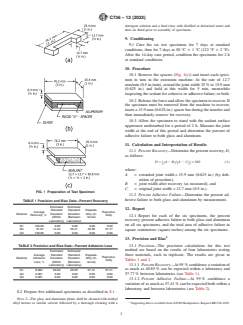
6.4 U Shaped Spacers, six, as shown in Fig. 1(a) made of a
C717 Terminology of Building Seals and Sealants
rigid, nonadhering material such as polyethylene, TFE-
C1375 Guide for Substrates Used in Testing Building Seals
fluorocarbon, or release-covered metal.
and Sealants
6.5 Metal C Clamps, twelve.
2.2 ISO Standard:
6.6 Circulating Air Oven, capable of maintaining 50 °C 6 1
ISO 7389 Building Construction–Sealants–Determination of
°C (122 °F 6 2 °F).
Elastic Recovery
7. Sampling
7.1 Take the sealant to be tested directly from the container
ThistestmethodisunderthejurisdictionofASTMCommitteeC24onBuilding
as commercially supplied by the manufacturer.
Seals and Sealantsand is the direct responsibility of Subcommittee C24.30 on
Adhesion.
8. Test Specimens
Current edition approved Jan. 1, 2022. Published January 2022. Originally
approved in 1972. Last previous edition approved in 2017 as C736 – 12 (2017).
8.1 Prepare a test specimen as follows: Apply a bead of
DOI: 10.1520/C0736-12R22.
1 1
sealant, 12.7 mm by 12.7 mm by 50.8 mm ( ⁄2 in. by ⁄2 in. by
For referenced ASTM standards, visit the ASTM website, www.astm.org, or
contact ASTM Customer Service at service@astm.org. For Annual Book of ASTM
2 in.) between parallel glass and anodized aluminum plates as
Standards volume information, refer to the standard’s Document Summary page on
shown in Fig. 1(b), using rigid, nonadhering spacer bars. Use
the ASTM website.
the C-clamps to hold the test assembly during the filling and
Available from theAmerican National Standards Institute, 11 W. 42nd St., 13th
Floor, New York, NY 10036. subsequent curing and handling of the specimens.
Copyright © ASTM International, 100 Barr Harbor Drive, PO Box C700, West Conshohocken, PA 19428-2959. United States
C736 − 12 (2022)
detergent solution and a final rinse with distilled or deionized water and
then air dried prior to assembly of specimens.
9. Conditioning
9.1 Cure the six test specimens for 7 days at st
...