

ASTM D6900-10(2020)
(Test Method)Standard Test Method for Wet Adhesion of Latex Paints to a Gloss Alkyd Enamel Substrate
General Information
- Abstract
SIGNIFICANCE AND USE
5.1 After application to either interior or exterior surfaces, latex paints may be subjected to conditions of high humidity, condensation, or precipitation. This may sometimes lead to a loss of adhesion to the substrate over which they have been applied. This method is a quantitative measure of the adhesion of latex paints to glossy substrates under such conditions.
SCOPE
1.1 This test method covers a procedure for measuring by scrubbing the adhesion of latex paints to glossy alkyd enamel substrates after exposure to wet conditions.
1.2 The values stated in SI units are to be regarded as the standard. The values given in parentheses are for information only.
1.3 This standard does not purport to address all of the safety concerns, if any, associated with its use. It is the responsibility of the user of this standard to establish appropriate safety, health, and environmental practices and determine the applicability of regulatory limitations prior to use.
1.4 This international standard was developed in accordance with internationally recognized principles on standardization established in the Decision on Principles for the Development of International Standards, Guides and Recommendations issued by the World Trade Organization Technical Barriers to Trade (TBT) Committee.
- Status
- Published
- Publication Date
- 30-Nov-2020
- Technical Committee
- D01 - Paint and Related Coatings, Materials, and Applications
- Drafting Committee
- D01.42 - Architectural Coatings

Overview
ASTM D6900-10(2020) establishes a standardized test method for measuring the wet adhesion of latex paints applied to gloss alkyd enamel substrates. Developed by ASTM International, this standard provides an objective procedure to assess and compare the ability of latex coatings to resist removal from glossy surfaces after exposure to wet conditions and mechanical abrasion. The method is essential for evaluating the performance of latex paints used on both interior and exterior surfaces, particularly where moisture exposure is expected.
Key Topics
- Wet Adhesion Definition: Wet adhesion is the ability of a coating to withstand being scrubbed or removed from a glossy substrate after exposure to water or humid conditions.
- Test Procedure:
- Preparation of glossy alkyd enamel panels as substrates.
- Application of latex paint over the prepared panels.
- Scrubbing the painted panels in a controlled environment after a period of water immersion.
- Measurements:
- Quantification of adhesive failure via percent removal or the number of scrub cycles until paint detachment.
- Use of repeatability and reproducibility statistics to assess the reliability of test results across different laboratories.
- Standardization Principles: The standard follows internationally accepted principles, supporting global trade and product quality assurance.
Applications
ASTM D6900-10(2020) provides practical value in a variety of contexts within the paint and coatings industry, including:
- Product Development: Paint manufacturers use this test to assess and improve the performance of new or modified latex paint formulations for enhanced wet adhesion on glossy substrates.
- Quality Control: Consistent testing using this methodology ensures that production batches meet required performance standards, reducing the risk of product failure in the field.
- Specification Compliance: The method helps manufacturers, specifiers, and contractors confirm that coatings comply with project and regulatory requirements related to moisture resistance and adhesion.
- Comparative Analysis: Laboratories and research institutions utilize the standard for benchmarking different latex paints and documenting performance claims.
- Field Failure Investigation: When paint failure due to moisture is reported, this standard provides a reproducible approach to investigate causes and recommend suitable products.
Related Standards
For a comprehensive evaluation of paint performance and adherence to industry best practices, ASTM D6900-10(2020) is frequently used in conjunction with other ASTM standards, including:
- ASTM D2486 – Test Methods for Scrub Resistance of Wall Paints
- ASTM D523 – Test Method for Specular Gloss
- ASTM D714 – Test Method for Evaluating Degree of Blistering of Paints
- ASTM D3924 – Specification for Standard Environment for Conditioning and Testing Paint, Varnish, Lacquer, and Related Materials
- ASTM E691 – Practice for Conducting an Interlaboratory Study to Determine the Precision of a Test Method
- ASTM E177 – Practice for Use of the Terms Precision and Bias in ASTM Test Methods
Practical Value
Implementing ASTM D6900-10(2020) supports:
- Reliability and durability in construction and renovation projects
- Minimized paint failures in high-humidity or damp environments
- Enhanced confidence in product selection through objective, comparable data
- Alignment with international best practices for paint adhesion testing
Ensuring robust wet adhesion performance is critical for end-user satisfaction and long-term appearance and protection of coated substrates. Following the guidance in ASTM D6900-10(2020) enables manufacturers and specifiers to deliver paints that reliably perform in challenging wet conditions.
Relations
- Effective Date
- 01-Jun-2017
- Effective Date
- 01-Dec-2016
- Effective Date
- 01-Apr-2016
- Effective Date
- 01-May-2014
- Effective Date
- 01-Jan-2014
- Effective Date
- 01-May-2013
- Effective Date
- 01-May-2013
- Effective Date
- 01-Nov-2011
- Effective Date
- 01-Jun-2011
- Effective Date
- 01-Oct-2010
- Effective Date
- 01-Jul-2009
- Effective Date
- 01-Oct-2008
- Effective Date
- 01-Oct-2008
- Effective Date
- 01-Jun-2008
- Effective Date
- 01-Feb-2008
Frequently Asked Questions
ASTM D6900-10(2020) is a standard published by ASTM International. Its full title is "Standard Test Method for Wet Adhesion of Latex Paints to a Gloss Alkyd Enamel Substrate". This standard covers: SIGNIFICANCE AND USE 5.1 After application to either interior or exterior surfaces, latex paints may be subjected to conditions of high humidity, condensation, or precipitation. This may sometimes lead to a loss of adhesion to the substrate over which they have been applied. This method is a quantitative measure of the adhesion of latex paints to glossy substrates under such conditions. SCOPE 1.1 This test method covers a procedure for measuring by scrubbing the adhesion of latex paints to glossy alkyd enamel substrates after exposure to wet conditions. 1.2 The values stated in SI units are to be regarded as the standard. The values given in parentheses are for information only. 1.3 This standard does not purport to address all of the safety concerns, if any, associated with its use. It is the responsibility of the user of this standard to establish appropriate safety, health, and environmental practices and determine the applicability of regulatory limitations prior to use. 1.4 This international standard was developed in accordance with internationally recognized principles on standardization established in the Decision on Principles for the Development of International Standards, Guides and Recommendations issued by the World Trade Organization Technical Barriers to Trade (TBT) Committee.
SIGNIFICANCE AND USE 5.1 After application to either interior or exterior surfaces, latex paints may be subjected to conditions of high humidity, condensation, or precipitation. This may sometimes lead to a loss of adhesion to the substrate over which they have been applied. This method is a quantitative measure of the adhesion of latex paints to glossy substrates under such conditions. SCOPE 1.1 This test method covers a procedure for measuring by scrubbing the adhesion of latex paints to glossy alkyd enamel substrates after exposure to wet conditions. 1.2 The values stated in SI units are to be regarded as the standard. The values given in parentheses are for information only. 1.3 This standard does not purport to address all of the safety concerns, if any, associated with its use. It is the responsibility of the user of this standard to establish appropriate safety, health, and environmental practices and determine the applicability of regulatory limitations prior to use. 1.4 This international standard was developed in accordance with internationally recognized principles on standardization established in the Decision on Principles for the Development of International Standards, Guides and Recommendations issued by the World Trade Organization Technical Barriers to Trade (TBT) Committee.
ASTM D6900-10(2020) is classified under the following ICS (International Classification for Standards) categories: 87.040 - Paints and varnishes. The ICS classification helps identify the subject area and facilitates finding related standards.
ASTM D6900-10(2020) has the following relationships with other standards: It is inter standard links to ASTM D2486-17, ASTM D2486-06(2016), ASTM D3924-16, ASTM E177-14, ASTM D523-14, ASTM E177-13, ASTM E691-13, ASTM E691-11, ASTM D3924-80(2011), ASTM E177-10, ASTM D714-02(2009), ASTM E691-08, ASTM E177-08, ASTM D523-08, ASTM D523-89(2008). Understanding these relationships helps ensure you are using the most current and applicable version of the standard.
ASTM D6900-10(2020) is available in PDF format for immediate download after purchase. The document can be added to your cart and obtained through the secure checkout process. Digital delivery ensures instant access to the complete standard document.
Standards Content (Sample)
This international standard was developed in accordance with internationally recognized principles on standardization established in the Decision on Principles for the
Development of International Standards, Guides and Recommendations issued by the World Trade Organization Technical Barriers to Trade (TBT) Committee.
Designation: D6900 − 10 (Reapproved 2020)
Standard Test Method for
Wet Adhesion of Latex Paints to a Gloss Alkyd Enamel
Substrate
This standard is issued under the fixed designation D6900; the number immediately following the designation indicates the year of
original adoption or, in the case of revision, the year of last revision. A number in parentheses indicates the year of last reapproval. A
superscript epsilon (´) indicates an editorial change since the last revision or reapproval.
1. Scope 3. Terminology
1.1 This test method covers a procedure for measuring by 3.1 Definitions of Terms Specific to This Standard:
scrubbing the adhesion of latex paints to glossy alkyd enamel
3.1.1 wet adhesion, n—the ability of a coating to resist
substrates after exposure to wet conditions.
removal by scrubbing from the surface beneath it after expo-
sure to wet conditions and abrasion.
1.2 The values stated in SI units are to be regarded as the
standard. The values given in parentheses are for information
4. Summary of Test Method
only.
4.1 Test paints, with optional control paint, are drawn down
1.3 This standard does not purport to address all of the
using a 7-mil clearance Dow applicator (~11 m /L) across a
safety concerns, if any, associated with its use. It is the
cured alkyd gloss enamel previously drawn down on a black or
responsibility of the user of this standard to establish appro-
white plastic panel.
priate safety, health, and environmental practices and deter-
mine the applicability of regulatory limitations prior to use.
4.2 The drawdown films are allowed to dry under standard-
1.4 This international standard was developed in accor-
izedconditions.Then,eighteencutsaremadetoforma6by10
dance with internationally recognized principles on standard-
cut block, creating sixty 6.4 mm (0.25 in) squares, in the center
ization established in the Decision on Principles for the
of each film with a razor blade.
Development of International Standards, Guides and Recom-
4.3 The panels are then soaked for 30 min in ambient tap
mendations issued by the World Trade Organization Technical
water. The panel is mounted in a washability tester and 20 mL
Barriers to Trade (TBT) Committee.
of water are applied. The panel is then scrubbed for up to 500
cycles or until all of the squares within each block are
2. Referenced Documents
2 completely removed.
2.1 ASTM Standards:
D523 Test Method for Specular Gloss
5. Significance and Use
D714 Test Method for Evaluating Degree of Blistering of
Paints
5.1 After application to either interior or exterior surfaces,
D2486 Test Methods for Scrub Resistance of Wall Paints
latex paints may be subjected to conditions of high humidity,
D3924 Specification for Standard Environment for Condi- condensation, or precipitation. This may sometimes lead to a
tioning and Testing Paint, Varnish, Lacquer, and Related
loss of adhesion to the substrate over which they have been
Materials applied. This method is a quantitative measure of the adhesion
E691 Practice for Conducting an Interlaboratory Study to
of latex paints to glossy substrates under such conditions.
Determine the Precision of a Test Method
E177 Practice for Use of the Terms Precision and Bias in
6. Apparatus
ASTM Test Methods
6.1 Constanttemperature/humidityroominaccordancewith
Specification D3924 [23 6 2°C (73.5 6 3.5°F) and 50 65%
1 relative humidity].
This test method is under the jurisdiction of ASTM Committee D01 on Paint
and Related Coatings, Materials, andApplications and is the direct responsibility of
6.2 Drawdown Plate.
Subcommittee D01.42 on Architectural Coatings.
Current edition approved Dec. 1, 2020. Published December 2020. Originally
6.3 Straight Line Washability Tester and Accessories, per
approved in 2003. Last previous edition approved in 2015 as D6900 – 10 (2015).
Test Methods D2486.
DOI:10.1520/D6900-10R20.
For referenced ASTM standards, visit the ASTM website, www.astm.org, or
6.4 Nylon Bristle Brush and Accessories (nominal weight
contact ASTM Customer Service at service@astm.org. For Annual Book of ASTM
455 g), having nylon brush bristles in 5/4 pattern extending 19
Standards volume information, refer to the standard’s Document Summary page on
the ASTM website. mm ( ⁄4 in.) from block (as per Test Methods D2486).
Copyright © ASTM International, 100 Barr Harbor Drive, PO Box C700, West Conshohocken, PA 19428-2959. United States
D6900 − 10 (2020)
6.5 Dow FilmApplicator,having7-mil(0.18-mm)clearance 8.2.2 Condition the panels for one week in the constant
by 5.2-in. (132-mm) width. applicator blade. temperature/humidity room as specified in Specification
D3924 or under other conditions agreed upon by buyer and
6.6 Single-edge Razor Blade, in safety holder.
seller.Shorterconditioningtimesmaybeusedifmorestringent
6.7 Metal Straight Edge (or appropriate guide).
measures of wet adhesion are needed, as in the case of
determining a coating’s “early” wet adhesion.
7. Reagents and Materials
NOTE 2—Since humidity and temperature both markedly influence the
7.1 A ready-mix deep-tint alkyd gloss enamel with a 60°
rateatwhichpaintdries,aconstanttemperature/humidityroomisstrongly
gloss of at least 65 as measured in accordance with Test
recommended in order to achieve reproducible results using this method.
Method D523 (or alkyd as agreed upon by the purchaser and
8.2.3 Condition, break in and rinse the scrub brush as
supplier).
specified in Test Methods D2486.
7.2 Plastic test panels as used in Test Methods D2486.
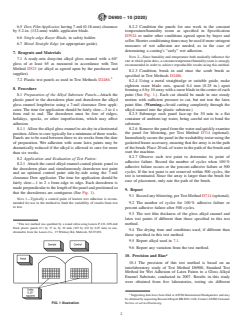
8.2.4 Using a metal straightedge or suitable guide, make
eighteen razor blade cuts, spaced 6.4 mm (0.25 in.) apart
8. Procedure
forminga6by10 array with a razor blade in the center of each
8.1 Preparation of the Alkyd Substrate Panels—Attach the paint (See Fig. 1.). Each cut should be made in one steady
motion with sufficient pressure to cut, but not tear the latex
plastic panel to the drawdown plate and drawdown the alkyd
gloss enamel lengthwise using a 7-mil clearance Dow appli- paint film. (Warning—Avoid cutting completely through the
alkyd enamel into the plastic substrate.)
cator. The time for application should be fairly slow—3 to 4 s
from end to end. The drawdown must be free of ridges, 8.2.5 Submerge each panel face-up for 30 min in a flat
container of ambient tap water, being careful not to bend the
holidays, specks, or other imperfections, which may affect
adhesion. substrate.
8.2.6 Removethepanelfromthewaterandquicklyexamine
8.1.1 Allow the alkyd gloss enamel to air-dry in a horizontal
position.Allowtocuretypicallyforaminimumofthreeweeks. the panel for blistering, per Test Method D714 (optional).
Immediatelysecurethepanelinthewashabilitytesterusingthe
Panels are to be used between three to six weeks from the date
of preparation. Wet adhesion with some latex paints may be gasketed frame accessory, ensuring that the array is in the path
of the brush. Place 20 mLof water in the path of the brush and
dramatically reduced if the alkyd is allowed to cure for more
than six weeks.
...