

ASTM E2692-10(2018)
(Test Method)Standard Test Method for Structural Performance of Thermal Barriers in Fenestration Products
General Information
- Abstract
SIGNIFICANCE AND USE
5.1 Thermal barriers require sufficient structural strength to carry the loads imposed on fenestration members while reducing the heat transfer through the depth of the framing members throughout their service life.
5.2 Sustained gravity, bending and tensile loads that stress the thermal barrier (that is, glazing infill weight, wind loads, and glazing gasket pressure) are not covered by this test method.
5.3 The reader is encouraged to read AAMA TIR-A8 for further information on thermal barriers and testing.
SCOPE
1.1 This test method evaluates the longitudinal shear strength before and after thermal cycling for thermally broken composite thermal barriers used in framing of windows, doors, and skylights. It also evaluates the ability of a thermal barrier to maintain its longitudinal dimension after thermal cycling.
1.2 This test method is applicable to all fenestration products that are constructed with structural thermal barriers that are affixed along their length to the adjoining metal profile
1.3 This test method is meant to be applicable to many types of fenestration frame types and is not meant to be specific to any single frame construction type.
1.4 The values stated in SI units are to be regarded as standard. No other units of measurement are included in this standard.
1.5 This standard does not purport to address all of the safety concerns, if any, associated with its use. It is the responsibility of the user of this standard to establish appropriate safety, health, and environmental practices and determine the applicability of regulatory limitations prior to use.
1.6 This international standard was developed in accordance with internationally recognized principles on standardization established in the Decision on Principles for the Development of International Standards, Guides and Recommendations issued by the World Trade Organization Technical Barriers to Trade (TBT) Committee.
- Status
- Published
- Publication Date
- 31-Aug-2018
- Technical Committee
- E06 - Performance of Buildings
- Drafting Committee
- E06.51 - Performance of Windows, Doors, Skylights and Curtain Walls
Overview
ASTM E2692-10(2018): Standard Test Method for Structural Performance of Thermal Barriers in Fenestration Products sets a recognized procedure for evaluating the structural performance of thermally broken composite thermal barriers. Specifically, this standard measures the longitudinal shear strength before and after thermal cycling, as well as the ability of the thermal barrier to maintain its longitudinal dimensions. These requirements are crucial for ensuring windows, doors, and skylights with thermal breaks retain structural integrity and promote energy efficiency throughout their service life. ASTM E2692 applies globally to all fenestration products using structural thermal barriers affixed to adjoining metal profiles.
Key Topics
- Thermal Barrier Structural Strength: Assesses the capacity of thermal barriers to sustain mechanical loads imposed on fenestration frames, helping maintain durability while reducing heat transfer.
- Longitudinal Shear Strength: Evaluates how well a thermal barrier resists shearing forces both before and after thermal stress cycling.
- Thermal Cycling Resistance: Measures the dimensional stability and adhesion of the thermal barrier subjected to repeated temperature variations-from cold to hot-simulating real-world weathering.
- Failure Modes: Defines and identifies adhesive failure, cohesive failure, and metal failure during testing, crucial for quality assurance and product improvement.
- Applicability: Designed for all fenestration frame types and does not favor any specific construction, making it suitable for various window, door, and skylight systems.
- Measurement and Conditioning: Requires specimens from actual production inventory, ensuring results reflect real-life application performance.
Applications
ASTM E2692-10(2018) is essential for:
- Manufacturers of Fenestration Products: Ensures that windows, doors, and skylights with structural thermal barriers meet required performance benchmarks for longevity, safety, and efficiency.
- Building Product Certification and Quality Assurance: Helps in product testing, certification programs, and quality control processes by standardizing test criteria for composite thermal barriers, especially relevant to energy-efficient construction.
- Architects, Designers, and Specifiers: Facilitates specification of fenestration products that comply with recognized standards for structural strength and energy efficiency.
- Construction and Building Regulations: Supports compliance with local and international codes that reference ASTM standards for product safety and performance.
- R&D and Product Development: Aids in the development and innovation of new fenestration systems by providing a repeatable, comparative testing methodology.
Related Standards
- AAMA TIR-A8: Provides additional guidance on the performance and testing of composite thermal barrier framing systems.
- AAMA 505: Prescribes thermal cycling test procedures for dry shrinkage and composite performance.
- Other ASTM Fenestration Standards: Specifications developed by ASTM Committee E06 on Performance of Buildings for windows, doors, curtain walls, and skylights.
- ISO and International Standardization: ASTM E2692 aligns with WTO Technical Barriers to Trade principles, promoting global acceptance and harmonization.
By referencing ASTM E2692-10(2018), stakeholders ensure that fenestration products meet structural and energy efficiency requirements, supporting high-performance building envelopes worldwide. For further details on test procedures and installation guidelines, users are encouraged to consult AAMA TIR-A8 and other related standards.
Relations
- Effective Date
- 01-Sep-2018
Get Certified
Connect with accredited certification bodies for this standard

DIBt (Deutsches Institut für Bautechnik)
German Institute for Building Technology.
DIN CERTCO
DIN Group product certification.

Aboma Certification B.V.
Specialized in construction, metal, and transport sectors.
Sponsored listings
Frequently Asked Questions
ASTM E2692-10(2018) is a standard published by ASTM International. Its full title is "Standard Test Method for Structural Performance of Thermal Barriers in Fenestration Products". This standard covers: SIGNIFICANCE AND USE 5.1 Thermal barriers require sufficient structural strength to carry the loads imposed on fenestration members while reducing the heat transfer through the depth of the framing members throughout their service life. 5.2 Sustained gravity, bending and tensile loads that stress the thermal barrier (that is, glazing infill weight, wind loads, and glazing gasket pressure) are not covered by this test method. 5.3 The reader is encouraged to read AAMA TIR-A8 for further information on thermal barriers and testing. SCOPE 1.1 This test method evaluates the longitudinal shear strength before and after thermal cycling for thermally broken composite thermal barriers used in framing of windows, doors, and skylights. It also evaluates the ability of a thermal barrier to maintain its longitudinal dimension after thermal cycling. 1.2 This test method is applicable to all fenestration products that are constructed with structural thermal barriers that are affixed along their length to the adjoining metal profile 1.3 This test method is meant to be applicable to many types of fenestration frame types and is not meant to be specific to any single frame construction type. 1.4 The values stated in SI units are to be regarded as standard. No other units of measurement are included in this standard. 1.5 This standard does not purport to address all of the safety concerns, if any, associated with its use. It is the responsibility of the user of this standard to establish appropriate safety, health, and environmental practices and determine the applicability of regulatory limitations prior to use. 1.6 This international standard was developed in accordance with internationally recognized principles on standardization established in the Decision on Principles for the Development of International Standards, Guides and Recommendations issued by the World Trade Organization Technical Barriers to Trade (TBT) Committee.
SIGNIFICANCE AND USE 5.1 Thermal barriers require sufficient structural strength to carry the loads imposed on fenestration members while reducing the heat transfer through the depth of the framing members throughout their service life. 5.2 Sustained gravity, bending and tensile loads that stress the thermal barrier (that is, glazing infill weight, wind loads, and glazing gasket pressure) are not covered by this test method. 5.3 The reader is encouraged to read AAMA TIR-A8 for further information on thermal barriers and testing. SCOPE 1.1 This test method evaluates the longitudinal shear strength before and after thermal cycling for thermally broken composite thermal barriers used in framing of windows, doors, and skylights. It also evaluates the ability of a thermal barrier to maintain its longitudinal dimension after thermal cycling. 1.2 This test method is applicable to all fenestration products that are constructed with structural thermal barriers that are affixed along their length to the adjoining metal profile 1.3 This test method is meant to be applicable to many types of fenestration frame types and is not meant to be specific to any single frame construction type. 1.4 The values stated in SI units are to be regarded as standard. No other units of measurement are included in this standard. 1.5 This standard does not purport to address all of the safety concerns, if any, associated with its use. It is the responsibility of the user of this standard to establish appropriate safety, health, and environmental practices and determine the applicability of regulatory limitations prior to use. 1.6 This international standard was developed in accordance with internationally recognized principles on standardization established in the Decision on Principles for the Development of International Standards, Guides and Recommendations issued by the World Trade Organization Technical Barriers to Trade (TBT) Committee.
ASTM E2692-10(2018) is classified under the following ICS (International Classification for Standards) categories: 91.060.50 - Doors and windows. The ICS classification helps identify the subject area and facilitates finding related standards.
ASTM E2692-10(2018) has the following relationships with other standards: It is inter standard links to ASTM E2692-10. Understanding these relationships helps ensure you are using the most current and applicable version of the standard.
ASTM E2692-10(2018) is available in PDF format for immediate download after purchase. The document can be added to your cart and obtained through the secure checkout process. Digital delivery ensures instant access to the complete standard document.
Standards Content (Sample)
This international standard was developed in accordance with internationally recognized principles on standardization established in the Decision on Principles for the
Development of International Standards, Guides and Recommendations issued by the World Trade Organization Technical Barriers to Trade (TBT) Committee.
Designation: E2692 − 10 (Reapproved 2018)
Standard Test Method for
Structural Performance of Thermal Barriers in Fenestration
Products
This standard is issued under the fixed designation E2692; the number immediately following the designation indicates the year of
original adoption or, in the case of revision, the year of last revision. A number in parentheses indicates the year of last reapproval. A
superscript epsilon (´) indicates an editorial change since the last revision or reapproval.
1. Scope AAMA TIR-A8 Performance of Composite Thermal Barrier
Framing Systems
1.1 This test method evaluates the longitudinal shear
strength before and after thermal cycling for thermally broken
3. Terminology
composite thermal barriers used in framing of windows, doors,
and skylights. It also evaluates the ability of a thermal barrier 3.1 Definitions:
to maintain its longitudinal dimension after thermal cycling.
3.1.1 adhesive failure, n—when an fenestration framing
member loses the bond with the thermal barrier, during the
1.2 This test method is applicable to all fenestration prod-
application of the load in the shear test.
ucts that are constructed with structural thermal barriers that
3.1.2 cohesive failure, n—when the thermal barrier in a
are affixed along their length to the adjoining metal profile
fenestration framing member breaks apart within the matrix of
1.3 This test method is meant to be applicable to many types
the thermal barrier itself during the application of the load in
of fenestration frame types and is not meant to be specific to
the shear test.
any single frame construction type.
3.1.3 fenestration products, n—windows, doors, and sky-
1.4 The values stated in SI units are to be regarded as
lights.
standard. No other units of measurement are included in this
3.1.4 longitudinal shear, n—shear in a longitudinal plane, or
standard.
parallel to the longitudinal axis, of the fenestration framing
1.5 This standard does not purport to address all of the
member.
safety concerns, if any, associated with its use. It is the
3.1.5 metal failure, n—yieldingofthemetalpriororequalto
responsibility of the user of this standard to establish appro-
3 mm of displacement in the thermal barrier during the
priate safety, health, and environmental practices and deter-
application of the load in the shear test.
mine the applicability of regulatory limitations prior to use.
1.6 This international standard was developed in accor-
3.1.6 room temperature, n—for this test method, it shall be
dance with internationally recognized principles on standard- defined as 22 6 3 °C.
ization established in the Decision on Principles for the
3.1.7 thermal barrier or thermal break, n—structure con-
Development of International Standards, Guides and Recom-
necting inner and outer metal profiles of a fenestration framing
mendations issued by the World Trade Organization Technical
member that consists of a thermally insulating (nonmetallic)
Barriers to Trade (TBT) Committee.
material used for the purpose of reducing heat transfer across
the assembly.
2. Referenced Documents
3.1.8 thermally broken composite, n—a fenestration framing
member composed of an inner and outer metal profile con-
2.1 AAMA Standards:
nected by a thermal barrier, affixed along their long axis.
AAMA 505 Dry Shrinkage and Composite Performance
Thermal Cycling Test Procedure
4. Summary of Test Method
4.1 This test method subjects thermally broken fenestration
extrusions to shear load before and after thermal cycling.
This test method is under the jurisdiction of ASTM Committee E06 on
Performance of Buildings and is the direct responsibility of Subcommittee E06.51
on Performance of Windows, Doors, Skylights and Curtain Walls.
5. Significance and Use
Current edition approved Sept. 1, 2018. Published September 2018. Originally
approved in 2010. Last previous edition approved in 2010 as E2692–10. DOI:
5.1 Thermal barriers require sufficient structural strength to
10.1520/E2692–10R18.
carry the loads imposed on fenestration members while reduc-
Available from the American Architectural Manufacturers Association
ing the heat transfer through the depth of the framing members
(AAMA), 1827 Walden Office Square, Suite 550, Schaumberg, IL 60173-4268,
http://www.aamanet.org. throughout their service life.
Copyright © ASTM International, 100 Barr Harbor Drive, PO Box C700, West Conshohocken, PA 19428-2959. United States
E2692 − 10 (2018)
5.2 Sustained gravity, bending and tensile loads that stress two temperatures at a controlled rate, within the time required
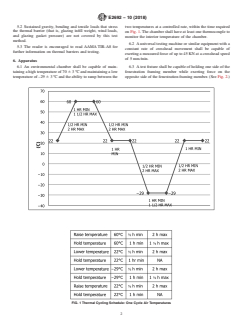
the thermal barrier (that is, glazing infill weight, wind loads, on Fig. 1. The chamber shall have at least one thermocouple to
and glazing gasket pressure) are not covered by this test
monitor the interior temperature of the chamber.
method.
6.2 Auniversal testing machine or similar equipment with a
5.3 The reader is encouraged to read AAMA TIR-A8 for
constant rate of crosshead movement shall be capable of
further information on thermal barriers and testing.
exerting a measured force of up to 45 KN at a crosshead speed
of 5 mm⁄min.
6. Apparatus
6.3 Atest fixture shall be capable of holding one side of the
6.1 An environmental chamber shall be capable of main-
taining a high temperature of 70 6 3 ºC and maintaining a low fenestration framing member while exerting force on the
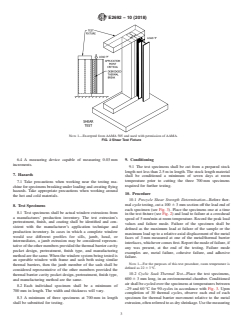
temperature of –29 6 3 ºC and the ability to ramp between the opposite side of the fenestration framing member. (See Fig. 2.)
FIG. 1 Thermal Cycling Schedule: One Cycle Air Temperatures
E2692 − 10 (2018)
NOTE 1—Excerpted from AAMA 505 and used with permission of AAMA.
FIG. 2 Shear Test Fixture
6.4 A measuring device capable of measuring 0.03 mm 9. Conditioning
increments.
9.1 The test specimens shall be cut from a prepared stock
length not less than 2.5 m in length. The stock length material
7. Hazards
shall be conditioned a minimum of seven days at room
temperature prior to cutting the three 700 mm specimens
7.1 Take precautions when working near the testing ma-
required for further testing.
chine for specimens breaking under loading and creating flying
hazards. Take ap
...