

ASTM A510/A510M-20
(Specification)Standard Specification for General Requirements for Wire Rods and Coarse Round Wire, Carbon Steel, and Alloy Steel
General Information
- Abstract
ABSTRACT
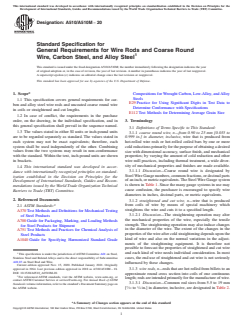
This specification covers the general requirements for carbon steel wire rods and uncoated coarse round wire in coils or straightened and cut lengths. Chemical compositions are specified by ranges or limits for carbon and other elements. The grades commonly specified for carbon steel wire rods and coarse round wire are presented. Grain size, when specified, and the mechanical properties enumerated in individual specifications shall be determined in accordance with reference test materials.
SCOPE
1.1 This specification covers general requirements for carbon and alloy steel wire rods and uncoated coarse round wire in coils or straightened and cut lengths.
1.2 In case of conflict, the requirements in the purchase order, on the drawing, in the individual specification, and in this general specification shall prevail in the sequence named.
1.3 The values stated in either SI units or inch-pound units are to be regarded separately as standard. The values stated in each system may not be exact equivalents; therefore, each system shall be used independently of the other. Combining values from the two systems may result in non-conformance with the standard. Within the text, inch-pound units are shown in brackets.
1.4 This international standard was developed in accordance with internationally recognized principles on standardization established in the Decision on Principles for the Development of International Standards, Guides and Recommendations issued by the World Trade Organization Technical Barriers to Trade (TBT) Committee.
- Status
- Published
- Publication Date
- 14-Nov-2020
- Technical Committee
- A01 - Steel, Stainless Steel and Related Alloys
- Drafting Committee
- A01.03 - Steel Rod and Wire
Buy Documents
ASTM A510/A510M-20 - Standard Specification for General Requirements for Wire Rods and Coarse Round Wire, Carbon Steel, and Alloy Steel
REDLINE ASTM A510/A510M-20 - Standard Specification for General Requirements for Wire Rods and Coarse Round Wire, Carbon Steel, and Alloy Steel
Overview
ASTM A510/A510M-20 is the established standard specification developed by ASTM International for general requirements for wire rods and coarse round wire of carbon steel and alloy steel. This standard applies to wire rods and uncoated coarse round wires supplied in coils or as straightened and cut lengths. It serves as the fundamental reference for chemical composition, dimensional tolerances, mechanical properties, and other key attributes required for manufacturing, processing, and end-use of steel wire products. Conformance to this standard ensures consistent product quality, reliable performance, and compatibility with both domestic and international supply chains in accordance with World Trade Organization Technical Barriers to Trade (TBT) principles.
Key Topics
- Scope of Application: Covers carbon and alloy steel wire rods and coarse round wire, in both coil and cut lengths.
- Chemical Composition: Specifies ranges or limits for carbon and other alloying elements, ensuring material traceability and compatibility with downstream processing.
- Units of Measure: Recognizes both SI (metric) and inch-pound (imperial) units, but requires the two systems to be used independently to avoid non-conformance.
- Product Forms and Definitions:
- Wire rods: Hot-rolled from billets into coil form, intended for subsequent wire production.
- Coarse round wire: Cold-reduced wire from wire rods, supplied in a range of diameters (typically 0.90 to 25 mm).
- Straightened and cut wire: Wire straightened and cut to specified lengths, acknowledging possible changes in mechanical properties post-processing.
- Dimensional Tolerances: Outlines permissible diameter, out-of-roundness, and length variations for each product form to ensure dimensional precision.
- Mechanical Properties and Testing: Mechanical properties, when specified in the order, are verified in accordance with referenced ASTM test standards.
- Inspection and Certification: Provides for manufacturer, purchaser, and third-party inspection and testing, with optional requirements for documentation and certification.
- Packaging and Marking: Details requirements for secure tagging and labeling for traceability and correct identification during shipping and storage.
Applications
Steel products conforming to ASTM A510/A510M-20 are essential in a wide variety of industries due to their versatility and standardized quality controls. Typical applications include:
- Wire Drawing and Manufacturing: Base material for manufacturing fine wire products, springs, fasteners, reinforcement wires, and cables.
- Construction and Engineering: Used for structural mesh, fencing, and pre-stressing applications where consistent mechanical properties are critical.
- Automotive and Industrial Components: Raw material for the production of rods, pins, and specialty wire forms in automotive assemblies and machinery.
- Packaging and Hardware: Utilized in the making of baling wire, wire ties, and hardware items.
By adhering to ASTM A510/A510M-20, manufacturers and end users benefit from improved supply chain efficiency, predictable quality, and compliance with regulatory and customer requirements.
Related Standards
To ensure comprehensive quality and performance, ASTM A510/A510M-20 references and works in conjunction with several other associated standards, including:
- ASTM A370: Test Methods and Definitions for Mechanical Testing of Steel Products
- ASTM A700: Guide for Packaging, Marking, and Loading of Steel Products for Shipment
- ASTM A751: Test Methods and Practices for Chemical Analysis of Steel Products
- ASTM A941: Terminology Relating to Steel, Stainless Steel, Related Alloys, and Ferroalloys
- ASTM A1040: Guide for Specifying Harmonized Standard Grade Compositions for Wrought Steel Products
- ASTM E29: Practice for Using Significant Digits in Test Data
- ASTM E112: Test Methods for Determining Average Grain Size
- ASTM E527: Practice for Numbering Metals and Alloys in the Unified Numbering System (UNS)
Following ASTM A510/A510M-20 helps ensure material compatibility and harmonization across a broad spectrum of steel wire applications.
Relations
- Effective Date
- 01-Mar-2024
- Effective Date
- 01-Nov-2019
- Effective Date
- 01-Jul-2019
- Refers
ASTM A370-17a - Standard Test Methods and Definitions for Mechanical Testing of Steel Products - Effective Date
- 15-Nov-2017
- Effective Date
- 01-Jan-2017
- Effective Date
- 01-Nov-2015
- Effective Date
- 01-Sep-2015
- Effective Date
- 01-Nov-2014
- Effective Date
- 15-May-2014
- Effective Date
- 01-Mar-2014
- Effective Date
- 15-Nov-2013
- Effective Date
- 15-Nov-2012
- Refers
ASTM A370-12a - Standard Test Methods and Definitions for Mechanical Testing of Steel Products - Effective Date
- 15-Oct-2012
- Effective Date
- 15-Mar-2012
- Refers
ASTM A370-11a - Standard Test Methods and Definitions for Mechanical Testing of Steel Products - Effective Date
- 15-Nov-2011
Buy Documents
ASTM A510/A510M-20 - Standard Specification for General Requirements for Wire Rods and Coarse Round Wire, Carbon Steel, and Alloy Steel
REDLINE ASTM A510/A510M-20 - Standard Specification for General Requirements for Wire Rods and Coarse Round Wire, Carbon Steel, and Alloy Steel
Get Certified
Connect with accredited certification bodies for this standard

Element Materials Technology
Materials testing and product certification.

Inštitut za kovinske materiale in tehnologije
Institute of Metals and Technology. Materials testing, metallurgical analysis, NDT.
Sponsored listings
Frequently Asked Questions
ASTM A510/A510M-20 is a technical specification published by ASTM International. Its full title is "Standard Specification for General Requirements for Wire Rods and Coarse Round Wire, Carbon Steel, and Alloy Steel". This standard covers: ABSTRACT This specification covers the general requirements for carbon steel wire rods and uncoated coarse round wire in coils or straightened and cut lengths. Chemical compositions are specified by ranges or limits for carbon and other elements. The grades commonly specified for carbon steel wire rods and coarse round wire are presented. Grain size, when specified, and the mechanical properties enumerated in individual specifications shall be determined in accordance with reference test materials. SCOPE 1.1 This specification covers general requirements for carbon and alloy steel wire rods and uncoated coarse round wire in coils or straightened and cut lengths. 1.2 In case of conflict, the requirements in the purchase order, on the drawing, in the individual specification, and in this general specification shall prevail in the sequence named. 1.3 The values stated in either SI units or inch-pound units are to be regarded separately as standard. The values stated in each system may not be exact equivalents; therefore, each system shall be used independently of the other. Combining values from the two systems may result in non-conformance with the standard. Within the text, inch-pound units are shown in brackets. 1.4 This international standard was developed in accordance with internationally recognized principles on standardization established in the Decision on Principles for the Development of International Standards, Guides and Recommendations issued by the World Trade Organization Technical Barriers to Trade (TBT) Committee.
ABSTRACT This specification covers the general requirements for carbon steel wire rods and uncoated coarse round wire in coils or straightened and cut lengths. Chemical compositions are specified by ranges or limits for carbon and other elements. The grades commonly specified for carbon steel wire rods and coarse round wire are presented. Grain size, when specified, and the mechanical properties enumerated in individual specifications shall be determined in accordance with reference test materials. SCOPE 1.1 This specification covers general requirements for carbon and alloy steel wire rods and uncoated coarse round wire in coils or straightened and cut lengths. 1.2 In case of conflict, the requirements in the purchase order, on the drawing, in the individual specification, and in this general specification shall prevail in the sequence named. 1.3 The values stated in either SI units or inch-pound units are to be regarded separately as standard. The values stated in each system may not be exact equivalents; therefore, each system shall be used independently of the other. Combining values from the two systems may result in non-conformance with the standard. Within the text, inch-pound units are shown in brackets. 1.4 This international standard was developed in accordance with internationally recognized principles on standardization established in the Decision on Principles for the Development of International Standards, Guides and Recommendations issued by the World Trade Organization Technical Barriers to Trade (TBT) Committee.
ASTM A510/A510M-20 is classified under the following ICS (International Classification for Standards) categories: 77.140.65 - Steel wire, wire ropes and link chains. The ICS classification helps identify the subject area and facilitates finding related standards.
ASTM A510/A510M-20 has the following relationships with other standards: It is inter standard links to ASTM A370-24, ASTM A700-14(2019), ASTM A370-19, ASTM A370-17a, ASTM A370-17, ASTM A370-15, ASTM A1040-10(2015)e1, ASTM A700-14, ASTM A370-14, ASTM A751-14, ASTM A370-13, ASTM E112-12, ASTM A370-12a, ASTM A370-12, ASTM A370-11a. Understanding these relationships helps ensure you are using the most current and applicable version of the standard.
ASTM A510/A510M-20 is available in PDF format for immediate download after purchase. The document can be added to your cart and obtained through the secure checkout process. Digital delivery ensures instant access to the complete standard document.
Standards Content (Sample)
This international standard was developed in accordance with internationally recognized principles on standardization established in the Decision on Principles for the
Development of International Standards, Guides and Recommendations issued by the World Trade Organization Technical Barriers to Trade (TBT) Committee.
Designation:A510/A510M −20
Standard Specification for
General Requirements for Wire Rods and Coarse Round
Wire, Carbon Steel, and Alloy Steel
This standard is issued under the fixed designationA510/A510M; the number immediately following the designation indicates the year
of original adoption or, in the case of revision, the year of last revision. A number in parentheses indicates the year of last reapproval.
A superscript epsilon (´) indicates an editorial change since the last revision or reapproval.
This standard has been approved for use by agencies of the U.S. Department of Defense.
1. Scope* Compositions for Wrought Carbon, Low-Alloy, andAlloy
Steels
1.1 This specification covers general requirements for car-
E29 Practice for Using Significant Digits in Test Data to
bon and alloy steel wire rods and uncoated coarse round wire
Determine Conformance with Specifications
in coils or straightened and cut lengths.
E112 Test Methods for Determining Average Grain Size
1.2 In case of conflict, the requirements in the purchase
order, on the drawing, in the individual specification, and in
3. Terminology
this general specification shall prevail in the sequence named.
3.1 Definitions of Terms Specific to This Standard:
1.3 The values stated in either SI units or inch-pound units
3.1.1 coarse round wire, n—from 0.90 to 25 mm [0.035 to
are to be regarded separately as standard. The values stated in 0.999 in.] in diameter, inclusive, wire that is produced from
each system may not be exact equivalents; therefore, each
hot-rolled wire rods or hot-rolled coiled bars by one or more
system shall be used independently of the other. Combining coldreductionsprimarilyforthepurposeofobtainingadesired
values from the two systems may result in non-conformance
size with dimensional accuracy, surface finish, and mechanical
with the standard. Within the text, inch-pound units are shown properties; by varying the amount of cold reduction and other
in brackets.
wire mill practices, including thermal treatment, a wide diver-
sity of mechanical properties and finishes are made available.
1.4 This international standard was developed in accor-
3.1.1.1 Discussion—Coarse round wire is designated by
dance with internationally recognized principles on standard-
SteelWireGaugenumbers,commonfractions,ordecimalparts
ization established in the Decision on Principles for the
of an inch, or metric equivalents.The SteelWire Gauge system
Development of International Standards, Guides and Recom-
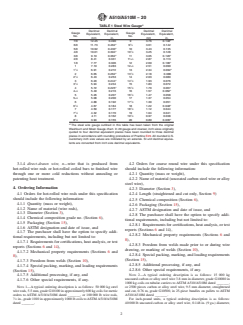
is shown in Table 1. Since the many gauge systems in use may
mendations issued by the World Trade Organization Technical
cause confusion, the purchaser is encouraged to specify wire
Barriers to Trade (TBT) Committee.
diameters in inches, decimal parts, or metric equivalents.
2. Referenced Documents
3.1.2 straightened and cut wire, n—wire that is produced
from coils of wire by means of special machinery which
2.1 ASTM Standards:
straightens the wire and cuts it to a specified length.
A370 Test Methods and Definitions for Mechanical Testing
3.1.2.1 Discussion—The straightening operation may alter
of Steel Products
the mechanical properties of the wire, especially the tensile
A700 Guide for Packaging, Marking, and Loading Methods
strength. The straightening operation may also induce changes
for Steel Products for Shipment
in the diameter of the wire. The extent of the changes in the
A751 Test Methods and Practices for Chemical Analysis of
propertiesofthewireaftercoldstraighteningdependsuponthe
Steel Products
kind of wire and also on the normal variations in the adjust-
A1040 Guide for Specifying Harmonized Standard Grade
ments of the straightening equipment. It is therefore not
possible to forecast the properties of straightened and cut wire
1 and each kind of wire needs individual consideration. In most
This specification is under the jurisdiction of ASTM Committee A01 on Steel,
Stainless Steel and Related Alloys and is the direct responsibility of Subcommittee cases, the end use of straightened and cut wire is not seriously
A01.03 on Steel Rod and Wire.
influenced by these changes.
Current edition approved Nov. 15, 2020. Published January 2021. Originally
3.1.3 wire rods, n—rods that are hot rolled from billets to an
approved in 1964. Last previous edition approved in 2018 as A510/A510M – 18.
DOI: 10.1520/A0510_A0510M-20.
approximate round cross section into coils of one continuous
For referenced ASTM standards, visit the ASTM website, www.astm.org, or
length;rodsareintendedprimarilyforthemanufactureofwire.
contact ASTM Customer Service at service@astm.org. For Annual Book of ASTM
3.1.3.1 Discussion—Common rod sizes from 5.5 to 19 mm
Standards volume information, refer to the standard’s Document Summary page on
7 3
the ASTM website. [ ⁄32 to ⁄4 in.] in diameter, inclusive, are designated in Table 2.
*A Summary of Changes section appears at the end of this standard
Copyright © ASTM International, 100 Barr Harbor Drive, PO Box C700, West Conshohocken, PA 19428-2959. United States
A510/A510M−20
A
TABLE 1 Steel Wire Gauge
Decimal Decimal Decimal Decimal
Gauge Gauge
Equivalent, Equivalent, Equivalent, Equivalent,
No. No.
mm in. mm in.
7/0 12.45 0.490 9 3.76 0.148*
6/0 11.73 0.462* 9 ⁄2 3.61 0.142
5/0 10.92 0.430* 10 3.43 0.135
4/0 10.01 0.394* 10 ⁄2 3.25 0.128
3/0 9.19 0.362* 11 3.05 0.120*
2/0 8.41 0.331 11 ⁄2 2.87 0.113
1/0 7.77 0.306 12 2.69 0.106*
1 7.19 0.283 12 ⁄2 2.51 0.099
1 ⁄2 6.91 0.272 13 2.34 0.092*
2 6.65 0.262* 13 ⁄2 2.18 0.086
2 ⁄2 6.43 0.253 14 2.03 0.080
3 6.20 0.244* 14 ⁄2 1.93 0.076
3 ⁄2 5.94 0.234 15 1.83 0.072
4 5.72 0.225* 15 ⁄2 1.70 0.067
4 ⁄2 5.49 0.216 16 1.57 0.062*
5 5.26 0.207 16 ⁄2 1.47 0.058
5 ⁄2 5.08 0.200 17 1.37 0.054
6 4.88 0.192 17 ⁄2 1.30 0.051
6 ⁄2 4.67 0.184 18 1.22 0.048*
7 4.50 0.177 18 ⁄2 1.12 0.044
7 ⁄2 4.32 0.170 19 1.04 0.041
8 4.11 0.162 19 ⁄2 0.97 0.038
8 ⁄2 3.94 0.155 20 0.89 0.035*
A
The steel wire gauge outlined in this table has been taken from the original
Washburn and Moen Gauge chart. In 20 gauge and coarser, inch sizes originally
quoted to four decimal equivalent places have been rounded to three decimal
places in accordance with rounding procedures of Practice E29.All rounded U.S.
customary inch size values are indicated by an asterisk. SI unit decimal equiva-
lents are converted from inch size decimal equivalents.
3.1.4 direct-drawn wire, n—wire that is produced from 4.2 Orders for coarse round wire under this specification
hot-rolled wire rods or hot-rolled coiled bars to finished wire should include the following information:
through one or more cold reductions without annealing or
4.2.1 Quantity (mass or weight),
patenting heat treatment.
4.2.2 Name of material (uncoated carbon steel wire or alloy
steel wire),
4. Ordering Information
4.2.3 Diameter (Section 3),
4.1 Orders for hot-rolled wire rods under this specification
4.2.4 Length (straightened and cut only, Section 9)
should include the following information:
4.2.5 Chemical composition (Section 6),
4.1.1 Quantity (mass or weight),
4.2.6 Packaging (Section 15),
4.1.2 Name of material (wire rods),
4.2.7 ASTM designation and date of issue, and
4.1.3 Diameter (Section 3),
4.2.8 The purchaser shall have the option to specify addi-
4.1.4 Chemical composition grade no. (Section 6),
tional requirements, including but not limited to:
4.1.5 Packaging (Section 15),
4.2.8.1 Requirements for certifications, heat analysis, or test
4.1.6 ASTM designation and date of issue, and
reports (Sections 6 and 14),
4.1.7 The purchaser shall have the option to specify addi-
4.2.8.2 Mechanical property requirements (Sections 6 and
tional requirements, including but not limited to:
8),
4.1.7.1 Requirements for certifications, heat analysis, or test
4.2.8.3 Freedom from welds made prior to or during wire
reports (Sections 6 and 14),
drawing, or marking of welds (Section 10),
4.1.7.2 Mechanical property requirements (Sections 6 and
4.2.8.4 Special packing, marking, and loading requirements
8),
(Section 15),
4.1.7.3 Freedom from welds (Section 10),
4.2.8.5 Additional processing, if any, and
4.1.7.4 Special packing, marking, and loading requirements
4.2.8.6 Other special requirements, if any.
(Section 15),
4.1.7.5 Additional processing, if any, and NOTE 2—A typical ordering description is as follows: 15 000 kg
uncoated carbon or alloy steel wire 3.8 mm in diameter, grade G10080 in
4.1.7.6 Other special requirements, if any.
1000 kg coils on tubular carriers toASTM A510/A510M dated _______,
NOTE 1—A typical ordering description is as follows: 50 000 kg steel or 2500 pieces carbon or alloy steel wire, 9.5 mm diameter, straightened
wirerods,5.5mm,gradeG10100inapproximately600kgcoilsformetric and cut, 0.76 m, grade G10500, in 25-piece bundles on pallets to ASTM
orders to ASTM A510/A510M dated _______, or 100 000 lb wire rods, A510/A510M dated _______.
⁄32 in., grade 1010 in approximately 1000 lb coils toASTM A510/A510M For inch-pound units, a typical ordering description is as follows:
dated _______. 40 000 lb uncoated carbon or alloy steel wire, 0.148 in. (9 ga.) diameter,
A510/A510M−20
A
TABLE 2 Common Sizes of Wire Rods TABLE 3 Permissible Variations for Product Analysis of Carbon
Steel
SI Units
Diameter, mm
Tolerance Tolerance
Limit, or Maximum of
5.5 12.5
Element Over Maximum Under Minimum
Specified Range, %
Limit, % Limit, %
6.5 13.5
Carbon 0.25 and under 0.02 0.02
over 0.25 to 0.55, incl 0.03 0.03
7.5 14.5
over 0.55 0.04 0.04
8.5 15.5
Manganese 0.90 and under 0.03 0.03
over 0.90 to 1.65, incl 0.06 0.06
9.5 16.5
10 17
Phosphorus to 0.040, incl 0.008 . . .
10.5 17.5
11 18
Sulfur to 0.060, incl 0.008 . . .
11.5 18.5
12 19
Silicon 0.35 and under 0.02 0.02
Inch-Pound Units over 0.35 to 0.60, incl 0.05 0.05
Decimal Decimal
Inch Fraction Inch Fraction
A
Equivalent, in. Equivalent, in. Copper under minimum only . . . 0.02
7 31
⁄32 0.219 ⁄64 0.484
B
15 1
Lead 0.15 to 0.35, incl 0.03 0.03
⁄64 0.234 ⁄2 0.500
1 33
⁄4 0.250 ⁄64 0.516
A
Product analysis permissible variations for copper apply only when the amount
of copper is specified or required. Copper bearing steels typically specify 0.20 %
17 17
⁄64 0.266 ⁄32 0.531
min copper.
9 35
⁄32 0.281 ⁄64 0.547 B
Product analysis permissible variations for lead applies both over and under to
19 9
⁄64 0.297 ⁄16 0.562
a specified range of 0.15 to 0.35 %.
5 37
⁄16 0.312 ⁄64 0.578
21 19
⁄64 0.328 ⁄32 0.594
11 39
⁄32 0.344 ⁄64 0.609
strengths within the allowable carbon range. The Mn, P, and S
23 5
⁄64 0.359 ⁄8 0.625
3 41 limits for carbon steel wire rods are normally specified
⁄8 0.375 ⁄64 0.641
25 21
⁄64 0.391 ⁄32 0.656 according to Guide A1040.
13 43
6.2 Boron Additions to Control Strain Aging Behavior—
⁄32 0.406 ⁄64 0.672
27 11
⁄64 0.422 ⁄16 0.688
Intentional additions of boron to low carbon steels for the
7 45
⁄16 0.438 ⁄64 0.703
purpose of controlling strain aging behavior during wire
29 23
drawing is permissible only with the agreement of the pur-
⁄64 0.453 ⁄32 0.719
15 47
⁄32 0.469 ⁄64 0.734
chaser. In such cases, the boron content shall be reported in
⁄4 0.750
either a material test report or certification.
A
Rounded off to three decimal places in decimal equivalents in accordance with
6.2.1 For steels that do not have intentional boron additions
procedures outlined in Practice E29.
for hardenability or for control of strain aging behavior, the
boron content will not normally exceed 0.0008 %.
grade 10080 in 500 lb coils on tubular carriers to ASTM A510/A510M 6.3 Heat Analysis (Formerly Ladle Analysis)—An analysis
dated _______, or
of each heat shall be made to determine the percentage of the
2500 pieces, carbon or alloy steel wire, 0.375 in. diameter, straightened
elements specified. The analysis shall be made from a test
and cut 29 ⁄2 in., grade 1015, in 25 piece bundles on pallets to ASTM
sample, preferably taken during the pouring of the heat. The
A510/A510M dated _______.
chemical composition thus determined shall be reported, if
5. Manufacture required, to the purchaser, or his representative. Reporting of
significant figures and rounding shall be in accordance with
5.1 The steel shall be made by any commercially accepted
Test Methods, Practices, and Terminology A751.
steel making process. The steel may be either ingot cast or
strand cast.
6.4 Product Analysis (Formerly Check Analysis)—A prod-
uct analysis may be made by the purchaser. The purpose of the
6. Chemical Composition
product analysis is to verify that the chemical composition is
6.1 The chemical composition for steel under this specifi- within specified limits for each element, including applicable
cation shall conform to the requirements set forth in the permissible variations in product analysis. The results of
purchase order. Chemical compositions are specified by ranges analyses taken from different pieces of a heat may differ within
or limits for carbon and other elements. The grades commonly permissible limits from each other and from the heat analysis.
specified for carbon and alloy steel wire rods and coarse round Table 3 shows the permissible variations for product analysis
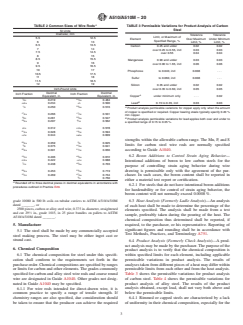
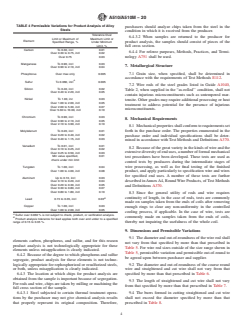
wire are designated in Guide A1040. Other grades not desig- of carbon steel. Table 4 shows the permissible variations for
nated in Guide A1040 may be specified. product analysis of alloy steel. The results of the product
6.1.1 For wire rods intended for direct-drawn wire, it is analysis obtained, except lead, shall not vary both above and
common practice to specify a range of tensile strength. If below the permissible limits.
chemistry ranges are also specified, due consideration should 6.4.1 Rimmed or capped steels are characterized by a lack
be taken to ensure that the producer can achieve the required of uniformity in their chemical composition, especially for the
A510/A510M−20
TABLE 4 Permissible Variations for Product Analysis of Alloy
purchasers should analyze chips taken from the steel in the
Steels
condition in which it is received from the producer.
Tolerance Over
6.4.3.2 When samples are returned to the producer for
Limit or Maximum of Maximum Limit or
Element
product analysis, the samples should consist of pieces of the
Specified Range, % Under Minimum
Limit, %
full cross section.
Carbon To 0.30, incl 0.01
6.4.4 For referee purposes, Methods, Practices, and Termi-
Over 0.30 to 0.75, incl 0.02
Over 0.75 0.03 nology A751 shall be used.
Manganese To 0.90, incl 0.03
7. Metallurgical Structure
Over 0.90 to 2.10, incl 0.04
7.1 Grain size, when specified, shall be determined in
Phosphorus Over max only 0.005
accordance with the requirements
...
This document is not an ASTM standard and is intended only to provide the user of an ASTM standard an indication of what changes have been made to the previous version. Because
it may not be technically possible to adequately depict all changes accurately, ASTM recommends that users consult prior editions as appropriate. In all cases only the current version
of the standard as published by ASTM is to be considered the official document.
Designation: A510/A510M − 18 A510/A510M − 20
Standard Specification for
General Requirements for Wire Rods and Coarse Round
Wire, Carbon Steel, and Alloy Steel
This standard is issued under the fixed designation A510/A510M; the number immediately following the designation indicates the year
of original adoption or, in the case of revision, the year of last revision. A number in parentheses indicates the year of last reapproval.
A superscript epsilon (´) indicates an editorial change since the last revision or reapproval.
This standard has been approved for use by agencies of the U.S. Department of Defense.
1. Scope*
1.1 This specification covers general requirements for carbon and alloy steel wire rods and uncoated coarse round wire in coils
or straightened and cut lengths.
1.2 In case of conflict, the requirements in the purchase order, on the drawing, in the individual specification, and in this general
specification shall prevail in the sequence named.
1.3 The values stated in either SI units or inch-pound units are to be regarded separately as standard. The values stated in each
system may not be exact equivalents; therefore, each system shall be used independently of the other. Combining values from the
two systems may result in non-conformance with the standard. Within the text, inch-pound units are shown in brackets.
1.4 This international standard was developed in accordance with internationally recognized principles on standardization
established in the Decision on Principles for the Development of International Standards, Guides and Recommendations issued
by the World Trade Organization Technical Barriers to Trade (TBT) Committee.
2. Referenced Documents
2.1 ASTM Standards:
A370 Test Methods and Definitions for Mechanical Testing of Steel Products
A700 Guide for Packaging, Marking, and Loading Methods for Steel Products for Shipment
A751 Test Methods and Practices for Chemical Analysis of Steel Products
A941 Terminology Relating to Steel, Stainless Steel, Related Alloys, and Ferroalloys
A1040 Guide for Specifying Harmonized Standard Grade Compositions for Wrought Carbon, Low-Alloy, and Alloy Steels
E29 Practice for Using Significant Digits in Test Data to Determine Conformance with Specifications
E112 Test Methods for Determining Average Grain Size
E527 Practice for Numbering Metals and Alloys in the Unified Numbering System (UNS)
3. Terminology
3.1 Definitions of Terms Specific to This Standard:
This specification is under the jurisdiction of ASTM Committee A01 on Steel, Stainless Steel and Related Alloys and is the direct responsibility of Subcommittee A01.03
on Steel Rod and Wire.
Current edition approved March 1, 2018Nov. 15, 2020. Published April 2018January 2021. Originally approved in 1964. Last previous edition approved in 20132018 as
A510 – 13.A510/A510M – 18. DOI: 10.1520/A0510_A0510M-18.10.1520/A0510_A0510M-20.
For referenced ASTM standards, visit the ASTM website, www.astm.org, or contact ASTM Customer Service at service@astm.org. For Annual Book of ASTM Standards
volume information, refer to the standard’s Document Summary page on the ASTM website.
*A Summary of Changes section appears at the end of this standard
Copyright © ASTM International, 100 Barr Harbor Drive, PO Box C700, West Conshohocken, PA 19428-2959. United States
A510/A510M − 20
3.1.1 coarse round wire, n—from 0.90 to 25 mm [0.035 to 0.999 in.] in diameter, inclusive, wire that is produced from hot-rolled
wire rods or hot-rolled coiled bars by one or more cold reductions primarily for the purpose of obtaining a desired size with
dimensional accuracy, surface finish, and mechanical properties. Byproperties; by varying the amount of cold reduction and other
wire mill practices, including thermal treatment, a wide diversity of mechanical properties and finishes are made available.
3.1.1.1 Discussion—
Coarse round wire is designated by Steel Wire Gauge numbers, common fractions, or decimal parts of an inch, or metric
equivalents. The Steel Wire Gauge system is shown in Table 1. Since the many gauge systems in use may cause confusion, the
purchaser is encouraged to specify wire diameters in inches, decimal parts, or metric equivalents.
3.1.2 straightened and cut wire, n—wire that is produced from coils of wire by means of special machinery which straightens the
wire and cuts it to a specified length.
3.1.2.1 Discussion—
The straightening operation may alter the mechanical properties of the wire, especially the tensile strength. The straightening
operation may also induce changes in the diameter of the wire. The extent of the changes in the properties of the wire after cold
straightening depends upon the kind of wire and also on the normal variations in the adjustments of the straightening equipment.
It is therefore not possible to forecast the properties of straightened and cut wire and each kind of wire needs individual
consideration. In most cases, the end use of straightened and cut wire is not seriously influenced by these changes.
3.1.3 wire rods, n—rods that are hot rolled from billets to an approximate round cross section into coils of one continuous length.
Rods are not comparable to hot-rolled bars in accuracy of cross section or surface finish and as a semifinished product are length;
rods are intended primarily for the manufacture of wire.
3.1.3.1 Discussion—
7 3
Rod Common rod sizes from 5.5 to 18.619 mm [ ⁄32 to ⁄4 in.] in diameter, inclusive, are designated in Table 2.
3.1.4 direct-drawn wire, n—wire that is produced from hot-rolled wire rods or hot-rolled coiled bars to finished wire through one
or more cold reductions without annealing or patenting heat treatment.
4. Ordering Information
4.1 Orders for hot-rolled wire rods under this specification should include the following information:
4.1.1 Quantity (mass or weight),
4.1.2 Name of material (wire rods),
4.1.3 Diameter ((SectionTable 2 3),
4.1.4 Chemical composition grade no. (see Section (Section 6),
4.1.5 Packaging, Packaging (Section 15),
4.1.6 ASTM designation and date of issue, and
4.1.7 The purchaser shall have the option to specify additional requirements, including but not limited to:
4.1.7.1 Requirements for certifications, heat analysis, or test reports (see Sections (Sections 6 and 14),
4.1.7.2 Mechanical property requirements (see Sections (Sections 6 &and 8),
4.1.7.3 Freedom from welds (see Section (Section 10),
4.1.7.4 Special packing, marking, and loading requirements (see Section (Section 15),
4.1.7.5 Additional processing, if any, and
4.1.7.6 Other special requirements, if any.
A510/A510M − 20
A
TABLE 1 Steel Wire Gauge
SI Units
Diameter, mm
0.90 6.0
1.00 6.5
1.10 7.0
1.20 7.5
1.30 8.0
1.40 8.5
1.60 9.0
1.80 9.5
2.0 10.0
2.1 11.0
2.2 12.0
2.4 13.0
2.5 14.0
2.6 15.0
2.8 16.0
3.0 17.0
3.2 18.0
3.5 19.0
3.8 20.0
4.0 21.0
4.2 22.0
4.5 23.0
4.8 24.0
5.0 25.0
5.5 –
Inch-
Pound
Units
Decimal Decimal
Gauge Gauge
Equivalent, Equivalent,
No. No.
in. in.
7⁄0 0.490 9 0.148*
6⁄0 0.462* 9 ⁄2 0.142
5⁄0 0.430* 10 0.135
4⁄0 0.394* 10 ⁄2 0.128
3⁄0 0.362* 11 0.120*
2⁄0 0.331 11 ⁄2 0.113
1⁄0 0.306 12 0.106*
1 0.283 12 ⁄2 0.099
1 ⁄2 0.272 13 0.092*
2 0.262* 13 ⁄2 0.086
2 ⁄2 0.253 14 0.080
3 0.244* 14 ⁄2 0.076
3 ⁄2 0.234 15 0.072
4 0.225* 15 ⁄2 0.067
4 ⁄2 0.216 16 0.062*
5 0.207 16 ⁄2 0.058
5 ⁄2 0.200 17 0.054
6 0.192 17 ⁄2 0.051
6 ⁄2 0.184 18 0.048*
7 0.177 18 ⁄2 0.044
7 ⁄2 0.170 19 0.041
8 0.162 19 ⁄2 0.038
8 ⁄2 0.155 20 0.035*
A
TABLE 1 Steel Wire Gauge
Decimal Decimal Decimal Decimal
Gauge Gauge
Equivalent, Equivalent, Equivalent, Equivalent,
No. No.
mm in. mm in.
7/0 12.45 0.490 9 3.76 0.148*
6/0 11.73 0.462* 9 ⁄2 3.61 0.142
5/0 10.92 0.430* 10 3.43 0.135
4/0 10.01 0.394* 10 ⁄2 3.25 0.128
3/0 9.19 0.362* 11 3.05 0.120*
2/0 8.41 0.331 11 ⁄2 2.87 0.113
1/0 7.77 0.306 12 2.69 0.106*
1 7.19 0.283 12 ⁄2 2.51 0.099
1 ⁄2 6.91 0.272 13 2.34 0.092*
2 6.65 0.262* 13 ⁄2 2.18 0.086
2 ⁄2 6.43 0.253 14 2.03 0.080
3 6.20 0.244* 14 ⁄2 1.93 0.076
3 ⁄2 5.94 0.234 15 1.83 0.072
4 5.72 0.225* 15 ⁄2 1.70 0.067
4 ⁄2 5.49 0.216 16 1.57 0.062*
A510/A510M − 20
5 5.26 0.207 16 ⁄2 1.47 0.058
5 ⁄2 5.08 0.200 17 1.37 0.054
6 4.88 0.192 17 ⁄2 1.30 0.051
6 ⁄2 4.67 0.184 18 1.22 0.048*
7 4.50 0.177 18 ⁄2 1.12 0.044
7 ⁄2 4.32 0.170 19 1.04 0.041
8 4.11 0.162 19 ⁄2 0.97 0.038
8 ⁄2 3.94 0.155 20 0.89 0.035*
A
The steel wire gauge outlined in this table has been taken from the original
Washburn and Moen Gauge chart. In 20 gauge and coarser, inch sizes originally
quoted to 4four decimal equivalent places have been rounded to 3three decimal
places in accordance with rounding procedures of Practice E29. All rounded U.S.
customary inch size values are indicated by an asterisk.
SI unit decimal equivalents are converted from inch size decimal equivalents.
NOTE 1—A typical ordering description is as follows: 50 000 kg steel wire rods, 5.5 mm, Gradegrade G10100 in approximately 600 kg coils for metric
orders to ASTM A510/A510M dated _______, or 100 000 lb Wire Rods,wire rods, ⁄32 in., Gradegrade 1010 in approximately 1000 lb Coilscoils to ASTM
A510/A510M dated _______.
4.2 Orders for coarse round wire under this specification should include the following information:
4.2.1 Quantity (mass or weight]),weight),
4.2.2 Name of material (uncoated carbon steel wire or alloy steel wire),
4.2.3 Diameter (see(Section 3.1.13),
4.2.4 Length (straightened and cut only), only, Section 9)
4.2.5 Chemical composition (see Section (Section 6),
4.2.6 Packaging, Packaging (Section 15),
4.2.7 ASTM designation and date of issue, and
4.2.8 The purchaser shall have the option to specify additional requirements, including but not limited to:
4.2.8.1 Requirements for certifications, heat analysis, or test reports (see Sections (Sections 6 and 14),
4.2.8.2 Mechanical property requirements (see Sections (Sections 6 &and 8),
4.2.8.3 Freedom from welds made prior to or during wire drawing, or marking of welds (see Section (Section 10),
4.2.8.4 Special packing, marking, and loading requirements (see Section (Section 15),
4.2.8.5 Additional processing, if any, and
4.2.8.6 Other special requirements, if any.
NOTE 2—A typical ordering description is as follows: 15 000 kg uncoated carbon or alloy steel wire 3.8 mm in diameter, Gradegrade G10080 in 1000
kg coils on tubular carriers to ASTM A510/A510M-XX, dated _______, or 2500 pieces carbon or alloy steel wire, 9.5 mm diameter, straightened and
cut, 0.76 m, Gradegrade G10500, in 25-piece bundles on pallets to ASTM A510/A510M dated _______.
For inch-pound units, a typical ordering description is as follows: 40 000 lb Uncoated Carbon or Alloy Steel Wire,uncoated carbon or alloy steel wire,
0.148 in. (9 ga.) diameter, Gradegrade 10080 in 500 lb Coilscoils on Tubuliartubular carriers to ASTM A510/A510M dated _______, or
2500 Pieces, Carbon or Alloy Steel Wire,pieces, carbon or alloy steel wire, 0.375 in. diameter, Straightenedstraightened and Cutcut 29 ⁄2 in.,
Gradegrade 1015, in 25 Piece Bundlespiece bundles on Palletspallets to ASTM A510/A510M dated _______.
5. Manufacture
5.1 The steel shall be made by any commercially accepted steel making process. The steel may be either ingot cast or strand cast.
A510/A510M − 20
A
TABLE 2 Common Sizes of Wire Rods
SI Units
Diameter, mm
5.5 12.5
5.5 12.5
6 13
6 13
6.5 13.5
6.5 13.5
7 14
7 14
7.5 14.5
7.5 14.5
8 15
8 15
8.5 15.5
8.5 15.5
9 16
9 16
9.5 16.5
9.5 16.5
10 17
10 17
10.5 17.5
10.5 17.5
11 18
11 18
11.5 18.5
11.5 18.5
12 19
12 19
Inch-Pound Units
Decimal Decimal
Inch Fraction Inch Fraction
Equivalent, in. Equivalent, in.
7 31
⁄32 0.219 ⁄64 0.484
7 31
⁄32 0.219 ⁄64 0.484
15 1
⁄64 0.234 ⁄2 0.500
15 1
⁄64 0.234 ⁄2 0.500
1 33
⁄4 0.250 ⁄64 0.516
1 33
⁄4 0.250 ⁄64 0.516
17 17
⁄64 0.266 ⁄32 0.531
17 17
⁄64 0.266 ⁄32 0.531
9 35
⁄32 0.281 ⁄64 0.547
9 35
⁄32 0.281 ⁄64 0.547
19 9
⁄64 0.297 ⁄16 0.562
19 9
⁄64 0.297 ⁄16 0.562
5 37
⁄16 0.312 ⁄64 0.578
5 37
⁄16 0.312 ⁄64 0.578
21 19
⁄64 0.328 ⁄32 0.594
21 19
⁄64 0.328 ⁄32 0.594
11 39
⁄32 0.344 ⁄64 0.609
11 39
⁄32 0.344 ⁄64 0.609
23 5
⁄64 0.359 ⁄8 0.625
23 5
⁄64 0.359 ⁄8 0.625
3 41
⁄8 0.375 ⁄64 0.641
3 41
⁄8 0.375 ⁄64 0.641
25 21
⁄64 0.391 ⁄32 0.656
25 21
⁄64 0.391 ⁄32 0.656
13 43
⁄32 0.406 ⁄64 0.672
13 43
⁄32 0.406 ⁄64 0.672
27 11
⁄64 0.422 ⁄16 0.688
27 11
⁄64 0.422 ⁄16 0.688
7 45
⁄16 0.438 ⁄64 0.703
7 45
⁄16 0.438 ⁄64 0.703
29 23
⁄64 0.453 ⁄32 0.719
29 23
⁄64 0.453 ⁄32 0.719
15 47
⁄32 0.469 ⁄64 0.734
15 47
⁄32 0.469 ⁄64 0.734
⁄4 0.750
A
Rounded off to 3three decimal places in decimal equivalents in accordance with
procedures outlined in Practice E29.
A510/A510M − 20
TABLE 3 Permissible Variations for Product Analysis of Carbon
Steel
Limit, or Max of Over Max Under Min
Element
Specified Range, % Limit, % Limit, %
Tolerance Tolerance
Limit, or Maximum of
Element Over Maximum Under Minimum
Specified Range, %
Limit, % Limit, %
Carbon 0.25 and under 0.02 0.02
over 0.25 to 0.55, incl 0.03 0.03
over 0.55 0.04 0.04
Manganese 0.90 and under 0.03 0.03
over 0.90 to 1.65, incl 0.06 0.06
Phosphorus to 0.040, incl 0.008 . . .
Sulfur to 0.060, incl 0.008 . . .
Silicon 0.35 and under 0.02 0.02
over 0.35 to 0.60, incl 0.05 0.05
A
Copper under minimum only . . . 0.02
B
Lead 0.15 to 0.35, incl 0.03 0.03
A
Product analysis permissible variations for copper apply only when the amount
of copper is specified or required. Copper bearing steels typically specify 0.20 %
min copper.
B
Product analysis permissible variations for lead apply only when the amount of
lead is specified or required. A range from 0.15 to 0.35 % lead is normally specified
for leaded steels.applies both over and under to a specified range of 0.15 to
0.35 %.
6. Chemical Composition
6.1 The chemical composition for steel under this specification shall conform to the requirements set forth in the purchase order.
Chemical compositions are specified by ranges or limits for carbon and other elements. The grades commonly specified for carbon
and alloy steel wire rods and coarse round wire are designated in Guide A1040. Other grades not designated in Guide A1040 may
be specified.
6.1.1 For wire rods intended for direct-drawn wire, it is common practice to specify a range of tensile strength. If chemistry ranges
are also specified, due consideration should be taken to ensure that the producer can achieve the required strengths within the
allowable carbon range. The Mn, P, and S limits for carbon steel wire rods are normally specified according to Guide A1040.
6.2 Boron Additions to Control Strain AgeingAging Behavior—Intentional additions of boron to low carbon steels for the purpose
of controlling strain ageingaging behavior during wire drawing is permissible only with the agreement of the purchaser. In such
cases, the boron content shall be reported in either a material test report or certification.
6.2.1 For steels that do not have intentional boron additions for hardenability or for control of strain ageingaging behavior, the
boron content will not normally exceed 0.0008 %.
6.3 Heat Analysis (Formerly Ladle Analysis)—An analysis of each cast or heat shall be made by the producer to determine the
percentage of the elements specified. The analysis shall be made from a test sample, preferably taken during the pouring of the
heat. The chemical composition thus determined shall be reported, if required, to the purchaser, or his representative. Reporting
of significant figures and rounding shall be in accordance with Test Methods, Practices, and Terminology A751.
6.4 Product Analysis (Formerly Check Analysis)—A product analysis may be made by the purchaser. The purpose of the product
analysis is to verify that the chemical composition is within specified limits for each element, including applicable permissible
variations in product analysis. The results of analyses taken from different pieces of a heat may differ within permissible limits from
each other and from the heat analysis. Table 3 shows the permissible variations for product analysis of carbon steel. Table 4 shows
the permissible variations for product analysis of alloy steel. The results of the product analysis obtained, except lead, shall not
vary both above and below the permissible limits.
A510/A510M − 20
TABLE 4 Product or Verification Analysis Tolerances—Alloy
Permissible Variations for Product Analysis of Alloy Steels
Tolerance Over
Limit or Maximum of Maximum Limit or
Element
Specified Range, % Under Minimum
Limit, %
Carbon To 0.30, incl 0.01
Over 0.30 to 0.75, incl 0.02
Over 0.75 0.03
Manganese To 0.90, incl 0.03
Over 0.90 to 2.10, incl 0.04
Phosphorus Over max only 0.005
A
Sulfur To 0.060, incl 0.005
Silicon To 0.40, incl 0.02
Over 0.40 to 2.20, incl 0.05
Nickel To 1.00, inc 0.03
Over 1.00 to 2.00, incl 0.05
Over 2.00 to 5.30, incl 0.07
Over 5.30 to 10.00, incl 0.10
Chromium To 0.90, incl 0.03
Over 0.90 to 2.10, incl 0.05
Over 2.10 to 3.99, incl 0.10
Molybdenum To 0.20, incl 0.01
Over 0.20 to 0.40, incl 0.02
Over 0.40 to 1.15, incl 0.03
Vanadium To 0.01, incl 0.01
Over 0.10 to 0.25, incl 0.02
Over 0.25 to 0.50, incl 0.03
Min value specified, 0.01
...