

ASTM D7153-22ae1
(Test Method)Standard Test Method for Freezing Point of Aviation Fuels (Automatic Laser Method)
General Information
- Abstract
SIGNIFICANCE AND USE
5.1 The freezing point of an aviation fuel is the lowest temperature at which the fuel remains free of solid hydrocarbon crystals which, if present in the fuel system of the aircraft, can restrict the flow of fuel through filters. The temperature of the fuel in the aircraft tank normally decreases during flight depending on aircraft speed, altitude, and flight duration. The freezing point of the fuel shall always be lower than the minimum operational fuel temperature.
5.2 Petroleum blending operations require precise measurement of the freezing point.
5.3 This test method expresses results to the nearest 0.1 °C, and it eliminates most of the operator time and judgment required by Test Method D2386.
5.4 When a specification requires Test Method D2386, do not substitute this test method or any other test method.
SCOPE
1.1 This test method covers the determination of the temperature below which solid hydrocarbon crystals may form in aviation turbine fuels.
1.2 This test method is designed to cover the temperature range of –80 °C to 20 °C; however, the interlaboratory study mentioned in 12.4 has only demonstrated the test method with fuels having freezing points in the range of –60 °C to –42 °C.
1.3 The values stated in SI units are to be regarded as standard. No other units of measurement are included in this standard.
1.4 This standard does not purport to address all of the safety concerns, if any, associated with its use. It is the responsibility of the user of this standard to establish appropriate safety, health, and environmental practices and to determine the applicability of regulatory limitations prior to use.
1.5 This international standard was developed in accordance with internationally recognized principles on standardization established in the Decision on Principles for the Development of International Standards, Guides and Recommendations issued by the World Trade Organization Technical Barriers to Trade (TBT) Committee.
- Status
- Published
- Publication Date
- 30-Sep-2022
- Technical Committee
- D02 - Petroleum Products, Liquid Fuels, and Lubricants
- Drafting Committee
- D02.07 - Flow Properties
Overview
ASTM D7153-22ae1 is the internationally recognized standard test method for determining the freezing point of aviation fuels using an automatic laser method. Issued by ASTM International, this method establishes the procedures to accurately identify the temperature below which solid hydrocarbon crystals may form in aviation turbine fuels. Proper control of fuel freezing point is critical for aviation safety, as solidified crystals can restrict fuel flow during flight, potentially leading to hazardous operating conditions.
The test is designed for aviation turbine fuels within a temperature range of –80 °C to 20 °C, with demonstrated performance for fuels with freezing points between –60 °C and –42 °C. Results are measured and reported in SI units to a precision of 0.1 °C, providing a high degree of accuracy and minimizing operator bias or error.
Key Topics
- Automatic Laser Detection: Utilizes microprocessor-controlled apparatus with laser illumination and optical detectors to identify the appearance and dissolution of hydrocarbon crystals in cooled fuel samples.
- Minimized Operator Intervention: The automated procedure reduces manual effort and subjective judgment compared to older methods (notably ASTM D2386).
- Precision and Repeatability: Offers repeatability within 0.6 °C and reproducibility within 0.9 °C, ensuring consistent results across laboratories.
- Scope and Limitations: Applies only to aviation turbine fuels and must not be substituted for other methods where specifically required by fuel specifications.
- Safety and Compliance: Users must adhere to appropriate safety, health, and environmental precautions, evaluating regulatory requirements as part of implementation.
Applications
ASTM D7153-22ae1 is essential in the following operational areas:
- Aviation Fuel Quality Control: Ensures jet fuel meets freezing point requirements for safe operation at high altitudes and varying temperatures.
- Petroleum Refining and Blending: Guides refiners in producing aviation fuels with appropriate low-temperature performance characteristics.
- Regulatory Compliance: Supports documentation and verification when demonstrating conformity to international aviation fuel standards.
- Laboratory Testing and Interlaboratory Studies: Facilitates accurate, reproducible results for fuel certification and comparative analysis between laboratories.
- Routine Maintenance and Verification: Regular use enables early detection of contaminants or deviations in fuel quality, supporting maintenance schedules and troubleshooting.
Related Standards
Several other key standards complement or relate to ASTM D7153-22ae1:
- ASTM D2386: Standard Test Method for Freezing Point of Aviation Fuels (Manual Method) - a traditional method that requires more operator input and may be required by some specifications.
- ASTM D4057: Standard Practice for Manual Sampling of Petroleum and Petroleum Products - describes best practices for obtaining representative fuel samples.
- ASTM D4177: Standard Practice for Automatic Sampling of Petroleum and Petroleum Products - outlines procedures for automated sampling.
- IP 16: Test Method for Determination of Freezing Point of Aviation Fuels - recognized by the Energy Institute, London, and considered technically equivalent in certain respects.
Keywords: ASTM D7153, aviation fuel freezing point, automatic laser method, jet fuel quality, aviation turbine fuel testing, hydrocarbon crystals, fuel safety, petroleum blending, ASTM standards, aviation fuel standardization.
Relations
- Effective Date
- 01-Jun-2015
- Refers
ASTM D4057-06(2011) - Standard Practice for Manual Sampling of Petroleum and Petroleum Products - Effective Date
- 01-Jun-2011
- Effective Date
- 01-Jan-2006
- Effective Date
- 01-Jul-2005
- Effective Date
- 10-May-2003
- Effective Date
- 10-Aug-2001
- Effective Date
- 10-Aug-2001
- Refers
ASTM D4057-95(2000) - Standard Practice for Manual Sampling of Petroleum and Petroleum Products - Effective Date
- 10-Apr-2000
Get Certified
Connect with accredited certification bodies for this standard

Element Materials Technology
Materials testing and product certification.

ABS Group Brazil
ABS Group certification services in Brazil.

ABS Quality Evaluations Inc.
American Bureau of Shipping quality certification.
Sponsored listings
Frequently Asked Questions
ASTM D7153-22ae1 is a standard published by ASTM International. Its full title is "Standard Test Method for Freezing Point of Aviation Fuels (Automatic Laser Method)". This standard covers: SIGNIFICANCE AND USE 5.1 The freezing point of an aviation fuel is the lowest temperature at which the fuel remains free of solid hydrocarbon crystals which, if present in the fuel system of the aircraft, can restrict the flow of fuel through filters. The temperature of the fuel in the aircraft tank normally decreases during flight depending on aircraft speed, altitude, and flight duration. The freezing point of the fuel shall always be lower than the minimum operational fuel temperature. 5.2 Petroleum blending operations require precise measurement of the freezing point. 5.3 This test method expresses results to the nearest 0.1 °C, and it eliminates most of the operator time and judgment required by Test Method D2386. 5.4 When a specification requires Test Method D2386, do not substitute this test method or any other test method. SCOPE 1.1 This test method covers the determination of the temperature below which solid hydrocarbon crystals may form in aviation turbine fuels. 1.2 This test method is designed to cover the temperature range of –80 °C to 20 °C; however, the interlaboratory study mentioned in 12.4 has only demonstrated the test method with fuels having freezing points in the range of –60 °C to –42 °C. 1.3 The values stated in SI units are to be regarded as standard. No other units of measurement are included in this standard. 1.4 This standard does not purport to address all of the safety concerns, if any, associated with its use. It is the responsibility of the user of this standard to establish appropriate safety, health, and environmental practices and to determine the applicability of regulatory limitations prior to use. 1.5 This international standard was developed in accordance with internationally recognized principles on standardization established in the Decision on Principles for the Development of International Standards, Guides and Recommendations issued by the World Trade Organization Technical Barriers to Trade (TBT) Committee.
SIGNIFICANCE AND USE 5.1 The freezing point of an aviation fuel is the lowest temperature at which the fuel remains free of solid hydrocarbon crystals which, if present in the fuel system of the aircraft, can restrict the flow of fuel through filters. The temperature of the fuel in the aircraft tank normally decreases during flight depending on aircraft speed, altitude, and flight duration. The freezing point of the fuel shall always be lower than the minimum operational fuel temperature. 5.2 Petroleum blending operations require precise measurement of the freezing point. 5.3 This test method expresses results to the nearest 0.1 °C, and it eliminates most of the operator time and judgment required by Test Method D2386. 5.4 When a specification requires Test Method D2386, do not substitute this test method or any other test method. SCOPE 1.1 This test method covers the determination of the temperature below which solid hydrocarbon crystals may form in aviation turbine fuels. 1.2 This test method is designed to cover the temperature range of –80 °C to 20 °C; however, the interlaboratory study mentioned in 12.4 has only demonstrated the test method with fuels having freezing points in the range of –60 °C to –42 °C. 1.3 The values stated in SI units are to be regarded as standard. No other units of measurement are included in this standard. 1.4 This standard does not purport to address all of the safety concerns, if any, associated with its use. It is the responsibility of the user of this standard to establish appropriate safety, health, and environmental practices and to determine the applicability of regulatory limitations prior to use. 1.5 This international standard was developed in accordance with internationally recognized principles on standardization established in the Decision on Principles for the Development of International Standards, Guides and Recommendations issued by the World Trade Organization Technical Barriers to Trade (TBT) Committee.
ASTM D7153-22ae1 is classified under the following ICS (International Classification for Standards) categories: 75.160.20 - Liquid fuels. The ICS classification helps identify the subject area and facilitates finding related standards.
ASTM D7153-22ae1 has the following relationships with other standards: It is inter standard links to ASTM D2386-15, ASTM D4057-06(2011), ASTM D2386-06, ASTM D2386-05, ASTM D2386-03, ASTM D2386-97, ASTM D2386-01, ASTM D4057-95(2000). Understanding these relationships helps ensure you are using the most current and applicable version of the standard.
ASTM D7153-22ae1 is available in PDF format for immediate download after purchase. The document can be added to your cart and obtained through the secure checkout process. Digital delivery ensures instant access to the complete standard document.
Standards Content (Sample)
This international standard was developed in accordance with internationally recognized principles on standardization established in the Decision on Principles for the
Development of International Standards, Guides and Recommendations issued by the World Trade Organization Technical Barriers to Trade (TBT) Committee.
´1
Designation: D7153 −22a
IP 529⁄16
Standard Test Method for
Freezing Point of Aviation Fuels (Automatic Laser
1,2
Method)
This standard is issued under the fixed designation D7153; the number immediately following the designation indicates the year of
original adoption or, in the case of revision, the year of last revision. A number in parentheses indicates the year of last reapproval. A
superscript epsilon (´) indicates an editorial change since the last revision or reapproval.
ε NOTE—Editorially corrected Fig. A1.5 in December 2022.
1. Scope* 2. Referenced Documents
2.1 ASTM Standards:
1.1 This test method covers the determination of the tem-
D2386 Test Method for Freezing Point of Aviation Fuels
perature below which solid hydrocarbon crystals may form in
D4057 Practice for Manual Sampling of Petroleum and
aviation turbine fuels.
Petroleum Products
1.2 This test method is designed to cover the temperature
D4177 Practice for Automatic Sampling of Petroleum and
range of –80 °C to 20 °C; however, the interlaboratory study
Petroleum Products
mentioned in 12.4 has only demonstrated the test method with
2.2 Energy Institute Standard:
fuels having freezing points in the range of –60 °C to –42 °C.
IP 16 Determination Freezing Point of Aviation Fuels
1.3 The values stated in SI units are to be regarded as
standard. No other units of measurement are included in this
3. Terminology
standard.
3.1 Definitions:
1.4 This standard does not purport to address all of the
3.1.1 freezing point, n—in aviation fuels, the fuel tempera-
safety concerns, if any, associated with its use. It is the
ture at which solid hydrocarbon crystals, formed on cooling,
responsibility of the user of this standard to establish appro-
disappear when the temperature of the fuel is allowed to rise
priate safety, health, and environmental practices and to
under specified conditions of test.
determine the applicability of regulatory limitations prior to
3.2 Definitions of Terms Specific to This Standard:
use.
3.2.1 automatic laser method, n—the procedures of auto-
1.5 This international standard was developed in accor-
matically cooling a liquid aviation fuel specimen until solid
dance with internationally recognized principles on standard-
hydrocarbon crystals appear, followed by controlled warming
ization established in the Decision on Principles for the
and recording of temperature at which hydrocarbon crystals
Development of International Standards, Guides and Recom-
completely redissolve into the liquid phase.
mendations issued by the World Trade Organization Technical
3.3 Symbols:
Barriers to Trade (TBT) Committee.
Cd = the specimen temperature at which the appearance of
the first crystals are detected in the specimen by an
This test method is under the jurisdiction of ASTM International Committee
optical crystal detector under specified conditions of
D02 on Petroleum Products, Liquid Fuels, and Lubricants and is the direct
test.
responsibility ofASTM Subcommittee D02.07 on Flow Properties. The technically
equivalent standard as referenced is under the jurisdiction of the Energy Institute
Subcommittee SC-B-7.
Current edition approved Oct. 1, 2022. Published December 2022. Originally
approved in 2005. Last previous edition approved in 2022 as D7153 – 22. DOI: For referenced ASTM standards, visit the ASTM website, www.astm.org, or
10.1520/D7153-22AE01. contact ASTM Customer Service at service@astm.org. For Annual Book of ASTM
This test method has been developed through the cooperative effort between Standards volume information, refer to the standard’s Document Summary page on
ASTM and the Energy Institute, London.ASTM and IPstandards were approved by the ASTM website.
ASTMandEItechnicalcommitteesasbeingtechnicallyequivalentbutthatdoesnot Annual Book of IP Standards Methods, Vol 1.Available from Energy Institute,
imply both standards are identical. 61 New Cavendish St., London, WIG 7AR, U.K.
*A Summary of Changes section appears at the end of this standard
Copyright © ASTM International, 100 Barr Harbor Drive, PO Box C700, West Conshohocken, PA 19428-2959. United States
´1
D7153 − 22a
appearance and disappearance of crystals and opacity, and
Co = the specimen temperature at which the appearance of
recording the temperature of the specimen.Adetailed descrip-
opacity in the specimen is detected by an optical
tion of the apparatus is provided in Annex A1.
opacity detector under specified conditions of test.
Do = the specimen temperature at which the disappearance
6.2 The apparatus shall be equipped with a specimen
of opacity in the specimen is detected by an optical
chamber, optical detectors, laser light source, digital display,
opacity detector under specified conditions of test.
cooling and heating systems, and a specimen temperature
measuring device.
4. Summary of Test Method
6.3 The temperature measuring device in the specimen
4.1 Aspecimen is cooled at a rate of 10 °C⁄min 6 5 °C⁄min
chamber shall be capable of measuring the temperature of the
while continuously being illuminated by a laser light source.
specimen from –80 °C to +20 °C at a resolution of 0.1 °C and
The specimen is continuously monitored by optical crystal and
accuracy of 0.1 °C.
opacity detectors for the first formation of solid hydrocarbon
6.4 The apparatus shall be capable of cooling the specimen
crystals. Once the hydrocarbon crystals are detected by both
at a rate of 10 °C⁄min 6 5 °C⁄min, heating the specimen at
sets of optical detectors, the specimen is then warmed at a rate
rates of 3 °C⁄min 6 0.5 °C⁄min and 12 °C⁄min 6 1 °C⁄min
of 3 °C⁄min 6 0.5 °C⁄min. When initial opacity in the speci-
over the temperature range of –80 °C to +20 °C.
men disappears, the specimen is then warmed at a rate of
12 °C⁄min 6l °C⁄min.Thespecimentemperatureatwhichthe
NOTE 1—The apparatus described is covered by a patent. If you are
last hydrocarbon crystals return to the liquid phase, as detected aware of an alternative(s) to the patented item, please attach to your ballot
return a description of the alternatives.All suggestions will be considered
by the crystal detector, is recorded as the freezing point.
by the committee.
4.2 In certain circumstances, as measured by the apparatus,
NOTE 2—The software version used in this apparatus is version V 5.3.
the specimen is reheated to approximately 10 °C, then cooled
6.5 Standard Syringe, capable of injecting approximately
at the rate in 4.1 until hydrocarbon crystals are detected by the
10 mL 62 mLofthespecimen,withatiporanadaptertipthat
crystal detector. The specimen is then warmed at a rate of
will fit the inlet of the test cell. A disposable 10 mL syringe
12 °C⁄min 6 l °C⁄min, until the last hydrocarbon crystals
with a Luer type cone connection has been found suitable.
return to the liquid phase. The specimen temperature at which
6.6 Waste Receiving Container, capable of collecting the
the last hydrocarbon crystals return to the liquid phase, as
overflow when the specimen is injected into the test cell. A
detected by the crystal detector, is recorded as the freezing
400 mL standard glass beaker has been found suitable.
point.
7. Sampling
5. Significance and Use
7.1 Obtain a sample in accordance with Practice D4057 or
5.1 The freezing point of an aviation fuel is the lowest
D4177.
temperature at which the fuel remains free of solid hydrocar-
bon crystals which, if present in the fuel system of the aircraft,
7.2 At least 30 mL of sample is required for each test.
can restrict the flow of fuel through filters. The temperature of
8. Preparation of Apparatus
the fuel in the aircraft tank normally decreases during flight
depending on aircraft speed, altitude, and flight duration. The
8.1 Install the apparatus for operation in accordance with
freezing point of the fuel shall always be lower than the
the manufacturer’s instructions.
minimum operational fuel temperature.
8.2 Turn on the main power switch of the analyzer.
5.2 Petroleum blending operations require precise measure-
ment of the freezing point.
9. Calibration and Standardization
5.3 This test method expresses results to the nearest 0.1 °C,
9.1 Ensure that all of the manufacturer’s instructions for
and it eliminates most of the operator time and judgment
calibration of the mechanical and electronic systems and
required by Test Method D2386.
operation of the apparatus are followed.
5.4 When a specification requires Test Method D2386,do
9.2 To verify the performance of the apparatus, an aviation
not substitute this test method or any other test method.
turbine fuel sample for which extensive data has been obtained
by Test Method D2386 may be used. Samples such as those
6. Apparatus
used in theASTM interlaboratory cross–check program would
6.1 Automatic Apparatus —This apparatus consists of a meet this criterion. Such verification materials can also be
microprocessor-controlled test cell that is capable of cooling
prepared from intra-company cross–checks.
and heating the specimen, dual optical detectors to monitor the
9.3 At intervals of not more than 12 months, check the
temperature measuring system against a temperature measur-
ing device that has a current calibration certificate.
The sole source of supply of the apparatus known to the committee at this time
is ISL model FZP 5G2s series Freezing Point Analyzer, available from PAC - ISL,
9.4 Verify the correct functioning of the apparatus in accor-
BP 70285 - VERSON, 14653 CARPIQUET Cedex, France. If you are aware of
dance with the manufacturer’s instructions using a verification
alternative suppliers, please provide this information to ASTM International
liquid (9.2) when first installed and thereafter at intervals not
Headquarters.Your comments will receive careful consideration at a meeting of the
responsible technical committee, which you may attend. exceeding one month.
´1
D7153 − 22a
10. Procedure
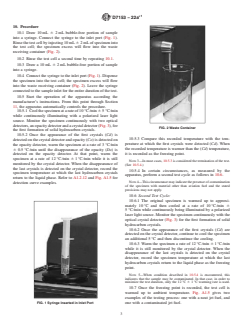
10.1 Draw 10 mL 6 2 mL bubble-free portion of sample
into a syringe. Connect the syringe to the inlet port (Fig. 1).
Rinse the test cell by injecting 10 mL 6 2 mLof specimen into
the test cell; the specimen excess will flow into the waste
receiving container (Fig. 2).
10.2 Rinse the test cell a second time by repeating 10.1.
10.3 Draw a 10 mL 6 2 mL bubble-free portion of sample
into a syringe.
10.4 Connect the syringe to the inlet port (Fig. 1). Dispense
the specimen into the test cell; the specimen excess will flow
into the waste receiving container (Fig. 2). Leave the syringe
connected to the sample inlet for the entire duration of the test.
10.5 Start the operation of the apparatus according the
manufacturer’s instructions. From this point through Section
11, the apparatus automatically controls the procedure.
10.5.1 Coolthespecimenatarateof10 °C⁄min 65 °C⁄min
while continuously illuminating with a polarized laser light
source. Monitor the specimen continuously with two optical
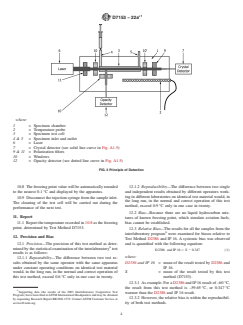
detectors,anopacitydetectorandacrystaldetector(Fig.3),for
FIG. 2 Waste Container
the first formation of solid hydrocarbon crystals.
10.5.2 Once the appearance of the first crystals (Cd)is
10.5.3 Compare this recorded temperature with the tem-
detected on the crystal detector and opacity (Co) is detected on
perature at which the first crystals were detected (Cd). When
the opacity detector, warm the specimen at a rate of 3 °C⁄min
the recorded temperature is warmer than the (Cd) temperature,
6 0.5 °C⁄min until the disappearance of the opacity (Do)is
it is recorded as the freezing point.
detected on the opacity detector. At that point, warm the
specimen at a rate of 12 °C⁄min 6 l °C⁄min while it is still
NOTE 3—In most cases, 10.5.3 is considered the termination of the test.
monitored by the crystal detector. When the disappearance of
(See 10.5.4.)
the last crystals is detected on the crystal detector, record the
10.5.4 In certain circumstances, as measured by the
specimen temperature at which the last hydrocarbon crystals
apparatus, perform a second test cycle as follows in 10.6.
return to the liquid phase. Refer to A1.2.12 and Fig. A1.5 for
NOTE4—Thiscircumstancemayindicatethepresenceofcontamination
detection curve examples.
of the specimen with material other than aviation fuel and the stated
precisions may not apply.
10.6 Second Test Cycle:
10.6.1 The original specimen is warmed up to approxi-
mately 10 °C and then cooled at a rate of 10 °C⁄min 6
5 °C⁄min while continuously being illuminated by a polarized
laser light source. Monitor the specimen continuously w
...