

ASTM A675/A675M-14(2019)
(Specification)Standard Specification for Steel Bars, Carbon, Hot-Wrought, Special Quality, Mechanical Properties
General Information
- Abstract
ABSTRACT
This guide covers standard specification for hot-wrought special quality carbon steel bars and bar size shapes produced to mechanical property requirements and intended for general constructional applications. Heat analysis shall be performed wherein the material shall conform to the required chemical composition for phosphorus, sulfur, copper, and lead. The steel shall meet the required tensile properties such as tensile strength, yield strength, and elongation. The test specimen shall undergo mechanical tests such as tension test and bend test.
SCOPE
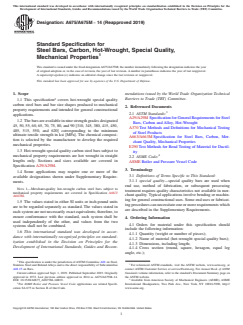
1.1 This specification2 covers hot-wrought special quality carbon steel bars and bar size shapes produced to mechanical property requirements and intended for general constructional applications.
1.2 The bars are available in nine strength grades designated 45, 50, 55, 60, 65, 70, 75, 80, and 90 [310, 345, 380, 415, 450, 485, 515, 550, and 620] corresponding to the minimum ultimate tensile strength in ksi [MPa]. The chemical composition is selected by the manufacturer to develop the required mechanical properties.
1.3 Hot-wrought special quality carbon steel bars subject to mechanical property requirements are hot wrought in straight lengths only. Sections and sizes available are covered in Specification A29/A29M.
1.4 Some applications may require one or more of the available designations shown under Supplementary Requirements.
Note 1: Merchant-quality hot-wrought carbon steel bars subject to mechanical property requirements are covered in Specification A663/A663M.
1.5 The values stated in either SI units or inch-pound units are to be regarded separately as standard. The values stated in each system are not necessarily exact equivalents; therefore, to ensure conformance with the standard, each system shall be used independently of the other, and values from the two systems shall not be combined.
1.6 This international standard was developed in accordance with internationally recognized principles on standardization established in the Decision on Principles for the Development of International Standards, Guides and Recommendations issued by the World Trade Organization Technical Barriers to Trade (TBT) Committee.
- Status
- Published
- Publication Date
- 31-Aug-2019
- Technical Committee
- A01 - Steel, Stainless Steel and Related Alloys
- Drafting Committee
- A01.15 - Bars

Overview
ASTM A675/A675M-14(2019) is a standard specification developed by ASTM International for hot-wrought special quality carbon steel bars and bar-size shapes. These products are manufactured to meet specific mechanical property requirements such as tensile strength, yield strength, and elongation, making them ideal for general constructional applications. This specification addresses requirements for straight-length bars in nine different strength grades, ensuring versatility for diverse structural and fabrication projects. It outlines important criteria for chemical composition, mechanical tests, and product quality, providing guidance for manufacturers, engineers, and construction professionals.
Key Topics
Scope and Applicability
- Covers hot-wrought, special quality carbon steel bars and shapes produced to meet mechanical property requirements.
- Bars are supplied in nine minimum strength grades: 45, 50, 55, 60, 65, 70, 75, 80, and 90 [310–620 MPa], tailored to specific tensile strength requirements.
- Only straight lengths are supplied; applicable for various cross-sections such as round, square, hexagon, and angles.
Chemical Composition
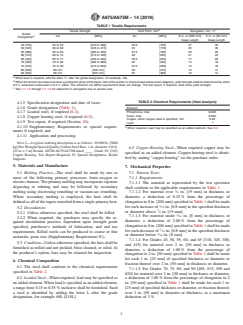
- Requires conformance to maximum limits for phosphorus (0.040%), sulfur (0.050%), and, if specified, minimum copper content (0.20%) and leaded steel.
- Manufacturers select alloy chemistry to achieve mechanical properties, with special restrictions possible by agreement (e.g., maximum carbon for select grades).
Mechanical Properties
- Products must pass tension tests as specified for yield strength, tensile strength, and elongation.
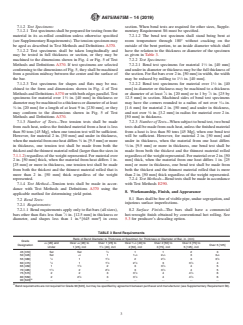
- Bend tests may be required for certain bar sizes and grades to confirm ductility.
- Test methods and sampling are defined for consistency.
Supplementary Requirements
- Purchasers can specify additional requirements, such as grain size, heat treatment, straightness, descaled surface, and bend requirements for specific grades.
- Certification and test reports can be required at the customer’s request.
Quality and Finish
- Bars must be free from injurious imperfections and are typically supplied with a hot-rolled finish unless otherwise specified.
Applications
ASTM A675/A675M hot-wrought carbon steel bars are widely used in:
- Building Construction: Ideal for frameworks, supports, bracing, and general structural uses requiring reliable mechanical performance.
- Fabrication and Engineering: Suited to components or assemblies needing machinability, bendability, and specific strength.
- Infrastructure Projects: Utilized in bridges, industrial plants, and infrastructure where mechanical reliability and structural quality are paramount.
- Boiler and Pressure Vessel Supports: When referenced in appropriate ASME code applications, these bars provide strength and durability for critical components.
The availability of multiple grades allows engineers and specifiers to choose materials optimized for design loads, fabrication methods, and service environments.
Related Standards
- ASTM A29/A29M: General requirements for carbon and alloy hot-wrought steel bars.
- ASTM A663/A663M: Specification for merchant-quality hot-wrought carbon steel bars.
- ASTM A370: Test methods and definitions for mechanical testing of steel products.
- ASTM E290: Test methods for bend testing of material for ductility.
- ASME Boiler and Pressure Vessel Code: Related specification SA 675 references ASTM A675/A675M for pressure application requirements.
These related standards provide further guidelines on manufacturing, testing, and material selection for carbon steel bars, supporting compliance and interoperability in construction and engineering sectors.
Keywords: ASTM A675, hot-wrought carbon steel bars, special quality, mechanical properties, construction steel standard, tensile strength, constructional applications, steel bar specification
Relations
- Effective Date
- 01-Sep-2019
- Effective Date
- 01-Mar-2024
- Effective Date
- 01-Nov-2023
- Effective Date
- 01-Jul-2019
- Refers
ASTM A370-17a - Standard Test Methods and Definitions for Mechanical Testing of Steel Products - Effective Date
- 15-Nov-2017
- Effective Date
- 01-Nov-2017
- Effective Date
- 01-Jan-2017
- Effective Date
- 01-Nov-2015
- Effective Date
- 01-Nov-2015
- Effective Date
- 15-May-2014
- Effective Date
- 15-Nov-2013
- Effective Date
- 01-Apr-2013
- Refers
ASTM A370-12a - Standard Test Methods and Definitions for Mechanical Testing of Steel Products - Effective Date
- 15-Oct-2012
- Effective Date
- 01-May-2012
- Effective Date
- 01-May-2012
Get Certified
Connect with accredited certification bodies for this standard

Element Materials Technology
Materials testing and product certification.

Inštitut za kovinske materiale in tehnologije
Institute of Metals and Technology. Materials testing, metallurgical analysis, NDT.
Sponsored listings
Frequently Asked Questions
ASTM A675/A675M-14(2019) is a technical specification published by ASTM International. Its full title is "Standard Specification for Steel Bars, Carbon, Hot-Wrought, Special Quality, Mechanical Properties". This standard covers: ABSTRACT This guide covers standard specification for hot-wrought special quality carbon steel bars and bar size shapes produced to mechanical property requirements and intended for general constructional applications. Heat analysis shall be performed wherein the material shall conform to the required chemical composition for phosphorus, sulfur, copper, and lead. The steel shall meet the required tensile properties such as tensile strength, yield strength, and elongation. The test specimen shall undergo mechanical tests such as tension test and bend test. SCOPE 1.1 This specification2 covers hot-wrought special quality carbon steel bars and bar size shapes produced to mechanical property requirements and intended for general constructional applications. 1.2 The bars are available in nine strength grades designated 45, 50, 55, 60, 65, 70, 75, 80, and 90 [310, 345, 380, 415, 450, 485, 515, 550, and 620] corresponding to the minimum ultimate tensile strength in ksi [MPa]. The chemical composition is selected by the manufacturer to develop the required mechanical properties. 1.3 Hot-wrought special quality carbon steel bars subject to mechanical property requirements are hot wrought in straight lengths only. Sections and sizes available are covered in Specification A29/A29M. 1.4 Some applications may require one or more of the available designations shown under Supplementary Requirements. Note 1: Merchant-quality hot-wrought carbon steel bars subject to mechanical property requirements are covered in Specification A663/A663M. 1.5 The values stated in either SI units or inch-pound units are to be regarded separately as standard. The values stated in each system are not necessarily exact equivalents; therefore, to ensure conformance with the standard, each system shall be used independently of the other, and values from the two systems shall not be combined. 1.6 This international standard was developed in accordance with internationally recognized principles on standardization established in the Decision on Principles for the Development of International Standards, Guides and Recommendations issued by the World Trade Organization Technical Barriers to Trade (TBT) Committee.
ABSTRACT This guide covers standard specification for hot-wrought special quality carbon steel bars and bar size shapes produced to mechanical property requirements and intended for general constructional applications. Heat analysis shall be performed wherein the material shall conform to the required chemical composition for phosphorus, sulfur, copper, and lead. The steel shall meet the required tensile properties such as tensile strength, yield strength, and elongation. The test specimen shall undergo mechanical tests such as tension test and bend test. SCOPE 1.1 This specification2 covers hot-wrought special quality carbon steel bars and bar size shapes produced to mechanical property requirements and intended for general constructional applications. 1.2 The bars are available in nine strength grades designated 45, 50, 55, 60, 65, 70, 75, 80, and 90 [310, 345, 380, 415, 450, 485, 515, 550, and 620] corresponding to the minimum ultimate tensile strength in ksi [MPa]. The chemical composition is selected by the manufacturer to develop the required mechanical properties. 1.3 Hot-wrought special quality carbon steel bars subject to mechanical property requirements are hot wrought in straight lengths only. Sections and sizes available are covered in Specification A29/A29M. 1.4 Some applications may require one or more of the available designations shown under Supplementary Requirements. Note 1: Merchant-quality hot-wrought carbon steel bars subject to mechanical property requirements are covered in Specification A663/A663M. 1.5 The values stated in either SI units or inch-pound units are to be regarded separately as standard. The values stated in each system are not necessarily exact equivalents; therefore, to ensure conformance with the standard, each system shall be used independently of the other, and values from the two systems shall not be combined. 1.6 This international standard was developed in accordance with internationally recognized principles on standardization established in the Decision on Principles for the Development of International Standards, Guides and Recommendations issued by the World Trade Organization Technical Barriers to Trade (TBT) Committee.
ASTM A675/A675M-14(2019) is classified under the following ICS (International Classification for Standards) categories: 77.140.60 - Steel bars and rods. The ICS classification helps identify the subject area and facilitates finding related standards.
ASTM A675/A675M-14(2019) has the following relationships with other standards: It is inter standard links to ASTM A675/A675M-14, ASTM A370-24, ASTM A663/A663M-23, ASTM A370-19, ASTM A370-17a, ASTM A663/A663M-17, ASTM A370-17, ASTM A29/A29M-15, ASTM A370-15, ASTM A370-14, ASTM A370-13, ASTM E290-13, ASTM A370-12a, ASTM A29/A29M-12, ASTM A29/A29M-12e1. Understanding these relationships helps ensure you are using the most current and applicable version of the standard.
ASTM A675/A675M-14(2019) is available in PDF format for immediate download after purchase. The document can be added to your cart and obtained through the secure checkout process. Digital delivery ensures instant access to the complete standard document.
Standards Content (Sample)
This international standard was developed in accordance with internationally recognized principles on standardization established in the Decision on Principles for the
Development of International Standards, Guides and Recommendations issued by the World Trade Organization Technical Barriers to Trade (TBT) Committee.
Designation:A675/A675M −14 (Reapproved 2019)
Standard Specification for
Steel Bars, Carbon, Hot-Wrought, Special Quality,
Mechanical Properties
This standard is issued under the fixed designationA675/A675M; the number immediately following the designation indicates the year
of original adoption or, in the case of revision, the year of last revision.Anumber in parentheses indicates the year of last reapproval.
A superscript epsilon (´) indicates an editorial change since the last revision or reapproval.
This standard has been approved for use by agencies of the U.S. Department of Defense.
1. Scope mendations issued by the World Trade Organization Technical
2 Barriers to Trade (TBT) Committee.
1.1 This specification covers hot-wrought special quality
carbon steel bars and bar size shapes produced to mechanical
2. Referenced Documents
property requirements and intended for general constructional
2.1 ASTM Standards:
applications.
A29/A29MSpecificationforGeneralRequirementsforSteel
1.2 Thebarsareavailableinninestrengthgradesdesignated
Bars, Carbon and Alloy, Hot-Wrought
45, 50, 55, 60, 65, 70, 75, 80, and 90 [310, 345, 380, 415, 450,
A370Test Methods and Definitions for Mechanical Testing
485, 515, 550, and 620] corresponding to the minimum
of Steel Products
ultimate tensile strength in ksi [MPa]. The chemical composi-
A663/A663MSpecification for Steel Bars, Carbon, Mer-
tion is selected by the manufacturer to develop the required
chant Quality, Mechanical Properties
mechanical properties.
E290Test Methods for Bend Testing of Material for Ductil-
1.3 Hot-wrought special quality carbon steel bars subject to
ity
mechanical property requirements are hot wrought in straight
2.2 ASME Code:
lengths only. Sections and sizes available are covered in
ASMEBoiler and Pressure Vessel Code
Specification A29/A29M.
3. Terminology
1.4 Some applications may require one or more of the
3.1 Definitions of Terms Specific to This Standard:
available designations shown under Supplementary Require-
3.1.1 special quality—special quality bars are used when
ments.
end use, method of fabrication, or subsequent processing
NOTE 1—Merchant-quality hot-wrought carbon steel bars subject to
treatment requires quality characteristics not available in mer-
mechanical property requirements are covered in Specification A663/
chant quality. Typical applications involve bending or machin-
A663M.
ing for general constructional uses. Some end uses or fabricat-
1.5 The values stated in either SI units or inch-pound units
ingprocedurescannecessitateoneormorerequirementswhich
are to be regarded separately as standard. The values stated in
are described in the Supplementary Requirements.
eachsystemarenotnecessarilyexactequivalents;therefore,to
ensure conformance with the standard, each system shall be
4. Ordering Information
used independently of the other, and values from the two
4.1 Orders for material under this specification should
systems shall not be combined.
include the following information:
1.6 This international standard was developed in accor-
4.1.1 Quantity (weight or number of pieces);
dance with internationally recognized principles on standard-
4.1.2 Name of material (hot-wrought special quality bars);
ization established in the Decision on Principles for the
4.1.3 Dimensions, including length;
Development of International Standards, Guides and Recom-
4.1.4 Cross section (round, square, hexagon, equal leg
angle, etc.);
This specification is under the jurisdiction ofASTM Committee A01 on Steel,
Stainless Steel and RelatedAlloys and is the direct responsibility of Subcommittee For referenced ASTM standards, visit the ASTM website, www.astm.org, or
A01.15 on Bars. contact ASTM Customer Service at service@astm.org. For Annual Book of ASTM
Current edition approved Sept. 1, 2019. Published September 2019. Originally Standards volume information, refer to the standard’s Document Summary page on
approved in 1972. Last previous edition approved in 2014 as A675/A675M–14. the ASTM website.
DOI: 10.1520/A0675_A0675M–14R19. Available from American Society of Mechanical Engineers (ASME), ASME
For ASME Boiler and Pressure Vessel Code applications see related Specifi- International Headquarters, Two Park Ave., New York, NY 10016-5990, http://
cation SA 675 in Section II of that Code. www.asme.org.
Copyright © ASTM International, 100 Barr Harbor Drive, PO Box C700, West Conshohocken, PA 19428-2959. United States
A675/A675M−14 (2019)
TABLE 1 Tensile Requirements
B C
Tensile Strength Yield Point, min Elongation, min, %
Grade
A ksi [MPa] ksi [MPa] 8 in. or [200 mm] 2 in. or [50 mm]
Designation
Gage Length Gage Length
45 [310] 45 to 55 [310 to 380] 22.5 [155] 27 33
50 [345] 50 to 60 [345 to 415] 25 [170] 25 30
55 [380] 55 to 65 [380 to 450] 27.5 [190] 23 26
60 [415] 60 to 72 [415 to 495] 30 [205] 21 22
65 [450] 65 to 77 [450 to 530] 32.5 [225] 17 20
70 [485] 70 to 85 [485 to 585] 35 [240] 14 18
75 [515] 75 to 90 [515 to 620] 37.5 [260] 14 18
80 [550] 80 min [550 min] 40 [275] 13 17
90 [620] 90 min [620 min] 55 [380] 10 14
A
When lead is required, add the letter “L” after the grade designation, for example, 45L.
B
When the tension test does not show a yield point (drop of the beam, halt of the pointer or sharp-kneed stress-strain diagram), yield strength shall be determined by either
0.5 % extension-under-load or 0.2 % offset. The minimum ksi (MPa) requirement does not change. The test report, if required, shall show yield strength.
C
See 7.1.1.2 through 7.1.1.5 for deduction in elongation due to section size.
TABLE 2 Chemical Requirements (Heat Analysis)
4.1.5 Specification designation and date of issue;
4.1.6 Grade designation (Table 1); Element
4.1.7 Leaded steel, if required (6.2); Phosphorus, max 0.040
Sulfur, max 0.050
4.1.8 Copper bearing steel, if required (6.3);
Copper, when copper steel is specified, min 0.20
4.1.9 Test report, if required (Section 10); A
Lead
4.1.10 Supplementary Requirements or special require-
A
When required, lead may be specified as an added element. See 6.2.
ments if required; and
4.1.11 Application and processing.
NOTE 2—Atypical ordering description is as follows: 10000 lb, [5000
kg]HotWroughtSpecialQualityCarbonSteelBars,1in.diameter×10ft,
6.3 Copper-Bearing Steel—When required copper may be
[25m×3m] Round,ASTMA675/A675M dated ____, Grade 50, [345]
specified as an added element. Copper-bearing steel is identi-
Copper Bearing, Test Report Required, S3 Special Straightness, Boiler
fied by stating “copper-bearing” on the purchase order.
Supports.
5. Materials and Manufacture
7. Mechanical Properties
5.1 Melting Practice—The steel shall be made by one or
7.1 Tension Tests:
more of the following primary processes: basic-oxygen or
7.1.1 Requirements:
electric-furnace.Theprimarymeltingmayincorporateseparate
7.1.1.1 The material as represented by the test specimen
degassing or refining and may be followed by secondary
shall conform to the applicable requirements in Table 1.
melting using electroslag remelting or vacuum-arc remelting.
7.1.1.2 For material over ⁄4 in. [19 mm] in thickness or
Where secondary melting is employed, the heat shall be
diameter, a deduction of 0.25% from the percentage of
definedasalloftheingotsremeltedfromasingleprimaryheat.
elongationin8in.[200mm]specifiedinTable1shallbemade
for each increase of ⁄32in. [0.8 mm] in the specified thickness
5.2 Deoxidation:
or diameter above ⁄4 in. [19 mm].
5.2.1 Unless otherwise specified, the steel shall be killed.
7.1.1.3 For material under ⁄16 in. [8 mm] in thickness or
5.2.2 When required, the purchaser may specify the re-
diameter, a deduction of 2.00% from the percentage of
quired deoxidation practice, dependent upon strength grade
elongationin8in.[200mm]specifiedinTable1shallbemade
specified, purchaser’s methods of fabrication, and end use
for each decrease of ⁄32in. [0.8 mm] in the specified thickness
requirements. Killed steels can be produced to coarse or fine
or diameter below ⁄16 in. [8 mm].
austenitic grain size (Supplementary Requirement S1).
7.1.1.4 For Grades 45, 50, 55, 60, and 65 [310, 345, 380,
5.3 Condition—Unlessotherwisespecified,thebarsshallbe
and 415] for material over 2 in. [50 mm] in thickness or
furnished as-rolled and not pickled, blast cleaned, or oiled.At
diameter, a deduction of 1.00% from the percentage of
the producer’s option, bars may be cleaned for inspection.
elongation in 2 in. [50 mm] specified in Table 1 shall be made
for each 1 in. [25 mm] of specified thickness or diameter or
6. Chemical Composition
fraction thereof over 2 in. [50 mm] in thickness or diameter.
6.1 The steel shall conform to the chemical requirements
7.1.1.5 For Grades 70, 75, 80, and 90 [485, 515, 550 and
specified in Table 2.
620] for material over 2 in. [50 mm] in thickness or diameter,
6.2 Leaded Steel—When required, lead may be specified as a deduction of 1.00% from the percentage of elongation in 2
an added element.When lead is specified as an added element, in. [50 mm] specified in Table 1 shall be made for each 1 in.
a range from 0.15 to 0.35% inclusive shall be furnished. Such [25mm]ofspecifiedthickne
...