

ASTM D8080-21
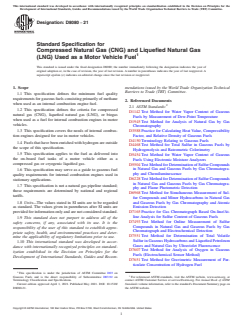
(Specification)Standard Specification for Compressed Natural Gas (CNG) and Liquefied Natural Gas (LNG) Used as a Motor Vehicle Fuel
General Information
- Abstract
SCOPE
1.1 This specification defines the minimum fuel quality requirements for gaseous fuels consisting primarily of methane when used as an internal combustion engine fuel.
1.2 This specification defines the criteria for compressed natural gas (CNG), liquefied natural gas (LNG), or biogas when used as a fuel for internal combustion engines in motor vehicles.
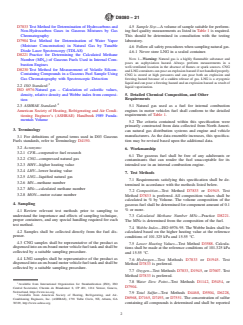
1.3 This specification covers the needs of internal combustion engines designed for use in motor vehicles.
1.4 Fuels that have been enriched with hydrogen are outside the scope of this specification.
1.5 This specification applies to the fuel as delivered into the on-board fuel tanks of a motor vehicle either as a compressed gas or cryogenic liquified gas.
1.6 This specification may serve as a guide to gaseous fuel quality requirements for internal combustion engines used in stationary applications.
1.7 This specification is not a natural gas pipeline standard; those requirements are determined by national and regional tariffs.
1.8 Units—The values stated in SI units are to be regarded as standard. The values given in parentheses after SI units are provided for information only and are not considered standard.
1.9 This standard does not purport to address all of the safety concerns, if any, associated with its use. It is the responsibility of the user of this standard to establish appropriate safety, health, and environmental practices and determine the applicability of regulatory limitations prior to use.
1.10 This international standard was developed in accordance with internationally recognized principles on standardization established in the Decision on Principles for the Development of International Standards, Guides and Recommendations issued by the World Trade Organization Technical Barriers to Trade (TBT) Committee.
- Status
- Published
- Publication Date
- 31-Mar-2021
- Technical Committee
- D03 - Gaseous Fuels
- Drafting Committee
- D03.92 - Terminology and Editorial
Overview
ASTM D8080-21: Standard Specification for Compressed Natural Gas (CNG) and Liquefied Natural Gas (LNG) Used as a Motor Vehicle Fuel provides essential fuel quality requirements for gaseous fuels, primarily methane-based, when used in internal combustion engines for motor vehicles. Developed by ASTM International, this standard targets both CNG and LNG, as well as biogas, to ensure safety, performance, and compatibility with automotive engines. The specification details delivery standards for fuel as dispensed into on-board vehicle fuel tanks, covering both compressed gas and cryogenic liquid formats. Additionally, it serves as a guidance document for similar stationary engine applications, helping manufacturers, fuel providers, and regulators maintain consistent product quality.
Key Topics
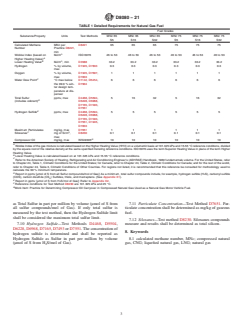
- Fuel Quality Requirements: Defines minimum acceptable levels for key properties including methane content, Wobbe index, lower and higher heating value, sulfur content, hydrogen content, oxygen content, water dew point, particulates, siloxanes, and compressor oil.
- Applicable Fuels: Covers CNG, LNG, and qualifying biogas, but specifically excludes natural gas blends enriched with hydrogen.
- Sampling and Test Methods: Specifies representative sampling procedures and references validated ASTM and ISO methods for testing fuel composition, contaminants, and physical properties.
- Definitions and Terminology: Incorporates industry-standard terminology and acronyms, essential for clear communication and regulatory alignment.
- Safety and Handling: Emphasizes safety measures during sampling and handling of natural gas and LNG, referencing hazards like flammability, explosion risks, and freezing potential.
- Chemical Limits: Sets strict thresholds for impurities-in particular, total sulfur, hydrogen sulfide, siloxanes, particulates, and water vapor-due to their impact on engine performance, emissions, and component longevity.
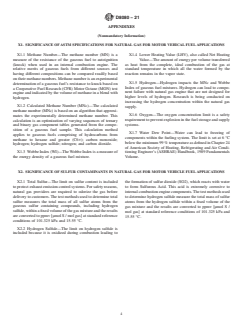
- Engine Protection and System Compatibility: Details how controlling contaminants like sulfur and particulates protects emission control systems and prevents damage to vehicle fuel systems.
Applications
Implementing ASTM D8080-21 provides several practical benefits for stakeholders in the natural gas vehicle (NGV) industry:
- Fuel Distributors and Suppliers: Ensures that CNG and LNG delivered to refueling stations meet stringent quality criteria, enhancing market confidence and reducing liability.
- Automotive OEMs and Engine Manufacturers: Offers a reference for designing engines and fuel system components calibrated for ASTM-compliant natural gas properties, supporting optimal performance and warranty coverage.
- Fleet Operators and End Users: Reduces the risk of fuel-related engine problems, emission system failures, and unexpected maintenance by promoting consistent fuel quality.
- Regulators and Standardization Bodies: Supports harmonization of gaseous fuel standards, enabling cross-boundary trade and regulatory enforcement in the NGV sector.
- Stationary Engine Applications: Though tailored to motor vehicles, the standard may be applied as a guide for stationary natural gas engines, promoting higher reliability and lower emissions in industrial power generation.
Related Standards
ASTM D8080-21 references and aligns with several international and national standards, including:
- ASTM D1945: Analysis of natural gas by gas chromatography
- ASTM D3588: Calculating heat value, compressibility, and relative density of gaseous fuels
- ASTM D4468, D5504, D6228, D6968, D7165, D7493, D7551: Methods for measuring sulfur compounds in gaseous fuels
- ASTM D7833, D7904, D8230: Analysis of hydrocarbons, moisture, and silicon-containing compounds
- ASTM D8221: Practice for calculating methane number of gaseous fuels for engines
- ISO 6976: Calculation of calorific value, density, and Wobbe index for natural gas
- ASHRAE Handbook (1989): Reference for ambient temperature requirements that inform water dew point limits
By conforming to ASTM D8080-21, industry participants help ensure performance, safety, and reliability of CNG and LNG motor vehicle fuels, supporting a cleaner, more sustainable transportation sector.
Relations
- Effective Date
- 15-Dec-2019
- Effective Date
- 01-Dec-2018
- Effective Date
- 01-Sep-2018
- Effective Date
- 01-Jul-2016
- Effective Date
- 01-Jun-2014
- Effective Date
- 01-Nov-2012
- Effective Date
- 01-Nov-2011
- Effective Date
- 01-Nov-2011
- Effective Date
- 01-Jun-2011
- Effective Date
- 01-Jun-2011
- Effective Date
- 01-Jun-2011
- Effective Date
- 01-Dec-2010
- Effective Date
- 01-Jul-2010
- Effective Date
- 01-May-2010
- Effective Date
- 01-Jan-2010
Get Certified
Connect with accredited certification bodies for this standard

Element Materials Technology
Materials testing and product certification.

ABS Group Brazil
ABS Group certification services in Brazil.

ABS Quality Evaluations Inc.
American Bureau of Shipping quality certification.
Sponsored listings
Frequently Asked Questions
ASTM D8080-21 is a technical specification published by ASTM International. Its full title is "Standard Specification for Compressed Natural Gas (CNG) and Liquefied Natural Gas (LNG) Used as a Motor Vehicle Fuel". This standard covers: SCOPE 1.1 This specification defines the minimum fuel quality requirements for gaseous fuels consisting primarily of methane when used as an internal combustion engine fuel. 1.2 This specification defines the criteria for compressed natural gas (CNG), liquefied natural gas (LNG), or biogas when used as a fuel for internal combustion engines in motor vehicles. 1.3 This specification covers the needs of internal combustion engines designed for use in motor vehicles. 1.4 Fuels that have been enriched with hydrogen are outside the scope of this specification. 1.5 This specification applies to the fuel as delivered into the on-board fuel tanks of a motor vehicle either as a compressed gas or cryogenic liquified gas. 1.6 This specification may serve as a guide to gaseous fuel quality requirements for internal combustion engines used in stationary applications. 1.7 This specification is not a natural gas pipeline standard; those requirements are determined by national and regional tariffs. 1.8 Units—The values stated in SI units are to be regarded as standard. The values given in parentheses after SI units are provided for information only and are not considered standard. 1.9 This standard does not purport to address all of the safety concerns, if any, associated with its use. It is the responsibility of the user of this standard to establish appropriate safety, health, and environmental practices and determine the applicability of regulatory limitations prior to use. 1.10 This international standard was developed in accordance with internationally recognized principles on standardization established in the Decision on Principles for the Development of International Standards, Guides and Recommendations issued by the World Trade Organization Technical Barriers to Trade (TBT) Committee.
SCOPE 1.1 This specification defines the minimum fuel quality requirements for gaseous fuels consisting primarily of methane when used as an internal combustion engine fuel. 1.2 This specification defines the criteria for compressed natural gas (CNG), liquefied natural gas (LNG), or biogas when used as a fuel for internal combustion engines in motor vehicles. 1.3 This specification covers the needs of internal combustion engines designed for use in motor vehicles. 1.4 Fuels that have been enriched with hydrogen are outside the scope of this specification. 1.5 This specification applies to the fuel as delivered into the on-board fuel tanks of a motor vehicle either as a compressed gas or cryogenic liquified gas. 1.6 This specification may serve as a guide to gaseous fuel quality requirements for internal combustion engines used in stationary applications. 1.7 This specification is not a natural gas pipeline standard; those requirements are determined by national and regional tariffs. 1.8 Units—The values stated in SI units are to be regarded as standard. The values given in parentheses after SI units are provided for information only and are not considered standard. 1.9 This standard does not purport to address all of the safety concerns, if any, associated with its use. It is the responsibility of the user of this standard to establish appropriate safety, health, and environmental practices and determine the applicability of regulatory limitations prior to use. 1.10 This international standard was developed in accordance with internationally recognized principles on standardization established in the Decision on Principles for the Development of International Standards, Guides and Recommendations issued by the World Trade Organization Technical Barriers to Trade (TBT) Committee.
ASTM D8080-21 is classified under the following ICS (International Classification for Standards) categories: 75.160.20 - Liquid fuels. The ICS classification helps identify the subject area and facilitates finding related standards.
ASTM D8080-21 has the following relationships with other standards: It is inter standard links to ASTM D4150-19, ASTM D8221-18a, ASTM D8221-18, ASTM D4150-08(2016), ASTM D7493-14, ASTM D7833-12, ASTM D4468-85(2011), ASTM D3588-98(2011), ASTM D5454-11e1, ASTM D7607-11, ASTM D5454-11, ASTM D6228-10, ASTM D7651-10, ASTM D7551-10, ASTM D1945-03(2010). Understanding these relationships helps ensure you are using the most current and applicable version of the standard.
ASTM D8080-21 is available in PDF format for immediate download after purchase. The document can be added to your cart and obtained through the secure checkout process. Digital delivery ensures instant access to the complete standard document.
Standards Content (Sample)
This international standard was developed in accordance with internationally recognized principles on standardization established in the Decision on Principles for the
Development of International Standards, Guides and Recommendations issued by the World Trade Organization Technical Barriers to Trade (TBT) Committee.
Designation:D8080 −21
Standard Specification for
Compressed Natural Gas (CNG) and Liquefied Natural Gas
(LNG) Used as a Motor Vehicle Fuel
This standard is issued under the fixed designation D8080; the number immediately following the designation indicates the year of
original adoption or, in the case of revision, the year of last revision. A number in parentheses indicates the year of last reapproval. A
superscript epsilon (´) indicates an editorial change since the last revision or reapproval.
1. Scope mendations issued by the World Trade Organization Technical
Barriers to Trade (TBT) Committee.
1.1 This specification defines the minimum fuel quality
requirements for gaseous fuels consisting primarily of methane
2. Referenced Documents
when used as an internal combustion engine fuel.
2.1 ASTM Standards:
1.2 This specification defines the criteria for compressed
D1142 Test Method for Water Vapor Content of Gaseous
natural gas (CNG), liquefied natural gas (LNG), or biogas
Fuels by Measurement of Dew-Point Temperature
when used as a fuel for internal combustion engines in motor
D1945 Test Method for Analysis of Natural Gas by Gas
vehicles.
Chromatography
D3588 Practice for Calculating Heat Value, Compressibility
1.3 This specification covers the needs of internal combus-
tion engines designed for use in motor vehicles. Factor, and Relative Density of Gaseous Fuels
D4150 Terminology Relating to Gaseous Fuels
1.4 Fuels that have been enriched with hydrogen are outside
D4468 Test Method for Total Sulfur in Gaseous Fuels by
the scope of this specification.
Hydrogenolysis and Rateometric Colorimetry
1.5 This specification applies to the fuel as delivered into
D5454 Test Method for Water Vapor Content of Gaseous
the on-board fuel tanks of a motor vehicle either as a
Fuels Using Electronic Moisture Analyzers
compressed gas or cryogenic liquified gas.
D5504 TestMethodforDeterminationofSulfurCompounds
in Natural Gas and Gaseous Fuels by Gas Chromatogra-
1.6 This specification may serve as a guide to gaseous fuel
phy and Chemiluminescence
quality requirements for internal combustion engines used in
D6228 TestMethodforDeterminationofSulfurCompounds
stationary applications.
in Natural Gas and Gaseous Fuels by Gas Chromatogra-
1.7 This specification is not a natural gas pipeline standard;
phy and Flame Photometric Detection
those requirements are determined by national and regional
D6968 Test Method for Simultaneous Measurement of Sul-
tariffs.
fur Compounds and Minor Hydrocarbons in Natural Gas
1.8 Units—The values stated in SI units are to be regarded and Gaseous Fuels by Gas Chromatography and Atomic
as standard. The values given in parentheses after SI units are Emission Detection
provided for information only and are not considered standard. D7165 Practice for Gas Chromatograph Based On-line/At-
line Analysis for Sulfur Content of Gaseous Fuels
1.9 This standard does not purport to address all of the
D7493 Test Method for Online Measurement of Sulfur
safety concerns, if any, associated with its use. It is the
Compounds in Natural Gas and Gaseous Fuels by Gas
responsibility of the user of this standard to establish appro-
Chromatograph and Electrochemical Detection
priate safety, health, and environmental practices and deter-
D7551 Test Method for Determination of Total Volatile
mine the applicability of regulatory limitations prior to use.
Sulfur in Gaseous Hydrocarbons and Liquefied Petroleum
1.10 This international standard was developed in accor-
Gases and Natural Gas by Ultraviolet Fluorescence
dance with internationally recognized principles on standard-
D7607 Test Method for Analysis of Oxygen in Gaseous
ization established in the Decision on Principles for the
Fuels (Electrochemical Sensor Method)
Development of International Standards, Guides and Recom-
D7651 Test Method for Gravimetric Measurement of Par-
ticulate Concentration of Hydrogen Fuel
This specification is under the jurisdiction of ASTM Committee D03 on
Gaseous Fuels and is the direct responsibility of Subcommittee D03.92 on For referenced ASTM standards, visit the ASTM website, www.astm.org, or
Terminology Classification and Specifications. contact ASTM Customer Service at service@astm.org. For Annual Book of ASTM
Current edition approved April 1, 2021. Published May 2021. DOI: 10.1520/ Standards volume information, refer to the standard’s Document Summary page on
D8080-21. the ASTM website.
Copyright © ASTM International, 100 Barr Harbor Drive, PO Box C700, West Conshohocken, PA 19428-2959. United States
D8080−21
D7833 Test Method for Determination of Hydrocarbons and 4.5 Sample Size—Avolume of sample suitable for perform-
Non-Hydrocarbon Gases in Gaseous Mixtures by Gas ing fuel quality measurements as listed in Table 1 is required.
Chromatography This should be determined in consultation with the testing
D7904 Test Method for Determination of Water Vapor laboratory.
(Moisture Concentration) in Natural Gas by Tunable
4.6 Follow all safety procedures when sampling natural gas.
Diode Laser Spectroscopy (TDLAS)
4.6.1 Never store LNG in a sealed container.
D8221 Practice for Determining the Calculated Methane
NOTE 1—Warning: Natural gas is a highly flammable substance and
Number (MN ) of Gaseous Fuels Used in Internal Com-
C
poses an asphyxiation hazard. Always perform measurements in a
bustion Engines
well-ventilated location in the absence of flames or spark sources. CNG
D8230 Test Method for Measurement of Volatile Silicon-
and LNG containers can pose an explosion hazard if not handled properly.
Containing Compounds in a Gaseous Fuel Sample Using
CNG is stored at high pressures and can pose both an explosion and
freezing hazard because of a sudden release of gas. LNG is a cryogenic
Gas Chromatography with Spectroscopic Detection
liquid and can pose a freezing hazard and an explosion hazard as result of
2.2 ISO Standard:
liquid vaporization.
ISO 6976 Natural gas – Calculation of calorific values,
5. Detailed Chemical Composition, and Other
density, relative density and Wobbe index from composi-
Requirements
tion
5.1 Natural gas used as a fuel for internal combustion
2.3 ASHRAE Standard:
engines in motor vehicles fuel shall conform to the detailed
American Society of Heating, Refrigerating and Air Condi-
requirements of Table 1.
tioning Engineer’s (ASHRAE) Handbook 1989 Funda-
mentals Volume
5.2 The criteria contained within this specification were
primarily constructed from data collected from North Ameri-
3. Terminology
can natural gas distribution systems and engine and vehicle
manufacturers. As the data ensemble increases, this specifica-
3.1 For definitions of general terms used in D03 Gaseous
tion may be revised based upon the additional data.
Fuels standards, refer to Terminology D4150.
3.2 Acronyms:
6. Workmanship
3.2.1 CFR—cooperative fuel research
6.1 The gaseous fuel shall be free of any adulterants or
3.2.2 CNG—compressed natural gas
contaminants that can render the fuel unacceptable for its
3.2.3 HHV—higher heating value
intended use in an internal combustion engine.
3.2.4 LHV—lower heating value
7. Test Methods
3.2.5 LNG—liquified natural gas
7.1 Requirements satisfying this specification shall be de-
3.2.6 MN—methane number
termined in accordance with the methods listed below.
3.2.7 MNc—calculated methane number
7.2 Composition—Test Method D7833 or D1945. Test
3.2.8 MON—motor octane number
Method D7833 is preferred. All composition values shall be
calculated in % by Volume. The volume composition of the
4. Sampling
gaseous fuel shall be determined for component amount of 0.1
% or more.
4.1 Review relevant test methods prior to sampling to
understand the importance and effects of sampling technique,
7.3 Calculated Methane Number MNc—Practice D8221.
proper containers, and any special handling required for each
The MNc is determined from the composition of the fuel.
test method.
7.4 Wobbe Index—ISO 6976-95. The Wobbe Index shall be
4.2 Samples shall be collected directly from the fuel dis-
calculated based on the higher heating value at the reference
penser.
conditions of 101.325 kPa and 15.55 °C.
4.3 CNG samples shall be representative of the product as
7.5 Lower Heating Values—Test Method D3588. Calcula-
dispensedintoanon-boardmotorvehiclefueltankandshallbe
tions shall be made at the reference conditions of 101.325 kPa
collected by a suitable sampling procedure.
and 15.55 °C.
4.4 LNG samples shall be representative of the product as
7.6 Hydrogen—Test Methods D7833 or D1945. Test
dispensedintoanon-boardmotorvehiclefueltankandshallbe
Method D7833 is preferred.
collected by a suitable sampling procedure.
7.7 Oxygen—Test Methods D7833, D1945,or D7607. Test
Method D7833 is preferred.
7.8 Water Dew Point—Test Methods D1142, D5454,or
Available from International Organization for Standardization (ISO), ISO
D7904.
Central Secretariat, Chemin de Blandonnet 8, CP 401, 1214 Vernier, Geneva,
Switzerland, https://www.iso.org.
7.9 Total Sulfur—Test Methods D4468, D5504, D6228,
Available from American Society of Heating, Refrigerating, and Air-
D6968, D7165, D7493,or D7551. The conce
...