

ASTM B562-95(2021)
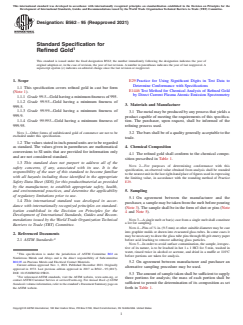
(Specification)Standard Specification for Refined Gold
General Information
- Abstract
ABSTRACT
This specification covers refined gold of Grades 99.5, 99.95, 99.99, and 99.995 in cast bar forms. Other forms of unfabricated gold of commerce are not to be excluded under this specification. The metal may be produced by any refining process that yields products capable of meeting the specified chemical composition requirements. Chemical assessment samples may be taken from the melt before pouring and shall be in the form of shots or pins, or by other alternative means on agreement between the manufacturer and purchaser.
SCOPE
1.1 This specification covers refined gold in cast bar form (Note 1).
1.1.1 Grade 99.5—Gold having a minimum fineness of 995.
1.1.2 Grade 99.95—Gold having a minimum fineness of 999.5.
1.1.3 Grade 99.99—Gold having a minimum fineness of 999.9.
1.1.4 Grade 99.995—Gold having a minimum fineness of 999.95.
Note 1: Other forms of unfabricated gold of commerce are not to be excluded under this specification.
1.2 The values stated in inch-pound units are to be regarded as standard. The values given in parentheses are mathematical conversions to SI units that are provided for information only and are not considered standard.
1.3 This standard does not purport to address all of the safety concerns, if any, associated with its use. It is the responsibility of the user of this standard to become familiar with all hazards including those identified in the appropriate Safety Data Sheet (SDS) for this product/material as provided by the manufacturer, to establish appropriate safety, health, and environmental practices, and determine the applicability of regulatory limitations prior to use.
1.4 This international standard was developed in accordance with internationally recognized principles on standardization established in the Decision on Principles for the Development of International Standards, Guides and Recommendations issued by the World Trade Organization Technical Barriers to Trade (TBT) Committee.
- Status
- Published
- Publication Date
- 31-Oct-2021
- Technical Committee
- B02 - Nonferrous Metals and Alloys

Overview
ASTM B562-95(2021): Standard Specification for Refined Gold sets internationally recognized quality requirements for refined gold in cast bar form. Published by ASTM International, this specification covers four commercial grades of gold with minimum fineness levels of 99.5%, 99.95%, 99.99%, and 99.995%. The standard also allows for other forms of unfabricated gold commonly traded in the marketplace.
This specification details permissible chemical compositions, sampling practices, and marking requirements for gold bullion, supporting traceability, consistency, and confidence in the quality of refined gold for both industrial and investment purposes. While the standard was developed for cast bars, it is not exclusive of other commercial forms of unfabricated gold.
Key Topics
Grades of Refined Gold:
- Grade 99.5 (minimum 995 fineness)
- Grade 99.95 (minimum 999.5 fineness)
- Grade 99.99 (minimum 999.9 fineness)
- Grade 99.995 (minimum 999.95 fineness)
Chemical Composition:
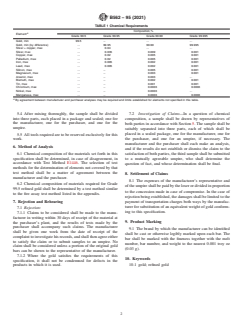
The standard mandates strict limits on impurities such as silver, copper, palladium, iron, lead, silicon, magnesium, arsenic, bismuth, tin, chromium, nickel, and manganese. These compositional requirements ensure high purity and quality.Production and Sampling:
Gold can be refined using any process, as long as the final product conforms with chemical criteria. Sampling is typically performed from the melt before casting, using methods like shots or pins. Alternative sampling procedures can be agreed upon between manufacturer and purchaser. Proper preparation and handling practices are crucial to avoid contamination.Testing and Analysis:
Chemical analysis is guided by ASTM E1446 or comparable methods, especially for dispute resolution. Grades of gold may require specific test methods, with the fire assay method recommended for Grade 99.5.Product Marking:
Each cast bar must be permanently marked with the manufacturer’s brand, fineness, melt number, bar number, and weight (to the nearest 0.001 troy ounce).Claims and Settlement:
Any claims concerning chemical composition must be made promptly and supported by test data. Disputes are resolved through representative sampling and umpires, ensuring fair resolution.
Applications
Refined gold produced in accordance with ASTM B562-95(2021) is widely used for:
- Bullion and Investment: Ensures universal acceptance and trust within precious metals markets by guaranteeing purity and standardization for gold bars held by investors, banks, and refineries.
- Manufacturing and Electronics: High-purity gold is essential in electronics, precision engineering, medical devices, and other industries where material integrity and performance are critical.
- Jewelry Production: Enables jewelers to reliably source quality gold meeting strict compositional standards.
By following ASTM B562-95(2021), businesses and institutions can confidently source, trade, and use refined gold, knowing materials meet globally recognized quality benchmarks.
Related Standards
- ASTM E1446 - Test Method for Chemical Analysis of Refined Gold by Direct Current Plasma Atomic Emission Spectrometry.
- ASTM E29 - Practice for Using Significant Digits in Test Data to Determine Conformance with Specifications.
- ISO and LBMA Good Delivery Rules - For organizations trading in global gold markets, referencing related international and industry-specific standards for refined gold.
- World Trade Organization TBT Principles - This standard follows the WTO’s Technical Barriers to Trade principles, ensuring international harmonization.
Keywords: refined gold specification, ASTM B562, gold bar standard, purity of gold, gold chemical composition, precious metals standards, gold bullion quality, gold sampling, gold testing, cast gold bar, gold marking requirements
Relations
- Effective Date
- 01-Oct-2008
- Effective Date
- 15-Nov-2006
- Effective Date
- 15-Sep-2006
- Effective Date
- 01-May-2006
- Effective Date
- 01-Oct-2005
- Effective Date
- 01-Dec-2004
- Effective Date
- 10-May-2002
- Effective Date
- 10-May-1999
- Effective Date
- 10-Apr-1997
Get Certified
Connect with accredited certification bodies for this standard

Element Materials Technology
Materials testing and product certification.

Inštitut za kovinske materiale in tehnologije
Institute of Metals and Technology. Materials testing, metallurgical analysis, NDT.
Sponsored listings
Frequently Asked Questions
ASTM B562-95(2021) is a technical specification published by ASTM International. Its full title is "Standard Specification for Refined Gold". This standard covers: ABSTRACT This specification covers refined gold of Grades 99.5, 99.95, 99.99, and 99.995 in cast bar forms. Other forms of unfabricated gold of commerce are not to be excluded under this specification. The metal may be produced by any refining process that yields products capable of meeting the specified chemical composition requirements. Chemical assessment samples may be taken from the melt before pouring and shall be in the form of shots or pins, or by other alternative means on agreement between the manufacturer and purchaser. SCOPE 1.1 This specification covers refined gold in cast bar form (Note 1). 1.1.1 Grade 99.5—Gold having a minimum fineness of 995. 1.1.2 Grade 99.95—Gold having a minimum fineness of 999.5. 1.1.3 Grade 99.99—Gold having a minimum fineness of 999.9. 1.1.4 Grade 99.995—Gold having a minimum fineness of 999.95. Note 1: Other forms of unfabricated gold of commerce are not to be excluded under this specification. 1.2 The values stated in inch-pound units are to be regarded as standard. The values given in parentheses are mathematical conversions to SI units that are provided for information only and are not considered standard. 1.3 This standard does not purport to address all of the safety concerns, if any, associated with its use. It is the responsibility of the user of this standard to become familiar with all hazards including those identified in the appropriate Safety Data Sheet (SDS) for this product/material as provided by the manufacturer, to establish appropriate safety, health, and environmental practices, and determine the applicability of regulatory limitations prior to use. 1.4 This international standard was developed in accordance with internationally recognized principles on standardization established in the Decision on Principles for the Development of International Standards, Guides and Recommendations issued by the World Trade Organization Technical Barriers to Trade (TBT) Committee.
ABSTRACT This specification covers refined gold of Grades 99.5, 99.95, 99.99, and 99.995 in cast bar forms. Other forms of unfabricated gold of commerce are not to be excluded under this specification. The metal may be produced by any refining process that yields products capable of meeting the specified chemical composition requirements. Chemical assessment samples may be taken from the melt before pouring and shall be in the form of shots or pins, or by other alternative means on agreement between the manufacturer and purchaser. SCOPE 1.1 This specification covers refined gold in cast bar form (Note 1). 1.1.1 Grade 99.5—Gold having a minimum fineness of 995. 1.1.2 Grade 99.95—Gold having a minimum fineness of 999.5. 1.1.3 Grade 99.99—Gold having a minimum fineness of 999.9. 1.1.4 Grade 99.995—Gold having a minimum fineness of 999.95. Note 1: Other forms of unfabricated gold of commerce are not to be excluded under this specification. 1.2 The values stated in inch-pound units are to be regarded as standard. The values given in parentheses are mathematical conversions to SI units that are provided for information only and are not considered standard. 1.3 This standard does not purport to address all of the safety concerns, if any, associated with its use. It is the responsibility of the user of this standard to become familiar with all hazards including those identified in the appropriate Safety Data Sheet (SDS) for this product/material as provided by the manufacturer, to establish appropriate safety, health, and environmental practices, and determine the applicability of regulatory limitations prior to use. 1.4 This international standard was developed in accordance with internationally recognized principles on standardization established in the Decision on Principles for the Development of International Standards, Guides and Recommendations issued by the World Trade Organization Technical Barriers to Trade (TBT) Committee.
ASTM B562-95(2021) is classified under the following ICS (International Classification for Standards) categories: 77.120.99 - Other non-ferrous metals and their alloys. The ICS classification helps identify the subject area and facilitates finding related standards.
ASTM B562-95(2021) has the following relationships with other standards: It is inter standard links to ASTM E29-08, ASTM E29-06b, ASTM E29-06a, ASTM E29-06, ASTM E1446-05, ASTM E29-04, ASTM E29-02e1, ASTM E29-93a(1999), ASTM E1446-92(1997)e1. Understanding these relationships helps ensure you are using the most current and applicable version of the standard.
ASTM B562-95(2021) is available in PDF format for immediate download after purchase. The document can be added to your cart and obtained through the secure checkout process. Digital delivery ensures instant access to the complete standard document.
Standards Content (Sample)
This international standard was developed in accordance with internationally recognized principles on standardization established in the Decision on Principles for the
Development of International Standards, Guides and Recommendations issued by the World Trade Organization Technical Barriers to Trade (TBT) Committee.
Designation:B562 −95 (Reapproved 2021)
Standard Specification for
Refined Gold
This standard is issued under the fixed designation B562; the number immediately following the designation indicates the year of
original adoption or, in the case of revision, the year of last revision. A number in parentheses indicates the year of last reapproval. A
superscript epsilon (´) indicates an editorial change since the last revision or reapproval.
1. Scope E29 Practice for Using Significant Digits in Test Data to
Determine Conformance with Specifications
1.1 This specification covers refined gold in cast bar form
E1446 Test Method for Chemical Analysis of Refined Gold
(Note 1).
by Direct Current Plasma Atomic Emission Spectrometry
1.1.1 Grade 99.5—Gold having a minimum fineness of 995.
1.1.2 Grade 99.95—Gold having a minimum fineness of
3. Materials and Manufacture
999.5.
1.1.3 Grade 99.99—Gold having a minimum fineness of
3.1 The metal may be produced by any process that yields a
999.9.
product capable of meeting the requirements of this specifica-
1.1.4 Grade 99.995—Gold having a minimum fineness of
tion. The purchaser, upon request, shall be informed of the
999.95.
refining process used.
NOTE 1—Other forms of unfabricated gold of commerce are not to be
3.2 The bars shall be of a quality generally acceptable to the
excluded under this specification.
trade.
1.2 The values stated in inch-pound units are to be regarded
as standard. The values given in parentheses are mathematical
4. Chemical Composition
conversions to SI units that are provided for information only
4.1 The refined gold shall conform to the chemical compo-
and are not considered standard.
sition prescribed in Table 1.
1.3 This standard does not purport to address all of the
NOTE 2—For purposes of determining conformance with this
safety concerns, if any, associated with its use. It is the
specification, an observed value obtained from analysis shall be rounded
responsibility of the user of this standard to become familiar
to the nearest unit in the last right-hand place of figures used in expressing
with all hazards including those identified in the appropriate
the limiting value, in accordance with the rounding method of Practice
E29.
Safety Data Sheet (SDS) for this product/material as provided
by the manufacturer, to establish appropriate safety, health,
and environmental practices, and determine the applicability 5. Sampling
of regulatory limitations prior to use.
5.1 On agreement between the manufacturer and the
1.4 This international standard was developed in accor-
purchaser, a sample may be taken from the melt before pouring
dance with internationally recognized principles on standard-
(Note 3). The sample shall be in the form of shot or pins (Note
ization established in the Decision on Principles for the
4 and Note 5).
Development of International Standards, Guides and Recom-
NOTE 3—Asingle melt or bar(s) cast from a single melt shall constitute
mendations issued by the World Trade Organization Technical
a lot for sampling.
Barriers to Trade (TBT) Committee.
NOTE 4—Pins of ⁄8 in. (9.5 mm) or other suitable diameter may be cast
into graphite molds or drawn into evacuated glass tubes. In some cases it
2. Referenced Documents
may be necessary to draw the glass tube pins through 60-grit emery paper
before acid leaching to remove adhering glass particles.
2.1 ASTM Standards:
NOTE 5—In order to avoid surface contamination, the sample, irrespec-
tive of its nature, is to be leached in hot 1 + 1 HCl for 5 min, washed in
water, rinsed twice in alcohol or acetone, and dried in a muffle at 110°C
This specification is under the jurisdiction of ASTM Committee B02 on
before portions are taken for analysis.
Nonferrous Metals and Alloys and is the direct responsibility of Subcommittee
B02.05 on Precious Metals and Electrical Contact Materials.
5.2 On agreement between manufacturer and purchaser an
Current edition approved Nov. 1, 2021. Published December 2021. Originally
alternative sampling procedure may be used.
approved in 1972. Last previous edition approved in 2017 as B562 – 95 (2017).
DOI: 10.1520/B0562-95R21.
5.3 The amount of sample taken shall be sufficient to supply
For referenced ASTM standards, visit the ASTM website, www.astm.org, or
three portions for analysis; the mass of each portion shall be
contact ASTM Customer Service at service@astm.org. For Annual Book of ASTM
sufficient to permit the determination of its composition as set
Standards volume information, refer to the standard’s Document Summary page on
the ASTM website. forth in Table 1.
Copyright © ASTM International, 100 Barr Harbor Drive, PO Box C700, West Conshohocken, PA 19428-2959. United States
B562−95 (2021)
TABLE 1 Chemical Requirements
Composition,%
A
Element
Grade 99.5 Grade 99.95 Grade 99.99 Grade 99.995
Gold, min 99.5 . . .
Gold, min (by difference) . 99.95 99.99 99.995
Silver + copper, max . 0.04 . .
Silver, max . 0.035 0.009 0.001
Copper, max . 0.02 0.005 0.001
Palladium, max . 0.02 0.005 0.001
Iron, max . 0.005 0.002 0.001
Lead, max . 0.005 0.002 0.001
Silicon, max . . 0.005 0.001
Magnesium, max . . 0.003 0.001
Arsenic, max . . 0.003 .
Bismuth, max . . 0.002 0.001
Tin, max . . 0.001 0.001
Chromium, max . . 0.0003 0.0003
Nickel, max . . 0.0003 .
Manganese, max . . 0.0003 0.0003
A
By agreement between manufacturer and purchaser analyses may be required and limits established for elements not specified in this table.
5.4 After mixing thoroughly, the sample shall be divided 7.2 Investigation of Claims—In a question of chemical
into three parts, each placed in a package and sealed; one for
composition, a sample shall be drawn by representatives of
the manufacturer, one for the purchaser, and one for the
both parties in accordance with Section 5. The sample shall be
umpire.
suitably separated into three parts, each of which shall be
placed in a sealed package, one for the manufacturer, one for
5.5 All tools required are to be reserved exclusively for this
the purchaser, and one for an umpire, if necessary. The
work.
manufacturer and the purchaser shall each make an analysis,
6. Method of Analysis
and if the results do not establish or dismiss the claim to the
6.1 Chemical composition of the materials set forth in this satisfaction of both parties, the third sample shall be submitted
specification shall be determined, in case of disagreement, in
to a mutually agreeable umpire, who shall determine the
accordance with Test Method E1446. The selection of test
question of fact, and whose determination shall be final.
methods for the determination of elements not covered by that
test method shall be a matter of agreement between the
8. Settlement of Claims
manufacturer and the purchaser.
8.1 The expenses of the manufacturer’s representative and
6.2 Chemical composition of materials required for Grade
oftheumpireshallbepaidbytheloserordividedinproportion
99.5 refined gold shall be determined by a test method similar
to the concession made in case of compromise. In the case of
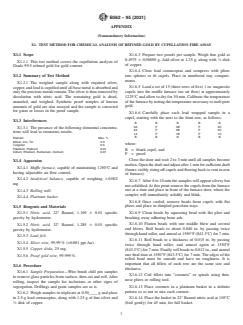
to the fire assay test method listed in the appendix.
rejection being established, the damages shall be limited t
...