

ASTM D5607-16
(Test Method)Standard Test Method for Performing Laboratory Direct Shear Strength Tests of Rock Specimens Under Constant Normal Force
General Information
- Abstract
SIGNIFICANCE AND USE
5.1 Determination of shear strength of a rock specimen is an important aspect in the design of structures such as rock slopes, dam foundations, tunnels, shafts, waste repositories, caverns for storage, and other purposes. Pervasive discontinuities (joints, bedding planes, shear zones, fault zones, schistosity) in a rock mass, and genesis, crystallography, texture, fabric, and other factors can cause the rock mass to behave as an anisotropic and heterogeneous discontinuum. Therefore, the precise prediction of rock mass behavior is difficult.
5.2 For nonplanar joints or discontinuities, shear strength is derived from a combination base material friction and overriding of asperities (dilatancy), shearing or breaking of the asperities, and rotations at or wedging of the asperities. Sliding on and shearing of the asperities can occur simultaneously. When the normal force is not sufficient to restrain dilation, the shear mechanism consists of the overriding of the asperities. When the normal load is large enough to completely restrain dilation, the shear mechanism consists of the shearing off of the asperities.
5.3 Using this test method to determine the shear strength of an intact specimen may generate overturning moments which could result in an inclined shear break.
5.4 Shear strength is influenced by the overburden or normal pressure; therefore, the larger the overburden pressure, the larger the shear strength.
5.5 In some cases, it may be desirable to conduct tests in situ rather than in the laboratory to determine the representative shear strength of the rock mass, particularly when design is controlled by discontinuities filled with very weak material. In situ direct shear testing limits the inherent scale effects found in rock mechanics problems where the laboratory scale may not be representative of the field scale.
5.6 The results can be highly influenced by how the specimen is treated from the time it is obtained until the time it is tested. Ther...
SCOPE
1.1 This test method establishes requirements and laboratory procedures for performing direct shear strength tests on rock specimens under a constant normal load. It includes procedures for both intact rock strength and sliding friction tests, which can be performed on specimens that are homogeneous, or have planes of weakness, including natural or artificial discontinuities. Examples of an artificial discontinuity include a rock-concrete interface or a lift line from a concrete pour. Discontinuities may be open, partially or completely healed or filled (that is, clay fillings and gouge). Only one discontinuity per specimen can be tested. The test is usually conducted in the undrained state with an applied constant normal load. However, a clean, open discontinuity may be free draining, and, therefore, a test on a clean, open discontinuity could be considered a drained test. During the test, shear strength is determined at various applied stresses normal to the sheared plane and at various shear displacements. Relationships derived from the test data include shear strength versus normal stress and shear stress versus shear displacement (shear stiffness).
Note 1: The term “normal force” is used in the title instead of normal stress because of the indefinable area of contact and the minimal relative displacement between upper and lower halves of the specimen during testing. The actual contact areas during testing change, but the actual total contact surface is unmeasurable. Therefore nominal area is used for loading purposes and calculations.
Note 2: Since this test method makes no provision for the measurement of pore pressures, the strength values determined are expressed in terms of total stress, uncorrected for pore pressure.
1.2 This standard applies to hard rock, medium rock, soft rock, and concrete.
1.3 This test method is only applicable to quasi-static testing of rock or concrete specimens under monotoni...
- Status
- Published
- Publication Date
- 30-Nov-2016
- Technical Committee
- D18 - Soil and Rock
- Drafting Committee
- D18.12 - Rock Mechanics
Buy Documents
ASTM D5607-16 - Standard Test Method for Performing Laboratory Direct Shear Strength Tests of Rock Specimens Under Constant Normal Force
REDLINE ASTM D5607-16 - Standard Test Method for Performing Laboratory Direct Shear Strength Tests of Rock Specimens Under Constant Normal Force
Overview
ASTM D5607-16: Standard Test Method for Performing Laboratory Direct Shear Strength Tests of Rock Specimens Under Constant Normal Force provides standardized laboratory procedures for directly measuring the shear strength of various rock and concrete specimens. This method is crucial in geotechnical engineering and rock mechanics, enabling accurate assessment of material response under shear with a constant normal load. The standard is widely applied to specimens with intact structures or those containing natural or artificial discontinuities, improving the reliability of engineering designs for structures interacting with rock masses.
Key Topics
- Shear Strength Determination: Measures the resistance of rock and concrete specimens to shearing along a specified plane under controlled normal force.
- Evaluation of Discontinuities: Includes procedures for testing specimens containing natural features (joints, faults, bedding planes) or artificial planes (e.g., rock-concrete interfaces).
- Influence Factors: Recognizes effects from genesis, crystallography, texture, fabrication, and material anisotropy, as well as overburden pressure and moisture conditions.
- Specimen Handling: Outlines requirements from sampling through preparation, storage, and encapsulation to preserve physical properties and minimize disturbance.
- Data Collection and Analysis: Specifies how to capture and report normal and shear forces, displacements, and graphical relationships like shear stress versus displacement.
- Measurement Specificity: Utilizes “constant normal force” terminology, referencing the challenge in accurately determining actual contact areas; uses nominal area for calculations.
Applications
- Rock slope stability analysis: The direct shear test informs critical design parameters for cut slopes, embankments, and open-pit mines by quantifying shear strength along potential failure planes.
- Dam, Tunnels, and Foundation Design: Essential in the design and assessment of dam foundations, underground tunnels, shafts, and large caverns, where understanding the behavior of rock or concrete interfaces under load is paramount.
- Waste Repositories and Storage Caverns: Supports safety assessments and integrity checks for subsurface waste isolation or storage facilities by providing direct input on shear resistance.
- Engineering Analysis of Rock Masses: Enables modeling of complex rock structures featuring discontinuities, aiding in risk assessment and support system design in mining and civil projects.
- In-situ vs. Laboratory Testing: Laboratory shear tests, as standardized in ASTM D5607-16, are often complemented by in-situ tests to address scale effects and field representativeness, especially in weakly filled discontinuity cases.
Related Standards
ASTM D5607-16 is part of a broader suite of standards utilized in geotechnical and rock mechanics testing:
- ASTM D653: Terminology Relating to Soil, Rock, and Contained Fluids
- ASTM D2216: Laboratory Determination of Water (Moisture) Content of Soil and Rock
- ASTM D3740: Minimum Requirements for Agencies Engaged in Testing and/or Inspection of Soil and Rock
- ASTM D6026: Practice for Using Significant Digits in Geotechnical Data
- ASTM E4: Force Verification of Testing Machines
- ISRM Suggested Methods: For Laboratory Determination of the Shear Strength of Rock Joints
Summary
The ASTM D5607-16 standard establishes robust and repeatable laboratory procedures for evaluating the direct shear strength of rock and concrete specimens under consistent normal force conditions. The data produced is invaluable to civil, mining, and geotechnical engineering projects, providing essential input for the design and analysis of critical infrastructures interacting with rock masses. Adhering to this standard enhances data reliability, supports regulatory compliance, and increases safety across numerous engineering applications.
Relations
- Effective Date
- 01-Nov-2023
- Effective Date
- 01-Oct-2019
- Effective Date
- 01-Mar-2019
- Effective Date
- 01-Aug-2014
- Effective Date
- 01-Jun-2014
- Effective Date
- 01-May-2012
- Effective Date
- 01-Mar-2012
- Effective Date
- 01-Sep-2011
- Effective Date
- 01-Sep-2011
- Effective Date
- 01-Aug-2011
- Effective Date
- 01-Jul-2010
- Effective Date
- 01-Jun-2010
- Effective Date
- 01-Mar-2010
- Effective Date
- 01-Nov-2009
- Effective Date
- 01-Aug-2009
Buy Documents
ASTM D5607-16 - Standard Test Method for Performing Laboratory Direct Shear Strength Tests of Rock Specimens Under Constant Normal Force
REDLINE ASTM D5607-16 - Standard Test Method for Performing Laboratory Direct Shear Strength Tests of Rock Specimens Under Constant Normal Force
Get Certified
Connect with accredited certification bodies for this standard

CIS Institut d.o.o.
Personal Protective Equipment (PPE) certification body. Notified Body NB-2890 for EU Regulation 2016/425 PPE.

Kiwa BDA Testing
Building and construction product certification.
Kmetijski inštitut Slovenije
Agricultural Institute of Slovenia. Soil testing, plant health, agricultural product analysis.
Sponsored listings
Frequently Asked Questions
ASTM D5607-16 is a standard published by ASTM International. Its full title is "Standard Test Method for Performing Laboratory Direct Shear Strength Tests of Rock Specimens Under Constant Normal Force". This standard covers: SIGNIFICANCE AND USE 5.1 Determination of shear strength of a rock specimen is an important aspect in the design of structures such as rock slopes, dam foundations, tunnels, shafts, waste repositories, caverns for storage, and other purposes. Pervasive discontinuities (joints, bedding planes, shear zones, fault zones, schistosity) in a rock mass, and genesis, crystallography, texture, fabric, and other factors can cause the rock mass to behave as an anisotropic and heterogeneous discontinuum. Therefore, the precise prediction of rock mass behavior is difficult. 5.2 For nonplanar joints or discontinuities, shear strength is derived from a combination base material friction and overriding of asperities (dilatancy), shearing or breaking of the asperities, and rotations at or wedging of the asperities. Sliding on and shearing of the asperities can occur simultaneously. When the normal force is not sufficient to restrain dilation, the shear mechanism consists of the overriding of the asperities. When the normal load is large enough to completely restrain dilation, the shear mechanism consists of the shearing off of the asperities. 5.3 Using this test method to determine the shear strength of an intact specimen may generate overturning moments which could result in an inclined shear break. 5.4 Shear strength is influenced by the overburden or normal pressure; therefore, the larger the overburden pressure, the larger the shear strength. 5.5 In some cases, it may be desirable to conduct tests in situ rather than in the laboratory to determine the representative shear strength of the rock mass, particularly when design is controlled by discontinuities filled with very weak material. In situ direct shear testing limits the inherent scale effects found in rock mechanics problems where the laboratory scale may not be representative of the field scale. 5.6 The results can be highly influenced by how the specimen is treated from the time it is obtained until the time it is tested. Ther... SCOPE 1.1 This test method establishes requirements and laboratory procedures for performing direct shear strength tests on rock specimens under a constant normal load. It includes procedures for both intact rock strength and sliding friction tests, which can be performed on specimens that are homogeneous, or have planes of weakness, including natural or artificial discontinuities. Examples of an artificial discontinuity include a rock-concrete interface or a lift line from a concrete pour. Discontinuities may be open, partially or completely healed or filled (that is, clay fillings and gouge). Only one discontinuity per specimen can be tested. The test is usually conducted in the undrained state with an applied constant normal load. However, a clean, open discontinuity may be free draining, and, therefore, a test on a clean, open discontinuity could be considered a drained test. During the test, shear strength is determined at various applied stresses normal to the sheared plane and at various shear displacements. Relationships derived from the test data include shear strength versus normal stress and shear stress versus shear displacement (shear stiffness). Note 1: The term “normal force” is used in the title instead of normal stress because of the indefinable area of contact and the minimal relative displacement between upper and lower halves of the specimen during testing. The actual contact areas during testing change, but the actual total contact surface is unmeasurable. Therefore nominal area is used for loading purposes and calculations. Note 2: Since this test method makes no provision for the measurement of pore pressures, the strength values determined are expressed in terms of total stress, uncorrected for pore pressure. 1.2 This standard applies to hard rock, medium rock, soft rock, and concrete. 1.3 This test method is only applicable to quasi-static testing of rock or concrete specimens under monotoni...
SIGNIFICANCE AND USE 5.1 Determination of shear strength of a rock specimen is an important aspect in the design of structures such as rock slopes, dam foundations, tunnels, shafts, waste repositories, caverns for storage, and other purposes. Pervasive discontinuities (joints, bedding planes, shear zones, fault zones, schistosity) in a rock mass, and genesis, crystallography, texture, fabric, and other factors can cause the rock mass to behave as an anisotropic and heterogeneous discontinuum. Therefore, the precise prediction of rock mass behavior is difficult. 5.2 For nonplanar joints or discontinuities, shear strength is derived from a combination base material friction and overriding of asperities (dilatancy), shearing or breaking of the asperities, and rotations at or wedging of the asperities. Sliding on and shearing of the asperities can occur simultaneously. When the normal force is not sufficient to restrain dilation, the shear mechanism consists of the overriding of the asperities. When the normal load is large enough to completely restrain dilation, the shear mechanism consists of the shearing off of the asperities. 5.3 Using this test method to determine the shear strength of an intact specimen may generate overturning moments which could result in an inclined shear break. 5.4 Shear strength is influenced by the overburden or normal pressure; therefore, the larger the overburden pressure, the larger the shear strength. 5.5 In some cases, it may be desirable to conduct tests in situ rather than in the laboratory to determine the representative shear strength of the rock mass, particularly when design is controlled by discontinuities filled with very weak material. In situ direct shear testing limits the inherent scale effects found in rock mechanics problems where the laboratory scale may not be representative of the field scale. 5.6 The results can be highly influenced by how the specimen is treated from the time it is obtained until the time it is tested. Ther... SCOPE 1.1 This test method establishes requirements and laboratory procedures for performing direct shear strength tests on rock specimens under a constant normal load. It includes procedures for both intact rock strength and sliding friction tests, which can be performed on specimens that are homogeneous, or have planes of weakness, including natural or artificial discontinuities. Examples of an artificial discontinuity include a rock-concrete interface or a lift line from a concrete pour. Discontinuities may be open, partially or completely healed or filled (that is, clay fillings and gouge). Only one discontinuity per specimen can be tested. The test is usually conducted in the undrained state with an applied constant normal load. However, a clean, open discontinuity may be free draining, and, therefore, a test on a clean, open discontinuity could be considered a drained test. During the test, shear strength is determined at various applied stresses normal to the sheared plane and at various shear displacements. Relationships derived from the test data include shear strength versus normal stress and shear stress versus shear displacement (shear stiffness). Note 1: The term “normal force” is used in the title instead of normal stress because of the indefinable area of contact and the minimal relative displacement between upper and lower halves of the specimen during testing. The actual contact areas during testing change, but the actual total contact surface is unmeasurable. Therefore nominal area is used for loading purposes and calculations. Note 2: Since this test method makes no provision for the measurement of pore pressures, the strength values determined are expressed in terms of total stress, uncorrected for pore pressure. 1.2 This standard applies to hard rock, medium rock, soft rock, and concrete. 1.3 This test method is only applicable to quasi-static testing of rock or concrete specimens under monotoni...
ASTM D5607-16 is classified under the following ICS (International Classification for Standards) categories: 13.080.20 - Physical properties of soils. The ICS classification helps identify the subject area and facilitates finding related standards.
ASTM D5607-16 has the following relationships with other standards: It is inter standard links to ASTM D3740-23, ASTM D3740-19, ASTM D2216-19, ASTM D653-14, ASTM E4-14, ASTM D3740-12a, ASTM D3740-12, ASTM D3740-11, ASTM D653-11, ASTM E122-09e1, ASTM D2216-10, ASTM E4-10, ASTM D3740-10, ASTM E4-09a, ASTM E122-09. Understanding these relationships helps ensure you are using the most current and applicable version of the standard.
ASTM D5607-16 is available in PDF format for immediate download after purchase. The document can be added to your cart and obtained through the secure checkout process. Digital delivery ensures instant access to the complete standard document.
Standards Content (Sample)
This international standard was developed in accordance with internationally recognized principles on standardization established in the Decision on Principles for the
Development of International Standards, Guides and Recommendations issued by the World Trade Organization Technical Barriers to Trade (TBT) Committee.
Designation: D5607 − 16
Standard Test Method for
Performing Laboratory Direct Shear Strength Tests of Rock
Specimens Under Constant Normal Force
This standard is issued under the fixed designation D5607; the number immediately following the designation indicates the year of
original adoption or, in the case of revision, the year of last revision. A number in parentheses indicates the year of last reapproval. A
superscript epsilon (´) indicates an editorial change since the last revision or reapproval.
1. Scope* constant normal load boundary condition may not be appro-
priate for problems where shearing is dilatancy controlled and
1.1 This test method establishes requirements and labora-
the normal stress is not constant along the discontinuity.
tory procedures for performing direct shear strength tests on
rock specimens under a constant normal load. It includes 1.4 All observed and calculated values shall conform to the
procedures for both intact rock strength and sliding friction guidelines for significant digits and rounding established in
tests, which can be performed on specimens that are Practice D6026.
homogeneous,orhaveplanesofweakness,includingnaturalor 1.4.1 Theproceduresusedtospecifyhowdataarecollected/
artificial discontinuities. Examples of an artificial discontinuity recorded and calculated in this standard are regarded as the
include a rock-concrete interface or a lift line from a concrete industry standard. In addition, they are representative of the
pour. Discontinuities may be open, partially or completely significant digits that generally should be retained. The proce-
healed or filled (that is, clay fillings and gouge). Only one dures used do not consider material variation, purpose for
discontinuity per specimen can be tested. The test is usually obtaining data, special purpose studies, or any considerations
conducted in the undrained state with an applied constant for the user’s objectives; and it is common practice to increase
normal load. However, a clean, open discontinuity may be free or reduce significant digits of reported data to commensurate
draining, and, therefore, a test on a clean, open discontinuity with these considerations. It is beyond the scope of these test
could be considered a drained test. During the test, shear methods to consider significant digits used in analysis methods
strength is determined at various applied stresses normal to the for engineering design
sheared plane and at various shear displacements. Relation-
1.5 Units—The values stated in SI units are to be regarded
ships derived from the test data include shear strength versus
as standard. The values given in parentheses are mathematical
normal stress and shear stress versus shear displacement (shear
conversions to inch-pound units, which are provided for
stiffness).
information only and are not considered standard. Reporting of
test results in units other than SI shall not be regarded as
NOTE 1—The term “normal force” is used in the title instead of normal
stress because of the indefinable area of contact and the minimal relative
nonconformance with this test method.
displacement between upper and lower halves of the specimen during
1.6 This standard does not purport to address all of the
testing. The actual contact areas during testing change, but the actual total
safety concerns, if any, associated with its use. It is the
contact surface is unmeasurable. Therefore nominal area is used for
loading purposes and calculations.
responsibility of the user of this standard to establish appro-
NOTE 2—Since this test method makes no provision for the measure-
priate safety and health practices and determine the applica-
ment of pore pressures, the strength values determined are expressed in
bility of regulatory limitations prior to use.
terms of total stress, uncorrected for pore pressure.
1.2 This standard applies to hard rock, medium rock, soft
2. Referenced Documents
rock, and concrete. 2
2.1 ASTM Standards:
1.3 Thistestmethodisonlyapplicabletoquasi-statictesting
D653 Terminology Relating to Soil, Rock, and Contained
of rock or concrete specimens under monotonic shearing with Fluids
a constant normal load boundary condition. The constant
D2216 Test Methods for Laboratory Determination of Water
normal load boundary condition is appropriate for problems (Moisture) Content of Soil and Rock by Mass
wherethenormalstressisconstantalongthediscontinuity.The
D3740 Practice for Minimum Requirements for Agencies
Engaged in Testing and/or Inspection of Soil and Rock as
ThistestmethodisunderthejurisdictionofASTMCommitteeD18onSoiland
Rock and is the direct responsibility of Subcommittee D18.12 on Rock Mechanics. For referenced ASTM standards, visit the ASTM website, www.astm.org, or
Current edition approved Dec. 1, 2016. Published January 2017. Originally contact ASTM Customer Service at service@astm.org. For Annual Book of ASTM
approved in 1994. Last previous edition approved in 2008 as D5607 – 08. DOI: Standards volume information, refer to the standard’s Document Summary page on
10.1520/D5607-16. the ASTM website.
*A Summary of Changes section appears at the end of this standard
Copyright © ASTM International, 100 Barr Harbor Drive, PO Box C700, West Conshohocken, PA 19428-2959. United States
D5607 − 16
Used in Engineering Design and Construction
D5079 Practices for Preserving and Transporting Rock Core
Samples (Withdrawn 2017)
D6026 Practice for Using Significant Digits in Geotechnical
Data
E4 Practices for Force Verification of Testing Machines
E122 Practice for Calculating Sample Size to Estimate,With
Specified Precision, the Average for a Characteristic of a
Lot or Process
2.2 ISRM Standard:
Suggested Methods for Laboratory Determination of the
Shear Strength of Rock Joints: Revised Version
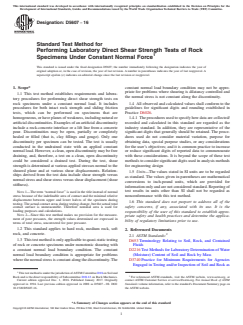
FIG. 1 Generalized Shear Stress and Shear Displacement Curve
3. Terminology
3.1 Definitions—For definitions of common technical terms
used in this standard, refer to Terminology D653.
3.2.9 shear stiffness, n—represents the resistance of the
specimen to shear displacements under an applied shear force
3.2 Definitions of Terms Specific to This Standard:
prior to reaching the peak shear strength, which is calculated
3.2.1 apparent stress, n—nominal stress, that is, external
by dividing the applied apparent shear stress by the resulting
loadperunitarea;calculatedbydividingtheexternallyapplied
shear displacement (slope of the curve prior to peak shear
load by the nominal area.
strength, Fig. 1).
3.2.2 asperity:
3.2.10 sliding friction shear strength, n—the peak shear
3.2.2.1 quality, n—the roughness of a surface.
resistance (in units of stress) of a rock specimen along an open
3.2.2.2 asperity feature, n—a surface irregularity ranging
discontinuity.
from sharp or angular to rounded or wavy.
3.2.2.3 asperities, n—thecollectionofasurface’sirregulari-
4. Summary of Test Method
ties that account for the surface’s roughness.
4.1 While maintaining a constant force normal to the
3.2.3 discontinuity, n—an abrupt change, interruption, or
nominal shear plane of the specimen, an increasing external
break in the integrity or physical properties of rock, such as a
shear force is applied along the designated shear plane to cause
bedding plane, fracture, cleavage, crack, joint, or fault where
shear displacement. The applied normal and shear forces and
the opposing rock surfaces may be planar to nonplanar and
the corresponding normal and shear displacements are mea-
matching to misfit.
sured and recorded. These data are the basis for calculating the
3.2.4 gapped discontinuity, n—consists of opposing rock required parameters.
surfaces separated by an open or filled space.
5. Significance and Use
3.2.5 tight discontinuity, n—consists of opposing rock sur-
faces in intimate and generally continuous contact; it may be
5.1 Determinationofshearstrengthofarockspecimenisan
valid to treat such a discontinuity as a single surface.
importantaspectinthedesignofstructuressuchasrockslopes,
dam foundations, tunnels, shafts, waste repositories, caverns
3.2.6 intact shear strength, n—the peak shear resistance (in
for storage, and other purposes. Pervasive discontinuities
units of stress) of an intact rock specimen or of a specimen
(joints, bedding planes, shear zones, fault zones, schistosity) in
containing a completely healed discontinuity.
a rock mass, and genesis, crystallography, texture, fabric, and
3.2.7 nominal area, n—area obtained by measuring or
other factors can cause the rock mass to behave as an
calculating the cross-sectional area of the shear plane and
anisotropic and heterogeneous discontinuum. Therefore, the
calculated after its relevant cross-sectional dimensions are
precise prediction of rock mass behavior is difficult.
determined.
5.2 For nonplanar joints or discontinuities, shear strength is
3.2.8 residual shear strength, n—the shear stress, (see Fig.
derived from a combination base material friction and overrid-
1), corresponding to a specific normal stress, for which the
ing of asperities (dilatancy), shearing or breaking of the
shear stress remains essentially constant with increasing shear
asperities, and rotations at or wedging of the asperities. Sliding
displacement.
on and shearing of the asperities can occur simultaneously.
3.2.8.1 Discussion—In most cases, the shear stress after
When the normal force is not sufficient to restrain dilation, the
reaching Point A is the residual shear strength.
shear mechanism consists of the overriding of the asperities.
When the normal load is large enough to completely restrain
dilation,theshearmechanismconsistsoftheshearingoffofthe
The last approved version of this historical standard is referenced on
asperities.
www.astm.org.
“ISRMSuggestedMethodsforLaboratoryDeterminationoftheShearStrength
5.3 Usingthistestmethodtodeterminetheshearstrengthof
of Rock Joints: Revised Version”, R. Ulusay (ed.), The ISRM Suggested Methods
an intact specimen may generate overturning moments which
for Rock Characterization, Testing and Monitoring: 2007-2014, DOI: 10.1007/978-
3-319-07713-0, Springer-Verlag Wien 2013. could result in an inclined shear break.
D5607 − 16
5.4 Shear strength is influenced by the overburden or integral part of the machine.
normal pressure; therefore, the larger the overburden pressure,
6.3 Load Monitoring Devices—Theloadmonitoringdevices
the larger the shear strength.
(such as load cells, proving rings, hydraulic gauges) should be
accurate to within 1 % of the specified load and be calibrated
5.5 Insomecases,itmaybedesirabletoconducttestsinsitu
rather than in the laboratory to determine the representative in accordance with Practices E4.
shear strength of the rock mass, particularly when design is
6.4 Pressure-Maintaining Device—A hydraulic component
controlled by discontinuities filled with very weak material. In
that will hold a pressure, within 1 % of the target load, within
situ direct shear testing limits the inherent scale effects found
the hydraulic system.
in rock mechanics problems where the laboratory scale may
6.5 Specimen Holding Rings—Aluminum or steel holding
not be representative of the field scale.
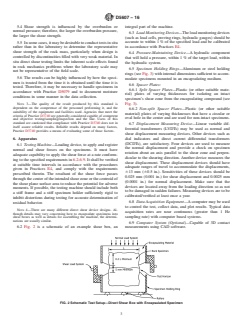
rings (see Fig. 3) with internal dimensions sufficient to accom-
5.6 The results can be highly influenced by how the speci-
modate specimens mounted in an encapsulating medium.
men is treated from the time it is obtained until the time it is
6.6 Spacer Plates:
tested. Therefore, it may be necessary to handle specimens in
6.6.1 Split Spacer Plates—Plastic (or other suitable mate-
accordance with Practice D5079 and to document moisture
rial) plates of varying thicknesses for isolating an intact
conditions in some manner in the data collection.
specimen’s shear zone from the encapsulating compound (see
NOTE 3—The quality of the result produced by this standard is
Fig. 3).
dependent on the competence of the personnel performing it, and the
6.6.2 Non-split Spacer Plates—Plastic (or other suitable
suitability of the equipment and facilities used. Agencies that meet the
material) plates of varying thicknesses that have a circular or
criteria of Practice D3740 are generally considered capable of competent
oval hole in the center and are used for non-intact specimens.
and objective testing/sampling/inspection and the like. Users of this
standard are cautioned that compliance with Practice D3740 does not in
6.7 Displacement Measuring Device—Linear variable dif-
itself assure reliable results. Reliable results depend on many factors,
ferential transformers (LVDTs) may be used as normal and
Practice D3740 provides a means of evaluating some of those factors.
shear displacement measuring devices. Other devices such as
6. Apparatus dial indicators and direct current differential transformers
(DCDTs), are satisfactory. Four devices are used to measure
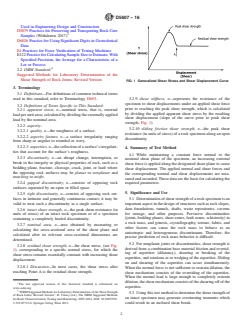
6.1 Testing Machine—Loading device, to apply and register
the normal displacement and provide a check on specimen
normal and shear forces on the specimens. It must have
rotation about an axis parallel to the shear zone and perpen-
adequate capability to apply the shear force at a rate conform-
dicular to the shearing direction. Another device measures the
ing to the specified requirements in 6.2-6.9. It shall be verified
shear displacement. These displacement devices should have
at suitable time intervals in accordance with the procedures
adequate ranges of travel to accommodate the displacements,
given in Practices E4, and comply with the requirements
613 mm (60.5 in.). Sensitivities of these devices should be
prescribed therein. The resultant of the shear force passes
0.025 mm (0.001 in.) for shear displacement and 0.0025 mm
through the center of the intended shear zone or the centroid of
(0.0001 in.) for normal displacement. Make sure that the
the shear plane surface area to reduce the potential for adverse
devices are located away from the loading direction so as not
moments. If possible, the testing machine should include both
to be damaged in sudden failures. Measuring devices are to be
a stiff frame and a stiff specimen holder sufficiently rigid to
calibrated/verified at least once a year.
inhibit distortions during testing for accurate determination of
6.8 Data Acquisition Equipment—A computer may be used
residual behavior.
to control the test, collect data, and plot results. Typical data
NOTE 4—There are many different direct shear device designs. Al-
acquisition rates are near continuous (greater than 1 Hz
though details may vary concerning how to encapsulate specimens into
sampling rate) with computer based systems.
shear boxes as well as details for assembling the machine, the determi-
nations are usually similar.
6.9 Computer System (Optional)—Capable of 3D contact
6.2 Fig. 2 is a schematic of an example shear box, an measurements using CAD software.
FIG. 2 Schematic Test Setup—Direct Shear Box with Encapsulated Specimen
D5607 − 16
NOTE 1—Note the split plastic plates for isolating the shear zone.
FIG. 3 View Showing Pouring Encapsulating Material Around Up-
per Half of Specimen
6.10 3D Noncontact Measuring Device (Optional)—Laser
scanner, photogrammetry, slit scanner or stereo-topometric
camera.
6.11 Miscellaneous Items—Carpenter’s contour gauge for
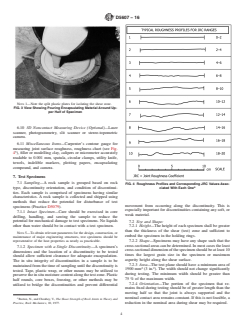
measuring joint surface roughness, roughness chart (see Fig.
4 ), filler or modelling clay, calipers or micrometer accurately
readable to 0.001 mm, spatula, circular clamps, utility knife,
towels, indelible markers, plotting papers, encapsulating
compound, and camera.
7. Test Specimens
7.1 Sampling—A rock sample is grouped based on rock
FIG. 4 Roughness Profiles and Corresponding JRC Values Asso-
type, discontinuity orientation, and condition of discontinui- ciated With Each One
ties. Each sample is comprised of specimens having similar
characteristics. A rock sample is collected and shipped using
methods that reduce the potential for disturbance of test
movement from occurring along the discontinuity. This is
specimens (Practice D5079).
especially important for discontinuities containing any soft, or
7.1.1 Intact Specimen—Care should be exercised in core
weak material.
drilling, handling, and sawing the sample to reduce the
potential for mechanical damage to test specimens. No liquids
7.2 Size and Shape:
other than water should be in contact with a test specimen. 7.2.1 Height—The height of each specimen shall be greater
than the thickness of the shear (test) zone and sufficient to
NOTE 5—To obtain relevant parameters for the design, construction, or
embed the specimen in the holding rings.
maintenance of major engineering structures, test specimens should be
representative of the host properties as nearly as practicable. 7.2.2 Shape—Specimens may have any shape such that the
cross-sectional areas can be determined. In most cases the least
7.1.2 Specimen with a Single Discontinuity—A specimen’s
cross-sectionaldimensionofthespecimenshouldbeatleast10
dimensions and the location of a discontinuity to be tested
times the largest grain size in the specimen or maximum
should allow sufficient clearance for adequate encapsulation.
asperity height along the shear surface.
The in situ integrity of discontinuities in a sample is to be
7.2.3 Area—The test plane should have a minimum area of
maintained from the time of sampling until the discontinuity is
2 2
1900 mm (3 in. ). The width should not change significantly
tested. Tape, plastic wrap, or other means may be utilized to
during testing. The minimum width should be greater than
preservetheinsitumoisturecontentalongthetestzone.Plastic
75 % of the maximum width.
half rounds, core boxes, freezing, or other methods may be
7.2.4 Orientation—The portion of the specimen that re-
utilized to bridge the discontinuities and prevent differential
mains fixed during testing should be of greater length than the
moving half so that the joint is always supported and the
nominal contact area remains constant. If this is not feasible, a
Barton, N., and Choubey, V., The Shear Strength of Rock Joints in Theory and
Practice, Rock Mechanics, 10, 1977. reduction in the nominal area during shear may be required.
D5607 − 16
7.3 Storage—Samples should be stored out of the weather ties of quick setting and adequate strength to the cured
after they are obtained at the work site (field) in order to encapsulating compound. A super strength gypsum cement is
preserve their integrity. recommended.
(c) For a Specimen Containing a Discontinuity—Position
7.4 Moisture Condition—If specimens are to be tested near
the lower half of the specimen (if the discontinuity is gapped,
the natural moisture condition of the host material, they should
thatis,openjointed)centrallyinthelowerhalfofthespecimen
be stored and transported in accordance with Practice D5079.
holder. Make sure that the shear horizon to be tested is secured
in the corre
...
This document is not an ASTM standard and is intended only to provide the user of an ASTM standard an indication of what changes have been made to the previous version. Because
it may not be technically possible to adequately depict all changes accurately, ASTM recommends that users consult prior editions as appropriate. In all cases only the current version
of the standard as published by ASTM is to be considered the official document.
Designation: D5607 − 08 D5607 − 16
Standard Test Method for
Performing Laboratory Direct Shear Strength Tests of Rock
Specimens Under Constant Normal Force
This standard is issued under the fixed designation D5607; the number immediately following the designation indicates the year of
original adoption or, in the case of revision, the year of last revision. A number in parentheses indicates the year of last reapproval. A
superscript epsilon (´) indicates an editorial change since the last revision or reapproval.
1. Scope*
1.1 This test method establishes requirements and laboratory procedures for performing direct shear strength tests on rock
specimens. specimens under a constant normal load. It includes procedures for both intact rock strength and sliding friction tests,
which can be performed on specimens that are homogeneous, or have planes of weakness, including natural or artificial
discontinuities. Examples of an artificial discontinuity include a rock-concrete interface or a lift line from a concrete pour.
Discontinuities may be open, partially or completely healed or filled (that is, clay fillings and gouge). Only one discontinuity per
specimen can be tested. The test is usually conducted in the undrained state with an applied constant normal load. However, a
clean, open discontinuity may be free draining, and, therefore, a test on a clean, open discontinuity could be considered a drained
test. During the test, shear strength is determined at various applied stresses normal to the sheared plane and at various shear
displacements. Relationships derived from the test data include shear strength versus normal stress and shear stress versus shear
displacement (shear stiffness).
NOTE 1—The term “normal force” is used in the title instead of normal stress because of the indefinable area of contact and the minimal relative
displacement between upper and lower halves of the specimen during testing. The actual contact areas during testing change, but the actual total contact
surface is unmeasurable. Therefore nominal area is used for loading purposes and calculations.
NOTE 2—Since this test method makes no provision for the measurement of pore pressures, the strength values determined are expressed in terms of
total stress, uncorrected for pore pressure.
1.2 This standard applies to hard rock, medium rock, soft rock, and concrete.
1.3 This test method is only applicable to quasi-static testing of rock or concrete specimens under monotonic shearing with a
constant normal load boundary condition. The constant normal load boundary condition is appropriate for problems where the
normal stress is constant along the discontinuity. The constant normal load boundary condition may not be appropriate for
problems where shearing is dilatancy controlled and the normal stress is not constant along the discontinuity.
1.4 All observed and calculated values shall conform to the guidelines for significant digits and rounding established in Practice
D6026.
1.4.1 The procedures used to specify how data are collected/recorded and calculated in this standard are regarded as the industry
standard. In addition, they are representative of the significant digits that generally should be retained. The procedures used do not
consider material variation, purpose for obtaining data, special purpose studies, or any considerations for the user’s objectives; and
it is common practice to increase or reduce significant digits of reported data to commensurate with these considerations. It is
beyond the scope of these test methods to consider significant digits used in analysis methods for engineering design
1.5 Units—The values stated in SI units are to be regarded as the standard. The values given in parentheses are mathematical
conversions to inch-pound units thatunits, which are provided for information only and are not considered standard. Reporting of
test results in units other than SI shall not be regarded as nonconformance with this test method.
1.6 This standard does not purport to address all of the safety concerns, if any, associated with its use. It is the responsibility
of the user of this standard to establish appropriate safety and health practices and determine the applicability of regulatory
limitations prior to use.
This test method is under the jurisdiction of ASTM Committee D18 on Soil and Rock and is the direct responsibility of Subcommittee D18.12 on Rock Mechanics.
Current edition approved July 1, 2008Dec. 1, 2016. Published July 2008January 2017. Originally approved in 1994. Last previous edition approved in 20062008 as
D5607 – 02 (2006).D5607 – 08. DOI: 10.1520/D5607-08.10.1520/D5607-16.
*A Summary of Changes section appears at the end of this standard
Copyright © ASTM International, 100 Barr Harbor Drive, PO Box C700, West Conshohocken, PA 19428-2959. United States
D5607 − 16
2. Referenced Documents
2.1 ASTM Standards:
D653 Terminology Relating to Soil, Rock, and Contained Fluids
D2216 Test Methods for Laboratory Determination of Water (Moisture) Content of Soil and Rock by Mass
D3740 Practice for Minimum Requirements for Agencies Engaged in Testing and/or Inspection of Soil and Rock as Used in
Engineering Design and Construction
D5079 Practices for Preserving and Transporting Rock Core Samples (Withdrawn 2017)
D6026 Practice for Using Significant Digits in Geotechnical Data
E4 Practices for Force Verification of Testing Machines
E122 Practice for Calculating Sample Size to Estimate, With Specified Precision, the Average for a Characteristic of a Lot or
Process
2.2 ISRM Standard:
Suggested Methods for Laboratory Determination of the Shear Strength of Rock Joints: Revised Version
3. Terminology
3.1 Definitions—For common definitions of common technical terms used in this standard, refer to Terminology D653.
3.2 Definitions of Terms Specific to This Standard:
3.2.1 apparent stress—stress, n—nominal stress, that is, external load per unit area. It is area; calculated by dividing the
externally applied load by the nominal area.
3.2.2 Asperity:
3.2.2.1 quality—the roughness of a surface.
3.2.2.2 feature—a surface irregularity ranging from sharp or angular to rounded or wavy.
3.2.2.3 asperities—the collection of a surface’s irregularities that account for the surface’s roughness.
3.2.2 asperity:
3.2.2.1 quality, n—the roughness of a surface.
3.2.2.2 asperity feature, n—a surface irregularity ranging from sharp or angular to rounded or wavy.
3.2.2.3 asperities, n—the collection of a surface’s irregularities that account for the surface’s roughness.
3.2.3 Discontinuity :
3.2.3.1 An abrupt change, interruption, or break in the integrity or physical properties of rock, such as a bedding plane, fracture,
cleavage, crack, joint, or fault.
3.2.3.2 A gapped discontinuity consists of opposing rock surfaces separated by an open or filled space. A tight discontinuity
consists of opposing rock surfaces in intimate and generally continuous contact; it may be valid to treat such a discontinuity as
a single surface.
3.2.3.3 A discontinuity’s opposing rock surfaces may be planar to nonplanar and matching to misfit.
3.2.3 discontinuity, n—an abrupt change, interruption, or break in the integrity or physical properties of rock, such as a bedding
plane, fracture, cleavage, crack, joint, or fault where the opposing rock surfaces may be planar to nonplanar and matching to misfit.
3.2.4 gapped discontinuity, n—consists of opposing rock surfaces separated by an open or filled space.
3.2.5 tight discontinuity, n—consists of opposing rock surfaces in intimate and generally continuous contact; it may be valid to
treat such a discontinuity as a single surface.
3.2.6 intact shear strength—strength, n—the peak shear resistance (in units of stress) of an intact rock specimen or of a specimen
containing a completely healed discontinuity.
3.2.7 nominal area—area, n—area obtained by measuring or calculating the cross-sectional area of the shear plane. It is plane
and calculated after its relevant cross-sectional dimensions are determined.
3.2.8 residual shear strength—strength, n—the shear stress, (see Fig. 1), corresponding to a specific normal stress, for which
the shear stress remains essentially constant with increasing shear displacement. In most cases, the shear stress after reaching Point
A is the residual shear strength.
For referenced ASTM standards, visit the ASTM website, www.astm.org, or contact ASTM Customer Service at service@astm.org. For Annual Book of ASTM Standards
volume information, refer to the standard’s Document Summary page on the ASTM website.
The last approved version of this historical standard is referenced on www.astm.org.
“ISRM Suggested Methods for Laboratory Determination of the Shear Strength of Rock Joints: Revised Version”, R. Ulusay (ed.), The ISRM Suggested Methods for
Rock Characterization, Testing and Monitoring: 2007-2014, DOI: 10.1007/978-3-319-07713-0, Springer-Verlag Wien 2013.
3.2.8.1 Discussion—
D5607 − 16
FIG. 1 Generalized Shear Stress and Shear Displacement Curve
In most cases, the shear stress after reaching Point A is the residual shear strength.
3.2.9 shear stiffness—stiffness, n—represents the resistance of the specimen to shear displacements under an applied shear force
prior to reaching the peak shear strength. Itstrength, which is calculated by dividing the applied apparent shear stress by the
resulting shear displacement (slope of the curve prior to peak shear strength, Fig. 1).
3.2.10 sliding friction shear strength—strength, n—the peak shear resistance (in units of stress) of a rock specimen
containingalong an open discontinuity.
4. Summary of Test Method
4.1 While maintaining a constant force normal to the nominal shear plane of the specimen, an increasing external shear force
is applied along the designated shear plane to cause shear displacement. The applied normal and shear forces and the corresponding
normal and shear displacements are measured and recorded. These data are the basis for calculating the required parameters.
5. Significance and Use
5.1 Determination of shear strength of a rock specimen is an important aspect in the design of structures such as rock slopes,
dam foundations, tunnels, shafts, waste repositories, caverns for storage, and other purposes. Pervasive discontinuities (joints,
bedding planes, shear zones, fault zones, schistosity) in a rock mass, and genesis, crystallography, texture, fabric, and other factors
can cause the rock mass to behave as an anisotropic and heterogeneous discontinuum. Therefore, the precise prediction of rock
mass behavior is difficult.
5.2 For nonplanar joints or discontinuities, shear strength is derived from a combination base material friction and overriding
of asperities (dilatancy), shearing or breaking of the asperities, and rotations at or wedging of the asperities. Sliding on and shearing
of the asperities can occur simultaneously. When the normal force is not sufficient to restrain dilation, the shear mechanism consists
of the overriding of the asperities. When the normal load is large enough to completely restrain dilation, the shear mechanism
consists of the shearing off of the asperities.
5.3 Using this test method to determine the shear strength of an intact specimen may generate overturning moments which could
result in an inclined shear break.
5.4 Shear strength is influenced by the overburden or normal pressure; therefore, the larger the overburden pressure, the larger
the shear strength.
5.5 In some cases, it may be desirable to conduct tests in situ rather than in the laboratory to determine the representative shear
strength of the rock mass, particularly when design is controlled by discontinuities filled with very weak material. In situ direct
shear testing limits the inherent scale effects found in rock mechanics problems where the laboratory scale may not be
representative of the field scale.
5.6 In some cases, it may be desirable to conduct tests in situ rather than inThe results can be highly influenced by how the
specimen is treated from the time it is obtained until the time it is tested. Therefore, it may be necessary to handle specimens in
accordance with Practice D5079 the laboratory to determine the representative shear strength of the rock mass, particularly when
design is controlled by discontinuities filled with very weak material.and to document moisture conditions in some manner in the
data collection.
NOTE 3—The quality of the result produced by this standard is dependent on the competence of the personnel performing it, and the suitability of the
equipment and facilities used. Agencies that meet the criteria of Practice D3740 are generally considered capable of competent and objective
testing/sampling/inspection and the like. Users of this standard are cautioned that compliance with Practice D3740 does not in itself assure reliable results.
Reliable results depend on many factors, Practice D3740 providesprovides a means of evaluating some of those factors.
6. Apparatus
6.1 Testing Machine—Loading device, to apply and register normal and shear forces on the specimens. It must have adequate
capability to apply the shear force at a rate conforming to the specified requirements. requirements in 6.2-6.9. It shall be verified
at suitable time intervals in accordance with the procedures given in Practices E4, and comply with the requirements prescribed
therein. The resultant of the shear force passes through the center of the intended shear zone or the centroid of the shear plane
surface area to minimize adverse moments.reduce the potential for adverse moments. If possible, the testing machine should
include both a stiff frame and a stiff specimen holder sufficiently rigid to inhibit distortions during testing for accurate
determination of residual behavior.
NOTE 4—There are many different direct shear device designs. Although details may vary concerning how to encapsulate specimens into shear boxes
as well as details for assembling the machine, the determinations are usually similar.
6.2 Fig. 2 is a schematic of an example shear box, an integral part of the machine.
6.3 Load Monitoring Devices—The load monitoring devices (such as load cells, proving rings, hydraulic gauges) should be
accurate to within 1 % of the specified load and be calibrated in accordance with Practices E4.
D5607 − 16
FIG. 2 Schematic Test Setup—Direct Shear Box with Encapsulated Specimen
6.4 Pressure-Maintaining Device—A hydraulic component that will hold a pressure, within specified tolerances, 1 % of the
target load, within the hydraulic system.
6.5 Specimen Holding Rings—Aluminum or steel holding rings (see Fig. 3) with internal dimensions sufficient to accommodate
specimens mounted in an encapsulating medium.
6.6 Spacer Plates:
6.6.1 Split Spacer Plates—Plastic (or other suitable material) plates of varying thicknesses for isolating an intact specimen’s
shear zone from the encapsulating compound (see Fig. 3).
6.6.2 Non-split Spacer Plates—Plastic (or other suitable material) plates of varying thicknesses that have a circular or oval hole
in the center and are used for non-intact specimens.
6.7 Displacement Measuring Device—Linear variable differential transformers (LVDTs) may be used as normal and shear
displacement measuring devices. Other devices such as dial indicators and direct current differential transformers (DCDTs), are
satisfactory. Four devices are used to measure the normal displacement and provide a check on specimen rotation about an axis
parallel to the shear zone and perpendicular to the shearing direction. Another device measures the shear displacement. These
displacement devices should have adequate ranges of travel to accommodate the displacements, 613 mm (60.5 in.). Sensitivities
of these devices should be 0.025 mm (0.001 in.) for shear displacement and 0.0025 mm (0.0001 in.) for normal displacement.
Ensure Make sure that the devices are located away from the loading direction so as not to be damaged in sudden failures.
Measuring devices are to be calibrated/verified at least once a year.
6.8 Data Acquisition Equipment—A computer may be used to control the test, collect data, and plot results. Typical data
acquisition rates are near continuous (greater than 1 Hz sampling rate) with computer based systems.
6.9 Computer System (Optional)—Capable of 3D contact measurements using CAD software.
6.10 3D Noncontact Measuring Device (Optional)—Laser scanner, photogrammetry, slit scanner or stereo-topometric camera.
NOTE 1—Note the split plastic plates for isolating the shear zone.
FIG. 3 View Showing Pouring Encapsulating Material Around Upper Half of Specimen
D5607 − 16
6.11 Miscellaneous Items—Carpenter’s contour gauge for measuring joint surface roughness, roughness chart (see Fig. 4 ), filler
or modelling clay, calipers or micrometer accurately readable to 0.001 mm, spatula, circular clamps, utility knife, towels, indelible
markers, plotting papers, encapsulating compound, and camera.
7. Reagents and Materials
7.1 Miscellaneous Items—Carpenter’s contour gauge for measuring joint surface roughness, roughness chart (see Fig. 4 ), filler
or modelling clay, calipers, spatula, circular clamps, utility knife, towels, markers, plotting papers, encapsulating compound, and
camera.
7. Test Specimens
7.1 Sampling: Sampling—A rock sample is grouped based on rock type, discontinuity orientation, and condition of
discontinuities. Each sample is comprised of specimens having similar characteristics. A rock sample is collected and shipped using
methods that reduce the potential for disturbance of test specimens (Practice D5079).
7.1.1 Intact Specimen—Care should be exercised in core drilling, handling, and sawing the samples to minimize sample to
reduce the potential for mechanical damage to test specimens. No liquids other than water should be in contact with a test
specimen.
NOTE 5—To obtain relevant parameters for the design, construction, or maintenance of major engineering structures, test specimens should be
representative of the host properties as nearly as practicable.
Barton, N., and Choubey, V., The Shear Strength of Rock Joints in Theory and Practice,Rock Mechanics, 10, 1977.
FIG. 4 Roughness Profiles and Corresponding JRC Values Associated With Each One
D5607 − 16
7.1.2 Specimen with a Single Discontinuity—Rock samples are collected and shipped using methods that minimize disturbance
of test zones. A specimen’s dimensions and the location of a discontinuity to be tested should allow sufficient clearance for
adequate encapsulation. The in situ integrity of discontinuities in a sample is to be maintained from the time of sampling until the
discontinuity is tested. Tape, plastic wrap, or other means may be utilized to preserve the in situ moisture content along the test
zone. Plastic half rounds, core boxes, freezing, or other methods may be utilized to bridge the discontinuities and prevent
differential movement from occurring along the discontinuity. This is especially important for discontinuities containing any soft,
or weak material.
7.2 Size and Shape—Shape: The height of specimen shall be greater than the thickness of the shear (test) zone and sufficient
to embed the specimen in the holding rings. Specimens may have any shape such that the cross-sectional areas can be readily
determined. In most cases the least cross-sectional dimension of the specimen should be at least 10 times the largest grain size in
2 2
the specimen. The test plane should have a minimum area of 1900 mm (3 in. ).
7.2.1 Height—The height of each specimen shall be greater than the thickness of the shear (test) zone and sufficient to embed
the specimen in the holding rings.
7.2.2 Shape—Specimens may have any shape such that the cross-sectional areas can be determined. In most cases the least
cross-sectional dimension of the specimen should be at least 10 times the largest grain size in the specimen or maximum asperity
height along the shear surface.
2 2
7.2.3 Area—The test plane should have a minimum area of 1900 mm (3 in. ). The width should not change significantly during
testing. The minimum width should be greater than 75 % of the maximum width.
7.2.4 Orientation—The portion of the specimen that remains fixed during testing should be of greater length than the moving
half so that the joint is always supported and the nominal contact area remains constant. If this is not feasible, a reduction in the
nominal area during shear may be required.
7.3 Storage—Samples should be stored out of the weather after they are obtained at the work site (field) in order to preserve
their integrity.
7.4 Moisture Condition—If specimens are to be tested near the natural moisture condition of the host material, they should be
stored and transported in moisture-proof containers, or coated with thinaccordance with Practice D5079sheets of plastic film and
wax.
9. Calibration and Standardization
9.1 Load Monitoring Devices—The load monitoring devices (such as load cells, proving rings, hydraulic gauges) should be
calibrated according to Practices E4.
9.2 Displacement Measuring Devices— Measuring devices are to be calibrated at least once a year.
8. Procedure
8.1 Moistur
...