


ASTM D6822-12b(2017)
(Test Method)Standard Test Method for Density, Relative Density, and API Gravity of Crude Petroleum and Liquid Petroleum Products by Thermohydrometer Method
Standard Test Method for Density, Relative Density, and API Gravity of Crude Petroleum and Liquid Petroleum Products by Thermohydrometer Method
SIGNIFICANCE AND USE
5.1 Density and API gravity are used in custody transfer quantity calculations and to satisfy transportation, storage, and regulatory requirements. Accurate determination of density or API gravity of crude petroleum and liquid petroleum products is necessary for the conversion of measured volumes to volumes at the standard temperatures of 15 °C or 60 °F.
5.2 Density and API gravity are also factors that indicate the quality of crude petroleum. Crude petroleum prices are frequently posted against values in kg/m3 or in degrees API. However, this property of petroleum is an uncertain indication of its quality unless correlated with other properties.
5.3 Field of Application—Because the thermohydrometer incorporates both the hydrometer and thermometer in one device, it is more applicable in field operations for determining density or API gravity of crude petroleum and other liquid petroleum products. The procedure is convenient for gathering main trunk pipelines and other field applications where limited laboratory facilities are available. The thermohydrometer method may have limitations in some petroleum density determinations. When this is the case, other methods such as Test Method D1298 (API MPMS Chapter 9.1) may be used.
5.4 This procedure is suitable for determining the density, relative density, or API gravity of low viscosity, transparent or opaque liquids, or both. This procedure, when used for opaque liquids, requires the use of a meniscus correction (see 9.2). Additionally for both transparent and opaque fluids the readings shall be corrected for the thermal glass expansion effect and alternate calibration temperature effects before correcting to the reference temperature. This procedure can also be used for viscous liquids by allowing sufficient time for the thermohydrometer to reach temperature equilibrium.
SCOPE
1.1 This test method covers the determination, using a glass thermohydrometer in conjunction with a series of calculations, of the density, relative density, or API gravity of crude petroleum, petroleum products, or mixtures of petroleum and nonpetroleum products normally handled as liquids and having a Reid vapor pressures of 101.325 kPa (14.696 psi) or less. Values are determined at existing temperatures and corrected to 15 °C or 60 °F by means of a series of calculations and international standard tables.
1.2 The initial thermohydrometer readings obtained are uncorrected hydrometer readings and not density measurements. Readings are measured on a thermohydrometer at either the reference temperature or at another convenient temperature, and readings are corrected for the meniscus effect, the thermal glass expansion effect, alternate calibration temperature effects and to the reference temperature by means of calculations and Adjunct to D1250 Guide for Use of the Petroleum Measurement Tables (API MPMS Chapter 11.1).
1.3 Readings determined as density, relative density, or API gravity can be converted to equivalent values in the other units or alternate reference temperatures by means of Interconversion Procedures (API MPMS Chapter 11.5) or Adjunct to D1250 Guide for Use of the Petroleum Measurement Tables (API MPMS Chapter 11.1), or both, or tables as applicable.
1.4 The initial thermohydrometer reading shall be recorded before performing any calculations. The calculations required in Section 9 shall be applied to the initial thermohydrometer reading with observations and results reported as required by Section 11 prior to use in a subsequent calculation procedure (measurement ticket calculation, meter factor calculation, or base prover volume determination).
1.5 Annex A1 contains a procedure for verifying or certifying the equipment of this test method.
1.6 The values stated in SI units are to be regarded as standard.
1.6.1 Exception—The values given in parentheses are for information only.
1.7 This standard does not purport to address all o...
General Information
Buy Standard
Standards Content (Sample)
NOTICE: This standard has either been superseded and replaced by a new version or withdrawn.
Contact ASTM International (www.astm.org) for the latest information
Designation: D6822 − 12b (Reapproved 2017)
Manual of Petroleum Measurement Standards (MPMS), Chapter 9.3
Standard Test Method for
Density, Relative Density, and API Gravity of Crude
Petroleum and Liquid Petroleum Products by
Thermohydrometer Method
This standard is issued under the fixed designation D6822; the number immediately following the designation indicates the year of
original adoption or, in the case of revision, the year of last revision. A number in parentheses indicates the year of last reapproval. A
superscript epsilon (´) indicates an editorial change since the last revision or reapproval.
1. Scope reading with observations and results reported as required by
Section 11 prior to use in a subsequent calculation procedure
1.1 This test method covers the determination, using a glass
(measurement ticket calculation, meter factor calculation, or
thermohydrometer in conjunction with a series of calculations,
base prover volume determination).
of the density, relative density, or API gravity of crude
petroleum, petroleum products, or mixtures of petroleum and 1.5 Annex A1 contains a procedure for verifying or certify-
nonpetroleum products normally handled as liquids and having ing the equipment of this test method.
a Reid vapor pressures of 101.325 kPa (14.696 psi) or less.
1.6 The values stated in SI units are to be regarded as
Values are determined at existing temperatures and corrected to
standard.
15 °C or 60 °F by means of a series of calculations and
1.6.1 Exception—The values given in parentheses are for
international standard tables.
information only.
1.2 The initial thermohydrometer readings obtained are
1.7 This standard does not purport to address all of the
uncorrected hydrometer readings and not density measure-
safety concerns, if any, associated with its use. It is the
ments. Readings are measured on a thermohydrometer at either
responsibility of the user of this standard to establish appro-
the reference temperature or at another convenient
priate safety and health practices and determine the applica-
temperature, and readings are corrected for the meniscus effect,
bility of regulatory limitations prior to use.
the thermal glass expansion effect, alternate calibration tem-
1.8 This international standard was developed in accor-
perature effects and to the reference temperature by means of
dance with internationally recognized principles on standard-
calculations and Adjunct to D1250 Guide for Use of the
ization established in the Decision on Principles for the
Petroleum Measurement Tables (API MPMS Chapter 11.1).
Development of International Standards, Guides and Recom-
mendations issued by the World Trade Organization Technical
1.3 Readings determined as density, relative density, or API
Barriers to Trade (TBT) Committee.
gravity can be converted to equivalent values in the other units
or alternate reference temperatures by means of Interconver-
2. Referenced Documents
sion Procedures (API MPMS Chapter 11.5) or Adjunct to
D1250 Guide for Use of the Petroleum Measurement Tables
2.1 ASTM Standards:
(API MPMS Chapter 11.1), or both, or tables as applicable.
D1250 Guide for Use of the Petroleum Measurement Tables
D1298 Test Method for Density, Relative Density, or API
1.4 The initial thermohydrometer reading shall be recorded
Gravity of Crude Petroleum and Liquid Petroleum Prod-
before performing any calculations. The calculations required
ucts by Hydrometer Method
in Section 9 shall be applied to the initial thermohydrometer
D4057 Practice for Manual Sampling of Petroleum and
Petroleum Products
D4177 Practice for Automatic Sampling of Petroleum and
This test method is under the jurisdiction of ASTM Committee D02 on
Petroleum Products
Petroleum Products, Liquid Fuels, and Lubricants and the API Committee on
Petroleum Measurement, and is the direct responsibility of Subcommittee D02.02
D5854 Practice for Mixing and Handling of Liquid Samples
/COMQ, the joint ASTM-API Committee on Hydrocarbon Measurement for
Custody Transfer (Joint ASTM-API). This test method has been approved by the
sponsoring committees and accepted by the Cooperating Societies in accordance
with established procedures. For referenced ASTM standards, visit the ASTM website, www.astm.org, or
Current edition approved July 15, 2017. Published July 2012. Originally contact ASTM Customer Service at service@astm.org. For Annual Book of ASTM
approved in 2002. Last previous edition approved in 2012 as D6822 – 12b. DOI: Standards volume information, refer to the standard’s Document Summary page on
10.1520/D6822-12BR17. the ASTM website.
© Jointly copyrighted by ASTM International, 100 Barr Harbor Drive, PO Box C700, West Conshohocken, PA 19428-2959, USA and the American Petroleum Institute (API), 1220 L Street NW, Washington DC 20005, USA
D6822 − 12b (2017)
of Petroleum and Petroleum Products amount of the correction or Meniscus correction. This menis-
D6300 Practice for Determination of Precision and Bias cus correction is documented and then subtracted from the
Data for Use in Test Methods for Petroleum Products and value represented by the Meniscus Reading to yield the
Lubricants Hydrometer Reading corrected for the Meniscus (Hydrometer
E100 Specification for ASTM Hydrometers Reading – Observed, Meniscus Corrected).
2.2 API Standards:
3.1.4 observed values, n—hydrometer readings observed at
MPMS Chapter 8.1 Practice for Manual Sampling of Petro-
a temperature other than the defined reference temperature.
leum and Petroleum Products (ASTM Practice D4057)
3.1.4.1 Discussion—These values are only hydrometer read-
MPMS Chapter 8.2 Practice for Automatic Sampling of
ings and not density, relative density, or API gravity at the
Petroleum and Petroleum Products (ASTM Practice
temperature.
D4177)
3.1.5 relative density, n—the ratio of the mass of a given
MPMSChapter 8.3 Practice for Mixing and Handling of
volume of liquid at a specific temperature to the mass of an
Liquid Samples of Petroleum and Petroleum Products
equal volume of pure water at the same or different tempera-
(ASTM Practice D5854)
ture. Both reference temperatures shall be explicitly stated.
MPMS Chapter 9.1 Hydrometer Test Method for Density,
3.1.5.1 Discussion—Common reference temperatures in-
Relative Density or API Gravity of Crude Petroleum and
clude 15/15 °C, 60 ⁄60 °F, 20/20 °C, and 20/4 °C. The historic
Liquid Petroleum Products (ASTM Test Method D1298)
term specific gravity may still be found.
MPMS Chapter 11.1 Temperature and Pressure Volume Cor-
3.1.6 thermohydrometer, n—a glass hydrometer with a self-
rection Factors for Generalized Crude Oils, Refined
contained thermometer.
Products, and Lubricating Oils (Adjunct to ASTM D1250)
MPMS Chapter 11.5 Density/Weight/Volume Intraconver-
4. Summary of Test Method
sion
4.1 The density or API gravity, after temperature equilib-
2.3 ASTM Adjuncts:
rium has been reached, is read by observing the freely floating
Adjunct to D1250 Guide for Use of the Petroleum Measure-
thermohydrometer and noting the graduation nearest to the
ment Tables (API MPMS Chapter 11.1)
apparent intersection of the horizontal plane surface of the
3. Terminology liquid with the vertical scale of the hydrometer after tempera-
ture equilibrium has been reached. The observed thermohy-
3.1 Definitions of Terms Specific to This Standard:
drometer reading is reduced to the reference temperature value
3.1.1 API gravity (°API), n—a special function of relative
by means of the Petroleum Measurement Tables (the appropri-
density 60/60 °F, represented by:
ate adjunct to Adjunct to D1250 Guide for Petroleum Mea-
°API5 @141.5/~relative density 60/60°F!# 2 131.5 (1)
surement Tables (API MPMS Chapter 11.1) and observed
3.1.1.1 Discussion—No statement of reference temperature
temperature from the enclosed thermometer.
is required, as 60 °F is included in the definition.
5. Significance and Use
3.1.2 density, n—the mass of liquid per unit volume at 15 °C
and 101.325 kPa with the standard unit of measurement being
5.1 Density and API gravity are used in custody transfer
kilograms per cubic metre (kg/m ).
quantity calculations and to satisfy transportation, storage, and
3.1.2.1 Discussion—Other reference temperatures, such as
regulatory requirements. Accurate determination of density or
20 °C, may be used for some products or in some locations.
API gravity of crude petroleum and liquid petroleum products
Less preferred units of measurement, for example, kg/L or
is necessary for the conversion of measured volumes to
g/mL, are still in use.
volumes at the standard temperatures of 15 °C or 60 °F.
3.1.3 hydrometer reading, n—the point on the hydrometer
5.2 Density and API gravity are also factors that indicate the
scale at which the surface of the liquid cuts the scale.
quality of crude petroleum. Crude petroleum prices are fre-
3.1.3.1 Discussion—In practice for transparent fluids this
quently posted against values in kg/m or in degrees API.
can be readily determined by aligning the surface of the liquid
However, this property of petroleum is an uncertain indication
on both sides of the hydrometer and reading the Hydrometer
of its quality unless correlated with other properties.
scale where these surface readings cut the scale (Hydrometer
5.3 Field of Application—Because the thermohydrometer
Reading – Observed). For nontransparent fluids the point at
incorporates both the hydrometer and thermometer in one
which the liquid surface cuts the Hydrometer scale cannot be
device, it is more applicable in field operations for determining
determined directly and requires a correction (Meniscus Cor-
density or API gravity of crude petroleum and other liquid
rection). The value represented by the point (Meniscus Read-
petroleum products. The procedure is convenient for gathering
ing) at which the liquid sample rises above the main surface of
main trunk pipelines and other field applications where limited
the liquid subtracted from the value represented by where the
laboratory facilities are available. The thermohydrometer
main surface of the liquid cuts the Hydrometer scale is the
method may have limitations in some petroleum density
determinations. When this is the case, other methods such as
Available from American Petroleum Institute (API), 1220 L. St., NW, Test Method D1298 (API MPMS Chapter 9.1) may be used.
Washington, DC 20005-4070, www.api.org.
4 5.4 This procedure is suitable for determining the density,
Available from ASTM International Headquarters. Order Adjunct No.
ADJD1250. Original adjunct produced in 1983. relative density, or API gravity of low viscosity, transparent or
D6822 − 12b (2017)
opaque liquids, or both. This procedure, when used for opaque 6.1.1 Kilograms/cubic metre (kg/m ) and degrees Celsius
liquids, requires the use of a meniscus correction (see 9.2). for density hydrometers, as shown in Table 1.
Additionally for both transparent and opaque fluids the read- 6.1.2 Degrees API (°API) and degrees Fahrenheit for hy-
ings shall be corrected for the thermal glass expansion effect drometers measuring in API Gravity, as shown in Table 2.
and alternate calibration temperature effects before correcting 6.1.3 The user should ascertain that the instruments used for
to the reference temperature. This procedure can also be used
this procedure conform to the requirements set out above with
for viscous liquids by allowing sufficient time for the thermo- respect to materials, dimensions, and scale errors. In cases
hydrometer to reach temperature equilibrium.
where the instrument is provided with a calibration certificate
issued by a recognized standardizing body, the instrument is
6. Apparatus
classed as certified and the appropriate corrections for the
6.1 Glass Thermohydrometers, as specified in Specification meniscus effect, the thermal glass expansion effect, and alter-
E100 (shown in Fig. 1), and graduated in: native calibration temperature effects shall be applied to the
FIG. 1 Typical Thermohydrometer Designs
D6822 − 12b (2017)
TABLE 1 Density Thermohydrometers
procedures described in Practices D4057 (API MPMS Chapter
ASTM Hydrometer No. Density, Range, kg/m 8.1) and D4177 (API MPMS Chapter 8.2).
300H 600 to 650
7.2 Samples of volatile crude petroleum or petroleum prod-
301H 650 to 700
302H 700 to 750
ucts are preferably taken by Practice D4177 (API MPMS
303H 750 to 800
Chapter 8.2), using a variable volume (floating piston) sample
304H 800 to 850
receiver to minimize any loss of light components which may
305H 850 to 900
306H 900 to 950
affect the accuracy of the density measurement. In the absence
307H 950 to 1000
of this facility, extreme care shall be taken to minimize these
308H 1000 to 1050
losses, including the transfer of the sample to a chilled
309H 1050 to 1100
345H 775 to 825
container immediately after sampling.
Hydrometer
Total length, mm 374 to 387
7.3 Sample Mixing—May be necessary to obtain a test
Body diameter, mm 18 to 25
portion representative of the bulk sample to be tested, but
Stem diameter, mm, min 4.0
precautions shall be taken to maintain the integrity of the
Hydrometer Scale
Standard temperature, °C 15
sample during this operation. Mixing of volatile crude petro-
Subdivisions, kg/m 0.5
leum or petroleum products containing water or sediments, or
Short intermediate lines at, kg/m 1
both, or the heating of waxy volatile crude petroleum or
Long intermediate lines at, kg/m 5
Main (numbered) lines at, kg/m 10
petroleum products may result in the loss of light components.
Scale error at any point not to 0.5
The following sections (7.3.1 – 7.3.4) will give some guidance
exceed, kg/m
on sample integrity maintenance.
Length of nominal scale, mm 125 to 145
Scale extension beyond nominal 2.5
7.3.1 Volatile Crude Petroleum and Petroleum Products
range limits, kg/m
Having an RVP Greater than 50 kPa—Mix the sample in its
Thermometer Scale
Range, °C original closed container in order to minimize the loss of light
Designation L −20 to +65
components.
Designation M 0 to +85
Designation H +20 to +105
NOTE 1—Mixing volatile samples in open containers will lead to loss of
Immersion total
light components and consequently affect the value of the density
Subdivisions, °C 1.0
obtained.
Intermediate lines at, °C 5
Main (numbered) lines at, °C 10
7.3.2 Waxy Crude Petroleum—If the petroleum has an
Scale error at any point not to 1.0
expected pour point above 10 °C, or a cloud point or WAT
exceed, °C
Scale length, mm 80 to 100
above 15 °C, warm the sample to a temperature that is
sufficient for ensuring the material is fluid enough to provide
adequate mixing without excessively heating the ma
...
This document is not an ASTM standard and is intended only to provide the user of an ASTM standard an indication of what changes have been made to the previous version. Because
it may not be technically possible to adequately depict all changes accurately, ASTM recommends that users consult prior editions as appropriate. In all cases only the current version
of the standard as published by ASTM is to be considered the official document.
Designation: D6822 − 12b D6822 − 12b (Reapproved 2017)
Manual of Petroleum Measurement Standards (MPMS), Chapter 9.3
Standard Test Method for
Density, Relative Density, and API Gravity of Crude
Petroleum and Liquid Petroleum Products by
Thermohydrometer Method
This standard is issued under the fixed designation D6822; the number immediately following the designation indicates the year of
original adoption or, in the case of revision, the year of last revision. A number in parentheses indicates the year of last reapproval. A
superscript epsilon (´) indicates an editorial change since the last revision or reapproval.
1. Scope*Scope
1.1 This test method covers the determination, using a glass thermohydrometer in conjunction with a series of calculations, of
the density, relative density, or API gravity of crude petroleum, petroleum products, or mixtures of petroleum and nonpetroleum
products normally handled as liquids and having a Reid vapor pressures of 101.325 kPa (14.696 psi) 101.325 kPa (14.696 psi) or
less. Values are determined at existing temperatures and corrected to 15°C15 °C or 60°F60 °F by means of a series of calculations
and international standard tables.
1.2 The initial thermohydrometer readings obtained are uncorrected hydrometer readings and not density measurements.
Readings are measured on a thermohydrometer at either the reference temperature or at another convenient temperature, and
readings are corrected for the meniscus effect, the thermal glass expansion effect, alternate calibration temperature effects and to
the reference temperature by means of calculations and Adjunct to D1250 Guide for Use of the Petroleum Measurement Tables
(API MPMS Chapter 11.1).
1.3 Readings determined as density, relative density, or API gravity can be converted to equivalent values in the other units or
alternate reference temperatures by means of Interconversion Procedures (API MPMS Chapter 11.5) or Adjunct to D1250 Guide
for Use of the Petroleum Measurement Tables (API MPMS Chapter 11.1), or both, or tables as applicable.
1.4 The initial thermohydrometer reading shall be recorded before performing any calculations. The calculations required in
Section 9 shall be applied to the initial thermohydrometer reading with observations and results reported as required by Section
11 prior to use in a subsequent calculation procedure (measurement ticket calculation, meter factor calculation, or base prover
volume determination).
1.5 Annex A1 contains a procedure for verifying or certifying the equipment of this test method.
1.6 The values stated in SI units are to be regarded as standard. The values given in parentheses are for information only.
1.6.1 Exception—The values given in parentheses are for information only.
1.7 This standard does not purport to address all of the safety concerns, if any, associated with its use. It is the responsibility
of the user of this standard to establish appropriate safety and health practices and determine the applicability of regulatory
limitations prior to use.
1.8 This international standard was developed in accordance with internationally recognized principles on standardization
established in the Decision on Principles for the Development of International Standards, Guides and Recommendations issued
by the World Trade Organization Technical Barriers to Trade (TBT) Committee.
2. Referenced Documents
2.1 ASTM Standards:
D1250 Guide for Use of the Petroleum Measurement Tables
This test method is under the jurisdiction of ASTM Committee D02 on Petroleum Products, Liquid Fuels, and Lubricants and the API Committee on Petroleum
Measurement, and is the direct responsibility of Subcommittee D02.02 /COMQ, the joint ASTM-API Committee on Hydrocarbon Measurement for Custody Transfer (Joint
ASTM-API). This test method has been approved by the sponsoring committees and accepted by the Cooperating Societies in accordance with established procedures.
Current edition approved June 1, 2012July 15, 2017. Published October 2012July 2012. Originally approved in 2002. Last previous edition approved in 2012 as
D6822D6822 – 12b.-12a. DOI: 10.1520/D6822-12B.10.1520/D6822-12BR17.
For referenced ASTM standards, visit the ASTM website, www.astm.org, or contact ASTM Customer Service at service@astm.org. For Annual Book of ASTM Standards
volume information, refer to the standard’s Document Summary page on the ASTM website.
*A Summary of Changes section appears at the end of this standard
© Jointly copyrighted by ASTM International, 100 Barr Harbor Drive, PO Box C700, West Conshohocken, PA 19428-2959, USA and the American Petroleum Institute (API), 1220 L Street NW, Washington DC 20005, USA
D6822 − 12b (2017)
D1298 Test Method for Density, Relative Density, or API Gravity of Crude Petroleum and Liquid Petroleum Products by
Hydrometer Method
D4057 Practice for Manual Sampling of Petroleum and Petroleum Products
D4177 Practice for Automatic Sampling of Petroleum and Petroleum Products
D5854 Practice for Mixing and Handling of Liquid Samples of Petroleum and Petroleum Products
D6300 Practice for Determination of Precision and Bias Data for Use in Test Methods for Petroleum Products and Lubricants
E100 Specification for ASTM Hydrometers
D6822 − 12b (2017)
2.2 API Standards:
MPMS Chapter 8.1 Practice for Manual Sampling of Petroleum and Petroleum Products (ASTM Practice D4057)
MPMS Chapter 8.2 Practice for Automatic Sampling of Petroleum and Petroleum Products (ASTM Practice D4177)
MPMSChapter 8.3 Practice for Mixing and Handling of Liquid Samples of Petroleum and Petroleum Products (ASTM Practice
D5854)
MPMS Chapter 9.1 Hydrometer Test Method for Density, Relative Density or API Gravity of Crude Petroleum and Liquid
Petroleum Products (ASTM Test Method D1298)
MPMS Chapter 11.1 Temperature and Pressure Volume Correction Factors for Generalized Crude Oils, Refined Products, and
Lubricating Oils (Adjunct to ASTM D1250)
MPMS Chapter 11.5 Density/Weight/Volume Intraconversion
2.3 ASTM Adjuncts:
Adjunct to D1250 Guide for Use of the Petroleum Measurement Tables (API MPMS Chapter 11.1)
3. Terminology
3.1 Definitions of Terms Specific to This Standard:
3.1.1 API gravity (°API), n—a special function of relative density 60/60°F,60/60 °F, represented by:
°API 5 141.5/ relative density 60/60°F 2 131.5 (1)
@ ~ !#
Available from American Petroleum Institute (API), 1220 L. St., NW, Washington, DC 20005-4070, www.api.org.
Available from ASTM International Headquarters. Order Adjunct No. ADJD1250. Original adjunct produced in 1983.
3.1.1.1 Discussion—
No statement of reference temperature is required, as 60°F60 °F is included in the definition.
3.1.2 density, n—the mass of liquid per unit volume at 15°C15 °C and 101.325 kPa 101.325 kPa with the standard unit of
measurement being kilograms per cubic metre (kg/m ).
3.1.2.1 Discussion—
Other reference temperatures, such as 20°C,20 °C, may be used for some products or in some locations. Less preferred units of
measurement, for example, kg/L or g/mL, are still in use.
3.1.3 hydrometer reading, n—the point on the hydrometer scale at which the surface of the liquid cuts the scale.
3.1.3.1 Discussion—
In practice for transparent fluids this can be readily determined by aligning the surface of the liquid on both sides of the hydrometer
and reading the Hydrometer scale where these surface readings cut the scale (Hydrometer Reading – Observed). For nontransparent
fluids the point at which the liquid surface cuts the Hydrometer scale cannot be determined directly and requires a correction
(Meniscus Correction). The value represented by the point (Meniscus Reading) at which the liquid sample rises above the main
surface of the liquid subtracted from the value represented by where the main surface of the liquid cuts the Hydrometer scale is
the amount of the correction or Meniscus correction. This meniscus correction is documented and then subtracted from the value
represented by the Meniscus Reading to yield the Hydrometer Reading corrected for the Meniscus (Hydrometer Reading –
Observed, Meniscus Corrected).
3.1.4 observed values, n—hydrometer readings observed at a temperature other than the defined reference temperature.
3.1.4.1 Discussion—
These values are only hydrometer readings and not density, relative density, or API gravity at the temperature.
3.1.5 relative density, n—the ratio of the mass of a given volume of liquid at a specific temperature to the mass of an equal
volume of pure water at the same or different temperature. Both reference temperatures shall be explicitly stated.
3.1.5.1 Discussion—
Common reference temperatures include 15/15°C, 60/60°F,15/15 °C, 60 20/20°C,⁄60 °F, 20/20 °C, and 20/4°C.20/4 °C. The
historic term specific gravity may still be found.
D6822 − 12b (2017)
3.1.6 thermohydrometer, n—a glass hydrometer with a self-contained thermometer.
4. Summary of Test Method
4.1 The density or API gravity, after temperature equilibrium has been reached, is read by observing the freely floating
thermohydrometer and noting the graduation nearest to the apparent intersection of the horizontal plane surface of the liquid with
the vertical scale of the hydrometer after temperature equilibrium has been reached. The observed thermohydrometer reading is
reduced to the reference temperature value by means of the Petroleum Measurement Tables (the appropriate adjunct to Adjunct
to D1250 Guide for Petroleum Measurement Tables (API MPMS Chapter 11.1) and observed temperature from the enclosed
thermometer.
5. Significance and Use
5.1 Density and API gravity are used in custody transfer quantity calculations and to satisfy transportation, storage, and
regulatory requirements. Accurate determination of density or API gravity of crude petroleum and liquid petroleum products is
necessary for the conversion of measured volumes to volumes at the standard temperatures of 15°C15 °C or 60°F.60 °F.
5.2 Density and API gravity are also factors that indicate the quality of crude petroleum. Crude petroleum prices are frequently
posted against values in kg/m or in degrees API. However, this property of petroleum is an uncertain indication of its quality
unless correlated with other properties.
5.3 Field of Application—Because the thermohydrometer incorporates both the hydrometer and thermometer in one device, it
is more applicable in field operations for determining density or API gravity of crude petroleum and other liquid petroleum
products. The procedure is convenient for gathering main trunk pipelines and other field applications where limited laboratory
facilities are available. The thermohydrometer method may have limitations in some petroleum density determinations. When this
is the case, other methods such as Test Method D1298 (API MPMS Chapter 9.1) may be used.
5.4 This procedure is suitable for determining the density, relative density, or API gravity of low viscosity, transparent or opaque
liquids, or both. This procedure, when used for opaque liquids, requires the use of a meniscus correction (see 9.2). Additionally
for both transparent and opaque fluids the readings shall be corrected for the thermal glass expansion effect and alternate calibration
temperature effects before correcting to the reference temperature. This procedure can also be used for viscous liquids by allowing
sufficient time for the thermohydrometer to reach temperature equilibrium.
6. Apparatus
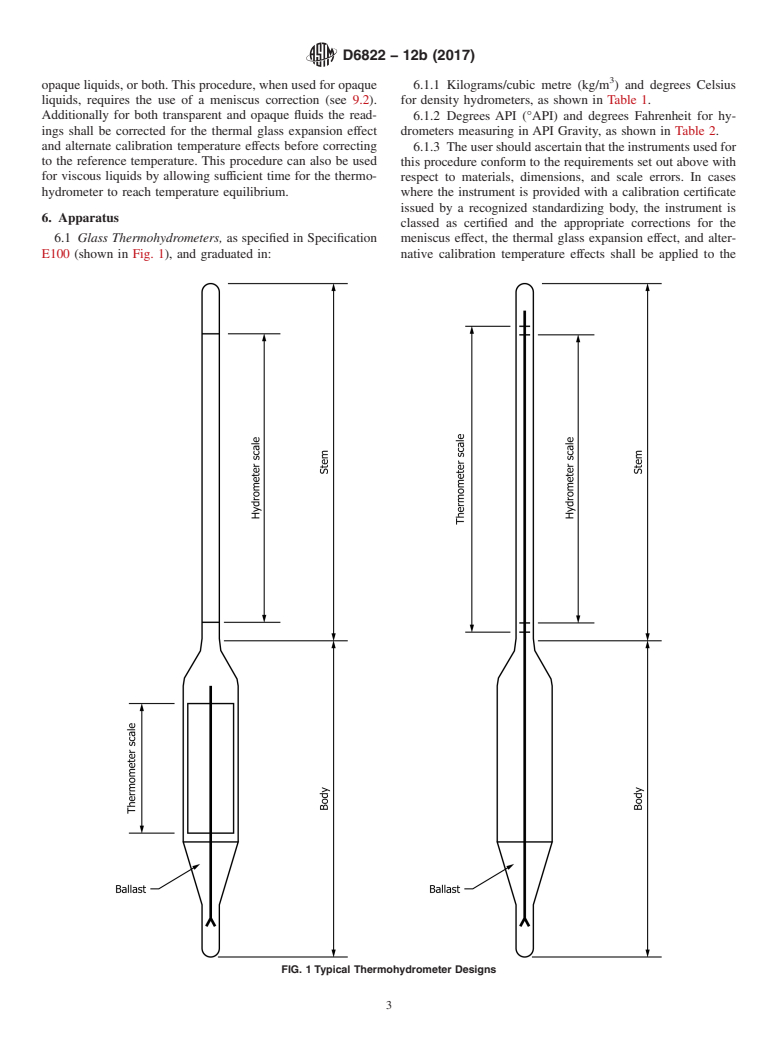
6.1 Glass Thermohydrometers, as specified in Specification E100 (shown in Fig. 1), and graduated in:
6.1.1 Kilograms/cubic metre (kg/m ) and degrees Celsius for density hydrometers, as shown in Table 1.
6.1.2 Degrees API (°API) and degrees Fahrenheit for hydrometers measuring in API Gravity, as shown in Table 2.
6.1.3 The user should ascertain that the instruments used for this procedure conform to the requirements set out above with
respect to materials, dimensions, and scale errors. In cases where the instrument is provided with a calibration certificate issued
by a recognized standardizing body, the instrument is classed as certified and the appropriate corrections for the meniscus effect,
the thermal glass expansion effect, and alternative calibration temperature effects shall be applied to the observed readings prior
to corrections. Instruments that satisfy the requirements of this test method, but are not provided with a recognized calibration
certificate, are classed as uncertified and the appropriate corrections for the meniscus effect, the thermal glass expansion effect, and
alternative calibration temperature effects shall be applied to the observed readings prior to corrections.
6.2 Hydrometer Cylinders, clear glass, plastic, or metal. For convenience of pouring, the cylinder may have a pouring lip. The
inside diameter shall be at least 25 mm (1 in.) 25 mm (1 in.) greater than the outside diameter of the thermohydrometer used. The
height of the cylinder shall be such that the bottom of the thermohydrometer clears the bottom of the cylinder by at least 25 mm
25 mm (1 in.) when suspended in the sample test portion.
6.2.1 For field testing, a sample thief of suitable dimensions may be more convenient than a hydrometer cylinder. The liquid
level shall be level with the top of the thief.
6.3 Temperature Bath, to control temperature close to the bulk hydrocarbon temperature or to control temperature close to the
reference temperature of 15°C15 °C or 60°F.60 °F.
7. Sampling, Test Specimens, and Test Units
7.1 Unless otherwise specified, samples of non-volatile petroleum and petroleum products shall be taken by the procedures
described in Practices D4057 (API MPMS Chapter 8.1) and D4177 (API MPMS Chapter 8.2).
7.2 Samples of volatile crude petroleum or petroleum products are preferably taken by Practice D4177 (API MPMS Chapter
8.2), using a variable volume (floating piston) sample receiver to minimize any loss of light components which may affect the
accuracy of the density measurement. In the absence of this facility, extreme care shall be taken to minimize these losses, including
the transfer of the sample to a chilled container immediately after sampling.
D6822 − 12b (2017)
FIG. 1 Typical Thermohydrometer Designs
7.3 Sample Mixing—May be necessary to obtain a test portion representative of the bulk sample to be tested, but precautions
shall be taken to mai
...
Questions, Comments and Discussion
Ask us and Technical Secretary will try to provide an answer. You can facilitate discussion about the standard in here.