

ASTM D7451-21
(Test Method)Standard Test Method for Water Separation Properties of Light and Middle Distillate, and Compression and Spark-Ignition Engine Fuels
General Information
- Abstract
SIGNIFICANCE AND USE
5.1 The primary use of this test method is to evaluate new additive packages in specific fuels to ensure that fuel-water separability will not be compromised by the use of the additive package, either at their normal treat rates or at several times the intended treat rate to evaluate the impact of potential overtreatment.
5.1.1 Water Volume Changes—Using this technique reveal the presence of water-soluble components, such as alcohols, in the fuel.
5.1.2 Interface Condition Ratings—Using this technique reveal the presence of partially soluble components, such as surfactants, in the fuel.
5.2 Additives or contaminants that affect the interface could harm water separation properties of fuels in equipment and quickly inhibit the free flow of fuel through filters and injection equipment, causing a decrease in combustion performance.
SCOPE
1.1 This test method covers the evaluation of the tendency of water and fuels with a final boiling point of less than 390 °C, as measured in Test Method D86, to separate cleanly rather than create emulsions when they may contain potential emulsion forming additives or components, or have been additized with potential emulsion forming additives, or components.
1.2 This test method applies primarily to gasoline, diesel, kerosine, and distillate grades of gas turbine, marine, home heating oils and furnace fuels (see Specifications D396, D975, D2880, D3699, D4814, and D6985). For fuel components such as biodiesel or alcohol, refer to X1.2 and X1.3.
1.3 This test method is not meant to certify or qualify fuels for sale, but it is intended for use by additive suppliers to determine the need for demulsifier components in their additive packages.
1.4 This test method is not meant for testing of fuels containing large amounts of aqueous soluble components, such as E85, or for testing of water emulsified fuels, or for testing of aviation fuels.
1.5 The values stated in SI units are to be regarded as standard. No other units of measurement are included in this standard.
1.6 This standard does not purport to address all of the safety concerns, if any, associated with its use. It is the responsibility of the user of this standard to establish appropriate safety, health, and environmental practices and determine the applicability of regulatory limitations prior to use.
1.7 This international standard was developed in accordance with internationally recognized principles on standardization established in the Decision on Principles for the Development of International Standards, Guides and Recommendations issued by the World Trade Organization Technical Barriers to Trade (TBT) Committee.
- Status
- Published
- Publication Date
- 30-Sep-2021
- Technical Committee
- D02 - Petroleum Products, Liquid Fuels, and Lubricants
- Drafting Committee
- D02.14 - Stability, Cleanliness and Compatibility of Liquid Fuels
Buy Documents
ASTM D7451-21 - Standard Test Method for Water Separation Properties of Light and Middle Distillate, and Compression and Spark-Ignition Engine Fuels
REDLINE ASTM D7451-21 - Standard Test Method for Water Separation Properties of Light and Middle Distillate, and Compression and Spark-Ignition Engine Fuels
Overview
ASTM D7451-21 is a key standard from ASTM International that specifies a test method for evaluating the water separation properties of light and middle distillate fuels, as well as compression and spark-ignition engine fuels. This method is primarily designed to assess how well these fuels, such as gasoline, diesel, kerosene, and fuel oils, can separate from water, especially when they contain additives that may influence emulsion formation.
Ensuring efficient fuel-water separation is crucial for maintaining fuel quality and preventing operational issues in engines and storage systems. Additives or contaminants that hinder separation can reduce combustion performance, clog filters, and damage fuel injection equipment.
Key Topics
- Purpose: The test method determines whether the introduction of additives or contaminants adversely affects the fuel’s ability to separate from water.
- Scope: Applies to fuels with a final boiling point below 390°C, including gasoline, diesel, kerosene, gas turbine, marine, and home heating oils.
- Assessment Points:
- Water Volume Change: Insight into the presence of water-soluble components such as alcohols, which increase water volume.
- Interface Condition Ratings: Qualitative evaluation of the formation of films, scum, or stable emulsions at the fuel-water interface, often due to surfactants or partially soluble contaminants.
- Fuel Clarity: Visual assessment of the fuel layer after separation, indicating the degree of phase separation.
- Limitations: The standard is not suitable for fuels with significant amounts of aqueous soluble components (such as E85), water-emulsified fuels, or aviation fuels. Biodiesel and alcohol blends require special consideration.
- Intended Users: Primarily aimed at additive suppliers to evaluate the need for demulsifier components in fuel additive packages. Not intended for certifying fuels for sale.
Applications
ASTM D7451-21 is widely used in the petroleum, fuel additive, and automotive industries to:
- Evaluate New Additive Packages: Confirm that additives do not compromise water separability, even at higher-than-normal treatment rates.
- Monitor Fuel Quality: Identify unintentional contamination or the need for demulsifiers in production or post-treatment processes.
- Support Equipment Protection: Prevent issues like filter plugging or injection equipment failure due to stable emulsions or impaired water separation.
- Comply with Specification Requirements: Ensure compatibility with fuels referenced in related ASTM specifications including D396 (Fuel Oils), D975 (Diesel Fuel), D2880 (Gas Turbine Fuels), D3699 (Kerosine), and D4814 (Automotive Spark-Ignition Engine Fuel).
- R&D and Quality Control: Facilitate research and development of new fuel formulations and additives, as well as ongoing quality assurance in fuel blending and distribution operations.
Related Standards
ASTM D7451-21 is closely associated with several other ASTM standards vital to fuel quality testing and compatibility:
- ASTM D86: Test Method for Distillation of Petroleum Products and Liquid Fuels
- ASTM D396: Specification for Fuel Oils
- ASTM D975: Specification for Diesel Fuel
- ASTM D2880: Specification for Gas Turbine Fuel Oils
- ASTM D3699: Specification for Kerosine
- ASTM D4175: Terminology Relating to Petroleum Products and Lubricants
- ASTM D4176: Test Method for Free Water and Particulate Contamination in Distillate Fuels
- ASTM D1193: Specification for Reagent Water
Understanding and implementing ASTM D7451-21 ensures robust fuel-water separation performance, helping to maintain system reliability, minimize maintenance costs, and support compliance with industry best practices for liquid fuel management.
Relations
- Effective Date
- 01-Jan-2024
- Effective Date
- 15-Dec-2023
- Refers
ASTM D4175-23a - Standard Terminology Relating to Petroleum Products, Liquid Fuels, and Lubricants - Effective Date
- 15-Dec-2023
- Effective Date
- 01-Dec-2023
- Effective Date
- 01-Dec-2023
- Effective Date
- 01-Dec-2023
- Refers
ASTM D4175-23e1 - Standard Terminology Relating to Petroleum Products, Liquid Fuels, and Lubricants - Effective Date
- 01-Jul-2023
- Effective Date
- 01-Feb-2020
- Effective Date
- 15-Dec-2019
- Effective Date
- 01-Dec-2019
- Effective Date
- 01-May-2019
- Effective Date
- 01-Feb-2019
- Effective Date
- 01-Dec-2018
- Effective Date
- 01-Oct-2018
- Effective Date
- 01-Oct-2018
Buy Documents
ASTM D7451-21 - Standard Test Method for Water Separation Properties of Light and Middle Distillate, and Compression and Spark-Ignition Engine Fuels
REDLINE ASTM D7451-21 - Standard Test Method for Water Separation Properties of Light and Middle Distillate, and Compression and Spark-Ignition Engine Fuels
Get Certified
Connect with accredited certification bodies for this standard

Element Materials Technology
Materials testing and product certification.

ABS Group Brazil
ABS Group certification services in Brazil.

ABS Quality Evaluations Inc.
American Bureau of Shipping quality certification.
Sponsored listings
Frequently Asked Questions
ASTM D7451-21 is a standard published by ASTM International. Its full title is "Standard Test Method for Water Separation Properties of Light and Middle Distillate, and Compression and Spark-Ignition Engine Fuels". This standard covers: SIGNIFICANCE AND USE 5.1 The primary use of this test method is to evaluate new additive packages in specific fuels to ensure that fuel-water separability will not be compromised by the use of the additive package, either at their normal treat rates or at several times the intended treat rate to evaluate the impact of potential overtreatment. 5.1.1 Water Volume Changes—Using this technique reveal the presence of water-soluble components, such as alcohols, in the fuel. 5.1.2 Interface Condition Ratings—Using this technique reveal the presence of partially soluble components, such as surfactants, in the fuel. 5.2 Additives or contaminants that affect the interface could harm water separation properties of fuels in equipment and quickly inhibit the free flow of fuel through filters and injection equipment, causing a decrease in combustion performance. SCOPE 1.1 This test method covers the evaluation of the tendency of water and fuels with a final boiling point of less than 390 °C, as measured in Test Method D86, to separate cleanly rather than create emulsions when they may contain potential emulsion forming additives or components, or have been additized with potential emulsion forming additives, or components. 1.2 This test method applies primarily to gasoline, diesel, kerosine, and distillate grades of gas turbine, marine, home heating oils and furnace fuels (see Specifications D396, D975, D2880, D3699, D4814, and D6985). For fuel components such as biodiesel or alcohol, refer to X1.2 and X1.3. 1.3 This test method is not meant to certify or qualify fuels for sale, but it is intended for use by additive suppliers to determine the need for demulsifier components in their additive packages. 1.4 This test method is not meant for testing of fuels containing large amounts of aqueous soluble components, such as E85, or for testing of water emulsified fuels, or for testing of aviation fuels. 1.5 The values stated in SI units are to be regarded as standard. No other units of measurement are included in this standard. 1.6 This standard does not purport to address all of the safety concerns, if any, associated with its use. It is the responsibility of the user of this standard to establish appropriate safety, health, and environmental practices and determine the applicability of regulatory limitations prior to use. 1.7 This international standard was developed in accordance with internationally recognized principles on standardization established in the Decision on Principles for the Development of International Standards, Guides and Recommendations issued by the World Trade Organization Technical Barriers to Trade (TBT) Committee.
SIGNIFICANCE AND USE 5.1 The primary use of this test method is to evaluate new additive packages in specific fuels to ensure that fuel-water separability will not be compromised by the use of the additive package, either at their normal treat rates or at several times the intended treat rate to evaluate the impact of potential overtreatment. 5.1.1 Water Volume Changes—Using this technique reveal the presence of water-soluble components, such as alcohols, in the fuel. 5.1.2 Interface Condition Ratings—Using this technique reveal the presence of partially soluble components, such as surfactants, in the fuel. 5.2 Additives or contaminants that affect the interface could harm water separation properties of fuels in equipment and quickly inhibit the free flow of fuel through filters and injection equipment, causing a decrease in combustion performance. SCOPE 1.1 This test method covers the evaluation of the tendency of water and fuels with a final boiling point of less than 390 °C, as measured in Test Method D86, to separate cleanly rather than create emulsions when they may contain potential emulsion forming additives or components, or have been additized with potential emulsion forming additives, or components. 1.2 This test method applies primarily to gasoline, diesel, kerosine, and distillate grades of gas turbine, marine, home heating oils and furnace fuels (see Specifications D396, D975, D2880, D3699, D4814, and D6985). For fuel components such as biodiesel or alcohol, refer to X1.2 and X1.3. 1.3 This test method is not meant to certify or qualify fuels for sale, but it is intended for use by additive suppliers to determine the need for demulsifier components in their additive packages. 1.4 This test method is not meant for testing of fuels containing large amounts of aqueous soluble components, such as E85, or for testing of water emulsified fuels, or for testing of aviation fuels. 1.5 The values stated in SI units are to be regarded as standard. No other units of measurement are included in this standard. 1.6 This standard does not purport to address all of the safety concerns, if any, associated with its use. It is the responsibility of the user of this standard to establish appropriate safety, health, and environmental practices and determine the applicability of regulatory limitations prior to use. 1.7 This international standard was developed in accordance with internationally recognized principles on standardization established in the Decision on Principles for the Development of International Standards, Guides and Recommendations issued by the World Trade Organization Technical Barriers to Trade (TBT) Committee.
ASTM D7451-21 is classified under the following ICS (International Classification for Standards) categories: 75.160.20 - Liquid fuels. The ICS classification helps identify the subject area and facilitates finding related standards.
ASTM D7451-21 has the following relationships with other standards: It is inter standard links to ASTM D4814-24, ASTM D975-23a, ASTM D4175-23a, ASTM D4814-23a, ASTM D86-23a, ASTM D86-23ae1, ASTM D4175-23e1, ASTM D4814-20, ASTM D396-19a, ASTM D4814-19a, ASTM D396-19, ASTM D975-19, ASTM D975-18a, ASTM D2880-18a, ASTM D4814-18c. Understanding these relationships helps ensure you are using the most current and applicable version of the standard.
ASTM D7451-21 is available in PDF format for immediate download after purchase. The document can be added to your cart and obtained through the secure checkout process. Digital delivery ensures instant access to the complete standard document.
Standards Content (Sample)
This international standard was developed in accordance with internationally recognized principles on standardization established in the Decision on Principles for the
Development of International Standards, Guides and Recommendations issued by the World Trade Organization Technical Barriers to Trade (TBT) Committee.
Designation: D7451 − 21
Standard Test Method for
Water Separation Properties of Light and Middle Distillate,
and Compression and Spark-Ignition Engine Fuels
This standard is issued under the fixed designation D7451; the number immediately following the designation indicates the year of
original adoption or, in the case of revision, the year of last revision. A number in parentheses indicates the year of last reapproval. A
superscript epsilon (´) indicates an editorial change since the last revision or reapproval.
1. Scope* 2. Referenced Documents
1.1 This test method covers the evaluation of the tendency 2.1 ASTM Standards:
ofwaterandfuelswithafinalboilingpointoflessthan390 °C, D86 Test Method for Distillation of Petroleum Products and
as measured in Test Method D86, to separate cleanly rather Liquid Fuels at Atmospheric Pressure
than create emulsions when they may contain potential emul- D396 Specification for Fuel Oils
sion forming additives or components, or have been additized D975 Specification for Diesel Fuel
with potential emulsion forming additives, or components. D1193 Specification for Reagent Water
D2274 Test Method for Oxidation Stability of Distillate Fuel
1.2 This test method applies primarily to gasoline, diesel,
Oil (Accelerated Method)
kerosine, and distillate grades of gas turbine, marine, home
D2880 Specification for Gas Turbine Fuel Oils
heating oils and furnace fuels (see Specifications D396, D975,
D3699 Specification for Kerosine
D2880, D3699, D4814, and D6985). For fuel components such
D4057 Practice for Manual Sampling of Petroleum and
as biodiesel or alcohol, refer to X1.2 and X1.3.
Petroleum Products
1.3 This test method is not meant to certify or qualify fuels
D4175 Terminology Relating to Petroleum Products, Liquid
for sale, but it is intended for use by additive suppliers to
Fuels, and Lubricants
determinetheneedfordemulsifiercomponentsintheiradditive
D4176 Test Method for FreeWater and Particulate Contami-
packages.
nation in Distillate Fuels (Visual Inspection Procedures)
D4177 Practice for Automatic Sampling of Petroleum and
1.4 This test method is not meant for testing of fuels
containing large amounts of aqueous soluble components, such Petroleum Products
D4814 Specification for Automotive Spark-Ignition Engine
as E85, or for testing of water emulsified fuels, or for testing of
Fuel
aviation fuels.
D6985 Specification for Middle Distillate Fuel Oil—
1.5 The values stated in SI units are to be regarded as
Military Marine Applications (Withdrawn 2010)
standard. No other units of measurement are included in this
2.2 ASTM Adjuncts:
standard.
Distillate Fuel Bar Chart
1.6 This standard does not purport to address all of the
Fuel Clarity Rating Standard (physical or digital
safety concerns, if any, associated with its use. It is the
5,6
versions)
responsibility of the user of this standard to establish appro-
priate safety, health, and environmental practices and deter-
3. Terminology
mine the applicability of regulatory limitations prior to use.
1.7 This international standard was developed in accor- 3.1 Definitions:
dance with internationally recognized principles on standard-
ization established in the Decision on Principles for the
Development of International Standards, Guides and Recom-
For referenced ASTM standards, visit the ASTM website, www.astm.org, or
mendations issued by the World Trade Organization Technical
contact ASTM Customer Service at service@astm.org. For Annual Book of ASTM
Standards volume information, refer to the standard’s Document Summary page on
Barriers to Trade (TBT) Committee.
the ASTM website.
The last approved version of this historical standard is referenced on
www.astm.org.
1 4
This test method is under the jurisdiction of ASTM Committee D02 on Available from ASTM International Headquarters. Order Adjunct No.
Petroleum Products, Liquid Fuels, and Lubricants and is the direct responsibility of ADJD417601. Original adjunct produced in 1991.
Subcommittee D02.14 on Stability, Cleanliness and Compatibility of Liquid Fuels. Available from ASTM International Headquarters. Order Adjunct No.
Current edition approved Oct. 1, 2021. Published October 2021. Originally ADJD7451. Original adjunct produced in 2008.
approved in 2008. Last previous edition approved in 2020 as D7451 – 20. DOI: Available from ASTM International Headquarters. Order Adjunct No.
10.1520/D7451-21. ADJD7451-E-PDF. Original adjunct produced in 2019.
*A Summary of Changes section appears at the end of this standard
Copyright © ASTM International, 100 Barr Harbor Drive, PO Box C700, West Conshohocken, PA 19428-2959. United States
D7451 − 21
3.1.1 For definitions of terms used in this test method, refer 6. Apparatus
to Terminology D4175.
6.1 Graduated Glass Tube—Sealable, blunt-tipped, 100 mL
3.1.2 film, n—thin, translucent layer that does not adhere to
with ⁄2 mL graduations from 1 mL to 10 mL and 2 mL
the wall of the glass test tube.
graduations from 10 mL to 100 mL not encompassing the
3.1.3 heavy scum, n—assessment that the fuel/water inter- whole diameter of the tube as to interfere with the clarity
face is covered with more than 50 % scum that extends into rating. The dimensions of the tube are as follows:
either of the two layers or forms an emulsion (1 mL or greater 6.1.1 Overall length = 200 mm 6 5 mm.
in volume), or both. 6.1.2 Outer diameter of the tube portion = 38 mm.
6.1.3 Neck length = 25 mm.
3.1.4 scum, n—layer thicker than film (up to 1 mL in
6.1.4 Headspace from 100 mL graduation to tube neck =
volume) or that adheres to the wall of the glass test tube, or
50 mm 6 5 mm.
both.
6.1.5 Tip length = 30 mm with a 45° taper.
3.2 Definitions of Terms Specific to This Standard:
NOTE 1—Contact Subcommittee D02.14 for a list of possible suppliers
3.2.1 interface condition rating, n—qualitative assessment
for the tubes and caps.
of thetendencyofa mixtureofwaterandfueltoforminterface 7
6.2 Shaking Apparatus (Optional) —An explosion-proof
films or precipitates.
apparatus capable of shaking the tubes as prescribed in 10.2 is
3.2.2 water separation rating, n—qualitative assessment of preferred for testing consistency. However, any method that
thetendencyofcomponentsinthefueltoproduceemulsionsor facilitates shaking at the prescribed stroke length, frequency,
precipitates, or both, in separated fuel and water layers. and sample orientation as outlined in 10.2 is acceptable.
3.2.3 water volume change, n—qualitative indication of the 6.3 Rating Chart—The line card and fuel clarity rating chart
presence of water-soluble components in fuels, or the decrease
from ASTM Adjuncts ADJD417601 and ADJD7451 (or
in water returned during the test due to the formation of scum ADJD7451-E-PDF) respectively. (See 10.4.2.)
or emulsions. NOTE 2—If the line card is not available or fuel clarity is not readily
discerniblefromusingthelinecard,thenprintedtextasdescribedinTable
3.2.3.1 Discussion—For example, the alcohol component in
1 may be used to assess fuel clarity.
an ethanol-blended gasoline would be extracted into the
aqueous phase, thus increasing the volume of the aqueous
7. Reagents
phase by the approximate volume of the ethanol present in the
7.1 Purity of Reagents—Reagent grade chemicals shall be
sample.
used in all tests. Unless otherwise indicated, it is intended that
all reagents shall conform to the specifications of the Commit-
4. Summary of Test Method
tee onAnalytical Reagents of theAmerican Chemical Society,
4.1 The cleanliness of the glass test tube is tested prior to where such specifications are available. Other grades may be
use in the test. used, provided it is first ascertained that the reagent is of
sufficient purity to permit its use without lessening the accu-
4.2 A sample of the fuel is shaken at room temperature
racy of the determination.
using a standardized technique with an aqueous phase in
7.2 Purity of Water—Unless otherwise indicated, references
thoroughly cleaned glassware.
to water shall be understood to mean distilled water or water of
4.3 The change in volume of the aqueous layer, the appear-
equivalent or greater purity. Any type of water specified in
ance of the interface and the clarity of the fuel are reported as
Specification D1193 may be used.
an indication of the water separation properties of the fuel.
7.3 Glass Cleaning Solution—Non-chromium containing
cleaning solution. (Warning—Corrosive. Health hazard. Oxi-
5. Significance and Use
dizing agent.)
5.1 The primary use of this test method is to evaluate new
NOTE 3—Contact Subcommittee D02.14 for a list of possible suppliers
additive packages in specific fuels to ensure that fuel-water
for the glass cleaning solutions.
separability will not be compromised by the use of the additive
7.4 Cleaning Solvent, Reagent Grade—Trisolvent (TAM)
package,eitherattheirnormaltreatratesoratseveraltimesthe
(as defined by Test Method D2274), n-hexane, n-heptane,
intended treat rate to evaluate the impact of potential overtreat-
methylbenzene, dimethylbenzene, isopropyl alcohol,
ment.
methanol, or acetone. (Warning—Flammable. Health hazard.)
5.1.1 Water Volume Changes—Using this technique reveal
the presence of water-soluble components, such as alcohols, in
8. Sampling
the fuel.
8.1 Sampling shall be consistent with the procedures of
5.1.2 Interface Condition Ratings—Using this technique
Practice D4057 or Practice D4177.
reveal the presence of partially soluble components, such as
surfactants, in the fuel.
The sole source of supply of the shaking apparatus known to the committee at
this time is Part No. 215086, Laciny Brothers Inc., St. Louis, MO,
5.2 Additives or contaminants that affect the interface could
http://www.lacinybros.com. If you are aware of alternative suppliers, please provide
harm water separation properties of fuels in equipment and
this information to ASTM International Headquarters. Your comments will receive
quicklyinhibitthefreeflowoffuelthroughfiltersandinjection
careful consideration at a meeting of the responsible technical committee, which
equipment, causing a decrease in combustion performance. you may attend.
D7451 − 21
TABLE 1 Fuel Clarity Ratings
NOTE 1—These rating systems have been determined for use in the tubes described in 6.1. The use of narrower or wider tube would give potentially
different ratings than those outlined in the tables.
Rating Appearance
1 Clear and bright, equal to the base fuel
2 Very slight haze
Black 10 pt bold Times New Roman font on a white background rea
...
This document is not an ASTM standard and is intended only to provide the user of an ASTM standard an indication of what changes have been made to the previous version. Because
it may not be technically possible to adequately depict all changes accurately, ASTM recommends that users consult prior editions as appropriate. In all cases only the current version
of the standard as published by ASTM is to be considered the official document.
Designation: D7451 − 20 D7451 − 21
Standard Test Method for
Water Separation Properties of Light and Middle Distillate,
and Compression and Spark-Ignition Engine Fuels
This standard is issued under the fixed designation D7451; the number immediately following the designation indicates the year of
original adoption or, in the case of revision, the year of last revision. A number in parentheses indicates the year of last reapproval. A
superscript epsilon (´) indicates an editorial change since the last revision or reapproval.
1. Scope*
1.1 This test method covers the evaluation of the tendency of water and fuels with a final boiling point of less than 390 °C, as
measured in Test Method D86, to separate cleanly rather than create emulsions when they may contain potential emulsion forming
additives or components, or have been additized with potential emulsion forming additives, or components.
1.2 This test method applies primarily to gasoline, diesel, kerosine, and distillate grades of gas turbine, marine, home heating oils
and furnace fuels (see Specifications D396, D975, D2880, D3699, D4814, and D6985). For fuel components such as biodiesel or
alcohol, refer to X1.2 and X1.3.
1.3 This test method is not meant to certify or qualify fuels for sale, but it is intended for use by additive suppliers to determine
the need for demulsifier components in their additive packages.
1.4 This test method is not meant for testing of fuels containing large amounts of aqueous soluble components, such as E85, or
for testing of water emulsified fuels, or for testing of aviation fuels.
1.5 The values stated in SI units are to be regarded as standard. No other units of measurement are included in this standard.
1.6 This standard does not purport to address all of the safety concerns, if any, associated with its use. It is the responsibility
of the user of this standard to establish appropriate safety, health, and environmental practices and determine the applicability of
regulatory limitations prior to use.
1.7 This international standard was developed in accordance with internationally recognized principles on standardization
established in the Decision on Principles for the Development of International Standards, Guides and Recommendations issued
by the World Trade Organization Technical Barriers to Trade (TBT) Committee.
2. Referenced Documents
2.1 ASTM Standards:
D86 Test Method for Distillation of Petroleum Products and Liquid Fuels at Atmospheric Pressure
D396 Specification for Fuel Oils
D975 Specification for Diesel Fuel
D1193 Specification for Reagent Water
This test method is under the jurisdiction of ASTM Committee D02 on Petroleum Products, Liquid Fuels, and Lubricants and is the direct responsibility of Subcommittee
D02.14 on Stability, Cleanliness and Compatibility of Liquid Fuels.
Current edition approved July 1, 2020Oct. 1, 2021. Published July 2020October 2021. Originally approved in 2008. Last previous edition approved in 20192020 as
D7451 – 19.D7451 – 20. DOI: 10.1520/D7451-20.10.1520/D7451-21.
For referenced ASTM standards, visit the ASTM website, www.astm.org, or contact ASTM Customer Service at service@astm.org. For Annual Book of ASTM Standards
volume information, refer to the standard’s Document Summary page on the ASTM website.
*A Summary of Changes section appears at the end of this standard
Copyright © ASTM International, 100 Barr Harbor Drive, PO Box C700, West Conshohocken, PA 19428-2959. United States
D7451 − 21
D2274 Test Method for Oxidation Stability of Distillate Fuel Oil (Accelerated Method)
D2880 Specification for Gas Turbine Fuel Oils
D3699 Specification for Kerosine
D4057 Practice for Manual Sampling of Petroleum and Petroleum Products
D4175 Terminology Relating to Petroleum Products, Liquid Fuels, and Lubricants
D4176 Test Method for Free Water and Particulate Contamination in Distillate Fuels (Visual Inspection Procedures)
D4177 Practice for Automatic Sampling of Petroleum and Petroleum Products
D4814 Specification for Automotive Spark-Ignition Engine Fuel
D6985 Specification for Middle Distillate Fuel Oil—Military Marine Applications (Withdrawn 2010)
2.2 ASTM Adjuncts:
Distillate Fuel Bar Chart
5,6
Fuel Clarity Rating Standard (physical or digital versions)
3. Terminology
3.1 Definitions:
3.1.1 For definitions of terms used in this test method, refer to Terminology D4175.
3.1.2 film, n—thin, translucent layer that does not adhere to the wall of the glass test tube.
3.1.3 heavy scum, n—assessment that the fuel/water interface is covered with more than 50 % scum that extends into either of the
two layers or forms an emulsion (1 mL or greater in volume), or both.
3.1.4 scum, n—layer thicker than film (up to 1 mL in volume) or that adheres to the wall of the glass test tube, or both.
3.2 Definitions of Terms Specific to This Standard:
3.2.1 interface condition rating, n—qualitative assessment of the tendency of a mixture of water and fuel to form interface films
or precipitates.
3.2.2 water separation rating, n—qualitative assessment of the tendency of components in the fuel to produce emulsions or
precipitates, or both, in separated fuel and water layers.
3.2.3 water volume change, n—qualitative indication of the presence of water-soluble components in fuels, or the decrease in
water returned during the test due to the formation of scum or emulsions.
3.2.3.1 Discussion—
For example, the alcohol component in an ethanol-blended gasoline would be extracted into the aqueous phase, thus increasing
the volume of the aqueous phase by the approximate volume of the ethanol present in the sample.
4. Summary of Test Method
4.1 The cleanliness of the glass test tube is tested prior to use in the test.
4.2 A sample of the fuel is shaken at room temperature using a standardized technique with an aqueous phase in thoroughly
cleaned glassware.
4.3 The change in volume of the aqueous layer, the appearance of the interface and the clarity of the fuel are reported as an
indication of the water separation properties of the fuel.
5. Significance and Use
5.1 The primary use of this test method is to evaluate new additive packages in specific fuels to ensure that fuel-water separability
The last approved version of this historical standard is referenced on www.astm.org.
Available from ASTM International Headquarters. Order Adjunct No. ADJD417601. Original adjunct produced in 1991.
Available from ASTM International Headquarters. Order Adjunct No. ADJD7451. Original adjunct produced in 2008.
Available from ASTM International Headquarters. Order Adjunct No. ADJD7451-E-PDF. Original adjunct produced in 2019.
D7451 − 21
will not be compromised by the use of the additive package, either at their normal treat rates or at several times the intended treat
rate to evaluate the impact of potential overtreatment.
5.1.1 Water Volume Changes—Using this technique reveal the presence of water-soluble components, such as alcohols, in the fuel.
5.1.2 Interface Condition Ratings—Using this technique reveal the presence of partially soluble components, such as surfactants,
in the fuel.
5.2 Additives or contaminants that affect the interface could harm water separation properties of fuels in equipment and quickly
inhibit the free flow of fuel through filters and injection equipment, causing a decrease in combustion performance.
6. Apparatus
6.1 Graduated Glass Tube—Sealable, blunt-tipped, 100 mL with ⁄2 mL graduations from 1 mL to 10 mL and 2 mL graduations
from 10 mL to 100 mL not encompassing the whole diameter of the tube as to interfere with the clarity rating. The dimensions of
the tube are as follows:
6.1.1 Overall length = 200 mm 6 5 mm.
6.1.2 Outer diameter of the tube portion = 38 mm.
6.1.3 Neck length = 25 mm.
6.1.4 Headspace from 100 mL graduation to tube neck = 50 mm 6 5 mm.
6.1.5 Tip length = 30 mm with a 45° taper.
NOTE 1—Contact Subcommittee D02.14 for a list of possible suppliers for the tubes and caps.
6.2 Shaking Apparatus (Optional) —An explosion-proof apparatus capable of shaking the tubes as prescribed in 10.2 is preferred
for testing consistency. However, any method that facilitates shaking at the prescribed stroke length, frequency, and sample
orientation as outlined in 10.2 is acceptable.
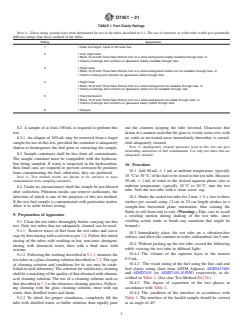
TABLE 1 Fuel Clarity Ratings
NOTE 1—These rating systems have been determined for use in the tubes described in 6.1. The use of narrower or wider tube would give potentially
different ratings than those outlined in the tables.
Rating Appearance
1 • Clear and bright, equal to the base fuel
2 • Very slight haze
• Black 10 pt bold Times New Roman font on a white background readily readable through tube, or
• Volume markings and numbers on glassware readily readable through tube
3 • Slight haze
• Black 10 pt bold Times New Roman font on a white background visible but not readable through tube, or
• Volume marking and numbers on glassware visible through tube
4 • Slight haze
• Black 10 pt bold Times New Roman font on a white background not readable through tube, or
• Volume markings and numbers on glassware visible but not readable through tube
5 • Hazy/translucent
• Black 10 pt bold Times New Roman font on a white background not visible through tube, or
• Volume markings and numbers on glassware barely visible through tube
6 • Opaque
The sole source of supply of the shaking apparatus known to the committee at this time is Part No. 215086, Laciny Brothers Inc., St. Louis, MO,
http://www.lacinybros.com. If you are aware of alternative suppliers, please provide this information to ASTM International Headquarters. Your comments will receive careful
consideration at a meeting of the responsible technical committee, which you may attend.
D7451 − 21
6.3 Rating Chart—The line card and fuel clarity rating chart from ASTM Adjuncts ADJD417601 and ADJD7451 (or
ADJD7451-E-PDF) respectively. (See 10.4.2.)
NOTE 2—If the line card is not available or fuel clarity is not readily discernible from using the line card, then printed text as described in Table 1 may
be used to assess fuel clarity.
7. Reagents
7.1 Purity of Reagents—Reagent grade chemicals shall be used in all tests. Unless otherwise indicated, it is intended that all
reagents shall conform to the specifications of the Committee on Analytical Reagents of the American Chemical Society, where
such specifications are available. Other grades may be used, provided it is first ascertained that the reagent is of sufficient purity
to permit its use without lessening the accuracy of the determination.
7.2 Purity of Water—Unless otherwise indicated, references to water shall be understood to mean distilled water or water of
equivalent
...