

ASTM C940-22
(Test Method)Standard Test Method for Expansion and Bleeding of Freshly Mixed Grouts for Preplaced-Aggregate Concrete in the Laboratory
General Information
- Abstract
SIGNIFICANCE AND USE
5.1 This test method is useful for determining the expansion and bleeding characteristics of freshly mixed fluid hydraulic cement grout commonly used in PA concrete and cementitious post-tensioning tendon grouts.
- Status
- Published
- Publication Date
- 30-Sep-2022
- Technical Committee
- C09 - Concrete and Concrete Aggregates
- Drafting Committee
- C09.41 - Hydraulic Cement Grouts
Buy Documents
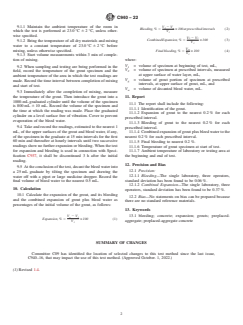


ASTM C940-22 - Standard Test Method for Expansion and Bleeding of Freshly Mixed Grouts for Preplaced-Aggregate Concrete in the Laboratory
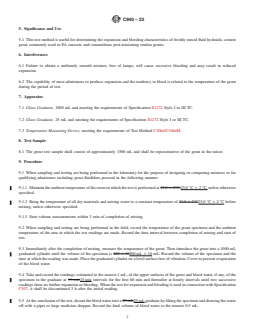

REDLINE ASTM C940-22 - Standard Test Method for Expansion and Bleeding of Freshly Mixed Grouts for Preplaced-Aggregate Concrete in the Laboratory
Overview
ASTM C940-22: Standard Test Method for Expansion and Bleeding of Freshly Mixed Grouts for Preplaced-Aggregate Concrete in the Laboratory provides a reliable laboratory method for assessing the expansion and bleeding characteristics of freshly mixed fluid hydraulic cement grout. This standard is essential for quality control and mix design verification in preplaced-aggregate (PA) concrete and cementitious post-tensioning tendon grout applications. By measuring both the expansion and the accumulation of bleed water, the method helps ensure mixture performance, stability, and long-term durability in the field.
Key Topics
- Grout Performance Evaluation: Determines expansion and bleeding, which are critical to the performance of hydraulic cement grouts used in PA concrete and post-tensioning systems.
- Testing Applicability: Covers grouts with or without fine aggregate and supplemental cementitious materials.
- Laboratory Procedures: Details the placement of grout in graduated cylinders, measurement of volume changes, and tracking of bleed water over time under controlled conditions.
- Measurement Precision: Includes specific procedures for consistent temperature control and sample handling to ensure reliable, reproducible results.
- Reporting Requirements: Specifies reporting expansion, bleeding, combined expansion, and temperature measurements at defined intervals for comprehensive documentation.
Applications
ASTM C940-22 is widely used in laboratory settings for:
- Mix Design Verification: Ensuring hydraulic cement grouts meet project requirements for expansion and minimize unwanted bleeding before field application.
- Admixture Qualification: Comparing and qualifying grout fluidifiers and other admixtures used in preplaced-aggregate concrete or post-tensioning grouts.
- Quality Control: Assessing batch-to-batch consistency and conformity to specifications prior to field placement, which is vital for construction quality assurance.
- Research and Development: Supporting innovation in grout formulations by providing standardized methods for evaluating performance characteristics.
Practitioners such as materials engineers, laboratory technicians, and quality control managers frequently use this test method within segments of the construction, infrastructure, and precast concrete industries that rely on high-performance cement grouts.
Related Standards
For broader testing and specification compliance in concrete and grout applications, the following ASTM standards are closely associated with ASTM C940-22:
- ASTM C125 - Terminology Relating to Concrete and Concrete Aggregates
- ASTM C219 - Terminology Relating to Hydraulic and Other Inorganic Cements
- ASTM C937 - Specification for Grout Fluidifier for Preplaced-Aggregate Concrete
- ASTM C1064/C1064M - Test Method for Temperature of Freshly Mixed Hydraulic-Cement Concrete
- ASTM E1272 - Specification for Laboratory Glass Graduated Cylinders
By integrating ASTM C940-22 with these related standards, organizations ensure precise evaluation, improved material performance, and adherence to industry best practices when working with hydraulic cementitious grouts, preplaced-aggregate concrete, and post-tensioning systems.
Keywords: ASTM C940-22, grout expansion, grout bleeding, preplaced-aggregate concrete, hydraulic cement grout, laboratory testing, quality control, post-tensioning grouts, concrete standards.
Relations
- Effective Date
- 01-Apr-2024
- Effective Date
- 01-Dec-2023
- Effective Date
- 01-Aug-2020
- Effective Date
- 01-Apr-2020
- Effective Date
- 15-Dec-2019
- Effective Date
- 15-Nov-2019
- Effective Date
- 01-Jun-2019
- Effective Date
- 01-Jan-2019
- Effective Date
- 01-Jan-2019
- Effective Date
- 01-Oct-2018
- Effective Date
- 01-Jul-2018
- Effective Date
- 01-Jan-2018
- Effective Date
- 15-Dec-2016
- Effective Date
- 15-Dec-2015
- Effective Date
- 01-Jul-2015
Buy Documents
ASTM C940-22 - Standard Test Method for Expansion and Bleeding of Freshly Mixed Grouts for Preplaced-Aggregate Concrete in the Laboratory
REDLINE ASTM C940-22 - Standard Test Method for Expansion and Bleeding of Freshly Mixed Grouts for Preplaced-Aggregate Concrete in the Laboratory
Get Certified
Connect with accredited certification bodies for this standard

DIBt (Deutsches Institut für Bautechnik)
German Institute for Building Technology.
DIN CERTCO
DIN Group product certification.

Aboma Certification B.V.
Specialized in construction, metal, and transport sectors.
Sponsored listings
Frequently Asked Questions
ASTM C940-22 is a standard published by ASTM International. Its full title is "Standard Test Method for Expansion and Bleeding of Freshly Mixed Grouts for Preplaced-Aggregate Concrete in the Laboratory". This standard covers: SIGNIFICANCE AND USE 5.1 This test method is useful for determining the expansion and bleeding characteristics of freshly mixed fluid hydraulic cement grout commonly used in PA concrete and cementitious post-tensioning tendon grouts.
SIGNIFICANCE AND USE 5.1 This test method is useful for determining the expansion and bleeding characteristics of freshly mixed fluid hydraulic cement grout commonly used in PA concrete and cementitious post-tensioning tendon grouts.
ASTM C940-22 is classified under the following ICS (International Classification for Standards) categories: 91.100.30 - Concrete and concrete products. The ICS classification helps identify the subject area and facilitates finding related standards.
ASTM C940-22 has the following relationships with other standards: It is inter standard links to ASTM C219-24, ASTM C1064/C1064M-23, ASTM C219-20a, ASTM C219-20, ASTM C125-19a, ASTM C219-19a, ASTM C219-19, ASTM E1272-02(2019), ASTM C125-19, ASTM C125-18b, ASTM C125-18a, ASTM C125-18, ASTM C125-16, ASTM C125-15b, ASTM C125-15a. Understanding these relationships helps ensure you are using the most current and applicable version of the standard.
ASTM C940-22 is available in PDF format for immediate download after purchase. The document can be added to your cart and obtained through the secure checkout process. Digital delivery ensures instant access to the complete standard document.
Standards Content (Sample)
This international standard was developed in accordance with internationally recognized principles on standardization established in the Decision on Principles for the
Development of International Standards, Guides and Recommendations issued by the World Trade Organization Technical Barriers to Trade (TBT) Committee.
Designation: C940 − 22
Standard Test Method for
Expansion and Bleeding of Freshly Mixed Grouts for
Preplaced-Aggregate Concrete in the Laboratory
This standard is issued under the fixed designation C940; the number immediately following the designation indicates the year of
original adoption or, in the case of revision, the year of last revision. A number in parentheses indicates the year of last reapproval. A
superscript epsilon (´) indicates an editorial change since the last revision or reapproval.
1. Scope* 3. Terminology
3.1 For definitions of terms used in this standard, refer to
1.1 This test method determines the amount of expansion
Terminology C125 and Terminology C219.
and accumulation of bleed water at the surface of freshly mixed
hydraulic-cement grout commonly used in the production of
4. Summary of Test Method
preplaced-aggregate (PA) concrete and cementitious post-
tensioning tendon grouts.
4.1 Grout is placed in a graduated cylinder. Changes in total
volume and accumulation of bleed water, if any, on the surface
1.2 It is for use with hydraulic cement grout whether or not
of the grout are observed over a period of time.
it includes fine aggregate or supplemental cementitious mate-
rials or both.
5. Significance and Use
1.3 The values stated in SI units are to be regarded as
5.1 This test method is useful for determining the expansion
standard. No other units of measurement are included in this
and bleeding characteristics of freshly mixed fluid hydraulic
standard.
cement grout commonly used in PA concrete and cementitious
post-tensioning tendon grouts.
1.4 This standard does not purport to address all of the
safety concerns, if any, associated with its use. It is the
6. Interferences
responsibility of the user of this standard to establish appro-
priate safety, health, and environmental practices and deter-
6.1 Failure to obtain a uniformly smooth mixture, free of
mine the applicability of regulatory limitations prior to use.
lumps, will cause excessive bleeding and may result in reduced
expansion.
2. Referenced Documents
6.2 The capability of most admixtures to produce expansion
and the tendency to bleed is related to the temperature of the
2.1 ASTM Standards:
C125 Terminology Relating to Concrete and Concrete Ag- grout during the period of test.
gregates
7. Apparatus
C219 Terminology Relating to Hydraulic and Other Inor-
ganic Cements
7.1 Glass Graduate, 1000 mL and meeting the requirements
C937 Specification for Grout Fluidifier for Preplaced-
of Specification E1272 Style I or III TC.
Aggregate Concrete
7.2 Glass Graduate, 25 mL and meeting the requirements of
C1064/C1064M Test Method for Temperature of Freshly
Specification E1272 Style I or III TC.
Mixed Hydraulic-Cement Concrete
7.3 Temperature Measuring Device, meeting the require-
E1272 Specification for Laboratory Glass Graduated Cylin-
ments of Test Method C1064/C1064M.
ders
8. Test Sample
1 8.1 The grout test sample shall consist of approximately
This test method is under the jurisdiction of ASTM Committee C09 on
Concrete and Concrete Aggregatesand is the direct responsibility of Subcommittee 1500 mL and shall be representative of the grout in the mixer.
C09.41 on Hydraulic Cement Grouts.
Current edition approved Oct. 1, 2022. Published October 2022. Originally
9. Procedure
approved in 1981. Last previous edition approved in 2016 as C940–16. DOI:
10.1520/C0940-22.
9.1 When sampling and testing are being performed in the
For referenced ASTM standards, visit the ASTM website, www.astm.org, or
laboratory for the purpose of designing or comparing mixtures
contact ASTM Customer Service at service@astm.org. For Annual Book of ASTM
or for qualifying admixtures including grout fluidifiers proceed
Standards volume information, refer to the standard’s Document Summary page on
the ASTM website. in the following manner:
*A Summary of Changes section appears at the end of this standard
Copyright © ASTM International, 100 Barr Harbor Drive, PO Box C700, West Conshohocken, PA 19428-2959. United States
C940 − 22
9.1.1 Maintain the ambient temperature of the room in V 2 V
2 g
Bleeding, % 5 × 100 at prescribed intervals (2)
which the test is performed at 23.0 °C 6 2 °C, unless other- V
wise specified.
V 2 V
2 1
Combined Expansion, % 5 × 100 (3)
9.1.2 Bring the temperature of all dry materials and mixing
V
water to a constant temperature of 23.0 °C 6 2 °C before
V
w
mixing, unless otherwise specified.
Final
...
This document is not an ASTM standard and is intended only to provide the user of an ASTM standard an indication of what changes have been made to the previous version. Because
it may not be technically possible to adequately depict all changes accurately, ASTM recommends that users consult prior editions as appropriate. In all cases only the current version
of the standard as published by ASTM is to be considered the official document.
Designation: C940 − 16 C940 − 22
Standard Test Method for
Expansion and Bleeding of Freshly Mixed Grouts for
Preplaced-Aggregate Concrete in the Laboratory
This standard is issued under the fixed designation C940; the number immediately following the designation indicates the year of
original adoption or, in the case of revision, the year of last revision. A number in parentheses indicates the year of last reapproval. A
superscript epsilon (´) indicates an editorial change since the last revision or reapproval.
1. Scope
1.1 This test method determines the amount of expansion and accumulation of bleed water at the surface of freshly mixed
hydraulic-cement grout commonly used in the production of preplaced-aggregate (PA) concrete and cementitious post-tensioning
tendon grouts.
1.2 It is for use with hydraulic cement grout whether or not it includes fine aggregate or supplemental cementitious materials or
both.
1.3 The values stated in SI units are to be regarded as standard. No other units of measurement are included in this standard.
1.4 This standard may involve hazardous materials, operations, and equipment. This standard does not purport to address all of
the safety concerns, if any, associated with its use. It is the responsibility of the user of this standard to establish appropriate safety
safety, health, and healthenvironmental practices and determine the applicability of regulatory limitations prior to use.
2. Referenced Documents
2.1 ASTM Standards:
C125 Terminology Relating to Concrete and Concrete Aggregates
C219 Terminology Relating to Hydraulic and Other Inorganic Cements
C937 Specification for Grout Fluidifier for Preplaced-Aggregate Concrete
C1064/C1064M Test Method for Temperature of Freshly Mixed Hydraulic-Cement Concrete
E1272 Specification for Laboratory Glass Graduated Cylinders
3. Terminology
3.1 For definitions of terms used in this standard, refer to Terminology C125 and Terminology C219.
4. Summary of Test Method
4.1 Grout is placed in a graduated cylinder. Changes in total volume and accumulation of bleed water, if any, on the surface of
the grout are observed over a period of time.
This test method is under the jurisdiction of ASTM Committee C09 on Concrete and Concrete Aggregatesand is the direct responsibility of Subcommittee C09.41 on
Hydraulic Cement Grouts.
Current edition approved Feb. 1, 2016Oct. 1, 2022. Published March 2016October 2022. Originally approved in 1981. Last previous edition approved in 20102016 as
C940–10a.–16. DOI: 10.1520/C0940-16.10.1520/C0940-22.
For referenced ASTM standards, visit the ASTM website, www.astm.org, or contact ASTM Customer Service at service@astm.org. For Annual Book of ASTM Standards
volume information, refer to the standard’s Document Summary page on the ASTM website.
Copyright © ASTM International, 100 Barr Harbor Drive, PO Box C700, West Conshohocken, PA 19428-2959. United States
C940 − 22
5. Significance and Use
5.1 This test method is useful for determining the expansion and bleeding characteristics of freshly mixed fluid hydraulic cement
grout commonly used in PA concrete and cementitious post-tensioning tendon grouts.
6. Interferences
6.1 Failure to obtain a uniformly smooth mixture, free of lumps, will cause excessive bleeding and may result in reduced
expansion.
6.2 The capability of most admixtures to produce expansion and the tendency to bleed is related to the temperature of the grout
during the period of test.
7. Apparatus
7.1 Glass Graduate, 1000 mL and meeting the requirements of Specification E1272 Style I or III TC.
7.2 Glass Graduate, 25 mL and meeting the requirements of Specification E1272 Style I or III TC.
7.3 Temperature Measuring Device, meeting the requirements of Test Method C1064/C1064M.
8. Test Sample
8.1 The grout test sample shall consist of approximately 1500 mL and shall be representative of the grout in the mixer.
9. Procedure
9.1 When sampling and testing are being performed in the laboratory for the purpose of designing or comparing mixtures or for
qualifying admixtures including grout fluidifiers proceed in the following manner:
9.1.1 Maintain the ambient temperature of the room in which the test is performed at 23.0 6 2°C,23.0 °C 6 2 °C, unless otherwise
specified.
9.1.2 Bring the temperature of all dry materials and mixing water to a constant temperature of 23.0 6 2°C23.0 °C 6 2 °C before
mixing, unless otherwise specified.
9.1.3 Start volume measurements within 3 min of completion of mixing.
9.2 When sampling and testing are being performed in the field, record the temperature of the grout specimen and the ambient
temperature of the area in which the test readings are made. Record the time interval between completion of mixing and start of
test.
...