

ASTM D7603-23
(Test Method)Standard Test Method for Determination of Storage Stability and Compatibility in Automotive Gear Oils
General Information
- Abstract
SIGNIFICANCE AND USE
5.1 To avoid equipment failure, a gear oil should remain a homogeneous liquid and the performance-enhancing additives should not separate out when the oil is stored for an extended period of time.
5.2 In addition, because different oils are often mixed when topping off, gear oils from different manufacturers, or containing different base fluids or performance-enhancing additives should be completely miscible and compatible with each other. Any incompatibility of such mixtures can also result in equipment failure if gelation or additive dropout occurs.
5.3 The test procedures described in this test method are designed to evaluate the performance of gear oils in each of the above circumstances.
5.4 This test method is based on the separate test methods FED-STD-791/3440.1 and FED-STD-791/3440.2. Minor changes have been made to the FED test methods to provide a coherent unified procedure. These changes do not significantly alter the test procedures. This test method has, therefore, potential for use as an alternative to the FED test methods in gear oil specifications such as SAE J2360 and Specification D5760.
SCOPE
1.1 This test method covers the determination of storage stability characteristics and the compatibility of automotive gear lubricants when blended with reference lubricants. The purpose of the test is to determine if performance-enhancing additives separate out under defined conditions.
1.2 The values stated in SI units are to be regarded as standard. No other units of measurement are included in this standard.
1.3 This standard does not purport to address all of the safety concerns, if any, associated with its use. It is the responsibility of the user of this standard to establish appropriate safety, health, and environmental practices and determine the applicability of regulatory limitations prior to use.
1.4 This international standard was developed in accordance with internationally recognized principles on standardization established in the Decision on Principles for the Development of International Standards, Guides and Recommendations issued by the World Trade Organization Technical Barriers to Trade (TBT) Committee.
- Status
- Published
- Publication Date
- 28-Feb-2023
- Technical Committee
- D02 - Petroleum Products, Liquid Fuels, and Lubricants
- Drafting Committee
- D02.B0.01 - Passenger Car Engine Oils
Overview
ASTM D7603-23 sets forth the standard test method for the determination of storage stability and compatibility in automotive gear oils. This method evaluates whether performance-enhancing additives in gear lubricants remain homogeneously dissolved over time and when mixed with other oils-key to preventing equipment failure in automotive gear systems. Developed by ASTM International, this standard unifies previous federal test methods and provides a reliable approach for assessing lubricant quality in line with international best practices.
Key Topics
- Storage Stability
Ensures that automotive gear oils retain additive homogeneity during prolonged storage, without separation or precipitation that could compromise lubricant effectiveness. - Compatibility Testing
Assesses if gear oils from different manufacturers, or those with various base fluids and additives, remain fully miscible and stable when blended, as often occurs during top-offs. - Qualitative and Quantitative Evaluations
The test includes both visual (qualitative) observations and optional procedures for quantifying the amount of additive separation, allowing for comprehensive evaluation. - Safety, Health, and Environmental Practices
The standard highlights the necessity for users to establish appropriate safety, health, and environmental practices tailored to their specific context.
Applications
The practical applications of ASTM D7603-23 are of significant value to the automotive lubricants industry, including:
- Gear Oil Formulation and Quality Control
Lubricant manufacturers and formulators use this test to verify that their products meet storage stability and compatibility requirements, ensuring their gear oils will not contribute to equipment breakdown due to additive dropout or gelation. - Specification Compliance
The method is applicable for compliance with specifications such as SAE J2360 and ASTM D5760, essential for suppliers to automotive OEMs and maintenance operations. - Mixing Practices and In-Service Performance
Automotive service providers use this standard to evaluate the risks of mixing gear oils from different sources, supporting best practices for topping off and maintaining reliability in service. - Alternate to Federal Test Methods
By consolidating FED-STD-791/3440.1 and FED-STD-791/3440.2, this test method offers a streamlined, internationally recognized alternative for inclusion in product specifications and procurement processes.
Related Standards
When utilizing ASTM D7603-23 for the determination of gear oil stability and compatibility, consider referencing the following related standards for a comprehensive approach:
- ASTM D235: Specification for mineral spirits used in testing and cleaning procedures.
- ASTM D1193: Specification for reagent water, ensuring test accuracy.
- ASTM D4175: Terminology relating to petroleum products, liquid fuels, and lubricants.
- ASTM D5760: Specification for the performance of manual transmission gear lubricants.
- SAE J2360: Global specification for automotive gear lubricants.
- FED-STD-791/3440.1 and FED-STD-791/3440.2: Federal methods now unified within ASTM D7603 for storage solubility and compatibility of gear lubricants.
Practical Value
By adhering to ASTM D7603-23, industry professionals can:
- Reduce the risk of drivetrain failures caused by lubricant instability or incompatibility.
- Ensure automotive gear oils meet international performance specifications.
- Avoid warranty issues, operational downtime, and costly repairs attributable to lubricant-related problems.
- Support environmental and safety compliance by identifying stable, reliable lubricants.
Keywords: ASTM D7603-23, gear oil storage stability, gear oil compatibility, automotive lubricant testing, lubricant additive separation, SAE J2360 compliance, gear oil mixing, lubricant quality control.
Relations
- Refers
ASTM D4175-23a - Standard Terminology Relating to Petroleum Products, Liquid Fuels, and Lubricants - Effective Date
- 15-Dec-2023
- Refers
ASTM D4175-23e1 - Standard Terminology Relating to Petroleum Products, Liquid Fuels, and Lubricants - Effective Date
- 01-Jul-2023
- Effective Date
- 01-May-2019
- Effective Date
- 01-Jan-2019
- Effective Date
- 15-Jun-2013
- Effective Date
- 01-Nov-2012
- Effective Date
- 01-Oct-2009
- Effective Date
- 01-Nov-2007
- Effective Date
- 01-Nov-2007
- Effective Date
- 01-Jun-2007
- Effective Date
- 01-Mar-2006
- Effective Date
- 01-Apr-2005
- Effective Date
- 10-Dec-2002
- Effective Date
- 10-Oct-2002
- Effective Date
- 10-Oct-2001
Get Certified
Connect with accredited certification bodies for this standard

Element Materials Technology
Materials testing and product certification.

ABS Group Brazil
ABS Group certification services in Brazil.

ABS Quality Evaluations Inc.
American Bureau of Shipping quality certification.
Sponsored listings
Frequently Asked Questions
ASTM D7603-23 is a standard published by ASTM International. Its full title is "Standard Test Method for Determination of Storage Stability and Compatibility in Automotive Gear Oils". This standard covers: SIGNIFICANCE AND USE 5.1 To avoid equipment failure, a gear oil should remain a homogeneous liquid and the performance-enhancing additives should not separate out when the oil is stored for an extended period of time. 5.2 In addition, because different oils are often mixed when topping off, gear oils from different manufacturers, or containing different base fluids or performance-enhancing additives should be completely miscible and compatible with each other. Any incompatibility of such mixtures can also result in equipment failure if gelation or additive dropout occurs. 5.3 The test procedures described in this test method are designed to evaluate the performance of gear oils in each of the above circumstances. 5.4 This test method is based on the separate test methods FED-STD-791/3440.1 and FED-STD-791/3440.2. Minor changes have been made to the FED test methods to provide a coherent unified procedure. These changes do not significantly alter the test procedures. This test method has, therefore, potential for use as an alternative to the FED test methods in gear oil specifications such as SAE J2360 and Specification D5760. SCOPE 1.1 This test method covers the determination of storage stability characteristics and the compatibility of automotive gear lubricants when blended with reference lubricants. The purpose of the test is to determine if performance-enhancing additives separate out under defined conditions. 1.2 The values stated in SI units are to be regarded as standard. No other units of measurement are included in this standard. 1.3 This standard does not purport to address all of the safety concerns, if any, associated with its use. It is the responsibility of the user of this standard to establish appropriate safety, health, and environmental practices and determine the applicability of regulatory limitations prior to use. 1.4 This international standard was developed in accordance with internationally recognized principles on standardization established in the Decision on Principles for the Development of International Standards, Guides and Recommendations issued by the World Trade Organization Technical Barriers to Trade (TBT) Committee.
SIGNIFICANCE AND USE 5.1 To avoid equipment failure, a gear oil should remain a homogeneous liquid and the performance-enhancing additives should not separate out when the oil is stored for an extended period of time. 5.2 In addition, because different oils are often mixed when topping off, gear oils from different manufacturers, or containing different base fluids or performance-enhancing additives should be completely miscible and compatible with each other. Any incompatibility of such mixtures can also result in equipment failure if gelation or additive dropout occurs. 5.3 The test procedures described in this test method are designed to evaluate the performance of gear oils in each of the above circumstances. 5.4 This test method is based on the separate test methods FED-STD-791/3440.1 and FED-STD-791/3440.2. Minor changes have been made to the FED test methods to provide a coherent unified procedure. These changes do not significantly alter the test procedures. This test method has, therefore, potential for use as an alternative to the FED test methods in gear oil specifications such as SAE J2360 and Specification D5760. SCOPE 1.1 This test method covers the determination of storage stability characteristics and the compatibility of automotive gear lubricants when blended with reference lubricants. The purpose of the test is to determine if performance-enhancing additives separate out under defined conditions. 1.2 The values stated in SI units are to be regarded as standard. No other units of measurement are included in this standard. 1.3 This standard does not purport to address all of the safety concerns, if any, associated with its use. It is the responsibility of the user of this standard to establish appropriate safety, health, and environmental practices and determine the applicability of regulatory limitations prior to use. 1.4 This international standard was developed in accordance with internationally recognized principles on standardization established in the Decision on Principles for the Development of International Standards, Guides and Recommendations issued by the World Trade Organization Technical Barriers to Trade (TBT) Committee.
ASTM D7603-23 is classified under the following ICS (International Classification for Standards) categories: 75.100 - Lubricants, industrial oils and related products. The ICS classification helps identify the subject area and facilitates finding related standards.
ASTM D7603-23 has the following relationships with other standards: It is inter standard links to ASTM D4175-23a, ASTM D4175-23e1, ASTM D5760-19, ASTM E1272-02(2019), ASTM D5760-13, ASTM E1272-02(2012), ASTM D5760-09, ASTM E1272-02(2007), ASTM E542-01(2007), ASTM D235-02(2007), ASTM D1193-06, ASTM D5760-05, ASTM D235-02, ASTM E1272-02, ASTM E542-00. Understanding these relationships helps ensure you are using the most current and applicable version of the standard.
ASTM D7603-23 is available in PDF format for immediate download after purchase. The document can be added to your cart and obtained through the secure checkout process. Digital delivery ensures instant access to the complete standard document.
Standards Content (Sample)
This international standard was developed in accordance with internationally recognized principles on standardization established in the Decision on Principles for the
Development of International Standards, Guides and Recommendations issued by the World Trade Organization Technical Barriers to Trade (TBT) Committee.
Designation: D7603 − 23
Standard Test Method for
Determination of Storage Stability and Compatibility in
Automotive Gear Oils
This standard is issued under the fixed designation D7603; the number immediately following the designation indicates the year of
original adoption or, in the case of revision, the year of last revision. A number in parentheses indicates the year of last reapproval. A
superscript epsilon (´) indicates an editorial change since the last revision or reapproval.
1. Scope E1272 Specification for Laboratory Glass Graduated Cylin-
ders
1.1 This test method covers the determination of storage
2.2 SAE Standards:
stability characteristics and the compatibility of automotive
J2360 Lubricating Oil, Gear Multipurpose (Metric) Military
gear lubricants when blended with reference lubricants. The
Use
purpose of the test is to determine if performance-enhancing
additives separate out under defined conditions.
2.3 Federal Test Method Standard:
FED-STD-791/3440.1 Storage Solubility Characteristics of
1.2 The values stated in SI units are to be regarded as
Universal Gear Lubricants
standard. No other units of measurement are included in this
FED-STD-791/3440.2 Compatibility Characteristics of Uni-
standard.
versal Gear Lubricants
1.3 This standard does not purport to address all of the
safety concerns, if any, associated with its use. It is the
3. Terminology
responsibility of the user of this standard to establish appro-
3.1 Definitions:
priate safety, health, and environmental practices and deter-
3.1.1 calibrate, v—to determine the indication or output of a
mine the applicability of regulatory limitations prior to use.
measuring device (for example, thermometer, manometer,
1.4 This international standard was developed in accor-
engine) with respect to that of a standard.
dance with internationally recognized principles on standard-
ization established in the Decision on Principles for the
3.1.2 candidate oil, n—an oil that is intended to have the
Development of International Standards, Guides and Recom-
performance characteristics necessary to satisfy a specification
mendations issued by the World Trade Organization Technical
and is to be tested against that specification. D4175
Barriers to Trade (TBT) Committee.
3.1.3 reference oil, n—an oil of known performance
characteristics, used as a basis for comparison.
2. Referenced Documents
3.1.3.1 Discussion—Reference oils are used to calibrate
2.1 ASTM Standards:
testing facilities, to compare the performance of other oils, or
D235 Specification for Mineral Spirits (Petroleum Spirits)
to evaluate other materials (such as seals) that interact with
(Hydrocarbon Dry Cleaning Solvent)
oils. D4175
D1193 Specification for Reagent Water
3.1.4 test oil, n—any oil subjected to evaluation in an
D4175 Terminology Relating to Petroleum Products, Liquid
established procedure. D4175
Fuels, and Lubricants
D5760 Specification for Performance of Manual Transmis-
4. Summary of Test Method
sion Gear Lubricants
4.1 Separation of the performance-enhancing additives in a
E542 Practice for Gravimetric Calibration of Laboratory
test oil during storage is determined by heating it to 120 °C,
Volumetric Instruments
storing at room temperature for 30 days, and making a
qualitative observation as to whether any material has sepa-
This test method is under the jurisdiction of ASTM Committee D02 on rated out.
Petroleum Products, Liquid Fuels, and Lubricants and is the direct responsibility of
Subcommittee D02.B0.01 on Passenger Car Engine Oils.
Current edition approved March 1, 2023. Published April 2023. Originally
approved in 2010. Last previous edition approved in 2013 as D7603 – 13, which was Available from SAE International (SAE), 400 Commonwealth Dr., Warrendale,
withdrawn January 2022 and reinstated in March 2023. DOI:10.1520/D7603-23. PA 15096-0001, http://www.sae.org.
2 4
For referenced ASTM standards, visit the ASTM website, www.astm.org, or Available online at www.assistdocs.com (search for FED-STD-791 in the
contact ASTM Customer Service at service@astm.org. For Annual Book of ASTM document ID field or from Standardization Documents Order Desk, DODSSP, Bldg.
Standards volume information, refer to the standard’s Document Summary page on 4, Section D, 700 Robbins Ave., Philadelphia, PA 19111-5098, http://
the ASTM website. dodssp.daps.dla.mil.
Copyright © ASTM International, 100 Barr Harbor Drive, PO Box C700, West Conshohocken, PA 19428-2959. United States
D7603 − 23
4.1.1 An optional, non-mandatory test method is also de- between various calibration marks are given in Table 1 and
scribed in Appendix X1 and Appendix X2 for quantifying the apply to calibrations made with air free water at 20 °C when
percent of the additive that separated out during storage of the
reading the bottom of the shaded meniscus. Verify the accuracy
test oil.
of the graduation marks, in accordance with Practice E542,
using equipment traceable through the National Institute of
4.2 The compatibility of a test oil is determined by blending
Standards and Technology (NIST) (www.nist.gov) or other
it with different reference oils, heating to 120 ºC, storing at
national standards. Tubes conforming to these requirements are
room temperature for 30 days, and making a qualitative
commercially available.
observation as to whether any material has separated out.
4.2.1 An optional, non-mandatory test method is also de-
6.2 Centrifuge:
scribed in Appendix X1 and Appendix X2 for quantifying the
6.2.1 Use a centrifuge meeting all safety requirements for
percent of the additive that separated out of the test oil/
normal use and capable of spinning two or more filled
reference oil mixture due to a compatibility problem between
centrifuge tubes at a speed that can be controlled to give a
these two oils.
minimum relative centrifugal force, rcf, of 407 at the tips of the
5. Significance and Use tubes.
6.2.2 A centrifuge with a diameter of swing (measured
5.1 To avoid equipment failure, a gear oil should remain a
between the tips of opposite tubes when in the rotating
homogeneous liquid and the performance-enhancing additives
position) of 407 mm 6 13 mm achieves this condition at a
should not separate out when the oil is stored for an extended
rotation speed of 1500 r/min 6 25 r/min.
period of time.
6.2.2.1 If the available centrifuge does not conform dimen-
5.2 In addition, because different oils are often mixed when
sionally to that described in 6.2.2, determine the rotation speed
topping off, gear oils from different manufacturers, or contain-
necessary to produce an rcf of 407 for other diameters of swing
ing different base fluids or performance-enhancing additives
from the following equation:
should be completely miscible and compatible with each other.
Any incompatibility of such mixtures can also result in
r/min 5 1500=407/d (1)
equipment failure if gelation or additive dropout occurs.
where:
5.3 The test procedures described in this test method are
d = the diameter, in millimetres, of the swing measured
designed to evaluate the performance of gear oils in each of the
between the tips of opposite tubes when in the rotating
above circumstances.
position.
5.4 This test method is based on the separate test methods
FED-STD-791/3440.1 and FED-STD-791/3440.2. Minor
6.2.3 Construct the revolving head, trunnion rings, and
changes have been made to the FED test methods to provide a
trunnion cups, including the cushions, to withstand the maxi-
coherent unified procedure. These changes do not significantly
mum centrifugal force capable of being delivered by the power
alter the test procedures. This test method has, therefore,
source. The trunnion cups and cushions shall firmly support the
potential for use as an alternative to the FED test methods in
tubes when the centrifuge is in motion. Enclose the centrifuge
gear oil specifications such as SAE J2360 and Specification
by a metal shield or case strong enough to contain flying debris
D5760.
in the event a tube breaks or the centrifuge malfunctions.
6. Apparatus
6.3 Mass Balance—Having a minimum indication resolu-
tion of 1 mg.
6.1 Centrifuge Tubes—Cone-shaped, with a capacity of
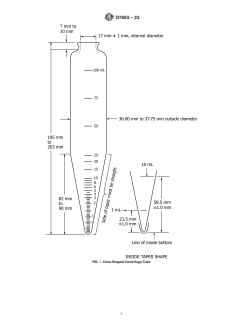
100 mL, conforming to the dimensions given in Fig. 1, and
6.4 Beaker—Made from heat-resistant glass and having a
made of thoroughly annealed glass. The graduations, numbered
capacity of 400 mL.
as shown in Fig. 1, shall be clear and distinct. Constrict the
6.5 Desiccator—Capable of holding several centrifuge
mouth of each tube for closure with a solvent-resistant rubber
stopper. Scale error tolerances and the smallest graduations tubes in a dry condition.
6.6 Forced Circulation Oven—Capable of being controlled
at 105 °C 6 3 °C and 120 °C 6 1 °C.
TABLE 1 Minimum Graduation Requirements and Maximum
Calibration Tolerances for the Centrifuge Tubes
6.7 Graduate Cylinders:
Range, mL Subdivision, mL Volume Tolerance, mL
6.7.1 For Measuring Volume of Test Oil for the Storage
0 to 0.1 0.05 ± 0.02
Stability Test—Having a capacity of 250 mL.
> 0.1 to 0.3 0.05 ± 0.03
> 0.3 to 0.5 0.05 ± 0.05
6.7.2 For Measuring Volume of Reference and Test Oils for
> 0.5 to 1.0 0.10 ± 0.05
the Compatibility Test—Conforming to Specification E1272,
> 1.0 to 2.0 0.10 ± 0.10
> 2.0 to 3.0 0.20 ± 0.10
Class A and having a capacity of 250 mL with graduation
> 3.0 to 5.0 0.5 ± 0.20
marks of 2 mL.
> 5.0 to 10 1 ± 0.50
> 10 to 25 15 ± 1.00
6.8 Mechanical Stirrer—Capable of stirring the contents of
> 25 to 100 25 ± 1.00
a beaker with a capacity of 400 mL at approximately 200 r/min.
D7603 − 23
FIG. 1 Cone-Shaped Centrifuge Tube
D7603 − 23
7. Reagents and Materials darkened area (such as a drawer or cupboard) in a room whose
temperature is controlled at 25 °C 6 3 °C.
7.1 Reference Oils for Compatibility Testing—Use the 6
8.1.5 Centrifuging—Transfer the tubes to the centrifuge,
reference oils available from the ASTM Test Monitoring
taking care not to disturb any material that may have separated
Center (TMC) as a 6-pack and identified as SSCT Fluid
from the oil. Operate the centrifuge for 30 min 6 1 min at a
(6-pack).
speed to give a rcf of 407 at the tips of the tubes (see 6.2).
7.2 Solvent—Use only mineral spirits meeting Specification
8.1.6 After centrifuging, remove the tubes from the centri-
D235, Type II, Class C for aromatic content (0 % to 2 %
fuge and check each tube visually to determine if solid or liquid
volume), flash point ≥ 61 °C and color (not darker than +25 on
material has separated out.
Saybolt scale or 25 on Pt-Co scale). Obtain a Certificate of
8.1.6.1 If there is no visual evidence of separated material in
Analysis for each batch of mineral spirits from the supplier.
the centrifuge tubes, stop the storage stability procedure, record
(Warning—Combustible. Health hazard.)
that the storage stability test resulted in zero residue, and report
7.3 Purity of Water—Unless otherwise indicated, references
as detailed in 9.1.1.
to water shall be understood to mean reagent water that meets
8.1.6.2 If solid or liquid material has separated out, record
that defined as Type IV of Specification D1193.
that the storage stability test resulted in residue, and report as
7.4 Acetone—Reagent grade or better. (Warning— detailed in 9.1.2. If it is desired to quantify the amount of
Extremely flammable. Vapors may cause flash fire.)
residue, proceed as directed in Appendix X1 and Appendix X2.
7.5 Liquid Detergent—Liquinox, a concentrated, anionic
8.2 Compatibility Testing—In general, when a mixture of a
liquid product. Use neat.
test oil and reference oil is stored, residue can originate
because of incompatibility between the test oil and reference
8. Procedure
oil, or from a storage stability problem associated with the test
8.1 Storage Stability Testing: and reference oils themselves, or both. In the specific case of
8.1.1 Perform duplicate storage stability tests (that is, use
the reference oils SSCT Fluid (6-pack), the situation is simpli-
two centrifuge tubes) for each test oil. fied because they do not normally produce storage stability
8.1.2 Preparation of the Centrifuge Tubes, Graduated
residues.
Cylinders, and Beakers:
NOTE 1—In principle, therefore, any residue observed in the compat-
8.1.2.1 Clean each piece of glassware as follows:
ibility test involving these reference oils arises either from incompatibility
(1) Rinse with solvent.
between the test oil and the reference oil or from storage stability
(2) Clean with Liquinox cleaning solution.
problems from the test oil alone. In practice, however, there is a possibility
that the reference oil(s) alone might produce residue during storage. For
(3) Rinse with distilled water.
instance, the reference oil(s) might have deteriorated during storage, or
(4) Rinse with acetone (see Warning in 7.4).
have become contaminated, or the test might have been carried out
8.1.2.2 Dry the cleaned glassware by laying flat in an oven
incorrectly. To cover such eventualities, the procedure requires that in the
maintained at 105 °C 6 3 °C for at least 30 min.
event a residue is observed in the compatibility test with a test oil, the
8.1.2.3 Remove from the oven and allow to cool to room reference oil(s) involved are subjected to the storage stability test with a
view to eliminating them as the source of residue.
temperature. Cool the centrifuge tubes in a desiccator.
8.1.2.4 Number each centrifuge tube and measur
...