


ASTM D6540-00
(Test Method)Standard Test Method for Accelerated Soiling of Pile Yarn Floor Covering
Standard Test Method for Accelerated Soiling of Pile Yarn Floor Covering
SCOPE
1.1 This test method describes the equipment, and the test method for assessing the propensity of pile yarn floor coverings to soiling in the absence of abrasive wear and texture changes, using a standard synthetic soil composition.
1.2 This test method is applicable for use in testing unused pile yarn floor covering of all types. It is not applicable for use in testing used pile yarn floor covering.
1.3 This test method can be used to compare the soiling propensity of two or more carpets; or it can be used to soil carpets as a preliminary step to other test procedures.
1.4 The values stated in SI units are to be regarded as the standard. The inch-pound units given in parenthesis are for information only.
1.5 This standard does not purport to address all of the safety concerns, if any, associated with its use. It is the responsibility of the user of this standard to establish appropriate safety and health practices and determine the applicability of regulatory limitations prior to use.
General Information
Relations

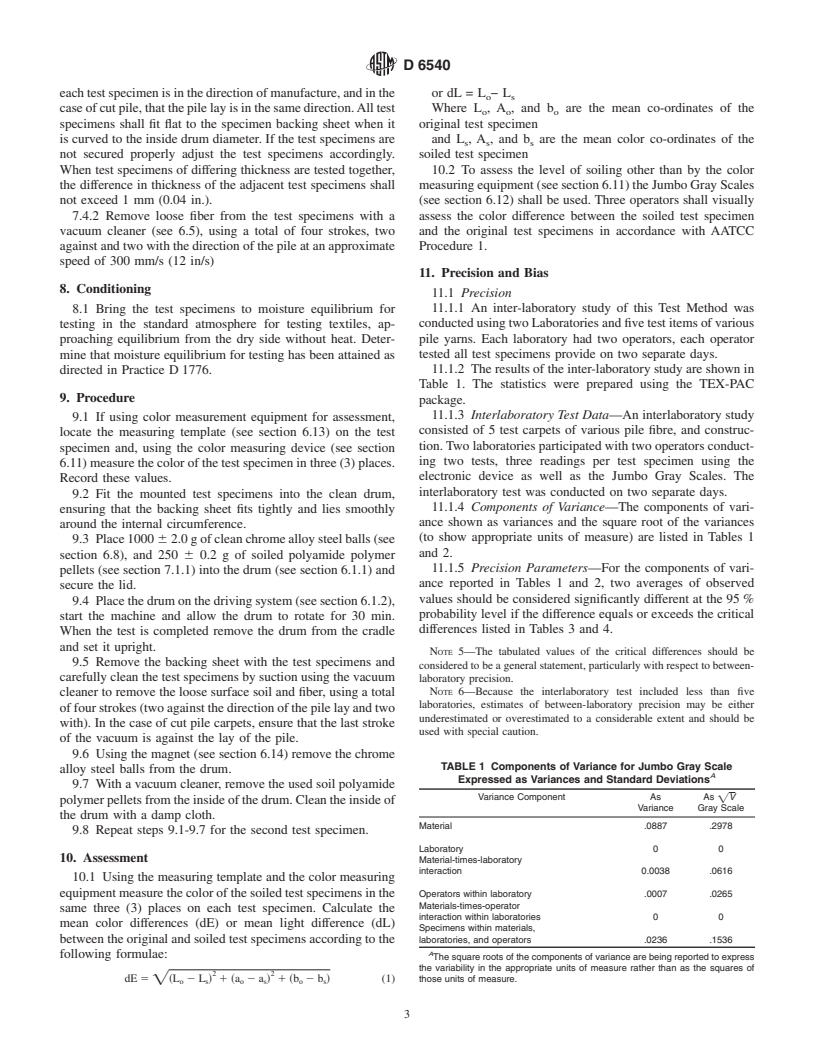
Standards Content (Sample)
NOTICE: This standard has either been superseded and replaced by a new version or withdrawn.
Contact ASTM International (www.astm.org) for the latest information
Designation:D6540–00
Standard Test Method for
Accelerated Soiling of Pile Yarn Floor Covering
This standard is issued under the fixed designation D6540; the number immediately following the designation indicates the year of
original adoption or, in the case of revision, the year of last revision.Anumber in parentheses indicates the year of last reapproval.A
superscript epsilon (e) indicates an editorial change since the last revision or reapproval.
1. Scope 105–J01 Textile—Testsforcolourfastness—PartJ01:Mea-
surement of Colour and Colour Differences
1.1 This test method describes the equipment, and the test
methodforassessingthepropensityofpileyarnfloorcoverings
3. Terminology
to soiling in the absence of abrasive wear and texture changes,
3.1 Definitions—For definitions of pile yarn floor covering
using a standard synthetic soil composition.
related terms used in this standard, Refer to Terminology
1.2 This test method is applicable for use in testing unused
D5684. For definitions of other textile terms used in this
pile yarn floor covering of all types. It is not applicable for use
standard, Refer to Terminology D123.
in testing used pile yarn floor covering.
1.3 This test method can be used to compare the soiling
4. Summary of Test Method
propensity of two or more carpets; or it can be used to soil
4.1 Thecarpettestspecimensaresecuredtoabackingsheet
carpets as a preliminary step to other test procedures.
that is mounted inside the drum with the pile surface exposed,
1.4 The values stated in SI units are to be regarded as the
and are subjected to an accelerated soiling process.The degree
standard. The inch-pound units given in parenthesis are for
of soiling is measured or assessed by comparing the change in
information only.
color between soiled and original pile yarn floor covering,
1.5 This standard does not purport to address all of the
using a measurement device or visually matching the differ-
safety concerns, if any, associated with its use. It is the
ences on the light-dark axis of Jumbo Gray Scales.
responsibility of the user of this standard to establish appro-
priate safety and health practices and determine the applica-
NOTE 1—Differentiation between test samples is significantly reduced
when Jumbo Gray Scales are used.
bility of regulatory limitations prior to use.
5. Significance and Use
2. Referenced Documents
5.1 This test method may be used to soil test specimens in
2.1 ASTM Standards:
the absence of abrasive wear and texture changes under
D123 Terminology Relating to Textiles
controlled conditions using a standard synthetic soil, or as a
D1776 Practice for Conditioning Textile Testing
preliminary step to other procedures.
D2906 Statements on Precision and Bias for Textiles
5.2 This test method will provide a uniformly soiled test
D5684 TerminologyRelatingtoPileYarnFloorCoverings
specimen to evaluate, is reproducible (see section 11), and is
2.2 ASTM Adjunct:
economical for Testing Laboratories.
TEX-PAC
5.3 This test method has been found to give results similar
2.3 AATCC Test Method:
to the actual floor service soiling, but its use is recommended
Evaluation Procedure 1 – Gray Scale for Color Change
only as a screening test method and not as a replacement for
2.4 ISO Standards:
floor testing.
5.4 The acceptance criteria of this test method shall be set
ThistestmethodisunderthejurisdictionofASTMCommitteeD13onTextiles
by mutual agreement between the purchaser and supplier.
and is the direct responsibility of Subcommittee D13.21 on Pile Yarn Floor
Coverings.
6. Apparatus and Materials
Current edition approved April 10, 2000. Published July 2000.
Annual Book of ASTM Standards, Vol 07.01. 6.1 Hexapod Tumble Tester
Annual Book of ASTM Standards, Vol 07.02.
The PC program on floppy disks for analyzing Committee D13 interlaboratory
data are available from ASTM. Request ADJ D2904.
5 6 nd th
Available from American Association of Textile Chemists and Colorists, PO AvailablefromAmericanNationalStandardsInstitute,11West42 Street,18
Box 12215, Research Triangle Park, NC 27709. Floor, New York, NY 10036.
Copyright © ASTM International, 100 Barr Harbor Drive, PO Box C700, West Conshohocken, PA 19428-2959, United States.
D6540
6.1.1 Drum—Constructed of molded PVC and is capped by
a lid that is secured. The drum base and lid have a locating
groovetoholdthespecimenbackingsheetflattotheinnerwall
of the drum. The drum dimensions are:
Internal Diameter 305 61mm (126 0.04 in.)
Wall Thickness 8 mm approx. (0.03 in. approx.)
Internal Depth 200 61mm (7.96 0.04 in.)
6.1.2 Driving System—Cradles the drum on rollers and
keeps the axis of the drum level, rotates at 0.6 6 0.03 r/s (35
6 2 rpm). The driving system reverses every 15 min with
approximately one minute stationary time.
6.2 Specimen Backing Sheet—is a polyethylene sheet 950
by 215 by 2 mm (37.4 by 8.5 by 0.08 in.)
6.3 Tape—double sided pressure sensitive adhesive, 50 mm
(2.0 in.) width.
6.4 Cleaning Frame—Arectangularframe1000by300mm
(39.4 by 11.8 in.) with a central rectangular aperture 940 by
200 mm (37.0 by 7.9 in.) to receive the test specimen, of
material similar in construction to the test specimen and
mounted on a backing sheet.
6.5 Vacuum Cleaner—upright type, with a rotating brush
and beater bar, unless this type of apparatus is not recom-
FIG. 1 Example of a Suitable Template for Color Measurement
mended by the manufacturer of the pile floor covering under
test, in that case the appropriate recommended device should
be used.
section6.7ute)inthemixingcontainer.Securethelidandplace
6.6 Mixing Container—a wide mouth container such as a
the mixing container on the driving system for 10 minutes,
Standard Mill jar.
reverse direction and continue for an additional 10 min, for a
6.7 Polymer Pellets—polyamide polymer pellets having a
total of 20 min to ensure a homogeneous mixture of the soil
maximum size of 7 6 2 mm (0.27 6 0.08 in.)
and polyamide polymer pellets.
6.8 Chrome Alloy Steel Balls (Ball Bearings)—witha9.5 6
NOTE 2—Tosimulateparticularuseareas,itmaybenecessarytoadjust
0.02 mm (0.37 6 0.01 in.) diameter.
thetypeand/orquantityofsoilingcompoundanddocumentthechangein
6.9 Standard Soiling Compound —A soiling compound,
the written report.
such as AATCC synthetic soil formula, which is compatible
NOTE 3—If large quantities of soiled pellets are prepared, that is more
with the equipment.
than 2000 g, they shall be kept in an airtight container to ensure no loss
6.10 Control Pile Yarn Floor Covering—an internal stan-
of moisture from the mixture occurs, and the supply shall not be allowed
dard light colored carpet of known specifications used as a to dwindle below 25% of the original quantity.
NOTE 4—This Test Method was developed using AATCC synthetic
reference for each test evaluation.
soiling compound and if another soiling compound is used the amount of
6.11 Color Measurement Equipment—Acolormeasurement
soil used to prepare the soiled polymer pellets must be adjusted.
devicewitha50 60.5mm(2.0 60.2in.)aperture,capableof
7.2 Ensure the inside of the drum and chrome alloy steel
measuring the color of pile yarn floor covering and expressing
balls are clean.
the results in Delta E (dE) or Delta L (dL).
7.3 Size of Test Specimens
6.12 Jumbo Gray Scales—standard gray scales used to
7.3.1 Cut a minimum of two test specimens per pile yarn
visiblyassesschangeincolorofpileyarnfloorcoveringasper
floor covering, measuring a minimum of 125 6 1 mm (5.0 6
AATCC Procedure 1.
0.04 in.) in the direction of manufacture by 205 6 2 mm (8.00
6.13 Template—to be the same size as the test specimen
60.08in.)wide.Markanarrowinthedirectionofthepilelay
with 3 holes of the same dimensions as the measuring head of
on the back of the test specimen. All test specimens shall be
the color measuring device. See Fig. 1.
conditioned (clause 8.1), flat singly, and with use-surface
6.14 Magnet—capable of attracting and holding several
uppermost, for a minimum of 24 h.
chrome alloy steel balls at one time.
7.4 Specimen Attachment
7. Sampling, and Preparation of Soiled Pellets, Sampling,
7.4.1 Tothespecimenbackingsheet(seesection6.2)attach
and Test Specimens
double sided pressure sensitive adhesive tape (see section 6.3)
at each edge, across the ends and at each junction of the test
7.1 Preparation of Soiled Polyamide Polymer Pellets
specimen. Mount the test specimens and internal standard
7.1.1 Place 3.0 g of the standard soiling compound (see
carpet with the use surface uppermost, allowing a 5 61mm
section 6.9) and 1000 g of polyamide polymer pellets (see
(0.20 6 0.04 in.) gap at each end and 8 6 1 mm (0.31 6 0.04
in.) between test specimens to allow for the test specimen to
remain attached when the specimen backing sheet is curved to
Prepared soils are available from Textile Innovations Corporation, P.O. Box 8,
Windsor NC
...
Questions, Comments and Discussion
Ask us and Technical Secretary will try to provide an answer. You can facilitate discussion about the standard in here.