

ASTM D2219-21
(Specification)Standard Specification for Poly(Vinyl Chloride) Insulation for Wire and Cable, 60 °C Operation
General Information
- Abstract
ABSTRACT
This specification covers thermoplastic insulating materials made of poly(vinyl chloride) or the copolymer of vinyl chloride and vinyl acetate recommended for use in wires and cables operating in wet or dry locations at specified conductor temperatures and maximum voltage ratings for power and control circuits. Since the insulation material cannot be tested unless it has been formed around a conductor or cable, tests shall then be done on insulated wire or cable solely to determine the relevant property of the insulation material and not to test the conductor or completed cable. Materials shall conform to the following physical requirements: unaged tensile strength and elongation at rupture; tensile strength and elongation after air oven aging; heat shock; heat distortion; behavior during vertical flame test; oil resistance; tensile strength and elongation after oil immersion; behavior during cold bend test, and size and thickness. Insulations shall also perform satisfactorily during tests for AC and DC voltage, insulation resistance, accelerated water absorption, and dielectric strength retention.
SCOPE
1.1 This specification covers a thermoplastic insulation of poly(vinyl chloride) or the copolymer of vinyl chloride and vinyl acetate.
1.2 This insulation is recommended for use at conductor temperatures not in excess of 60 °C in wet or dry locations at a maximum voltage rating of 600 V for power and control circuits.
1.3 In many instances, the insulation material cannot be tested unless it has been formed around a conductor or cable. Therefore, tests are done on insulated wire or cable in this specification solely to determine the relevant property of the insulation material and not to test the conductor or completed cable.
1.4 The values stated in inch-pound units are to be regarded as standard. The values given in parentheses are mathematical conversions to SI units that are provided for information only and are not considered standard.
1.4.1 In some cases (including the title), temperatures are described in degrees Celsius only.
1.5 This international standard was developed in accordance with internationally recognized principles on standardization established in the Decision on Principles for the Development of International Standards, Guides and Recommendations issued by the World Trade Organization Technical Barriers to Trade (TBT) Committee.
- Status
- Published
- Publication Date
- 31-Dec-2020
- Technical Committee
- D09 - Electrical and Electronic Insulating Materials
- Drafting Committee
- D09.07 - Electrical Insulating Materials
Buy Documents


ASTM D2219-21 - Standard Specification for Poly(Vinyl Chloride) Insulation for Wire and Cable, 60 °C Operation
REDLINE ASTM D2219-21 - Standard Specification for Poly(Vinyl Chloride) Insulation for Wire and Cable, 60 °C Operation
Overview
ASTM D2219-21 specifies requirements for poly(vinyl chloride) (PVC) insulation and copolymers of vinyl chloride and vinyl acetate used in wire and cable. These thermoplastic insulation materials are intended for power and control circuits operating at conductor temperatures up to 60 °C in both wet and dry locations, with a maximum voltage rating of 600 V. The standard outlines the physical and electrical properties necessary to ensure reliable performance and safety of insulated wire and cable in various electrical applications.
This internationally recognized ASTM standard supports quality, safety, and performance consistency across wire and cable products, providing clear guidance to manufacturers, specifiers, and users.
Key Topics
- Material Composition: Details the allowable use of PVC or vinyl chloride-vinyl acetate copolymers as insulation.
- Temperature and Voltage Ratings: Insulation is specified for operation at up to 60 °C and for use in systems up to 600 V.
- Physical Property Requirements:
- Unaged and aged tensile strength
- Elongation at rupture
- Resistance to heat shock and heat distortion
- Vertical flame resistance
- Oil resistance and performance after oil immersion
- Cold bend performance at -10 °C
- Dimensional consistency in insulation thickness
- Electrical Performance:
- AC and DC voltage withstand tests
- Insulation resistance (e.g., consistent with size AWG 26 and above)
- Dielectric strength retention after stress testing
- Accelerated water absorption controls for permittivity and capacitance rise
- Testing Practices: Assays are performed on insulated wires or cables, focusing on insulation properties, not the conductor.
- Workmanship: Insulation must fit tightly without visible defects; repairs must meet full test requirements.
Applications
ASTM D2219-21 PVC insulation is widely used in the manufacturing and quality assurance of electrical power and control cables. Key applications include:
- Industrial control wiring where consistent performance at moderate temperatures is needed
- Power cables for machine tools, panels, or building systems
- Wiring installed in environments prone to humidity or occasional submersion, such as conduit runs in wet locations
- Indoor and limited outdoor environments where flame resistance and oil resistance are required
- Direct burial or underground duct installations (with increased insulation thickness and additional protection)
- Projects where both national electrical code and international standards compliance is important
By specifying physical and electrical requirements, the standard promotes product reliability, operational safety, and regulatory alignment in electrical installations.
Related Standards
- ASTM D1711: Terminology relating to electrical insulation, ensuring clear definitions.
- ASTM D2633: Test methods for thermoplastic insulations and jackets, referenced for sampling and testing protocols.
- ASTM D8354: Method for assessing flammability of electrical insulating materials.
- ASTM G153 / G155: Practices for weather resistance testing using carbon arc or xenon arc apparatus, referenced as optional tests for weathering durability.
These documents support the consistent application and verification of electrical insulation quality for wire and cable per ASTM D2219-21, ensuring products meet industry expectations for safety, performance, and durability.
Keywords: ASTM D2219-21, poly(vinyl chloride) insulation, PVC wire insulation, 60 °C cable insulation, insulation resistance, flame test, power and control circuits, electrical wire standards, cable insulation requirements, ASTM standards.
Relations
- Effective Date
- 01-Mar-2024
- Effective Date
- 01-Nov-2015
- Effective Date
- 01-Nov-2014
- Effective Date
- 01-May-2014
- Effective Date
- 01-Nov-2013
- Effective Date
- 01-Aug-2011
- Effective Date
- 01-Dec-2010
- Effective Date
- 01-May-2008
- Effective Date
- 01-Oct-2005
- Effective Date
- 01-Jul-2005
- Effective Date
- 01-Oct-2004
- Effective Date
- 01-Oct-2004
- Effective Date
- 01-Feb-2004
- Effective Date
- 10-Mar-2002
- Effective Date
- 10-Aug-2000
Buy Documents
ASTM D2219-21 - Standard Specification for Poly(Vinyl Chloride) Insulation for Wire and Cable, 60 °C Operation
REDLINE ASTM D2219-21 - Standard Specification for Poly(Vinyl Chloride) Insulation for Wire and Cable, 60 °C Operation
Get Certified
Connect with accredited certification bodies for this standard

IMQ S.p.A. (Certification)
Italian electrical product certification.

SLG Prüf- und Zertifizierungs GmbH
German testing and certification body.

UL Solutions
Global safety science company with testing, inspection and certification.
Sponsored listings
Frequently Asked Questions
ASTM D2219-21 is a technical specification published by ASTM International. Its full title is "Standard Specification for Poly(Vinyl Chloride) Insulation for Wire and Cable, 60 °C Operation". This standard covers: ABSTRACT This specification covers thermoplastic insulating materials made of poly(vinyl chloride) or the copolymer of vinyl chloride and vinyl acetate recommended for use in wires and cables operating in wet or dry locations at specified conductor temperatures and maximum voltage ratings for power and control circuits. Since the insulation material cannot be tested unless it has been formed around a conductor or cable, tests shall then be done on insulated wire or cable solely to determine the relevant property of the insulation material and not to test the conductor or completed cable. Materials shall conform to the following physical requirements: unaged tensile strength and elongation at rupture; tensile strength and elongation after air oven aging; heat shock; heat distortion; behavior during vertical flame test; oil resistance; tensile strength and elongation after oil immersion; behavior during cold bend test, and size and thickness. Insulations shall also perform satisfactorily during tests for AC and DC voltage, insulation resistance, accelerated water absorption, and dielectric strength retention. SCOPE 1.1 This specification covers a thermoplastic insulation of poly(vinyl chloride) or the copolymer of vinyl chloride and vinyl acetate. 1.2 This insulation is recommended for use at conductor temperatures not in excess of 60 °C in wet or dry locations at a maximum voltage rating of 600 V for power and control circuits. 1.3 In many instances, the insulation material cannot be tested unless it has been formed around a conductor or cable. Therefore, tests are done on insulated wire or cable in this specification solely to determine the relevant property of the insulation material and not to test the conductor or completed cable. 1.4 The values stated in inch-pound units are to be regarded as standard. The values given in parentheses are mathematical conversions to SI units that are provided for information only and are not considered standard. 1.4.1 In some cases (including the title), temperatures are described in degrees Celsius only. 1.5 This international standard was developed in accordance with internationally recognized principles on standardization established in the Decision on Principles for the Development of International Standards, Guides and Recommendations issued by the World Trade Organization Technical Barriers to Trade (TBT) Committee.
ABSTRACT This specification covers thermoplastic insulating materials made of poly(vinyl chloride) or the copolymer of vinyl chloride and vinyl acetate recommended for use in wires and cables operating in wet or dry locations at specified conductor temperatures and maximum voltage ratings for power and control circuits. Since the insulation material cannot be tested unless it has been formed around a conductor or cable, tests shall then be done on insulated wire or cable solely to determine the relevant property of the insulation material and not to test the conductor or completed cable. Materials shall conform to the following physical requirements: unaged tensile strength and elongation at rupture; tensile strength and elongation after air oven aging; heat shock; heat distortion; behavior during vertical flame test; oil resistance; tensile strength and elongation after oil immersion; behavior during cold bend test, and size and thickness. Insulations shall also perform satisfactorily during tests for AC and DC voltage, insulation resistance, accelerated water absorption, and dielectric strength retention. SCOPE 1.1 This specification covers a thermoplastic insulation of poly(vinyl chloride) or the copolymer of vinyl chloride and vinyl acetate. 1.2 This insulation is recommended for use at conductor temperatures not in excess of 60 °C in wet or dry locations at a maximum voltage rating of 600 V for power and control circuits. 1.3 In many instances, the insulation material cannot be tested unless it has been formed around a conductor or cable. Therefore, tests are done on insulated wire or cable in this specification solely to determine the relevant property of the insulation material and not to test the conductor or completed cable. 1.4 The values stated in inch-pound units are to be regarded as standard. The values given in parentheses are mathematical conversions to SI units that are provided for information only and are not considered standard. 1.4.1 In some cases (including the title), temperatures are described in degrees Celsius only. 1.5 This international standard was developed in accordance with internationally recognized principles on standardization established in the Decision on Principles for the Development of International Standards, Guides and Recommendations issued by the World Trade Organization Technical Barriers to Trade (TBT) Committee.
ASTM D2219-21 is classified under the following ICS (International Classification for Standards) categories: 29.035.20 - Plastics and rubber insulating materials. The ICS classification helps identify the subject area and facilitates finding related standards.
ASTM D2219-21 has the following relationships with other standards: It is inter standard links to ASTM D1711-24, ASTM D1711-15, ASTM D1711-14a, ASTM D1711-14, ASTM D1711-13, ASTM D1711-11a, ASTM G153-04(2010), ASTM D1711-08, ASTM G155-05a, ASTM G155-05, ASTM G155-04a, ASTM G153-04, ASTM G155-04, ASTM D1711-02, ASTM G155-00a. Understanding these relationships helps ensure you are using the most current and applicable version of the standard.
ASTM D2219-21 is available in PDF format for immediate download after purchase. The document can be added to your cart and obtained through the secure checkout process. Digital delivery ensures instant access to the complete standard document.
Standards Content (Sample)
This international standard was developed in accordance with internationally recognized principles on standardization established in the Decision on Principles for the
Development of International Standards, Guides and Recommendations issued by the World Trade Organization Technical Barriers to Trade (TBT) Committee.
Designation: D2219 −21
Standard Specification for
Poly(Vinyl Chloride) Insulation for Wire and Cable, 60 °C
Operation
This standard is issued under the fixed designation D2219; the number immediately following the designation indicates the year of
original adoption or, in the case of revision, the year of last revision. A number in parentheses indicates the year of last reapproval. A
superscript epsilon (´) indicates an editorial change since the last revision or reapproval.
1. Scope* Jackets for Wire and Cable
D8354 Test Method for Flammability of Electrical Insulat-
1.1 This specification covers a thermoplastic insulation of
ing Materials Used for Sleeving or Tubing
poly(vinyl chloride) or the copolymer of vinyl chloride and
G153 Practice for Operating Enclosed Carbon Arc Light
vinyl acetate.
Apparatus for Exposure of Nonmetallic Materials
1.2 This insulation is recommended for use at conductor
G155 Practice for Operating XenonArc LightApparatus for
temperatures not in excess of 60 °C in wet or dry locations at
Exposure of Non-Metallic Materials
a maximum voltage rating of 600 V for power and control
circuits.
3. Terminology
1.3 In many instances, the insulation material cannot be
3.1 Definitions:
tested unless it has been formed around a conductor or cable.
3.1.1 Fordefinitionsoftermsusedinthisspecification,refer
Therefore, tests are done on insulated wire or cable in this
to Terminology D1711.
specification solely to determine the relevant property of the
insulation material and not to test the conductor or completed 4. Physical Properties
cable.
4.1 The insulation shall conform to the requirements for
1.4 The values stated in inch-pound units are to be regarded physical properties prescribed in Table 1. In terms of this
as standard. The values given in parentheses are mathematical specification, the act of aging is the response of materials to
their exposure to air or oil at a temperature and a time as
conversions to SI units that are provided for information only
and are not considered standard. specified in Table 1. The vertical flame test shall be conducted
in accordance with Test Method D8354.
1.4.1 In some cases (including the title), temperatures are
described in degrees Celsius only.
5. Electrical Requirements
1.5 This international standard was developed in accor-
5.1 Perform the ac voltage, insulation resistance, and dc
dance with internationally recognized principles on standard-
ization established in the Decision on Principles for the voltage tests in that order when any of these tests are required.
The sequence for other testing is not specified.
Development of International Standards, Guides and Recom-
mendations issued by the World Trade Organization Technical
5.2 AC Voltage Test—Test the insulated conductor at the ac
Barriers to Trade (TBT) Committee.
withstand voltage as specified in Table 2. Unless otherwise
specified, omit this test if the dc withstand voltage test
2. Referenced Documents
described in 5.4 is performed.
2.1 ASTM Standards: 5.2.1 For cables or conditions of service where mechanical
D1711 Terminology Relating to Electrical Insulation stresses govern, such as in vertical risers, it is possible that the
D2633 Test Methods for Thermoplastic Insulations and minimum conductor sizes in Table 2 are not strong enough.
5.2.2 The thicknesses given in Table 2 apply to aerial cables
andtosingleconductorsinstalledinconduitsabovegroundand
This specification is under the jurisdiction of ASTM Committee D09 on
to the individual conductors of all multiple-conductor cables
Electrical and Electronic Insulating Materials and is the direct responsibility of
having a common jacket metallic sheath or protective covering
Subcommittee D09.07 on Electrical Insulating Materials.
over the assembly, except as shown in 5.2.2.1.
Current edition approved Jan. 1, 2021. Published February 2021. Originally
5.2.2.1 For single-conductor cables for installation in under-
approved in 1963. Last previous edition approved in 2017 as D2219 – 17. DOI:
10.1520/D2219-21.
ground ducts or direct earth burial, add 15 mils (0.38 mm) to
For referenced ASTM standards, visit the ASTM website, www.astm.org, or
theinsulationthicknessesgiveninTable2whensuchcablesdo
contact ASTM Customer Service at service@astm.org. For Annual Book of ASTM
not have a thermoplastic jacket or metallic sheath over the
Standards volume information, refer to the standard’s Document Summary page on
the ASTM website. assembly.
*A Summary of Changes section appears at the end of this standard
Copyright © ASTM International, 100 Barr Harbor Drive, PO Box C700, West Conshohocken, PA 19428-2959. United States
D2219 − 21
TABLE 1 Physical Properties Requirements
correction factor from Table 1,Temperature Correction Factors
Unaged Requirements: for Insulation Resistance at 60 °F, of Test Methods D2633.
Tensile strength, min, psi (MPa) 1500 (10.3)
5.4 DC Voltage Test—Upon completion of the insulation
Elongation at rupture, min, % 100
Aged Requirements:
resistance test, test each non-shielded insulated conductor for
After Air Oven Test at 100±1°Cfor168h:
5 min at a dc withstand voltage which is three times the ac test
Tubular Specimens—Up to size AWG 6 (13.3 mm )
voltage specified in Table 2. Unless otherwise specified, omit
Tensile strength, min, % of unaged value 65
Elongation, min, % of unaged value 65
this test if the ac withstand voltage test described in 5.2 is
Buffed Die-cut Specimens—sizes AWG 6 and larger
performed.
Tensile strength, min, % of unaged value 65
Elongation, min, % of unaged value 45
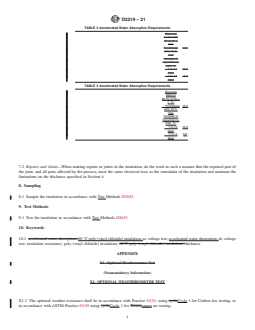
5.5 Accelerated Water Absorption—The insulation shall
...
This document is not an ASTM standard and is intended only to provide the user of an ASTM standard an indication of what changes have been made to the previous version. Because
it may not be technically possible to adequately depict all changes accurately, ASTM recommends that users consult prior editions as appropriate. In all cases only the current version
of the standard as published by ASTM is to be considered the official document.
Designation: D2219 − 17 D2219 − 21
Standard Specification for
Poly(Vinyl Chloride) Insulation for Wire and Cable,
60°C60 °C Operation
This standard is issued under the fixed designation D2219; the number immediately following the designation indicates the year of
original adoption or, in the case of revision, the year of last revision. A number in parentheses indicates the year of last reapproval. A
superscript epsilon (´) indicates an editorial change since the last revision or reapproval.
1. Scope*
1.1 This specification covers a thermoplastic insulation of poly(vinyl chloride) or the copolymer of vinyl chloride and vinyl
acetate.
1.2 This insulation is recommended for use at conductor temperatures not in excess of 60°C 60 °C in wet or dry locations at a
maximum voltage rating of 600 V for power and control circuits.
1.3 In many instances, the insulation material cannot be tested unless it has been formed around a conductor or cable. Therefore,
tests are done on insulated wire or cable in this specification solely to determine the relevant property of the insulation material
and not to test the conductor or completed cable.
1.4 The values stated in inch-pound units are to be regarded as standard. The values given in parentheses are mathematical
conversions to SI units that are provided for information only and are not considered standard.
1.4.1 In some cases (including the title), temperatures are described in degrees Celsius only.
1.5 This international standard was developed in accordance with internationally recognized principles on standardization
established in the Decision on Principles for the Development of International Standards, Guides and Recommendations issued
by the World Trade Organization Technical Barriers to Trade (TBT) Committee.
2. Referenced Documents
2.1 ASTM Standards:
D1711 Terminology Relating to Electrical Insulation
D2633 Test Methods for Thermoplastic Insulations and Jackets for Wire and Cable
D2633D8354 Test Methods for Thermoplastic Insulations and Jackets for Wire and CableMethod for Flammability of Electrical
Insulating Materials Used for Sleeving or Tubing
G153 Practice for Operating Enclosed Carbon Arc Light Apparatus for Exposure of Nonmetallic Materials
G155 Practice for Operating Xenon Arc Light Apparatus for Exposure of Non-Metallic Materials
3. Terminology
3.1 Definitions:
This specification is under the jurisdiction of ASTM Committee D09 on Electrical and Electronic Insulating Materials and is the direct responsibility of Subcommittee
D09.07 on Electrical Insulating Materials.
Current edition approved March 1, 2017Jan. 1, 2021. Published March 2017February 2021. Originally approved in 1963. Last previous edition approved in 20112017 as
D2219 – 11.D2219 – 17. DOI: 10.1520/D2219-17.10.1520/D2219-21.
For referenced ASTM standards, visit the ASTM website, www.astm.org, or contact ASTM Customer Service at service@astm.org. For Annual Book of ASTM Standards
volume information, refer to the standard’s Document Summary page on the ASTM website.
*A Summary of Changes section appears at the end of this standard
Copyright © ASTM International, 100 Barr Harbor Drive, PO Box C700, West Conshohocken, PA 19428-2959. United States
D2219 − 21
3.1.1 For definitions of terms used in this specification, refer to Terminology D1711.
3.2 Definitions of Terms Specific to This Standard:
3.2.1 aging (act of), n—exposure of materials to air or oil at a temperature and a time as specified in Table 1.
TABLE 1 Physical Properties Requirements
Unaged Requirements:
Tensile strength, min, psi (MPa) 1500 (10.3)
Tensile strength, min, psi (MPa) 1500 (10.3)
Elongation at rupture, min, % 100
Elongation at rupture, min, % 100
Aged Requirements:
After air oven test at 100± 1°C for 168 h:
After Air Oven Test at 100 ± 1 °C for 168 h:
Tubular Specimens—up to size AWG 6 (13.3 mm )
Tubular Specimens—Up to size AWG 6 (13.3 mm )
Tensile strength, min, % of unaged value 65
Tensile strength, min, % of unaged value 65
Elongation, min, % of unaged value 65
Elongation, min, % of unaged value 65
Buffed die-cut Specimens—sizes AWG 6 and larger
Buffed Die-cut Specimens—sizes AWG 6 and larger
Tensile strength, min, % of unaged value 65
Tensile strength, min, % of unaged value 65
Elongation, min, % of unaged value 45
Elongation, min, % of unaged value 45
Heat shock, 121 ± 1°C no cracks
Heat Shock, 121 ± 1 °C no cracks
Heat distortion, 121 ± 1°C, max, % 50
Heat Distortion, 121 ± 1 °C, max, % 50
Vertical flame test, after passes
Vertical Flame test, after passes
five 15-s applications
Five 15-s applications in accordance with
Test Method D8354
Oil resistance test:
Oil Resistance Test:
After oil immersion at 70 ± 1°C for 4 h:
After Oil Immersion at 70 ± 1 °C for 4 h:
Tubular Specimens—up to size AWG 6 (13.3 mm )
Tubular Specimens—Up to size AWG 6 (13.3 mm )
Tensile strength, min, % of unaged value 85
Tensile strength, min, % of unaged value 85
Elongation, min, % of unaged value 85
Elongation, min, % of unaged value 85
Buffed die-cut Specimens—sizes AWG 6 and larger
Buffed Sie-cut Specimens—Sizes AWG 6 and larger
Tensile strength, min, % of unaged value 80
Tensile strength, min, % of unaged value 80
Elongation, min, % of unaged value 60
Elongation, min, % of unaged value 60
Cold bend test, -10 ± 1°C for 1 h no cracks
Cold Bend Test, –10 ± 1 °C for 1 h no cracks
4. Physical Properties
4.1 The insulation shall conform to the requirements for physical properties prescribed in Table 1. In terms of this specification,
the act of aging is the response of materials to their exposure to air or oil at a temperature and a time as specified in Table 1. The
vertical flame test shall be conducted in accordance with Test Method D8354.
5. Electrical Requirements
5.1 Perform the ac voltage, insulation resistance, and dc voltage tests in that order when any of these tests are required. The
sequence for other testing is not specified.
5.2 AC Voltage Test—Test the insulated conductor at the ac withstand voltage as specified in Table 2. Unless otherwise specified,
omit this test if the dc withstand voltage test described in 5.4 is performed.
D2219 − 21
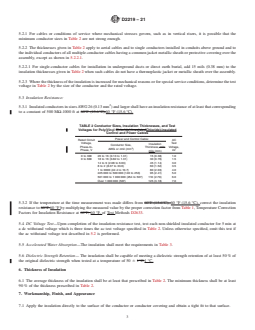
5.2.1 For cables or conditions of service where mechanical stresses govern, such as in vertical risers, it is possible that the
minimum conductor sizes in Table 2 are not strong enough.
5.2.2 The thicknesses given in Table 2 apply to aerial cables and to single conductors installed in conduits above ground and to
the individual conductors of all multiple-conductor c
...