

ASTM F2051-00(2022)
(Specification)Standard Specification for Implantable Saline-Filled Breast Prostheses
General Information
- Abstract
ABSTRACT
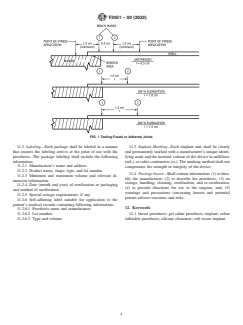
This specification covers the requirements for single use saline inflatable, smooth and textured silicone shell implantable breast prostheses, intended for use in surgical reconstruction, augmentation, or replacement of the breast. This specification does not cover custom fabricated implantable breast prostheses and other gel-saline type implants. The silicone elastomer compositions for use as primary material of construction of the shell including the exterior (tissue contact) surface shall include: (1) polymer types MQ or VMQ, (2) fillers A, B, or C, (3) additive J (for radiopacity), and (4) catalysts B, G, J, or K. The requirements for the following are specified: (1) fabrication including vulcanization and postcure, (2) volume and dimension of saline filled prostheses, (3) fixation sites, and (4) orientation means. The following tests shall be performed: (1) physical property tests such as shell leakage and tension tests (2) biocompatibility test, (3) shell rupture or failure test, (4) valve competence, and (5) abrasion test. The physical property requirements are specified for (1) shell percent elongation, breaking strength, and tensile set, and (2) critical and non-critical fused or adhered joints. Illustrations for testing fused or adhered joints are provided. Requirements for sterilization, packaging, labeling, and package inserts are detailed as well.
SCOPE
1.1 This specification covers the requirements for single-use, saline inflatable, smooth and textured silicone shell implantable breast prostheses intended for use in surgical reconstruction, augmentation, or replacement of the breast.
1.2 Limitations:
1.2.1 This specification does not cover custom fabricated implantable breast prostheses.
1.2.2 This specification does not cover gel/saline type implants, which are within the scope of Specification F703.
1.3 This standard does not purport to address all of the safety concerns, if any, associated with its use. It is the responsibility of the user of this standard to establish appropriate safety, health, and environmental practices and determine the applicability of regulatory limitations prior to use.
1.4 This international standard was developed in accordance with internationally recognized principles on standardization established in the Decision on Principles for the Development of International Standards, Guides and Recommendations issued by the World Trade Organization Technical Barriers to Trade (TBT) Committee.
- Status
- Published
- Publication Date
- 30-Sep-2022
- Technical Committee
- F04 - Medical and Surgical Materials and Devices
- Drafting Committee
- F04.32 - Plastic and Reconstructive Surgery
Overview
ASTM F2051-00(2022) is the internationally recognized standard specification for implantable saline-filled breast prostheses. Developed by ASTM International, this standard outlines essential requirements for single-use, saline inflatable, silicone shell breast implants, including both smooth and textured designs. The prostheses covered by this standard are intended for use in surgical breast reconstruction, augmentation, or replacement procedures.
This standard does not extend to custom fabricated breast implants or gel/saline combination implants, which are addressed under separate standards. Adherence to ASTM F2051 ensures a high level of patient safety, product quality, and regulatory compliance for medical device manufacturers, surgeons, and healthcare facilities.
Key Topics
- Material Requirements: Specifies the use of medical-grade silicone elastomers as the primary construction material for the implant shell. Acceptable polymer and additive types are itemized to ensure structural integrity and biocompatibility.
- Fabrication and Quality Control: Outlines manufacturing processes such as vulcanization and postcure steps, as well as inspection protocols for the prosthesis shell, critical joints, and valves.
- Volume and Dimensions: Mandates clear labeling of the minimum and maximum saline fill volumes, as well as dimensional information, providing guidance for correct surgical selection and use.
- Testing Methods: Establishes comprehensive mechanical and physical tests, including:
- Shell leakage and rupture/failure tests
- Tension and elongation tests
- Valve competence evaluations
- Abrasion resistance (wet and dry methods)
- Biocompatibility: Requires compliance with industry biological testing standards (such as ISO 10993-1 and ASTM F748), including cytotoxicity, sensitization, and implant tests.
- Sterilization and Packaging: Details requirements for pre-sterilization, validated sterilization protocols, packaging that maintains sterility and prevents damage, and thorough labeling for traceability.
- Labeling and Documentation: Ensures each implant and package provides vital information: manufacturer identity, product specifications, lot tracking, sterilization data, and usage instructions.
Applications
ASTM F2051 is crucial for a range of stakeholders in the medical device field:
- Device Manufacturers: Guides the design, material selection, and production of safe, high-quality saline-filled breast implants that meet regulatory and industry standards.
- Healthcare Providers and Surgeons: Offers clear product information and validated test data to inform clinical decisions in breast reconstruction and augmentation surgeries.
- Regulatory Professionals: Supports evidence-based submissions for device approval, postmarket surveillance, and compliance with U.S. FDA and international regulations.
- Quality Assurance Teams: Provides standardized test methods and documentation requirements to ensure ongoing product quality and patient safety.
Adhering to ASTM F2051 enhances confidence in implant performance, supports global trade, and improves patient outcomes by reducing the risk of device failure, leakage, or biocompatibility issues.
Related Standards
ASTM F2051 references and works in conjunction with several other standards and best practices to ensure comprehensive safety and performance:
- ASTM F703: Specification for gel/saline breast prostheses, applicable to combination implants.
- ASTM F748: Practice for selecting biological test methods for materials and devices.
- ISO 10993-1 / ANSI/AAMI/ISO 10993-1: Biological evaluation of medical devices - Part 1: Guidance on selection of tests.
- 21 CFR Part 820: U.S. FDA Quality System Regulation for medical devices.
- AAMI Sterilization Standards: Procedures for ethylene oxide, radiation, and moist heat sterilization validation and routine control.
By referencing these related standards, ASTM F2051 enables harmonization with global best practices for implantable medical devices, supporting product reliability and patient safety in the context of saline-filled breast prostheses.
Keywords: saline-filled breast implants, silicone shell, medical device standard, ASTM F2051, biocompatibility, breast reconstruction, prosthesis testing, implant labeling, sterilization requirements.
Relations
- Effective Date
- 01-Apr-2016
- Effective Date
- 01-Jun-2010
- Effective Date
- 01-Apr-2007
- Effective Date
- 01-Dec-2006
- Effective Date
- 01-May-2004
- Effective Date
- 10-Apr-2003
- Effective Date
- 10-Aug-1998
- Effective Date
- 10-Jun-1996
- Effective Date
- 10-Jun-1996
- Effective Date
- 01-Jan-1996
- Effective Date
- 01-Jan-1995
- Refers
ASTM F604-94 - Specification for Silicone Elastomers Used in Medical Applications (Withdrawn 2001) - Effective Date
- 01-Jan-1994
Get Certified
Connect with accredited certification bodies for this standard

BSI Group
BSI (British Standards Institution) is the business standards company that helps organizations make excellence a habit.

TÜV Rheinland
TÜV Rheinland is a leading international provider of technical services.

TÜV SÜD
TÜV SÜD is a trusted partner of choice for safety, security and sustainability solutions.
Sponsored listings
Frequently Asked Questions
ASTM F2051-00(2022) is a technical specification published by ASTM International. Its full title is "Standard Specification for Implantable Saline-Filled Breast Prostheses". This standard covers: ABSTRACT This specification covers the requirements for single use saline inflatable, smooth and textured silicone shell implantable breast prostheses, intended for use in surgical reconstruction, augmentation, or replacement of the breast. This specification does not cover custom fabricated implantable breast prostheses and other gel-saline type implants. The silicone elastomer compositions for use as primary material of construction of the shell including the exterior (tissue contact) surface shall include: (1) polymer types MQ or VMQ, (2) fillers A, B, or C, (3) additive J (for radiopacity), and (4) catalysts B, G, J, or K. The requirements for the following are specified: (1) fabrication including vulcanization and postcure, (2) volume and dimension of saline filled prostheses, (3) fixation sites, and (4) orientation means. The following tests shall be performed: (1) physical property tests such as shell leakage and tension tests (2) biocompatibility test, (3) shell rupture or failure test, (4) valve competence, and (5) abrasion test. The physical property requirements are specified for (1) shell percent elongation, breaking strength, and tensile set, and (2) critical and non-critical fused or adhered joints. Illustrations for testing fused or adhered joints are provided. Requirements for sterilization, packaging, labeling, and package inserts are detailed as well. SCOPE 1.1 This specification covers the requirements for single-use, saline inflatable, smooth and textured silicone shell implantable breast prostheses intended for use in surgical reconstruction, augmentation, or replacement of the breast. 1.2 Limitations: 1.2.1 This specification does not cover custom fabricated implantable breast prostheses. 1.2.2 This specification does not cover gel/saline type implants, which are within the scope of Specification F703. 1.3 This standard does not purport to address all of the safety concerns, if any, associated with its use. It is the responsibility of the user of this standard to establish appropriate safety, health, and environmental practices and determine the applicability of regulatory limitations prior to use. 1.4 This international standard was developed in accordance with internationally recognized principles on standardization established in the Decision on Principles for the Development of International Standards, Guides and Recommendations issued by the World Trade Organization Technical Barriers to Trade (TBT) Committee.
ABSTRACT This specification covers the requirements for single use saline inflatable, smooth and textured silicone shell implantable breast prostheses, intended for use in surgical reconstruction, augmentation, or replacement of the breast. This specification does not cover custom fabricated implantable breast prostheses and other gel-saline type implants. The silicone elastomer compositions for use as primary material of construction of the shell including the exterior (tissue contact) surface shall include: (1) polymer types MQ or VMQ, (2) fillers A, B, or C, (3) additive J (for radiopacity), and (4) catalysts B, G, J, or K. The requirements for the following are specified: (1) fabrication including vulcanization and postcure, (2) volume and dimension of saline filled prostheses, (3) fixation sites, and (4) orientation means. The following tests shall be performed: (1) physical property tests such as shell leakage and tension tests (2) biocompatibility test, (3) shell rupture or failure test, (4) valve competence, and (5) abrasion test. The physical property requirements are specified for (1) shell percent elongation, breaking strength, and tensile set, and (2) critical and non-critical fused or adhered joints. Illustrations for testing fused or adhered joints are provided. Requirements for sterilization, packaging, labeling, and package inserts are detailed as well. SCOPE 1.1 This specification covers the requirements for single-use, saline inflatable, smooth and textured silicone shell implantable breast prostheses intended for use in surgical reconstruction, augmentation, or replacement of the breast. 1.2 Limitations: 1.2.1 This specification does not cover custom fabricated implantable breast prostheses. 1.2.2 This specification does not cover gel/saline type implants, which are within the scope of Specification F703. 1.3 This standard does not purport to address all of the safety concerns, if any, associated with its use. It is the responsibility of the user of this standard to establish appropriate safety, health, and environmental practices and determine the applicability of regulatory limitations prior to use. 1.4 This international standard was developed in accordance with internationally recognized principles on standardization established in the Decision on Principles for the Development of International Standards, Guides and Recommendations issued by the World Trade Organization Technical Barriers to Trade (TBT) Committee.
ASTM F2051-00(2022) is classified under the following ICS (International Classification for Standards) categories: 11.040.40 - Implants for surgery, prosthetics and orthotics. The ICS classification helps identify the subject area and facilitates finding related standards.
ASTM F2051-00(2022) has the following relationships with other standards: It is inter standard links to ASTM F748-16, ASTM F748-06(2010), ASTM F703-07, ASTM F748-06, ASTM F748-04, ASTM F1251-89(2003), ASTM F748-98, ASTM F703-96(2002), ASTM F703-96(2002)e1, ASTM F703-96, ASTM F1251-89(1995), ASTM F604-94. Understanding these relationships helps ensure you are using the most current and applicable version of the standard.
ASTM F2051-00(2022) is available in PDF format for immediate download after purchase. The document can be added to your cart and obtained through the secure checkout process. Digital delivery ensures instant access to the complete standard document.
Standards Content (Sample)
This international standard was developed in accordance with internationally recognized principles on standardization established in the Decision on Principles for the
Development of International Standards, Guides and Recommendations issued by the World Trade Organization Technical Barriers to Trade (TBT) Committee.
Designation: F2051 −00 (Reapproved 2022)
Standard Specification for
Implantable Saline-Filled Breast Prostheses
This standard is issued under the fixed designation F2051; the number immediately following the designation indicates the year of
original adoption or, in the case of revision, the year of last revision.Anumber in parentheses indicates the year of last reapproval.A
superscript epsilon (´) indicates an editorial change since the last revision or reapproval.
1. Scope F703Specification for Implantable Breast Prostheses
F748PracticeforSelectingGenericBiologicalTestMethods
1.1 This specification covers the requirements for single-
for Materials and Devices
use, saline inflatable, smooth and textured silicone shell
F1251Terminology Relating to Polymeric Biomaterials in
implantable breast prostheses intended for use in surgical
Medical and Surgical Devices (Withdrawn 2012)
reconstruction, augmentation, or replacement of the breast.
2.2 Other Documents:
1.2 Limitations:
USP(United States Pharmacopeia)
1.2.1 This specification does not cover custom fabricated
Federal RegisterTitle 21, Part 820
implantable breast prostheses.
Association for the Advancement of Medical Instrumenta-
1.2.2 This specification does not cover gel/saline type
tion
implants, which are within the scope of Specification F703.
ANSI/AAMI/ISO 10993-1Biological Testing of Medical
1.3 This standard does not purport to address all of the
and Dental Materials and Devices—Part 1: Guidance on
safety concerns, if any, associated with its use. It is the
Selection of Tests
responsibility of the user of this standard to establish appro-
ANSI/AAMI/ST50-1995Dry Heat (Heated Air) Sterilizers
priate safety, health, and environmental practices and deter-
ANSI/AAMI/ISO11135-1994MedicalDevices—Validation
mine the applicability of regulatory limitations prior to use.
and Routine Control of Ethylene Oxide Sterilization
1.4 This international standard was developed in accor-
ANSI/AAMI/ISO 11137-1994Sterilization of Health Care
dance with internationally recognized principles on standard-
Products—Requirements for Validation and Routine and
ization established in the Decision on Principles for the
Routine Control—Radiation Sterilization
Development of International Standards, Guides and Recom-
ANSI/AAMI/ISO 11134-1993Sterilization of Health Care
mendations issued by the World Trade Organization Technical
Products—Requirements for Validation and Routine
Barriers to Trade (TBT) Committee.
Control—Industrial Moist Heat Sterilization
Parenteral Drug Association1981 Technical Report No. 3,
2. Referenced Documents
Validation of Dry Heat Processes Used for Sterilization
2.1 ASTM Standards:
and Depyrogenation
D412TestMethodsforVulcanizedRubberandThermoplas-
FDADraft Guidance for Preparation of PMA Applications
tic Elastomers—Tension
for Silicone Inflatable (Saline) Breast Prostheses
D1349Practice for Rubber—Standard Conditions for Test-
ing 3. Terminology
D3389Test Method for Coated FabricsAbrasion Resistance
3.1 Definitions:
(Rotary Platform Abrader)
F604Specification for Silicone Elastomers Used in Medical
Applications (Withdrawn 2001)
United States Pharmacopeia, Vol XXI, Mack Publishing Company, Easton, PA
1989. Available from Pharmacopeia Convention, Inc., 12601 Twinbrook Parkway,
Rockville, NC 00852.
1 5
This specification is under the jurisdiction of ASTM Committee F04 on Federal Register,Vol 43, No. 141, Friday, July 21, 1978 Part II.Available from
Medical and Surgical Materials and Devices and is the direct responsibility of U.S. Government Printing Office Superintendent of Documents, 732 N. Capitol St.,
Subcommittee F04.32 on Plastic and Reconstructive Surgery. NW, Mail Stop: SDE, Washington, DC 20401, http://www.access.gpo.gov.
Current edition approved Oct. 1, 2022. Published October 2022. Originally Available from Association for the Advancement of Medical Instrumentation
approved in 2000. Last previous edition approved in 2014 as F2051–00 (2014). (AAMI), 1110 N. Glebe Rd., Suite 220, Arlington, VA 22201-4795. http://
DOI: 10.1520/F2051-00R22. www.aami.org.
2 7
For referenced ASTM standards, visit the ASTM website, www.astm.org, or Available fromAmerican National Standards Institute (ANSI), 25 W. 43rd St.,
contact ASTM Customer Service at service@astm.org. For Annual Book of ASTM 4th Floor, New York, NY 10036, http://www.ansi.org.
Standards volume information, refer to the standard’s Document Summary page on Available from Parenteral Drug Association (PDA), Bethesda Towers, 4350
the ASTM website. East West Hwy., Suite 200, Bethesda, MD 20814. http://www.pda.org.
3 9
The last approved version of this historical standard is referenced on Available from Food and Drug Administration (FDA), 5600 Fishers Ln.,
www.astm.org. Rockville, MD 20857, http://www.fda.gov.
Copyright © ASTM International, 100 Barr Harbor Drive, PO Box C700, West Conshohocken, PA 19428-2959. United States
F2051 − 00 (2022)
3.1.1 fused or adhered joints (seams)—sites in the shell or intended applications. When new information becomes avail-
other parts of implantable breast prosthesis where materials able or changes in state-of-the-art science and technology
have been joined (fused or bonded) together, with or without occur and relevance to subject prostheses has been established
adhesive, as part of the manufacturing process. by valid science, it is intended that this specification will be
revised in accordance with ASTM guidelines.
3.1.2 inflatable breast prosthesis—implantable breast pros-
thesisnotcontainingsiliconegel;implantablebreastprosthesis
5. Materials
designed and provided prefilled with saline or empty and to be
5.1 Silicone Elastomer—Select and specify elastomers for
filled with saline at the time of use to adjust the volume of the
use in implantable breast prostheses in keeping with Specifi-
prosthesis.
cation F604.
3.1.2.1 type 1, fixed volume inflatable breast prosthesis—an
5.1.1 Shell—The following describes suitable silicone elas-
implantable breast prosthesis composed of a single lumen,
tomer compositions for use as the primary material of con-
emptywhensuppliedandhavingavalvetofacilitatefillingthe
struction of the shell including the exterior (tissue contact)
lumen with saline at the time of use.
surface:
3.1.2.2 type 2, variable volume inflatable breast
polymer types MQ or VMQ
prosthesis—an implantable breast prosthesis composed of a
fillers A, B, or C
additive J (for radiopacity)
single lumen, empty when supplied and having a valve to
catalysts B, G, J, or K
facilitate filling the lumen with a portion of the volume of
NOTE 1—The compositions listed in this section are not intended to
saline at the time of use. The valve system is designed to
limit the compositions that may be used providing all other requirements
facilitate further post-operative adjustment with saline as
of this specification are satisfied.
instructed in product literature.
5.1.2 Fabrication—Fabrication techniques must necessarily
3.1.2.3 type 3, fixed volume inflatable breast prosthesis—an
be dependent on the type of elastomer, the portion of an
implantable breast prosthesis composed of a single lumen,
implantable breast prosthesis fabricated, its shape, location,
prefilled with saline by the manufacturer prior to time of use.
and function on the prosthesis.
3.1.3 lumen—a cavity within a shell of an implantable
5.1.3 Vulcanization and Postcure—Timeandtemperatureof
breast prosthesis. Inflatable lumens are accessible by valve to
vulcanizationandpostcuremustbeadjustedwithconsideration
facilitate the addition of saline to adjust the volume of the
of the elastomer type and the multi-step fabrication require-
prosthesis at the time of use.
ments of specific prostheses. Final postcure is typically done
3.1.4 orientation means—any mark or palpable portion of only after the shell or shells and all other portions have been
completely assembled. Time and temperature of final postcure
an implantable breast prosthesis to assist the surgeon in
positioning the implant. shall be adequate to drive the chemistry of vulcanization of all
elastomertocompletionandremoveby-productsofthecurein
3.1.5 saline—only sodium chloride for injection (USP) is
keeping with the chemical stoichiometry of the specific cure
recommended for filling lumens of inflatable breast prosthesis.
system (e.g., after postcure no additional vulcanization should
3.1.6 shell—a silicone elastomer continuous layer or mem-
occurwhenheatedadditionallyatrecommendedcuretempera-
branecontainer(sac)whichenclosesalumenofanimplantable
ture).
breast prosthesis.
5.1.4 Physical Property Testing and Requirements—
3.1.7 silicone elastomer—an elastomer containing cross-
Silicone elastomer shells shall demonstrate an acceptable
linked silicone polymer and fumed amorphous (non-
response in physical property tests. Prostheses for testing
crystalline) silica as a reinforcing filler.
should be selected from standard production batches which
3.1.8 valve—sealableorself-sealingopeninginaninflatable have gone through all manufacturing processes, including
sterilization.
prosthesis,extendingfromtheexteriorsurfaceoftheshellinto
a lumen, designed to facilitate addition of saline at the time of 5.1.4.1 Specimen Preparation—Cut required tests speci-
mens from shells with Test Method D412 dies. Devices or
use or postoperatively to adjust prosthesis volume.
specimensshallbeconditionedbeforetestingforatleast1hat
3.1.9 patch—apieceofsiliconeelastomerwhichcoversand
23 6 2°C (73.4 6 3.6°F).
seals the hole which results from the manufacturing process of
5.1.4.2 Dimension—The individual shape, range of volume
shell fabrication.
(displacement), base size, and anterior projection are deter-
4. Significance and Use
mined by the manufacturer.
4.1 This specification contains requirements based on state-
6. Volume and Dimensions
of-the-art science and technology as applicable to various
6.1 Volumes of Prostheses:
considerations that have been identified as important to ensure
6.1.1 Saline Inflatable Prostheses—The designed or mini-
reasonable safety and efficacy as it relates to the biocompat-
mum and maximum recommended volume of saline fill shall
ibility and the mechanical integrity of the device components
be listed in instructions for use.
in implantable breast prostheses.
4.1.1 This specification is not intended to limit the science 6.2 Dimensions—Therangesofshapes,volumes,basesizes,
and technology that may be considered and applied to ensure and anterior projections are determined by the manufacturer.
performance characteristics of subject breast prostheses in Pertinent information shall be contained in the package insert.
F2051 − 00 (2022)
7. Fixation Sites 9.2.3.3 Tensile Set—The tensile set shall be <10%, deter-
mine in accordance withTest MethodD412. Determine tensile
7.1 Thepresenceoffixationsitesonanytypeofimplantable
at 300 % elongation, stress the specimen for 3 min, then allow
breastprosthesisisoptional.Whenused,thesizeandlocations
3 min for relaxation.
of fixation sites shall be clearly stated in instructions for use.
9.2.3.4 Fused or Adhered Joined—Requirements for ad-
heredorfusedsiliconerubbermaterialsshallbecriticaltotheir
8. Orientation Means
integrity.
8.1 Orientation means are optional features of subject pros-
(1) Critical Fused or Adhered Joints—Joints or seams that
theses. When orientation means are claimed, the location and
are critical to the integrity of the prosthesis envelope shall not
recommended techniques for use shall be clearly described in
fail when the shell adjacent to the joint is stressed to 200%
instructions for use.
elongation for 10s (see Fig. 1).
(2) Noncritical Fused or Adhered Joints—Fused joints or
9. Test Methods and Requirements
seams that are bonded to the prosthesis envelope but are not
critical to the envelope integrity (fixation sites, orientation
9.1 Biocompatibility:
means, valve covers, and so forth) shall not fail when the shell
9.1.1 Practice F748—New or existing materials shall be in
adjacent to the joint is stressed to 100 % elongation for 10s
compliance with Practice F748 or other accepted standards
(see Fig. 1).
such as ISO/AAMI/ANSI 10993-1. Assays recommended by
9.3 Shell Rupture/Failure Testing—No standard test for
Practice F748 include cell culture cytotoxicity assays; short-
assessingshellrupturehasyetbeendeveloped.Whensuchtest
term intramuscular implantation assay; short-term subcutane-
method has been developed it will be added to this specifica-
ous assay; carcinogenicity; long-term implant test; systemic
tion.
injection (acute toxicity) assay; sensitization assay; mutagen-
icity; and pyrogenicity.
9.4 Valve Competence:
9.1.2 Silicone Saline-Filled Prostheses—Test specimens for
9.4.1 Test Method—Prior to testing, manipulate valve to
chronic implantation assays (carcinogenicity and long-term
duplicate its use for filling and inflate prosthesis with saline as
implanttests)shallbefabricatedfromthesamecombinationof
described in instructions for use. Test such manipulated valve
silicone elastomer and by the same or similar procedures and
at both high and low retrograde pressures. Use air or other
conditions used in fabricating prostheses. The thickness of
suitable gas, distilled water, or isotonic saline as test media.
shell in specimens shall be typical of thickness used in
Pressures in order to be tested are 30 cm and 3 cm H O
prostheses.
pressure, respectively. Maintain each test pressure for 5 min.
9.1.3 Prior Biocompatibility Assays—When prior biocom-
When air or other suitable gases are tested, immediately
patibility data are available for silicone elastomer in
...