

ASTM D7702/D7702M-14(2021)
(Guide)Standard Guide for Considerations When Evaluating Direct Shear Results Involving Geosynthetics
General Information
- Abstract
SIGNIFICANCE AND USE
4.1 The shear strength of soil-geosynthetic interfaces and geosynthetic-geosynthetic interfaces is a critical design parameter for many civil engineering projects, including, but not limited to: waste containment systems, mining applications, dam designs involving geosynthetics, mechanically stabilized earth structures, reinforced soil slopes, and liquid impoundments. Since geosynthetic interfaces often serve as a weak plane on which sliding may occur, shear strengths of these interfaces are needed to assess the stability of earth materials resting on these interfaces, such as a waste mass or ore body over a lining system or the ability of a final cover to remain on a slope. Accordingly, project-specific shear testing using representative materials under conditions similar to those expected in the field is recommended for final design. Shear strengths of geosynthetic interfaces are obtained by either Test Method D5321/D5321M (geosynthetics) or D6243/D6243M (geosynthetic clay liners). This guide touches upon some of the issues that should be considered when evaluating shear strength data. Because of the large number of potential conditions that could exist, there may be other conditions not identified in this guide that could affect interpretation of the results. The seemingly infinite combinations of soils, geosynthetics, hydration and wetting conditions, normal load distributions, strain rates, creep, pore pressures, etc., will always require individual engineering evaluations by qualified practitioners. Along the same lines, the list of references provided in this guide is not exhaustive, nor are the findings and suggestions of any particular reference meant to be considered conclusive. The references and their related findings are presented herein only as examples available in the literature of the types of considerations that others have found useful when evaluating direct shear test results.
4.2 The figures included in this guide are only examples intended t...
SCOPE
1.1 This guide presents a summary of available information related to the evaluation of direct shear test results involving geosynthetic materials.
1.2 This guide is intended to assist designers and users of geosynthetics. This guide is not intended to replace education or experience and should only be used in conjunction with professional judgment. This guide is not intended to represent or replace the standard of care by which the adequacy of a given professional service must be judged, nor should this document be applied without consideration of a project’s many unique aspects. Not all aspects of this practice may be applicable in all circumstances. The word “Standard” in the title of this document means only that the document has been approved through the ASTM consensus process.
1.3 This guide is applicable to soil-geosynthetic and geosynthetic-geosynthetic direct shear test results, obtained using either Test Method D5321/D5321M or D6243/D6243M.
1.4 This guide does not address selection of peak or large-displacement shear strength values for design. References on this topic include Thiel (1),2 Gilbert (2), Koerner and Bowman (3), and Stark and Choi (4).
1.5 The values stated in either SI units or inch-pound units are to be regarded separately as standard. The values stated in each system are not necessarily exact equivalents; therefore, to ensure conformance with the standard, each system shall be used independently of the other, and values from the two systems shall not be combined.
1.6 This standard does not purport to address all of the safety concerns, if any, associated with its use. It is the responsibility of the user of this standard to establish appropriate safety, health, and environmental practices and determine the applicability of regulatory limitations prior to use.
1.7 This international standard was developed in accordance with internationally recognized principles on standardizatio...
- Status
- Published
- Publication Date
- 31-Jul-2021
- Technical Committee
- D35 - Geosynthetics
- Drafting Committee
- D35.04 - Geosynthetic Clay Liners
Overview
ASTM D7702/D7702M-14(2021), Standard Guide for Considerations When Evaluating Direct Shear Results Involving Geosynthetics, is a comprehensive reference developed by ASTM International. This standard offers guidance for interpreting direct shear test data relating to soil-geosynthetic and geosynthetic-geosynthetic interfaces. The shear strength of these interfaces is a critical parameter in civil and geotechnical engineering, especially when designing and evaluating structures such as waste containment systems, mining facilities, dams, reinforced soil slopes, mechanically stabilized earth structures, and liquid impoundments.
Given that geosynthetic interfaces often serve as potential slip planes, it is vital to accurately evaluate their shear strength using relevant direct shear test methods (such as ASTM D5321/D5321M and D6243/D6243M). ASTM D7702/D7702M provides important considerations and issues to be addressed during the testing and data interpretation process, helping engineers ensure the integrity and safety of their designs.
Key Topics
- Shear Strength Evaluation: Guidance on the significance of shear strength at soil-geosynthetic and geosynthetic-geosynthetic interfaces, including best practices for laboratory testing.
- Direct Shear Testing: Recommendations for conducting project-specific shear testing under representative field conditions, and interpreting results using methods like ASTM D5321/D5321M and D6243/D6243M.
- Interpretation of Test Data: Discussion on interpreting peak versus post-peak (large displacement) shear strength values, understanding Mohr-Coulomb parameters (cohesion and friction angle), and caution against extrapolating outside the tested normal stress range.
- Practical Considerations: Importance of reviewing shear-displacement curves for understanding failure modes (brittle vs. ductile behavior), ensuring quality tests, and identifying specimen or test setup issues.
- Variability and Project Specificity: Acknowledgement of the variability inherent in geosynthetic materials, soils, hydration conditions, strain rates, and other field and lab parameters. Emphasis on the need for engineering judgement and case-by-case evaluation.
- Reporting and Documentation: Best practices for summarizing and reporting direct shear test results to support design and construction documentation.
Applications
ASTM D7702/D7702M serves a broad range of geotechnical and civil engineering applications where geosynthetics are used to contain, reinforce, protect, or stabilize soils and waste materials. Typical uses include:
- Waste Containment Systems: Landfills, hazardous waste facilities, and environmental protection barriers where geosynthetics form critical containment layers.
- Mining Applications: Heap leach pads, tailings dams, and other mining earthworks requiring stable containment over geosynthetic liners.
- Dams and Impoundments: Design and analysis of water retention structures involving geosynthetic clay liners (GCLs) or geomembranes.
- Reinforced Soil Slopes and Mechanically Stabilized Earth (MSE) Structures: Stability analysis of slopes and retaining walls that utilize geotextile or geogrid reinforcement layers.
- Slope Stability: Assessment of potential slip surfaces in natural and engineered slopes where weak geosynthetic interfaces are present.
By following the guidance in this ASTM standard, designers and engineers can better ensure the safety, reliability, and performance of geosynthetic applications under project-specific loading and environmental conditions.
Related Standards
- ASTM D5321/D5321M: Standard Test Method for Determining the Shear Strength of Soil-Geosynthetic and Geosynthetic-Geosynthetic Interfaces by Direct Shear.
- ASTM D6243/D6243M: Standard Test Method for Determining the Internal and Interface Shear Strength of Geosynthetic Clay Liner by the Direct Shear Method.
- ASTM D653: Terminology Relating to Soil, Rock, and Contained Fluids.
- ASTM D4439: Terminology for Geosynthetics.
These standards work in conjunction to provide a complete framework for geosynthetic direct shear testing and data interpretation, supporting the implementation of ASTM D7702/D7702M in geotechnical engineering projects.
Keywords: ASTM D7702, geosynthetics, direct shear, shear strength, soil-geosynthetic interface, geotechnical engineering, slope stability, waste containment, test methods, civil engineering.
Relations
- Effective Date
- 01-Feb-2024
- Effective Date
- 15-Mar-2020
- Effective Date
- 01-Jul-2019
- Effective Date
- 15-Apr-2018
- Effective Date
- 01-Aug-2017
- Effective Date
- 01-Jun-2017
- Effective Date
- 01-Jan-2016
- Effective Date
- 01-Sep-2015
- Effective Date
- 01-Jul-2015
- Effective Date
- 01-Aug-2014
- Effective Date
- 01-Mar-2014
- Effective Date
- 01-Jan-2014
- Effective Date
- 23-Aug-2013
- Effective Date
- 01-Jul-2013
- Effective Date
- 01-Oct-2011
Get Certified
Connect with accredited certification bodies for this standard

Control Union Certifications
Global certification for agriculture and sustainability.

Hohenstein Institut
Textile testing and certification.

Bureau Veritas Bangladesh
Bureau Veritas certification services in Bangladesh.
Sponsored listings
Frequently Asked Questions
ASTM D7702/D7702M-14(2021) is a guide published by ASTM International. Its full title is "Standard Guide for Considerations When Evaluating Direct Shear Results Involving Geosynthetics". This standard covers: SIGNIFICANCE AND USE 4.1 The shear strength of soil-geosynthetic interfaces and geosynthetic-geosynthetic interfaces is a critical design parameter for many civil engineering projects, including, but not limited to: waste containment systems, mining applications, dam designs involving geosynthetics, mechanically stabilized earth structures, reinforced soil slopes, and liquid impoundments. Since geosynthetic interfaces often serve as a weak plane on which sliding may occur, shear strengths of these interfaces are needed to assess the stability of earth materials resting on these interfaces, such as a waste mass or ore body over a lining system or the ability of a final cover to remain on a slope. Accordingly, project-specific shear testing using representative materials under conditions similar to those expected in the field is recommended for final design. Shear strengths of geosynthetic interfaces are obtained by either Test Method D5321/D5321M (geosynthetics) or D6243/D6243M (geosynthetic clay liners). This guide touches upon some of the issues that should be considered when evaluating shear strength data. Because of the large number of potential conditions that could exist, there may be other conditions not identified in this guide that could affect interpretation of the results. The seemingly infinite combinations of soils, geosynthetics, hydration and wetting conditions, normal load distributions, strain rates, creep, pore pressures, etc., will always require individual engineering evaluations by qualified practitioners. Along the same lines, the list of references provided in this guide is not exhaustive, nor are the findings and suggestions of any particular reference meant to be considered conclusive. The references and their related findings are presented herein only as examples available in the literature of the types of considerations that others have found useful when evaluating direct shear test results. 4.2 The figures included in this guide are only examples intended t... SCOPE 1.1 This guide presents a summary of available information related to the evaluation of direct shear test results involving geosynthetic materials. 1.2 This guide is intended to assist designers and users of geosynthetics. This guide is not intended to replace education or experience and should only be used in conjunction with professional judgment. This guide is not intended to represent or replace the standard of care by which the adequacy of a given professional service must be judged, nor should this document be applied without consideration of a project’s many unique aspects. Not all aspects of this practice may be applicable in all circumstances. The word “Standard” in the title of this document means only that the document has been approved through the ASTM consensus process. 1.3 This guide is applicable to soil-geosynthetic and geosynthetic-geosynthetic direct shear test results, obtained using either Test Method D5321/D5321M or D6243/D6243M. 1.4 This guide does not address selection of peak or large-displacement shear strength values for design. References on this topic include Thiel (1),2 Gilbert (2), Koerner and Bowman (3), and Stark and Choi (4). 1.5 The values stated in either SI units or inch-pound units are to be regarded separately as standard. The values stated in each system are not necessarily exact equivalents; therefore, to ensure conformance with the standard, each system shall be used independently of the other, and values from the two systems shall not be combined. 1.6 This standard does not purport to address all of the safety concerns, if any, associated with its use. It is the responsibility of the user of this standard to establish appropriate safety, health, and environmental practices and determine the applicability of regulatory limitations prior to use. 1.7 This international standard was developed in accordance with internationally recognized principles on standardizatio...
SIGNIFICANCE AND USE 4.1 The shear strength of soil-geosynthetic interfaces and geosynthetic-geosynthetic interfaces is a critical design parameter for many civil engineering projects, including, but not limited to: waste containment systems, mining applications, dam designs involving geosynthetics, mechanically stabilized earth structures, reinforced soil slopes, and liquid impoundments. Since geosynthetic interfaces often serve as a weak plane on which sliding may occur, shear strengths of these interfaces are needed to assess the stability of earth materials resting on these interfaces, such as a waste mass or ore body over a lining system or the ability of a final cover to remain on a slope. Accordingly, project-specific shear testing using representative materials under conditions similar to those expected in the field is recommended for final design. Shear strengths of geosynthetic interfaces are obtained by either Test Method D5321/D5321M (geosynthetics) or D6243/D6243M (geosynthetic clay liners). This guide touches upon some of the issues that should be considered when evaluating shear strength data. Because of the large number of potential conditions that could exist, there may be other conditions not identified in this guide that could affect interpretation of the results. The seemingly infinite combinations of soils, geosynthetics, hydration and wetting conditions, normal load distributions, strain rates, creep, pore pressures, etc., will always require individual engineering evaluations by qualified practitioners. Along the same lines, the list of references provided in this guide is not exhaustive, nor are the findings and suggestions of any particular reference meant to be considered conclusive. The references and their related findings are presented herein only as examples available in the literature of the types of considerations that others have found useful when evaluating direct shear test results. 4.2 The figures included in this guide are only examples intended t... SCOPE 1.1 This guide presents a summary of available information related to the evaluation of direct shear test results involving geosynthetic materials. 1.2 This guide is intended to assist designers and users of geosynthetics. This guide is not intended to replace education or experience and should only be used in conjunction with professional judgment. This guide is not intended to represent or replace the standard of care by which the adequacy of a given professional service must be judged, nor should this document be applied without consideration of a project’s many unique aspects. Not all aspects of this practice may be applicable in all circumstances. The word “Standard” in the title of this document means only that the document has been approved through the ASTM consensus process. 1.3 This guide is applicable to soil-geosynthetic and geosynthetic-geosynthetic direct shear test results, obtained using either Test Method D5321/D5321M or D6243/D6243M. 1.4 This guide does not address selection of peak or large-displacement shear strength values for design. References on this topic include Thiel (1),2 Gilbert (2), Koerner and Bowman (3), and Stark and Choi (4). 1.5 The values stated in either SI units or inch-pound units are to be regarded separately as standard. The values stated in each system are not necessarily exact equivalents; therefore, to ensure conformance with the standard, each system shall be used independently of the other, and values from the two systems shall not be combined. 1.6 This standard does not purport to address all of the safety concerns, if any, associated with its use. It is the responsibility of the user of this standard to establish appropriate safety, health, and environmental practices and determine the applicability of regulatory limitations prior to use. 1.7 This international standard was developed in accordance with internationally recognized principles on standardizatio...
ASTM D7702/D7702M-14(2021) is classified under the following ICS (International Classification for Standards) categories: 59.080.70 - Geotextiles. The ICS classification helps identify the subject area and facilitates finding related standards.
ASTM D7702/D7702M-14(2021) has the following relationships with other standards: It is inter standard links to ASTM D4439-24, ASTM D6243/D6243M-20, ASTM D5321/D5321M-19, ASTM D4439-18, ASTM D4439-17, ASTM D5321/D5321M-17, ASTM D6243/D6243M-16, ASTM D4439-15a, ASTM D4439-15, ASTM D653-14, ASTM D4439-14, ASTM D5321/D5321M-14, ASTM D5321/D5321M-13, ASTM D6243/D6243M-13a, ASTM D4439-11. Understanding these relationships helps ensure you are using the most current and applicable version of the standard.
ASTM D7702/D7702M-14(2021) is available in PDF format for immediate download after purchase. The document can be added to your cart and obtained through the secure checkout process. Digital delivery ensures instant access to the complete standard document.
Standards Content (Sample)
This international standard was developed in accordance with internationally recognized principles on standardization established in the Decision on Principles for the
Development of International Standards, Guides and Recommendations issued by the World Trade Organization Technical Barriers to Trade (TBT) Committee.
Designation: D7702/D7702M − 14 (Reapproved 2021)
Standard Guide for
Considerations When Evaluating Direct Shear Results
Involving Geosynthetics
This standard is issued under the fixed designation D7702/D7702M; the number immediately following the designation indicates the
year of original adoption or, in the case of revision, the year of last revision. A number in parentheses indicates the year of last
reapproval. A superscript epsilon (´) indicates an editorial change since the last revision or reapproval.
1. Scope 1.7 This international standard was developed in accor-
dance with internationally recognized principles on standard-
1.1 This guide presents a summary of available information
ization established in the Decision on Principles for the
related to the evaluation of direct shear test results involving
Development of International Standards, Guides and Recom-
geosynthetic materials.
mendations issued by the World Trade Organization Technical
1.2 This guide is intended to assist designers and users of
Barriers to Trade (TBT) Committee.
geosynthetics. This guide is not intended to replace education
or experience and should only be used in conjunction with 2. Referenced Documents
professional judgment. This guide is not intended to represent
2.1 ASTM Standards:
or replace the standard of care by which the adequacy of a
D653 Terminology Relating to Soil, Rock, and Contained
given professional service must be judged, nor should this
Fluids
document be applied without consideration of a project’s many
D4439 Terminology for Geosynthetics
unique aspects. Not all aspects of this practice may be
D5321/D5321M Test Method for Determining the Shear
applicable in all circumstances. The word “Standard” in the
Strength of Soil-Geosynthetic and Geosynthetic-
title of this document means only that the document has been
Geosynthetic Interfaces by Direct Shear
approved through the ASTM consensus process.
D6243/D6243M Test Method for Determining the Internal
1.3 This guide is applicable to soil-geosynthetic and
and Interface Shear Strength of Geosynthetic Clay Liner
geosynthetic-geosynthetic direct shear test results, obtained by the Direct Shear Method
using either Test Method D5321/D5321M or D6243/D6243M.
3. Terminology
1.4 This guide does not address selection of peak or
3.1 Definitions—For definitions of terms relating to soil and
large-displacement shear strength values for design. Refer-
rock, refer to Terminology D653. For definitions of terms
ences on this topic include Thiel (1), Gilbert (2), Koerner and
relating to geosynthetics and GCLs, refer to Terminology
Bowman (3), and Stark and Choi (4).
D4439.
1.5 The values stated in either SI units or inch-pound units
3.2 Definitions of Terms Specific to This Standard:
are to be regarded separately as standard. The values stated in
3.2.1 adhesion, c or c, n—the y-intercept of the Mohr-
each system are not necessarily exact equivalents; therefore, to a
Coulomb shear strength envelope; the component of shear
ensure conformance with the standard, each system shall be
strength indicated by the term c , in Coulomb’s equation, τ =
used independently of the other, and values from the two a
c + σ tan δ.
systems shall not be combined. a
3.2.2 failure envelope, n—curvi-linear line on the shear
1.6 This standard does not purport to address all of the
stress-normal stress plot representing the combination of shear
safety concerns, if any, associated with its use. It is the
and normal stresses that define a selected shear failure criterion
responsibility of the user of this standard to establish appro-
(for example, peak and post-peak). Also referred to as shear
priate safety, health, and environmental practices and deter-
strength envelope.
mine the applicability of regulatory limitations prior to use.
3.2.3 Mohr-Coulomb friction angle δ,n—angle of friction
of a material or between two materials (degrees), the angle
This guide is under the jurisdiction ofASTM Committee D35 on Geosynthetics
defined by the least-squares, “best-fit” straight line through a
and is the direct responsibility of Subcommittee D35.04 on Geosynthetic Clay
Liners.
Current edition approved Aug. 1, 2021. Published August 2021. Originally
approved in 2011. Last previous edition approved in 2014 as D7702_D7702 – 14. For referenced ASTM standards, visit the ASTM website, www.astm.org, or
DOI:10.1520/D7702_D7702M-14R21. contact ASTM Customer Service at service@astm.org. For Annual Book of ASTM
The boldface numbers in parentheses refer to a list of references at the end of Standards volume information, refer to the standard’s Document Summary page on
this standard. the ASTM website.
Copyright © ASTM International, 100 Barr Harbor Drive, PO Box C700, West Conshohocken, PA 19428-2959. United States
D7702/D7702M − 14 (2021)
defined section of the shear strength-normal stress failure infinite combinations of soils, geosynthetics, hydration and
envelope; the component of the shear strength indicated by the wetting conditions, normal load distributions, strain rates,
term δ, in Coulomb’s equation, τ = c + σ tan δ.
creep, pore pressures, etc., will always require individual
engineering evaluations by qualified practitioners. Along the
3.2.4 Mohr-Coulomb shear strength envelope, n—the least-
squares, “best-fit” straight line through a defined section of the same lines, the list of references provided in this guide is not
shear strength-normal stress failure envelope described in the exhaustive, nor are the findings and suggestions of any
equation τ = c + σ tan δ. The envelope can be described for
particular reference meant to be considered conclusive. The
a
any chosen shear failure criteria (for example, peak, post-peak,
references and their related findings are presented herein only
or residual).
as examples available in the literature of the types of consid-
erations that others have found useful when evaluating direct
3.2.5 secant friction angle, δ ,n—(degrees) the angle
sec
defined by a line drawn from the origin to a data point on the shear test results.
shear strength-normal stress failure envelope. Intended to be
4.2 The figures included in this guide are only examples
used only at the shearing normal stress for which it is defined.
intended to demonstrate selected concepts related to direct
3.2.6 shear strength, τ,n—the shear force on a given failure
shear testing of geosynthetics. The values shown in the figures
plane. In the direct shear test it is always stated in relation to
may not be representative and should not be used for design
the normal stress acting on the failure plane. Two different
purposes. Site-specific and material-specific tests should al-
types of shear strengths are often estimated and used in
ways be performed.
standard practice:
3.2.6.1 peak shear strength, n—the largest value of shear
5. Shear Strength Fundamentals
resistance experienced during the test under a given normal
stress. 5.1 Mohr first presented a theory for shear failure, showing
that a material experiences failure at a critical combination of
3.2.6.2 post-peak shear strength, n—the minimum, or
normal and shear stress, and not through some maximum
steady-state value of shear resistance that occurs after the peak
normal or shear stress alone. In other words, the shear stress on
shear strength is experienced.
a given failure plane was shown to be a function of the normal
3.2.6.3 Discussion—Due to horizontal displacement limita-
stress acting on that plane (5):
tions of many commercially available shear boxes used to
τ 5 f~σ! (1)
determine interface shear strength, the post-peak shear strength
is often specified and reported as the value of shear resistance
If a series of shear tests at different values of normal stress
that occurs at 75 mm [3 in.] of displacement. The end user is
is performed, and the stress circle corresponding to failure is
cautioned that the reported value of post-peak shear strength
plotted for each test, at least one point on each circle must
(regardless how defined) is not necessarily the residual shear
represent the normal and shear stress combination associated
strength. In some instances, a post-peak shear strength may not
with failure (6). As the number of tests increases, a failure
be defined before the limit of horizontal displacement is
envelope (line tangent to the failure circles) for the material
reached.
becomes apparent (Fig. 1).
4. Significance and Use
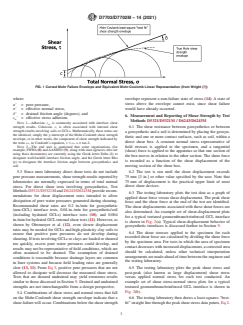
5.2 In general, the failure envelope described by Eq 1 is a
4.1 The shear strength of soil-geosynthetic interfaces and
curved line for many materials (5). For most geotechnical
geosynthetic-geosynthetic interfaces is a critical design param-
engineering problems, the shear stress on the failure plane is
eter for many civil engineering projects, including, but not
approximated as a linear function of the total or effective
limited to: waste containment systems, mining applications,
normal stress within a selected normal stress range, as shown
dam designs involving geosynthetics, mechanically stabilized
in Fig. 1. This linear approximation is known as the Mohr-
earth structures, reinforced soil slopes, and liquid impound-
Coulomb shear strength envelope. In the case of total stresses,
ments. Since geosynthetic interfaces often serve as a weak
the Mohr-Coulomb shear strength envelope is expressed as:
plane on which sliding may occur, shear strengths of these
interfaces are needed to assess the stability of earth materials
τ 5 c 1σ tan δ (2)
a
resting on these interfaces, such as a waste mass or ore body
where:
over a lining system or the ability of a final cover to remain on
τ = shear stress,
a slope. Accordingly, project-specific shear testing using rep-
σ = normal stress,
resentativematerialsunderconditionssimilartothoseexpected
δ = friction angle (degrees), and
in the field is recommended for final design. Shear strengths of
c = adhesion.
a
geosynthetic interfaces are obtained by either Test Method
D5321/D5321M (geosynthetics) or D6243/D6243M (geosyn-
Inthecaseofeffectivestresses,thelinearfailureenvelopeis:
thetic clay liners). This guide touches upon some of the issues
'
τ 5 c 1~σ 2 u! tan δ (3)
a
that should be considered when evaluating shear strength data.
Because of the large number of potential conditions that could
or
exist, there may be other conditions not identified in this guide
'
that could affect interpretation of the results. The seemingly τ 5 c 1σ’ tan δ’
a
D7702/D7702M − 14 (2021)
FIG. 1 Curved Mohr Failure Envelope and Equivalent Mohr-Coulomb Linear Representation (from Wright (7))
where: envelope represent a non-failure state of stress (14). A state of
stress above the envelope cannot exist, since shear failure
u’ = pore pressure,
would have already occurred.
σ’ = effective normal stress,
δ’ = drained friction angle (degrees), and
6. Measurement and Reporting of Shear Strength by Test
c ’ = effective stress adhesion.
a
Methods D5321/D5321M / D6243/D6243M
NOTE 1—Adhesion, c , is commonly associated with interface shear
a
strength results. Cohesion, c, is often associated with internal shear
6.1 The shear resistance between geosynthetics or between
strength results involving soils or GCLs. Mathematically, these terms are
a geosynthetic and a soil is determined by placing the geosyn-
the identical; simply the y-intercept of the Mohr-Coulomb shear strength
thetic and one or more contact surfaces, such as soil, within a
envelope, or in other words, the component of shear strength indicated by
direct shear box. A constant normal stress representative of
the term c , in Coulomb’s equation, τ = c + σ tan δ.
a a
NOTE 2—The end user is cautioned that some organizations (for
field stresses is applied to the specimen, and a tangential
example, FHWA (8) andAASHTO (9), along with state agencies who are
(shear) force is applied to the apparatus so that one section of
using these documents) are currently using the Greek letter Delta (δ)to
the box moves in relation to the other section. The shear force
designate wall-backfill interface friction angle, and the Greek letter Rho
is recorded as a function of the shear displacement of the
(ρ) to designate the interface friction angle between geosynthetics and
moving section of the shear box.
soil.
5.3 Since most laboratory direct shear tests do not include 6.2 The test is run until the shear displacement exceeds
75 mm [3 in.] or other value specified by the user. Note that
pore pressure measurements, shear strength results reported by
laboratories are normally expressed in terms of total normal 75 mm of displacement is the practical upper limit of most
direct shear devices.
stress. For direct shear tests involving geosynthetics, Test
MethodsD5321/D5321MandD6243/D6243Mproviderecom-
6.3 The testing laboratory plots the test data as a graph of
mendations for shear displacement rates intended to allow
applied shear force versus shear displacement. The peak shear
dissipation of pore water pressures generated during shearing.
force and the shear force at the end of the test are identified.
Recommended shear rates are 0.2 in./min for geosynthetic
The shear displacements associated with these shear forces are
(non-GCL) interface tests, 0.04 in.⁄min for geosynthetic/soil
also determined. An example set of shear-displacement plots
(including hydrated GCLs) interface tests (10), and 0.004
for a typical textured geomembrane/reinforced GCL interface
in./min for hydrated GCLinternal shear tests (11). However, as
is shown in Fig. 2(a). Typical shear-displacement behavior of
shown by Obermeyer et al. (12), even slower displacement
geosynthetic interfaces is discussed further in Section 9.
rates may be needed for GCLs and high-plasticity clay soils to
6.4 The shear stresses applied to the specimen for each
ensure that positive pore pressures do not develop during
recorded shear force are calculated by dividing the shear force
shearing.IftestsinvolvingGCLsorclaysareloadedorsheared
by the specimen area. For tests in which the area of specimen
too quickly, excess pore water pressures could develop, and
contactdecreaseswithincreaseddisplacement,acorrectedarea
results may not be representative of field conditions, which are
should be calculated, unless other technical interpretation
often assumed to be drained. The assumption of drained
arrangementsaremadeaheadoftimebetweentheengineerand
conditions is reasonable because drainage layers are common
the testing laboratory.
in liner systems and because field loading rates are generally
slow (13, 11). From Eq 3, positive pore pressures that are not 6.5 The testing laboratory plots the peak shear stress and
allowed to dissipate will decrease the measured shear stress. post-peak (also known as large displacement) shear stress
Tests that are sheared undrained may yield erroneous results versus applied normal stress for each test conducted. An
similar to those discussed in Section 9. Drained and undrained example set of shear stress-normal stress plots for a typical
strengths are not interchangeable from a design perspective. textured geomembrane/reinforced GCL interface is shown in
Fig. 2(b).
5.4 Combinations of shear stress and normal stress that fall
on the Mohr-Coulomb shear strength envelope indicate that a 6.6 The testing laboratory then draws a least-squares “best-
shearfailurewilloccur.Combinationsbelowtheshearstrength fit” straight line through the peak shear stress data points, Eq 2.
D7702/D7702M − 14 (2021)
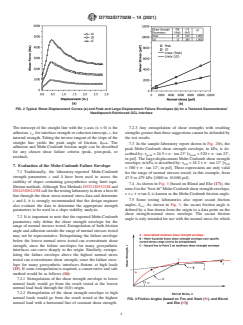
FIG. 2 Typical Shear-Displacement Curves (a) and Peak and Large Displacement Failure Envelopes (b) for a Textured Geomembrane/
Needlepunch-Reinforced GCL Interface
The intercept of the straight line with the y-axis (x = 0) is the 7.2.3 Any extrapolation of shear strengths with resulting
adhesion, c , for interface strength or cohesion intercept, c, for strengths greater than these suggestions cannot be defended by
a
internal strength. Taking the inverse tangent of the slope of the the test results.
straight line yields the peak angle of friction, δ . The
peak
7.3 In the sample laboratory report shown in Fig. 2(b), the
adhesion and Mohr-Coulomb friction angle can be described
peak Mohr-Coulomb shear strength envelope, in kPa, is de-
for any chosen shear failure criteria (peak, post-peak, or
scribed by: τ = 24.9 + σ · tan 23° [τ = 520 + σ · tan 23°,
peak peak
residual).
in psf]. The large-displacement Mohr-Coulomb shear strength
envelope, in kPa, is described by: τ = 18.2 + σ · tan 12° [τ
LD LD
7. Evaluation of the Mohr-Coulomb Failure Envelope
= 380 + σ · tan 12°, in psf]. These expressions are only valid
7.1 Traditionally, the laboratory-reported Mohr-Coulomb
for the range of normal stresses tested; in this example, from
strength parameters c and δ have been used to assess the
47.9 to 479 kPa [1000 to 10 000 psf].
stability of slopes containing geosynthetics using limit equi-
7.4 As shown in Fig. 3 (based on Blond and Elie (17)), the
librium methods.Although Test Methods D5321/D5321M and
term δinthe“best-fit”Mohr-Coulombshearstrengthenvelope,
D6243/D6243Mcallforthetestinglaboratorytodrawabest-fit
τ = c + σ tan δ, is known as the Mohr-Coulomb friction angle.
line through the shear stress-normal stress data and determine
7.5 Some testing laboratories also report secant friction
c and δ, it is strongly recommended that the design engineer
angles, δ . As shown in Fig. 3, the secant friction angle is
also evaluate the data to determine the appropriate strength sec
defined by a line drawn from the origin to a data point on the
parameters to be used in a slope stability analysis.
shear strength-normal stress envelope. The secant friction
7.2 It is important to note that the reported Mohr-Coulomb
angle is only intended for use with the normal stress for which
parameters only define the shear strength envelope for the
range of normal stresses tested. Extrapolation of both friction
angle and adhesion outside the range of normal stresses tested
may not be representative. Extrapolating the failure envelope
below the lowest normal stress tested can overestimate shear
strength, since the failure envelopes for many geosynthetic
interfaces can curve sharply to the origin. Similarly, extrapo-
lating the failure envelope above the highest normal stress
tested can overestimate shear strength, since the failure enve-
lope for many geosynthetic interfaces flattens at high loads
(15). If some extrapolation is required, a conservative and safe
method would be as follows (16):
7.2.1 Extrapolation of the shear strength envelope to lower
normal loads would go from the result tested at the lowest
normal load back through the (0,0) origin.
7.2.2 Extrapolation of the shear strength envelope to high
normal loads would go from the result tested at the highest
FIG. 3 Friction Angles (based on Fox and Stark (11), and Blond
normal load with a horizontal line of constant shear strength. and Elie (17))
D7702/D7702M − 14 (2021)
it was defined and should not be confused with the Mohr-
Coulomb friction angle (11). Except for the unique case where
c = 0 and the shear strength envelope is linear, the secant and
Mohr-Coulomb friction angles will be different. (Section 8
discusses how the secant angle can be useful when interpreting
shear strength results for a slope stability analysis.)
NOTE 3—Contrary to standard practice, the ISO standard on shear
strength properties defines the “angle of friction” as the secant angle, not
the Mohr-Coulomb angle.
7.6 In simple cases where the shear strength data is actually
linear, the linear failure envelope constructed by the testing
laboratoryshouldbeanaccuraterepresentationoftheavailable
shear strength. However, Fox and Stark (11) and Giroud et al.
(18)showthatinterpretationofthefailureenvelopemaynotbe
as straightforward if the data indicate curved or multilinear
failure envelopes. Fox and Stark presented several common
models used to characterize GCL shear strength envelopes
FIG. 5 Linear Approximations of Interface Shear Strength. Best fit
(Fig. 4), which can also generally apply to many geosynthetic
straight line for (1) high normal stresses, (2) low normal
interfaces.Additionally, several studies have shown that many
stresses, and (3) all laboratory data points (Giroud et al. (18))
geosyntheticinterfacesexhibitnonlinearfailureenvelopesover
a large range of normal stresses, including textured
geomembranes/nonwoven geotextiles (19, 20), smooth
should only be used for the middle range of data. The intent of
geomembranes/clays (21), reinforced GCLs (22-24), and tex-
this example is to demonstrate that it would be unwise to
tured geomembranes/GCLs (10, 23). In such cases, the linear
characterize a nonlinear data set with a single best-fit straight
shear strength parameters (c and δ) reported by the laboratory
line. To address this difficulty, Giroud proposed the use of a
may not be appropriate, or may only be appropriate for a
curved, hyperbolic failure envelope to accurately fit the data at
portion of the data. For example, Fig. 5 from Giroud et al. (18)
all normal stresses.
shows an example set of geosynthetic shear test results, along
with three possible “best-fit” lines through the data set. Line #1
7.7 It is important to note that Giroud’s best-fit Line #3 in
appears to provide a good approximation of shear strength at
Fig. 5, as well as many of the models presented by Fox and
largenormalstressvalues.However,ifconsideringlownormal
Stark in Fig. 4, include a non-zero y-intercept (cohesion or
stresses, Line #1 would greatly overestimate the available
adhesion). Common methods of interpreting cohesion and
shear strength. Use of Line #1 in a slope stability analysis for
adhesion are discussed further in Section 8.
an application expected to be under low normal stresses would
therefore be unconservative. Using Line #2 would accurately
8. Interpretation of Cohesion or Adhesion
depict shear strength for low normal load applications, but
8.1 As discussed in Section 7, laboratory shear test reports
would overestimate shear strength at high normal stresses; also
involving geosynthetics often indicate a non-zero y-intercept
an unconservative, and potentially dangerous approach. Line
(cohesion or adhesion). The ultimate decision whether to
#3, the least-squares regression through all of the data points,
include the reported cohesion/adhesion in a slope stability
may lead to either overly conservative or under conservative
analysis rests with the design engineer. In geotechnical engi-
estimates, depending on the normal stress considered. Line #3
neering practice, interpretation of cohesion in soils is very
project-specific. Cohesion values for sands, non-plastic silts,
and normally consolidated clays are generally approximated as
zero (5). Although overconsolidated clays or cemented sands
may exhibit cohesion, engineers often choose to ignore this
term because it may not be reliable for long-term conditions
(16). Regarding the interpretation of cohesion/adhesion when
geosynthetics are involved, Dixon et al. (25) state, “While it is
common practice in many applications involving soil to ignore
cohesion or adhesion values in design, this approach is not
recommended for geosynthetic interfaces. Apparent adhesion
values can be considered in design of structures that incorpo-
rate interfaces with a true strength at zero normal stress (for
example, Velcro type effect between nonwoven needlepunched
geotextile and textured geomembranes).” As discussed in the
GRI White Paper #11 by Koerner and Koerner (26), several
geosynthetics and geosynthetic interfaces have been shown to
FIG. 4 Typical Failure Envelope Shapes for GCL and Geosyn-
thetic Interfaces (Fox and Stark (11)) exhibit cohesion or adhesion:
D7702/D7702M − 14 (2021)
8.1.1 Textured polyethylene geomembranes (HDPE and As discussed in 7.7, since the Mohr-Coulomb failure envelope
LLDPE) against geotextiles or soil. is just a linear representation of data that is oftentimes
8.1.2 Smooth geomembranes (LLDPE, fPP, EPDM, and nonlinear, it would be natural to expect a non-zero y-intercept.
PVC) against other geosynthetics or soil. Although the cohesion value may not have a true physical
8.1.3 Drainage geocomposites, where geotextiles are ther- meaning for the particular interface tested, its use for design in
mally bonded to geonets. these cases would still be justified. This concept is shown
8.1.4 GCL internal shear strength, where needlepunching graphically in Fig. 7, from Giroud et al. (18). In this figure, the
provides internal reinforcement of the bentonite layer. material’s true failure envelope follows a hyperbolic shape,
8.1.5 Selected geosynthetic-soil interfaces (for example, which curves sharply to the origin at low normal stresses.
cohesive soil against a nonwoven geotextile) where the inter- Drawing a best-fit line through the data beyond 20 kPa
face friction between the two materials is high enough to force produces a significant cohesion or adhesion. Disregarding the
the failure plane into the soil. cohesion would be conservative, perhaps overly conservative
to the point that no two materials would be able to meet shear
8.2 Koerner and Koerner concluded that, “If adhesion is
strength requirements.
indicated by the linear failure envelope associated with one of
these interfaces, its use in a stability analysis can be justified.” 8.5 Dixon et al. (25) raise the question of negative cohesion
values. Negative cohesion results have been occasionally
8.3 Swan (27) provides an example of the potential conse-
reported, the likely result of forcing a best-fit line through
quences of indiscriminately ignoring cohesion. Fig. 6 presents
limited test data representative of a nonlinear envelope. The
the results of two sets of direct shear tests reported by Swan:
state of the practice in these situations is to either force the
the first between a smooth polyethylene geomembrane and a
failure envelope through the origin (resulting in a decreased
site soil, and the second between a textured polyethylene
friction angle), or to re-test.
geomembrane and the same site soil. The test results show
significant adhesion values for both sets of tests. If one were to 8.6 Dixon et al. (25) also bring the concept of variability
only look at the reported friction angles (7° versus 3°), the into the discussion. There is inherent variability in direct shear
designer would conclude that the smooth geomembrane/soil tests, due to variability in soils and geosynthetics, as well as
interface is far stronger and far less likely to slip than the equipment calibration and measurement errors. Ramsey and
interface between the textured geomembrane and that same Youngblood (28) cite data from the GeosyntheticAccreditation
soil. However, if both the reported friction angles and adhesion Institute-Laboratory Accreditation Program (GAI-LAP) which
values are considered together, then one would arrive at an shows that direct shear testing protocol produces variation in
entirely different conclusion: the textured geomembrane/soil excess of 15 %. Variations between the measured shear
interface would be far stronger and far more stable, consistent strength value and the actual value will affect both the slope
with intuition and past experience. (tan δ) and the intercept (c) of the failure envelope. However,
due to the large cost and time commitment associated with
8.4 Thiel (1) offers another perspective: “If we recognize
shear tests, multiple (for example, replicate) shear tests at
...