


ASTM D5886-95(2018)
(Guide)Standard Guide for Selection of Test Methods to Determine Rate of Fluid Permeation Through Geomembranes for Specific Applications
Standard Guide for Selection of Test Methods to Determine Rate of Fluid Permeation Through Geomembranes for Specific Applications
SIGNIFICANCE AND USE
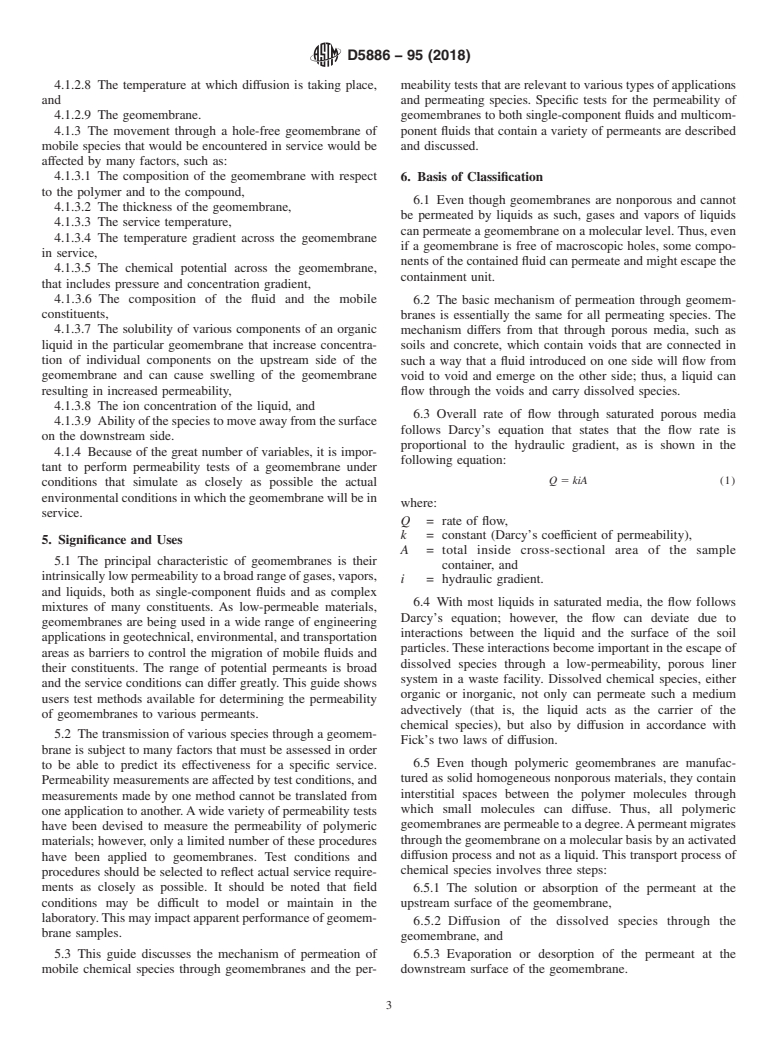
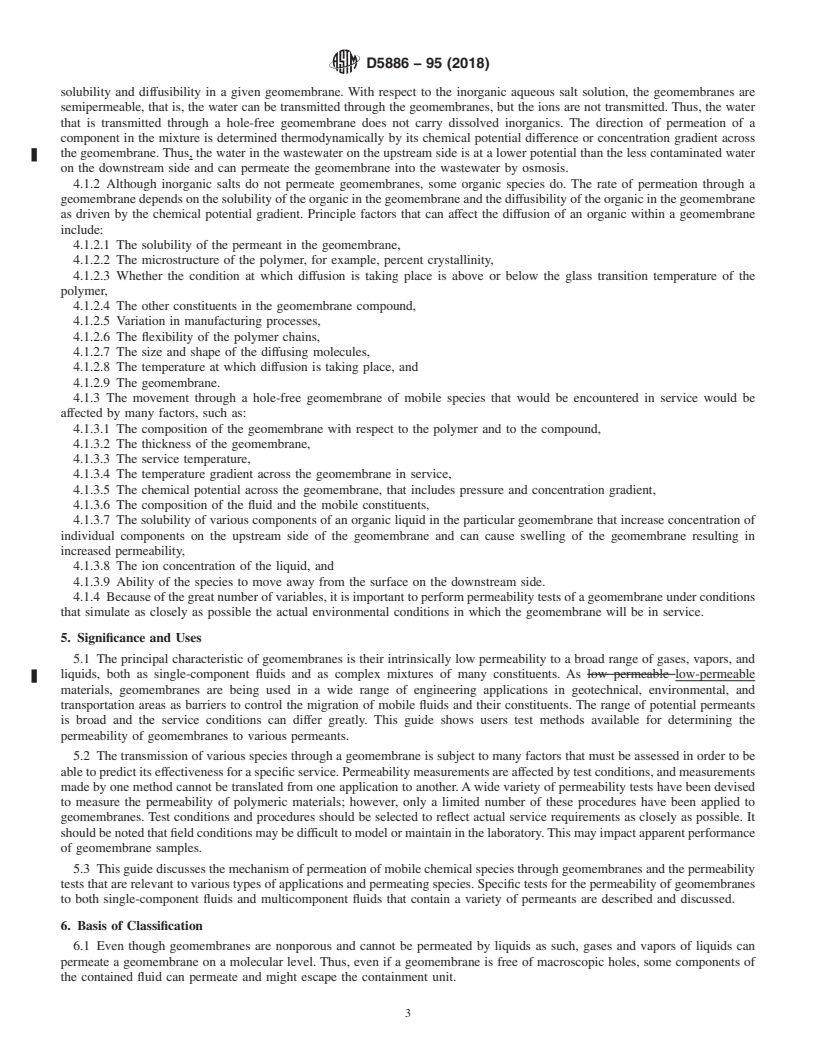
5.1 The principal characteristic of geomembranes is their intrinsically low permeability to a broad range of gases, vapors, and liquids, both as single-component fluids and as complex mixtures of many constituents. As low-permeable materials, geomembranes are being used in a wide range of engineering applications in geotechnical, environmental, and transportation areas as barriers to control the migration of mobile fluids and their constituents. The range of potential permeants is broad and the service conditions can differ greatly. This guide shows users test methods available for determining the permeability of geomembranes to various permeants.
5.2 The transmission of various species through a geomembrane is subject to many factors that must be assessed in order to be able to predict its effectiveness for a specific service. Permeability measurements are affected by test conditions, and measurements made by one method cannot be translated from one application to another. A wide variety of permeability tests have been devised to measure the permeability of polymeric materials; however, only a limited number of these procedures have been applied to geomembranes. Test conditions and procedures should be selected to reflect actual service requirements as closely as possible. It should be noted that field conditions may be difficult to model or maintain in the laboratory. This may impact apparent performance of geomembrane samples.
5.3 This guide discusses the mechanism of permeation of mobile chemical species through geomembranes and the permeability tests that are relevant to various types of applications and permeating species. Specific tests for the permeability of geomembranes to both single-component fluids and multicomponent fluids that contain a variety of permeants are described and discussed.
SCOPE
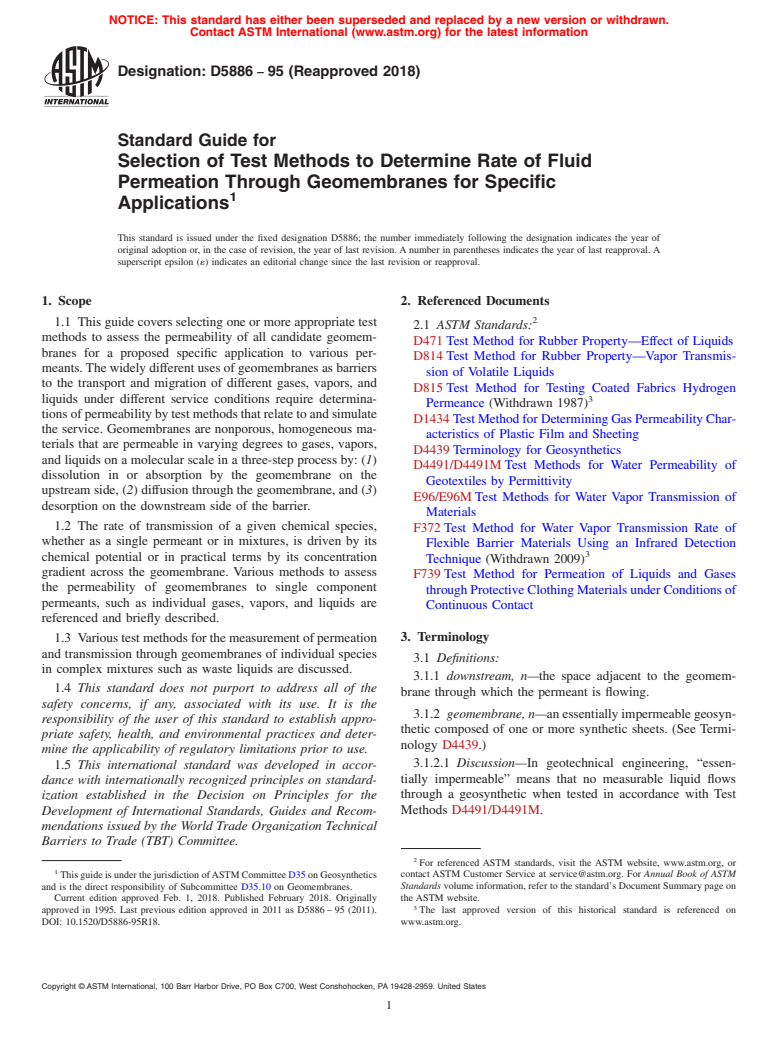
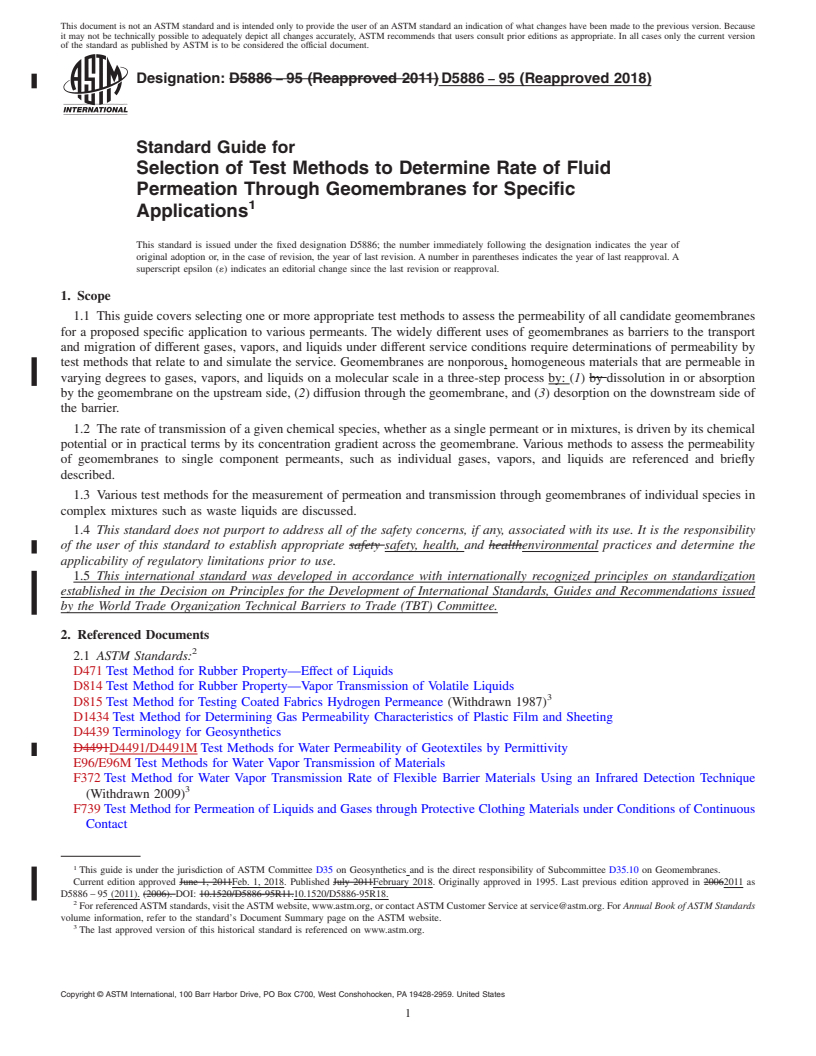
1.1 This guide covers selecting one or more appropriate test methods to assess the permeability of all candidate geomembranes for a proposed specific application to various permeants. The widely different uses of geomembranes as barriers to the transport and migration of different gases, vapors, and liquids under different service conditions require determinations of permeability by test methods that relate to and simulate the service. Geomembranes are nonporous, homogeneous materials that are permeable in varying degrees to gases, vapors, and liquids on a molecular scale in a three-step process by: (1) dissolution in or absorption by the geomembrane on the upstream side, (2) diffusion through the geomembrane, and (3) desorption on the downstream side of the barrier.
1.2 The rate of transmission of a given chemical species, whether as a single permeant or in mixtures, is driven by its chemical potential or in practical terms by its concentration gradient across the geomembrane. Various methods to assess the permeability of geomembranes to single component permeants, such as individual gases, vapors, and liquids are referenced and briefly described.
1.3 Various test methods for the measurement of permeation and transmission through geomembranes of individual species in complex mixtures such as waste liquids are discussed.
1.4 This standard does not purport to address all of the safety concerns, if any, associated with its use. It is the responsibility of the user of this standard to establish appropriate safety, health, and environmental practices and determine the applicability of regulatory limitations prior to use.
1.5 This international standard was developed in accordance with internationally recognized principles on standardization established in the Decision on Principles for the Development of International Standards, Guides and Recommendations issued by the World Trade Organization Technical Barriers to Trade (TBT) Committee.
General Information
Buy Standard
Standards Content (Sample)
NOTICE: This standard has either been superseded and replaced by a new version or withdrawn.
Contact ASTM International (www.astm.org) for the latest information
Designation: D5886 − 95 (Reapproved 2018)
Standard Guide for
Selection of Test Methods to Determine Rate of Fluid
Permeation Through Geomembranes for Specific
Applications
This standard is issued under the fixed designation D5886; the number immediately following the designation indicates the year of
original adoption or, in the case of revision, the year of last revision. A number in parentheses indicates the year of last reapproval. A
superscript epsilon (´) indicates an editorial change since the last revision or reapproval.
1. Scope 2. Referenced Documents
1.1 This guide covers selecting one or more appropriate test
2.1 ASTM Standards:
methods to assess the permeability of all candidate geomem-
D471 Test Method for Rubber Property—Effect of Liquids
branes for a proposed specific application to various per-
D814 Test Method for Rubber Property—Vapor Transmis-
meants. The widely different uses of geomembranes as barriers
sion of Volatile Liquids
to the transport and migration of different gases, vapors, and
D815 Test Method for Testing Coated Fabrics Hydrogen
liquids under different service conditions require determina- 3
Permeance (Withdrawn 1987)
tions of permeability by test methods that relate to and simulate
D1434 Test Method for Determining Gas Permeability Char-
the service. Geomembranes are nonporous, homogeneous ma-
acteristics of Plastic Film and Sheeting
terials that are permeable in varying degrees to gases, vapors,
D4439 Terminology for Geosynthetics
and liquids on a molecular scale in a three-step process by: (1)
D4491/D4491M Test Methods for Water Permeability of
dissolution in or absorption by the geomembrane on the
Geotextiles by Permittivity
upstream side, (2) diffusion through the geomembrane, and (3)
E96/E96M Test Methods for Water Vapor Transmission of
desorption on the downstream side of the barrier.
Materials
1.2 The rate of transmission of a given chemical species,
F372 Test Method for Water Vapor Transmission Rate of
whether as a single permeant or in mixtures, is driven by its
Flexible Barrier Materials Using an Infrared Detection
chemical potential or in practical terms by its concentration
Technique (Withdrawn 2009)
gradient across the geomembrane. Various methods to assess
F739 Test Method for Permeation of Liquids and Gases
the permeability of geomembranes to single component
through Protective Clothing Materials under Conditions of
permeants, such as individual gases, vapors, and liquids are
Continuous Contact
referenced and briefly described.
3. Terminology
1.3 Various test methods for the measurement of permeation
and transmission through geomembranes of individual species
3.1 Definitions:
in complex mixtures such as waste liquids are discussed.
3.1.1 downstream, n—the space adjacent to the geomem-
1.4 This standard does not purport to address all of the
brane through which the permeant is flowing.
safety concerns, if any, associated with its use. It is the
3.1.2 geomembrane, n—an essentially impermeable geosyn-
responsibility of the user of this standard to establish appro-
thetic composed of one or more synthetic sheets. (See Termi-
priate safety, health, and environmental practices and deter-
nology D4439.)
mine the applicability of regulatory limitations prior to use.
3.1.2.1 Discussion—In geotechnical engineering, “essen-
1.5 This international standard was developed in accor-
tially impermeable” means that no measurable liquid flows
dance with internationally recognized principles on standard-
through a geosynthetic when tested in accordance with Test
ization established in the Decision on Principles for the
Methods D4491/D4491M.
Development of International Standards, Guides and Recom-
mendations issued by the World Trade Organization Technical
Barriers to Trade (TBT) Committee.
For referenced ASTM standards, visit the ASTM website, www.astm.org, or
This guide is under the jurisdiction of ASTM Committee D35 on Geosynthetics contact ASTM Customer Service at service@astm.org. For Annual Book of ASTM
and is the direct responsibility of Subcommittee D35.10 on Geomembranes. Standards volume information, refer to the standard’s Document Summary page on
Current edition approved Feb. 1, 2018. Published February 2018. Originally the ASTM website.
approved in 1995. Last previous edition approved in 2011 as D5886 – 95 (2011). The last approved version of this historical standard is referenced on
DOI: 10.1520/D5886-95R18. www.astm.org.
Copyright © ASTM International, 100 Barr Harbor Drive, PO Box C700, West Conshohocken, PA 19428-2959. United States
D5886 − 95 (2018)
3.1.3 geosynthetic, n—a planar product manufactured from the dissolved constituents, and the driving force for such
polymeric material used with soil, rock, earth, or other geo- permeation is hydraulic pressure. Due to the selective nature of
technical engineering-related material as an integral part of a geomembranes, the permeation of the dissolved constituents in
man-made project, structure, or system. (See Terminology
liquids can vary greatly, that is, components of a mixture can
D4439.) permeate at different rates due to differences in solubility and
diffusibility in a given geomembrane. With respect to the
3.1.4 permeability, n—the rate of flow under a differential
inorganic aqueous salt solution, the geomembranes are
pressure, temperature, or concentration of a gas, liquid, or
semipermeable, that is, the water can be transmitted through
vapor through a material. (Modified from Test Methods D4491/
the geomembranes, but the ions are not transmitted. Thus, the
D4491M.)
water that is transmitted through a hole-free geomembrane
3.1.5 permeant, n—a chemical species, gas, liquid, or vapor
does not carry dissolved inorganics. The direction of perme-
that can pass through a substance.
ation of a component in the mixture is determined thermody-
namically by its chemical potential difference or concentration
4. Summary of Guide
gradient across the geomembrane. Thus, the water in the
4.1 The wide range of uses of geomembranes as barriers in
wastewater on the upstream side is at a lower potential than the
many different environments to many different permeating
less contaminated water on the downstream side and can
species requires different test procedures to assess the effec-
permeate the geomembrane into the wastewater by osmosis.
tiveness of a given membrane for a given application. The
4.1.2 Although inorganic salts do not permeate
permeating species range from a single component to highly
geomembranes, some organic species do. The rate of perme-
complex mixtures such as those found in waste liquids and
ation through a geomembrane depends on the solubility of the
leachates. In specialized applications, it may be important to
organic in the geomembrane and the diffusibility of the organic
measure transmission or migration of a species that would take
in the geomembrane as driven by the chemical potential
place under specific conditions and environments including
gradient. Principle factors that can affect the diffusion of an
temperature, vapor pressure, and concentration gradients. Tests
organic within a geomembrane include:
that would be applicable to the measurement of the permeabil-
ity of a material to different permeants present in various 4.1.2.1 The solubility of the permeant in the geomembrane,
applications are summarized in Table 1.
4.1.2.2 The microstructure of the polymer, for example,
4.1.1 In the use of geomembranes in service as barriers to
percent crystallinity,
the transmission of fluids, it is essential to recognize the
4.1.2.3 Whether the condition at which diffusion is taking
difference between geomembranes that are nonporous, homo-
place is above or below the glass transition temperature of the
geneous materials and other liner materials that are porous,
polymer,
such as soils and concretes. The transmission of permeating
4.1.2.4 The other constituents in the geomembrane
species through geomembranes without holes proceeds by
compound,
absorption of the species in the geomembrane and diffusion
4.1.2.5 Variation in manufacturing processes,
through the geomembrane on a molecular basis. The driving
4.1.2.6 The flexibility of the polymer chains,
force is chemical potential across the geomembrane. A liquid
permeates porous materials in a condensed state that can carry 4.1.2.7 The size and shape of the diffusing molecules,
TABLE 1 Applicable Test Method for Measuring Permeability of Geomembranes to Various Permeants
Applicable Test Method and Permeant
Fluid Being Contained Example of Permeant Example of Field Application
Detector and Quantifier
Single-Component Fluids:
Gas H , O Barriers, pipe, and hose liners D815
2 2
N , CH D1434-V
2 4
CO D1434-P
Water vapor H O Moisture vapor barriers, water reservoir E96/E96M, D653
covers
Liquid water H O Liners for reservoirs, dams, and canals Soil-type permeameter with hydraulic
pressure
Organic vapor Organic species Secondary containment for organic sol- D814, E96/E96M, F372
vent and gasoline
Organic liquid Organic solvents species Containers, tank liners secondary con- D814, E96/E96M
tainment
Multicomponents Fluids:
Gases CO /CH Barriers, separation of gases F372, GC, GCMS
2 4
Aqueous solutions of inorganic, for Ions, salts Pond liners Pouch, osmotic cell, ion analysis
example, brines, incinerator ash
leachates, leach pad leachate
Mixtures of organics, spills, hydrocar- Organic species Liners for tanks and secondary contain- E96/E96M with headspace, GC
bon fuels ment
Aqueous solutions of organics Organic species, H O Liners for ponds and waste disposal Pouch, Multicompartment cell with
analysis by GC on GCMS
Complex aqueous solutions of organics H O, organic species, dissolved salts Liners for waste disposal Pouch, Multicompartment cell, osmotic
and inorganic species cell, analysis by head-space GC
D5886 − 95 (2018)
4.1.2.8 The temperature at which diffusion is taking place, meability tests that are relevant to various types of applications
and and permeating species. Specific tests for the permeability of
4.1.2.9 The geomembrane. geomembranes to both single-component fluids and multicom-
4.1.3 The movement through a hole-free geomembrane of ponent fluids that contain a variety of permeants are described
mobile species that would be encountered in service would be and discussed.
affected by many factors, such as:
4.1.3.1 The composition of the geomembrane with respect 6. Basis of Classification
to the polymer and to the compound,
6.1 Even though geomembranes are nonporous and cannot
4.1.3.2 The thickness of the geomembrane,
be permeated by liquids as such, gases and vapors of liquids
4.1.3.3 The service temperature,
can permeate a geomembrane on a molecular level. Thus, even
4.1.3.4 The temperature gradient across the geomembrane
if a geomembrane is free of macroscopic holes, some compo-
in service,
nents of the contained fluid can permeate and might escape the
4.1.3.5 The chemical potential across the geomembrane,
containment unit.
that includes pressure and concentration gradient,
4.1.3.6 The composition of the fluid and the mobile
6.2 The basic mechanism of permeation through geomem-
constituents,
branes is essentially the same for all permeating species. The
4.1.3.7 The solubility of various components of an organic
mechanism differs from that through porous media, such as
liquid in the particular geomembrane that increase concentra- soils and concrete, which contain voids that are connected in
tion of individual components on the upstream side of the
such a way that a fluid introduced on one side will flow from
geomembrane and can cause swelling of the geomembrane void to void and emerge on the other side; thus, a liquid can
resulting in increased permeability,
flow through the voids and carry dissolved species.
4.1.3.8 The ion concentration of the liquid, and
6.3 Overall rate of flow through saturated porous media
4.1.3.9 Ability of the species to move away from the surface
follows Darcy’s equation that states that the flow rate is
on the downstream side.
proportional to the hydraulic gradient, as is shown in the
4.1.4 Because of the great number of variables, it is impor-
following equation:
tant to perform permeability tests of a geomembrane under
Q 5 kiA (1)
conditions that simulate as closely as possible the actual
environmental conditions in which the geomembrane will be in
where:
service.
Q = rate of flow,
k = constant (Darcy’s coefficient of permeability),
5. Significance and Uses
A = total inside cross-sectional area of the sample
5.1 The principal characteristic of geomembranes is their
container, and
intrinsically low permeability to a broad range of gases, vapors,
i = hydraulic gradient.
and liquids, both as single-component fluids and as complex
6.4 With most liquids in saturated media, the flow follows
mixtures of many constituents. As low-permeable materials,
Darcy’s equation; however, the flow can deviate due to
geomembranes are being used in a wide range of engineering
interactions between the liquid and the surface of the soil
applications in geotechnical, environmental, and transportation
particles. These interactions become important in the escape of
areas as barriers to control the migration of mobile fluids and
dissolved species through a low-permeability, porous liner
their constituents. The range of potential permeants is broad
system in a waste facility. Dissolved chemical species, either
and the service conditions can differ greatly. This guide shows
organic or inorganic, not only can permeate such a medium
users test methods available for determining the permeability
advectively (that is, the liquid acts as the carrier of the
of geomembranes to various permeants.
chemical species), but also by diffusion in accordance with
5.2 The transmission of various species through a geomem-
Fick’s two laws of diffusion.
brane is subject to many factors that must be assessed in order
6.5 Even though polymeric geomembranes are manufac-
to be able to predict its effectiveness for a specific service.
tured as solid homogeneous nonporous materials, they contain
Permeability measurements are affected by test conditions, and
interstitial spaces between the polymer molecules through
measurements made by one method cannot be translated from
which small molecules can diffuse. Thus, all polymeric
one application to another. A wide variety of permeability tests
geomembranes are permeable to a degree. A permeant migrates
have been devised to measure the permeability of polymeric
through the geomembrane on a molecular basis by an activated
materials; however, only a limited number of these procedures
diffusion process and not as a liquid. This transport process
...
This document is not an ASTM standard and is intended only to provide the user of an ASTM standard an indication of what changes have been made to the previous version. Because
it may not be technically possible to adequately depict all changes accurately, ASTM recommends that users consult prior editions as appropriate. In all cases only the current version
of the standard as published by ASTM is to be considered the official document.
Designation: D5886 − 95 (Reapproved 2011) D5886 − 95 (Reapproved 2018)
Standard Guide for
Selection of Test Methods to Determine Rate of Fluid
Permeation Through Geomembranes for Specific
Applications
This standard is issued under the fixed designation D5886; the number immediately following the designation indicates the year of
original adoption or, in the case of revision, the year of last revision. A number in parentheses indicates the year of last reapproval. A
superscript epsilon (´) indicates an editorial change since the last revision or reapproval.
1. Scope
1.1 This guide covers selecting one or more appropriate test methods to assess the permeability of all candidate geomembranes
for a proposed specific application to various permeants. The widely different uses of geomembranes as barriers to the transport
and migration of different gases, vapors, and liquids under different service conditions require determinations of permeability by
test methods that relate to and simulate the service. Geomembranes are nonporous, homogeneous materials that are permeable in
varying degrees to gases, vapors, and liquids on a molecular scale in a three-step process by: (1) by dissolution in or absorption
by the geomembrane on the upstream side, (2) diffusion through the geomembrane, and (3) desorption on the downstream side of
the barrier.
1.2 The rate of transmission of a given chemical species, whether as a single permeant or in mixtures, is driven by its chemical
potential or in practical terms by its concentration gradient across the geomembrane. Various methods to assess the permeability
of geomembranes to single component permeants, such as individual gases, vapors, and liquids are referenced and briefly
described.
1.3 Various test methods for the measurement of permeation and transmission through geomembranes of individual species in
complex mixtures such as waste liquids are discussed.
1.4 This standard does not purport to address all of the safety concerns, if any, associated with its use. It is the responsibility
of the user of this standard to establish appropriate safety safety, health, and healthenvironmental practices and determine the
applicability of regulatory limitations prior to use.
1.5 This international standard was developed in accordance with internationally recognized principles on standardization
established in the Decision on Principles for the Development of International Standards, Guides and Recommendations issued
by the World Trade Organization Technical Barriers to Trade (TBT) Committee.
2. Referenced Documents
2.1 ASTM Standards:
D471 Test Method for Rubber Property—Effect of Liquids
D814 Test Method for Rubber Property—Vapor Transmission of Volatile Liquids
D815 Test Method for Testing Coated Fabrics Hydrogen Permeance (Withdrawn 1987)
D1434 Test Method for Determining Gas Permeability Characteristics of Plastic Film and Sheeting
D4439 Terminology for Geosynthetics
D4491D4491/D4491M Test Methods for Water Permeability of Geotextiles by Permittivity
E96/E96M Test Methods for Water Vapor Transmission of Materials
F372 Test Method for Water Vapor Transmission Rate of Flexible Barrier Materials Using an Infrared Detection Technique
(Withdrawn 2009)
F739 Test Method for Permeation of Liquids and Gases through Protective Clothing Materials under Conditions of Continuous
Contact
This guide is under the jurisdiction of ASTM Committee D35 on Geosynthetics and is the direct responsibility of Subcommittee D35.10 on Geomembranes.
Current edition approved June 1, 2011Feb. 1, 2018. Published July 2011February 2018. Originally approved in 1995. Last previous edition approved in 20062011 as
D5886 – 95 (2011). (2006). DOI: 10.1520/D5886-95R11.10.1520/D5886-95R18.
For referenced ASTM standards, visit the ASTM website, www.astm.org, or contact ASTM Customer Service at service@astm.org. For Annual Book of ASTM Standards
volume information, refer to the standard’s Document Summary page on the ASTM website.
The last approved version of this historical standard is referenced on www.astm.org.
Copyright © ASTM International, 100 Barr Harbor Drive, PO Box C700, West Conshohocken, PA 19428-2959. United States
D5886 − 95 (2018)
3. Terminology
3.1 Definitions:
3.1.1 downstream, n—the space adjacent to the geomembrane through which the permeant is flowing.
3.1.2 geomembrane, n—an essentially impermeable geosynthetic composed of one or more synthetic sheets. (See Terminology
D4439.)
3.1.2.1 Discussion—
In geotechnical engineering, essentially impermeable“essentially impermeable” means that no measurable liquid flows through a
geosynthetic when tested in accordance with Test Methods D4491D4491/D4491M.
3.1.3 geosynthetic, n—a planar product manufactured from polymeric material used with soil, rock, earth, or other geotechnical
engineering-related material as an integral part of a man-made project, structure, or system. (See Terminology D4439.)
3.1.4 permeability, n—the rate of flow under a differential pressure, temperature, or concentration of a gas, liquid, or vapor
through a material. (Modified from Test Methods D4491D4491/D4491M.)
3.1.5 permeant, n—a chemical species, gas, liquid, or vapor that can pass through a substance.
4. Summary of Guide
4.1 The wide range of uses of geomembranes as barriers in many different environments to many different permeating species
requires different test procedures to assess the effectiveness of a given membrane for a given application. The permeating species
range from a single component to highly complex mixtures such as those found in waste liquids and leachates. In specialized
applications, service it may be important to measure transmission or migration of a species that would take place under specific
conditions and environments including temperature, vapor pressure, and concentration gradients. Tests that would be applicable
to the measurement of the permeability of a material to different permeants present in various applications are summarized in Table
1.
4.1.1 In the use of geomembranes in service as barriers to the transmission of fluids, it is essential to recognize the difference
between geomembranes that are nonporous, homogeneous materials and other liner materials that are porous, such as soils and
concretes. The transmission of permeating species through geomembranes without holes proceeds by absorption of the species in
the geomembrane and diffusion through the geomembrane on a molecular basis. The driving force is chemical potential across the
geomembrane. A liquid permeates porous materials in a condensed state that can carry the dissolved constituents, and the driving
force for such permeation is hydraulic pressure. Due to the selective nature of geomembranes, the permeation of the dissolved
constituents in liquids can vary greatly, that is, components of a mixture can permeate at different rates due to differences in
TABLE 1 Applicable Test Method for Measuring Permeability of Geomembranes to Various Permeants
Applicable Test Method and Permeant
Fluid Being Contained Example of Permeant Example of Field Application
Detector and Quantifier
Single-Component Fluids:
Gas H , O Barriers, pipe, and hose liners D815
2 2
N , CH D1434-V
2 4
CO D1434-P
Water vapor H O Moisture vapor barriers, water reservoir E96/E96M, D653
covers
Liquid water H O Liners for reservoirs, dams, and canals Soil-type permeameter with hydraulic
pressure
Organic vapor Organic species Secondary containment for organic sol- D814, E96/E96M, F372
vent and gasoline
Organic liquid Organic solvents species Containers, tank liners secondary con- D814, E96/E96M
tainment
Multicomponents Fluids:
Gases CO /CH Barriers, separation of gases F372, GC, GCMS
2 4
Aqueous solutions of inorganic, for Ions, salts Pond liners Pouch, osmotic cell, ion analysis
example, brines, incinerator ash
leachates, leach pad leachate
Mixtures of organics, spills, hydrocar- Organic species Liners for tanks and secondary contain- E96/E96M with headspace, GC
bon fuels ment
Aqueous solutions of organics Organic species, H O Liners for ponds and waste disposal Pouch, Multi-compartment cell with
analysis by GC on GCMS
Aqueous solutions of organics Organic species, H O Liners for ponds and waste disposal Pouch, Multicompartment cell with
analysis by GC on GCMS
Complex aqueous solutions of organics H O, organic species, dissolved salts Liners for waste disposal Pouch, Multi-compartment cell, osmotic
and inorganic species cell, analysis by head-space GC
Complex aqueous solutions of organics H O, organic species, dissolved salts Liners for waste disposal Pouch, Multicompartment cell, osmotic
and inorganic species cell, analysis by head-space GC
D5886 − 95 (2018)
solubility and diffusibility in a given geomembrane. With respect to the inorganic aqueous salt solution, the geomembranes are
semipermeable, that is, the water can be transmitted through the geomembranes, but the ions are not transmitted. Thus, the water
that is transmitted through a hole-free geomembrane does not carry dissolved inorganics. The direction of permeation of a
component in the mixture is determined thermodynamically by its chemical potential difference or concentration gradient across
the geomembrane. Thus, the water in the wastewater on the upstream side is at a lower potential than the less contaminated water
on the downstream side and can permeate the geomembrane into the wastewater by osmosis.
4.1.2 Although inorganic salts do not permeate geomembranes, some organic species do. The rate of permeation through a
geomembrane depends on the solubility of the organic in the geomembrane and the diffusibility of the organic in the geomembrane
as driven by the chemical potential gradient. Principle factors that can affect the diffusion of an organic within a geomembrane
include:
4.1.2.1 The solubility of the permeant in the geomembrane,
4.1.2.2 The microstructure of the polymer, for example, percent crystallinity,
4.1.2.3 Whether the condition at which diffusion is taking place is above or below the glass transition temperature of the
polymer,
4.1.2.4 The other constituents in the geomembrane compound,
4.1.2.5 Variation in manufacturing processes,
4.1.2.6 The flexibility of the polymer chains,
4.1.2.7 The size and shape of the diffusing molecules,
4.1.2.8 The temperature at which diffusion is taking place, and
4.1.2.9 The geomembrane.
4.1.3 The movement through a hole-free geomembrane of mobile species that would be encountered in service would be
affected by many factors, such as:
4.1.3.1 The composition of the geomembrane with respect to the polymer and to the compound,
4.1.3.2 The thickness of the geomembrane,
4.1.3.3 The service temperature,
4.1.3.4 The temperature gradient across the geomembrane in service,
4.1.3.5 The chemical potential across the geomembrane, that includes pressure and concentration gradient,
4.1.3.6 The composition of the fluid and the mobile constituents,
4.1.3.7 The solubility of various components of an organic liquid in the particular geomembrane that increase concentration of
individual components on the upstream side of the geomembrane and can cause swelling of the geomembrane resulting in
increased permeability,
4.1.3.8 The ion concentration of the liquid, and
4.1.3.9 Ability of the species to move away from the surface on the downstream side.
4.1.4 Because of the great number of variables, it is important to perform permeability tests of a geomembrane under conditions
that simulate as closely as possible the actual environmental conditions in which the geomembrane will be in service.
5. Significance and Uses
5.1 The principal characteristic of geomembranes is their intrinsically low permeability to a broad range of gases, vapors, and
liquids, both as single-component fluids and as complex mixtures of many constituents. As low permeable low-permeable
materials, geomembranes are being used in a wide range of engineering applications in geotechnical, environmental, and
transportation areas as barriers to control the migration of mobile fluids and their constituents. The range of potential permeants
is broad and the service conditions can differ greatly. This guide shows users test methods available for determining the
permeability of geomembranes to various permeants.
5.2 The transmission of various species through a geomembrane is subject to many factors that must be assessed in order to be
able to predict its effectiveness for a specific service. Permeability measurements are affected by test conditions, and measurements
made by one method cannot be translated from one application to another. A wide variety of permeability tests have been devised
to measure the permeability of polymeric materials; however, only a limited number of these procedures have been applied to
geomembranes. Test conditions and procedures should be selected to reflect actual service requirements as closely as possible. It
should be noted that field conditions may be difficult to model or maintain in the laboratory. This may impact apparent performance
of geomembrane samples.
5.3 This guide discusses the mechanism of permeation of mobile chemical species through geomembranes and the permeability
tests that are relevant to various types of applications and permeating species. Specific tests for the permeability of geomembranes
to both single-component fluids and multicomponent fluids that contain a variety of permeants are described and discussed.
6. Basis of Classification
6.1 Even though geomembranes are nonporous and cannot be permeated by liquids as such, gases and vapors of liquids can
permeate a geomembrane on a molecular level. Thus, even if a geomembrane is free of macroscopic holes, some components of
the contained fluid can permeate and might escape the containment unit.
D5886 − 95 (2018)
6.2 The basic mechanism of permeation through geomembranes is essentially the same for all permeating species. The
mechanism differs from that through porous media, such as soils and concrete, which contain voids that are connected in such a
way that a fluid introduced on one side will flow from void to void and emerge on the other side; thus, a liquid can flow through
the voids and carry dissolved species.
6.3 Overall rate of flow through saturated porous media follows Darcy’s equation that states that the flow rate is proportional
to the hydraulic gradient, as i
...
Questions, Comments and Discussion
Ask us and Technical Secretary will try to provide an answer. You can facilitate discussion about the standard in here.