

ASTM A3-01(2019)
(Specification)Standard Specification for Steel Joint Bars, Low, Medium, and High Carbon (Non-Heat-Treated)
General Information
- Abstract
ABSTRACT
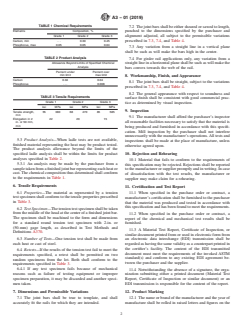
This specification covers steel joint bars of low-carbon, medium-carbon, and high-carbon grades (Grades 1, 2, and 3) for railway applications. Steel shall be made through basic-oxygen or electric-furnace processes and cast through continuous process or in ingots. An analysis of each heat or cast shall be made to determine the percentage compositions of carbon, manganese, phosphorus, and sulfur. Tension test shall also be made to conform to specified tensile strength and elongation values. Guidelines on the dimensions and physical variations of joint bars are given. Inspection, rejection, rehearing, certification, and product marking procedures are cited.
SCOPE
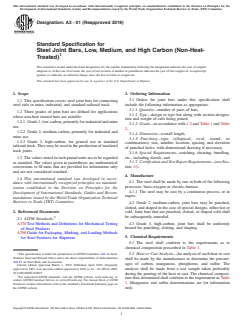
1.1 This specification covers steel joint bars for connecting steel rails in mine, industrial, and standard railroad track.
1.2 Three grades of joint bars are defined for applications where non-heat treated bars are suitable:
1.2.1 Grade 1, low-carbon, primarily for industrial and mine use.
1.2.2 Grade 2, medium-carbon, primarily for industrial and mine use.
1.2.3 Grade 3, high-carbon, for general use in standard railroad track. They may be used in the production of insulated track joints.
1.3 The values stated in inch-pound units are to be regarded as standard. The values given in parentheses are mathematical conversions to SI units that are provided for information only and are not considered standard.
1.4 This international standard was developed in accordance with internationally recognized principles on standardization established in the Decision on Principles for the Development of International Standards, Guides and Recommendations issued by the World Trade Organization Technical Barriers to Trade (TBT) Committee.
- Status
- Published
- Publication Date
- 28-Feb-2019
- Technical Committee
- A01 - Steel, Stainless Steel and Related Alloys
- Drafting Committee
- A01.01 - Steel Rails and Accessories


Overview
ASTM A3-01(2019) - Standard Specification for Steel Joint Bars, Low, Medium, and High Carbon (Non-Heat-Treated) is a recognized international standard developed by ASTM for steel joint bars used in railway applications. This specification outlines requirements for low, medium, and high carbon steel joint bars used to join rails across mine, industrial, and standard railroad tracks, where non-heat-treated bars are appropriate. The standard details the manufacturing methods, chemical composition, mechanical properties, dimensional tolerances, and marking requirements for steel joint bars to ensure safety, durability, and compatibility in rail joining applications.
Key Topics
Steel Grades:
- Grade 1: Low-carbon steel, primarily for industrial and mine use.
- Grade 2: Medium-carbon steel, also for industrial and mine use.
- Grade 3: High-carbon steel, used for general applications in standard railroad tracks, including insulated track joints.
Manufacturing Process:
- Steel must be produced using basic-oxygen or electric-furnace methods and cast either continuously or in ingots.
- Process requirements for punching, slotting, and shaping depend on the grade.
Chemical & Mechanical Requirements:
- Specifies permissible content of carbon, manganese, phosphorus, and sulfur.
- Requires tension tests to verify minimum tensile strength and elongation, with re-testing provisions.
- Product analysis may be performed for finished material as needed.
Dimensions & Variations:
- Provides detailed guidelines for the size, punch hole specifications, permissible dimension variations, and camber in both vertical and horizontal planes.
- Accuracy in fit and finish is emphasized for safety and performance.
Inspection & Certification:
- Calls for thorough inspection during manufacture, with test reports and certifications provided as ordered.
- Product marking includes manufacturer identification, year of manufacture, and additional section markings for Grade 3 bars.
Applications
- Railway Track Construction: ASTM A3-01(2019) joint bars are essential for securely connecting rail ends, ensuring track alignment and stability in mining operations, industrial facilities, and standard mainline railroads.
- Insulated Track Joints: Grade 3, high-carbon bars are suitable for use in the production of insulated track joints, which are critical for railway signaling systems.
- Maintenance and Repair: The standard supports rail infrastructure maintenance by providing specifications that ensure replacement joint bars are consistent with original design, fit, and performance requirements.
- Customized Rail Solutions: The ordering information framework allows facilities and contractors to specify dimensions, punching patterns, and special requirements for unique rail configurations.
Related Standards
- ASTM A370: Test Methods and Definitions for Mechanical Testing of Steel Products - referenced for tension testing procedures.
- ASTM A700: Guide for Packaging, Marking, and Loading Methods for Steel Products for Shipment - relevant for proper shipment and storage practices.
- Railway Engineering Standards: ASTM A3-01(2019) aligns with international best practices and is developed under World Trade Organization TBT principles, ensuring compatibility and wide acceptance for railway applications globally.
Keywords: ASTM A3-01(2019), steel joint bars, railway applications, non-heat-treated, track joints, rail connection, carbon steel, mechanical properties, rail industry standards, ASTM rail standards.
Relations
- Effective Date
- 01-Mar-2019
- Effective Date
- 01-Mar-2024
- Effective Date
- 01-Nov-2019
- Effective Date
- 01-Jul-2019
- Refers
ASTM A370-17a - Standard Test Methods and Definitions for Mechanical Testing of Steel Products - Effective Date
- 15-Nov-2017
- Effective Date
- 01-Jan-2017
- Effective Date
- 01-Nov-2015
- Effective Date
- 01-Nov-2014
- Effective Date
- 15-May-2014
- Effective Date
- 15-Nov-2013
- Refers
ASTM A370-12a - Standard Test Methods and Definitions for Mechanical Testing of Steel Products - Effective Date
- 15-Oct-2012
- Effective Date
- 15-Mar-2012
- Refers
ASTM A370-11a - Standard Test Methods and Definitions for Mechanical Testing of Steel Products - Effective Date
- 15-Nov-2011
- Effective Date
- 15-Jun-2010
- Refers
ASTM A370-09a - Standard Test Methods and Definitions for Mechanical Testing of Steel Products - Effective Date
- 01-Jun-2009
Get Certified
Connect with accredited certification bodies for this standard

Element Materials Technology
Materials testing and product certification.

Inštitut za kovinske materiale in tehnologije
Institute of Metals and Technology. Materials testing, metallurgical analysis, NDT.
Sponsored listings
Frequently Asked Questions
ASTM A3-01(2019) is a technical specification published by ASTM International. Its full title is "Standard Specification for Steel Joint Bars, Low, Medium, and High Carbon (Non-Heat-Treated)". This standard covers: ABSTRACT This specification covers steel joint bars of low-carbon, medium-carbon, and high-carbon grades (Grades 1, 2, and 3) for railway applications. Steel shall be made through basic-oxygen or electric-furnace processes and cast through continuous process or in ingots. An analysis of each heat or cast shall be made to determine the percentage compositions of carbon, manganese, phosphorus, and sulfur. Tension test shall also be made to conform to specified tensile strength and elongation values. Guidelines on the dimensions and physical variations of joint bars are given. Inspection, rejection, rehearing, certification, and product marking procedures are cited. SCOPE 1.1 This specification covers steel joint bars for connecting steel rails in mine, industrial, and standard railroad track. 1.2 Three grades of joint bars are defined for applications where non-heat treated bars are suitable: 1.2.1 Grade 1, low-carbon, primarily for industrial and mine use. 1.2.2 Grade 2, medium-carbon, primarily for industrial and mine use. 1.2.3 Grade 3, high-carbon, for general use in standard railroad track. They may be used in the production of insulated track joints. 1.3 The values stated in inch-pound units are to be regarded as standard. The values given in parentheses are mathematical conversions to SI units that are provided for information only and are not considered standard. 1.4 This international standard was developed in accordance with internationally recognized principles on standardization established in the Decision on Principles for the Development of International Standards, Guides and Recommendations issued by the World Trade Organization Technical Barriers to Trade (TBT) Committee.
ABSTRACT This specification covers steel joint bars of low-carbon, medium-carbon, and high-carbon grades (Grades 1, 2, and 3) for railway applications. Steel shall be made through basic-oxygen or electric-furnace processes and cast through continuous process or in ingots. An analysis of each heat or cast shall be made to determine the percentage compositions of carbon, manganese, phosphorus, and sulfur. Tension test shall also be made to conform to specified tensile strength and elongation values. Guidelines on the dimensions and physical variations of joint bars are given. Inspection, rejection, rehearing, certification, and product marking procedures are cited. SCOPE 1.1 This specification covers steel joint bars for connecting steel rails in mine, industrial, and standard railroad track. 1.2 Three grades of joint bars are defined for applications where non-heat treated bars are suitable: 1.2.1 Grade 1, low-carbon, primarily for industrial and mine use. 1.2.2 Grade 2, medium-carbon, primarily for industrial and mine use. 1.2.3 Grade 3, high-carbon, for general use in standard railroad track. They may be used in the production of insulated track joints. 1.3 The values stated in inch-pound units are to be regarded as standard. The values given in parentheses are mathematical conversions to SI units that are provided for information only and are not considered standard. 1.4 This international standard was developed in accordance with internationally recognized principles on standardization established in the Decision on Principles for the Development of International Standards, Guides and Recommendations issued by the World Trade Organization Technical Barriers to Trade (TBT) Committee.
ASTM A3-01(2019) is classified under the following ICS (International Classification for Standards) categories: 77.140.70 - Steel profiles. The ICS classification helps identify the subject area and facilitates finding related standards.
ASTM A3-01(2019) has the following relationships with other standards: It is inter standard links to ASTM A3-01(2012), ASTM A370-24, ASTM A700-14(2019), ASTM A370-19, ASTM A370-17a, ASTM A370-17, ASTM A370-15, ASTM A700-14, ASTM A370-14, ASTM A370-13, ASTM A370-12a, ASTM A370-12, ASTM A370-11a, ASTM A370-10, ASTM A370-09a. Understanding these relationships helps ensure you are using the most current and applicable version of the standard.
ASTM A3-01(2019) is available in PDF format for immediate download after purchase. The document can be added to your cart and obtained through the secure checkout process. Digital delivery ensures instant access to the complete standard document.
Standards Content (Sample)
This international standard was developed in accordance with internationally recognized principles on standardization established in the Decision on Principles for the
Development of International Standards, Guides and Recommendations issued by the World Trade Organization Technical Barriers to Trade (TBT) Committee.
Designation:A3 −01 (Reapproved 2019)
Standard Specification for
Steel Joint Bars, Low, Medium, and High Carbon (Non-Heat-
Treated)
This standard is issued under the fixed designationA3; the number immediately following the designation indicates the year of original
adoption or, in the case of revision, the year of last revision.Anumber in parentheses indicates the year of last reapproval.Asuperscript
epsilon (´) indicates an editorial change since the last revision or reapproval.
This standard has been approved for use by agencies of the U.S. Department of Defense.
1. Scope 3. Ordering Information
3.1 Orders for joint bars under this specification shall
1.1 This specification covers steel joint bars for connecting
include the following information as appropriate:
steel rails in mine, industrial, and standard railroad track.
3.1.1 Quantity—number of pairs of bars,
1.2 Three grades of joint bars are defined for applications
3.1.2 Type—design or type bar along with section designa-
where non-heat treated bars are suitable:
tion and weight of rails being joined,
1.2.1 Grade 1, low-carbon, primarily for industrial and mine
3.1.3 Grade—in accordance with 1.2 and Table 1 and Table
use.
2,
1.2.2 Grade 2, medium-carbon, primarily for industrial and
3.1.4 Dimension—overall length,
mine use.
3.1.5 Punching—type (elliptical, oval, round, or
1.2.3 Grade 3, high-carbon, for general use in standard
combinations), size, number, location, spacing, and elevation
railroad track. They may be used in the production of insulated
of punched holes, with dimensional drawing if necessary,
track joints.
3.1.6 Special Requirements—notching, shearing, bundling,
etc., including details, and
1.3 The values stated in inch-pound units are to be regarded
as standard. The values given in parentheses are mathematical 3.1.7 Certification and Test Report Requirements—(see Sec-
tion 11).
conversions to SI units that are provided for information only
and are not considered standard.
4. Manufacture
1.4 This international standard was developed in accor-
4.1 The steel shall be made by one or both of the following
dance with internationally recognized principles on standard-
processes: basic-oxygen or electric-furnace.
ization established in the Decision on Principles for the
4.1.1 The steel may be cast by a continuous process, or in
Development of International Standards, Guides and Recom-
ingots.
mendations issued by the World Trade Organization Technical
Barriers to Trade (TBT) Committee.
4.2 Grade 2, medium-carbon, joint bars may be punched,
slotted, and shaped in the case of special designs, either hot or
2. Referenced Documents
cold. Joint bars that are punched, slotted, or shaped cold shall
2 be subsequently annealed.
2.1 ASTM Standards:
A370 Test Methods and Definitions for Mechanical Testing 4.3 Grade 3, high-carbon, joint bars shall be uniformly
heated for punching, slotting, and shaping.
of Steel Products
A700 Guide for Packaging, Marking, and Loading Methods
5. Chemical Requirements
for Steel Products for Shipment
5.1 The steel shall conform to the requirements as to
chemical composition prescribed in Table 1.
This specification is under the jurisdiction of ASTM Committee A01 on Steel,
5.2 Heat or Cast Analysis—An analysis of each heat or cast
Stainless Steel and Related Alloys and is the direct responsibility of Subcommittee
shall be made by the manufacturer to determine the percent-
A01.01 on Steel Rails and Accessories.
ages of carbon, manganese, phosphorus, and sulfur. The
Current edition approved March 1, 2019. Published April 2019. Originally
analysis shall be made from a test sample taken preferably
approved in 1901. Last previous edition approved in 2012 as A3 – 01 (2012). DOI:
10.1520/A0003-01R19.
during the pouring of the heat or cast. The chemical composi-
For referenced ASTM standards, visit the ASTM website, www.astm.org, or
tion thus determined shall conform to the requirement in Table
contact ASTM Customer Service at service@astm.org. For Annual Book of ASTM
1. Manganese and sulfur determinations are for information
Standards volume information, refer to the standard’s Document Summary page on
the ASTM website. only.
Copyright © ASTM International, 100 Barr Harbor Drive, PO Box C700, West Conshohocken, PA 19428-2959. United States
A3−01 (2019)
TABLE 1 Chemical Requirements
7.2 The joint bars shall be either sheared or sawed to length,
Elements Composition, % punched to the dimensions specified by the purchaser and
Grade 1 Grade 2 Grade 3 alignment adjusted, all subject to the permissible variations
Carbon, min . . . 0.30 0.45 prescribed in 7.3, 7.4, and Table 4.
Phosphorus, max 0.05 0.05 0.04
7.3 Any variation from a straight line in a vertical plane
shall be such as will make the bars high in the center.
TABLE 2 Product Analysis
7.4 For girder rail applications only, any variation from a
Allowance Beyond Limits of Specified Chemical
straight line in a horizontal plane shall be such as will make the
Analysis
bars convex towards the web of the rail.
Percent under Percent over
min limit max limit
8. Workmanship, Finish, and Appearance
Carbon 0.04 0.04
8.1 The joint bars shall be straight, subject to the variations
Phosphorus . . . 0.008
prescribed in 7.3, 7.4, and Table 4.
8.2 The general appearance with respect to soundness and
TABLE 3 Tensile Requirements
surface finish shall be consistent with good commercial prac-
Grade 1 Grade 2 Grade 3
tice as determined by visual inspection.
ksi MPa ksi MPa ksi MPa
9. Inspection
Tensile strength, 55 380 68 470 85 585
min
9.1 The manufacturer shall afford the purchaser’s inspector
Elongation in 2 22 20 15
all reasonable facilities necessary to satisfy that the material is
in.or50mm,
min
being produced and furnished in accordance with this specifi-
cation. Mill inspection by the purchaser shall not interfere
unnecessarily with the manufacturer’s operations.All tests and
5.3 Product Analysis—When ladle tests are not available,
inspections shall be made at the place o
...