

ASTM D8184-18e1
(Test Method)Standard Test Method for Ferrous Wear Debris Monitoring in In-Service Fluids Using a Particle Quantifier Instrument
General Information
- Abstract
SIGNIFICANCE AND USE
5.1 This test method is intended for the application of PQ magnetometry in assessing the progression of wear in machinery, for example, engines and gearboxes, by trending the mass of ferrous debris in samples of lubricating oils or greases.
5.2 In-service oil analysis is carried out routinely by commercial laboratories on a wide range of samples from many sources and is accepted as a reliable means of monitoring machinery health by trend analysis. In particular, the extent of wear can be readily assessed from any changes in the ferrous debris burden within periodically extracted samples as reflected in the PQ Index.
5.3 PQ measurements can be used as a means of rapidly screening samples for the presence or absence of ferrous wear debris, allowing quick decisions to be made on whether or not to proceed to a more detailed spectroscopic analysis for probable wear metals in the sample.
5.4 The use of standardized sample containers and a consistent protocol enables reliable trending information to be recorded. Although it is not possible to assign general limits or thresholds for abnormal conditions, it is recommended that interpretation of PQ values should be carried out in consultation with historical data, equipment logs, and/or service history in order to formulate guidelines on individual items of machinery. Guide D7720 is particularly useful in this context.
SCOPE
1.1 This test method describes the use of offline particle quantification (often referred to as PQ) magnetometers to trend wear rates in machinery by monitoring the amount of ferromagnetic material suspended in a fluid sample that has been in contact with the moving parts of the machinery. It is particularly relevant to monitoring wear debris in lubricating oils and greases.
1.2 The values stated in SI units are to be regarded as standard. Values of the burden (mass) of ferrous wear debris in the sample are reported as a PQ Index. The PQ Index is a numerical value that scales with the ferrous debris burden.
1.3 This standard does not purport to address all of the safety concerns, if any, associated with its use. It is the responsibility of the user of this standard to establish appropriate safety, health, and environmental practices and determine the applicability of regulatory limitations prior to use.
1.4 This international standard was developed in accordance with internationally recognized principles on standardization established in the Decision on Principles for the Development of International Standards, Guides and Recommendations issued by the World Trade Organization Technical Barriers to Trade (TBT) Committee.
- Status
- Published
- Publication Date
- 14-May-2018
- Technical Committee
- D02 - Petroleum Products, Liquid Fuels, and Lubricants
Overview
ASTM D8184-18e1 provides a standardized test method for monitoring ferrous wear debris in in-service fluids using a Particle Quantifier (PQ) instrument. Developed by ASTM International, this method is widely used in the condition monitoring of machinery such as engines, gearboxes, and hydraulics. The standard enables trend analysis by quantifying ferromagnetic material-primarily iron and steel particles-suspended in lubricating oils and greases. The resulting PQ Index gives a numerical measurement reflecting the mass of these ferrous particles, supporting proactive maintenance efforts and enhancing the reliability of heavy equipment and machinery.
Key Topics
Ferrous Wear Debris Detection: The method relies on PQ magnetometry, which accurately measures the ferrous content in oil and grease samples. As ferrous particles are mainly generated by mechanical wear, tracking them helps identify early-stage machinery deterioration.
PQ Index: Results from the test are reported as a PQ Index, a dimensionless numerical value proportional to the ferrous debris burden. This allows for direct comparison and trend monitoring over time.
Routine Oil Analysis: The standard is tailored for use in commercial laboratories that regularly analyze a wide variety of equipment samples. This routine analysis is an essential component of predictive maintenance programs.
Screening and Advanced Analysis: PQ measurements can quickly screen samples for potential problems, enabling rapid decision-making on whether more detailed, often more expensive, spectroscopic analyses (such as ICP-OES or RDE-OES) are warranted.
Sample Handling Consistency: Consistent procedures in sample collection, container type, and handling are crucial for reliable trending and interpretation. This includes standardized bottle fill levels and timely homogenization before measurement.
Interpreting Results: While the PQ Index indicates ferrous content, the standard advocates for interpreting results with reference to historical data and equipment logs, supporting informed maintenance decisions. General thresholds are not prescribed due to machinery variability.
Applications
Predictive Maintenance: Regular PQ testing allows organizations to track wear progression, schedule maintenance proactively, and minimize unplanned downtime.
Machinery Health Monitoring: By trending changes in ferrous debris content, maintenance teams can monitor the health of critical equipment such as engines, gearboxes, transmissions, final drive units, and hydraulic systems.
Screening for Further Testing: PQ analysis serves as an efficient first-line screening tool. Samples with elevated PQ Index values can be prioritized for more exhaustive wear metal analysis to pinpoint the sources and types of wear.
Quality Control and Assurance: Consistent use of this test method helps laboratories ensure data integrity and comparability across samples and over time.
Industry Sectors: This standard is applied extensively in the transportation, construction, power generation, mining, and manufacturing sectors, where equipment reliability is critical.
Related Standards
- ASTM D4057: Practice for Manual Sampling of Petroleum and Petroleum Products.
- ASTM D4177: Practice for Automatic Sampling of Petroleum and Petroleum Products.
- ASTM D5185: Test Method for Multielement Determination of Used and Unused Lubricating Oils and Base Oils by Inductively Coupled Plasma Atomic Emission Spectrometry (ICP-AES).
- ASTM D6300: Practice for Determination of Precision and Bias Data for Use in Test Methods for Petroleum Products and Lubricants.
- ASTM D7720: Guide for Statistically Evaluating Measurand Alarm Limits when Using Oil Analysis to Monitor Equipment and Oil for Fitness and Contamination.
- ASTM D4175: Terminology Relating to Petroleum Products, Liquid Fuels, and Lubricants.
By following ASTM D8184-18e1, organizations benefit from early detection of wear, enhanced machinery uptime, improved maintenance strategies, and standardized oil analysis procedures. This test method becomes an essential component in any comprehensive machine condition monitoring and reliability program.
Relations
- Effective Date
- 15-May-2018
- Effective Date
- 01-Mar-2024
- Refers
ASTM D4175-23a - Standard Terminology Relating to Petroleum Products, Liquid Fuels, and Lubricants - Effective Date
- 15-Dec-2023
- Effective Date
- 01-Dec-2023
- Refers
ASTM D4175-23e1 - Standard Terminology Relating to Petroleum Products, Liquid Fuels, and Lubricants - Effective Date
- 01-Jul-2023
- Effective Date
- 01-Dec-2019
- Effective Date
- 01-Apr-2018
- Effective Date
- 01-Apr-2016
- Effective Date
- 01-Jun-2015
- Effective Date
- 01-Jun-2014
- Effective Date
- 01-Jun-2014
- Effective Date
- 01-May-2014
- Effective Date
- 01-Dec-2013
- Effective Date
- 15-Jul-2013
- Effective Date
- 01-Jun-2011
Get Certified
Connect with accredited certification bodies for this standard

Element Materials Technology
Materials testing and product certification.

ABS Group Brazil
ABS Group certification services in Brazil.

ABS Quality Evaluations Inc.
American Bureau of Shipping quality certification.
Sponsored listings
Frequently Asked Questions
ASTM D8184-18e1 is a standard published by ASTM International. Its full title is "Standard Test Method for Ferrous Wear Debris Monitoring in In-Service Fluids Using a Particle Quantifier Instrument". This standard covers: SIGNIFICANCE AND USE 5.1 This test method is intended for the application of PQ magnetometry in assessing the progression of wear in machinery, for example, engines and gearboxes, by trending the mass of ferrous debris in samples of lubricating oils or greases. 5.2 In-service oil analysis is carried out routinely by commercial laboratories on a wide range of samples from many sources and is accepted as a reliable means of monitoring machinery health by trend analysis. In particular, the extent of wear can be readily assessed from any changes in the ferrous debris burden within periodically extracted samples as reflected in the PQ Index. 5.3 PQ measurements can be used as a means of rapidly screening samples for the presence or absence of ferrous wear debris, allowing quick decisions to be made on whether or not to proceed to a more detailed spectroscopic analysis for probable wear metals in the sample. 5.4 The use of standardized sample containers and a consistent protocol enables reliable trending information to be recorded. Although it is not possible to assign general limits or thresholds for abnormal conditions, it is recommended that interpretation of PQ values should be carried out in consultation with historical data, equipment logs, and/or service history in order to formulate guidelines on individual items of machinery. Guide D7720 is particularly useful in this context. SCOPE 1.1 This test method describes the use of offline particle quantification (often referred to as PQ) magnetometers to trend wear rates in machinery by monitoring the amount of ferromagnetic material suspended in a fluid sample that has been in contact with the moving parts of the machinery. It is particularly relevant to monitoring wear debris in lubricating oils and greases. 1.2 The values stated in SI units are to be regarded as standard. Values of the burden (mass) of ferrous wear debris in the sample are reported as a PQ Index. The PQ Index is a numerical value that scales with the ferrous debris burden. 1.3 This standard does not purport to address all of the safety concerns, if any, associated with its use. It is the responsibility of the user of this standard to establish appropriate safety, health, and environmental practices and determine the applicability of regulatory limitations prior to use. 1.4 This international standard was developed in accordance with internationally recognized principles on standardization established in the Decision on Principles for the Development of International Standards, Guides and Recommendations issued by the World Trade Organization Technical Barriers to Trade (TBT) Committee.
SIGNIFICANCE AND USE 5.1 This test method is intended for the application of PQ magnetometry in assessing the progression of wear in machinery, for example, engines and gearboxes, by trending the mass of ferrous debris in samples of lubricating oils or greases. 5.2 In-service oil analysis is carried out routinely by commercial laboratories on a wide range of samples from many sources and is accepted as a reliable means of monitoring machinery health by trend analysis. In particular, the extent of wear can be readily assessed from any changes in the ferrous debris burden within periodically extracted samples as reflected in the PQ Index. 5.3 PQ measurements can be used as a means of rapidly screening samples for the presence or absence of ferrous wear debris, allowing quick decisions to be made on whether or not to proceed to a more detailed spectroscopic analysis for probable wear metals in the sample. 5.4 The use of standardized sample containers and a consistent protocol enables reliable trending information to be recorded. Although it is not possible to assign general limits or thresholds for abnormal conditions, it is recommended that interpretation of PQ values should be carried out in consultation with historical data, equipment logs, and/or service history in order to formulate guidelines on individual items of machinery. Guide D7720 is particularly useful in this context. SCOPE 1.1 This test method describes the use of offline particle quantification (often referred to as PQ) magnetometers to trend wear rates in machinery by monitoring the amount of ferromagnetic material suspended in a fluid sample that has been in contact with the moving parts of the machinery. It is particularly relevant to monitoring wear debris in lubricating oils and greases. 1.2 The values stated in SI units are to be regarded as standard. Values of the burden (mass) of ferrous wear debris in the sample are reported as a PQ Index. The PQ Index is a numerical value that scales with the ferrous debris burden. 1.3 This standard does not purport to address all of the safety concerns, if any, associated with its use. It is the responsibility of the user of this standard to establish appropriate safety, health, and environmental practices and determine the applicability of regulatory limitations prior to use. 1.4 This international standard was developed in accordance with internationally recognized principles on standardization established in the Decision on Principles for the Development of International Standards, Guides and Recommendations issued by the World Trade Organization Technical Barriers to Trade (TBT) Committee.
ASTM D8184-18e1 is classified under the following ICS (International Classification for Standards) categories: 75.100 - Lubricants, industrial oils and related products. The ICS classification helps identify the subject area and facilitates finding related standards.
ASTM D8184-18e1 has the following relationships with other standards: It is inter standard links to ASTM D8184-18, ASTM D6300-24, ASTM D4175-23a, ASTM D6300-23a, ASTM D4175-23e1, ASTM D6300-19a, ASTM D5185-18, ASTM D6300-16, ASTM D6300-15, ASTM D6300-14ae1, ASTM D6300-14a, ASTM D6300-14, ASTM D6300-13a, ASTM D6300-13, ASTM D7720-11. Understanding these relationships helps ensure you are using the most current and applicable version of the standard.
ASTM D8184-18e1 is available in PDF format for immediate download after purchase. The document can be added to your cart and obtained through the secure checkout process. Digital delivery ensures instant access to the complete standard document.
Standards Content (Sample)
This international standard was developed in accordance with internationally recognized principles on standardization established in the Decision on Principles for the
Development of International Standards, Guides and Recommendations issued by the World Trade Organization Technical Barriers to Trade (TBT) Committee.
´1
Designation:D8184 −18
Standard Test Method for
Ferrous Wear Debris Monitoring in In-Service Fluids Using a
Particle Quantifier Instrument
This standard is issued under the fixed designation D8184; the number immediately following the designation indicates the year of
original adoption or, in the case of revision, the year of last revision. A number in parentheses indicates the year of last reapproval. A
superscript epsilon (´) indicates an editorial change since the last revision or reapproval.
ε NOTE—A Research Report footnote was added editorially in June 2019.
1. Scope D4177 Practice for Automatic Sampling of Petroleum and
Petroleum Products
1.1 This test method describes the use of offline particle
D5185 Test Method for Multielement Determination of
quantification (often referred to as PQ) magnetometers to trend
Used and Unused Lubricating Oils and Base Oils by
wear rates in machinery by monitoring the amount of ferro-
Inductively Coupled Plasma Atomic Emission Spectrom-
magnetic material suspended in a fluid sample that has been in
etry (ICP-AES)
contact with the moving parts of the machinery. It is particu-
D6300 Practice for Determination of Precision and Bias
larly relevant to monitoring wear debris in lubricating oils and
Data for Use in Test Methods for Petroleum Products and
greases.
Lubricants
1.2 The values stated in SI units are to be regarded as
D7720 Guide for Statistically Evaluating Measurand Alarm
standard.Values of the burden (mass) of ferrous wear debris in
Limits when Using Oil Analysis to Monitor Equipment
the sample are reported as a PQ Index. The PQ Index is a
and Oil for Fitness and Contamination
numerical value that scales with the ferrous debris burden.
1.3 This standard does not purport to address all of the
3. Terminology
safety concerns, if any, associated with its use. It is the
3.1 Definitions:
responsibility of the user of this standard to establish appro-
3.1.1 condition monitoring, n—the recording and analyzing
priate safety, health, and environmental practices and deter-
of data relating to the condition of equipment or machinery for
mine the applicability of regulatory limitations prior to use.
the purpose of predictive maintenance or optimization of
1.4 This international standard was developed in accor-
performance.
dance with internationally recognized principles on standard-
3.1.2 ferromagnetic, n—metals, alloys, and other materials
ization established in the Decision on Principles for the
that exhibit medium to high magnetic permeabilities; further
Development of International Standards, Guides and Recom-
classified into “hard” and “soft” magnetic materials when
mendations issued by the World Trade Organization Technical
capable of becoming permanently magnetized or not, respec-
Barriers to Trade (TBT) Committee.
tively.
2. Referenced Documents
3.1.3 inductively coupled plasma optical emission spectros-
copy (ICP-OES), n—a form of emission spectroscopy that uses
2.1 ASTM Standards:
a plasma to excite atoms and ions that subsequently emit
D4057 Practice for Manual Sampling of Petroleum and
electromagnetic radiation in the visible region; the emission
Petroleum Products
wavelengths are characteristic of a particular wavelength, and
D4175 Terminology Relating to Petroleum Products, Liquid
the intensity of emission is related to the concentration of the
Fuels, and Lubricants
emitting element.
3.1.4 machinery health, n—qualitative indication of the
This test method is under the jurisdiction of ASTM Committee D02 on
overall condition of equipment or machinery; may depend on
Petroleum Products, Liquid Fuels, and Lubricants and is the direct responsibility of
data and trend analysis from several sources.
Subcommittee D02.96.06 on Practices and Techniques for Prediction and Determi-
nation of Microscopic Wear and Wear-related Properties.
3.1.5 PQI, n—a dimensionless index related to the ferro-
Current edition approved May 15, 2018. Published June 2018. DOI: 10.1520/
magnetic content of an oil or grease sample.
D8184-18E01.
For referenced ASTM standards, visit the ASTM website, www.astm.org, or
3.1.5.1 Discussion—The scale is defined by a 750 PQI
contact ASTM Customer Service at service@astm.org. For Annual Book of ASTM
primary standard developed by The University of Swansea in
Standards volume information, refer to the standard’s Document Summary page on
the ASTM website. the 1980s. The original primary standard is currently in the
Copyright © ASTM International, 100 Barr Harbor Drive, PO Box C700, West Conshohocken, PA 19428-2959. United States
´1
D8184−18
possession of Parker Hannifin Manufacturing Ltd. debris burden within periodically extracted samples as re-
(Littlehampton, UK) who manufacture and supply secondary flected in the PQ Index.
standards for instrument validation purposes.
5.3 PQ measurements can be used as a means of rapidly
3.1.6 rotating disc electrode optical emission spectroscopy
screening samples for the presence or absence of ferrous wear
(RDE-OES), n—similar to ICP-OES, but the exciting medium
debris, allowing quick decisions to be made on whether or not
is now an electrical discharge between an electrode and a
to proceed to a more detailed spectroscopic analysis for
rotating disc with the oil sample located within the discharge.
probable wear metals in the sample.
3.1.7 trend analysis, n—the interpretation of regular or
5.4 The use of standardized sample containers and a con-
continuous (in time) condition monitoring data in order to
sistent protocol enables reliable trending information to be
determine any changes indicative of deterioration or incipient
recorded.Although it is not possible to assign general limits or
failure in equipment or machinery.
thresholds for abnormal conditions, it is recommended that
3.1.8 wear, n—the loss of material from a surface, generally
interpretation of PQ values should be carried out in consulta-
occurring between two surfaces in relative motion, and result-
tionwithhistoricaldata,equipmentlogs,and/orservicehistory
ing from mechanical or chemical action, or a combination of
in order to formulate guidelines on individual items of machin-
both.
ery. Guide D7720 is particularly useful in this context.
4. Summary of Test Method
6. Interferences
4.1 Lubricating Oils—Asample of oil is extracted from the
6.1 Sample Related Interferences:
machinery and collected in a bottle to a depth sufficient to
6.1.1 PQ instruments have a high sensitivity to the presence
exceed the flux field of the sensing coil in the instrument.
of low concentrations of ferromagnetic materials in the test
Distortion of the flux field due to the presence of any
material (iron, steel, and so forth) due to their magnetic
ferromagnetic material is determined and a numerical value
susceptibility. However, large concentrations of high conduc-
(PQ Index) assigned to the extent of the distortion. This index
tivity metals, for example, copper, can cause a small distortion
is related to the concentration and spatial distribution of the
to the excitation field through the generation of eddy currents
ferromagneticmaterialwithinthesensingvolumeofthecoil.If
in the debris particles. These eddy currents generate an
the oil sample has been undisturbed for some time, this is the
opposing ac magnetic field to the excitation field (Lenz’s law),
same as the concentration within the bulk. However, if the
which causes an imbalance and hence a detectable signal. Note
ferrous burden undergoes settling, for example, from an initial
that this phenomenon is several orders of magnitude lower in
well-shaken state, then the signal may exhibit a time depen-
effect than that due to the magnetic permeability of ferrous
dency due to debris mobility. It is possible to derive informa-
materials. The presence of any suspected high conductivity
tion on the size (mass) of the debris from the rate of any time
metal contamination can be verified or eliminated by, for
dependent behavior noted.
example, Test Method D5185.
4.2 Greases—Asampleofgreaseissimilarlyextractedfrom
6.2 External (Environmental) Interferences:
a bearing housing or similar and transferred to a small volume
6.2.1 As noted in 9.2, the toner material in some printed
(5 mL) pot. Reliable trending information requires the use of
labels can contain iron powder and care should be taken to
the same size and shape of pot for reasons of consistency.
eliminate this interference by careful label positioning and/or
Mobility of debris within grease is restricted, the contents of
the use of non-iron containing inks.
the pot are completely within the flux field of the sensing coil,
6.2.2 PQinstrumentsshouldnotbesitedonorclosetolarge
and no time dependent behavior is observed.
metallic structures due to the possibility of field distortion
caused by their proximity, see 10.1.
5. Significance and Use
7. Apparatus
5.1 This test method is intended for the application of PQ
magnetometry in assessing the progression of wear in
7.1 PQ instruments are of a propriety design and currently
4,5
machinery, for example, engines and gearboxes, by trending
manufactured by Parker Hannifin Ltd., Littlehampton, U.K.
the mass of ferrous debris in samples of lubricating oils or
The development of PQ test methodology began at Swansea
greases.
University in the 1980s. Instruments have been manufactured
under license, since the initial development, by Swansea Oil
5.2 In-service oil analysis is carried out routinely by com-
Analysis Program (SOAP) Ltd., Analex Ltd., and Kittiwake
mercial laboratories on a wide range of samples from many
Developments Ltd, and a large number are still in operation in
sources and is accepted as a reliable means of monitoring
machinery health by trend analysis. In particular, the extent of
wear can be readily assessed from any changes in the ferrous
The sole source of supply of the apparatus known to the committee at this time
is Parker Hannifin Ltd., Littlehampton, U.K. If you are aware of alternative
suppliers, please provide this information to ASTM International Headquarters.
The sole source of supply of the apparatus (recommended grease sample pots) Your comments will receive careful consideration at a meeting of the responsible
known to the committee at this time is Parker Hannifin Ltd., Littlehampton, UK. If technical committee, which you may attend.
you are aware of alternative suppliers, please provide this information to ASTM PQ – GB trademark number 2210262 for “Apparatus and instruments for the
International Headquarters. Your comments will receive careful consideration at a detection and/or quantification of wear debris in lubricating fluids and hydraulic
meeting of the responsible technical committee, which you may attend. fluids,” applies to the instrument and not the measurement index.
´1
D8184−18
many commercial laboratories. Current PQ instruments are 9. Sampling, Test Specimens, and Test Units
marketed and supported globally by Parker Hannifin Ltd.
9.1 In-service oil and grease samples should be collected in
7.2 Adescription of the apparatus and method can be found accordance with the practices described in Practice D4057 or
in the patents listed in Related Materials. In brief, PQ instru- Practice D4177. Oil samples should be transferred to clean
ments comprise an excitation coil providing an ac magnetic 100 mL bottles or 5 mL pots and sealed (Fig. 3). Grease
field with a frequency between 1 kHz and 10 kHz, two sense samples should be transferred to 5 mL pots and similarly
coils arranged above and below the excitation coil and with the sealed. Suitable containers are available from several manu-
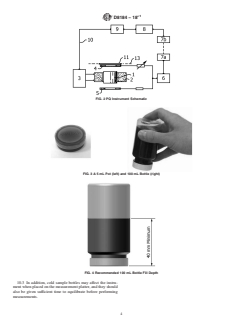
sample sited close to one of the excitation coils. See Fig. 1 and facturers. For oil samples in 100 mL bottles, a minimum fill
Fig. 2 for details. In Fig. 2, 11 and 13 are the sample and a depth of 40 mm is recommended (Fig. 4). The 5 mL pots
support plate, 2 is the excitation coil wound on a former (1), 3 should be completely filled with either oil or grease samples; a
is an oscillator driving this coil, 4 and 5 are the two sense coils consistent approach with respect to sample volume in this step
arranged in a differential manner (initially balanced by some will provide the most reliable results.
means to provide a null signal), with 6 through 8 providing a
9.2 Note that certain printer toners and inks can contain iron
means to detect and amplify any subsequent imbalance in the
oxides.Ifitisrequiredtoattachprint
...