

ASTM D6075-13(2020)
(Test Method)Standard Test Method for Cracking Resistance of Leather
General Information
- Abstract
SIGNIFICANCE AND USE
5.1 This test method is designed to determine the cracking resistance of the grain or finish surface of leather on a pass/fail basis. This test method attempts to replicate the conditions that may be encountered by leather that is bent around a buckle frame or other anchoring device, folded over in seams or welts, and so forth. The cracking resistance of leather is influenced by many factors such as quantity, location, and type of fatliquoring materials; moisture content; thickness; the presence of defects or scar tissue, or both; the presence of processing damages to the skin or hide tissue; finish system formulation, and so forth. This test method is useful for manufacturing control in the tannery, specification acceptance, and quality control in the end product manufacturing plant.
SCOPE
1.1 This test method covers the determination of the resistance of leather to cracking when the leather is bent or folded with the grain (or finish) surface on the outside of the bend. Heavy leathers (for example, harness, belt, strap, bag, case, and so forth) are usually bent around a mandrel using either mechanical resistance (for example, clamp, vise, and so forth) or by hand. Lighter leathers (for example, shoe upper, upholstery, garment, glove, and so forth) are usually given a sharp double-fold (crosswise) bend after cooling to a low temperature. This test method does not apply to wet blue.
1.2 The values stated in SI units are to be regarded as the standard. The values given in parentheses are for information only.
1.3 This standard does not purport to address all of the safety concerns, if any, associated with its use. It is the responsibility of the user of this standard to establish appropriate safety, health, and environmental practices and determine the applicability of regulatory limitations prior to use.
1.4 This international standard was developed in accordance with internationally recognized principles on standardization established in the Decision on Principles for the Development of International Standards, Guides and Recommendations issued by the World Trade Organization Technical Barriers to Trade (TBT) Committee.
- Status
- Published
- Publication Date
- 30-Nov-2020
- Technical Committee
- D31 - Leather
- Drafting Committee
- D31.01 - Vegetable Leather


Overview
ASTM D6075-13(2020) - Standard Test Method for Cracking Resistance of Leather establishes reliable procedures to determine the cracking resistance of leather surfaces under mechanical stress. Developed and maintained by ASTM International, this standard replicates real-world situations where leather products experience bending, folding, or stress around frames or seams. The method applies to both heavy leathers (such as harness, strap, or bag leathers) and lighter leathers (like shoe uppers, upholstery, and glove leathers), providing manufacturers and quality control personnel with a crucial pass/fail assessment for product durability.
This standard aims to support manufacturing control in tanneries, specification compliance, and quality management in end-product manufacturing facilities. It is recognized internationally and aligns with the World Trade Organization's principles for developing technical standards.
Key Topics
Test Procedures: The standard details three main procedures for assessing cracking resistance, tailored to heavy and lighter leather types:
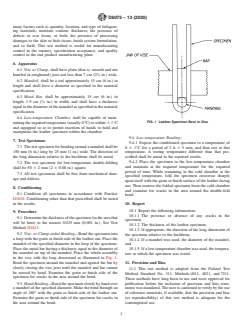
- Mandrel bending with a vise or clamp for heavy leathers
- Hand bending over a mandrel for heavy leathers
- Low-temperature double-fold bending for lighter leathers
Specimen Conditioning: Specimens must be conditioned per ASTM D1610, ensuring consistency in moisture and temperature prior to testing.
Cracks Evaluation: Visual inspection for finish cracking (ruptures in the finish layer) or grain cracking (ruptures of the grain enamel on the leather surface), both of which may impact product integrity.
Result Reporting: Requires documenting the presence or absence of cracks, specimen thickness, bending method, mandrel diameter, and any temperature conditions used during testing.
Influencing Factors: Emphasizes fatliquoring materials, moisture content, leather thickness, physical defects, finish systems, and processing damages as key variables affecting resistance to cracking.
Applications
ASTM D6075-13(2020) is widely applied in the leather industry to ensure the quality, durability, and reliability of finished products. Typical applications include:
- Tanneries: Helps monitor process variables and maintain quality standards in raw and finished leathers.
- Product Manufacturers: Used for acceptance testing and quality control in the production of belts, harnesses, luggage, handbags, footwear, automotive and furniture upholstery, and gloves.
- Specification Compliance: Assists in contractual or regulatory acceptance of leather goods by demonstrating conformance to cracking resistance requirements.
- Research and Development: Serves as a reference in developing more robust leather processing methods and finish formulations.
By adhering to ASTM D6075-13(2020), manufacturers can minimize product failures caused by grain or finish cracking when leather is subjected to routine wear and handling.
Related Standards
- ASTM D1517: Terminology Relating to Leather, provides standardized definitions for leather industry terms.
- ASTM D1610: Practice for Conditioning Leather and Leather Products for Testing, outlines proper specimen conditioning.
- ASTM D1813: Test Method for Measuring Thickness of Leather Test Specimens.
- Federal Test Method Standards 4011, 4021, and 7211: Predecessors integrated into the current test method.
These related standards ensure compatibility and comprehensive coverage for testing leather quality, supporting industry-wide consistency and reliability.
Keywords: ASTM D6075-13(2020), cracking resistance of leather, leather testing standard, grain cracking, finish cracking, leather durability, quality control, leather manufacturing standards, leather product reliability.
Relations
- Effective Date
- 01-Dec-2015
- Refers
ASTM D1610-01(2013) - Standard Practice for Conditioning Leather and Leather Products for Testing - Effective Date
- 01-May-2013
- Effective Date
- 01-May-2013
- Effective Date
- 01-Oct-2010
- Effective Date
- 01-Oct-2010
- Refers
ASTM D1610-01(2007) - Standard Practice for Conditioning Leather and Leather Products for Testing - Effective Date
- 01-Apr-2007
- Effective Date
- 01-Oct-2006
- Effective Date
- 01-Apr-2005
- Effective Date
- 01-Sep-2004
- Effective Date
- 01-Sep-2004
- Effective Date
- 01-Apr-2004
- Effective Date
- 10-May-2001
- Effective Date
- 10-May-2001
- Effective Date
- 10-May-2000
- Effective Date
- 10-May-1999
Get Certified
Connect with accredited certification bodies for this standard

Control Union Certifications
Global certification for agriculture and sustainability.

Hohenstein Institut
Textile testing and certification.

Bureau Veritas Bangladesh
Bureau Veritas certification services in Bangladesh.
Sponsored listings
Frequently Asked Questions
ASTM D6075-13(2020) is a standard published by ASTM International. Its full title is "Standard Test Method for Cracking Resistance of Leather". This standard covers: SIGNIFICANCE AND USE 5.1 This test method is designed to determine the cracking resistance of the grain or finish surface of leather on a pass/fail basis. This test method attempts to replicate the conditions that may be encountered by leather that is bent around a buckle frame or other anchoring device, folded over in seams or welts, and so forth. The cracking resistance of leather is influenced by many factors such as quantity, location, and type of fatliquoring materials; moisture content; thickness; the presence of defects or scar tissue, or both; the presence of processing damages to the skin or hide tissue; finish system formulation, and so forth. This test method is useful for manufacturing control in the tannery, specification acceptance, and quality control in the end product manufacturing plant. SCOPE 1.1 This test method covers the determination of the resistance of leather to cracking when the leather is bent or folded with the grain (or finish) surface on the outside of the bend. Heavy leathers (for example, harness, belt, strap, bag, case, and so forth) are usually bent around a mandrel using either mechanical resistance (for example, clamp, vise, and so forth) or by hand. Lighter leathers (for example, shoe upper, upholstery, garment, glove, and so forth) are usually given a sharp double-fold (crosswise) bend after cooling to a low temperature. This test method does not apply to wet blue. 1.2 The values stated in SI units are to be regarded as the standard. The values given in parentheses are for information only. 1.3 This standard does not purport to address all of the safety concerns, if any, associated with its use. It is the responsibility of the user of this standard to establish appropriate safety, health, and environmental practices and determine the applicability of regulatory limitations prior to use. 1.4 This international standard was developed in accordance with internationally recognized principles on standardization established in the Decision on Principles for the Development of International Standards, Guides and Recommendations issued by the World Trade Organization Technical Barriers to Trade (TBT) Committee.
SIGNIFICANCE AND USE 5.1 This test method is designed to determine the cracking resistance of the grain or finish surface of leather on a pass/fail basis. This test method attempts to replicate the conditions that may be encountered by leather that is bent around a buckle frame or other anchoring device, folded over in seams or welts, and so forth. The cracking resistance of leather is influenced by many factors such as quantity, location, and type of fatliquoring materials; moisture content; thickness; the presence of defects or scar tissue, or both; the presence of processing damages to the skin or hide tissue; finish system formulation, and so forth. This test method is useful for manufacturing control in the tannery, specification acceptance, and quality control in the end product manufacturing plant. SCOPE 1.1 This test method covers the determination of the resistance of leather to cracking when the leather is bent or folded with the grain (or finish) surface on the outside of the bend. Heavy leathers (for example, harness, belt, strap, bag, case, and so forth) are usually bent around a mandrel using either mechanical resistance (for example, clamp, vise, and so forth) or by hand. Lighter leathers (for example, shoe upper, upholstery, garment, glove, and so forth) are usually given a sharp double-fold (crosswise) bend after cooling to a low temperature. This test method does not apply to wet blue. 1.2 The values stated in SI units are to be regarded as the standard. The values given in parentheses are for information only. 1.3 This standard does not purport to address all of the safety concerns, if any, associated with its use. It is the responsibility of the user of this standard to establish appropriate safety, health, and environmental practices and determine the applicability of regulatory limitations prior to use. 1.4 This international standard was developed in accordance with internationally recognized principles on standardization established in the Decision on Principles for the Development of International Standards, Guides and Recommendations issued by the World Trade Organization Technical Barriers to Trade (TBT) Committee.
ASTM D6075-13(2020) is classified under the following ICS (International Classification for Standards) categories: 59.140.30 - Leather and furs. The ICS classification helps identify the subject area and facilitates finding related standards.
ASTM D6075-13(2020) has the following relationships with other standards: It is inter standard links to ASTM D1517-15, ASTM D1610-01(2013), ASTM D1813-13, ASTM D1813-00(2010), ASTM D1517-10, ASTM D1610-01(2007), ASTM D1517-06, ASTM D1813-00(2005), ASTM D1517-04, ASTM D1517-04e1, ASTM D1517-99(2004), ASTM D1610-01, ASTM D1610-00, ASTM D1813-00, ASTM D1517-99. Understanding these relationships helps ensure you are using the most current and applicable version of the standard.
ASTM D6075-13(2020) is available in PDF format for immediate download after purchase. The document can be added to your cart and obtained through the secure checkout process. Digital delivery ensures instant access to the complete standard document.
Standards Content (Sample)
This international standard was developed in accordance with internationally recognized principles on standardization established in the Decision on Principles for the
Development of International Standards, Guides and Recommendations issued by the World Trade Organization Technical Barriers to Trade (TBT) Committee.
Designation: D6075 − 13 (Reapproved 2020)
Standard Test Method for
Cracking Resistance of Leather
This standard is issued under the fixed designation D6075; the number immediately following the designation indicates the year of
original adoption or, in the case of revision, the year of last revision. A number in parentheses indicates the year of last reapproval. A
superscript epsilon (´) indicates an editorial change since the last revision or reapproval.
This standard has been approved for use by agencies of the U.S. Department of Defense.
1. Scope D1610 Practice for Conditioning Leather and Leather Prod-
ucts for Testing
1.1 This test method covers the determination of the resis-
D1813 Test Method for Measuring Thickness of Leather
tance of leather to cracking when the leather is bent or folded
Test Specimens
with the grain (or finish) surface on the outside of the bend.
Heavyleathers(forexample,harness,belt,strap,bag,case,and
3. Terminology
so forth) are usually bent around a mandrel using either
3.1 For definitions of general leather terms used in this test
mechanical resistance (for example, clamp, vise, and so forth)
method, refer to Terminology D1517.
or by hand. Lighter leathers (for example, shoe upper,
upholstery, garment, glove, and so forth) are usually given a
3.2 Definitions:
sharp double-fold (crosswise) bend after cooling to a low
3.2.1 finish cracking—the appearance of cracks (that is,
temperature. This test method does not apply to wet blue.
ruptures) in the finish of leather which may extend through the
finish layer to the surface of the crust leather or deeper.
1.2 The values stated in SI units are to be regarded as the
standard. The values given in parentheses are for information 3.2.2 grain cracking—the appearance of cracks (that is,
only.
ruptures of the grain enamel) on the grain surface of the leather
which may even extend deeper into the leather cross section.
1.3 This standard does not purport to address all of the
safety concerns, if any, associated with its use. It is the
4. Summary of Test Method
responsibility of the user of this standard to establish appro-
4.1 A specimen of leather is conditioned and then bent by
priate safety, health, and environmental practices and deter-
one of three procedures. The grain (or finish) surface of the
mine the applicability of regulatory limitations prior to use.
bent specimen is then examined for the appearance of any
1.4 This international standard was developed in accor-
dance with internationally recognized principles on standard- cracks or ruptures in the area around the bend.
4.1.1 One bending procedure for heavier leathers involves a
ization established in the Decision on Principles for the
Development of International Standards, Guides and Recom- mandrel rod, a metal bar with thickness equal to the diameter
of the mandrel, and a large clamp or vise to force and hold the
mendations issued by the World Trade Organization Technical
leather in the bent configuration around the mandrel with the
Barriers to Trade (TBT) Committee.
metal bar placed between the flesh surfaces of the bent leather.
2. Referenced Documents
4.1.2 A second bending procedure for heavier leathers
involves bending the leather around a mandrel by hand and
2.1 ASTM Standards:
forcing and holding the leather so the flesh surfaces of the bent
D1517 Terminology Relating to Leather
leather are in contact.
4.1.3 Athird bending procedure for lighter leathers involves
This test method is under the jurisdiction ofASTM Committee D31 on Leather
cooling the leather specimen and then creating a sharp double
and is the direct responsibility of Subcommittee D31.01 on Vegetable Leather. This
(crosswise) fold while the specimen remains in the cold
test method is a combination of three methods (that is, Methods 4011, 4021,
chamber.
and 7211) that were part of FederalTest Method Standard No. 311.This test method
was developed in cooperation with the U.S. Defense Personnel Support Center,
5. Significance and Use
Directorate of Clothing and Textiles, Philadelphia, PA and the U.S. Army Natick
Research, Development and Engineering Center Natick, MA.
5.1 This test method is designed to determine the cracking
Current edition approved Dec. 1, 2020. Published December 2020. Originally
resistance of the grain or finish surface of leather on a pass/fail
approved in 1997. Last previous edition approved in 2013 as D6075 – 00 (2013).
DOI: 10.1520/D6075-13R20.
basis. This test method attempts to replicate the conditions that
For referenced ASTM standards, visit the ASTM website, www.astm.org, or
may be encountered by leather that is bent around a buckle
contact ASTM Customer Service at service@astm.org. For Annual Book of ASTM
frame or other anchoring device, folded over in seams or welts,
Standards volume information, refer to the standard’s Document Summary page on
the ASTM website. and so forth.The cracking resistance of leather is influenced by
Copyright © ASTM International, 100 Barr Harbor Drive, PO Box C700, West Conshohocken, PA 19428-2959. United States
D6075 − 13 (2020)
many factors such as quantity, location, and type of fatliquor-
ing materials; moisture content; thickness; the presence of
defects or scar tissue, or both; the presence of processing
damages to the skin or hide tissue; finish system formulation,
and
...