

ASTM D1782-17
(Test Method)Standard Test Methods for Operating Performance of Particulate Cation-Exchange Materials
General Information
- Abstract
SIGNIFICANCE AND USE
9.1 Cation exchange materials are frequently used in the sodium form to exchange divalent and trivalent ions in the influent water for sodium ions on the resin sites. This process is commonly referred to as softening water since it removes those ions that form a “hard” curd of insoluble salts with the fatty acids used in some soaps and that also precipitate when water is boiled. In such a process, sodium chloride is used as the regenerant to return the cation-exchanging groups to the sodium form.
9.2 This test method is intended to simulate the performance of such materials in actual usage. It may be used either to compare the performance of new materials or to compare the performance of a material that has been used with its original performance.
9.3 Regenerant concentrations and dosages used herein are typical for the types of materials used in this application. If different concentrations or amounts of regenerant are agreed upon by parties using this test method, this fact should be stated when the results are reported. Similarly, the test water specified is the agreed upon standard. Where other test waters or the water to be treated are used in the test, the analysis of the water in terms of total solids, sodium, calcium, magnesium, other di- or trivalent metals as well as the major anions present should be reported with the test results.
SCOPE
1.1 These test methods cover the determination of the operating capacity of particulate cation-exchange materials when used for the removal of calcium, magnesium, and sodium ions from water. It is intended for use in testing both new and used materials. The following two test methods are included:
Sections
Test Method A—Sodium Cycle
8 to 14
Test Method B—Hydrogen Cycle
15 to 21
1.2 The values stated in SI units are to be regarded as standard. The values given in parentheses are mathematical conversions to inch-pound units that are provided for information only and are not considered standard.
1.3 This standard does not purport to address all of the safety concerns, if any, associated with its use. It is the responsibility of the user of this standard to establish appropriate safety, health and environmental practices and determine the applicability of regulatory limitations prior to use.
1.4 This international standard was developed in accordance with internationally recognized principles on standardization established in the Decision on Principles for the Development of International Standards, Guides and Recommendations issued by the World Trade Organization Technical Barriers to Trade (TBT) Committee.
- Status
- Published
- Publication Date
- 31-Jul-2017
- Technical Committee
- D19 - Water
- Drafting Committee
- D19.08 - Membranes and Ion Exchange Materials
Buy Documents
ASTM D1782-17 - Standard Test Methods for Operating Performance of Particulate Cation-Exchange Materials
REDLINE ASTM D1782-17 - Standard Test Methods for Operating Performance of Particulate Cation-Exchange Materials
Overview
ASTM D1782-17, published by ASTM International, defines standardized test methods for assessing the operating performance of particulate cation-exchange materials. These materials are critical in water treatment applications for removing calcium, magnesium, and sodium ions, which contribute to water hardness. The standard outlines procedures for both new and used ion-exchange materials, providing a consistent framework for evaluating and comparing resin efficiency under realistic operating conditions in either the sodium or hydrogen form.
Key Topics
- Cation-Exchange Materials: These are typically used in the sodium form to trap divalent and trivalent ions and release sodium ions, effectively softening water. In the hydrogen cycle, hydrogen ions are exchanged for all cations in the water.
- Test Methods:
- Test Method A – Sodium Cycle: Simulates softening conditions commonly found in industrial and municipal water systems by using sodium chloride as a regenerant.
- Test Method B – Hydrogen Cycle: Assesses performance under conditions where resins are regenerated with acids (hydrochloric or sulfuric), primarily targeting a wider range of cations.
- Testing Parameters: The standard utilizes specified concentrations of regenerants and defined test waters. However, alternative conditions can be reported by agreement between test parties, provided the exact conditions and water analyses are documented.
- Reporting: Results must be averaged over three service cycles for accuracy, and all test variables, such as regenerant concentration and water chemistry, must be disclosed for traceability and regulatory compliance.
- Precision and Bias: The standard provides guidance on precision but, due to the nature of ion exchange materials, bias cannot be absolutely determined.
Applications
ASTM D1782-17 is widely used in industries where water quality directly impacts operations, safety, and equipment lifespan. Typical application areas include:
- Water Softening: Ensuring the effectiveness and reliability of softening resins in domestic, municipal, and industrial water systems.
- Comparative Analysis: Comparing new versus used cation-exchange materials, or different resin products, to inform procurement and maintenance decisions.
- Quality Control: Assisting manufacturers and users in evaluating batch-to-batch consistency and performance of ion-exchange materials.
- Regulatory Compliance: Providing documented evidence of material performance in line with industry-accepted standards, facilitating adherence to water quality regulations.
- Process Optimization: Supporting engineers and plant managers in selecting the most effective resin and regeneration strategies for operational efficiency.
Related Standards
ASTM D1782-17 references or is commonly used in conjunction with several other ASTM standards pertaining to water analysis and ion-exchange material testing:
- ASTM D1067 – Test Methods for Acidity or Alkalinity of Water
- ASTM D1126 – Test Method for Hardness in Water
- ASTM D1129 – Terminology Relating to Water
- ASTM D1193 – Specification for Reagent Water
- ASTM D2687 – Practices for Sampling Particulate Ion-Exchange Materials
These related standards provide foundational terminology, sampling procedures, and analytical methods essential for accurate and reliable application of ASTM D1782-17. By integrating this standard with established test protocols, professionals can ensure robust quality assurance and consistent performance evaluation across water treatment processes.
Keywords: cation exchange, ion exchange resin, water softening, ASTM D1782, sodium cycle, hydrogen cycle, water hardness, resin performance, operating capacity, water treatment.
Relations
- Effective Date
- 01-Aug-2017
- Effective Date
- 01-Apr-2024
- Effective Date
- 01-May-2020
- Effective Date
- 15-May-2016
- Effective Date
- 01-Mar-2012
- Effective Date
- 01-Mar-2010
- Effective Date
- 01-Dec-2007
- Effective Date
- 01-Aug-2007
- Effective Date
- 15-Dec-2006
- Effective Date
- 01-Sep-2006
- Effective Date
- 01-Sep-2006
- Effective Date
- 01-Mar-2006
- Effective Date
- 15-Feb-2006
- Effective Date
- 01-Mar-2004
- Effective Date
- 01-Mar-2004
Buy Documents
ASTM D1782-17 - Standard Test Methods for Operating Performance of Particulate Cation-Exchange Materials
REDLINE ASTM D1782-17 - Standard Test Methods for Operating Performance of Particulate Cation-Exchange Materials
Get Certified
Connect with accredited certification bodies for this standard

ECOCERT
Organic and sustainability certification.

Eurofins Food Testing Global
Global leader in food, environment, and pharmaceutical product testing.

Intertek Bangladesh
Intertek certification and testing services in Bangladesh.
Sponsored listings
Frequently Asked Questions
ASTM D1782-17 is a standard published by ASTM International. Its full title is "Standard Test Methods for Operating Performance of Particulate Cation-Exchange Materials". This standard covers: SIGNIFICANCE AND USE 9.1 Cation exchange materials are frequently used in the sodium form to exchange divalent and trivalent ions in the influent water for sodium ions on the resin sites. This process is commonly referred to as softening water since it removes those ions that form a “hard” curd of insoluble salts with the fatty acids used in some soaps and that also precipitate when water is boiled. In such a process, sodium chloride is used as the regenerant to return the cation-exchanging groups to the sodium form. 9.2 This test method is intended to simulate the performance of such materials in actual usage. It may be used either to compare the performance of new materials or to compare the performance of a material that has been used with its original performance. 9.3 Regenerant concentrations and dosages used herein are typical for the types of materials used in this application. If different concentrations or amounts of regenerant are agreed upon by parties using this test method, this fact should be stated when the results are reported. Similarly, the test water specified is the agreed upon standard. Where other test waters or the water to be treated are used in the test, the analysis of the water in terms of total solids, sodium, calcium, magnesium, other di- or trivalent metals as well as the major anions present should be reported with the test results. SCOPE 1.1 These test methods cover the determination of the operating capacity of particulate cation-exchange materials when used for the removal of calcium, magnesium, and sodium ions from water. It is intended for use in testing both new and used materials. The following two test methods are included: Sections Test Method A—Sodium Cycle 8 to 14 Test Method B—Hydrogen Cycle 15 to 21 1.2 The values stated in SI units are to be regarded as standard. The values given in parentheses are mathematical conversions to inch-pound units that are provided for information only and are not considered standard. 1.3 This standard does not purport to address all of the safety concerns, if any, associated with its use. It is the responsibility of the user of this standard to establish appropriate safety, health and environmental practices and determine the applicability of regulatory limitations prior to use. 1.4 This international standard was developed in accordance with internationally recognized principles on standardization established in the Decision on Principles for the Development of International Standards, Guides and Recommendations issued by the World Trade Organization Technical Barriers to Trade (TBT) Committee.
SIGNIFICANCE AND USE 9.1 Cation exchange materials are frequently used in the sodium form to exchange divalent and trivalent ions in the influent water for sodium ions on the resin sites. This process is commonly referred to as softening water since it removes those ions that form a “hard” curd of insoluble salts with the fatty acids used in some soaps and that also precipitate when water is boiled. In such a process, sodium chloride is used as the regenerant to return the cation-exchanging groups to the sodium form. 9.2 This test method is intended to simulate the performance of such materials in actual usage. It may be used either to compare the performance of new materials or to compare the performance of a material that has been used with its original performance. 9.3 Regenerant concentrations and dosages used herein are typical for the types of materials used in this application. If different concentrations or amounts of regenerant are agreed upon by parties using this test method, this fact should be stated when the results are reported. Similarly, the test water specified is the agreed upon standard. Where other test waters or the water to be treated are used in the test, the analysis of the water in terms of total solids, sodium, calcium, magnesium, other di- or trivalent metals as well as the major anions present should be reported with the test results. SCOPE 1.1 These test methods cover the determination of the operating capacity of particulate cation-exchange materials when used for the removal of calcium, magnesium, and sodium ions from water. It is intended for use in testing both new and used materials. The following two test methods are included: Sections Test Method A—Sodium Cycle 8 to 14 Test Method B—Hydrogen Cycle 15 to 21 1.2 The values stated in SI units are to be regarded as standard. The values given in parentheses are mathematical conversions to inch-pound units that are provided for information only and are not considered standard. 1.3 This standard does not purport to address all of the safety concerns, if any, associated with its use. It is the responsibility of the user of this standard to establish appropriate safety, health and environmental practices and determine the applicability of regulatory limitations prior to use. 1.4 This international standard was developed in accordance with internationally recognized principles on standardization established in the Decision on Principles for the Development of International Standards, Guides and Recommendations issued by the World Trade Organization Technical Barriers to Trade (TBT) Committee.
ASTM D1782-17 is classified under the following ICS (International Classification for Standards) categories: 71.100.40 - Surface active agents. The ICS classification helps identify the subject area and facilitates finding related standards.
ASTM D1782-17 has the following relationships with other standards: It is inter standard links to ASTM D1782-95(2009), ASTM D2687-95(2024), ASTM D1129-13(2020)e2, ASTM D2687-95(2016), ASTM D1126-12, ASTM D1129-10, ASTM D2687-95(2007)e1, ASTM D1126-02(2007)e1, ASTM D1067-06, ASTM D1129-06ae1, ASTM D1129-06a, ASTM D1193-06, ASTM D1129-06, ASTM D1129-04e1, ASTM D1129-04. Understanding these relationships helps ensure you are using the most current and applicable version of the standard.
ASTM D1782-17 is available in PDF format for immediate download after purchase. The document can be added to your cart and obtained through the secure checkout process. Digital delivery ensures instant access to the complete standard document.
Standards Content (Sample)
This international standard was developed in accordance with internationally recognized principles on standardization established in the Decision on Principles for the
Development of International Standards, Guides and Recommendations issued by the World Trade Organization Technical Barriers to Trade (TBT) Committee.
Designation: D1782 − 17
Standard Test Methods for
Operating Performance of Particulate Cation-Exchange
Materials
This standard is issued under the fixed designation D1782; the number immediately following the designation indicates the year of
original adoption or, in the case of revision, the year of last revision. A number in parentheses indicates the year of last reapproval. A
superscript epsilon (´) indicates an editorial change since the last revision or reapproval.
1. Scope 3. Terminology
1.1 These test methods cover the determination of the 3.1 Definitions:
operating capacity of particulate cation-exchange materials 3.1.1 For definitions of terms used in these standards, refer
whenusedfortheremovalofcalcium,magnesium,andsodium to Terminology D1129.
ions from water. It is intended for use in testing both new and
3.2 Definitions of Terms Specific to This Standard:
used materials. The following two test methods are included:
3.2.1 Certain terms in these standards that relate specifically
Sections
to ion exchange are defined as follows:
Test Method A—Sodium Cycle 8 to 14
3.2.2 free mineral acidity—the quantitative capacity of
Test Method B—Hydrogen Cycle 15 to 21
aqueous media to react with hydroxyl ions to pH 4.3.
1.2 The values stated in SI units are to be regarded as
3.2.3 hydrogen cycle—the operation of a cation-exchange
standard. The values given in parentheses are mathematical
cycle wherein the removal of specified cations from influent
conversions to inch-pound units that are provided for informa-
water is accomplished by exchange with an equivalent amount
tion only and are not considered standard.
of hydrogen ion from the exchange material.
1.3 This standard does not purport to address all of the
3.2.4 theoretical free mineral acidity—thefreemineralacid-
safety concerns, if any, associated with its use. It is the
ity that would result from the conversion of the anions of
responsibility of the user of this standard to establish appro-
strong acids in solution to their respective free acids.
priate safety, health and environmental practices and deter-
mine the applicability of regulatory limitations prior to use.
4. Summary of Test Methods
1.4 This international standard was developed in accor-
dance with internationally recognized principles on standard- 4.1 Test MethodAconsists of repeated cycles of backwash,
brine regeneration, rinse, and exhaustion of the sample in the
ization established in the Decision on Principles for the
Development of International Standards, Guides and Recom- form of a bed in a transparent column.The exhausting medium
used is an ion-exchange test water.
mendations issued by the World Trade Organization Technical
Barriers to Trade (TBT) Committee.
4.2 Test Method B consists of repeated cycles of backwash,
acid regeneration, rinse, and exhaustion of the sample in the
2. Referenced Documents
form of a bed in a transparent column.The exhausting medium
2.1 ASTM Standards:
used is an ion-exchange test water.
D1067 Test Methods for Acidity or Alkalinity of Water
D1126 Test Method for Hardness in Water
5. Apparatus
D1129 Terminology Relating to Water
5.1 Test Assemble (see Fig. 1), consisting of the following:
D1193 Specification for Reagent Water
5.1.1 Column, transparent, vertically supported, 25.4 6 2.5
D2687 PracticesforSamplingParticulateIon-ExchangeMa-
mm (1.0 6 0.1 in.) in inside diameter and approximately 1500
terials
mm(60in.)long.Thebottomofthecolumnshallbeclosedand
provided with an outlet of approximately 6-mm inside diam-
These test methods are under the jurisdiction of ASTM Committee D19 on
eter. Connections shall be provided at top and bottom for
Water and are the direct responsibility of Subcommittee D19.08 on Membranes and
admission and removal of solutions as described in Section 10.
Ion Exchange Materials.
Adequate means for measuring and regulating flow shall be
Current edition approved Aug. 1, 2017. Published August 2017. Originally
provided. Calibrate the column in such a manner that the
approved in 1960. Last previous edition approved in 2009 as D1782 – 95 (2009).
DOI: 10.1520/D1782-17.
volume readings required by the test method can be made.
For referenced ASTM standards, visit the ASTM website, www.astm.org, or
Make all measurements at 25 6 5°C.
contact ASTM Customer Service at service@astm.org. For Annual Book of ASTM
5.1.2 Support, for the sample, so designed that the distance
Standards volume information, refer to the standard’s Document Summary page on
the ASTM website. from the sample to the column outlet is at least 50 mm. A
Copyright © ASTM International, 100 Barr Harbor Drive, PO Box C700, West Conshohocken, PA 19428-2959. United States
D1782 − 17
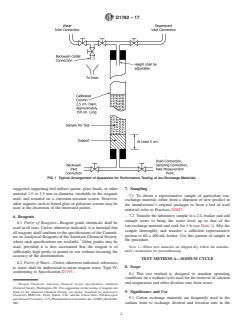
FIG. 1 Typical Arrangement of Apparatus for Performance Testing of Ion-Exchange Materials
suggested supporting bed utilizes quartz, glass beads, or other 7. Sampling
material 1.5 to 3.5 mm in diameter, insoluble in the reagents
7.1 To obtain a representative sample of particulate ion-
used, and retained on a corrosion-resistant screen. However,
exchange material, either from a shipment of new product in
other supports such as fritted glass or polyester screens may be
the manufacturer’s original packages or from a bed of used
used at the discretion of the interested parties.
material, refer to Practices D2687.
6. Reagents 7.2 Transfer the laboratory sample to a 2-L beaker and add
enough water to bring the water level up to that of the
6.1 Purity of Reagents—Reagent grade chemicals shall be
ion-exchange material and soak for 1 h (see Note 1). Mix the
used in all tests. Unless otherwise indicated, it is intended that
sample thoroughly and transfer a sufficient representative
all reagents shall conform to the specifications of the Commit-
portion to fill a 400-mL beaker. Use this portion of sample in
tee onAnalytical Reagents of theAmerican Chemical Society,
3 the procedure.
where such specifications are available. Other grades may be
used, provided it is first ascertained that the reagent is of NOTE 1—Where new materials are shipped dry, follow the manufac-
turer’s instructions for preconditioning.
sufficiently high purity to permit its use without lessening the
accuracy of the determination.
TEST METHOD A—SODIUM CYCLE
6.2 Purity of Water—Unless otherwise indicated, references
8. Scope
to water shall be understood to mean reagent water, Type IV,
conforming to Specification D1193.
8.1 This test method is designed to simulate operating
conditions on a sodium cycle used for the removal of calcium
and magnesium and other divalent ions from water.
Reagent Chemicals, American Chemical Society Specifications, American
Chemical Society, Washington, DC. For suggestions on the testing of reagents not
listed by the American Chemical Society, see Analar Standards for Laboratory 9. Significance and Use
Chemicals, BDH Ltd., Poole, Dorset, U.K., and the United States Pharmacopeia
9.1 Cation exchange materials are frequently used in the
and National Formulary, U.S. Pharmaceutical Convention, Inc. (USPC), Rockville,
MD. sodium form to exchange divalent and trivalent ions in the
D1782 − 17
influent water for sodium ions on the resin sites. This process 11. Procedure
is commonly referred to as softening water since it removes
11.1 Adjust the temperature of the water and all solutions to
those ions that form a “hard” curd of insoluble salts with the
be used in this procedure to 25 6 5°C and maintain this
fatty acids used in some soaps and that also precipitate when
temperature throughout the test.
water is boiled. In such a process, sodium chloride is used as
11.2 Fill the column approximately half full of water and
the regenerant to return the cation-exchanging groups to the
add sufficient sample to give a bed height of 750 6 75 mm
sodium form.
above the top of the support. To avoid drying out of the
9.2 Thistestmethodisintendedtosimulatetheperformance
ion-exchange material, maintain a layer of liquid at least 20 to
of such materials in actual usage. It may be used either to
30 mm deep above the top of the bed at all times during the
compare the performance of new materials or to compare the
procedure.
performance of a material that has been used with its original
11.3 Backwash with water for 10 min using a flow rate that
performance.
will maintain a 50 % expansion of the bed. If the supernatant
9.3 Regenerant concentrations and dosages used herein are
liquid is clear at this point, proceed to 11.4. If the liquid is
typical for the types of materials used in this application. If
cloudy (indicating the presence of light, insoluble, extraneous
different concentrations or amounts of regenerant are agreed
material), adjust the backwash outlet tube to a height above the
upon by parties using this test method, this fact should be
bed equal to 75 % of the bed height. Continue backwashing at
stated when the results are reported. Similarly, the test water
the same rate until the effluent is clear.
specified is the agreed upon standard. Where other test waters
11.4 Allow the bed to settle and then drain at a rate of
orthewatertobetreatedareusedinthetest,theanalysisofthe
approximately100mL/minuntilthewaterlevelis20to30mm
water in terms of total solids, sodium, calcium, magnesium,
above the top of the bed. Do not jar. Record the volume, in
other di- or trivalent metals as well as the major anions present
millilitres, of ion-exchange material. Repeat the 10-min back-
should be reported with the test results.
wash until two successive readings of volume agree within 5
10. Reagents and Materials mL. The average of these two readings shall be the sample
volume for new materials shipped in the sodium form.
10.1 Brine Regenerants:
10.1.1 For synthetic organic ion-exchange materials: 11.5 Exhaust the ion exchanger with cation-exchange test
water A at a flow rate of 0.33 mL/min/mL of exchanger, as
10.1.1.1 Sodium Chloride (100 g/L)—Dissolve enough so-
dium chloride (NaCl) in water to make a solution containing in measured in 11.4. Maintain a head of liquid not less than 50
mmabovethetopofthebed.Continuetherununtiltheeffluent
each litre 100.0 g of NaCl.
10.1.2 For all other ion-exchange materials: shows 0.2 meq/L (or other agreed-upon hardness level) when
tested in accordance with Test Method D1126. Record the
10.1.2.1 Sodium Chloride (50 g/L)—Dissolve enough NaCl
in water to make a solution containing in each litre 50.0 g of volume of test water used.
NaCl.
11.6 Repeat the 10-min backwash and drain as described in
10.2 Cation-Exchange Test Water A (10 meq/L)—Dissolve 11.3 and 11.4. When testing new material shipped in the
sodium form, only one backwash is necessary at this point
enough calcium chloride (CaCl ·2H O) and magnesium sulfate
2 2
(MgSO ·7H O) in water to make a solution containing, in each because a determination of volume has already been made.
4 2
litre, 0.49 g of CaCl ·2H O and 0.415 g of MgSO ·7H O. However, used material other than in the sodium form must
2 2 4 2
Adjust the pH to 7.5 by the addition of Na CO (30 g/L) and have a volume determination made here as described in 11.4.
2 3
determine the hardness of the solution in accordance with Test Use this sample volume determined on the exhausted material
Method D1126. The hardness of the test water will be 10.0 6 in calculating the capacity of used ion-exchange materials.
0.5 meq/L. Use the determined hardness in calculating operat-
11.7 Determine the amount of brine regenerant and rate
ing capacity as indicated in 12.1. This test water shall be used
required, from Table 1. For use with Table 1, the volume
for all tests.
sample for new material shall be that determined in accordance
10.3 Hardness Test Reagents—For reagents used in deter- with 11.4 and for used material shall be that determined in
mining hardness, refer to Test Method D1126. This reagent is accordance with 11.6.
used only in preparation of test water (see 10.2).
11.8 Pass the specified volume of brine regenerant through
10.4 Sodium Carbonate Solution(30g/L)—Dissolve30gof the bed at the specified rate until only a 20 to 30-mm layer of
sodium carbonate (Na CO ) in water and dilute to 1 L. liquid remains above the bed. Rinse the bed with water, using
2 3
TABLE 1 Amount of Brine Regenerant Required for Use in Test Method A
Type of Exchange Regeneration
Brine Regenerant, Rate of Flow, Contact Time,
Material Level
g/L mL brine/min/mL of Exchanger min lb/ft g/L
Synthetic organic 100 0.032 30 6.00 96.1
Greensand 50 0.027 15 1.25 20.0
Synthetic siliceous 50 0.080 20 3.00 80.1
Carbonaceous 50 0.067 15 3.15 50.5
D1782 − 17
the same rate, until one bed-volume of liquid has been 14.2 The pre
...
This document is not an ASTM standard and is intended only to provide the user of an ASTM standard an indication of what changes have been made to the previous version. Because
it may not be technically possible to adequately depict all changes accurately, ASTM recommends that users consult prior editions as appropriate. In all cases only the current version
of the standard as published by ASTM is to be considered the official document.
Designation: D1782 − 95 (Reapproved 2009) D1782 − 17
Standard Test Methods for
Operating Performance of Particulate Cation-Exchange
Materials
This standard is issued under the fixed designation D1782; the number immediately following the designation indicates the year of
original adoption or, in the case of revision, the year of last revision. A number in parentheses indicates the year of last reapproval. A
superscript epsilon (´) indicates an editorial change since the last revision or reapproval.
1. Scope
1.1 These test methods cover the determination of the operating capacity of particulate cation-exchange materials when used
for the removal of calcium, magnesium, and sodium ions from water. It is intended for use in testing both new and used materials.
The following two test methods are included:
Sections
Test Method A—Sodium Cycle 8 to 14
Test Method B—Hydrogen Cycle 15 to 21
Sections
Test Method A—Sodium Cycle 8 to 14
Test Method B—Hydrogen Cycle 15 to 21
1.2 The values givenstated in SI units are to be regarded as the standard. The inch-pound units values given in parentheses are
for information only.mathematical conversions to inch-pound units that are provided for information only and are not considered
standard.
1.3 This standard does not purport to address all of the safety concerns, if any, associated with its use. It is the responsibility
of the user of this standard to establish appropriate safety safety, health and healthenvironmental practices and determine the
applicability of regulatory limitations prior to use.
1.4 This international standard was developed in accordance with internationally recognized principles on standardization
established in the Decision on Principles for the Development of International Standards, Guides and Recommendations issued
by the World Trade Organization Technical Barriers to Trade (TBT) Committee.
2. Referenced Documents
2.1 ASTM Standards:
D1067 Test Methods for Acidity or Alkalinity of Water
D1126 Test Method for Hardness in Water
D1129 Terminology Relating to Water
D1193 Specification for Reagent Water
D2687 Practices for Sampling Particulate Ion-Exchange Materials
3. Terminology
3.1 Definitions—Definitions: For definitions of terms used in these test methods, refer to Terminology D1129
3.1.1 For definitions of terms used in these standards, refer to Terminology D1129.
3.2 Definitions of Terms Specific to This Standard:
3.2.1 Certain terms in these test methods standards that relate specifically to ion exchange are defined as follows:
3.2.2 free mineral acidity—the quantitative capacity of aqueous media to react with hydroxyl ions to pH 4.3.
3.2.3 hydrogen cycle—the operation of a cation-exchange cycle wherein the removal of specified cations from influent water
is accomplished by exchange with an equivalent amount of hydrogen ion from the exchange material.
These test methods are under the jurisdiction of ASTM Committee D19 on Water and are the direct responsibility of Subcommittee D19.08 on Membranes and Ion
Exchange Materials.
Current edition approved May 1, 2009Aug. 1, 2017. Published June 2009August 2017. Originally approved in 1960. Last previous edition approved in 20072009 as
D1782 – 95 (2007).(2009). DOI: 10.1520/D1782-95R09.10.1520/D1782-17.
For referenced ASTM standards, visit the ASTM website, www.astm.org, or contact ASTM Customer Service at service@astm.org. For Annual Book of ASTM Standards
volume information, refer to the standard’s Document Summary page on the ASTM website.
Copyright © ASTM International, 100 Barr Harbor Drive, PO Box C700, West Conshohocken, PA 19428-2959. United States
D1782 − 17
3.2.4 theoretical free mineral acidity—the free mineral acidity that would result from the conversion of the anions of strong
acids in solution to their respective free acids.
4. Summary of Test Methods
4.1 Test Method A consists of repeated cycles of backwash, brine regeneration, rinse, and exhaustion of the sample in the form
of a bed in a transparent column. The exhausting medium used is an ion-exchange test water.
4.2 Test Method B consists of repeated cycles of backwash, acid regeneration, rinse, and exhaustion of the sample in the form
of a bed in a transparent column. The exhausting medium used is an ion-exchange test water.
5. Apparatus
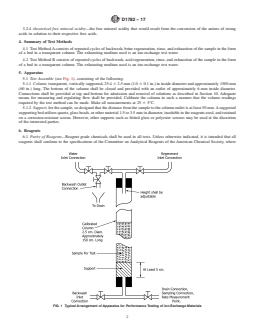
5.1 Test Assemble (see Fig. 1), consisting of the following:
5.1.1 Column, transparent, vertically supported, 25.4 6 2.5 mm (1.0 6 0.1 in.) in inside diameter and approximately 1500 mm
(60 in.) long. The bottom of the column shall be closed and provided with an outlet of approximately 6-mm inside diameter.
Connections shall be provided at top and bottom for admission and removal of solutions as described in Section 10. Adequate
means for measuring and regulating flow shall be provided. Calibrate the column in such a manner that the volume readings
required by the test method can be made. Make all measurements at 25 6 5°C.
5.1.2 Support, for the sample, so designed that the distance from the sample to the column outlet is at least 50 mm. A suggested
supporting bed utilizes quartz, glass beads, or other material 1.5 to 3.5 mm in diameter, insoluble in the reagents used, and retained
on a corrosion-resistant screen. However, other supports such as fritted glass or polyester screens may be used at the discretion
of the interested parties.
6. Reagents
6.1 Purity of Reagents—Reagent grade chemicals shall be used in all tests. Unless otherwise indicated, it is intended that all
reagents shall conform to the specifications of the Committee on Analytical Reagents of the American Chemical Society, where
FIG. 1 Typical Arrangement of Apparatus for Performance Testing of Ion-Exchange Materials
D1782 − 17
such specifications are available. Other grades may be used, provided it is first ascertained that the reagent is of sufficiently high
purity to permit its use without lessening the accuracy of the determination.
6.2 Purity of Water—Unless otherwise indicated, references to water shall be understood to mean reagent water, Type IV,
conforming to Specification D1193.
7. Sampling
7.1 To obtain a representative sample of particulate ion-exchange material, either from a shipment of new product in the
manufacturer’s original packages or from a bed of used material, refer to Practices D2687.
7.2 Transfer the laboratory sample to a 2-L beaker and add enough water to bring the water level up to that of the ion-exchange
material and soak for 1 h (see Note 1). Mix the sample thoroughly and transfer a sufficient representative portion to fill a 400-mL
beaker. Use this portion of sample in the procedure.
NOTE 1—Where new materials are shipped dry, follow the manufacturer’s instructions for preconditioning.
TEST METHOD A—SODIUM CYCLE
8. Scope
8.1 This test method is designed to simulate operating conditions on a sodium cycle used for the removal of calcium and
magnesium and other divalent ions from water.
8. Scope
8.1 This test method is designed to simulate operating conditions on a sodium cycle used for the removal of calcium and
magnesium and other divalent ions from water.
9. Significance and Use
9.1 Cation exchange materials are frequently used in the sodium form to exchange divalent and trivalent ions in the influent
water for sodium ions on the resin sites. This process is commonly referred to as softening water since it removes those ions that
form a “hard” curd of insoluble salts with the fatty acids used in some soaps and that also precipitate when water is boiled. In such
a process, sodium chloride is used as the regenerant to return the cation-exchanging groups to the sodium form.
9.2 This test method is intended to simulate the performance of such materials in actual usage. It may be used either to compare
the performance of new materials or to compare the performance of a material that has been used with its original performance.
9.3 Regenerant concentrations and dosages used herein are typical for the types of materials used in this application. If different
concentrations or amounts of regenerant are agreed upon by parties using this test method, this fact should be stated when the
results are reported. Similarly, the test water specified is the agreed upon standard. Where other test waters or the water to be treated
are used in the test, the analysis of the water in terms of total solids, sodium, calcium, magnesium, other di- or trivalent metals
as well as the major anions present should be reported with the test results.
10. Reagents and Materials
10.1 Brine Regenerants:
10.1.1 For synthetic organic ion-exchange materials:
10.1.1.1 Sodium Chloride (100 g/L)—Sodium ChlorideDissolve (100 g/L)—Dissolve enough sodium chloride (NaCl) in water
to make a solution containing in each litre 100.0 g of NaCl.
10.1.2 For all other ion-exchange materials:
10.1.2.1 Sodium Chloride (50 g/L)—Sodium ChlorideDissolve (50 g/L)—Dissolve enough NaCl in water to make a solution
containing in each litre 50.0 g of NaCl.
10.2 Cation-Exchange Test Water A (10 meq/L)—Dissolve enough calcium chloride (CaCl ·2H O) and magnesium sulfate
2 2
(MgSO ·7H O) in water to make a solution containing, in each litre, 0.49 g of CaCl ·2H O and 0.415 g of MgSO ·7H O. Adjust
4 2 2 2 4 2
the pH to 7.5 by the addition of Na CO (30 g/L) and determine the hardness of the solution in accordance with Test Method
2 3
D1126. The hardness of the test water will be 10.0 6 0.5 meq/L. Use the determined hardness in calculating operating capacity
as indicated in 12.1. This test water shall be used for all tests.
10.3 Hardness Test Reagents—For reagents used in determining hardness, refer to Test Method D1126. This reagent is used only
in preparation of test water (see 10.2).
10.4 Sodium Carbonate Solution (30 g/L)—Dissolve 30 g of sodium carbonate (Na CO ) in water and dilute to 1 L.
2 3
Reagent Chemicals, American Chemical Society Specifications Specifications, , American Chemical Society, Washington, DC. For suggestions on the testing of reagents
not listed by the American Chemical Society, see Analar Standards for Laboratory Chemicals, BDH Ltd., Poole, Dorset, U.K., and the United States Pharmacopeia and
National Formulary, U.S. Pharmaceutical Convention, Inc. (USPC), Rockville, MD.
D1782 − 17
11. Procedure
11.1 Adjust the temperature of the water and all solutions to be used in this procedure to 25 6 5°C and maintain this temperature
throughout the test.
11.2 Fill the column approximately half full of water and add sufficient sample to give a bed height of 750 6 75 mm above
the top of the support. To avoid drying out of the ion-exchange material, maintain a layer of liquid at least 20 to 30 mm deep above
the top of the bed at all times during the procedure.
11.3 Backwash with water for 10 min using a flow rate that will maintain a 50 % expansion of the bed. If the supernatant liquid
is clear at this point, proceed to 11.4. If the liquid is cloudy (indicating the presence of light, insoluble, extraneous material), adjust
the backwash outlet tube to a height above the bed equal to 75 % of the bed height. Continue backwashing at the same rate until
the effluent is clear.
11.4 Allow the bed to settle and then drain at a rate of approximately 100 mL/min until the water level is 20 to 30 mm above
the top of the bed. Do not jar. Record the volume, in millilitres, of ion-exchange material. Repeat the 10-min backwash until two
successive readings of volume agree within 5 mL. The average of these two readings shall be the sample volume for new materials
shipped in the sodium form.
11.5 Exhaust the ion exchanger with cation-exchange test water A at a flow rate of 0.33 mL/min/mL of exchanger, as measured
in 11.4. Maintain a head of liquid not less than 50 mm above the top of the bed. Continue the run until the effluent shows 0.2 meq/L
(or other agreed-upon hardness level) when tested in accordance with Test Method D1126. Record the volume of test water used.
11.6 Repeat the 10-min backwash and drain as described in 11.3 and 11.4. When testing new material shipped in the sodium
form, only one backwash is necessary at this point because a determination of volume has already been made. However, used
material other than in the sodium form must have a volume determination made here as described in 11.4. Use this sample volume
determined on the exhausted material in calculating the capacity of used ion-exchange materials.
11.7 Determine the amount of brine regenerant and rate required, from Table 1. For use with Table 1, the volume sample for
new material shall be that determined in accordance with 11.4 and for used material shall be that determined in accordance with
11.6.
11.8 Pass the specified volume of brine regenerant through the bed at the specified rate until only a 20 to 30-mm layer of liquid
remains above the bed. Rinse the bed with water, using the same rate, until one bed-volume of liquid has been displaced. Increase
the rinse rate to approximately 100 mL/min. Test for hardness at 3-min intervals by adding 0.5 mL of buffer solution to 50 mL
of the effluent followed by three drops of hardness indicator and 0.5 mL of sodium ethylendiamine tetraacetate solution (1 mL = 1.0
mg CaCO ), with stirring. If a blue color develops, the effluent contains 0.2 meq/L or less hardness and the rinse is completed.
If the color is red, the end point has not been reached. Continue the rinse until the effluent shows 0.2 meq/L or less hardness.
11.9 Repeat the service run described in 11.5.
11.10 Repeat the cycle, beginning with a single backwash (see 11.6), omitting the determination of bed volume. Continue with
a regeneration and rinse (see 11.8), and end with a service run (see 11.5). Repeat the cycle until each of three successive runs agrees
within 65 % of their average capacity as calculated in accordance with Section 12.
12. Calculation
12.1 Calculate the operating capacity, in milliequivalents per millilitre, of the ion exchange material as as:
capacity, meq/mL 5 A 3B /S
~ !
where:
A = hardness of
...