

ASTM A423/A423M-19
(Specification)Standard Specification for Seamless and Electric-Welded Low-Alloy Steel Tubes
General Information
- Abstract
ABSTRACT
This specification covers standards for minimum-wall-thickness, seamless, and electric-resistance welded low-alloy steel tubes to be used for pressure containing parts, that is economizers, and for other corrosion resistant applications. Steel tubes shall either be processed to hot or cold finish. All tubes shall be normalized or given such heat treatment as may be necessary to conform to the requirements of this specification. Chemical composition shall adhere to specified carbon, manganese, phosphorus, sulfur, silicon, copper, chromium, nickel, and molybdenum contents. Tension, flattening, flaring, flange, hardness, reverse flattening, and hydrostatic tests shall be performed. Tubes when inserted in the boiler shall stand expanding and bending without showing cracks or flaws. Tubes shall also conform to tensile strength, yield strength, hardness, and elongation requirements.
SCOPE
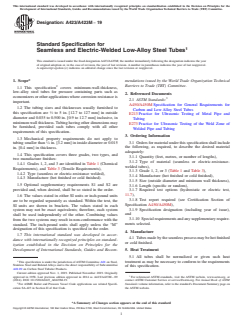
1.1 This specification2 covers minimum-wall-thickness, low-alloy steel tubes for pressure containing parts such as economizers or other applications where corrosion resistance is important.
1.2 The tubing sizes and thicknesses usually furnished to this specification are 1/2 to 5 in. [12.7 to 127 mm] in outside diameter and 0.035 to 0.500 in. [0.9 to 12.7 mm] inclusive, in minimum wall thickness. Tubing having other dimensions may be furnished, provided such tubes comply with all other requirements of this specification.
1.3 Mechanical property requirements do not apply to tubing smaller than 1/4 in. [3.2 mm] in inside diameter or 0.015 in. [0.4 mm] in thickness.
1.4 This specification covers three grades, two types, and two manufacture finishes:
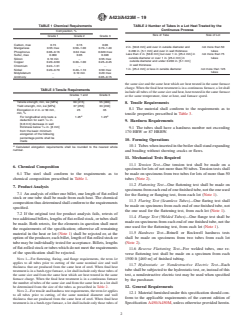
1.4.1 Grades 1, 2, and 3 are identified in Table 1 (Chemical Requirements), and Table 3 (Tensile Requirements),
1.4.2 Type (seamless or electric-resistance welded),
1.4.3 Manufacture (hot finished or cold finished).
1.5 Optional supplementary requirements S1 and S2 are provided and, when desired, shall be so stated in the order.
1.6 The values stated in either SI units or inch-pound units are to be regarded separately as standard. Within the text, the SI units are shown in brackets. The values stated in each system may not be exact equivalents; therefore, each system shall be used independently of the other. Combining values from the two systems may result in non-conformance with the standard. The inch-pound units shall apply unless the “M” designation of this specification is specified in the order.
1.7 This international standard was developed in accordance with internationally recognized principles on standardization established in the Decision on Principles for the Development of International Standards, Guides and Recommendations issued by the World Trade Organization Technical Barriers to Trade (TBT) Committee.
- Status
- Published
- Publication Date
- 31-Oct-2019
- Technical Committee
- A01 - Steel, Stainless Steel and Related Alloys
- Drafting Committee
- A01.09 - Carbon Steel Tubular Products
Buy Documents


ASTM A423/A423M-19 - Standard Specification for Seamless and Electric-Welded Low-Alloy Steel Tubes
REDLINE ASTM A423/A423M-19 - Standard Specification for Seamless and Electric-Welded Low-Alloy Steel Tubes
Overview
ASTM A423/A423M-19: The Standard Specification for Seamless and Electric-Welded Low-Alloy Steel Tubes establishes requirements for minimum-wall-thickness, low-alloy steel tubes, delivered either as seamless or electric-resistance welded. Developed and maintained by ASTM, these tubes are designed primarily for pressure-containing applications where corrosion resistance is a priority, such as economizers and boiler parts. This specification encompasses several grades, types, and manufacturing finish options to meet specific industrial requirements.
Key Topics
Scope and Coverage
- Applies to low-alloy steel tubes with minimum wall thickness
- Covers both seamless and electric-resistance welded types
- Includes hot-finished and cold-finished manufacturing methods
- Intended for pressure-containing, corrosion-resistant applications
Grades and Sizes
- Grades 1, 2, and 3, each with distinct chemical composition requirements
- Covers tubes in outside diameters from 1/2 to 5 in. (12.7 to 127 mm) and wall thicknesses from 0.035 to 0.500 in. (0.9 to 12.7 mm)
- Mechanical property requirements do not apply to very small tubing (<1/4 in. inside diameter or <0.015 in. thickness)
Chemical and Mechanical Properties
- Strict chemical limits for elements such as carbon, manganese, phosphorus, sulfur, silicon, copper, chromium, nickel, and molybdenum
- Minimum requirements for tensile strength, yield strength, hardness, and elongation
- Tubes must withstand expanding and bending during boiler installation without cracks or flaws
Testing and Inspection
- Mandatory test methods: tension, flattening, flaring (for seamless), flange (for welded), hardness, reverse flattening (for welded), hydrostatic, or nondestructive electric tests
- Supplementary testing, including ultrasonic inspection per ASME requests, available when specified
Unit Systems
- Values can be stated in SI or inch-pound units; both are standard, but must not be intermixed
Applications
ASTM A423/A423M-19 steel tubes are widely used in critical applications demanding strength, reliability, and corrosion resistance:
- Boiler Economizers: Primary use, as these tubes must sustain high pressures and resist corrosion from flue gases and boiler water.
- Pressure Vessels: For components where tube integrity is essential to prevent leaks or failure under pressure.
- Heat Exchangers: In power, chemical, and petrochemical plants requiring robust tubes that maintain performance in harsh environments.
- Industrial Piping: Systems needing alloy steel tubes for elevated temperature or aggressive media.
Their rigorous testing and certification requirements ensure conformity to structural and chemical standards vital for safety and performance in demanding environments.
Related Standards
For comprehensive compliance and best practices, consider these related ASTM and industry standards:
- ASTM A450/A450M: General requirements for carbon and low-alloy steel tubes, covering aspects like heat treatment, straightness, and tolerances.
- ASTM E213: Practice for ultrasonic testing of metal pipe and tubing.
- ASTM E273: Practice for ultrasonic testing of the weld zone in welded pipe and tubing.
- ASME SA-423: The ASME-adopted version for Boiler and Pressure Vessel Code applications.
Keywords: ASTM A423, seamless steel tube, electric-welded tube, low-alloy steel, pressure tubing, corrosion resistant steel tubing, economizer tubes, boiler tubes, steel tube standards.
By adhering to ASTM A423/A423M-19, manufacturers and users ensure the reliability, performance, and safety of low-alloy steel tubing in high-stress, corrosive environments.
Relations
- Effective Date
- 01-Nov-2019
- Effective Date
- 01-Nov-2023
- Effective Date
- 01-Sep-2018
- Effective Date
- 01-May-2015
- Refers
ASTM E273-10 - Standard Practice for Ultrasonic Testing of the Weld Zone of Welded Pipe and Tubing - Effective Date
- 01-Jun-2010
- Effective Date
- 01-May-2010
- Effective Date
- 01-Oct-2009
- Effective Date
- 01-Jun-2009
- Effective Date
- 01-Nov-2007
- Effective Date
- 01-Jun-2005
- Effective Date
- 01-Oct-2004
- Effective Date
- 01-Mar-2004
- Effective Date
- 01-Jan-2004
- Effective Date
- 10-Sep-2003
- Effective Date
- 10-Jul-2001
Buy Documents
ASTM A423/A423M-19 - Standard Specification for Seamless and Electric-Welded Low-Alloy Steel Tubes
REDLINE ASTM A423/A423M-19 - Standard Specification for Seamless and Electric-Welded Low-Alloy Steel Tubes
Get Certified
Connect with accredited certification bodies for this standard

Institut za varilstvo d.o.o. (Welding Institute)
Slovenia's leading welding institute since 1952. ISO 3834, EN 1090, pressure equipment certification, NDT personnel, welder qualification. Only IIW Au
Sponsored listings
Frequently Asked Questions
ASTM A423/A423M-19 is a technical specification published by ASTM International. Its full title is "Standard Specification for Seamless and Electric-Welded Low-Alloy Steel Tubes". This standard covers: ABSTRACT This specification covers standards for minimum-wall-thickness, seamless, and electric-resistance welded low-alloy steel tubes to be used for pressure containing parts, that is economizers, and for other corrosion resistant applications. Steel tubes shall either be processed to hot or cold finish. All tubes shall be normalized or given such heat treatment as may be necessary to conform to the requirements of this specification. Chemical composition shall adhere to specified carbon, manganese, phosphorus, sulfur, silicon, copper, chromium, nickel, and molybdenum contents. Tension, flattening, flaring, flange, hardness, reverse flattening, and hydrostatic tests shall be performed. Tubes when inserted in the boiler shall stand expanding and bending without showing cracks or flaws. Tubes shall also conform to tensile strength, yield strength, hardness, and elongation requirements. SCOPE 1.1 This specification2 covers minimum-wall-thickness, low-alloy steel tubes for pressure containing parts such as economizers or other applications where corrosion resistance is important. 1.2 The tubing sizes and thicknesses usually furnished to this specification are 1/2 to 5 in. [12.7 to 127 mm] in outside diameter and 0.035 to 0.500 in. [0.9 to 12.7 mm] inclusive, in minimum wall thickness. Tubing having other dimensions may be furnished, provided such tubes comply with all other requirements of this specification. 1.3 Mechanical property requirements do not apply to tubing smaller than 1/4 in. [3.2 mm] in inside diameter or 0.015 in. [0.4 mm] in thickness. 1.4 This specification covers three grades, two types, and two manufacture finishes: 1.4.1 Grades 1, 2, and 3 are identified in Table 1 (Chemical Requirements), and Table 3 (Tensile Requirements), 1.4.2 Type (seamless or electric-resistance welded), 1.4.3 Manufacture (hot finished or cold finished). 1.5 Optional supplementary requirements S1 and S2 are provided and, when desired, shall be so stated in the order. 1.6 The values stated in either SI units or inch-pound units are to be regarded separately as standard. Within the text, the SI units are shown in brackets. The values stated in each system may not be exact equivalents; therefore, each system shall be used independently of the other. Combining values from the two systems may result in non-conformance with the standard. The inch-pound units shall apply unless the “M” designation of this specification is specified in the order. 1.7 This international standard was developed in accordance with internationally recognized principles on standardization established in the Decision on Principles for the Development of International Standards, Guides and Recommendations issued by the World Trade Organization Technical Barriers to Trade (TBT) Committee.
ABSTRACT This specification covers standards for minimum-wall-thickness, seamless, and electric-resistance welded low-alloy steel tubes to be used for pressure containing parts, that is economizers, and for other corrosion resistant applications. Steel tubes shall either be processed to hot or cold finish. All tubes shall be normalized or given such heat treatment as may be necessary to conform to the requirements of this specification. Chemical composition shall adhere to specified carbon, manganese, phosphorus, sulfur, silicon, copper, chromium, nickel, and molybdenum contents. Tension, flattening, flaring, flange, hardness, reverse flattening, and hydrostatic tests shall be performed. Tubes when inserted in the boiler shall stand expanding and bending without showing cracks or flaws. Tubes shall also conform to tensile strength, yield strength, hardness, and elongation requirements. SCOPE 1.1 This specification2 covers minimum-wall-thickness, low-alloy steel tubes for pressure containing parts such as economizers or other applications where corrosion resistance is important. 1.2 The tubing sizes and thicknesses usually furnished to this specification are 1/2 to 5 in. [12.7 to 127 mm] in outside diameter and 0.035 to 0.500 in. [0.9 to 12.7 mm] inclusive, in minimum wall thickness. Tubing having other dimensions may be furnished, provided such tubes comply with all other requirements of this specification. 1.3 Mechanical property requirements do not apply to tubing smaller than 1/4 in. [3.2 mm] in inside diameter or 0.015 in. [0.4 mm] in thickness. 1.4 This specification covers three grades, two types, and two manufacture finishes: 1.4.1 Grades 1, 2, and 3 are identified in Table 1 (Chemical Requirements), and Table 3 (Tensile Requirements), 1.4.2 Type (seamless or electric-resistance welded), 1.4.3 Manufacture (hot finished or cold finished). 1.5 Optional supplementary requirements S1 and S2 are provided and, when desired, shall be so stated in the order. 1.6 The values stated in either SI units or inch-pound units are to be regarded separately as standard. Within the text, the SI units are shown in brackets. The values stated in each system may not be exact equivalents; therefore, each system shall be used independently of the other. Combining values from the two systems may result in non-conformance with the standard. The inch-pound units shall apply unless the “M” designation of this specification is specified in the order. 1.7 This international standard was developed in accordance with internationally recognized principles on standardization established in the Decision on Principles for the Development of International Standards, Guides and Recommendations issued by the World Trade Organization Technical Barriers to Trade (TBT) Committee.
ASTM A423/A423M-19 is classified under the following ICS (International Classification for Standards) categories: 23.040.10 - Iron and steel pipes. The ICS classification helps identify the subject area and facilitates finding related standards.
ASTM A423/A423M-19 has the following relationships with other standards: It is inter standard links to ASTM A423/A423M-09(2014), ASTM A450/A450M-23, ASTM A450/A450M-18, ASTM A450/A450M-15, ASTM E273-10, ASTM A450/A450M-10, ASTM A450/A450M-09, ASTM E213-09, ASTM A450/A450M-07, ASTM E273-01(2005), ASTM A450/A450M-04a, ASTM A450/A450M-04, ASTM E213-04, ASTM A450/A450M-03, ASTM E273-93. Understanding these relationships helps ensure you are using the most current and applicable version of the standard.
ASTM A423/A423M-19 is available in PDF format for immediate download after purchase. The document can be added to your cart and obtained through the secure checkout process. Digital delivery ensures instant access to the complete standard document.
Standards Content (Sample)
This international standard was developed in accordance with internationally recognized principles on standardization established in the Decision on Principles for the
Development of International Standards, Guides and Recommendations issued by the World Trade Organization Technical Barriers to Trade (TBT) Committee.
Designation:A423/A423M −19
Standard Specification for
Seamless and Electric-Welded Low-Alloy Steel Tubes
This standard is issued under the fixed designationA423/A423M; the number immediately following the designation indicates the year
of original adoption or, in the case of revision, the year of last revision. A number in parentheses indicates the year of last reapproval.
A superscript epsilon (´) indicates an editorial change since the last revision or reapproval.
1. Scope* mendations issued by the World Trade Organization Technical
Barriers to Trade (TBT) Committee.
1.1 This specification covers minimum-wall-thickness,
low-alloy steel tubes for pressure containing parts such as
2. Referenced Documents
economizersorotherapplicationswherecorrosionresistanceis
2.1 ASTM Standards:
important.
A450/A450M Specification for General Requirements for
1.2 The tubing sizes and thicknesses usually furnished to
Carbon and Low Alloy Steel Tubes
this specification are ⁄2 to 5 in. [12.7 to 127 mm] in outside
E213 Practice for Ultrasonic Testing of Metal Pipe and
diameter and 0.035 to 0.500 in. [0.9 to 12.7 mm] inclusive, in
Tubing
minimum wall thickness.Tubing having other dimensions may
E273 Practice for Ultrasonic Testing of the Weld Zone of
be furnished, provided such tubes comply with all other
Welded Pipe and Tubing
requirements of this specification.
3. Ordering Information
1.3 Mechanical property requirements do not apply to
3.1 Orders for material under this specification shall include
tubing smaller than ⁄4 in. [3.2 mm] in inside diameter or 0.015
the following, as required, to describe the desired material
in. [0.4 mm] in thickness.
adequately:
1.4 This specification covers three grades, two types, and
3.1.1 Quantity (feet, metres, or number of lengths),
two manufacture finishes:
3.1.2 Type of material (seamless or electric-resistance-
1.4.1 Grades 1, 2, and 3 are identified in Table 1 (Chemical
welded tubes),
Requirements), and Table 3 (Tensile Requirements),
3.1.3 Grade 1, 2, or 3 (Table 1 and Table 3),
1.4.2 Type (seamless or electric-resistance welded),
3.1.4 Manufacture (hot finished or cold finished),
1.4.3 Manufacture (hot finished or cold finished).
3.1.5 Size (outside diameter and minimum wall thickness),
1.5 Optional supplementary requirements S1 and S2 are
3.1.6 Length (specific or random),
provided and, when desired, shall be so stated in the order.
3.1.7 Required test options (hydrostatic or electric test,
11.7),
1.6 The values stated in either SI units or inch-pound units
3.1.8 Test report required (see Certification Section of
are to be regarded separately as standard. Within the text, the
Specification A450/A450M),
SI units are shown in brackets. The values stated in each
3.1.9 Specification designation (including year of issue),
system may not be exact equivalents; therefore, each system
and
shall be used independently of the other. Combining values
3.1.10 Specialrequirementsandanysupplementaryrequire-
from the two systems may result in non-conformance with the
ments selected.
standard. The inch-pound units shall apply unless the “M”
designation of this specification is specified in the order.
4. Manufacture
1.7 This international standard was developed in accor-
4.1 Tubesmadebytheseamlessprocessmaybehotfinished
dance with internationally recognized principles on standard-
or cold finished.
ization established in the Decision on Principles for the
Development of International Standards, Guides and Recom-
5. Heat Treatment
5.1 All tubes shall be normalized or given such heat
This specification is under the jurisdiction of ASTM Committee A01 on Steel, treatment as may be necessary to conform to the requirements
Stainless Steel and Related Alloys and is the direct responsibility of Subcommittee
of this specification.
A01.09 on Carbon Steel Tubular Products.
Current edition approved Nov. 1, 2019. Published November 2019. Originally
approved in 1958. Last previous edition approved in 2014 as A423/A423M – 09 For referenced ASTM standards, visit the ASTM website, www.astm.org, or
(2014). DOI: 10.1520/A0423_A0423M-19. contact ASTM Customer Service at service@astm.org. For Annual Book of ASTM
For ASME Boiler and Pressure Vessel Code applications see related Specifi- Standards volume information, refer to the standard’s Document Summary page on
cation SA-423 in Section II of that Code. the ASTM website.
*A Summary of Changes section appears at the end of this standard
Copyright © ASTM International, 100 Barr Harbor Drive, PO Box C700, West Conshohocken, PA 19428-2959. United States
A423/A423M−19
TABLE 1 Chemical Requirements TABLE 2 Number of Tubes in a Lot Heat Treated by the
Continuous Process
Composition, %
Size of Tube Size of Lot
Grade 1 Grade 2 Grade 3
Carbon, max 0.15 0.15 0.06
2 in. [50.8 mm] and over in outside diameter and not more than 50
Manganese 0.55 max 0.50–1.00 0.70–1.40
0.200 in. [5.1 mm] and over in wall thickness tubes
Phosphorus 0.06–0.16 0.04 max 0.020 max
Less than 2 in. [50.8 mm] but over 1 in. [25.4 mm] in not more than 75
Sulfur, max 0.060 0.05 0.020
outside diameter or over 1 in. [25.4 mm] in tubes
Silicon 0.10 min . 0.55 max
outside diameter and under 0.200 in. [5.1 mm]
Copper 0.20–0.60 0.30–1.00 0.25–0.45
in wall thickness
Chromium 0.24–1.31 . .
1 in. [25.4 mm] or less in outside diameter not more than 125
Nickel 0.20–0.70 0.40–1.10 0.50 max
tubes
Molybdenum . 0.10 min 0.20 max
Antimony . . 0.05–0.15
the same size and the same heat which are heat treated in the same furnace
charge.Whenthefinalheattreatmentisinacontinuousfurnace,alotshall
TABLE 3 Tensile Requirements
includealltubesofthesamesizeandheat,heattreatedinthesamefurnace
Grades 1 and Grade 3
at the same temperature, time at heat, and furnace speed.
Tensile strength, min, ksi [MPa] 60 [415] 55 [380]
8. Tensile Requirements
Yield strength, min, ksi [MPa] 37 [255] 33 [230]
8.1 The material shall conform to the requirements as to
Elongation in 2 in. or 50 mm, 25 35
min, %
tensile properties prescribed in Table 3.
A A
For longitudinal strip tests a 1.25 1.25
deduction for each ⁄32 in.
9. Hardness Requirements
[0.8 mm] decrease in wall
thickness below ⁄16 in. [8 mm]
9.1 The tubes shall have a hardness number not exceeding
from the basic minimum
170 HBW or 87 HRBW.
elongation of the following
percentage points shall be
10. Forming Operations
made
A
10.1 Tubeswheninsertedintheboilershallstandexpanding
Calculated elongation requirements shall be rounded to the nearest whole
number.
and beading without showing cracks or flaws.
11. Mechanical Tests Required
11.1 Tension Test—One tension
...
This document is not an ASTM standard and is intended only to provide the user of an ASTM standard an indication of what changes have been made to the previous version. Because
it may not be technically possible to adequately depict all changes accurately, ASTM recommends that users consult prior editions as appropriate. In all cases only the current version
of the standard as published by ASTM is to be considered the official document.
Designation: A423/A423M − 09 (Reapproved 2014) A423/A423M − 19
Standard Specification for
Seamless and Electric-Welded Low-Alloy Steel Tubes
This standard is issued under the fixed designation A423/A423M; the number immediately following the designation indicates the year
of original adoption or, in the case of revision, the year of last revision. A number in parentheses indicates the year of last reapproval.
A superscript epsilon (´) indicates an editorial change since the last revision or reapproval.
1. Scope Scope*
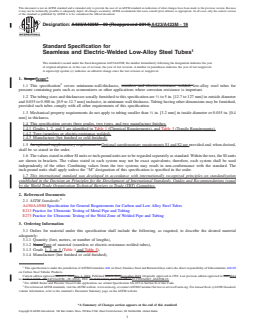
1.1 This specification covers minimum-wall-thickness, seamless and electric-resistance welded, low-alloy steel tubes for
pressure containing parts such as economizers or other applications where corrosion resistance is important.
1.2 The tubing sizes and thicknesses usually furnished to this specification are ⁄2 to 5 in. [12.7 to 127 mm] in outside diameter
and 0.035 to 0.500 in. [0.9 to 12.7 mm] inclusive, in minimum wall thickness. Tubing having other dimensions may be furnished,
provided such tubes comply with all other requirements of this specification.
1.3 Mechanical property requirements do not apply to tubing smaller than ⁄4 in. [3.2 mm] in inside diameter or 0.015 in. [0.4
mm] in thickness.
1.4 This specification covers three grades, two types, and two manufacture finishes:
1.4.1 Grades 1, 2, and 3 are identified in Table 1 (Chemical Requirements), and Table 3 (Tensile Requirements),
1.4.2 Type (seamless or electric-resistance welded),
1.4.3 Manufacture (hot finished or cold finished).
1.5 An optional supplementary requirement is Optional supplementary requirements S1 and S2 are provided and, when desired,
shall be so stated in the order.
1.6 The values stated in either SI units or inch-pound units are to be regarded separately as standard. Within the text, the SI units
are shown in brackets. The values stated in each system may not be exact equivalents; therefore, each system shall be used
independently of the other. Combining values from the two systems may result in non-conformance with the standard. The
inch-pound units shall apply unless the “M” designation of this specification is specified in the order.
1.7 This international standard was developed in accordance with internationally recognized principles on standardization
established in the Decision on Principles for the Development of International Standards, Guides and Recommendations issued
by the World Trade Organization Technical Barriers to Trade (TBT) Committee.
2. Referenced Documents
2.1 ASTM Standards:
A450/A450M Specification for General Requirements for Carbon and Low Alloy Steel Tubes
E213 Practice for Ultrasonic Testing of Metal Pipe and Tubing
E273 Practice for Ultrasonic Testing of the Weld Zone of Welded Pipe and Tubing
3. Ordering Information
3.1 Orders for material under this specification shall include the following, as required, to describe the desired material
adequately:
3.1.1 Quantity (feet, metres, or number of lengths),
3.1.2 NameType of material (seamless or electric-resistance-welded tubes),
3.1.3 Grade 1, 2, or 3 (Table 1 and Table 3),
3.1.4 Manufacture (hot finished or cold finished),
This specification is under the jurisdiction of ASTM Committee A01 on Steel, Stainless Steel and Related Alloys and is the direct responsibility of Subcommittee A01.09
on Carbon Steel Tubular Products.
Current edition approved March 1, 2014Nov. 1, 2019. Published March 2014November 2019. Originally approved in 1958. Last previous edition approved in 20092014
as A423/A423M – 09.A423/A423M – 09 (2014). DOI: 10.1520/A0423_A0423M-09R14.10.1520/A0423_A0423M-19.
For ASME Boiler and Pressure Vessel Code applications see related Specification SA-423 in Section II of that Code.
For referenced ASTM standards, visit the ASTM website, www.astm.org, or contact ASTM Customer Service at service@astm.org. For Annual Book of ASTM Standards
volume information, refer to the standard’s Document Summary page on the ASTM website.
*A Summary of Changes section appears at the end of this standard
Copyright © ASTM International, 100 Barr Harbor Drive, PO Box C700, West Conshohocken, PA 19428-2959. United States
A423/A423M − 19
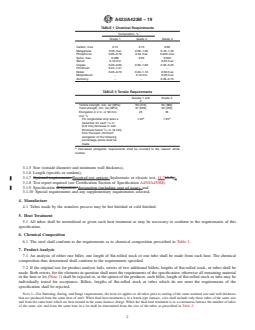
TABLE 1 Chemical Requirements
Composition, %
Grade 1 Grade 2 Grade 3
Carbon, max 0.15 0.15 0.06
Manganese 0.55 max 0.50–1.00 0.70–1.40
Phosphorus 0.06–0.16 0.04 max 0.020 max
Sulfur, max 0.060 0.05 0.020
Silicon 0.10 min . 0.55 max
Copper 0.20–0.60 0.30–1.00 0.25–0.45
Chromium 0.24–1.31 . .
Nickel 0.20–0.70 0.40–1.10 0.50 max
Molybdenum . 0.10 min 0.20 max
Antimony . . 0.05–0.15
TABLE 3 Tensile Requirements
Grades 1 and Grade 3
Tensile strength, min, ksi [MPa] 60 [415] 55 [380]
Yield strength, min, ksi [MPa] 37 [255] 33 [230]
Elongation in 2 in. or 50 mm, 25 35
min, %
A A
For longitudinal strip tests a 1.25 1.25
deduction for each ⁄32 in.
[0.8 mm] decrease in wall
thickness below ⁄16 in. [8 mm]
from the basic minimum
elongation of the following
percentage points shall be
made
A
Calculated elongation requirements shall be rounded to the nearest whole
number.
3.1.5 Size (outside diameter and minimum wall thickness),
3.1.6 Length (specific or random),
3.1.7 Optional requirements Required test options (hydrostatic or electric test, 11.713.7),),
3.1.8 Test report required (see Certification Section of Specification A450/A450M),
3.1.9 Specification designation, designation (including year of issue), and
3.1.10 Special requirements and any supplementary requirements selected.
4. Manufacture
4.1 Tubes made by the seamless process may be hot finished or cold finished.
5. Heat Treatment
5.1 All tubes shall be normalized or given such heat treatment as may be necessary to conform to the requirements of this
specification.
6. Chemical Composition
6.1 The steel shall conform to the requirements as to chemical composition prescribed in Table 1.
7. Product Analysis
7.1 An analysis of either one billet, one length of flat-rolled stock or one tube shall be made from each heat. The chemical
composition thus determined shall conform to the requirements specified.
7.2 If the original test for product analysis fails, retests of two additional billets, lengths of flat-rolled stock, or tubes shall be
made. Both retests, for the elements in question shall meet the requirements of the specification; otherwise all remaining material
in the heat or lot (Note 1) shall be rejected or, at the option of the producer, each billet, length of flat-rolled stock or tube may be
individually tested for acceptance. Billets, lengths of flat-rolled stock or tubes which do not meet the requirements of the
specification shall be rejected.
NOTE 1—For flattening, flaring, and flange requirements, the term lot applies to all tubes prior to cutting of the same nominal size and wall thickness
that are produced from the same heat of steel. When final heat treatment is in a batch-type furnace, a lot shall include only those tubes of the same size
and from the same heat which are heat treated in the same furnace charge. When the final heat treatment is in a continuous furnace the number of tubes
of the same size and from the same heat in a lot shall be determined from the size of the tubes as prescribed in Table 2.
A423/A423M − 19
TABLE 2 Number of Tubes in a Lot Heat Treated by the
Continuous Process
Size of Tube Size of Lot
2 in. [50.8 mm] and over in outside diameter and not more than 50
0.200 in. [5.1 mm] and over in w
...