

ASTM D1675-18
(Test Method)Standard Test Methods for Polytetrafluoroethylene Tubing
General Information
- Abstract
SIGNIFICANCE AND USE
4.1 The test methods in this standard are considered important to characterize polytetrafluoroethylene tubing. They are intended primarily for, but not limited to polytetrafluoroethylene tubing.
4.2 Variations in these methods or alternate contemporary methods of measurement may be used to determine the values for the properties in this standard provided such methods ensure quality levels and measurement accuracy equal to or better than those prescribed herein. It is the responsibility of the organizations using alternate test methods to be able to demonstrate this condition. In cases of dispute, the methods specified herein shall be used.
Note 2: Provision for alternate methods is necessary because of (1) the desire to simplify procedures for specific applications, and (2) the desire to eliminate redundant testing and use data generated during manufacturing process control, including that generated under Statistical Process Control (SPC) conditions, using equipment and methods other than those specified herein. An example would be the use of laser micrometers or optical comparators to measure dimensions.
SCOPE
1.1 These test methods cover procedures for testing polytetrafluoroethylene tubing for use as electrical insulation. The procedures appear in the following sections:
Procedure
Sections
ASTM
Methods
Conditioning
7
...
Dielectric Breakdown Voltage
28 – 30
D149, D876
Inside Diameter
8 – 13
D876
Mandrel Bend Test
46 – 52
D149, D876
Melting Point
41 – 45
D3418, D4895
Penetration Test
26 and 27
D876
Specific Gravity
36 – 40
D792, D1505
Strain Relief
31 – 35
...
Volatile Loss
20 – 25
...
Wall Thickness
14 – 19
...
Note 1: These test methods are similar but not identical to those in IEC 60684–2.
1.2 The values stated in inch-pound units are the standard except for temperature, which is stated in degrees Celsius. Values in parentheses are for information only.
1.3 This standard does not purport to address all of the safety concerns, if any, associated with its use. It is the responsibility of the user of this standard to establish appropriate safety, health, and environmental practices and determine the applicability of regulatory limitations prior to use. For specific warning statements, see Section 5.
1.4 This international standard was developed in accordance with internationally recognized principles on standardization established in the Decision on Principles for the Development of International Standards, Guides and Recommendations issued by the World Trade Organization Technical Barriers to Trade (TBT) Committee.
- Status
- Published
- Publication Date
- 30-Apr-2018
- Technical Committee
- D09 - Electrical and Electronic Insulating Materials
- Drafting Committee
- D09.07 - Electrical Insulating Materials
Overview
ASTM D1675-18 is the internationally recognized standard developed by ASTM for the characterization and testing of polytetrafluoroethylene (PTFE) tubing, particularly when used as electrical insulation. These standard test methods ensure quality and consistency by specifying procedures for evaluating various key physical and electrical properties of PTFE tubing. The standard is designed for use by manufacturers, quality control laboratories, and users of PTFE tubing to verify compliance and suitability for electrical and electronic applications.
In many industries, PTFE tubing is valued for its electrical insulating properties, chemical resistance, and stable performance in demanding environments. ASTM D1675-18 provides a baseline for evaluating these essential characteristics through reproducible test methods, which are especially important for maintaining high-quality standards in critical applications.
Key Topics
The ASTM D1675-18 standard covers several fundamental test methods for PTFE tubing as electrical insulation, including:
- Dielectric Breakdown Voltage: Determines the electrical insulating properties and resistance to puncture under high voltage.
- Inside Diameter and Wall Thickness: Ensures dimensional accuracy for proper fit and function in assemblies.
- Mandrel Bend Test: Assesses tubing flexibility and resistance to cracking or crazing during bending.
- Melting Point: Identifies and verifies the PTFE polymer type via differential scanning calorimetry (DSC).
- Penetration Test: Addresses resistance to deformation at elevated temperatures.
- Specific Gravity: Evaluates the physical state and purity of PTFE material.
- Strain Relief: Measures dimensional changes and shrinkage under heat exposure.
- Volatile Loss: Indicates removal efficiency of volatile substances during processing, aiding in quality control.
The standard also acknowledges the use of alternate or contemporary testing methods, provided they maintain or exceed specified quality and accuracy requirements. In case of disputes, the methods outlined in the standard take precedence.
Applications
PTFE tubing tested according to ASTM D1675-18 is used extensively in the following areas:
- Electrical and Electronic Insulation: PTFE tubing provides critical insulation in wiring and components, particularly in high-voltage or high-temperature environments.
- Aerospace and Defense: Ensures dependability and uniformity for mission-critical applications requiring robust insulation properties.
- Industrial Equipment: Used in machinery and automation for its chemical inertness and ability to withstand harsh operational environments.
- Manufacturing and Quality Assurance: Supports product development, process control, and validation of PTFE tubing’s physical and electrical properties.
Utilizing ASTM D1675-18 helps manufacturers and end-users confirm that PTFE tubing meets application-specific requirements for electrical insulation, durability, and performance, ultimately reducing risk and improving equipment reliability.
Related Standards
ASTM D1675-18 references and relates to several other important standards in the field of plastics and electrical insulation, including:
- ASTM D149 – Dielectric Breakdown Voltage and Dielectric Strength of Insulating Materials
- ASTM D792 – Density and Specific Gravity of Plastics by Displacement
- ASTM D876 – Nonrigid Vinyl Chloride Polymer Tubing for Electrical Insulation
- ASTM D1505 – Density of Plastics by the Density-Gradient Technique
- ASTM D3418 – Transition Temperatures and Enthalpies of Fusion of Polymers by DSC
- ASTM D4895 – Specification for PTFE Resin Produced from Dispersion
- IEC 60684-2 – Flexible Insulating Sleeves, Methods of Test
By adhering to these related test methods and specifications, organizations can ensure comprehensive evaluation and international compatibility for PTFE tubing products.
Relations
- Effective Date
- 01-May-2018
- Effective Date
- 01-Mar-2024
- Effective Date
- 01-Jan-2024
- Effective Date
- 01-Jan-2020
- Effective Date
- 15-Dec-2018
- Effective Date
- 01-Mar-2018
- Refers
ASTM D3487-16e1 - Standard Specification for Mineral Insulating Oil Used in Electrical Apparatus - Effective Date
- 15-Jun-2016
- Refers
ASTM D3487-16 - Standard Specification for Mineral Insulating Oil Used in Electrical Apparatus - Effective Date
- 15-Jun-2016
- Effective Date
- 01-May-2016
- Effective Date
- 01-Nov-2015
- Effective Date
- 01-Aug-2015
- Effective Date
- 01-Aug-2015
- Effective Date
- 01-May-2015
- Effective Date
- 01-Feb-2015
- Effective Date
- 01-Nov-2014
Get Certified
Connect with accredited certification bodies for this standard

IMQ S.p.A. (Certification)
Italian electrical product certification.

SLG Prüf- und Zertifizierungs GmbH
German testing and certification body.

UL Solutions
Global safety science company with testing, inspection and certification.
Sponsored listings
Frequently Asked Questions
ASTM D1675-18 is a standard published by ASTM International. Its full title is "Standard Test Methods for Polytetrafluoroethylene Tubing". This standard covers: SIGNIFICANCE AND USE 4.1 The test methods in this standard are considered important to characterize polytetrafluoroethylene tubing. They are intended primarily for, but not limited to polytetrafluoroethylene tubing. 4.2 Variations in these methods or alternate contemporary methods of measurement may be used to determine the values for the properties in this standard provided such methods ensure quality levels and measurement accuracy equal to or better than those prescribed herein. It is the responsibility of the organizations using alternate test methods to be able to demonstrate this condition. In cases of dispute, the methods specified herein shall be used. Note 2: Provision for alternate methods is necessary because of (1) the desire to simplify procedures for specific applications, and (2) the desire to eliminate redundant testing and use data generated during manufacturing process control, including that generated under Statistical Process Control (SPC) conditions, using equipment and methods other than those specified herein. An example would be the use of laser micrometers or optical comparators to measure dimensions. SCOPE 1.1 These test methods cover procedures for testing polytetrafluoroethylene tubing for use as electrical insulation. The procedures appear in the following sections: Procedure Sections ASTM Methods Conditioning 7 ... Dielectric Breakdown Voltage 28 – 30 D149, D876 Inside Diameter 8 – 13 D876 Mandrel Bend Test 46 – 52 D149, D876 Melting Point 41 – 45 D3418, D4895 Penetration Test 26 and 27 D876 Specific Gravity 36 – 40 D792, D1505 Strain Relief 31 – 35 ... Volatile Loss 20 – 25 ... Wall Thickness 14 – 19 ... Note 1: These test methods are similar but not identical to those in IEC 60684–2. 1.2 The values stated in inch-pound units are the standard except for temperature, which is stated in degrees Celsius. Values in parentheses are for information only. 1.3 This standard does not purport to address all of the safety concerns, if any, associated with its use. It is the responsibility of the user of this standard to establish appropriate safety, health, and environmental practices and determine the applicability of regulatory limitations prior to use. For specific warning statements, see Section 5. 1.4 This international standard was developed in accordance with internationally recognized principles on standardization established in the Decision on Principles for the Development of International Standards, Guides and Recommendations issued by the World Trade Organization Technical Barriers to Trade (TBT) Committee.
SIGNIFICANCE AND USE 4.1 The test methods in this standard are considered important to characterize polytetrafluoroethylene tubing. They are intended primarily for, but not limited to polytetrafluoroethylene tubing. 4.2 Variations in these methods or alternate contemporary methods of measurement may be used to determine the values for the properties in this standard provided such methods ensure quality levels and measurement accuracy equal to or better than those prescribed herein. It is the responsibility of the organizations using alternate test methods to be able to demonstrate this condition. In cases of dispute, the methods specified herein shall be used. Note 2: Provision for alternate methods is necessary because of (1) the desire to simplify procedures for specific applications, and (2) the desire to eliminate redundant testing and use data generated during manufacturing process control, including that generated under Statistical Process Control (SPC) conditions, using equipment and methods other than those specified herein. An example would be the use of laser micrometers or optical comparators to measure dimensions. SCOPE 1.1 These test methods cover procedures for testing polytetrafluoroethylene tubing for use as electrical insulation. The procedures appear in the following sections: Procedure Sections ASTM Methods Conditioning 7 ... Dielectric Breakdown Voltage 28 – 30 D149, D876 Inside Diameter 8 – 13 D876 Mandrel Bend Test 46 – 52 D149, D876 Melting Point 41 – 45 D3418, D4895 Penetration Test 26 and 27 D876 Specific Gravity 36 – 40 D792, D1505 Strain Relief 31 – 35 ... Volatile Loss 20 – 25 ... Wall Thickness 14 – 19 ... Note 1: These test methods are similar but not identical to those in IEC 60684–2. 1.2 The values stated in inch-pound units are the standard except for temperature, which is stated in degrees Celsius. Values in parentheses are for information only. 1.3 This standard does not purport to address all of the safety concerns, if any, associated with its use. It is the responsibility of the user of this standard to establish appropriate safety, health, and environmental practices and determine the applicability of regulatory limitations prior to use. For specific warning statements, see Section 5. 1.4 This international standard was developed in accordance with internationally recognized principles on standardization established in the Decision on Principles for the Development of International Standards, Guides and Recommendations issued by the World Trade Organization Technical Barriers to Trade (TBT) Committee.
ASTM D1675-18 is classified under the following ICS (International Classification for Standards) categories: 29.035.20 - Plastics and rubber insulating materials. The ICS classification helps identify the subject area and facilitates finding related standards.
ASTM D1675-18 has the following relationships with other standards: It is inter standard links to ASTM D1675-03(2011), ASTM D1711-24, ASTM E176-24, ASTM D149-20, ASTM E176-18a, ASTM E176-18, ASTM D3487-16e1, ASTM D3487-16, ASTM D4895-16, ASTM D1711-15, ASTM E176-15a, ASTM E176-15ae1, ASTM D4895-15, ASTM E176-15, ASTM D1711-14a. Understanding these relationships helps ensure you are using the most current and applicable version of the standard.
ASTM D1675-18 is available in PDF format for immediate download after purchase. The document can be added to your cart and obtained through the secure checkout process. Digital delivery ensures instant access to the complete standard document.
Standards Content (Sample)
This international standard was developed in accordance with internationally recognized principles on standardization established in the Decision on Principles for the
Development of International Standards, Guides and Recommendations issued by the World Trade Organization Technical Barriers to Trade (TBT) Committee.
Designation: D1675 −18
Standard Test Methods for
Polytetrafluoroethylene Tubing
This standard is issued under the fixed designation D1675; the number immediately following the designation indicates the year of
original adoption or, in the case of revision, the year of last revision. A number in parentheses indicates the year of last reapproval. A
superscript epsilon (´) indicates an editorial change since the last revision or reapproval.
This standard has been approved for use by agencies of the U.S. Department of Defense.
1. Scope* 2. Referenced Documents
1.1 These test methods cover procedures for testing poly- 2.1 ASTM Standards:
tetrafluoroethylene tubing for use as electrical insulation. The D149 Test Method for Dielectric Breakdown Voltage and
procedures appear in the following sections: Dielectric Strength of Solid Electrical Insulating Materials
at Commercial Power Frequencies
ASTM
Procedure Sections Methods
D792 Test Methods for Density and Specific Gravity (Rela-
tive Density) of Plastics by Displacement
Conditioning 7 .
D876 Test Methods for Nonrigid Vinyl Chloride Polymer
Dielectric Breakdown Voltage 28 – 30 D149, D876
Inside Diameter 8 – 13 D876
Tubing Used for Electrical Insulation
Mandrel Bend Test 46 – 52 D149, D876
D1505 Test Method for Density of Plastics by the Density-
Melting Point 41 – 45 D3418, D4895
Gradient Technique
Penetration Test 26 and 27 D876
Specific Gravity 36 – 40 D792, D1505
D1711 Terminology Relating to Electrical Insulation
Strain Relief 31–35 .
D3418 Test Method for Transition Temperatures and En-
Volatile Loss 20–25 .
thalpies of Fusion and Crystallization of Polymers by
Wall Thickness 14–19 .
Differential Scanning Calorimetry
NOTE 1—These test methods are similar but not identical to those in
D3487 Specification for Mineral Insulating Oil Used in
IEC 60684–2.
Electrical Apparatus
1.2 The values stated in inch-pound units are the standard
D4895 Specification for Polytetrafluoroethylene (PTFE)
except for temperature, which is stated in degrees Celsius.
Resin Produced From Dispersion
Values in parentheses are for information only.
E176 Terminology of Fire Standards
1.3 This standard does not purport to address all of the
2.2 IEC Standards
safety concerns, if any, associated with its use. It is the
60684–2 Flexible Insulating Sleeves—Part 2: Methods of
responsibility of the user of this standard to establish appro- 3
Test
priate safety, health, and environmental practices and deter-
mine the applicability of regulatory limitations prior to use.
3. Terminology
For specific warning statements, see Section 5.
3.1 Definitions:
1.4 This international standard was developed in accor-
3.1.1 For definitions pertaining to electrical insulation, refer
dance with internationally recognized principles on standard-
to Terminology D1711.
ization established in the Decision on Principles for the
3.1.2 For definitions pertaining to fire standards, refer to
Development of International Standards, Guides and Recom-
Terminology E176.
mendations issued by the World Trade Organization Technical
3.2 Definitions of Terms Specific to This Standard:
Barriers to Trade (TBT) Committee.
1 2
These test methods are under the jurisdiction of ASTM Committee D09 on For referenced ASTM standards, visit the ASTM website, www.astm.org, or
Electrical and Electronic Insulating Materials and are the direct responsibility of contact ASTM Customer Service at service@astm.org. For Annual Book of ASTM
Subcommittee D09.07 on Electrical Insulating Materials. Standards volume information, refer to the standard’s Document Summary page on
Current edition approved May 1, 2018. Published May 2018. Originally the ASTM website.
approved in 1959. Last previous edition approved in 2011 as D1675 – 03 (2011). Available from American National Standards Institute (ANSI), 25 W. 43rd St.,
DOI: 10.1520/D1675-18. 4th Floor, New York, NY 10036, http://www.ansi.org.
*A Summary of Changes section appears at the end of this standard
Copyright © ASTM International, 100 Barr Harbor Drive, PO Box C700, West Conshohocken, PA 19428-2959. United States
D1675 − 18
3.2.1 apparent melting point, n—the temperature at which 6.2 In the case of material offered in cut lengths, do not
the appearance of the plastic changes from opaque to transpar- prepare specimens from samples of material closer than 1 in.
ent. (25 mm) from each end.
3.2.2 strain relief, n—a dimensional change brought about
6.3 Do not use specimens with obvious defects unless the
by subjecting the tubing to an elevated temperature.
purpose of the test is to determine the effects of these defects.
3.2.3 volatile loss, n—the reduction in weight by vaporiza-
7. Conditioning
tion under controlled conditions.
7.1 (Warning—See 5.2.)
4. Significance and Use
7.2 Unless otherwise specified, condition and test speci-
4.1 The test methods in this standard are considered impor-
mensatleast3 hat23 65°Cand50 610 %relativehumidity.
tant to characterize polytetrafluoroethylene tubing. They are
intended primarily for, but not limited to polytetrafluoroethyl-
INSIDE DIAMETER
ene tubing.
8. Significance and Use
4.2 Variations in these methods or alternate contemporary
methods of measurement may be used to determine the values
8.1 The inside diameter is of importance in determining the
for the properties in this standard provided such methods proper physical fit of the tubing.
ensure quality levels and measurement accuracy equal to or
better than those prescribed herein. It is the responsibility of 9. Apparatus
the organizations using alternate test methods to be able to
9.1 Gage Rods—Use standard gage steel rods with smooth
demonstrate this condition. In cases of dispute, the methods
surfaces and hemispherical ends having diameters within
specified herein shall be used.
60.0002 in. (60.005 mm) of the values listed as maxima and
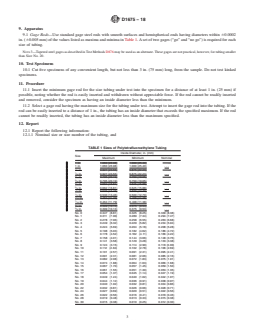
NOTE2—Provisionforalternatemethodsisnecessarybecauseof(1)the minima in Table 1. A set of two gages (“go” and “no go”) is
desire to simplify procedures for specific applications, and (2) the desire
required for each size of tubing.
to eliminate redundant testing and use data generated during manufactur-
NOTE 3—Tapered steel gages as described in Test Methods D876 may
ing process control, including that generated under Statistical Process
be used as an alternate. These gages are not practical, however, for tubing
Control (SPC) conditions, using equipment and methods other than those
smaller than Size No. 20.
specified herein. An example would be the use of laser micrometers or
optical comparators to measure dimensions.
5. Hazards
TABLE 1 Sizes of Polytetrafluoroethylene Tubing
5.1 Lethal voltages may be present during this test. It is
Inside Diameter, in. (mm)
essential that the test apparatus, and all associated equipment
Size
Maximum Minimum Nominal
that may be electrically connected to it, be properly designed
1 in. 1.060 (26.98) 1.000 (25.40) . . .
and installed for safe operation. Solidly ground all electrically
⁄8 in. 0.927 (23.55) 0.875 (22.23) . . .
conductive parts that any person might come in contact with
⁄4 in. 0.795 (20.19) 0.750 (19.05) . . .
during the test. Provide means for use at the completion of any
⁄8 in. 0.662 (16.81) 0.625 (15.88) . . .
⁄2 in. 0.530 (13.46) 0.500 (12.70) . . .
test to ground any parts which: were at high voltage during the
⁄16 in. 0.464 (11.79) 0.438 (11.38) . . .
test; may have acquired an induced charge during the test; may
⁄8 in. 0.399 (10.13) 0.375 (9.53) . . .
retain a charge even after disconnection of the voltage source. No. 0 0.347 (8.81) 0.325 (8.25) 0.330 (8.38)
No. 1 0.311 (7.90) 0.289 (7.34) 0.294 (7.47)
Thoroughly instruct all operators in the proper way to conduct
No. 2 0.278 (7.06) 0.258 (6.55) 0.263 (6.68)
tests safely. When making high voltage tests, particularly in
No. 3 0.249 (6.32) 0.229 (5.82) 0.234 (5.94)
compressed gas or in oil, the energy released at breakdown
No. 4 0.224 (5.69) 0.204 (5.18) 0.208 (5.28)
No. 5 0.198 (5.03) 0.182 (4.62) 0.186 (4.72)
may be suffıcient to result in fire, explosion, or rupture of the
No. 6 0.178 (4.52) 0.162 (4.11) 0.166 (4.22)
test chamber. Design test equipment, test chambers, and test
No. 7 0.158 (4.01) 0.144 (3.66) 0.148 (3.76)
specimens so as to minimize the possibility of such occurrences No. 8 0.141 (3.58) 0.129 (3.28) 0.133 (3.38)
No. 9 0.124 (3.15) 0.114 (2.90) 0.118 (3.00)
and to eliminate the possibility of personal injury. See Section
No. 10 0.112 (2.84) 0.102 (2.78) 0.106 (2.69)
28.
No. 11 0.101 (2.57) 0.091 (2.31) 0.095 (2.41)
No. 12 0.091 (2.31) 0.081 (2.06) 0.085 (2.16)
5.2 Toxic Chemicals from Thermal Decomposition:
No. 13 0.082 (2.08) 0.072 (1.83) 0.075 (1.91)
5.2.1 Polytetrafluoroethylene at temperatures above 200°C
No. 14 0.074 (1.88) 0.064 (1.63) 0.066 (1.68)
No. 15 0.067 (1.70) 0.057 (1.45) 0.059 (1.50)
may produce sufficient toxic vapors to be hazardous in a
No. 16 0.061 (1.55) 0.051 (1.30) 0.053 (1.35)
confined area. Sufficient ventilation must be provided in all
No. 17 0.054 (1.37) 0.045 (1.14) 0.047 (1.19)
tests where the material is subjected to testing above 200°C.
No. 18 0.049 (1.24) 0.040 (1.02) 0.042 (1.07)
No. 19 0.044 (1.12) 0.036 (0.91) 0.038 (0.97)
(See Sections 7, 23, 26, 33, and 43.)
No. 20 0.040 (1.02) 0.032 (0.81) 0.034 (0.86)
No. 22 0.032 (0.81) 0.026 (0.66) 0.028 (0.71)
6. Selection of Test Specimens
No. 24 0.027 (0.69) 0.020 (0.51) 0.022 (0.56)
No. 26 0.022 (0.56) 0.016 (0.41) 0.018 (0.46)
6.1 In the case of material on spools or in coils, remove and
No. 28 0.019 (0.48) 0.013 (0.33) 0.015 (0.38)
discard at least two turns of the product before selecting
No. 30 0.015 (0.38) 0.010 (0.25) 0.012 (0.30)
material for samples from which to prepare test specimens.
D1675 − 18
10. Test Specimens 17. Procedure
10.1 Cut five specimens of any convenient length, but not 17.1 For Size No. 22 and larger, measure the wall thickness
less than 3 in. (75 mm) long, from the sample. Do not test of the specimen using the rod and chisel apparatus by raising
kinked specimens. the chisel from the rod and placing the specimen on the rod in
such a manner that the rod passes through the center of the
11. Procedure
tubingspecimenandrestsflatlyagainsttheupperinsidewallof
11.1 Insert the minimum gage rod for the size tubing under
the specimen. Gently lower the flat chisel edge until it rests
test into the specimen for a distance of at least 1 in. (25 mm)
lightly on the upper outside wall of the specimen. Rotate the
if possible, noting whether the rod is easily inserted and
tubing and determine the minimum and maximum wall thick-
withdrawn without appreciable force. If the rod cannot be
ness.The average of these two readings is the wall thickness of
readily inserted and removed, consider the specimen as having
the specimen.
an inside diameter less than the minimum.
17.2 For Size No. 24 and smaller, use a reference method
11.2 Select a gage rod having the maximum size for the
employing optical means acceptable to both the manufacturer
tubingundertest.Attempttoinsertthegagerodintothetubing. and the purchaser to determine the maximum and minimum
Iftherodcanbeeasilyinsertedtoadistanceof1in.,thetubing
wall thickness.
has an inside diameter that exceeds the specified maximum. If
18. Report
the rod cannot be readily inserted, the tubing has an inside
diameter less than the maximum specified.
18.1 Report the following information:
18.1.1 Nominal size or number of the tubing, and
12. Report
18.1.2 Minimum, maximum, and average wall thickness.
12.1 Report the following information:
12.1.1 Nominal size or size number of the tubing, and 19. Precision and Bias
12.1.2 Size or size number as determined.
19.1 Thistestmethodhasbeeninuseformanyyears,butno
information has been presented to ASTM International upon
13. Precision and Bias
which to base a statement of precision. No activity has been
13.1 Thistestmethodhasbeeninuseformanyyears,butno
planned to develop such information. This test method has no
information has been presented to ASTM International upon
bias because the value for wall thickness is determined solely
which to base a statement of precision. No activity has been
in terms of this test method.
planned to develop such information. This test method has no
bias because the value for inside diameter is determined solely
VOLATILE LOSS
in terms of this test method.
20. Significance and Use
WALL THICKNESS
20.1 Volatile loss is indicative of the efficiency of removal
of volatiles during processing, and may indicate the p
...
This document is not an ASTM standard and is intended only to provide the user of an ASTM standard an indication of what changes have been made to the previous version. Because
it may not be technically possible to adequately depict all changes accurately, ASTM recommends that users consult prior editions as appropriate. In all cases only the current version
of the standard as published by ASTM is to be considered the official document.
Designation: D1675 − 03 (Reapproved 2011) D1675 − 18
Standard Test Methods for
Polytetrafluoroethylene Tubing
This standard is issued under the fixed designation D1675; the number immediately following the designation indicates the year of
original adoption or, in the case of revision, the year of last revision. A number in parentheses indicates the year of last reapproval. A
superscript epsilon (´) indicates an editorial change since the last revision or reapproval.
This standard has been approved for use by agencies of the U.S. Department of Defense.
1. Scope Scope*
1.1 These test methods cover procedures for testing polytetrafluoroethylene tubing for use as electrical insulation. The
procedures appear in the following sections:
ASTM
Procedure Sections Methods
Conditioning 7 .
Dielectric Breakdown Voltage 28 – 30 D149, D876
Inside Diameter 8 – 13 D876
Mandrel Bend Test 46 – 52 D149, D876
Melting Point 41 – 45 D3418, D4895
Penetration Test 26 and 27 D876
Specific Gravity 36 – 40 D792, D1505
Strain Relief 31 – 35 .
Volatile Loss 20 – 25 .
Wall Thickness 14 – 19 .
NOTE 1—These test methods are similar but not identical to those in IEC 60684–2.
1.2 The values stated in inch-pound units are the standard except for temperature, which is stated in degrees Celsius. Values in
parentheses are for information only.
1.3 This standard does not purport to address all of the safety concerns, if any, associated with its use. It is the responsibility
of the user of this standard to establish appropriate safety safety, health, and healthenvironmental practices and determine the
applicability of regulatory limitations prior to use. For specific warning statements, see Section 5.
1.4 This international standard was developed in accordance with internationally recognized principles on standardization
established in the Decision on Principles for the Development of International Standards, Guides and Recommendations issued
by the World Trade Organization Technical Barriers to Trade (TBT) Committee.
2. Referenced Documents
2.1 ASTM Standards:
D149 Test Method for Dielectric Breakdown Voltage and Dielectric Strength of Solid Electrical Insulating Materials at
Commercial Power Frequencies
D792 Test Methods for Density and Specific Gravity (Relative Density) of Plastics by Displacement
D876 Test Methods for Nonrigid Vinyl Chloride Polymer Tubing Used for Electrical Insulation
D1505 Test Method for Density of Plastics by the Density-Gradient Technique
D1711 Terminology Relating to Electrical Insulation
D3418 Test Method for Transition Temperatures and Enthalpies of Fusion and Crystallization of Polymers by Differential
Scanning Calorimetry
D3487 Specification for Mineral Insulating Oil Used in Electrical Apparatus
D4895 Specification for Polytetrafluoroethylene (PTFE) Resin Produced From Dispersion
E176 Terminology of Fire Standards
These test methods are under the jurisdiction of ASTM Committee D09 on Electrical and Electronic Insulating Materials and are the direct responsibility of Subcommittee
D09.07 on Flexible and Rigid Electrical Insulating Materials.
Current edition approved Aug. 1, 2011May 1, 2018. Published August 2011May 2018. Originally approved in 1959. Last previous edition approved in 20032011 as
D1675 – 03.D1675 – 03 (2011). DOI: 10.1520/D1675-03R11.10.1520/D1675-18.
For referenced ASTM standards, visit the ASTM website, www.astm.org, or contact ASTM Customer Service at service@astm.org. For Annual Book of ASTM Standards
volume information, refer to the standard’s Document Summary page on the ASTM website.
*A Summary of Changes section appears at the end of this standard
Copyright © ASTM International, 100 Barr Harbor Drive, PO Box C700, West Conshohocken, PA 19428-2959. United States
D1675 − 18
2.2 IEC Standards
60684–2 Flexible Insulating Sleeves—Part 2: Methods of Test
3. Terminology
3.1 Definitions:
3.1.1 For definitions pertaining to electrical insulation, refer to Terminology D1711.
3.1.2 For definitions pertaining to fire standards, refer to Terminology E176.
3.2 Definitions of Terms Specific to This Standard:
3.2.1 apparent melting point, n—the temperature at which the appearance of the plastic changes from opaque to transparent.
3.2.2 strain relief, n—a dimensional change brought about by subjecting the tubing to an elevated temperature.
3.2.3 volatile loss, n—the reduction in weight by vaporization under controlled conditions.
4. Significance and Use
4.1 The test methods in this standard are considered important to characterize polytetrafluoroethylene tubing. They are intended
primarily for, but not limited to polytetrafluoroethylene tubing.
4.2 Variations in these methods or alternate contemporary methods of measurement may be used to determine the values for
the properties in this standard provided such methods ensure quality levels and measurement accuracy equal to or better than those
prescribed herein. It is the responsibility of the organizations using alternate test methods to be able to demonstrate this condition.
In cases of dispute, the methods specified herein shall be used.
NOTE 2—Provision for alternate methods is necessary because of (1) the desire to simplify procedures for specific applications, and (2) the desire to
eliminate redundant testing and use data generated during manufacturing process control, including that generated under Statistical Process Control (SPC)
conditions, using equipment and methods other than those specified herein. An example would be the use of laser micrometers or optical comparators
to measure dimensions.
5. Hazards
5.1 Lethal voltages may be present during this test. It is essential that the test apparatus, and all associated equipment that may
be electrically connected to it, be properly designed and installed for safe operation. Solidly ground all electrically conductive
parts that any person might come in contact with during the test. Provide means for use at the completion of any test to ground
any parts which: were at high voltage during the test; may have acquired an induced charge during the test; may retain a charge
even after disconnection of the voltage source. Thoroughly instruct all operators in the proper way to conduct tests safely. When
making high voltage tests, particularly in compressed gas or in oil, the energy released at breakdown may be suffıcient to result
in fire, explosion, or rupture of the test chamber. Design test equipment, test chambers, and test specimens so as to minimize the
possibility of such occurrences and to eliminate the possibility of personal injury. See Section 28.
5.2 Toxic Chemicals from Thermal Decomposition:
5.2.1 Polytetrafluoroethylene at temperatures above 200°C may produce sufficient toxic vapors to be hazardous in a confined
area. Sufficient ventilation must be provided in all tests where the material is subjected to testing above 200°C. (See Sections 7,
23, 26, 33, and 43.)
6. Selection of Test Specimens
6.1 In the case of material on spools or in coils, remove and discard at least two turns of the product before selecting material
for samples from which to prepare test specimens.
6.2 In the case of material offered in cut lengths, do not prepare specimens from samples of material closer than 1 in. (25 mm)
from each end.
6.3 Do not use specimens with obvious defects unless the purpose of the test is to determine the effects of these defects.
7. Conditioning
7.1 (Warning—See 5.2.)
7.2 Unless otherwise specified, condition and test specimens at least 3 h 3 h at 23 6 2°C (73.4 6 4°F) 5°C and 50 6 5 %10 %
relative humidity.
INSIDE DIAMETER
8. Significance and Use
8.1 The inside diameter is of importance in determining the proper physical fit of the tubing.
Available from American National Standards Institute (ANSI), 25 W. 43rd St., 4th Floor, New York, NY 10036, http://www.ansi.org.
D1675 − 18
9. Apparatus
9.1 Gage Rods—Use standard gage steel rods with smooth surfaces and hemispherical ends having diameters within 60.0002
in. (60.005 mm) of the values listed as maxima and minima in Table 1. A set of two gages (“go” and “no go”) is required for each
size of tubing.
NOTE 3—Tapered steel gages as described in Test Methods D876 may be used as an alternate. These gages are not practical, however, for tubing smaller
than Size No. 20.
10. Test Specimens
10.1 Cut five specimens of any convenient length, but not less than 3 in. (75 mm) long, from the sample. Do not test kinked
specimens.
11. Procedure
11.1 Insert the minimum gage rod for the size tubing under test into the specimen for a distance of at least 1 in. (25 mm) if
possible, noting whether the rod is easily inserted and withdrawn without appreciable force. If the rod cannot be readily inserted
and removed, consider the specimen as having an inside diameter less than the minimum.
11.2 Select a gage rod having the maximum size for the tubing under test. Attempt to insert the gage rod into the tubing. If the
rod can be easily inserted to a distance of 1 in., the tubing has an inside diameter that exceeds the specified maximum. If the rod
cannot be readily inserted, the tubing has an inside diameter less than the maximum specified.
12. Report
12.1 Report the following information:
12.1.1 Nominal size or size number of the tubing, and
TABLE 1 Sizes of Polytetrafluoroethylene Tubing
Inside Diameter, in. (mm)
Size
Maximum Minimum Nominal
1 in. 1.060 (26.98) 1.000 (25.40) .
1 in. 1.060 (26.98) 1.000 (25.40) . . .
⁄8 in. 0.927 (23.55) 0.875 (22.23) .
⁄8 in. 0.927 (23.55) 0.875 (22.23) . . .
⁄4 in. 0.795 (20.19) 0.750 (19.05) .
⁄4 in. 0.795 (20.19) 0.750 (19.05) . . .
⁄8 in. 0.662 (16.81) 0.625 (15.88) .
⁄8 in. 0.662 (16.81) 0.625 (15.88) . . .
⁄2 in. 0.530 (13.46) 0.500 (12.70) .
⁄2 in. 0.530 (13.46) 0.500 (12.70) . . .
⁄16 in. 0.464 (11.79) 0.438 (11.38) .
⁄16 in. 0.464 (11.79) 0.438 (11.38) . . .
⁄8 in. 0.399 (10.13) 0.375 (9.53) .
⁄8 in. 0.399 (10.13) 0.375 (9.53) . . .
No. 0 0.347 (8.81) 0.325 (8.25) 0.330 (8.38)
No. 1 0.311 (7.90) 0.289 (7.34) 0.294 (7.47)
No. 2 0.278 (7.06) 0.258 (6.55) 0.263 (6.68)
No. 3 0.249 (6.32) 0.229 (5.82) 0.234 (5.94)
No. 4 0.224 (5.69) 0.204 (5.18) 0.208 (5.28)
No. 5 0.198 (5.03) 0.182 (4.62) 0.186 (4.72)
No. 6 0.178 (4.52) 0.162 (4.11) 0.166 (4.22)
No. 7 0.158 (4.01) 0.144 (3.66) 0.148 (3.76)
No. 8 0.141 (3.58) 0.129 (3.28) 0.133 (3.38)
No. 9 0.124 (3.15) 0.114 (2.90) 0.118 (3.00)
No. 10 0.112 (2.84) 0.102 (2.78) 0.106 (2.69)
No. 11 0.101 (2.57) 0.091 (2.31) 0.095 (2.41)
No. 12 0.091 (2.31) 0.081 (2.06) 0.085 (2.16)
No. 13 0.082 (2.08) 0.072 (1.83) 0.075 (1.91)
No. 14 0.074 (1.88) 0.064 (1.63) 0.066 (1.68)
No. 15 0.067 (1.70) 0.057 (1.45) 0.059 (1.50)
No. 16 0.061 (1.55) 0.051 (1.30) 0.053 (1.35)
No. 17 0.054 (1.37) 0.045 (1.14) 0.047 (1.19)
No. 18 0.049 (1.24) 0.040 (1.02) 0.042 (1.07)
No. 19 0.044 (1.12) 0.036 (0.91) 0.038 (0.97)
No. 20 0.040 (1.02) 0.032 (0.81) 0.034 (0.86)
No. 22 0.032 (0.81) 0.026 (0.66) 0.028 (0.71)
No. 24 0.027 (0.69) 0.020 (0.51) 0.022 (0.56)
No. 26 0.022 (0.56) 0.016 (0.41) 0.018 (0.46)
No. 28 0.019 (0.48) 0.013 (0.33) 0.015 (0.38)
No. 30 0.015 (0.38) 0.010 (0.25) 0.012 (0.30)
D1675 − 18
12.1.2 Size or size number as determined.
13. Precision and Bias
13.1 This test method has been in use for many years, but no information has been presented to ASTM International upon which
to base a statement of precision. No activity has been planned to develop such information. This test method has no bias because
the value for inside diameter is determined solely in terms of this test method.
WALL THICKNESS
14. Significance and Use
14.1 The wall thickness provides design data. It is also useful in computing certain physical and electrical properties of the
tubing.
15. Apparatus
15.1 Dial Micrometer—For Size No. 22 and larger, use a dial micrometer equipped with a rod support for the specimen and
a chisel-edge plunger. Use a gage with a minimum graduation of 0.0005 in. (0.01 mm) and a gaging load not exceeding 25 g. Use
a rod made of hardened steel 0.020 in. (0.50 mm) in diameter and ⁄8 in. (9.5 mm) long. Ensure that the chisel edge of the plunger
is flat and approximately 0.043 in. (1.1 mm) across and ⁄16 in. (8 mm) long.
15.2 Microscope—For Size No. 24 and smaller, use an optical means such as a toolmaker’s microscope.
16. Test Specimens
16.1 Cut five ⁄2-in. (13-mm) specimens free from kinks from the sample. Make the cut edge perpendicular to the longitudinal
axis of the sample.
17. Procedure
17.1 For Size No. 22 and larger, measure the wall thickness of the specimen using the rod and chisel apparatus by raising the
chisel from the rod and placing the specimen on the rod in such a manner that the rod passes through the center of the tubing
specimen and rests flatly ag
...