

ASTM C1741-18
(Test Method)Standard Test Method for Bleed Stability of Cementitious Post-Tensioning Tendon Grout
General Information
- Abstract
SIGNIFICANCE AND USE
4.1 This test method is designed to evaluate the bleed stability of a freshly-mixed grout under static pressure. It can be used in both the laboratory to qualify grout materials and in the field as a quality control test. When used to qualify grout materials, replicate tests may be specified. It is intended that the test pressure, acceptance criteria, and number of replicate tests be set forth in the contract documents if this test method is referenced. These values will normally vary depending on the vertical rise of the post-tensioning tendon.
Note 1: Appendix X1 includes a reference for an example of test pressures and bleeding limits.
4.2 The procedure for this test was developed by Schokker et al.4 based on previous work by Schupack.5
SCOPE
1.1 This test method is designed to determine the bleed stability of freshly-mixed cementitious grout under static pressure.
1.2 Units—The values stated in SI units are to be regarded as standard. No other units of measurement are included in this standard.
1.3 This standard does not purport to address all of the safety concerns, if any, associated with its use. It is the responsibility of the user of this standard to establish appropriate safety and health practices and determine the applicability of regulatory limitations prior to use. (Warning—Fresh hydraulic cementitious mixtures are caustic and may cause chemical burns to skin and tissue upon prolonged exposure.2)
1.4 This international standard was developed in accordance with internationally recognized principles on standardization established in the Decision on Principles for the Development of International Standards, Guides and Recommendations issued by the World Trade Organization Technical Barriers to Trade (TBT) Committee.
- Status
- Published
- Publication Date
- 30-Sep-2018
- Technical Committee
- C09 - Concrete and Concrete Aggregates
- Drafting Committee
- C09.41 - Hydraulic Cement Grouts
Buy Documents

ASTM C1741-18 - Standard Test Method for Bleed Stability of Cementitious Post-Tensioning Tendon Grout

REDLINE ASTM C1741-18 - Standard Test Method for Bleed Stability of Cementitious Post-Tensioning Tendon Grout
Overview
ASTM C1741-18: Standard Test Method for Bleed Stability of Cementitious Post-Tensioning Tendon Grout provides a standardized procedure to evaluate the bleed stability of freshly-mixed cementitious grout subjected to static pressure. Published by ASTM International, this standard is critical for ensuring the quality, durability, and performance of grout used in post-tensioned concrete systems. The method can be applied both in laboratory settings for material qualification and in the field as a quality control measure, ensuring that grout meets stringent project specifications for bleed control.
Key Topics
- Bleed Stability Measurement: Defines procedures to determine a grout's resistance to bleeding - the autogenous flow and separation of water within or from the grout under pressure.
- Test Apparatus: Involves the use of a pressure filtration funnel, a regulated pressure supply, and a bleed water collection system to replicate conditions similar to those found in post-tensioned structures.
- Mixing and Sample Preparation: Specifies guidance for mixing grout samples consistently using manufacturer’s instructions or ASTM C938 when instructions are not provided.
- Pressure Application: Outlines steps for subjecting grout to a preset static pressure and monitoring for bleed water over a fixed time period.
- Reporting Requirements: Details the parameters to report, including percentage bleeding, applied pressure, and duration.
- Precision Statement: Offers information regarding the repeatability of test results, emphasizing the importance of replicate testing when qualifying grout materials.
- Safety and Health Practices: Highlights the need for appropriate safety protocols when handling cementitious materials, which are caustic and may cause chemical burns.
Applications
ASTM C1741-18 is essential for a variety of stakeholders in the concrete construction and civil engineering sectors:
- Material Qualification: Used by manufacturers and laboratories to validate the bleed stability of cementitious grout prior to approval for post-tensioning applications.
- Quality Assurance and Control: Employed at construction sites to ensure grout performance aligns with project specifications, reducing the risk of voids, corrosion, or structural issues in post-tensioned concrete.
- Structural Integrity: Helps ensure the long-term durability and service life of bridges, buildings, and infrastructure utilizing post-tensioned tendon systems by minimizing detrimental bleed water migration.
- Specification Compliance: Facilitates compliance with contract documents that require specific pressure levels and bleed limits based on the structure’s design and tendon configuration.
Related Standards
- ASTM C125 - Terminology Relating to Concrete and Concrete Aggregates: Provides key definitions referenced throughout ASTM C1741-18.
- ASTM C938 - Practice for Proportioning Grout Mixtures for Preplaced-Aggregate Concrete: Describes procedures for mixing cementitious grouts when manufacturer guidance is not available.
- Post-Tensioning Institute (PTI) Specifications: While not directly referenced, these organization guidelines often align with or reference ASTM test methods for tendon grout materials.
- International Standards on Post-Tensioned Concrete: Provide complementary guidance relevant for global infrastructure projects where bleed stability is critical.
By adhering to ASTM C1741-18, project teams can confidently assess the bleed stability of cementitious grouts, ensuring high-quality results for post-tensioned construction applications. This standard supports robust quality control programs, reduces the risk of structural deficiencies, and builds a foundation for durable, reliable concrete infrastructure. For further information, reviewing the latest official ASTM documentation is recommended.
Relations
- Effective Date
- 15-Dec-2019
- Refers
ASTM C938-19 - Standard Practice for Proportioning Grout Mixtures for Preplaced-Aggregate Concrete - Effective Date
- 01-May-2019
- Effective Date
- 01-Jan-2019
- Effective Date
- 01-Oct-2018
- Effective Date
- 01-Jul-2018
- Effective Date
- 01-Jan-2018
- Effective Date
- 15-Dec-2016
- Refers
ASTM C938-16 - Standard Practice for Proportioning Grout Mixtures for Preplaced-Aggregate Concrete - Effective Date
- 01-Feb-2016
- Effective Date
- 15-Dec-2015
- Effective Date
- 01-Jul-2015
- Effective Date
- 01-Feb-2015
- Effective Date
- 01-Aug-2014
- Effective Date
- 15-Dec-2013
- Effective Date
- 01-Aug-2013
- Effective Date
- 01-Feb-2013
Buy Documents
ASTM C1741-18 - Standard Test Method for Bleed Stability of Cementitious Post-Tensioning Tendon Grout
REDLINE ASTM C1741-18 - Standard Test Method for Bleed Stability of Cementitious Post-Tensioning Tendon Grout
Get Certified
Connect with accredited certification bodies for this standard

DIBt (Deutsches Institut für Bautechnik)
German Institute for Building Technology.
DIN CERTCO
DIN Group product certification.

Aboma Certification B.V.
Specialized in construction, metal, and transport sectors.
Sponsored listings
Frequently Asked Questions
ASTM C1741-18 is a standard published by ASTM International. Its full title is "Standard Test Method for Bleed Stability of Cementitious Post-Tensioning Tendon Grout". This standard covers: SIGNIFICANCE AND USE 4.1 This test method is designed to evaluate the bleed stability of a freshly-mixed grout under static pressure. It can be used in both the laboratory to qualify grout materials and in the field as a quality control test. When used to qualify grout materials, replicate tests may be specified. It is intended that the test pressure, acceptance criteria, and number of replicate tests be set forth in the contract documents if this test method is referenced. These values will normally vary depending on the vertical rise of the post-tensioning tendon. Note 1: Appendix X1 includes a reference for an example of test pressures and bleeding limits. 4.2 The procedure for this test was developed by Schokker et al.4 based on previous work by Schupack.5 SCOPE 1.1 This test method is designed to determine the bleed stability of freshly-mixed cementitious grout under static pressure. 1.2 Units—The values stated in SI units are to be regarded as standard. No other units of measurement are included in this standard. 1.3 This standard does not purport to address all of the safety concerns, if any, associated with its use. It is the responsibility of the user of this standard to establish appropriate safety and health practices and determine the applicability of regulatory limitations prior to use. (Warning—Fresh hydraulic cementitious mixtures are caustic and may cause chemical burns to skin and tissue upon prolonged exposure.2) 1.4 This international standard was developed in accordance with internationally recognized principles on standardization established in the Decision on Principles for the Development of International Standards, Guides and Recommendations issued by the World Trade Organization Technical Barriers to Trade (TBT) Committee.
SIGNIFICANCE AND USE 4.1 This test method is designed to evaluate the bleed stability of a freshly-mixed grout under static pressure. It can be used in both the laboratory to qualify grout materials and in the field as a quality control test. When used to qualify grout materials, replicate tests may be specified. It is intended that the test pressure, acceptance criteria, and number of replicate tests be set forth in the contract documents if this test method is referenced. These values will normally vary depending on the vertical rise of the post-tensioning tendon. Note 1: Appendix X1 includes a reference for an example of test pressures and bleeding limits. 4.2 The procedure for this test was developed by Schokker et al.4 based on previous work by Schupack.5 SCOPE 1.1 This test method is designed to determine the bleed stability of freshly-mixed cementitious grout under static pressure. 1.2 Units—The values stated in SI units are to be regarded as standard. No other units of measurement are included in this standard. 1.3 This standard does not purport to address all of the safety concerns, if any, associated with its use. It is the responsibility of the user of this standard to establish appropriate safety and health practices and determine the applicability of regulatory limitations prior to use. (Warning—Fresh hydraulic cementitious mixtures are caustic and may cause chemical burns to skin and tissue upon prolonged exposure.2) 1.4 This international standard was developed in accordance with internationally recognized principles on standardization established in the Decision on Principles for the Development of International Standards, Guides and Recommendations issued by the World Trade Organization Technical Barriers to Trade (TBT) Committee.
ASTM C1741-18 is classified under the following ICS (International Classification for Standards) categories: 91.100.10 - Cement. Gypsum. Lime. Mortar. The ICS classification helps identify the subject area and facilitates finding related standards.
ASTM C1741-18 has the following relationships with other standards: It is inter standard links to ASTM C125-19a, ASTM C938-19, ASTM C125-19, ASTM C125-18b, ASTM C125-18a, ASTM C125-18, ASTM C125-16, ASTM C938-16, ASTM C125-15b, ASTM C125-15a, ASTM C125-15, ASTM C125-14, ASTM C125-13b, ASTM C125-13a, ASTM C125-13. Understanding these relationships helps ensure you are using the most current and applicable version of the standard.
ASTM C1741-18 is available in PDF format for immediate download after purchase. The document can be added to your cart and obtained through the secure checkout process. Digital delivery ensures instant access to the complete standard document.
Standards Content (Sample)
This international standard was developed in accordance with internationally recognized principles on standardization established in the Decision on Principles for the
Development of International Standards, Guides and Recommendations issued by the World Trade Organization Technical Barriers to Trade (TBT) Committee.
Designation: C1741 − 18
Standard Test Method for
Bleed Stability of Cementitious Post-Tensioning Tendon
Grout
This standard is issued under the fixed designation C1741; the number immediately following the designation indicates the year of
original adoption or, in the case of revision, the year of last revision. A number in parentheses indicates the year of last reapproval. A
superscript epsilon (´) indicates an editorial change since the last revision or reapproval.
1. Scope* 3.2 Definitions of Terms Specific to This Standard:
3.2.1 bleed stability, n—of cementitious grout, resistance to
1.1 This test method is designed to determine the bleed
bleeding.
stability of freshly-mixed cementitious grout under static
3.2.2 bleeding, n—of cementitious post-tensioning tendon
pressure.
grout, autogenous flow of mixing water within, or its emer-
1.2 Units—The values stated in SI units are to be regarded
gence from, newly placed grout; caused by the settlement of
as standard. No other units of measurement are included in this
the solid materials within the grout and the filtering action of
standard.
strands and wires when subjected to static pressure and
1.3 This standard does not purport to address all of the
capillary action.
safety concerns, if any, associated with its use. It is the
3.2.3 grout, n—mixture of cementitious material and water,
responsibility of the user of this standard to establish appro-
with or without aggregate and admixtures, proportioned to
priate safety and health practices and determine the applica-
produce a pourable consistency without segregation of the
bility of regulatory limitations prior to use. (Warning—Fresh
constituents.
hydraulic cementitious mixtures are caustic and may cause
3.2.4 post-tensioning, adj—referring to a method of pre-
chemical burns to skin and tissue upon prolonged exposure. )
stressing in which prestressing steel is tensioned after the
1.4 This international standard was developed in accor-
concrete has gained sufficient strength.
dance with internationally recognized principles on standard-
ization established in the Decision on Principles for the
4. Significance and Use
Development of International Standards, Guides and Recom-
mendations issued by the World Trade Organization Technical 4.1 This test method is designed to evaluate the bleed
Barriers to Trade (TBT) Committee. stability of a freshly-mixed grout under static pressure. It can
be used in both the laboratory to qualify grout materials and in
2. Referenced Documents
the field as a quality control test. When used to qualify grout
2.1 ASTM Standards: materials, replicate tests may be specified. It is intended that
C125 Terminology Relating to Concrete and Concrete Ag- the test pressure, acceptance criteria, and number of replicate
gregates tests be set forth in the contract documents if this test method
C938 Practice for Proportioning Grout Mixtures for is referenced. These values will normally vary depending on
Preplaced-Aggregate Concrete the vertical rise of the post-tensioning tendon.
NOTE 1—Appendix X1 includes a reference for an example of test
3. Terminology
pressures and bleeding limits.
3.1 Definitions—For definitions of terms used in this test 4.2 The procedure for this test was developed by Schokker
4 5
method, refer to Terminology C125. et al. based on previous work by Schupack.
5. Apparatus
This test method is under the jurisdiction of ASTM Committee C09 on
Concrete and Concrete Aggregates and is the direct responsibility of Subcommittee
5.1 The apparatus consists of a commercially available
C09.41 on Hydraulic Cement Grouts.
pressure filtration funnel, stand, pressure supply with gauge,
Current edition approved Oct. 1, 2018. Published October 2018. Originally
approved in 2011. Last previous edition approved in 2012 as C1741 – 12. DOI:
10.1520/C1741-18.
2 4
Section on Safety Precautions, Manual of Aggregate and Concrete Testing, Schokker, A. J., Koester, B. D., Breen, J. E., and Kreger, M. E., “Development
Annual Book of ASTM Standards, Vol 04.02. of High Performance Grouts for Bonded Post- Tensioned Structures,” Research
For referenced ASTM standards, visit the ASTM website, www.astm.org, or Report 1405-2, Center for Transportation Research, October 1999.
contact ASTM Customer Service at service@astm.org. For Annual Book of ASTM Schupack, M. “Admixture for Controlling Bleed in Cement Grout Used in
Standards volume information, refer to the standard’s Document Summary page on Post-Tensioning,”Precast/Prestressed Concrete Institute Journal, Nov.–Dec. 1974,
the ASTM website. pp. 1–10.
*A Summary of Changes section appears at the end of this standard
Copyright © ASTM International, 100 Barr Harbor Drive, PO Box C700, West Conshohocken, PA 19428-2959. United States
C1741 − 18
NOTE 2—A wire of approximately 1 mm diameter has been found
pressure regulator, valve, drip wick, and bleed water collection
satisfactory for the drip wick.
container as shown in Fig. 1 and Fig. 2.
5.1.1 Filtration Funnel—A 47-mm diameter stainless steel 5.1.5 Bleed Water Collection Container—The bleed water
pressure filtration funnel with a nominal capacity of 200 mL as collection container shall consist of a 10-mL transparent
shown in Fig. 2. The filtration funnel shall have removable graduated cylinder with 0.2-mL graduation marks.
threaded caps at both ends with a stem for connection of the
6. Sample Preparation
gas supply and a 7.0 6 0.5 mm inside diameter stem 90 6 1
mm long for escape of water. The base of the vessel shall
6.1 Grout shall be mixed in accordance with the manufac-
contain a 35 6 1 mm diameter stainless steel 45 μm (No. 325)
turer’s instructions or in accordance with Practice C938 if no
screen that supports a 47 mm diameter Type A/E borosilicate
other instructions are provided. For field quality control testing,
glass filter (1-μm pore size) as shown in Fig. 2. The screen shall
the grout shall be mixed using the same equipment and
be inserted with the woven side against the glass filter, and the
procedure as used for the installation of the material.
funnel gasket shall be placed above the glass filter as shown in
Fig. 2. The glass filter shall cover the screen across the inside 7. Proc
...
This document is not an ASTM standard and is intended only to provide the user of an ASTM standard an indication of what changes have been made to the previous version. Because
it may not be technically possible to adequately depict all changes accurately, ASTM recommends that users consult prior editions as appropriate. In all cases only the current version
of the standard as published by ASTM is to be considered the official document.
Designation: C1741 − 12 C1741 − 18
Standard Test Method for
Bleed Stability of Cementitious Post-Tensioning Tendon
Grout
This standard is issued under the fixed designation C1741; the number immediately following the designation indicates the year of
original adoption or, in the case of revision, the year of last revision. A number in parentheses indicates the year of last reapproval. A
superscript epsilon (´) indicates an editorial change since the last revision or reapproval.
1. Scope Scope*
1.1 This test method is designed to determine the bleed stability of freshly-mixed cementitious grout under static pressure.
1.2 Units—The values stated in SI units are to be regarded as standard. No other units of measurement are included in this
standard.
1.3 This standard does not purport to address all of the safety concerns, if any, associated with its use. It is the responsibility
of the user of this standard to establish appropriate safety and health practices and determine the applicability of regulatory
limitations prior to use.(Warning—Fresh hydraulic cementitious mixtures are caustic and may cause chemical burns to skin and
tissue upon prolonged exposure. )
1.4 This international standard was developed in accordance with internationally recognized principles on standardization
established in the Decision on Principles for the Development of International Standards, Guides and Recommendations issued
by the World Trade Organization Technical Barriers to Trade (TBT) Committee.
2. Referenced Documents
2.1 ASTM Standards:
C125 Terminology Relating to Concrete and Concrete Aggregates
C938 Practice for Proportioning Grout Mixtures for Preplaced-Aggregate Concrete
3. Terminology
3.1 Definitions—For definitions of terms used in this test method, refer to Terminology C125.
3.2 Definitions of Terms Specific to This Standard:
3.2.1 bleed stability, n—of cementitious grout, resistance to bleeding.
3.2.2 bleeding, n—of cementitious post-tensioning tendon grout, autogenous flow of mixing water within, or its emergence
from, newly placed grout; caused by the settlement of the solid materials within the grout and the filtering action of strands and
wires when subjected to static pressure and capillary action.
3.2.3 grout, n—mixture of cementitious material and water, with or without aggregate and admixtures, proportioned to produce
a pourable consistency without segregation of the constituents.
3.2.4 post-tensioning, adj—referring to a method of prestressing in which prestressing steel is tensioned after the concrete has
gained sufficient strength.
4. Significance and Use
4.1 This test method is designed to evaluate the bleed stability of a freshly-mixed grout under static pressure. It can be used
in both the laboratory to qualify grout materials and in the field as a quality control test. When used to qualify grout materials,
This test method is under the jurisdiction of ASTM Committee C09 on Concrete and Concrete Aggregates and is the direct responsibility of Subcommittee C09.41 on
Hydraulic Cement Grouts.
Current edition approved June 1, 2012Oct. 1, 2018. Published July 2012October 2018. Originally approved in 2011. Last previous edition approved in 20112012 as C1741
– 11a.12. DOI: 10.1520/C1741-12.10.1520/C1741-18.
Section on Safety Precautions, Manual of Aggregate and Concrete Testing,Annual Book of ASTM Standards, Vol 04.02.
For referenced ASTM standards, visit the ASTM website, www.astm.org, or contact ASTM Customer Service at service@astm.org. For Annual Book of ASTM Standards
volume information, refer to the standard’s Document Summary page on the ASTM website.
*A Summary of Changes section appears at the end of this standard
Copyright © ASTM International, 100 Barr Harbor Drive, PO Box C700, West Conshohocken, PA 19428-2959. United States
C1741 − 18
replicate tests may be specified. It is intended that the test pressure, acceptance criteria, and number of replicate tests be set forth
in the contract documents if this test method is referenced. These values will normally vary depending on the vertical rise of the
post-tensioning tendon.
NOTE 1—Appendix X1 includes a reference for an example of test pressures and bleeding limits.
4 5
4.2 The procedure for this test was developed by Schokker et al. based on previous work by Schupack.
5. Apparatus
5.1 The apparatus consists of a commercially available pressure filtration funnel, stand, pressure supply with gauge, pressure
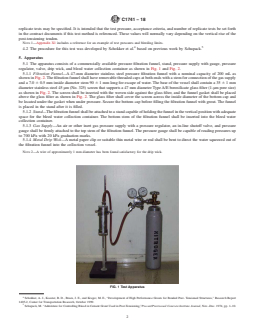
regulator, valve, drip wick, and bleed water collection container as shown in Fig. 1 and Fig. 2.
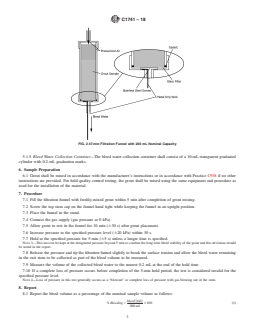
5.1.1 Filtration Funnel—A 47-mm diameter stainless steel pressure filtration funnel with a nominal capacity of 200 mL as
shown in Fig. 2. The filtration funnel shall have removable threaded caps at both ends with a stem for connection of the gas supply
and a 7.0 6 0.5 mm inside diameter stem 90 6 1 mm long for escape of water. The base of the vessel shall contain a 35 6 1 mm
diameter stainless steel 45 μm (No. 325) screen that supports a 47 mm diameter Type A/E borosilicate glass filter (1-μm pore size)
as shown in Fig. 2. The screen shall be inserted with the woven side against the glass filter, and the funnel gasket shall be placed
above the glass filter as shown in Fig. 2. The glass filter shall cover the screen across the inside diameter of the bottom cap and
be located under the gasket when under pressure. Secure the bottom cap before filling the filtration funnel with grout. The funnel
is placed in the stand after it is filled.
5.1.2 Stand—The filtration funnel shall be attached to a stand capable of holding the funnel in the vertical position with adequate
space for the bleed water collection container. The bottom stem of the filtration funnel shall be inserted into the bleed water
collection container.
5.1.3 Gas Supply—An air or other inert gas pressure supply with a pressure regulator, an in-line shutoff valve, and pressure
gauge shall be firmly attached to the top stem of the filtration funnel. The pressure gauge shall be capable of reading pressures up
to 700 kPa with 20 kPa graduation marks.
5.1.4 Metal Drip Wick—A metal paper clip or suitable thin metal wire or rod shall be bent to direct the water squeezed out of
the filtration funnel i
...