

ASTM D6497/D6497M-02(2021)
(Guide)Standard Guide for Mechanical Attachment of Geomembrane to Penetrations or Structures
General Information
- Abstract
SIGNIFICANCE AND USE
4.1 This guide attempts to detail specific areas of concern regarding the attachment of geomembranes to structures. Components of the geomembrane attachment are addressed as to the type and use of each component.
4.2 Although this guide does not address all aspects of geomembrane attachments, the user of this guide may note important objectives and design issues of each component of the geomembrane. All these objectives and design issues may or may not be required to obtain an appropriate geomembrane attachment. By describing these areas of concern, it is hoped that the user of this guide will be able to design geomembrane attachments, develop specifications or construct geomembrane attachments, or both, which fulfill the requirements of its design intent.
SCOPE
1.1 This guide covers procedures that can be employed to mechanically attach fabricated geomembranes to structures, pipes, etc.
1.2 This guide does not address all problems or situations a geomembrane installer or design engineer may face in the attachment of geomembranes to structures, pipes, etc. The sole purpose of this standard guide is to point out typical problems with geomembrane attachments and clearly state objectives of each component of the geomembrane attachment(s).
1.3 This guide has been generated for geomembrane application(s); however, a geomembrane installer or design engineer, or both, may find portions of this guide applicable to other geosynthetics.
1.4 The values stated in either SI units or inch-pound units are to be regarded separately as standard. The values stated in each system are not necessarily exact equivalents; therefore, to ensure conformance with the standard, each system shall be used independently of the other, and values from the two systems shall not be combined.
1.5 This standard does not purport to address all of the safety concerns, if any, associated with its use. It is the responsibility of the user of this standard to establish appropriate safety, health, and environmental practices and determine the applicability of regulatory limitations prior to use.
1.6 This international standard was developed in accordance with internationally recognized principles on standardization established in the Decision on Principles for the Development of International Standards, Guides and Recommendations issued by the World Trade Organization Technical Barriers to Trade (TBT) Committee.
- Status
- Published
- Publication Date
- 30-Jun-2021
- Technical Committee
- D35 - Geosynthetics
- Drafting Committee
- D35.10 - Geomembranes
Overview
ASTM D6497/D6497M-02(2021): Standard Guide for Mechanical Attachment of Geomembrane to Penetrations or Structures provides essential guidelines for the effective mechanical attachment of geomembranes to various structures, such as pipes, concrete, metal, and other penetrations. Developed by ASTM International, this guide offers recommendations for design, specification, and installation to enhance the integrity and performance of geomembrane systems in containment and barrier applications.
This standard underscores the importance of addressing potential problems and critical areas in geomembrane attachment. By describing typical issues and the objectives of each attachment component, ASTM D6497/D6497M-02(2021) assists design engineers, installers, and project managers in achieving successful geomembrane installations that fulfill their intended functions.
Key Topics
- Attachment Components: The guide details common components such as battens, clamps, banding straps, boots, gaskets, rondels, and sealants used in mechanical attachment systems.
- Types of Mechanical Connections: Discussion includes batten connections for flat surfaces, clamp or banding strap methods for round penetrations, welding techniques for thermoplastics, and bonded (adhesive) attachments for dissimilar materials.
- Critical Design Considerations: The standard addresses key concerns such as protection against geomembrane deformation, handling of edges and void spaces, material compatibility, torque and bolt spacing, and sealant selection.
- Surface and Structural Considerations: Emphasis is placed on preparing structural surfaces, rounding edges to prevent damage, and using protective layers where needed.
- Quality Assurance: Recommendations for cleanliness and quality of attachment, including the use of factory pre-fabricated boots, corners, and edges to improve installation quality and reduce field errors.
- Penetration Design: Guidance on handling multiple or irregular penetrations, proximity issues, and optimizing the shape and size of structural penetrations for easier geomembrane attachment.
Applications
ASTM D6497/D6497M is highly relevant for professionals involved in the installation and design of geomembrane containment systems, such as in:
- Waste containment facilities: Lining of landfills, storage pads, and lagoons.
- Water containment and storage: Reservoirs, ponds, and tanks.
- Environmental protection: Barriers for pollution control and groundwater protection.
- Industrial sectors: Lining systems around tanks, pipelines, and process vessels.
- Civil engineering and infrastructure: Basements, tunnels, and retaining walls requiring impermeable barriers.
The guide is useful for both new installations and retrofits, helping ensure the long-term performance and durability of geomembrane attachments across a range of project scale and complexity.
Related Standards
This standard works in conjunction with other ASTM and industry standards to ensure comprehensive coverage of geosynthetic, sealing, and installation practices. Key referenced standards include:
- ASTM D4439 - Terminology for Geosynthetics
- ASTM C717 - Terminology of Building Seals and Sealants
- ASTM C822 - Terminology Relating to Concrete Pipe and Related Products
- ASTM D4848 - Terminology Related to Force, Deformation, and Related Properties of Textiles
- ASTM F118 - Definitions of Terms Relating to Gaskets
Additionally, practitioners may consult relevant EPA guidance documents and other international standards associated with geosynthetic installation and quality control.
Practical Value
By following ASTM D6497/D6497M-02(2021), users can:
- Improve system containment integrity: Reduce the risk of leakage at connection points.
- Enhance installation reliability: Address critical design elements that affect longevity and performance.
- Facilitate regulatory compliance: Align with best practices recognized in environmental and containment engineering.
- Mitigate construction challenges: Access proven solutions for attaching geomembranes to multiple types of structures and penetrations.
This standard is a pivotal resource for enhancing best practices in geomembrane installation and ensuring durable, leak-resistant barrier systems.
Relations
- Effective Date
- 01-Feb-2024
- Effective Date
- 01-Mar-2019
- Effective Date
- 01-Sep-2018
- Effective Date
- 15-Apr-2018
- Effective Date
- 01-Mar-2018
- Effective Date
- 01-Jan-2018
- Effective Date
- 01-Nov-2017
- Effective Date
- 01-Aug-2017
- Effective Date
- 01-Jan-2017
- Effective Date
- 15-Nov-2016
- Effective Date
- 01-Sep-2016
- Effective Date
- 01-Sep-2015
- Effective Date
- 01-Jul-2015
- Effective Date
- 01-May-2014
- Effective Date
- 01-Mar-2014
Get Certified
Connect with accredited certification bodies for this standard

Control Union Certifications
Global certification for agriculture and sustainability.

Hohenstein Institut
Textile testing and certification.

Bureau Veritas Bangladesh
Bureau Veritas certification services in Bangladesh.
Sponsored listings
Frequently Asked Questions
ASTM D6497/D6497M-02(2021) is a guide published by ASTM International. Its full title is "Standard Guide for Mechanical Attachment of Geomembrane to Penetrations or Structures". This standard covers: SIGNIFICANCE AND USE 4.1 This guide attempts to detail specific areas of concern regarding the attachment of geomembranes to structures. Components of the geomembrane attachment are addressed as to the type and use of each component. 4.2 Although this guide does not address all aspects of geomembrane attachments, the user of this guide may note important objectives and design issues of each component of the geomembrane. All these objectives and design issues may or may not be required to obtain an appropriate geomembrane attachment. By describing these areas of concern, it is hoped that the user of this guide will be able to design geomembrane attachments, develop specifications or construct geomembrane attachments, or both, which fulfill the requirements of its design intent. SCOPE 1.1 This guide covers procedures that can be employed to mechanically attach fabricated geomembranes to structures, pipes, etc. 1.2 This guide does not address all problems or situations a geomembrane installer or design engineer may face in the attachment of geomembranes to structures, pipes, etc. The sole purpose of this standard guide is to point out typical problems with geomembrane attachments and clearly state objectives of each component of the geomembrane attachment(s). 1.3 This guide has been generated for geomembrane application(s); however, a geomembrane installer or design engineer, or both, may find portions of this guide applicable to other geosynthetics. 1.4 The values stated in either SI units or inch-pound units are to be regarded separately as standard. The values stated in each system are not necessarily exact equivalents; therefore, to ensure conformance with the standard, each system shall be used independently of the other, and values from the two systems shall not be combined. 1.5 This standard does not purport to address all of the safety concerns, if any, associated with its use. It is the responsibility of the user of this standard to establish appropriate safety, health, and environmental practices and determine the applicability of regulatory limitations prior to use. 1.6 This international standard was developed in accordance with internationally recognized principles on standardization established in the Decision on Principles for the Development of International Standards, Guides and Recommendations issued by the World Trade Organization Technical Barriers to Trade (TBT) Committee.
SIGNIFICANCE AND USE 4.1 This guide attempts to detail specific areas of concern regarding the attachment of geomembranes to structures. Components of the geomembrane attachment are addressed as to the type and use of each component. 4.2 Although this guide does not address all aspects of geomembrane attachments, the user of this guide may note important objectives and design issues of each component of the geomembrane. All these objectives and design issues may or may not be required to obtain an appropriate geomembrane attachment. By describing these areas of concern, it is hoped that the user of this guide will be able to design geomembrane attachments, develop specifications or construct geomembrane attachments, or both, which fulfill the requirements of its design intent. SCOPE 1.1 This guide covers procedures that can be employed to mechanically attach fabricated geomembranes to structures, pipes, etc. 1.2 This guide does not address all problems or situations a geomembrane installer or design engineer may face in the attachment of geomembranes to structures, pipes, etc. The sole purpose of this standard guide is to point out typical problems with geomembrane attachments and clearly state objectives of each component of the geomembrane attachment(s). 1.3 This guide has been generated for geomembrane application(s); however, a geomembrane installer or design engineer, or both, may find portions of this guide applicable to other geosynthetics. 1.4 The values stated in either SI units or inch-pound units are to be regarded separately as standard. The values stated in each system are not necessarily exact equivalents; therefore, to ensure conformance with the standard, each system shall be used independently of the other, and values from the two systems shall not be combined. 1.5 This standard does not purport to address all of the safety concerns, if any, associated with its use. It is the responsibility of the user of this standard to establish appropriate safety, health, and environmental practices and determine the applicability of regulatory limitations prior to use. 1.6 This international standard was developed in accordance with internationally recognized principles on standardization established in the Decision on Principles for the Development of International Standards, Guides and Recommendations issued by the World Trade Organization Technical Barriers to Trade (TBT) Committee.
ASTM D6497/D6497M-02(2021) is classified under the following ICS (International Classification for Standards) categories: 59.080.70 - Geotextiles. The ICS classification helps identify the subject area and facilitates finding related standards.
ASTM D6497/D6497M-02(2021) has the following relationships with other standards: It is inter standard links to ASTM D4439-24, ASTM C717-19, ASTM D4848-98(2018), ASTM D4439-18, ASTM C717-18, ASTM C822-18, ASTM C717-17a, ASTM D4439-17, ASTM C717-17, ASTM C717-16a, ASTM C717-16, ASTM D4439-15a, ASTM D4439-15, ASTM C717-14a, ASTM D4439-14. Understanding these relationships helps ensure you are using the most current and applicable version of the standard.
ASTM D6497/D6497M-02(2021) is available in PDF format for immediate download after purchase. The document can be added to your cart and obtained through the secure checkout process. Digital delivery ensures instant access to the complete standard document.
Standards Content (Sample)
This international standard was developed in accordance with internationally recognized principles on standardization established in the Decision on Principles for the
Development of International Standards, Guides and Recommendations issued by the World Trade Organization Technical Barriers to Trade (TBT) Committee.
Designation: D6497/D6497M − 02 (Reapproved 2021)
Standard Guide for
Mechanical Attachment of Geomembrane to Penetrations or
Structures
This standard is issued under the fixed designation D6497/D6497M; the number immediately following the designation indicates the
year of original adoption or, in the case of revision, the year of last revision. A number in parentheses indicates the year of last
reapproval. A superscript epsilon (´) indicates an editorial change since the last revision or reapproval.
1. Scope 2. Referenced Documents
1.1 This guide covers procedures that can be employed to 2.1 ASTM Standards:
mechanically attach fabricated geomembranes to structures, C717 Terminology of Building Seals and Sealants
pipes, etc. C822 Terminology Relating to Concrete Pipe and Related
Products
1.2 This guide does not address all problems or situations a
D4439 Terminology for Geosynthetics
geomembrane installer or design engineer may face in the
D4848 Terminology Related to Force, Deformation and
attachment of geomembranes to structures, pipes, etc. The sole
Related Properties of Textiles
purpose of this standard guide is to point out typical problems
F118 Definitions of Terms Relating to Gaskets
with geomembrane attachments and clearly state objectives of
2.2 EPA Document:
each component of the geomembrane attachment(s).
Quality Assurance and Quality Control for Waste Contain-
1.3 This guide has been generated for geomembrane appli-
ment Facilities, Technical Guidance Document, United
cation(s); however, a geomembrane installer or design
States Environmental Protection Agency, EPA/600/R-93/
engineer, or both, may find portions of this guide applicable to
182, September 1993
other geosynthetics.
3. Terminology
1.4 The values stated in either SI units or inch-pound units
are to be regarded separately as standard. The values stated in 3.1 Definitions:
each system are not necessarily exact equivalents; therefore, to 3.1.1 banding strap, n—a flexible narrow strip of metal,
ensure conformance with the standard, each system shall be plastic, or other material, which compresses the geomembrane
used independently of the other, and values from the two around a penetration by acting as a clamp around the penetra-
systems shall not be combined. tion.
1.5 This standard does not purport to address all of the 3.1.2 batten, n—a rigid narrow strip of metal, wood, plastic,
safety concerns, if any, associated with its use. It is the or other material which distributes the forces to compress the
responsibility of the user of this standard to establish appro- geomembrane against a penetration or structure.
priate safety, health, and environmental practices and deter-
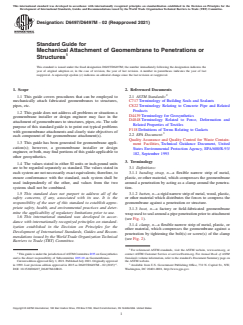
3.1.3 boot, n—a factory or field-fabricated geomembrane
mine the applicability of regulatory limitations prior to use.
wrap used to seal around a pipe penetration prior to attachment
1.6 This international standard was developed in accor-
(see Fig. 1).
dance with internationally recognized principles on standard-
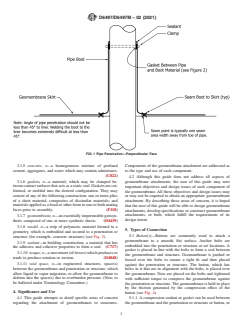
3.1.4 clamp, n—a flexible narrow strip of metal, plastic, or
ization established in the Decision on Principles for the
other material, which compresses the geomembrane against a
Development of International Standards, Guides and Recom-
penetration by tightening the bolt(s) or screw(s) of the clamp
mendations issued by the World Trade Organization Technical
(see Fig. 2).
Barriers to Trade (TBT) Committee.
For referenced ASTM standards, visit the ASTM website, www.astm.org, or
This guide is under the jurisdiction ofASTM Committee D35 on Geosynthetics contact ASTM Customer Service at service@astm.org. For Annual Book of ASTM
and is the direct responsibility of Subcommittee D35.10 on Geomembranes. Standards volume information, refer to the standard’s Document Summary page on
Current edition approved July 1, 2021. Published July 2021. Originally approved the ASTM website.
ɛ1 3
in 1999. Last previous edition approved in 2015 as D6497/D6497M – 02 (2015) . Available from U.S. Government Publishing Office, 732 N. Capitol St., NW,
DOI: 10.1520/D6497_D6497M-02R21. Washington, DC 20401-0001, http://www.gpo.gov.
Copyright © ASTM International, 100 Barr Harbor Drive, PO Box C700, West Conshohocken, PA 19428-2959. United States
D6497/D6497M − 02 (2021)
FIG. 1 Pipe Penetration—Perpendicular Face
3.1.5 concrete, n—a homogeneous mixture of portland Components of the geomembrane attachment are addressed as
cement, aggregates, and water which may contain admixtures. to the type and use of each component.
(C822)
4.2 Although this guide does not address all aspects of
3.1.6 gaskets, n—a material, which may be clamped be-
geomembrane attachments, the user of this guide may note
tweencontactsurfacesthatactsasastaticseal.Gasketsarecut,
important objectives and design issues of each component of
formed, or molded into the desired configuration. They may
the geomembrane. All these objectives and design issues may
consist of any of the following construction: one or more plies
or may not be required to obtain an appropriate geomembrane
of a sheet material; composites of dissimilar materials; and
attachment. By describing these areas of concern, it is hoped
materials applied as a bead or other form to one or both mating
that the user of this guide will be able to design geomembrane
faces prior to assembly. (F118)
attachments, develop specifications or construct geomembrane
attachments, or both, which fulfill the requirements of its
3.1.7 geomembrane, n—anessentiallyimpermeablegeosyn-
design intent.
thetic composed of one or more synthetic sheets. (D4439)
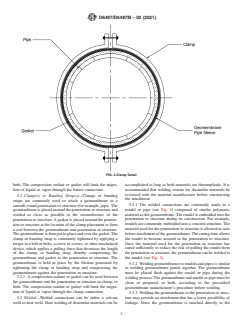
3.1.8 rondel, n—a strip of polymeric material formed to a
5. Types of Connection
geometry, which is embedded and secured to a penetration or
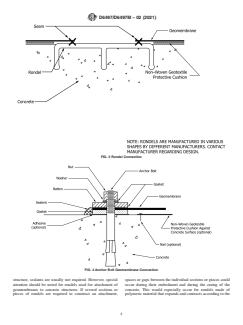
5.1 Batten(s)—Battens are commonly used to attach a
structure (for example, concrete structure) (see Fig. 3).
geomembrane to a smooth, flat surface. Anchor bolts are
3.1.9 sealant—in building construction, a material that has
embedded into the penetration or structure at set locations. A
the adhesive and cohesive properties to form a seal. (C717)
gasket is placed in-line with the bolts to form a seal between
3.1.10 torque,n—amovement(offorces)whichproducesor
the geomembrane and structure. Geomembrane is pushed or
tends to produce rotation or torsion. (D4848)
forced over the bolts to ensure a tight fit and then placed
3.1.11 void space, n—in engineered structures, space(s)
against the penetration or structure. The batten, which has
between the geomembrane and penetration or structure, which
holes in it that are in alignment with the bolts, is placed over
allow liquid or vapor migration, or allow the geomembrane to
the geomembrane. Nuts are placed on the bolts and tightened
deform into the space(s) due to overburden pressure. (New, to
with sufficient torque to compress the geomembrane against
be balloted under Terminology Committee.)
the penetration or structure. The geomembrane is held in place
by the friction generated by the compression effect of the
4. Significance and Use
batten (see Fig. 4).
4.1 This guide attempts to detail specific areas of concern 5.1.1 A compression sealant or gasket can be used between
regarding the attachment of geomembranes to structures. the geomembrane and the penetration or structure or batten, or
D6497/D6497M − 02 (2021)
FIG. 2 Clamp Detail
both. The compression sealant or gasket will limit the migra- accomplished as long as both materials are thermoplastic. It is
tion of liquid or vapor through the batten connection. recommended that welding criteria for dissimilar materials be
reviewed with the material manufacturer before constructing
5.2 Clamp(s) or Banding Strap(s)—Clamps or banding
the attachment.
straps are commonly used to attach a geomembrane to a
5.3.1 The welded connections are commonly made to a
smooth,roundpenetrationorstructure(forexample,pipe).The
rondel or pipe (see Fig. 5) composed of similar polymeric
geomembrane is placed around the penetration or structure and
material as the geomembrane. The rondel is embedded into the
welded as close as possible to the circumference of the
penetration or structure during its construction. For example,
penetration or structure.Agasket is placed around the penetra-
rondels are commonly embedded into a concrete structure.The
tion or structure at the location of the clamp placement to form
material used for the penetration or structure is allowed to cure
a seal between the geomembrane and penetration or structure.
beforeattachmentofthegeomembrane.Thecuringtimeallows
The geomembrane is then put in place and over the gasket.The
the rondel to become secured in the penetration or structure.
clamp or banding strap is commonly tightened by applying a
torquetoaboltorbolts,ascreworscrews,orothermechanical Once the material used for the penetration or structure has
cured sufficiently to reduce the risk of pulling the rondel from
device, which applies a pulling force that decreases the length
of the clamp, or banding strap, thereby compressing the thepenetrationorstructure,thegeomembranecanbeweldedto
the rondel (see Fig. 3).
geomembrane and gasket to the penetration or structure. The
geomembrane is held in place by the friction generated by
5.3.2 Weldinggeomembranestorondelsandpipesissimilar
tightening the clamp or banding strap and compressing the
to welding geomembrane panels together. The geomembrane
geomembrane against the penetration or structure.
must be placed flush against the rondel or pipe during the
5.2.1 A compression sealant or gasket can be used between
weldingprocess.Thegeomembraneandrondelorpipemustbe
the geomembrane and the penetration or structure or clamp, or
clean or prepared, or both, according to the prescribed
both. The compression sealant or gasket will limit the migra-
geomembrane manufacturer’s procedure before welding.
tion of liquid or vapor through the clamp connection.
5.3.3 Welding the geomembrane to the penetration or struc-
5.3 Welded—Welded connections can be either a solvent ture may provide an attachment that has a lower possibility of
weld or heat weld. Heat welding of dissimilar materials can be leakage. Since the geomembrane is attached directly to the
D6497/D6497M − 02 (2021)
FIG. 3 Rondel Connection
FIG. 4 Anchor Bolt Geomembrane Connection
structure, sealants are usually not required. However, special spaces or gaps between the individual sections or pieces could
attention should be noted for rondels used for attachment of occur during their embedment and during the curing of the
geomembranes to concrete structures. If several sections or concrete. This would especially occur for rondels made of
pieces of rondels are required to construct an attachment, polymeric material that expands and contracts according to the
D6497/D6497M − 02 (2021)
FIG. 5 Pipe Boot
temperature of the concrete during the curing process. Sealants walls, tanks, manholes, and pylons. The use of battens, clamps
may be required to fill the spaces or gaps between the rondels or banding strips, or bonding can attach a geomembrane to
to further limit the migration of liquid or vapor through the concrete structures. When attaching a geomembrane to any
batten connection. concrete structure, consider each critical concern detailed in
5.3.4 Pre-fabrication of the complete rondel attachment Section 7.
before placement into the concrete is recommended. The
6.2 Metal—Metal structures that require attachment of
pre-fabricated rondel is composed of welded sections or pieces
geomembranes include, but are not limited to: pads, floors,
of rondels, thereby eliminating the possibility of gaps between
walls, pipes, and tanks. The use of battens, clamps, or banding
sections or pieces on rondels after the concrete cures.
strips can attach a geomembrane to metal structures. When
5.4 Bonded—Bonded connections commonly require the
attaching a geomembrane to any metal structure, consider each
use of an adhesive to construct the attachment. The use of an
critical concern detailed in Section 7.
adhesive allows the geomembrane to be attached to dissimilar
6.3 Pipe—Pipe structures can be composed of concrete,
material. The adhesive used must be compatible with both the
metal, or polymer. Clamps, banding strips, solvent weld, or
geomembrane and the surface material of the penetration or
heat weld can attach a geomembrane to pipe structures. The
structure. The application and curing of the adhesive should
attachment of a geomembrane to any pipe structure should
not significantly deteriorate the strength of the geomembrane
consider critical concerns detailed in 7.1, 7.3, 7.4, 7.5, and 7.6.
or the material surface of the penetration or structure beyond
the design requirements of the attachment.
7. Critical Areas for the Protection of the Geomembrane
5.4.1 The geomembrane and the surface of the penetration
or structure should be clean and prepared according the
7.1 Surface Characteristics—The surface of the structure
adhesive manufacturer’s and geomembrane manufacturer’s
for which the geomembrane is to be attached should be
recommendation.
constructed or formed to limit damage to the geomembrane.
5.4.2 Bonding the geomembrane to the penetration or struc-
This is particularly important in cases where the geomembrane
ture may provide an attachmen
...