

ASTM F2181-20
(Specification)Standard Specification for Wrought Seamless Stainless Steel Tubing for Surgical Implants
General Information
- Abstract
ABSTRACT
This specification covers the requirements for three compositions of wrought seamless stainless steel tubing for the manufacture of surgical implants. Materials shall be tested and shall conform to chemical composition, metallurgical requirements, and mechanical properties. Materials and manufacture are also detailed.
SCOPE
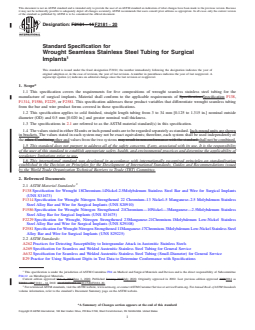
1.1 This specification covers the requirements for five compositions of wrought seamless stainless steel tubing for the manufacture of surgical implants. Material shall conform to the applicable requirements of Specification F138, F1314, F1586, F2229, or F2581. This specification addresses those product variables that differentiate wrought seamless tubing from the bar and wire product forms covered in these specifications.
1.2 This specification applies to cold finished, straight length tubing from 3 to 34 mm [0.125 to 1.315 in.] nominal outside diameter (OD) and 0.5 mm [0.020 in.] and greater nominal wall thickness.
1.3 The specifications in 2.1 are referred to as the ASTM material standard(s) in this specification.
1.4 The values stated in either SI units or inch-pound units are to be regarded separately as standard. Inch-pound units are shown in brackets. The values stated in each system may not be exact equivalents; therefore, each system shall be used independently of the other and values from the two systems shall not be combined.
1.5 This standard does not purport to address all of the safety concerns, if any, associated with its use. It is the responsibility of the user of this standard to establish appropriate safety, health, and environmental practices and determine the applicability of regulatory limitations prior to use.
1.6 This international standard was developed in accordance with internationally recognized principles on standardization established in the Decision on Principles for the Development of International Standards, Guides and Recommendations issued by the World Trade Organization Technical Barriers to Trade (TBT) Committee.
- Status
- Published
- Publication Date
- 31-May-2020
- Technical Committee
- F04 - Medical and Surgical Materials and Devices
- Drafting Committee
- F04.12 - Metallurgical Materials
Buy Documents
ASTM F2181-20 - Standard Specification for Wrought Seamless Stainless Steel Tubing for Surgical Implants
REDLINE ASTM F2181-20 - Standard Specification for Wrought Seamless Stainless Steel Tubing for Surgical Implants
Overview
ASTM F2181-20 is the internationally recognized standard specification for wrought seamless stainless steel tubing intended for use in surgical implants. Issued by ASTM International, this standard defines the essential requirements for manufacturing, chemical composition, mechanical properties, surface finish, and quality systems related to seamless tubing used in critical medical applications. The specification specifically addresses tubing sizes, performance characteristics, and testing protocols necessary to ensure biocompatibility, structural integrity, and traceability for surgical implants.
Key Topics
Material Compositions
The standard covers five specific wrought seamless stainless steel alloy compositions suitable for surgical implant applications. These alloys comply with ASTM Specifications F138, F1314, F1586, F2229, or F2581.Tubing Dimensions
Specifies cold-finished, straight length seamless tubing with:- Nominal outside diameter (OD): 3 to 34 mm [0.125 to 1.315 in.]
- Nominal wall thickness: 0.5 mm [0.020 in.] and greater
Surface Finish and Quality
Includes detailed requirements for both the outer and inner surface roughness to maintain high standards of cleanliness and minimize imperfections. Maximum permissible imperfection depths and roughness values are provided.Mechanical and Chemical Properties
Requires that tubing meet applicable chemical composition and mechanical requirements for implant-grade materials, ensuring strength, ductility, and corrosion resistance.Manufacturing and Testing
Mandates seamless construction and outlines permissible tolerances in OD, ID, wall thickness, concentricity, and straightness. Testing follows referenced practices to verify compliance.Certification and Quality Systems
Producers must certify compliance and maintain recognized quality programs, such as ISO 9001 or ISO 13485. Purchasers may audit suppliers to ensure ongoing conformity.
Applications
Orthopedic Implants
Used in the fabrication of critical implantable devices including intramedullary nails, medical bone screws, and other structural supports where biocompatibility and strength are essential.Cardiovascular Devices
Suitable for certain small-diameter tubing employed in cardiovascular applications, ensuring precise tolerances and superior mechanical properties.Trauma Fixation Systems
Essential in components where reliable, seamless construction enhances fatigue resistance and patient safety.Custom Surgical Tools
Manufacturers of specialized surgical instruments and tools may specify ASTM F2181-20 tubing to meet rigorous medical device standards.
Related Standards
- ASTM F138 - Wrought 18 Chromium-14 Nickel-2.5 Molybdenum Stainless Steel Bar and Wire for Surgical Implants
- ASTM F1314 - Wrought Nitrogen Strengthened Stainless Steel Alloy Bar and Wire for Surgical Implants
- ASTM F1586, F2229, F2581 - Additional relevant specifications for different alloy compositions
- ASTM A269, ASTM A632 - Specifications for general seamless and welded stainless steel tubing
- ISO 5832-1, ISO 5832-9 - International standards for surgical implant metallic materials
- ISO 9001, ISO 13485 - Quality management systems for consistent product quality
- ASME Y14.5.1M - Dimensioning and tolerancing principles
ASTM F2181-20 provides the medical device industry with a comprehensive, standardized approach for producing and certifying seamless stainless steel tubing for surgical implants. Adherence to this standard supports regulatory compliance, product reliability, and, most importantly, patient safety in critical medical applications.
Relations
- Effective Date
- 01-Dec-2019
- Effective Date
- 01-Sep-2019
- Effective Date
- 01-Feb-2018
- Effective Date
- 01-Oct-2014
- Effective Date
- 01-Oct-2013
- Effective Date
- 01-Oct-2013
- Effective Date
- 01-Oct-2013
- Effective Date
- 01-May-2013
- Effective Date
- 01-Apr-2013
- Effective Date
- 01-Apr-2013
- Effective Date
- 01-Oct-2012
- Effective Date
- 01-Apr-2010
- Effective Date
- 01-Apr-2010
- Effective Date
- 01-Feb-2009
- Effective Date
- 01-Oct-2008
Buy Documents
ASTM F2181-20 - Standard Specification for Wrought Seamless Stainless Steel Tubing for Surgical Implants
REDLINE ASTM F2181-20 - Standard Specification for Wrought Seamless Stainless Steel Tubing for Surgical Implants
Get Certified
Connect with accredited certification bodies for this standard

BSI Group
BSI (British Standards Institution) is the business standards company that helps organizations make excellence a habit.

TÜV Rheinland
TÜV Rheinland is a leading international provider of technical services.

TÜV SÜD
TÜV SÜD is a trusted partner of choice for safety, security and sustainability solutions.
Sponsored listings
Frequently Asked Questions
ASTM F2181-20 is a technical specification published by ASTM International. Its full title is "Standard Specification for Wrought Seamless Stainless Steel Tubing for Surgical Implants". This standard covers: ABSTRACT This specification covers the requirements for three compositions of wrought seamless stainless steel tubing for the manufacture of surgical implants. Materials shall be tested and shall conform to chemical composition, metallurgical requirements, and mechanical properties. Materials and manufacture are also detailed. SCOPE 1.1 This specification covers the requirements for five compositions of wrought seamless stainless steel tubing for the manufacture of surgical implants. Material shall conform to the applicable requirements of Specification F138, F1314, F1586, F2229, or F2581. This specification addresses those product variables that differentiate wrought seamless tubing from the bar and wire product forms covered in these specifications. 1.2 This specification applies to cold finished, straight length tubing from 3 to 34 mm [0.125 to 1.315 in.] nominal outside diameter (OD) and 0.5 mm [0.020 in.] and greater nominal wall thickness. 1.3 The specifications in 2.1 are referred to as the ASTM material standard(s) in this specification. 1.4 The values stated in either SI units or inch-pound units are to be regarded separately as standard. Inch-pound units are shown in brackets. The values stated in each system may not be exact equivalents; therefore, each system shall be used independently of the other and values from the two systems shall not be combined. 1.5 This standard does not purport to address all of the safety concerns, if any, associated with its use. It is the responsibility of the user of this standard to establish appropriate safety, health, and environmental practices and determine the applicability of regulatory limitations prior to use. 1.6 This international standard was developed in accordance with internationally recognized principles on standardization established in the Decision on Principles for the Development of International Standards, Guides and Recommendations issued by the World Trade Organization Technical Barriers to Trade (TBT) Committee.
ABSTRACT This specification covers the requirements for three compositions of wrought seamless stainless steel tubing for the manufacture of surgical implants. Materials shall be tested and shall conform to chemical composition, metallurgical requirements, and mechanical properties. Materials and manufacture are also detailed. SCOPE 1.1 This specification covers the requirements for five compositions of wrought seamless stainless steel tubing for the manufacture of surgical implants. Material shall conform to the applicable requirements of Specification F138, F1314, F1586, F2229, or F2581. This specification addresses those product variables that differentiate wrought seamless tubing from the bar and wire product forms covered in these specifications. 1.2 This specification applies to cold finished, straight length tubing from 3 to 34 mm [0.125 to 1.315 in.] nominal outside diameter (OD) and 0.5 mm [0.020 in.] and greater nominal wall thickness. 1.3 The specifications in 2.1 are referred to as the ASTM material standard(s) in this specification. 1.4 The values stated in either SI units or inch-pound units are to be regarded separately as standard. Inch-pound units are shown in brackets. The values stated in each system may not be exact equivalents; therefore, each system shall be used independently of the other and values from the two systems shall not be combined. 1.5 This standard does not purport to address all of the safety concerns, if any, associated with its use. It is the responsibility of the user of this standard to establish appropriate safety, health, and environmental practices and determine the applicability of regulatory limitations prior to use. 1.6 This international standard was developed in accordance with internationally recognized principles on standardization established in the Decision on Principles for the Development of International Standards, Guides and Recommendations issued by the World Trade Organization Technical Barriers to Trade (TBT) Committee.
ASTM F2181-20 is classified under the following ICS (International Classification for Standards) categories: 11.040.40 - Implants for surgery, prosthetics and orthotics. The ICS classification helps identify the subject area and facilitates finding related standards.
ASTM F2181-20 has the following relationships with other standards: It is inter standard links to ASTM F138-19, ASTM A632-19, ASTM F1314-18, ASTM A632-04(2014), ASTM F1314-13ae1, ASTM F138-13a, ASTM A269-13, ASTM A262-13, ASTM F138-13, ASTM F1314-13, ASTM F2581-12, ASTM A262-10, ASTM A269-10, ASTM F2257-09, ASTM E29-08. Understanding these relationships helps ensure you are using the most current and applicable version of the standard.
ASTM F2181-20 is available in PDF format for immediate download after purchase. The document can be added to your cart and obtained through the secure checkout process. Digital delivery ensures instant access to the complete standard document.
Standards Content (Sample)
This international standard was developed in accordance with internationally recognized principles on standardization established in the Decision on Principles for the
Development of International Standards, Guides and Recommendations issued by the World Trade Organization Technical Barriers to Trade (TBT) Committee.
Designation:F2181 −20
Standard Specification for
Wrought Seamless Stainless Steel Tubing for Surgical
Implants
This standard is issued under the fixed designation F2181; the number immediately following the designation indicates the year of
original adoption or, in the case of revision, the year of last revision. A number in parentheses indicates the year of last reapproval. A
superscript epsilon (´) indicates an editorial change since the last revision or reapproval.
1. Scope* 2. Referenced Documents
2.1 ASTM Material Standards:
1.1 This specification covers the requirements for five
compositions of wrought seamless stainless steel tubing for the F138 Specification for Wrought 18Chromium-14Nickel-
manufactureofsurgicalimplants.Materialshallconformtothe 2.5Molybdenum Stainless Steel Bar andWire for Surgical
applicable requirements of Specification F138, F1314, F1586, Implants (UNS S31673)
F2229,or F2581. This specification addresses those product F1314 Specification for Wrought Nitrogen Strengthened 22
variables that differentiate wrought seamless tubing from the Chromium–13 Nickel–5 Manganese–2.5 Molybdenum
bar and wire product forms covered in these specifications. Stainless Steel Alloy Bar and Wire for Surgical Implants
(UNS S20910)
1.2 This specification applies to cold finished, straight
F1586 Specification for Wrought Nitrogen Strengthened
length tubing from 3 to 34 mm [0.125 to 1.315 in.] nominal
21Chromium—10Nickel—3Manganese—
outside diameter (OD) and 0.5 mm [0.020 in.] and greater
2.5Molybdenum Stainless Steel Alloy Bar for Surgical
nominal wall thickness.
Implants (UNS S31675)
1.3 The specifications in 2.1 are referred to as the ASTM
F2229 Specification for Wrought, Nitrogen Strengthened
material standard(s) in this specification.
23Manganese-21Chromium-1Molybdenum Low-Nickel
Stainless Steel Alloy Bar and Wire for Surgical Implants
1.4 The values stated in either SI units or inch-pound units
(UNS S29108)
are to be regarded separately as standard. Inch-pound units are
F2581 Specification for Wrought Nitrogen Strengthened
showninbrackets.Thevaluesstatedineachsystemmaynotbe
11Manganese-17Chromium-3Molybdenum Low-Nickel
exact equivalents; therefore, each system shall be used inde-
Stainless Steel Alloy Bar and Wire for Surgical Implants
pendently of the other and values from the two systems shall
(UNS S29225)
not be combined.
2.2 ASTM Standards:
1.5 This standard does not purport to address all of the
A262 Practices for Detecting Susceptibility to Intergranular
safety concerns, if any, associated with its use. It is the
Attack in Austenitic Stainless Steels
responsibility of the user of this standard to establish appro-
A269 Specification for Seamless and Welded Austenitic
priate safety, health, and environmental practices and deter-
Stainless Steel Tubing for General Service
mine the applicability of regulatory limitations prior to use.
A632 Specification for Seamless and Welded Austenitic
1.6 This international standard was developed in accor-
Stainless Steel Tubing (Small-Diameter) for General Ser-
dance with internationally recognized principles on standard-
vice
ization established in the Decision on Principles for the
E29 Practice for Using Significant Digits in Test Data to
Development of International Standards, Guides and Recom-
Determine Conformance with Specifications
mendations issued by the World Trade Organization Technical
F2257 Specification for Wrought Seamless or Welded and
Barriers to Trade (TBT) Committee.
Drawn 18 Chromium-14Nickel-2.5Molybdenum Stainless
Steel Small Diameter Tubing for Surgical Implants (UNS
S31673)
This specification is under the jurisdiction of ASTM Committee F04 on
Medical and Surgical Materials and Devices and is the direct responsibility of
Subcommittee F04.12 on Metallurgical Materials. For referenced ASTM standards, visit the ASTM website, www.astm.org, or
CurrenteditionapprovedJune1,2020.PublishedJuly2020.Originallyapproved contact ASTM Customer Service at service@astm.org. For Annual Book of ASTM
in 2002. Last previous edition approved 2014 as F2181 – 14. DOI: 10.1520/F2181- Standards volume information, refer to the standard’s Document Summary page on
20. the ASTM website.
*A Summary of Changes section appears at the end of this standard
Copyright © ASTM International, 100 Barr Harbor Drive, PO Box C700, West Conshohocken, PA 19428-2959. United States
F2181−20
IEEE/ASTM SI 10 American National Standard for Use of of the tube. Sample concentricity shall be expressed as a
theInternationalSystemofUnits(SI):TheModernMetric percent of the wall thickness and shall be calculated using the
System following equation:
2.3 ISO Standards:
A 2 B
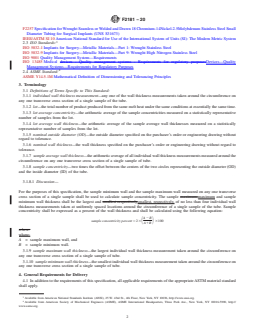
sample concentricity percent 5 2 3 3100
S D
ISO 5832-1 Implants for Surgery—Metallic Materials—Part
A1B
1: Wrought Stainless Steel
where:
ISO 5832-9 Implants for Surgery—Metallic Materials—Part
A = sample maximum wall, and
9: Wrought High Nitrogen Stainless Steel
B = sample minimum wall.
ISO 9001 Quality Management System—Requirements
ISO 13485 Medical Devices—Quality Management
3.1.9 sample maximum wall thickness—the largest indi-
Systems—Requirements for Regulatory Purposes
vidual wall thickness measurement taken around the circum-
2.4 ASME Standard:
ference on any one transverse cross section of a single sample
ASMEY14.5.1M Mathematical Definition of Dimensioning
of tube.
and Tolerancing Principles
3.1.10 sample minimum wall thickness—the smallest indi-
vidual wall thickness measurement taken around the circum-
3. Terminology
ference on any one transverse cross section of a single sample
3.1 Definitions of Terms Specific to This Standard:
of tube.
3.1.1 individual wall thickness measurement—any one of
the wall thickness measurements taken around the circumfer-
4. General Requirements for Delivery
ence on any one transverse cross section of a single sample of
4.1 In addition to the requirements of this specification, all
the tube.
applicable requirements of the appropriate ASTM material
3.1.2 lot—the total number of product produced from the
standard shall apply.
same melt heat under the same conditions at essentially the
4.2 In addition to the requirements of this specification, all
same time.
applicable seamless tubing requirements of Specification A269
3.1.3 lot average concentricity—the arithmetic average of
or Specification A632 shall apply. Flare testing is not appli-
the sample concentricities measured on a statistically represen-
cable.
tative number of samples from the lot.
4.3 If a conflict exists between this specification and those
3.1.4 lot average wall thickness—the arithmetic average of
listed in Section 2, or if a conflict exists between those
the sample average wall thicknesses measured on a statistically
specifications listed in 2.1 and those listed in 2.2 and 2.3, the
representative number of samples from the lot.
following order of precedence applies: (1) this specification,
3.1.5 nominal outside diameter (OD)—the outside diameter
(2) the ASTM material standard referenced on the purchase
specified on the purchaser’s order or engineering drawing
order, and (3) all other referenced specifications.
without regard to tolerance.
3.1.6 nominal wall thickness—the wall thickness specified
5. Ordering Information
onthepurchaser’sorderorengineeringdrawingwithoutregard
5.1 Inquiries and orders for material under this specification
to tolerance.
should include the following information:
3.1.7 sample average wall thickness—the arithmetic aver-
5.1.1 Quantity (weight, total length, or number of pieces),
age of all individual wall thickness measurements measured
5.1.2 This ASTM specification and date of issue,
around the circumference on any one transverse cross section
5.1.3 The appropriate ASTM material standard and date of
of a single sample of tube.
issue,
3.1.8 sample concentricity—two times the offset between 5.1.4 Units to be certified—SI or inch-pound,
5.1.5 Condition (see 6.2),
the centers of the two circles representing the outside diameter
(OD) and the inside diameter (ID) of the tube. 5.1.6 Surface finish (see 6.3),
5.1.7 Applicable dimensions including OD and ID, OD and
3.1.8.1 Discussion—For the purposes of this specification,
the sample minimum wall and the sample maximum wall wall or ID and wall, length (exact, random, multiples), or
engineering drawing reference number,
measured on any one transverse cross section of a single
sample shall be used to calculate sample concentricity. The 5.1.8 Dimensional tolerances (see Table 1 and Table 2),
5.1.9 Special requirements or supplements, if any, and
samplemaximumandsampleminimumwallthicknessshallbe
the largest and smallest, respectively, of no less than four 5.1.10 Certification requirements.
individual wall thickness measurements taken at uniformly
spaced locations around the circumference of a single sample 6. Materials and Manufacture
6.1 Method of Manufacture:
6.1.1 Tubing shall be made by the seamless process in
Available fromAmerican National Standards Institute (ANSI), 25 W. 43rd St.,
4th Floor, New York, NY 10036, http://www.ansi.org. which the tube periphery is continuous at all stages of the
Available from American Society of Mechanical Engineers (ASME), ASME
process.
International Headquarters, Three Park Ave., New York, NY 10016-5990, http://
www.asme.org. 6.2 Condition:
F2181−20
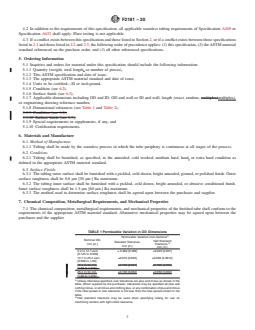
TABLE 1 Permissible Variation in OD Dimensions
nor inner surface imperfections shall exceed 0.08 mm [0.003
A
Permissible Variation from Nominal in.] in depth. For tubes with wall thickness greater than or
Nominal OD, Half Standard
equal to 6.5 mm [0.250 in.], neither outer nor inner surface
Standard Tolerance,
B
mm [in.]
Tolerance,
mm [in.]
imperfections shall exceed 0.13 mm [0.005 in.] in depth. For
mm [in.]
3.2 to 12.7 excl. ± 0.050 [0.002] ±0.025 [0.001]
tubes with wall thickness less than 1.5 mm [0.060 in.], outer
[0.125 to 0.500]
and inner surface imperfection depth shall be agreed upon
12.7 to 25.4 excl. ±0.075 [0.003] ±0.038 [0.0015]
between purchaser and supplier.
[0.500 to 1.00]
25.4to34incl. ±0.100 [0.004] ±0.050 [0.002]
8.2 The method of inspecting for these imperfections shall
[1.00 to 1.315]
be negotiated between the purchaser and supplier.
A
Unless otherwise specified, size tolerances are plus and minus as shown in the
table. When required by the purchaser, tolerances may be specified all plus and
8.3 Outer surface imperfections may be removed by grind-
nothingminus,orallminusandnothingplus,oranycombinationofplusandminus
ingorpolishingprovidingthattheresultantwallthicknessdoes
if the total spread in size tolerance is not less than the total spread shown in the
table.
not violate the minimum wall thickness. The ground or
B
Half standard tolerance may be used when specifying tubing for use on
polished surface shall meet the surface finish requirements of
machining centers with tight collet clearance.
6.3.1.
9. Special Tests
TABLE 2 Permissible Variation in ID Dimensions
9.1 The material shall conform to the special test require-
Nominal ID, Permissible Variation
A
mm [in.] from Nominal, mm [in.]
ments of the appropriate ASTM material standard.
Up to 12.7 excl. [0.500] ±0.050 [0.002]
9.2 When required by the appropriate ASTM material
12.7 to 25.4 excl. [0.500 to 1.00] ±0.075 [0.003]
25.4 and over [1.00] ±0.100 [0.004]
standard, both OD and ID surfaces of the finished tube shall be
A
capable of passing the intergranular corrosion susceptibility
Unless otherwise specified, size tolerances are plus and minus as shown in the
table. When required by the purchaser, tolerances may be specified all plus and
test in accordance with Practice E of Practices A262.
nothingminus,orallminusandnothingplus,oranycombinationofplusandminus
if the total spread in size tolerance is not less than the total spread shown in the
10. Dimensions and Permissible Variation
table.
10.1 Units of Measure:
10.1.1 Selection—This specification requires that the pur-
6.2.1 Tubing shall be furnished, as specified, in the
chase
...
This document is not an ASTM standard and is intended only to provide the user of an ASTM standard an indication of what changes have been made to the previous version. Because
it may not be technically possible to adequately depict all changes accurately, ASTM recommends that users consult prior editions as appropriate. In all cases only the current version
of the standard as published by ASTM is to be considered the official document.
Designation: F2181 − 14 F2181 − 20
Standard Specification for
Wrought Seamless Stainless Steel Tubing for Surgical
Implants
This standard is issued under the fixed designation F2181; the number immediately following the designation indicates the year of
original adoption or, in the case of revision, the year of last revision. A number in parentheses indicates the year of last reapproval. A
superscript epsilon (´) indicates an editorial change since the last revision or reapproval.
1. Scope*
1.1 This specification covers the requirements for five compositions of wrought seamless stainless steel tubing for the
manufacture of surgical implants. Material shall conform to the applicable requirements of SpecificationsSpecification F138,
F1314, F1586, F2229, or F2581. This specification addresses those product variables that differentiate wrought seamless tubing
from the bar and wire product forms covered in these specifications.
1.2 This specification applies to cold finished, straight length tubing from 3 to 34 mm [0.125 to 1.315 in.] nominal outside
diameter (OD) and 0.5 mm [0.020 in.] and greater nominal wall thickness.
1.3 The specifications in 2.1 are referred to as the ASTM material standard(s) in this specification.
1.4 The values stated in either SI units or inch-pound units are to be regarded separately as standard. Inch-pound units are shown
in brackets. The values stated in each system may not be exact equivalents; therefore, each system shall be used independently of
the other. Combiningother and values from the two systems may result in nonconformance with the standard.shall not be combined.
1.5 This standard does not purport to address all of the safety concerns, if any, associated with its use. It is the responsibility
of the user of this standard to establish appropriate safety, health, and environmental practices and determine the applicability of
regulatory limitations prior to use.
1.6 This international standard was developed in accordance with internationally recognized principles on standardization
established in the Decision on Principles for the Development of International Standards, Guides and Recommendations issued
by the World Trade Organization Technical Barriers to Trade (TBT) Committee.
2. Referenced Documents
2.1 ASTM Material Standards:
F138 Specification for Wrought 18Chromium-14Nickel-2.5Molybdenum Stainless Steel Bar and Wire for Surgical Implants
(UNS S31673)
F1314 Specification for Wrought Nitrogen Strengthened 22 Chromium–13 Nickel–5 Manganese–2.5 Molybdenum Stainless
Steel Alloy Bar and Wire for Surgical Implants (UNS S20910)
F1586 Specification for Wrought Nitrogen Strengthened 21Chromium—10Nickel—3Manganese—2.5Molybdenum Stainless
Steel Alloy Bar for Surgical Implants (UNS S31675)
F2229 Specification for Wrought, Nitrogen Strengthened 23Manganese-21Chromium-1Molybdenum Low-Nickel Stainless
Steel Alloy Bar and Wire for Surgical Implants (UNS S29108)
F2581 Specification for Wrought Nitrogen Strengthened 11Manganese-17Chromium-3Molybdenum Low-Nickel Stainless Steel
Alloy Bar and Wire for Surgical Implants (UNS S29225)
2.2 ASTM Standards:
A262 Practices for Detecting Susceptibility to Intergranular Attack in Austenitic Stainless Steels
A269 Specification for Seamless and Welded Austenitic Stainless Steel Tubing for General Service
A632 Specification for Seamless and Welded Austenitic Stainless Steel Tubing (Small-Diameter) for General Service
E29 Practice for Using Significant Digits in Test Data to Determine Conformance with Specifications
This specification is under the jurisdiction of ASTM Committee F04 on Medical and Surgical Materials and Devices and is the direct responsibility of Subcommittee
F04.12 on Metallurgical Materials.
Current edition approved Oct. 1, 2014June 1, 2020. Published January 2015July 2020. Originally approved in 2002. Last previous edition approved 20092014 as
F2181 – 09.F2181 – 14. DOI: 10.1520/F2181-14.10.1520/F2181-20.
For referenced ASTM standards, visit the ASTM website, www.astm.org, or contact ASTM Customer Service at service@astm.org. For Annual Book of ASTM Standards
volume information, refer to the standard’s Document Summary page on the ASTM website.
*A Summary of Changes section appears at the end of this standard
Copyright © ASTM International, 100 Barr Harbor Drive, PO Box C700, West Conshohocken, PA 19428-2959. United States
F2181 − 20
F2257 Specification for Wrought Seamless or Welded and Drawn 18 Chromium-14Nickel-2.5Molybdenum Stainless Steel Small
Diameter Tubing for Surgical Implants (UNS S31673)
IEEE/ASTM SI 10 American National Standard for Use of the International System of Units (SI): The Modern Metric System
2.3 ISO Standards:
ISO 5832-1 Implants for Surgery—Metallic Materials—Part 1: Wrought Stainless Steel
ISO 5832-9 Implants for Surgery—Metallic Materials—Part 9: Wrought High Nitrogen Stainless Steel
ISO 9001 Quality Management System—Requirements
ISO 13485 Medical devices - Quality management systems - Requirements for regulatory purposesDevices—Quality
Management Systems—Requirements for Regulatory Purposes
2.4 ASME Standard:
ASME Y14.5.1M Mathematical Definition of Dimensioning and Tolerancing Principles
3. Terminology
3.1 Definitions of Terms Specific to This Standard:
3.1.1 individual wall thickness measurement—any one of the wall thickness measurements taken around the circumference on
any one transverse cross section of a single sample of the tube.
3.1.2 lot—the total number of product produced from the same melt heat under the same conditions at essentially the same time.
3.1.3 lot average concentricity—the arithmetic average of the sample concentricities measured on a statistically representative
number of samples from the lot.
3.1.4 lot average wall thickness—the arithmetic average of the sample average wall thicknesses measured on a statistically
representative number of samples from the lot.
3.1.5 nominal outside diameter (OD)—the outside diameter specified on the purchaser’s order or engineering drawing without
regard to tolerance.
3.1.6 nominal wall thickness—the wall thickness specified on the purchaser’s order or engineering drawing without regard to
tolerance.
3.1.7 sample average wall thickness—the arithmetic average of all individual wall thickness measurements measured around the
circumference on any one transverse cross section of a single sample of tube.
3.1.8 sample concentricity—two times the offset between the centers of the two circles representing the outside diameter (OD)
and the inside diameter (ID) of the tube.
3.1.8.1 Discussion—
For the purposes of this specification, the sample minimum wall and the sample maximum wall measured on any one transverse
cross section of a single sample shall be used to calculate sample concentricity. The sample maximum,maximum and sample
minimum wall thickness shall be the largest and smallest respectivelysmallest, respectively, of no less than four individual wall
thickness measurements taken at uniformly spaced locations around the circumference of a single sample of the tube. Sample
concentricity shall be expressed as a percent of the wall thickness and shall be calculated using the following equation:
A 2 B
sample concentricity percent 5 23 3100
S D
A1B
where:
where:
A = sample maximum wall, and
B = sample minimum wall.
3.1.9 sample maximum wall thickness—the largest individual wall thickness measurement taken around the circumference on
any one transverse cross section of a single sample of tube.
3.1.10 sample minimum wall thickness—the smallest individual wall thickness measurement taken around the circumference on
any one transverse cross section of a single sample of tube.
4. General Requirements for Delivery
4.1 In addition to the requirements of this specification, all applicable requirements of the appropriate ASTM material standard
shall apply.
Available from American National Standards Institute (ANSI), 25 W. 43rd St., 4th Floor, New York, NY 10036, http://www.ansi.org.
Available from American Society of Mechanical Engineers (ASME), ASME International Headquarters, Three Park Ave., New York, NY 10016-5990, http://
www.asme.org.
F2181 − 20
4.2 In addition to the requirements of this specification, all applicable seamless tubing requirements of Specification A269 or
Specification A632 shall apply. Flare testing is not applicable.
4.3 If a conflict exists between this specification and those listed in Section 2, or if a conflict exists between those specifications
listed in 2.1 and those listed in 2.2 and 2.3, the following order of precedence applies: (1) this specification, (2) the ASTM material
standard referenced on the purchase order, and (3) all other referenced specifications.
5. Ordering Information
5.1 Inquiries and orders for material under this specification should include the following information:
5.1.1 Quantity (weight, total length, or number of pieces),
5.1.2 This ASTM specification and date of issue,
5.1.3 The appropriate ASTM material standard and date of issue,
5.1.4 Units to be certified—SI or inch-pound,
5.1.5 Condition (see 6.2),
5.1.6 Surface finish (see 6.3),
5.1.7 Applicable dimensions including OD and ID, OD and wall or ID and wall, length (exact, random, multiples)multiples),
or engineering drawing reference number,
5.1.8 Dimensional tolerances (see Table 1 and Table 2),
5.1.9 Condition (see 6.2),
5.1.10 Surface finish (see 6.3),
5.1.9 Special requirements or supplements, if any, and
5.1.10 Certification requirements.
6. Materials and Manufacture
6.1 Method of Manufacture:
6.1.1 Tubing shall be made by the seamless process in which the tube periphery is continuous at all stages of the process.
6.2 Condition:
6.2.1 Tubing shall be furnished, as specified, in the annealed, cold worked, medium hard, hard, or extra hard condition as
defined in the appropriate ASTM material standard.
6.3 Surface Finish:
6.3.1 The tubing outer surface shall be furnished with a pickled, cold drawn, bright annealed, ground, or polished finish. Outer
surface roughness shall be 0.8 μm [30 μin.] Ra maximum.
6.3.2 The tubing inner surface shall be furnished with a pickled, cold drawn, bright annealed, or abrasive conditioned finish.
Inner surface roughness shall be 1.5 μm [60 μin.] Ra maximum.
6.3.3 The method used to determine surface roughness shall be agreed upon between the purchaser and supplier.
7. Chemical Composition, Metallurgical Requirements, and Mechanical Properties
7.1 The chemical composition, metallurgical requirements, and mechanical properties of the finished tube shall conform to the
requirements of the appropriate ASTM material standard. Alternative mechanical properties may be agreed upon between the
purchaser and the supplier.
TABLE 1 Permissible Variation in OD Dimensions
A
Permissible Variation from Nominal
Nominal OD,
Half Standard
Standard Tolerance,
B
mm [in.]
Tolerance,
mm [in.]
mm [in.]
3.2 to 12.7 excl. ± 0.050 [0.002] ±0.025 [0.001]
[0.125 to 0.500]
12.7 to 25.4 excl. ±0.075 [0.003] ±0.038 [0.0015]
[0.500 to 1.00]
25.4 to 34 incl. ±0.100 [0.004] ±0.050 [0.002)
[1.00 to 1.315]
25.4 to 34 incl. ±0.100 [0.004] ±0.050 [0.002]
[1.00 to 1.315]
A
Unless otherwise specified, size tolerances are plus and minus as shown in the
table. When required by the purchaser, tolerances may be specified all plus and
nothing minus, or all minus and nothing plus, or any combination of plus and minus
if the total spread in size tolerance is not less than the total spread shown in the
table.
B
Half standard tolerance may be used when specifying tubing for use on
machining centers with tight collet clearance.
F2181 − 20
TABLE 2 Permissible Variation in ID Dimensions
Nominal ID, Permissible Variation
A
mm [in.] from Nominal, mm [in.]
Up to 12.7 excl. [0.500] ±0.050 [0.002]
12.7 to 25.4 excl. [0.500 to 1.00] ±0.075 [0.003]
25.4 and over [1.00] ±0.100 (0.004]
25.4 and over [1.00] ±0.100 [0.004]
A
Unless otherwise specified, size tolerances are plus and minus as shown in the
table. When required by the purchaser, tolerances may be specified all plus and
nothing minus, or all minus and nothing plus, or any combination of plus and minus
if the total spread in size tolerance is not less than the total spread shown in the
table.
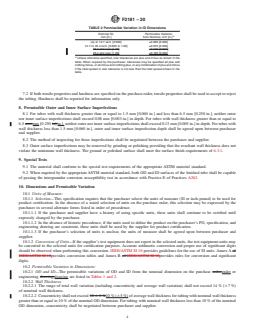
7.2 If both tensile properties and hardness are specified on the purchase order, tensile properties shall be used to accept or reject
the tubing. Hardness shall be reported for information only.
8. Permissible Outer and Inner Surface Imperfections
8.1 For tubes with wall thickness greater than
...