

ASTM B829-19a
(Specification)Standard Specification for General Requirements for Nickel and Nickel Alloys Seamless Pipe and Tube
General Information
- Abstract
ABSTRACT
This general specification contains the mandatory requirements to the ASTM standards listed herein for seamless pipes and tubes made from nickel and nickel alloys. In case of conflict, the requirements listed in the particular product specification takes precedence over those listed here.
SCOPE
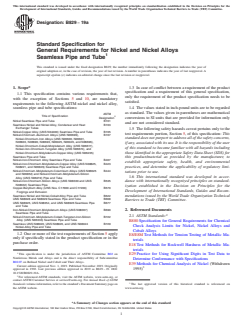
1.1 This specification contains various requirements that, with the exception of Sections 5 and 10, are mandatory requirements to the following ASTM nickel and nickel alloy, seamless pipe and tube specifications:
Title of Specification
ASTM
Designation2
Nickel Seamless Pipe and Tube
B161
Seamless Nickel and Nickel Alloy, Condenser and Heat
Exchanger Tubes
B163
Nickel-Copper Alloy (UNS N04400) Seamless Pipe and Tube
B165
Nickel-Chromium-Aluminum Alloys (UNS N06699),
Nickel-Chromium-Iron Alloys (UNS N06600, N06601,
N06603, N06690, N06693, N06025, N06045, and N06696),
Nickel-Chromium-Cobalt-Molybdenum Alloy (UNS N06617),
Nickel-Iron-Chromium-Tungsten Alloy (UNS N06674), and
Nickel-Chromium-Molybdenum-Copper Alloy (UNS N06235) Seamless Pipe and Tube
B167
Nickel-Iron-Chromium Alloy Seamless Pipe and Tube
B407
Nickel-Iron-Chromium-Molybdenum-Copper Alloy (UNS N08825,
N08221, and N06845) Seamless Pipe and Tube
B423
Nickel-Chromium-Molybdenum-Columbium Alloys (UNS N06625
and N06852) and Nickel-Chromium-Molybdenum-Silicon
Alloy (UNS N06219) Pipe and Tube
B444
Nickel-Iron-Chromium-Silicon Alloys (UNS N08330 and UNS
N08332) Seamless Pipe
B535
Copper-Beryllium Alloy (UNS Nos. C17000 and C17200)
Forgings and Extrusion
B570
Seamless Nickel and Nickel-Cobalt Alloy Pipe and Tube
B622
UNS N08028 and N08029 Seamless Pipe and Tube
B668
UNS N08925, UNS N08354, and UNS N08926 Seamless Pipe
and Tube
B677
Iron-Nickel-Chromium-Molybdenum Alloys (UNS N08367)
Seamless Pipe and Tube
B690
Nickel-Chromium-Molybdenum-Cobalt-Tungsten-Iron-Silicon
Alloy (UNS N06333) Seamless Pipe and Tube
B722
Seamless UNS N08020, UNS N08026, and UNS N08024
Nickel-Alloy Pipe and Tube
B729
1.2 One or more of the test requirements of Section 5 apply only if specifically stated in the product specification or in the purchase order.
1.3 In case of conflict between a requirement of the product specification and a requirement of this general specification, only the requirement of the product specification needs to be satisfied.
1.4 The values stated in inch-pound units are to be regarded as standard. The values given in parentheses are mathematical conversions to SI units that are provided for information only and are not considered standard.
1.5 The following safety hazards caveat pertains only to the test requirements portion, Section 5, of this specification: This standard does not purport to address all of the safety concerns, if any, associated with its use. It is the responsibility of the user of this standard to become familiar with all hazards including those identified in the appropriate Safety Data Sheet (SDS) for this product/material as provided by the manufacturer, to establish appropriate safety, health, and environmental practices, and determine the applicability of regulatory limitations prior to use.
1.6 This international standard was developed in accordance with internationally recognized principles on standardization established in the Decision on Principles for the Development of International Standards, Guides and Recommendations issued by the World Trade Organization Technical Barriers to Trade (TBT) Committee.
- Status
- Published
- Publication Date
- 31-Oct-2019
- Technical Committee
- B02 - Nonferrous Metals and Alloys
- Drafting Committee
- B02.07 - Refined Nickel and Cobalt and Their Alloys
Buy Documents
ASTM B829-19a - Standard Specification for General Requirements for Nickel and Nickel Alloys Seamless Pipe and Tube
REDLINE ASTM B829-19a - Standard Specification for General Requirements for Nickel and Nickel Alloys Seamless Pipe and Tube
Overview
ASTM B829-19a: Standard Specification for General Requirements for Nickel and Nickel Alloys Seamless Pipe and Tube establishes the mandatory requirements for seamless pipes and tubes manufactured from nickel and nickel alloys. Issued by ASTM International, this specification serves as the foundational reference for a variety of ASTM standards covering different nickel alloy grades and products. In cases where this general specification conflicts with a specific product standard, the requirements of the latter take precedence.
This standard applies broad, essential criteria such as chemical composition, mechanical properties, dimensional tolerances, test methodologies, sampling, inspection, marking, and packaging. ASTM B829-19a is crucial for manufacturers, purchasers, and users seeking consistency in the production and procurement of high-quality nickel and nickel alloy seamless pipes and tubes.
Key Topics
- Applicability: Covers general requirements for multiple ASTM nickel and nickel alloy specifications, including B161, B163, B165, B167, B407, B423, B444, B535, B570, B622, B668, B677, B690, B722, and B729.
- Material Requirements: Provides standards for chemical composition and allowable variations, to be verified against product specifications.
- Test Methods: Details mandatory and optional test procedures, including:
- Hydrostatic test
- Eddy current and ultrasonic nondestructive testing
- Tension, hardness, flare, and grain size testing following referenced ASTM practices
- Dimensional Tolerances: Defines permissible variations for outside diameter, wall thickness, length, and ovality, referenced from ANSI B36.19 and detailed in comprehensive tables.
- Workmanship & Marking: Sets standards for surface finish, uniformity, identity marking, and packaging to maintain accurate traceability from production to delivery.
- Certification & Documentation: Specifies requirements for manufacturers to certify and provide test results upon request.
Applications
ASTM B829-19a ensures the quality, safety, and reliability of nickel and nickel alloy seamless pipe and tube across a range of demanding industrial environments, including:
- Chemical Processing Plants: Where corrosion resistance is vital, nickel alloys are used for transporting reactive chemicals and fluids.
- Power Generation: Seamless nickel alloy tubes are critical in heat exchangers and condensers for their strength and durability at high temperatures.
- Petrochemical & Oil Refining: Processes involving aggressive media rely on seamless nickel alloy pipes for longevity and performance.
- Pharmaceutical Manufacturing: Cleanability and corrosion resistance make these materials suitable for high-purity applications.
- Aerospace Engineering: Uses seamless nickel tubes for their high stress and temperature tolerance.
By adhering to ASTM B829-19a, organizations ensure their products meet internationally recognized standards, streamlining sourcing, compliance, and performance expectations, especially in regulated industries.
Related Standards
ASTM B829-19a provides the overarching requirements for the following product specifications:
- ASTM B161: Nickel Seamless Pipe and Tube
- ASTM B163: Seamless Nickel and Nickel Alloy Condenser and Heat Exchanger Tubes
- ASTM B165: Nickel-Copper Alloy (UNS N04400) Seamless Pipe and Tube
- ASTM B167: Nickel-Chromium-Iron and Related Alloys Seamless Pipe and Tube
- ASTM B407/B423/B444/B535/B570/B622/B668/B677/B690/B722/B729: Various specific nickel-containing alloy grades and product types
Other referenced standards integral to this specification include:
- ASTM B880: Chemical check analysis for nickel, cobalt, and their alloys
- ASTM E8/E8M: Tension Testing of Metallic Materials
- ASTM E18: Rockwell Hardness Testing
- ASTM E213/E426/E571: Ultrasonic and Eddy Current Non-Destructive Examination
- ANSI B1.20.1: Pipe Threads
- ANSI B36.10/B36.19: Welded and Seamless Wrought Steel and Stainless Steel Pipes
Keywords: nickel seamless pipe, nickel alloy tube, ASTM B829, nickel-copper alloys, heat exchanger tube, chemical plant piping, nonferrous metal standards, dimensional tolerance, corrosion resistant tube, testing requirements ASTM.
Relations
- Effective Date
- 01-Jan-2024
- Effective Date
- 01-Jul-2019
- Effective Date
- 01-Jul-2018
- Effective Date
- 01-Jul-2017
- Effective Date
- 15-Jul-2016
- Effective Date
- 01-Feb-2015
- Effective Date
- 01-Jun-2013
- Effective Date
- 01-Dec-2012
- Effective Date
- 15-Nov-2012
- Effective Date
- 01-Aug-2012
- Effective Date
- 01-Aug-2012
- Effective Date
- 01-Dec-2011
- Effective Date
- 01-Nov-2011
- Effective Date
- 01-Nov-2010
- Effective Date
- 01-Jun-2009
Buy Documents
ASTM B829-19a - Standard Specification for General Requirements for Nickel and Nickel Alloys Seamless Pipe and Tube
REDLINE ASTM B829-19a - Standard Specification for General Requirements for Nickel and Nickel Alloys Seamless Pipe and Tube
Get Certified
Connect with accredited certification bodies for this standard

Institut za varilstvo d.o.o. (Welding Institute)
Slovenia's leading welding institute since 1952. ISO 3834, EN 1090, pressure equipment certification, NDT personnel, welder qualification. Only IIW Au
Sponsored listings
Frequently Asked Questions
ASTM B829-19a is a technical specification published by ASTM International. Its full title is "Standard Specification for General Requirements for Nickel and Nickel Alloys Seamless Pipe and Tube". This standard covers: ABSTRACT This general specification contains the mandatory requirements to the ASTM standards listed herein for seamless pipes and tubes made from nickel and nickel alloys. In case of conflict, the requirements listed in the particular product specification takes precedence over those listed here. SCOPE 1.1 This specification contains various requirements that, with the exception of Sections 5 and 10, are mandatory requirements to the following ASTM nickel and nickel alloy, seamless pipe and tube specifications: Title of Specification ASTM Designation2 Nickel Seamless Pipe and Tube B161 Seamless Nickel and Nickel Alloy, Condenser and Heat Exchanger Tubes B163 Nickel-Copper Alloy (UNS N04400) Seamless Pipe and Tube B165 Nickel-Chromium-Aluminum Alloys (UNS N06699), Nickel-Chromium-Iron Alloys (UNS N06600, N06601, N06603, N06690, N06693, N06025, N06045, and N06696), Nickel-Chromium-Cobalt-Molybdenum Alloy (UNS N06617), Nickel-Iron-Chromium-Tungsten Alloy (UNS N06674), and Nickel-Chromium-Molybdenum-Copper Alloy (UNS N06235) Seamless Pipe and Tube B167 Nickel-Iron-Chromium Alloy Seamless Pipe and Tube B407 Nickel-Iron-Chromium-Molybdenum-Copper Alloy (UNS N08825, N08221, and N06845) Seamless Pipe and Tube B423 Nickel-Chromium-Molybdenum-Columbium Alloys (UNS N06625 and N06852) and Nickel-Chromium-Molybdenum-Silicon Alloy (UNS N06219) Pipe and Tube B444 Nickel-Iron-Chromium-Silicon Alloys (UNS N08330 and UNS N08332) Seamless Pipe B535 Copper-Beryllium Alloy (UNS Nos. C17000 and C17200) Forgings and Extrusion B570 Seamless Nickel and Nickel-Cobalt Alloy Pipe and Tube B622 UNS N08028 and N08029 Seamless Pipe and Tube B668 UNS N08925, UNS N08354, and UNS N08926 Seamless Pipe and Tube B677 Iron-Nickel-Chromium-Molybdenum Alloys (UNS N08367) Seamless Pipe and Tube B690 Nickel-Chromium-Molybdenum-Cobalt-Tungsten-Iron-Silicon Alloy (UNS N06333) Seamless Pipe and Tube B722 Seamless UNS N08020, UNS N08026, and UNS N08024 Nickel-Alloy Pipe and Tube B729 1.2 One or more of the test requirements of Section 5 apply only if specifically stated in the product specification or in the purchase order. 1.3 In case of conflict between a requirement of the product specification and a requirement of this general specification, only the requirement of the product specification needs to be satisfied. 1.4 The values stated in inch-pound units are to be regarded as standard. The values given in parentheses are mathematical conversions to SI units that are provided for information only and are not considered standard. 1.5 The following safety hazards caveat pertains only to the test requirements portion, Section 5, of this specification: This standard does not purport to address all of the safety concerns, if any, associated with its use. It is the responsibility of the user of this standard to become familiar with all hazards including those identified in the appropriate Safety Data Sheet (SDS) for this product/material as provided by the manufacturer, to establish appropriate safety, health, and environmental practices, and determine the applicability of regulatory limitations prior to use. 1.6 This international standard was developed in accordance with internationally recognized principles on standardization established in the Decision on Principles for the Development of International Standards, Guides and Recommendations issued by the World Trade Organization Technical Barriers to Trade (TBT) Committee.
ABSTRACT This general specification contains the mandatory requirements to the ASTM standards listed herein for seamless pipes and tubes made from nickel and nickel alloys. In case of conflict, the requirements listed in the particular product specification takes precedence over those listed here. SCOPE 1.1 This specification contains various requirements that, with the exception of Sections 5 and 10, are mandatory requirements to the following ASTM nickel and nickel alloy, seamless pipe and tube specifications: Title of Specification ASTM Designation2 Nickel Seamless Pipe and Tube B161 Seamless Nickel and Nickel Alloy, Condenser and Heat Exchanger Tubes B163 Nickel-Copper Alloy (UNS N04400) Seamless Pipe and Tube B165 Nickel-Chromium-Aluminum Alloys (UNS N06699), Nickel-Chromium-Iron Alloys (UNS N06600, N06601, N06603, N06690, N06693, N06025, N06045, and N06696), Nickel-Chromium-Cobalt-Molybdenum Alloy (UNS N06617), Nickel-Iron-Chromium-Tungsten Alloy (UNS N06674), and Nickel-Chromium-Molybdenum-Copper Alloy (UNS N06235) Seamless Pipe and Tube B167 Nickel-Iron-Chromium Alloy Seamless Pipe and Tube B407 Nickel-Iron-Chromium-Molybdenum-Copper Alloy (UNS N08825, N08221, and N06845) Seamless Pipe and Tube B423 Nickel-Chromium-Molybdenum-Columbium Alloys (UNS N06625 and N06852) and Nickel-Chromium-Molybdenum-Silicon Alloy (UNS N06219) Pipe and Tube B444 Nickel-Iron-Chromium-Silicon Alloys (UNS N08330 and UNS N08332) Seamless Pipe B535 Copper-Beryllium Alloy (UNS Nos. C17000 and C17200) Forgings and Extrusion B570 Seamless Nickel and Nickel-Cobalt Alloy Pipe and Tube B622 UNS N08028 and N08029 Seamless Pipe and Tube B668 UNS N08925, UNS N08354, and UNS N08926 Seamless Pipe and Tube B677 Iron-Nickel-Chromium-Molybdenum Alloys (UNS N08367) Seamless Pipe and Tube B690 Nickel-Chromium-Molybdenum-Cobalt-Tungsten-Iron-Silicon Alloy (UNS N06333) Seamless Pipe and Tube B722 Seamless UNS N08020, UNS N08026, and UNS N08024 Nickel-Alloy Pipe and Tube B729 1.2 One or more of the test requirements of Section 5 apply only if specifically stated in the product specification or in the purchase order. 1.3 In case of conflict between a requirement of the product specification and a requirement of this general specification, only the requirement of the product specification needs to be satisfied. 1.4 The values stated in inch-pound units are to be regarded as standard. The values given in parentheses are mathematical conversions to SI units that are provided for information only and are not considered standard. 1.5 The following safety hazards caveat pertains only to the test requirements portion, Section 5, of this specification: This standard does not purport to address all of the safety concerns, if any, associated with its use. It is the responsibility of the user of this standard to become familiar with all hazards including those identified in the appropriate Safety Data Sheet (SDS) for this product/material as provided by the manufacturer, to establish appropriate safety, health, and environmental practices, and determine the applicability of regulatory limitations prior to use. 1.6 This international standard was developed in accordance with internationally recognized principles on standardization established in the Decision on Principles for the Development of International Standards, Guides and Recommendations issued by the World Trade Organization Technical Barriers to Trade (TBT) Committee.
ASTM B829-19a is classified under the following ICS (International Classification for Standards) categories: 23.040.15 - Non-ferrous metal pipes. The ICS classification helps identify the subject area and facilitates finding related standards.
ASTM B829-19a has the following relationships with other standards: It is inter standard links to ASTM E8/E8M-24, ASTM E571-19, ASTM E18-18, ASTM E18-17, ASTM E8/E8M-16, ASTM E8/E8M-15, ASTM E8/E8M-13, ASTM E18-12, ASTM E112-12, ASTM E426-12, ASTM E571-12, ASTM E8/E8M-11, ASTM E18-11, ASTM E112-10, ASTM E213-09. Understanding these relationships helps ensure you are using the most current and applicable version of the standard.
ASTM B829-19a is available in PDF format for immediate download after purchase. The document can be added to your cart and obtained through the secure checkout process. Digital delivery ensures instant access to the complete standard document.
Standards Content (Sample)
This international standard was developed in accordance with internationally recognized principles on standardization established in the Decision on Principles for the
Development of International Standards, Guides and Recommendations issued by the World Trade Organization Technical Barriers to Trade (TBT) Committee.
Designation:B829 −19a
Standard Specification for
General Requirements for Nickel and Nickel Alloys
Seamless Pipe and Tube
This standard is issued under the fixed designation B829; the number immediately following the designation indicates the year of
original adoption or, in the case of revision, the year of last revision. A number in parentheses indicates the year of last reapproval. A
superscript epsilon (´) indicates an editorial change since the last revision or reapproval.
1. Scope* 1.3 In case of conflict between a requirement of the product
specification and a requirement of this general specification,
1.1 This specification contains various requirements that,
only the requirement of the product specification needs to be
with the exception of Sections 5 and 10, are mandatory
satisfied.
requirements to the following ASTM nickel and nickel alloy,
seamless pipe and tube specifications: 1.4 The values stated in inch-pound units are to be regarded
as standard. The values given in parentheses are mathematical
ASTM
Title of Specification
Designation
conversions to SI units that are provided for information only
Nickel Seamless Pipe and Tube B161
and are not considered standard.
Seamless Nickel and Nickel Alloy, Condenser and Heat B163
Exchanger Tubes
1.5 The following safety hazards caveat pertains only to the
Nickel-Copper Alloy (UNS N04400) Seamless Pipe and Tube B165
test requirements portion, Section 5, of this specification: This
Nickel-Chromium-Aluminum Alloys (UNS N06699), B167
standard does not purport to address all of the safety concerns,
Nickel-Chromium-Iron Alloys (UNS N06600, N06601,
N06603, N06690, N06693, N06025, N06045, and N06696),
if any, associated with its use. It is the responsibility of the user
Nickel-Chromium-Cobalt-Molybdenum Alloy (UNS N06617),
of this standard to become familiar with all hazards including
Nickel-Iron-Chromium-Tungsten Alloy (UNS N06674), and
those identified in the appropriate Safety Data Sheet (SDS) for
Nickel-Chromium-Molybdenum-Copper Alloy (UNS N06235)
Seamless Pipe and Tube
this product/material as provided by the manufacturer, to
Nickel-Iron-Chromium Alloy Seamless Pipe and Tube B407
establish appropriate safety, health, and environmental
Nickel-Iron-Chromium-Molybdenum-Copper Alloy (UNS N08825, B423
N08221, and N06845) Seamless Pipe and Tube practices, and determine the applicability of regulatory limi-
Nickel-Chromium-Molybdenum-Columbium Alloys (UNS N06625 B444
tations prior to use.
and N06852) and Nickel-Chromium-Molybdenum-Silicon
1.6 This international standard was developed in accor-
Alloy (UNS N06219) Pipe and Tube
Nickel-Iron-Chromium-Silicon Alloys (UNS N08330 and UNS B535 dance with internationally recognized principles on standard-
N08332) Seamless Pipe
ization established in the Decision on Principles for the
Copper-Beryllium Alloy (UNS Nos. C17000 and C17200) B570
Development of International Standards, Guides and Recom-
Forgings and Extrusion
Seamless Nickel and Nickel-Cobalt Alloy Pipe and Tube B622 mendations issued by the World Trade Organization Technical
UNS N08028 and N08029 Seamless Pipe and Tube B668
Barriers to Trade (TBT) Committee.
UNS N08925, UNS N08354, and UNS N08926 Seamless Pipe B677
and Tube
Iron-Nickel-Chromium-Molybdenum Alloys (UNS N08367) B690
2. Referenced Documents
Seamless Pipe and Tube
2.1 ASTM Standards:
Nickel-Chromium-Molybdenum-Cobalt-Tungsten-Iron-Silicon B722
Alloy (UNS N06333) Seamless Pipe and Tube
B880 Specification for General Requirements for Chemical
Seamless UNS N08020, UNS N08026, and UNS N08024 B729
Check Analysis Limits for Nickel, Nickel Alloys and
Nickel-Alloy Pipe and Tube
Cobalt Alloys
1.2 One or more of the test requirements of Section 5 apply
E8/E8M Test Methods for Tension Testing of Metallic Ma-
only if specifically stated in the product specification or in the
terials
purchase order.
E18 Test Methods for Rockwell Hardness of Metallic Ma-
terials
This specification is under the jurisdiction of ASTM Committee B02 on
E29 Practice for Using Significant Digits in Test Data to
Nonferrous Metals and Alloys and is the direct responsibility of Subcommittee
Determine Conformance with Specifications
B02.07 on Refined Nickel and Cobalt and Their Alloys.
E39 Methods for Chemical Analysis of Nickel (Withdrawn
Current edition approved Nov. 1, 2019. Published November 2019. Originally
1995)
approved in 1992. Last previous edition approved in 2019 as B829 – 19. DOI:
10.1520/B0829-19A.
For referenced ASTM standards, visit the ASTM website, www.astm.org, or
contact ASTM Customer Service at service@astm.org. For Annual Book of ASTM
Standards volume information, refer to the standard’s Document Summary page on The last approved version of this historical standard is referenced on
the ASTM website. www.astm.org.
*A Summary of Changes section appears at the end of this standard
Copyright © ASTM International, 100 Barr Harbor Drive, PO Box C700, West Conshohocken, PA 19428-2959. United States
B829−19a
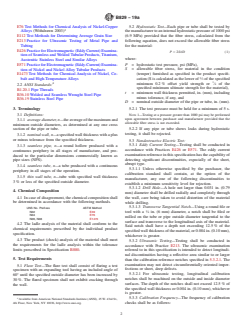
E76 Test Methods for Chemical Analysis of Nickel-Copper 5.2 Hydrostatic Test—Each pipe or tube shall be tested by
Alloys (Withdrawn 2003) themanufacturertoaninternalhydrostaticpressureof1000psi
E112 Test Methods for Determining Average Grain Size (6.9 MPa) provided that the fiber stress, calculated from the
E213 Practice for Ultrasonic Testing of Metal Pipe and following equation, does not exceed the allowable fiber stress
Tubing for the material:
E426 Practice for Electromagnetic (Eddy Current) Examina-
P 5 2St/D (1)
tion of Seamless and Welded Tubular Products, Titanium,
where:
Austenitic Stainless Steel and Similar Alloys
E571 PracticeforElectromagnetic(Eddy-Current)Examina- P = hydrostatic test pressure, psi (MPa),
S = allowable fiber stress, for material in the condition
tion of Nickel and Nickel Alloy Tubular Products
(temper) furnished as specified in the product specifi-
E1473 Test Methods for Chemical Analysis of Nickel, Co-
cation (S is calculated as the lower of ⁄3 of the specified
balt and High-Temperature Alloys
minimum 0.2 % offset yield strength or ⁄4 of the
2.2 ANSI Standards:
specified minimum ultimate strength for the material),
B1.20.1 Pipe Threads
t = minimum wall thickness permitted, in. (mm), including
B36.10 Welded and Seamless Wrought Steel Pipe
minus tolerance, if any, and
B36.19 Stainless Steel Pipe
D = nominal outside diameter of the pipe or tube, in. (mm).
3. Terminology 5.2.1 The test pressure must be held for a minimum of 5 s.
3.1 Definitions:
NOTE 1—Testing at a pressure greater than 1000 psi may be performed
upon agreement between purchaser and manufacturer provided that the
3.1.1 averagediameter,n—theaverageofthemaximumand
allowable fiber stress is not exceeded.
minimum outside diameters, as determined at any one cross
section of the pipe or tube. 5.2.2 If any pipe or tube shows leaks during hydrostatic
testing, it shall be rejected.
3.1.2 nominalwall,n—aspecifiedwallthicknesswithaplus
or minus tolerance from the specified thickness.
5.3 Nondestructive Electric Test:
5.3.1 Eddy Current Testing—Testing shall be conducted in
3.1.3 seamless pipe, n—a round hollow produced with a
accordance with Practices E426 or E571. The eddy current
continuous periphery in all stages of manufacture, and pro-
examination reference in this specification has the capability of
duced to the particular dimensions commercially known as
detecting significant discontinuities, especially of the short,
pipe sizes (NPS).
abrupt type.
3.1.4 seamless tube, n—a tube produced with a continuous
5.3.1.1 Unless otherwise specified by the purchaser, the
periphery in all stages of the operation.
calibration standard shall contain, at the option of the
3.1.5 thin wall tube, n—tube with specified wall thickness
manufacturer, any one of the following discontinuities to
3 % or less of the specified outside diameter.
establish a minimum sensitivity level for rejection.
5.3.1.2 Drill Hole—A hole not larger than 0.031 in. (0.79
4. Chemical Composition
mm) diameter shall be drilled radially and completely through
4.1 In case of disagreement, the chemical composition shall
the wall, care being taken to avoid distortion of the material
be determined in accordance with the following methods. while drilling.
5.3.1.3 Transverse Tangential Notch—Using a round file or
UNS No. Prefixes ASTM Method
N02 E39
tool with a ⁄4 in. (6 mm) diameter, a notch shall be filed or
N04 E76
milled on the tube or pipe outside diameter tangential to the
N06, N08 E1473
surface and transverse to the longitudinal axis of the material.
4.2 The ladle analysis of the material shall conform to the
Said notch shall have a depth not exceeding 12.5 % of the
chemical requirements prescribed by the individual product
specifiedwallthicknessofthematerial,or0.004in.(0.10mm),
specification.
whichever is greater.
4.3 The product (check) analysis of the material shall meet
5.3.2 Ultrasonic Testing—Testing shall be conducted in
the requirements for the ladle analysis within the tolerance
accordance with Practice E213. The ultrasonic examination
limits prescribed in Specification B880.
referred to in this specification is intended to detect longitudi-
nal discontinuities having a reflective area similar to or larger
5. Test Requirements
than the calibration reference notches specified in 5.3.2.1. The
examination may not detect circumferentially oriented imper-
5.1 Flare Test—The flare test shall consist of flaring a test
fections or short, deep defects.
specimen with an expanding tool having an included angle of
5.3.2.1 For ultrasonic testing, longitudinal calibration
60° until the specified outside diameter has been increased by
notches shall be machined on the outside and inside diameter
30 %. The flared specimen shall not exhibit cracking through
surfaces. The depth of the notches shall not exceed 12.5 % of
the wall.
the specified wall thickness or 0.004 in. (0.10 mm), whichever
is greater.
5.3.3 Calibration Frequency—The frequency of calibration
Available from American National Standards Institute (ANSI), 25 W. 43rd St.,
4th Floor, New York, NY 10036, http://www.ansi.org. checks shall be as follows:
B829−19a
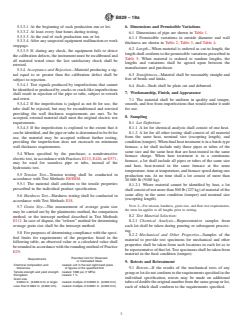
5.3.3.1 At the beginning of each production run or lot. 6. Dimensions and Permissible Variations
5.3.3.2 At least every four hours during testing.
6.1 Dimensions of pipe are shown in Table 1.
5.3.3.3 At the end of each production run or lot.
6.1.1 Permissible variations in outside diameter and wall
5.3.3.4 After any suspected equipment malfunction or work
thickness are shown in Table 2, Table 3, and Table 4.
stoppage.
6.2 Length—When material is ordered as cut-to-length, the
5.3.3.5 If, during any check, the equipment fails to detect
length shall conform to the permissible variations prescribed in
the calibration defects, the instrument must be recalibrated and
Table 5. When material is ordered to random lengths, the
all material tested since the last satisfactory check shall be
lengths and variations shall be agreed upon between the
retested.
manufacturer and purchaser.
5.3.4 Acceptance and Rejection—Material producing a sig-
6.3 Straightness—Material shall be reasonably straight and
nal equal to or greater than the calibration defect shall be
free of bends and kinks.
subject to rejection.
5.3.4.1 Test signals produced by imperfections that cannot
6.4 Ends—Ends shall be plain cut and deburred.
be identified or produced by cracks or crack-like imperfections
7. Workmanship, Finish, and Appearance
shall result in rejection of the pipe or tube, subject to rework
and retest.
7.1 The material shall be uniform in quality and temper,
5.3.4.2 If the imperfection is judged as not fit for use, the
smooth, and free from imperfections that would render it unfit
tube shall be rejected, but may be reconditioned and retested
for use.
providing the wall thickness requirements are met. To be
8. Sampling
accepted, retested material shall meet the original electric test
requirements. 8.1 Lot Definition:
8.1.1 A lot for chemical analysis shall consist of one heat.
5.3.4.3 If the imperfection is explored to the extent that it
8.1.2 A lot for all other testing shall consist of all material
canbeidentified,andthepipeortubeisdeterminedtobefitfor
from the same heat, nominal size (excepting length), and
use, the material may be accepted without further testing,
condition(temper).Whenfinalheattreatmentisinabatch-type
providing the imperfection does not encroach on minimum
furnace, a lot shall include only those pipes or tubes of the
wall thickness requirements.
same size and the same heat that are heat-treated in the same
5.4 When specified by the purchaser, a nondestructive
furnace charge. When heat treatment is in a continuous
electrictest,inaccordancewithPracticesE213,E426,orE571,
furnace, a lot shall include all pipes or tubes of the same size
may be used for seamless pipe or tube, instead of the
and heat, heat-treated in the same furnace at the same
hydrostatic test.
temperature,timeattemperature,andfurnacespeedduringone
5.5 Tension Test—Tension testing shall be conducted in
production run. At no time shall a lot consist of more than
accordance with Test Methods E8/E8M.
20 000 lb (9100 kg).
5.5.1 The material shall conform to the tensile properties
8.1.2.1 Where material cannot be identified by heat, a lot
prescribed in the individual product specification.
shallconsistofnotmorethan500lb(227kg)ofmaterialofthe
same alloy in the same condition (temper) and nominal size
5.6 Hardness Test—Hardness testing shall be conducted in
(excepting length).
accordance with Test Methods E18.
NOTE 2—For tension, hardness, grain size, and flare test requirements,
5.7 Grain Size—The measurement of average grain size
the term lot applies to all lengths prior to cutting.
may be carried out by the planimetric method, the comparison
8.2 Test Material Selection:
method, or the intercept method described in Test Methods
8.2.1 Chemical Analysis—Representative samples from
E112. In case of dispute, the “referee” method for determining
each lot shall be taken during pouring or subsequent process-
average grain size shall be the intercept method.
ing.
5.8 For purposes of determining compliance with the speci-
8.2.2 Mechanical and Other Properties—Samples of the
fied limits for requirements of the properties listed in the
material to provide test specimens for mechanical and other
following table, an observed value or a calculated value shall
properties shall be taken from such locations in each lot as to
beroundedinaccordancewiththeroundingmethodofPractice
berepresentativeofthatlot.Testspecimensshallbetakenfrom
E29:
material in the final condition (temper).
Rounded Unit for Observed
Requirements
or Calculated Value
9. Retests and Retreatment
Chemical composition and nearest unit in the last right-hand place
tolerances of figures of the specified limit 9.1 Retests—If the results of the mechanical tests of any
Tensile strength and yield strength nearest 1000 psi
...
This document is not an ASTM standard and is intended only to provide the user of an ASTM standard an indication of what changes have been made to the previous version. Because
it may not be technically possible to adequately depict all changes accurately, ASTM recommends that users consult prior editions as appropriate. In all cases only the current version
of the standard as published by ASTM is to be considered the official document.
Designation: B829 − 19 B829 − 19a
Standard Specification for
General Requirements for Nickel and Nickel Alloys
Seamless Pipe and Tube
This standard is issued under the fixed designation B829; the number immediately following the designation indicates the year of
original adoption or, in the case of revision, the year of last revision. A number in parentheses indicates the year of last reapproval. A
superscript epsilon (´) indicates an editorial change since the last revision or reapproval.
1. Scope*
1.1 This specification contains various requirements that, with the exception of Sections 5 and 10, are mandatory requirements
to the following ASTM nickel and nickel alloy, seamless pipe and tube specifications:
ASTM
Title of Specification
Designation
Nickel Seamless Pipe and Tube B161
Seamless Nickel and Nickel Alloy, Condenser and Heat B163
Exchanger Tubes
Nickel-Copper Alloy (UNS N04400) Seamless Pipe and Tube B165
Nickel-Chromium-Aluminum Alloys (UNS N06699), B167
Nickel-Chromium-Iron Alloys (UNS N06600, N06601,
N06603, N06690, N06693, N06025, N06045, and N06696),
Nickel-Chromium-Cobalt-Molybdenum Alloy (UNS N06617),
Nickel-Iron-Chromium-Tungsten Alloy (UNS N06674), and
Nickel-Chromium-Molybdenum-Copper Alloy (UNS N06235)
Seamless Pipe and Tube
Nickel-Iron-Chromium Alloy Seamless Pipe and Tube B407
Nickel-Iron-Chromium-Molybdenum-Copper Alloy (UNS N08825, B423
N08221, and N06845) Seamless Pipe and Tube
Nickel-Chromium-Molybdenum-Columbium Alloys (UNS N06625 B444
and N06852) and Nickel-Chromium-Molybdenum-Silicon
Alloy (UNS N06219) Pipe and Tube
Nickel-Iron-Chromium-Silicon Alloys (UNS N08330 and UNS B535
N08332) Seamless Pipe
Copper-Beryllium Alloy (UNS Nos. C17000 and C17200) B570
Forgings and Extrusion
Seamless Nickel and Nickel-Cobalt Alloy Pipe and Tube B622
UNS N08028 and N08029 Seamless Pipe and Tube B668
UNS N08925, UNS N08354, and UNS N08926 Seamless Pipe B677
and Tube
Iron-Nickel-Chromium-Molybdenum Alloys (UNS N08367) B690
Seamless Pipe and Tube
Nickel-Chromium-Molybdenum-Cobalt-Tungsten-Iron-Silicon B722
Alloy (UNS N06333) Seamless Pipe and Tube
Seamless UNS N08020, UNS N08026, and UNS N08024 B729
Nickel-Alloy Pipe and Tube
1.2 One or more of the test requirements of Section 5 apply only if specifically stated in the product specification or in the
purchase order.
1.3 In case of conflict between a requirement of the product specification and a requirement of this general specification, only
the requirement of the product specification needs to be satisfied.
1.4 The values stated in inch-pound units are to be regarded as standard. The values given in parentheses are mathematical
conversions to SI units that are provided for information only and are not considered standard.
1.5 The following safety hazards caveat pertains only to the test requirements portion, Section 5, of this specification: This
standard does not purport to address all of the safety concerns, if any, associated with its use. It is the responsibility of the user
This specification is under the jurisdiction of ASTM Committee B02 on Nonferrous Metals and Alloys and is the direct responsibility of Subcommittee B02.07 on Refined
Nickel and Cobalt and Their Alloys.
Current edition approved April 1, 2019Nov. 1, 2019. Published April 2019November 2019. Originally approved in 1992. Last previous edition approved in 20182019 as
B829 – 18.B829 – 19. DOI: 10.1520/B0829-19.10.1520/B0829-19A.
For referenced ASTM standards, visit the ASTM website, www.astm.org, or contact ASTM Customer Service at service@astm.org. For Annual Book of ASTM Standards
volume information, refer to the standard’s Document Summary page on the ASTM website.
*A Summary of Changes section appears at the end of this standard
Copyright © ASTM International, 100 Barr Harbor Drive, PO Box C700, West Conshohocken, PA 19428-2959. United States
B829 − 19a
of this standard to become familiar with all hazards including those identified in the appropriate Safety Data Sheet (SDS) for this
product/material as provided by the manufacturer, to establish appropriate safety, health, and environmental practices, and
determine the applicability of regulatory limitations prior to use.
1.6 This international standard was developed in accordance with internationally recognized principles on standardization
established in the Decision on Principles for the Development of International Standards, Guides and Recommendations issued
by the World Trade Organization Technical Barriers to Trade (TBT) Committee.
2. Referenced Documents
2.1 ASTM Standards:
B880 Specification for General Requirements for Chemical Check Analysis Limits for Nickel, Nickel Alloys and Cobalt Alloys
E8/E8M Test Methods for Tension Testing of Metallic Materials
E18 Test Methods for Rockwell Hardness of Metallic Materials
E29 Practice for Using Significant Digits in Test Data to Determine Conformance with Specifications
E39 Methods for Chemical Analysis of Nickel (Withdrawn 1995)
E76 Test Methods for Chemical Analysis of Nickel-Copper Alloys (Withdrawn 2003)
E112 Test Methods for Determining Average Grain Size
E213 Practice for Ultrasonic Testing of Metal Pipe and Tubing
E426 Practice for Electromagnetic (Eddy Current) Examination of Seamless and Welded Tubular Products, Titanium, Austenitic
Stainless Steel and Similar Alloys
E571 Practice for Electromagnetic (Eddy-Current) Examination of Nickel and Nickel Alloy Tubular Products
E1473 Test Methods for Chemical Analysis of Nickel, Cobalt and High-Temperature Alloys
2.2 ANSI Standards:
B1.20.1 Pipe Threads
B36.10 Welded and Seamless Wrought Steel Pipe
B36.19 Stainless Steel Pipe
3. Terminology
3.1 Definitions:
3.1.1 average diameter, n—the average of the maximum and minimum outside diameters, as determined at any one cross section
of the pipe or tube.
3.1.2 nominal wall, n—a specified wall thickness with a plus or minus tolerance from the specified thickness.
3.1.3 seamless pipe, n—a round hollow produced with a continuous periphery in all stages of manufacture, and produced to the
particular dimensions commercially known as pipe sizes (NPS).
3.1.4 seamless tube, n—a tube produced with a continuous periphery in all stages of the operation.
3.1.5 thin wall tube, n—tube with specified wall thickness 3 % or less of the specified outside diameter.
4. Chemical Composition
4.1 In case of disagreement, the chemical composition shall be determined in accordance with the following methods.
UNS No. Prefixes ASTM Method
N02 E39
N04 E76
N06, N08 E1473
4.2 The ladle analysis of the material shall conform to the chemical requirements prescribed by the individual product
specification.
4.3 The product (check) analysis of the material shall meet the requirements for the ladle analysis within the tolerance limits
prescribed in Specification B880.
5. Test Requirements
5.1 Flare Test—The flare test shall consist of flaring a test specimen with an expanding tool having an included angle of 60°
until the specified outside diameter has been increased by 30 %. The flared specimen shall not exhibit cracking through the wall.
5.2 Hydrostatic Test—Each pipe or tube shall be tested by the manufacturer to an internal hydrostatic pressure of 1000 psi (6.9
MPa) provided that the fiber stress, calculated from the following equation, does not exceed the allowable fiber stress for the
material:
The last approved version of this historical standard is referenced on www.astm.org.
Available from American National Standards Institute (ANSI), 25 W. 43rd St., 4th Floor, New York, NY 10036, http://www.ansi.org.
B829 − 19a
P 5 2St/D (1)
where:
P = hydrostatic test pressure, psi (MPa),
S = allowable fiber stress, for material in the condition (temper) furnished as specified in the product specification (S is
2 1
calculated as the lower of ⁄3 of the specified minimum 0.2 % offset yield strength or ⁄4 of the specified minimum ultimate
strength for the material),
t = minimum wall thickness permitted, in. (mm), including minus tolerance, if any, and
D = nominal outside diameter of the pipe or tube, in. (mm).
5.2.1 The test pressure must be held for a minimum of 5 s.
NOTE 1—Testing at a pressure greater than 1000 psi may be performed upon agreement between purchaser and manufacturer provided that the
allowable fiber stress is not exceeded.
5.2.2 If any pipe or tube shows leaks during hydrostatic testing, it shall be rejected.
5.3 Nondestructive Electric Test:
5.3.1 Eddy Current Testing—Testing shall be conducted in accordance with Practices E426 or E571. The eddy current
examination reference in this specification has the capability of detecting significant discontinuities, especially of the short, abrupt
type.
5.3.1.1 Unless otherwise specified by the purchaser, the calibration standard shall contain, at the option of the manufacturer, any
one of the following discontinuities to establish a minimum sensitivity level for rejection.
5.3.1.2 Drill Hole—A hole not larger than 0.031 in. (0.79 mm) diameter shall be drilled radially and completely through the
wall, care being taken to avoid distortion of the material while drilling.
5.3.1.3 Transverse Tangential Notch—Using a round file or tool with a ⁄4 in. (6 mm) diameter, a notch shall be filed or milled
on the tube or pipe outside diameter tangential to the surface and transverse to the longitudinal axis of the material. Said notch
shall have a depth not exceeding 12.5 % of the specified wall thickness of the material, or 0.004 in. (0.10 mm), whichever is
greater.
5.3.2 Ultrasonic Testing—Testing shall be conducted in accordance with Practice E213. The ultrasonic examination referred to
in this specification is intended to detect longitudinal discontinuities having a reflective area similar to or larger than the calibration
reference notches specified in 5.3.2.1. The examination may not detect circumferentially oriented imperfections or short, deep
defects.
5.3.2.1 For ultrasonic testing, longitudinal calibration notches shall be machined on the outside and inside diameter surfaces.
The depth of the notches shall not exceed 12.5 % of the specified wall thickness or 0.004 in. (0.10 mm), whichever is greater.
5.3.3 Calibration Frequency—The frequency of calibration checks shall be as follows:
5.3.3.1 At the beginning of each production run or lot.
5.3.3.2 At least every four hours during testing.
5.3.3.3 At the end of each production run or lot.
5.3.3.4 After any suspected equipment malfunction or work stoppage.
5.3.3.5 If, during any check, the equipment fails to detect the calibration defects, the instrument must be recalibrated and all
material tested since the last satisfactory check shall be retested.
5.3.4 Acceptance and Rejection—Material producing a signal equal to or greater than the calibration defect shall be subject to
rejection.
5.3.4.1 Test signals produced by imperfections that cannot be identified or produced by cracks or crack-like imperfections shall
result in rejection of the pipe or tube, subject to rework and retest.
5.3.4.2 If the imperfection is judged as not fit for use, the tube shall be rejected, but may be reconditioned and retested providing
the wall thickness requirements are met. To be accepted, retested material shall meet the original electric test requirements.
5.3.4.3 If the imperfection is explored to the extent that it can be identified, and the pipe or tube is determined to be fit for use,
the material may be accepted without further testing, providing the imperfection does not encroach on minimum wall thickness
requirements.
5.4 When specified by the purchaser, a nondestructive electric test, in accordance with Practices E213, E426, or E571, may be
used for seamless pipe or tube, instead of the hydrostatic test.
5.5 Tension Test—Tension testing shall be conducted in accordance with Test Methods E8/E8M.
5.5.1 The material shall conform to the tensile properties prescribed in the individual product specification.
5.6 Hardness Test—Hardness testing shall be conducted in accordance with Test Methods E18.
5.7 Grain Size—The measurement of average grain size may be carried out by the planimetric method, the comparison method,
or the intercept method described in Test Methods E112. In case of dispute, the “referee” method for determining average grain
size shall be the intercept method.
B829 − 19a
5.8 For purposes of determining compliance with the specified limits for requirements of the properties listed in the following
table, an observed value or a calculated value shall be rounded in accordance with the rounding method of Practice E29:
Rounded Unit for Observed
Requirements
or Calculated Value
Chemical composition and nearest unit in the last right-hand place
tolerances of figures of the specified limit
Tensile strength and yield strength nearest 1000 psi (7 MPa)
Elongation nearest 1 %
Grain size
0.0024 in. (0.060 mm) or larger nearest multiple of 0.0002 in. (0.005 mm)
Less than 0.0024 in. (0.060 mm) nearest multiple of 0.0001 in. (0.002 mm)
6. Dimensions and Permissible Variations
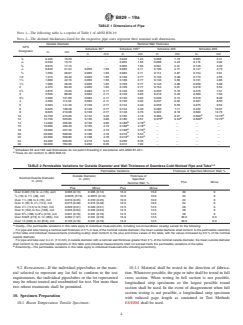
6.1 Dimensions of pipe are shown in Table 1.
6.1.1 Permissible variations in outside diameter and wall thickness are shown in Table 2, Table 3, and Table 4.
6.2 Length—When material is ordered as cut-to-length, the length shall conform to the permissible variations prescribed in
Table 5. When material is ordered to random lengths, the lengths and variations shall be agreed upon between the manufacturer
and purchaser.
6.3 Straightness—Material shall be reasonably straight and free of bends and kinks.
6.4 Ends—Ends shall be plain cut and deburred.
7. Workmanship, Finish, and Appearance
7.1 The material shall be uniform in quality and temper, smooth, and free from imperfections that would render it unfit for use.
8. Sampling
8.1 Lot Definition:
8.1.1 A lot for chemical analysis shall consist of one heat.
8.1.2 A lot for all other testing shall consist of all material from the same heat, nominal size (excepting length), and condition
(temper). When final heat treatment is in a batch-type furnace, a lot shall include only those pipes or tubes of the same size and
the same heat that are heat-treated in the same furnace charge. When heat treatment is in a continuous furnace, a lot shall include
TABLE 1 Dimensions of Pipe
NOTE 1—The following table is a reprint of Table 1 of ANSI B36.19.
NOTE 2—The decimal thicknesses listed for the respective pipe sizes represent their nominal wall dimensions.
Outside Diameter Nominal Wall Thickness
NPS
A A
Schedule 5S Schedule 10S Schedule 40S Schedule 80S
Designator
in. mm
in. mm in. mm in. mm in. mm
⁄8 0.405 10.29 . . 0.049 1.24 0.068 1.73 0.095 2.41
⁄4 0.540 13.72 . . 0.065 1.65 0.088 2.24 0.119 3.02
⁄8 0.675 17.15 . . 0.065 1.65 0.091 2.31 0.126 3.20
⁄2 0.840 21.34 0.065 1.65 0.083 2.11 0.109 2.77 0.147 3.73
⁄4 1.050 26.67 0.065 1.65 0.083 2.11 0.113 2.87 0.154 3.91
1.0 1.315 33.40 0.065 1.65 0.109 2.77 0.133 3.38 0.179 4.55
1 ⁄4 1.660 42.16 0.065 1.65 0.109 2.77 0.140 3.56 0.191 4.85
1 ⁄2 1.900 48.26 0.065 1.65 0.109 2.77 0.145 3.68 0.200 5.08
2 2.375 60.33 0.065 1
...