

ASTM D1319-20a
(Test Method)Standard Test Method for Hydrocarbon Types in Liquid Petroleum Products by Fluorescent Indicator Adsorption
General Information
- Abstract
SIGNIFICANCE AND USE
5.1 The determination of the total volume percent of saturates, olefins, and aromatics in petroleum fractions is important in characterizing the quality of petroleum fractions as gasoline blending components and as feeds to catalytic reforming processes. This information is also important in characterizing petroleum fractions and products from catalytic reforming and from thermal and catalytic cracking as blending components for motor and aviation fuels. This information is also important as a measure of the quality of fuels, such as specified in Specification D1655.
SCOPE
1.1 This test method covers the determination of hydrocarbon types of total aromatics, total olefins, and total saturates in petroleum fractions that distill below 315 °C. Samples containing dark-colored components that interfere in reading the chromatographic bands cannot be analyzed.
Note 1: For the determination of olefins below 0.3 % by volume, other test methods are available, such as Test Method D2710.
1.2 This test method is intended for use with full boiling range products. Cooperative data have established that the precision statement does not apply to narrow boiling petroleum fractions near the 315 °C limit. Such samples are not eluted properly, and results are erratic.
1.3 This test method is also applicable to automotive spark-ignition engine fuels which are gasolines with and without blended oxygenates, such as alcohols and ethers (for example MTBE, ethanol) and where gasoline is the primary component by volume in the blend.
1.4 The applicability of this test method to products derived from fossil fuels other than petroleum, such as coal, shale, or tar sands, has not been determined, and the precision statement may or may not apply to such products.
1.5 This test method has two precision statements depicted in Table 3 and Table 4.
1.5.1 Table 3 is applicable to fuels that do not contain oxygenated blending components over the test method concentration working ranges from 5 % to 99 % by volume aromatics, 1 % to 55 % by volume olefins, and 1 % to 95 % by volume saturates in petroleum fractions and with a final boiling point of
1.5.2 Table 4 precision was derived from an ILS containing only blended oxygenated (for example, MTBE, ethanol) and non-oxygenated automotive spark-ignition engine fuels (gasolines) and is applicable only in the test method concentration working range of 13 % to 40 % by volume aromatics, 4 % to 33 % by volume olefins, and 45 % to 68 % by volume saturates.
1.5.3 Non-oxygenated automotive spark-ignition engine fuels (gasolines) outside the inclusive valid test result reporting concentration ranges of Table 4 may use the precision in Table 3 and its applicable concentration ranges.
1.6 The oxygenated blending components, methanol, ethanol, methyl-tert-butylether (MTBE), tert-amylmethylether (TAME), and ethyl-tert-butylether (ETBE), do not interfere with the determination of hydrocarbon types at concentrations normally found in commercial blends. These oxygenated components are not detected since they elute with the alcohol desorbent. Other oxygenated compounds shall be individually verified. When samples containing oxygenated blending components are analyzed, correct the results to a total-sample basis.
1.7 This test method includes a relative bias section based on Practice D6708 accuracy assessment between Test Method D1319 and Test Method D5769 for total aromatics in spark-ignition engine fuels as a possible Test Method D1319 alternative to Test Method D5769 for U.S. EPA spark-ignition engine fuel regulations reporting. The Practice D6708 derived correlation equation is only applicable for fuels in the total aromatic concentration range from 3.3 % to 34.4 % by volume as measured by Test Method D1319 and the distillation temperature T95, at which 95 % of the sample has evaporated, ranges from 149.1 °C to 196.6 °C (300.3 °F to 385.8 °F) when tested according to ...
- Status
- Published
- Publication Date
- 31-Jul-2020
- Technical Committee
- D02 - Petroleum Products, Liquid Fuels, and Lubricants
- Drafting Committee
- D02.04.0C - Liquid Chromatography
Buy Documents
ASTM D1319-20a - Standard Test Method for Hydrocarbon Types in Liquid Petroleum Products by Fluorescent Indicator Adsorption
REDLINE ASTM D1319-20a - Standard Test Method for Hydrocarbon Types in Liquid Petroleum Products by Fluorescent Indicator Adsorption
Overview
ASTM D1319-20a is a standardized test method established by ASTM International for the determination of hydrocarbon types-specifically total aromatics, olefins, and saturates-in liquid petroleum products. Using fluorescent indicator adsorption (FIA), this method offers reliable quantitative analysis for petroleum fractions that distill below 315°C. Widely adopted in the petroleum refining and fuels industries, ASTM D1319-20a plays a critical role in characterizing product quality, especially for gasoline blending components, motor, and aviation fuels.
Key Topics
- Hydrocarbon Type Determination: Accurately quantifies volume percent of three primary hydrocarbon classes:
- Saturates (alkanes and cycloalkanes)
- Olefins (alkenes, cycloalkenes, and some dienes)
- Aromatics (monocyclic and polycyclic, plus aromatic olefins)
- Analytical Scope: Applicable to full boiling range products with distillation endpoints below 315°C. Excludes dark-colored samples that interfere with band visualization.
- Sample Compatibility: Designed for analysis of automotive spark-ignition engine fuels, including gasolines with or without oxygenated blending components such as ethanol and MTBE.
- Oxygenated Compounds: Common oxygenates (methanol, ethanol, MTBE, TAME, and ETBE) do not interfere with the determination. Correction for total sample basis required when oxygenates are present.
- Precision and Repeatability: Includes detailed precision statements and valid concentration ranges for fuels with and without oxygenates. Method precision varies depending on the hydrocarbon type and product matrix.
- Regulatory Compliance: Recognized for use as an alternative to other methods (e.g., ASTM D5769) for regulatory reporting of total aromatics in engine fuels, with specific bias corrections per U.S. EPA requirements.
Applications
ASTM D1319-20a is vital for ensuring the quality and regulatory compliance of liquid petroleum products in several areas:
- Gasoline Production and Blending: Determines properties relevant to octane rating and engine performance, supporting optimal gasoline formulation.
- Aviation Turbine Fuels: Assesses hydrocarbon distribution in jet fuels as specified by ASTM D1655, a key quality criterion.
- Refinery Process Feeds: Characterizes fractions for catalytic reforming, cracking, and other refining processes to inform operational adjustments.
- Compliance Testing: Supports U.S. EPA and other regulatory mandates for accurate composition data on aromatics in finished gasolines.
- Research and Development: Utilized in laboratory studies and R&D to compare feedstocks, monitor product change, and support innovation in alternative fuels.
Related Standards
To ensure robust analysis and interoperability, ASTM D1319-20a references and complements several other key standards:
- ASTM D86 – Test Method for Distillation of Petroleum Products and Liquid Fuels at Atmospheric Pressure
- ASTM D1655 – Specification for Aviation Turbine Fuels
- ASTM D2710 – Test Method for Bromine Index of Petroleum Hydrocarbons
- ASTM D4815 – Test Method for Oxygenates in Gasoline by Gas Chromatography
- ASTM D5599 – Test Method for Determination of Oxygenates by Oxygen Selective Flame Ionization Detection
- ASTM D5769 – Test Method for Benzene, Toluene, and Total Aromatics in Gasolines
- ASTM D6708 – Practice for Statistical Assessment of Agreement Between Methods
ASTM D1319-20a provides a trusted and widely recognized approach for hydrocarbon analysis, supporting process optimization, quality control, and regulatory compliance in the global fuels and petroleum industries. Incorporate this method to ensure your fuel analysis meets industry and regulatory standards for hydrocarbon content and product performance.
Relations
- Effective Date
- 15-Mar-2024
- Effective Date
- 01-Mar-2024
- Effective Date
- 01-Mar-2024
- Effective Date
- 01-Dec-2023
- Effective Date
- 01-Dec-2023
- Effective Date
- 01-Dec-2023
- Effective Date
- 01-Oct-2023
- Effective Date
- 01-May-2020
- Effective Date
- 01-Dec-2019
- Effective Date
- 01-May-2019
- Effective Date
- 01-Apr-2018
- Effective Date
- 01-Jan-2018
- Effective Date
- 01-Dec-2017
- Effective Date
- 01-May-2017
- Effective Date
- 01-Dec-2016
Buy Documents
ASTM D1319-20a - Standard Test Method for Hydrocarbon Types in Liquid Petroleum Products by Fluorescent Indicator Adsorption
REDLINE ASTM D1319-20a - Standard Test Method for Hydrocarbon Types in Liquid Petroleum Products by Fluorescent Indicator Adsorption
Get Certified
Connect with accredited certification bodies for this standard

Element Materials Technology
Materials testing and product certification.

ABS Group Brazil
ABS Group certification services in Brazil.

ABS Quality Evaluations Inc.
American Bureau of Shipping quality certification.
Sponsored listings
Frequently Asked Questions
ASTM D1319-20a is a standard published by ASTM International. Its full title is "Standard Test Method for Hydrocarbon Types in Liquid Petroleum Products by Fluorescent Indicator Adsorption". This standard covers: SIGNIFICANCE AND USE 5.1 The determination of the total volume percent of saturates, olefins, and aromatics in petroleum fractions is important in characterizing the quality of petroleum fractions as gasoline blending components and as feeds to catalytic reforming processes. This information is also important in characterizing petroleum fractions and products from catalytic reforming and from thermal and catalytic cracking as blending components for motor and aviation fuels. This information is also important as a measure of the quality of fuels, such as specified in Specification D1655. SCOPE 1.1 This test method covers the determination of hydrocarbon types of total aromatics, total olefins, and total saturates in petroleum fractions that distill below 315 °C. Samples containing dark-colored components that interfere in reading the chromatographic bands cannot be analyzed. Note 1: For the determination of olefins below 0.3 % by volume, other test methods are available, such as Test Method D2710. 1.2 This test method is intended for use with full boiling range products. Cooperative data have established that the precision statement does not apply to narrow boiling petroleum fractions near the 315 °C limit. Such samples are not eluted properly, and results are erratic. 1.3 This test method is also applicable to automotive spark-ignition engine fuels which are gasolines with and without blended oxygenates, such as alcohols and ethers (for example MTBE, ethanol) and where gasoline is the primary component by volume in the blend. 1.4 The applicability of this test method to products derived from fossil fuels other than petroleum, such as coal, shale, or tar sands, has not been determined, and the precision statement may or may not apply to such products. 1.5 This test method has two precision statements depicted in Table 3 and Table 4. 1.5.1 Table 3 is applicable to fuels that do not contain oxygenated blending components over the test method concentration working ranges from 5 % to 99 % by volume aromatics, 1 % to 55 % by volume olefins, and 1 % to 95 % by volume saturates in petroleum fractions and with a final boiling point of 1.5.2 Table 4 precision was derived from an ILS containing only blended oxygenated (for example, MTBE, ethanol) and non-oxygenated automotive spark-ignition engine fuels (gasolines) and is applicable only in the test method concentration working range of 13 % to 40 % by volume aromatics, 4 % to 33 % by volume olefins, and 45 % to 68 % by volume saturates. 1.5.3 Non-oxygenated automotive spark-ignition engine fuels (gasolines) outside the inclusive valid test result reporting concentration ranges of Table 4 may use the precision in Table 3 and its applicable concentration ranges. 1.6 The oxygenated blending components, methanol, ethanol, methyl-tert-butylether (MTBE), tert-amylmethylether (TAME), and ethyl-tert-butylether (ETBE), do not interfere with the determination of hydrocarbon types at concentrations normally found in commercial blends. These oxygenated components are not detected since they elute with the alcohol desorbent. Other oxygenated compounds shall be individually verified. When samples containing oxygenated blending components are analyzed, correct the results to a total-sample basis. 1.7 This test method includes a relative bias section based on Practice D6708 accuracy assessment between Test Method D1319 and Test Method D5769 for total aromatics in spark-ignition engine fuels as a possible Test Method D1319 alternative to Test Method D5769 for U.S. EPA spark-ignition engine fuel regulations reporting. The Practice D6708 derived correlation equation is only applicable for fuels in the total aromatic concentration range from 3.3 % to 34.4 % by volume as measured by Test Method D1319 and the distillation temperature T95, at which 95 % of the sample has evaporated, ranges from 149.1 °C to 196.6 °C (300.3 °F to 385.8 °F) when tested according to ...
SIGNIFICANCE AND USE 5.1 The determination of the total volume percent of saturates, olefins, and aromatics in petroleum fractions is important in characterizing the quality of petroleum fractions as gasoline blending components and as feeds to catalytic reforming processes. This information is also important in characterizing petroleum fractions and products from catalytic reforming and from thermal and catalytic cracking as blending components for motor and aviation fuels. This information is also important as a measure of the quality of fuels, such as specified in Specification D1655. SCOPE 1.1 This test method covers the determination of hydrocarbon types of total aromatics, total olefins, and total saturates in petroleum fractions that distill below 315 °C. Samples containing dark-colored components that interfere in reading the chromatographic bands cannot be analyzed. Note 1: For the determination of olefins below 0.3 % by volume, other test methods are available, such as Test Method D2710. 1.2 This test method is intended for use with full boiling range products. Cooperative data have established that the precision statement does not apply to narrow boiling petroleum fractions near the 315 °C limit. Such samples are not eluted properly, and results are erratic. 1.3 This test method is also applicable to automotive spark-ignition engine fuels which are gasolines with and without blended oxygenates, such as alcohols and ethers (for example MTBE, ethanol) and where gasoline is the primary component by volume in the blend. 1.4 The applicability of this test method to products derived from fossil fuels other than petroleum, such as coal, shale, or tar sands, has not been determined, and the precision statement may or may not apply to such products. 1.5 This test method has two precision statements depicted in Table 3 and Table 4. 1.5.1 Table 3 is applicable to fuels that do not contain oxygenated blending components over the test method concentration working ranges from 5 % to 99 % by volume aromatics, 1 % to 55 % by volume olefins, and 1 % to 95 % by volume saturates in petroleum fractions and with a final boiling point of 1.5.2 Table 4 precision was derived from an ILS containing only blended oxygenated (for example, MTBE, ethanol) and non-oxygenated automotive spark-ignition engine fuels (gasolines) and is applicable only in the test method concentration working range of 13 % to 40 % by volume aromatics, 4 % to 33 % by volume olefins, and 45 % to 68 % by volume saturates. 1.5.3 Non-oxygenated automotive spark-ignition engine fuels (gasolines) outside the inclusive valid test result reporting concentration ranges of Table 4 may use the precision in Table 3 and its applicable concentration ranges. 1.6 The oxygenated blending components, methanol, ethanol, methyl-tert-butylether (MTBE), tert-amylmethylether (TAME), and ethyl-tert-butylether (ETBE), do not interfere with the determination of hydrocarbon types at concentrations normally found in commercial blends. These oxygenated components are not detected since they elute with the alcohol desorbent. Other oxygenated compounds shall be individually verified. When samples containing oxygenated blending components are analyzed, correct the results to a total-sample basis. 1.7 This test method includes a relative bias section based on Practice D6708 accuracy assessment between Test Method D1319 and Test Method D5769 for total aromatics in spark-ignition engine fuels as a possible Test Method D1319 alternative to Test Method D5769 for U.S. EPA spark-ignition engine fuel regulations reporting. The Practice D6708 derived correlation equation is only applicable for fuels in the total aromatic concentration range from 3.3 % to 34.4 % by volume as measured by Test Method D1319 and the distillation temperature T95, at which 95 % of the sample has evaporated, ranges from 149.1 °C to 196.6 °C (300.3 °F to 385.8 °F) when tested according to ...
ASTM D1319-20a is classified under the following ICS (International Classification for Standards) categories: 75.080 - Petroleum products in general. The ICS classification helps identify the subject area and facilitates finding related standards.
ASTM D1319-20a has the following relationships with other standards: It is inter standard links to ASTM D1655-24, ASTM D6300-24, ASTM D6708-24, ASTM D86-23ae1, ASTM D86-23a, ASTM D6300-23a, ASTM D1655-23a, ASTM D2710-20, ASTM D6300-19a, ASTM D6708-19, ASTM D6708-18, ASTM D1655-18, ASTM D1655-17a, ASTM D5599-17, ASTM D1655-16c. Understanding these relationships helps ensure you are using the most current and applicable version of the standard.
ASTM D1319-20a is available in PDF format for immediate download after purchase. The document can be added to your cart and obtained through the secure checkout process. Digital delivery ensures instant access to the complete standard document.
Standards Content (Sample)
This international standard was developed in accordance with internationally recognized principles on standardization established in the Decision on Principles for the
Development of International Standards, Guides and Recommendations issued by the World Trade Organization Technical Barriers to Trade (TBT) Committee.
Designation: D1319 − 20a
Standard Test Method for
Hydrocarbon Types in Liquid Petroleum Products by
Fluorescent Indicator Adsorption
This standard is issued under the fixed designation D1319; the number immediately following the designation indicates the year of
original adoption or, in the case of revision, the year of last revision. A number in parentheses indicates the year of last reapproval. A
superscript epsilon (´) indicates an editorial change since the last revision or reapproval.
This standard has been approved for use by agencies of the U.S. Department of Defense.
1. Scope* non-oxygenated automotive spark-ignition engine fuels (gaso-
lines) and is applicable only in the test method concentration
1.1 This test method covers the determination of hydrocar-
working range of 13 % to 40 % by volume aromatics, 4 % to
bon types of total aromatics, total olefins, and total saturates in
33 % by volume olefins, and 45 % to 68 % by volume
petroleum fractions that distill below 315 °C. Samples contain-
saturates.
ing dark-colored components that interfere in reading the
1.5.3 Non-oxygenated automotive spark-ignition engine fu-
chromatographic bands cannot be analyzed.
els (gasolines) outside the inclusive valid test result reporting
NOTE1—Forthedeterminationofolefinsbelow0.3 %byvolume,other
concentration ranges of Table 4 may use the precision in Table
test methods are available, such as Test Method D2710.
3 and its applicable concentration ranges.
1.2 This test method is intended for use with full boiling
1.6 The oxygenated blending components, methanol,
range products. Cooperative data have established that the
ethanol, methyl-tert-butylether (MTBE), tert-amylmethylether
precisionstatementdoesnotapplytonarrowboilingpetroleum
(TAME), and ethyl-tert-butylether (ETBE), do not interfere
fractions near the 315 °C limit. Such samples are not eluted
with the determination of hydrocarbon types at concentrations
properly, and results are erratic.
normally found in commercial blends. These oxygenated
1.3 This test method is also applicable to automotive spark-
components are not detected since they elute with the alcohol
ignition engine fuels which are gasolines with and without
desorbent. Other oxygenated compounds shall be individually
blended oxygenates, such as alcohols and ethers (for example
verified. When samples containing oxygenated blending com-
MTBE, ethanol) and where gasoline is the primary component
ponentsareanalyzed,correcttheresultstoatotal-samplebasis.
by volume in the blend.
1.7 This test method includes a relative bias section based
1.4 The applicability of this test method to products derived
on Practice D6708 accuracy assessment between Test Method
from fossil fuels other than petroleum, such as coal, shale, or
D1319 and Test Method D5769 for total aromatics in spark-
tar sands, has not been determined, and the precision statement
ignition engine fuels as a possible Test Method D1319 alter-
may or may not apply to such products.
native to Test Method D5769 for U.S. EPA spark-ignition
1.5 This test method has two precision statements depicted
engine fuel regulations reporting. The Practice D6708 derived
in Table 3 and Table 4.
correlation equation is only applicable for fuels in the total
1.5.1 Table 3 is applicable to fuels that do not contain
aromatic concentration range from 3.3 % to 34.4 % by volume
oxygenated blending components over the test method concen-
as measured by Test Method D1319 and the distillation
trationworkingrangesfrom5 %to99 %byvolumearomatics,
temperature T , at which 95 % of the sample has evaporated,
1 % to 55 % by volume olefins, and 1 % to 95 % by volume
ranges from 149.1 °C to 196.6 °C (300.3 °F to 385.8 °F) when
saturatesinpetroleumfractionsandwithafinalboilingpointof
tested according to Test Method D86.
<315 °C. It may or may not apply to automotive gasolines
1.7.1 The applicable Test Method D5769 range for total
containing lead antiknock mixtures.
aromatics is 3.7 % to 29.4 % by volume as reported by Test
1.5.2 Table 4 precision was derived from an ILS containing
Method D5769 and the distillation temperature T values, at
only blended oxygenated (for example, MTBE, ethanol) and
which 95 % of the sample has evaporated, when tested
according to Test Method D86 is from 149.1 °C to 196.6 °C
(300.3 °F to 385.8 °F).
This test method is under the jurisdiction of ASTM Committee D02 on
1.7.2 Regulations may change over time and the user is
Petroleum Products, Liquid Fuels, and Lubricants and is the direct responsibility of
advised to verify current regulatory requirements.
Subcommittee D02.04.0C on Liquid Chromatography.
Current edition approved Aug. 1, 2020. Published September 2020. Originally
1.8 WARNING—Mercury has been designated by many
approved in 1954. Last previous edition approved in 2020 as D1319 – 20. DOI:
10.1520/D1319-20A. regulatory agencies as a hazardous substance that can cause
*A Summary of Changes section appears at the end of this standard
Copyright © ASTM International, 100 Barr Harbor Drive, PO Box C700, West Conshohocken, PA 19428-2959. United States
D1319 − 20a
serious medical issues. Mercury, or its vapor, has been dem- 2.2 Other Standards:
onstrated to be hazardous to health and corrosive to materials. BS 410–1:2000 Test sieves. Technical requirements and
Use caution when handling mercury and mercury-containing testing. Test sieves of metal wire cloth
products. See the applicable product Safety Data Sheet (SDS)
3. Terminology
for additional information. The potential exists that selling
mercury or mercury-containing products, or both, is prohibited
3.1 Definitions of Terms Specific to This Standard:
by local or national law. Users must determine legality of sales
3.1.1 aromatics, n—the volume percent of monocyclic and
in their location.
polycyclic aromatics, plus aromatic olefins, some dienes,
compounds containing sulfur and nitrogen, or higher boiling
1.9 The values stated in SI units are to be regarded as
oxygenated compounds (excluding those listed in 1.6).
standard. The values given in parentheses after SI units are
provided for information only and are not considered standard.
3.1.2 gasoline, n—a volatile mixture of liquid
hydrocarbons, generally containing small amounts of
1.10 This standard does not purport to address all of the
additives, suitable for use as a fuel in spark-ignition, internal
safety concerns, if any, associated with its use. It is the
combustion engines.
responsibility of the user of this standard to establish appro-
priate safety, health, and environmental practices and deter- 3.1.3 olefins, n—the volume percent of alkenes, plus
mine the applicability of regulatory limitations prior to use. cycloalkenes, and some dienes.
For specific warning statements, see Section 7, 8.1, and 10.5.
3.1.4 saturates, n—the volume percent of alkanes, plus
1.11 This international standard was developed in accor-
cycloalkanes.
dance with internationally recognized principles on standard-
ization established in the Decision on Principles for the
4. Summary of Test Method
Development of International Standards, Guides and Recom-
4.1 Approximately 0.75 mL of sample is introduced into a
mendations issued by the World Trade Organization Technical
special glass adsorption column packed with activated silica
Barriers to Trade (TBT) Committee.
gel. A small layer of the silica gel contains a mixture of
fluorescentdyes.Whenallthesamplehasbeenadsorbedonthe
2. Referenced Documents
gel, alcohol is added to desorb the sample down the column.
2.1 ASTM Standards: The hydrocarbons are separated in accordance with their
D86 Test Method for Distillation of Petroleum Products and adsorption affinities into aromatics, olefins, and saturates. The
Liquid Fuels at Atmospheric Pressure fluorescent dyes are also separated selectively, with the hydro-
D1655 Specification for Aviation Turbine Fuels carbon types, and make the boundaries of the aromatic, olefin,
and saturate zones visible under ultraviolet light. The volume
D2710 Test Method for Bromine Index of Petroleum Hydro-
carbons by Electrometric Titration percentage of each hydrocarbon type is calculated from the
length of each zone in the column.
D3663 Test Method for Surface Area of Catalysts and
Catalyst Carriers
5. Significance and Use
D4057 Practice for Manual Sampling of Petroleum and
Petroleum Products
5.1 The determination of the total volume percent of
D4815 Test Method for Determination of MTBE, ETBE,
saturates, olefins, and aromatics in petroleum fractions is
TAME, DIPE, tertiary-Amyl Alcohol and C to C Alco-
important in characterizing the quality of petroleum fractions
1 4
hols in Gasoline by Gas Chromatography
as gasoline blending components and as feeds to catalytic
D5599 Test Method for Determination of Oxygenates in
reforming processes. This information is also important in
Gasoline by Gas Chromatography and Oxygen Selective
characterizing petroleum fractions and products from catalytic
Flame Ionization Detection
reforming and from thermal and catalytic cracking as blending
D5769 Test Method for Determination of Benzene, Toluene,
components for motor and aviation fuels. This information is
and Total Aromatics in Finished Gasolines by Gas
also important as a measure of the quality of fuels, such as
Chromatography/Mass Spectrometry
specified in Specification D1655.
D6300 Practice for Determination of Precision and Bias
Data for Use in Test Methods for Petroleum Products, 6. Apparatus
Liquid Fuels, and Lubricants
6.1 AdsorptionColumns,withprecisionbore(“truebore”IP
D6708 Practice for StatisticalAssessment and Improvement
designation) tubing, as shown on the right in Fig. 1, made of
of Expected Agreement Between Two Test Methods that
glass and consisting of a charger section with a capillary neck,
Purport to Measure the Same Property of a Material
a separator section, and an analyzer section; or with standard
E11 Specification for Woven Wire Test Sieve Cloth and Test
wall tubing, as shown on the left in Fig. 1. Refer to Table 1 for
Sieves
column tolerance limits.
6.1.1 The inner diameter of the analyzer section for the
precisionboretubingshallbe1.60 mmto1.65mm.Inaddition
For referenced ASTM standards, visit the ASTM website, www.astm.org, or
contact ASTM Customer Service at service@astm.org. For Annual Book of ASTM
Standards volume information, refer to the standard’s Document Summary page on Available from British Standards Institution (BSI), 389 Chiswick High Rd.,
the ASTM website. London W4 4AL, U.K., http://www.bsigroup.com.
D1319 − 20a
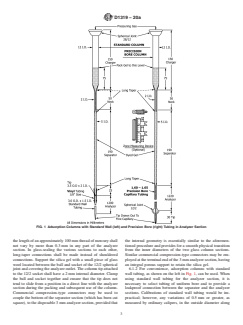
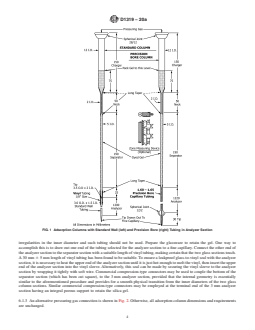
FIG. 1 Adsorption Columns with Standard Wall (left) and Precision Bore (right) Tubing in Analyzer Section
thelengthofanapproximately100 mmthreadofmercuryshall the internal geometry is essentially similar to the aforemen-
not vary by more than 0.3 mm in any part of the analyzer tioned procedure and provides for a smooth physical transition
section. In glass-sealing the various sections to each other, from the inner diameters of the two glass column sections.
long-taper connections shall be made instead of shouldered Similar commercial compression-type connectors may be em-
connections. Support the silica gel with a small piece of glass ployedattheterminalendofthe3 mmanalyzersection,having
wool located between the ball and socket of the 12/2 spherical an integral porous support to retain the silica gel.
joint and covering the analyzer outlet. The column tip attached 6.1.2 For convenience, adsorption columns with standard
to the 12/2 socket shall have a 2 mm internal diameter. Clamp wall tubing, as shown on the left in Fig. 1, can be used. When
the ball and socket together and ensure that the tip does not using standard wall tubing for the analyzer section, it is
tend to slide from a position in a direct line with the analyzer necessary to select tubing of uniform bore and to provide a
section during the packing and subsequent use of the column. leakproof connection between the separator and the analyzer
Commercial compression-type connectors may be used to sections. Calibrations of standard wall tubing would be im-
couple the bottom of the separator section (which has been cut practical; however, any variations of 0.5 mm or greater, as
square), to the disposable 3 mm analyzer section, provided that measured by ordinary calipers, in the outside diameter along
D1319 − 20a
TABLE 1 Tolerance Limits to Column Dimensions
5 mm length of vinyl tubing has been found to be suitable. To
Standard Column Dimensions ensurealeakproofglass-to-vinylsealwiththeanalyzersection,
Charger Section
it is necessary to heat the upper end of the analyzer section
Inside diameter = 12 mm±2mm
untilitisjusthotenoughtomeltthevinyl,theninserttheupper
Pack gel to this level = approximately 75 mm
Overall length = 150 mm±5mm end of the analyzer section into the vinyl sleeve.Alternatively,
Neck Section
this seal can be made by securing the vinyl sleeve to the
Inside diameter = 2 mm ± 0.5 mm
analyzer section by wrapping it tightly with soft wire. Com-
Overall length = 50 mm±5mm
Separator Section
mercial compression-type connectors may be used to couple
Inside diameter = 5 mm ± 0.5 mm
the bottom of the separator section (which has been cut
Overall length = 190 mm±5mm
square), to the 3 mm analyzer section, provided that the
Long taper section below separator
Tip outside diameter = 3.5 mm ± 0.5 mm internal geometry is essentially similar to the aforementioned
Tip inside diameter = 2 mm ± 0.5 mm
procedure and provides for a smooth physical transition from
Overall length = 25 mm±2mm
the inner diameters of the two glass column sections. Similar
Analyzer Section
Inside diameter = 1.5 mm ± 0.5 mm
commercial compression-type connectors may be employed at
Standard wall tubing
the terminal end of the 3 mm analyzer section having an
Overall length = 1200 mm ± 30 mm
integral porous support to retain the silica gel.
Precision Bore Column Dimensions
Charger section
6.1.3 An alternative pressuring gas connection is shown in
Inside diameter = 12 mm±2mm
Fig. 2. Otherwise, all adsorption column dimensions and
Pack gel to this level = approximately 75 mm
requirements are unchanged.
Overall length = 150 mm±5mm
Neck Section
6.2 Zone-Measuring Device—The zones may be marked
Inside diameter = 2 mm ± 0.5 mm
Overall length = 50 mm±5mm
with a glass-writing pencil and the distances measured with a
Separator Section
meter rule, with the analyzer section lying horizontally.
Inside diameter = 5 mm ± 0.5 mm
Alternatively, the meter rule may be fastened adjacent to the
Overall length = 190 mm±5mm
Analyzer Section column. In this case, it is convenient to have each rule fitted
Inside diameter = 1.60 mm -1.65 mm
with four movable metal index clips (Fig. 1) for marking zone
Overall length = 1200 mm ± 30 mm
boundaries and measuring the length of each zone.
Tip
Overall length = 30 mm±5mm
6.3 Ultraviolet Light Source, with radiation predominantly
at 365 nm is required. A convenient arrangement consists of
oneortwo915 mmor1220 mmunitsmountedverticallyalong
the tube can be taken as an indication of irregularities in the
the apparatus. Adjust to give the best fluorescence.
inner diameter and such tubing should not be used. Prepare the
6.4 ElectricVibrator,forvibratingindividualcolumnsorthe
glassware to retain the gel. One way to accomplish this is to
frame supporting multiple columns.
drawoutoneendofthetubingselectedfortheanalyzersection
toafinecapillary.Connecttheotherendoftheanalyzersection 6.5 Hypodermic Syringe, 1 mL, graduated to 0.01 mL or
to the separator section with a suitable length of vinyl tubing, 0.02 mL, with needle 102 mm in length. Needles of No. 18
making certain that the two glass sections touch. A 30 mm 6 gauge, 20 gauge, or 22 gauge are satisfactory.
FIG. 2 Adsorption Column with Typical Threaded Joint Pressur-
ing Gas Connection
D1319 − 20a
6.6 Regulator(s), capable of adjusting and maintaining the 3000000982.
pressure within the 0 kPa to 103 kPa delivery range. Current production of batches of the dyed gel will have lot
numbers starting with 3000000983.
7. Reagents and Materials
7.2.1.1 In 2019, UOP LLC obtained a new supplier for the
missing component of the Fluorescent Indicator Dyed Gel and
7.1 Silica Gel, manufactured to conform to the specifica-
produced a prototype version (Lot # 3000000983) of the dyed
tions shown in Table 2. To be suitable for use, dry the gel in a
gel for evaluation. A performance evaluation (see Appendix
shallowvesselat175 °Cfor3 h.Transferthedriedgeltoanair
X1) to compare multiple batches of original (legacy) dyed gel
tight container while still hot, and protect it thereafter from
to the prototype was conducted and the data indicates that all
atmospheric moisture.
the dyed gels demonstrated similar reproducibility. Biases in
NOTE 2—Some batches of silica gel that otherwise meet specifications
the order of magnitude of repeatability were determined with
have been found to produce olefin boundary fading. The exact reason for
aromatics in spark-ignition engine fuels (gasoline) and with
this phenomenon is unknown but will affect accuracy and precision.
aromatics and olefins in aviation turbine fuel. The calculation
TABLE 2 Silica Gel Specifications
A 2
and reporting sections of the method do not require a bias
Surface area, m /g 430 to 530
B
pH of 5 % water slurry 5.5to7.0 correction. Where appropriate, consult specification and regu-
Loss on ignition at 955 °C, mass percent 4.5 to 10.0
latory organizations on the use of this method.
Iron content as Fe O , dry basis, mass-ppm 50 max
2 3
Particle Size
7.3 Isoamyl Alcohol, (3-methyl-1-butanol) 99 %.
C
Sieve Number µm Mass Percent
(Warning—Flammable. Health hazard.)
on 60 250 0.0 max
on 80 180 1.2 max 7.4 Isopropyl Alcohol, (2-propanol) minimum 99 % purity.
on 100 150 5.0 max
(Warning—Flammable. Health hazard.)
through 200 75 15.0 max
A 7.5 Pressuring Gas—Air (or nitrogen) delivered to the top
Silica gel surface area determined by Test Method D3663.
B
The pH of the silica gel is determined as follows: Calibrate a pH meter with of the column at pressures controllable over the range from
standard pH 4 and pH 7 buffer solutions. Place 5 g of the gel sample in a 250 mL
0 kPa to 103 kPa gauge. (Warning—Compressed gas under
beaker. Add 100 mL of D.I. water and a stirring bar. Stir the slurry on a magnetic
high pressure.)
stirrer for 20 min and then determine the pH with the calibrated meter.
C
Detailed requirements for these sieves are given in Specification E11 and BS
7.6 Acetone, reagent grade, residue free. (Warning—
410–1:2000.
Flammable. Health hazard.)
7.2 Fluorescent Indicator Dyed Gel—A standard dyed gel,
4,5 7.7 Buffer Solutions, pH 4 and 7.
consistingofamixtureofrecrystallizedPetrolRedAB4and
purified portions of the olefin and aromatic dyes obtained by
8. Sampling
chromatographic adsorption, following a definite, uniform
8.1 Obtain a representative sample in accordance with
procedure, and deposited on silica gel. The dyed gel shall be
sampling procedures in Practice D4057. For samples that
stored in a dark place under an atmosphere of nitrogen. When
would meet volatility conditions of Group 2 or less of Test
storedundertheseconditions,thedyedgelcanhaveashelflife
Method D86, ensure that the sample is maintained at a
of at least five years. It is recommended that portions of the
temperature of≤4 °C when opening or transferring the sample.
dyed gel be transferred as required to a smaller working vial
(Warning—Flammable. Health hazard.)
from which the dyed gel is routinely taken for analyses.
7.2.1 Early in 2018, a key component of the Fluorescent
9. Preparation of Apparatus
Indicator Dyed Gel became unavailable. An alternative dye
9.1 Mount the apparatus assembly in a darkened room or
was substituted, but the reformulated dyed gel was later found
area to facilitate observation of zone boundaries. For multiple
to be unsuitable for the analysis of aviation turbine fuel, diesel
determinations, assemble an apparatus that includes the ultra-
fuel, and gasoline samples (spark-ignition engine fuels). Al-
violet light source, a rack to hold the columns, and a gas
thoughUOPLLC,thelistedsolesourcesupplyofthedyedgel,
manifold system providing a connection to the desired number
suspended manufacture and sale of the Fluorescent Indicator
of columns.
Dyed Gel upon learning of this issue, six lots of the reformu-
lated dyed gel had already been distributed and two lots were
10. Procedure
not made commercially available. In analyzing any sample
type by Test Method D1319, users shall not report results
10.1 Ensure that the silica gel is tightly packed in the
obtained using any of the following lot numbers of Fluorescent
columnandchargersection(uptotheappropriatelevel),which
Indicator Dyed Gel: 3000000975, 3000000976, 3000000977,
includes the appropriate amount of dyed gel (3 mm to 5 mm)
3000000978, 3000000979, 3000000980, 3000000981, and
added to an approximately half-full separator section, prior to
the start of the sample analysis. See Note 3 for specific
guidance.
If you are aware of alternative suppliers, please provide this information to
NOTE 3—One way to prepare the column for analysis is to freely
ASTM International Headquarters. Your comments will receive careful consider-
suspend the column from a loose-fitting clamp placed immediately below
ation at a meeting of the responsible technical committee, which you may attend.
the pressuring gas connection of the charger section. While vibrating the
The sole source of supply of the standard dyed gel known to the committee at
column along its entire length, add small increments of silica gel through
this time is produced by UOP LLC, and distributed by Advanced Specialty Gas
Equipment Inc, 241 Lackland Drive, Middlesex, New Jersey 08846. Request “FIA a glass funnel into the charger section until the separator section is half
Standard Dyed Gel,” UOP LLC Product No. 80675. full. Stop the vibrator and add a 3 mm to 5 mm layer of dyed gel. Start the
D1319 − 20a
vibrator and vibrate the column while adding additional silica gel.
Continue to add silica gel until the tightly packed gel extends approxi-
mately 75 mm into the charger section. Wipe the length of the column
with a damp cloth while vibrating the column. This aids in packing the
column by removing static electricity. Vibrate the column after filling is
completed for at least 4 min. More than one column can be prepared
simultaneously by mounting several on a frame or rack to which an
electric vibrator is attached.
10.2 Attach the filled column to the apparatus assembly in
the darkened room or area, and when a permanently mounted
meter rule is used, fasten the lower end of the column to the
fixed rule.
10.3 For samples that would meet
...
This document is not an ASTM standard and is intended only to provide the user of an ASTM standard an indication of what changes have been made to the previous version. Because
it may not be technically possible to adequately depict all changes accurately, ASTM recommends that users consult prior editions as appropriate. In all cases only the current version
of the standard as published by ASTM is to be considered the official document.
Designation: D1319 − 20 D1319 − 20a
Standard Test Method for
Hydrocarbon Types in Liquid Petroleum Products by
Fluorescent Indicator Adsorption
This standard is issued under the fixed designation D1319; the number immediately following the designation indicates the year of
original adoption or, in the case of revision, the year of last revision. A number in parentheses indicates the year of last reapproval. A
superscript epsilon (´) indicates an editorial change since the last revision or reapproval.
This standard has been approved for use by agencies of the U.S. Department of Defense.
1. Scope*
1.1 This test method covers the determination of hydrocarbon types of total aromatics, total olefins, and total saturates in
petroleum fractions that distill below 315 °C. Samples containing dark-colored components that interfere in reading the
chromatographic bands cannot be analyzed.
NOTE 1—For the determination of olefins below 0.3 % by volume, other test methods are available, such as Test Method D2710.
1.2 This test method is intended for use with full boiling range products. Cooperative data have established that the precision
statement does not apply to narrow boiling petroleum fractions near the 315 °C limit. Such samples are not eluted properly, and
results are erratic.
1.3 This test method is also applicable to automotive spark-ignition engine fuels which are gasolines with and without blended
oxygenates, such as alcohols and ethers (for example MTBE, ethanol) and where gasoline is the primary component by volume
in the blend.
1.4 The applicability of this test method to products derived from fossil fuels other than petroleum, such as coal, shale, or tar sands,
has not been determined, and the precision statement may or may not apply to such products.
1.5 This test method has two precision statements depicted in Table 3 and Table 4.
1.5.1 Table 3 is applicable to fuels that do not contain oxygenated blending components over the test method concentration
working ranges from 5 % to 99 % by volume aromatics, 1 % to 55 % by volume olefins, and 1 % to 95 % by volume saturates
in petroleum fractions and with a final boiling point of <315 °C. It may or may not apply to automotive gasolines containing lead
antiknock mixtures.
1.5.2 Table 4 precision was derived from an ILS containing only blended oxygenated (for example, MTBE, ethanol) and
non-oxygenated automotive spark-ignition engine fuels (gasolines) and is applicable only in the test method concentration working
range of 13 % to 40 % by volume aromatics, 4 % to 33 % by volume olefins, and 45 % to 68 % by volume saturates.
1.5.3 Non-oxygenated automotive spark-ignition engine fuels (gasolines) outside the inclusive valid test result reporting
concentration ranges of Table 4 may use the precision in Table 3 and its applicable concentration ranges.
This test method is under the jurisdiction of ASTM Committee D02 on Petroleum Products, Liquid Fuels, and Lubricants and is the direct responsibility of Subcommittee
D02.04.0C on Liquid Chromatography.
Current edition approved July 15, 2020Aug. 1, 2020. Published September 2020. Originally approved in 1954. Last previous edition approved in 20192020 as
D1319 – 19.D1319 – 20. DOI: 10.1520/D1319-20.10.1520/D1319-20A.
*A Summary of Changes section appears at the end of this standard
Copyright © ASTM International, 100 Barr Harbor Drive, PO Box C700, West Conshohocken, PA 19428-2959. United States
D1319 − 20a
1.6 The oxygenated blending components, methanol, ethanol, methyl-tert-butylether (MTBE), tert-amylmethylether (TAME), and
ethyl-tert-butylether (ETBE), do not interfere with the determination of hydrocarbon types at concentrations normally found in
commercial blends. These oxygenated components are not detected since they elute with the alcohol desorbent. Other oxygenated
compounds shall be individually verified. When samples containing oxygenated blending components are analyzed, correct the
results to a total-sample basis.
1.7 This test method includes a relative bias section based on Practice D6708 accuracy assessment between Test Method D1319
and Test Method D5769 for total aromatics in spark-ignition engine fuels as a possible Test Method D1319 alternative to Test
Method D5769 for U.S. EPA spark-ignition engine fuel regulations reporting. The Practice D6708 derived correlation equation is
only applicable for fuels in the total aromatic concentration range from 3.3 % to 34.4 % by volume as measured by Test Method
D1319 and the distillation temperature T , at which 95 % of the sample has evaporated, ranges from 149.1 °C to 196.6 °C
(300.3 °F to 385.8 °F) when tested according to Test Method D86.
1.7.1 The applicable Test Method D5769 range for total aromatics is 3.7 % to 29.4 % by volume as reported by Test Method
D5769 and the distillation temperature T values, at which 95 % of the sample has evaporated, when tested according to Test
Method D86 is from 149.1 °C to 196.6 °C (300.3 °F to 385.8 °F).
1.7.2 Regulations may change over time and the user is advised to verify current regulatory requirements.
1.8 WARNING—Mercury has been designated by many regulatory agencies as a hazardous substance that can cause serious
medical issues. Mercury, or its vapor, has been demonstrated to be hazardous to health and corrosive to materials. Use caution
when handling mercury and mercury-containing products. See the applicable product Safety Data Sheet (SDS) for additional
information. The potential exists that selling mercury or mercury-containing products, or both, is prohibited by local or national
law. Users must determine legality of sales in their location.
1.9 The values stated in SI units are to be regarded as standard. The values given in parentheses after SI units are provided for
information only and are not considered standard.
1.10 This standard does not purport to address all of the safety concerns, if any, associated with its use. It is the responsibility
of the user of this standard to establish appropriate safety, health, and environmental practices and determine the applicability of
regulatory limitations prior to use. For specific warning statements, see Section 7, 8.1, and 10.5.
1.11 This international standard was developed in accordance with internationally recognized principles on standardization
established in the Decision on Principles for the Development of International Standards, Guides and Recommendations issued
by the World Trade Organization Technical Barriers to Trade (TBT) Committee.
2. Referenced Documents
2.1 ASTM Standards:
D86 Test Method for Distillation of Petroleum Products and Liquid Fuels at Atmospheric Pressure
D1655 Specification for Aviation Turbine Fuels
D2710 Test Method for Bromine Index of Petroleum Hydrocarbons by Electrometric Titration
D3663 Test Method for Surface Area of Catalysts and Catalyst Carriers
D4057 Practice for Manual Sampling of Petroleum and Petroleum Products
D4815 Test Method for Determination of MTBE, ETBE, TAME, DIPE, tertiary-Amyl Alcohol and C to C Alcohols in
1 4
Gasoline by Gas Chromatography
D5599 Test Method for Determination of Oxygenates in Gasoline by Gas Chromatography and Oxygen Selective Flame
Ionization Detection
D5769 Test Method for Determination of Benzene, Toluene, and Total Aromatics in Finished Gasolines by Gas
Chromatography/Mass Spectrometry
D6300 Practice for Determination of Precision and Bias Data for Use in Test Methods for Petroleum Products, Liquid Fuels, and
Lubricants
D6708 Practice for Statistical Assessment and Improvement of Expected Agreement Between Two Test Methods that Purport
to Measure the Same Property of a Material
E11 Specification for Woven Wire Test Sieve Cloth and Test Sieves
For referenced ASTM standards, visit the ASTM website, www.astm.org, or contact ASTM Customer Service at service@astm.org. For Annual Book of ASTM Standards
volume information, refer to the standard’s Document Summary page on the ASTM website.
D1319 − 20a
2.2 Other Standards:
BS 410–1:2000 Test sieves. Technical requirements and testing. Test sieves of metal wire cloth
3. Terminology
3.1 Definitions of Terms Specific to This Standard:
3.1.1 aromatics, n—the volume percent of monocyclic and polycyclic aromatics, plus aromatic olefins, some dienes, compounds
containing sulfur and nitrogen, or higher boiling oxygenated compounds (excluding those listed in 1.6).
3.1.2 gasoline, n—a volatile mixture of liquid hydrocarbons, generally containing small amounts of additives, suitable for use as
a fuel in spark-ignition, internal combustion engines.
3.1.3 olefins, n—the volume percent of alkenes, plus cycloalkenes, and some dienes.
3.1.4 saturates, n—the volume percent of alkanes, plus cycloalkanes.
4. Summary of Test Method
4.1 Approximately 0.75 mL of sample is introduced into a special glass adsorption column packed with activated silica gel. A
small layer of the silica gel contains a mixture of fluorescent dyes. When all the sample has been adsorbed on the gel, alcohol is
added to desorb the sample down the column. The hydrocarbons are separated in accordance with their adsorption affinities into
aromatics, olefins, and saturates. The fluorescent dyes are also separated selectively, with the hydrocarbon types, and make the
boundaries of the aromatic, olefin, and saturate zones visible under ultraviolet light. The volume percentage of each hydrocarbon
type is calculated from the length of each zone in the column.
5. Significance and Use
5.1 The determination of the total volume percent of saturates, olefins, and aromatics in petroleum fractions is important in
characterizing the quality of petroleum fractions as gasoline blending components and as feeds to catalytic reforming processes.
This information is also important in characterizing petroleum fractions and products from catalytic reforming and from thermal
and catalytic cracking as blending components for motor and aviation fuels. This information is also important as a measure of
the quality of fuels, such as specified in Specification D1655.
6. Apparatus
6.1 Adsorption Columns, with precision bore (“true bore” IP designation) tubing, as shown on the right in Fig. 1, made of glass
and consisting of a charger section with a capillary neck, a separator section, and an analyzer section; or with standard wall tubing,
as shown on the left in Fig. 1. Refer to Table 1 for column tolerance limits.
6.1.1 The inner diameter of the analyzer section for the precision bore tubing shall be 1.60 mm to 1.65 mm. In addition the length
of an approximately 100 mm thread of mercury shall not vary by more than 0.3 mm in any part of the analyzer section. In
glass-sealing the various sections to each other, long-taper connections shall be made instead of shouldered connections. Support
the silica gel with a small piece of glass wool located between the ball and socket of the 12/2 spherical joint and covering the
analyzer outlet. The column tip attached to the 12/2 socket shall have a 2 mm internal diameter. Clamp the ball and socket together
and ensure that the tip does not tend to slide from a position in a direct line with the analyzer section during the packing and
subsequent use of the column. Commercial compression-type connectors may be used to couple the bottom of the separator section
(which has been cut square), to the disposable 3 mm analyzer section, provided that the internal geometry is essentially similar to
the aforementioned procedure and provides for a smooth physical transition from the inner diameters of the two glass column
sections. Similar commercial compression-type connectors may be employed at the terminal end of the 3 mm analyzer section,
having an integral porous support to retain the silica gel.
6.1.2 For convenience, adsorption columns with standard wall tubing, as shown on the left in Fig. 1, can be used. When using
standard wall tubing for the analyzer section, it is necessary to select tubing of uniform bore and to provide a leakproof connection
between the separator and the analyzer sections. Calibrations of standard wall tubing would be impractical; however, any variations
of 0.5 mm or greater, as measured by ordinary calipers, in the outside diameter along the tube can be taken as an indication of
Available from British Standards Institution (BSI), 389 Chiswick High Rd., London W4 4AL, U.K., http://www.bsigroup.com.
D1319 − 20a
FIG. 1 Adsorption Columns with Standard Wall (left) and Precision Bore (right) Tubing in Analyzer Section
irregularities in the inner diameter and such tubing should not be used. Prepare the glassware to retain the gel. One way to
accomplish this is to draw out one end of the tubing selected for the analyzer section to a fine capillary. Connect the other end of
the analyzer section to the separator section with a suitable length of vinyl tubing, making certain that the two glass sections touch.
A 30 mm 6 5 mm length of vinyl tubing has been found to be suitable. To ensure a leakproof glass-to-vinyl seal with the analyzer
section, it is necessary to heat the upper end of the analyzer section until it is just hot enough to melt the vinyl, then insert the upper
end of the analyzer section into the vinyl sleeve. Alternatively, this seal can be made by securing the vinyl sleeve to the analyzer
section by wrapping it tightly with soft wire. Commercial compression-type connectors may be used to couple the bottom of the
separator section (which has been cut square), to the 3 mm analyzer section, provided that the internal geometry is essentially
similar to the aforementioned procedure and provides for a smooth physical transition from the inner diameters of the two glass
column sections. Similar commercial compression-type connectors may be employed at the terminal end of the 3 mm analyzer
section having an integral porous support to retain the silica gel.
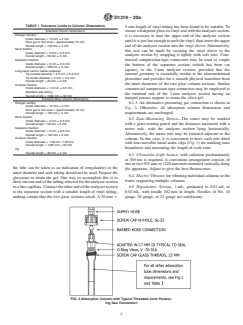
6.1.3 An alternative pressuring gas connection is shown in Fig. 2. Otherwise, all adsorption column dimensions and requirements
are unchanged.
D1319 − 20a
TABLE 1 Tolerance Limits to Column Dimensions
Standard Column Dimensions
Charger Section
Inside diameter = 12 mm ± 2 mm
Pack gel to this level = approximately 75 mm
Overall length = 150 mm ± 5 mm
Neck Section
Inside diameter = 2 mm ± 0.5 mm
Overall length = 50 mm ± 5 mm
Separator Section
Inside diameter = 5 mm ± 0.5 mm
Overall length = 190 mm ± 5 mm
Long taper section below separator
Tip outside diameter = 3.5 mm ± 0.5 mm
Tip inside diameter = 2 mm ± 0.5 mm
Overall length = 25 mm ± 2 mm
Analyzer Section
Inside diameter = 1. mm5 ± 0.5 mm
Inside diameter = 1.5 mm ± 0.5 mm
Standard wall tubing
Overall length = 1200 mm ± 30 mm
Precision Bore Column Dimensions
Charger section
Inside diameter = 12 mm ± 2 mm
Pack gel to this level = approximately 75 mm
Overall length = 150 mm ± 5 mm
Neck Section
Inside diameter = 2 mm ± 0.5 mm
Overall length = 50 mm ± 5 mm
Separator Section
Inside diameter = 5 mm ± 0.5 mm
Overall length = 190 mm ± 5 mm
Analyzer Section
Inside diameter = 1.60 mm -1.65 mm
Overall length = 1200 mm ± 30 mm
Tip
Overall length = 30 mm ± 5 mm
6.2 Zone-Measuring Device—The zones may be marked with a glass-writing pencil and the distances measured with a meter rule,
with the analyzer section lying horizontally. Alternatively, the meter rule may be fastened adjacent to the column. In this case, it
is convenient to have each rule fitted with four movable metal index clips (Fig. 1) for marking zone boundaries and measuring the
length of each zone.
6.3 Ultraviolet Light Source, with radiation predominantly at 365 nm is required. A convenient arrangement consists of one or two
915 mm or 1220 mm units mounted vertically along the apparatus. Adjust to give the best fluorescence.
6.4 Electric Vibrator, for vibrating individual columns or the frame supporting multiple columns.
6.5 Hypodermic Syringe, 1 mL, graduated to 0.01 mL or 0.02 mL, with needle 102 mm in length. Needles of No. 18 gauge, 20
gauge, or 22 gauge are satisfactory.
6.6 Regulator(s), capable of adjusting and maintaining the pressure within the 0 kPa to 103 kPa delivery range.
7. Reagents and Materials
7.1 Silica Gel, manufactured manufactured to conform to the specifications shown in Table 2. To be suitable for use, dry the gel
in a shallow vessel at 175 °C for 3 h. Transfer the dried gel to an air tight container while still hot, and protect it thereafter from
atmospheric moisture.
NOTE 2—Some batches of silica gel that otherwise meet specifications have been found to produce olefin boundary fading. The exact reason for this
If you are aware of alternative suppliers, please provide this information to ASTM International Headquarters. Your comments will receive careful consideration at a
meeting of the responsible technical committee, which you may attend.
D1319 − 20a
FIG. 2 Adsorption Column with Typical Threaded Joint Pressur-
ing Gas Connection
phenomenon is unknown but will affect accuracy and precision.
TABLE 2 Silica Gel Specifications
A 2
Surface area, m /g 430 to 530
B
pH of 5 % water slurry 5.5 to 7.0
Loss on ignition at 955 °C, mass percent 4.5 to 10.0
Iron content as Fe O , dry basis, mass-ppm 50 max
2 3
Particle Size
C
Sieve Number μm Mass Percent
on 60 250 0.0 max
on 80 180 1.2 max
on 100 150 5.0 max
through 200 75 15.0 max
A
Silica gel surface area determined by Test Method D3663.
B
The pH of the silica gel is determined as follows: Calibrate a pH meter with standard pH 4 and pH 7 buffer solutions. Place 5 g of the gel sample in a 250 mL beaker.
Add 100 mL of D.I. water and a stirring bar. Stir the slurry on a magnetic stirrer for 20 min and then determine the pH with the calibrated meter.
C
Detailed requirements for these sieves are given in Specification E11 and BS 410–1:2000.
4,5
7.2 Fluorescent Indicator Dyed Gel—A standard dyed gel, consisting of a mixture of recrystallized Petrol Red AB4 and purified
portions of the olefin and aromatic dyes obtained by chromatographic adsorption, following a definite, uniform procedure, and
deposited on silica gel. The dyed gel shall be stored in a dark place under an atmosphere of nitrogen. When stored under these
conditions, the dyed gel can have a shelf life of at least five years. It is recommended that portions of the dyed gel be transferred
as required to a smaller working vial from which the dyed gel is routinely taken for analyses.
7.2.1 Early in 2018, a key component of the Fluorescent Indicator Dyed Gel became unavailable. An alternative dye was
substituted, but the reformulated dyed gel was later found to be unsuitable for the analysis of jet aviation turbine fuel, diesel fuel,
and gasoline samples. samples (spark-ignition engine fuels). Although UOP LLC, the listed sole source supply of the dyed gel,
suspended manufacture and sale of the Fluorescent Indicator Dyed Gel upon learning of this issue, six lots of the reformulated dyed
gel had already been distributed. distributed and two lots were not made commercially available. In analyzing any sample type by
Test Method D1319, users shall not report results obtained using any of the following lot numbers of Fluorescent Indicator Dyed
Gel: 3000000975, 3000000976, 3000000977, 3000000978, 3000000979, 3000000980, 3000000981, and
3000000980.3000000982.
Current production of batches of the dyed gel will have lot numbers starting with 3000000983.
7.2.1.1 In 2019, UOP LLC obtained a new supplier for the missing component of the Fluorescent Indicator Dyed Gel and
produced a prototype version (Lot # 3000000983) of the dyed gel for evaluation. A performance evaluation (see Appendix X1)
The sole source of supply of the standard dyed gel known to the committee at this time is produced by UOP LLC, and distributed by Advanced Specialty Gas Equipment
Inc, 241 Lackland Drive, Middlesex, New Jersey 08846. Request “FIA Standard Dyed Gel,” UOP LLC Product No. 80675.
D1319 − 20a
to compare multiple batches of original (legacy) dyed gel to the prototype was conducted and the data indicates that all the dyed
gels demonstrated similar reproducibility. Biases in the order of magnitude of repeatability were determined with aromatics in
spark-ignition engine fuels (gasoline) and with aromatics and olefins in aviation turbine fuel. The calculation and reporting sections
of the method do not require a bias correction. Where appropriate, consult specification and regulatory organizations on the use
of this method.
7.3 Isoamyl Alcohol, (3-methyl-1-butanol) 99 %. (Warning—Flammable. Health hazard.)
7.4 Isopropyl Alcohol, (2-propanol) minimum 99 % purity. (Warning—Flammable. Health hazard.)
7.5 Pressuring Gas—Air (or nitrogen) delivered to the top of the column at pressures controllable over the range from 0 kPa to
103 kPa gauge. (Warning—Compressed gas under high pressure.)
7.6 Acetone, reagent grade, residue free. (Warning—Flammable. Health hazard.)
7.7 Buffer Solutions, pH 4 and 7.
8. Sampling
8.1 Obtain a representative sample in accordance with sampling procedures in Practice D4057. For samples that would meet
volatility conditions of Group 2 or less of Test Method D86, ensure that the sample is maintained at a temperature of ≤4°C≤4 °C
when opening or transferring the sample. (Warning—Flammable. Health hazard.)
9. Preparation of Apparatus
9.1 Mount the apparatus assembly in a darkened room or area to facilitate observation of zone boundaries. For multiple
determinations, assemble an apparatus that includes the ultraviolet light source, a rack to hold the columns, and a gas manifold
system providing a connection to the desired number of columns.
10. Procedure
10.1 Ensure that the silica gel is tightly packed in the column and charger section (up to the appropriate level), which includes
the appropriate amount of dyed gel (3 mm to 5 mm) added to an approximately half-full separator section, prior to the start of the
sample analysis. See Note 3 for specific guidance.
NOTE 3—One way to prepare the column for analysis is to freely suspend the column from a loose-fitting clamp placed immediately below the pressuring
gas connection of the charger section. While vibrating the column along its entire length, add small increments of silica gel through a glass funnel into
the charger section until the separator section is half full. Stop the vibrator and add a 3 mm to 5 mm layer of dyed gel. Start the vibrator and vibrate the
column while adding additional silica gel. Continue to add silica gel until the tightly packed gel extends approximately 75 mm into the charger section.
Wipe the length of the column with a damp cloth while vibrating the column. This aids in packing the column by removing static electricity. Vibrate the
column after filling is completed for at least 4 min. More than one column can be prepared simultaneously by mounting several on a frame or rack to
which an electric vibrator is attached.
10.1.1 Early in 2018, a key component of the Fluorescent Indicator Dyed Gel became unavailable. An alternative dye was
substituted, but the reformulated dyed gel was later found to be unsuitable for the analysis of jet fuel, diesel fuel, and gasoline
samples. Although UOP LLC, the listed sole source supply of the dyed gel, suspended manufacture and sale of the Fluorescent
Indicator Dyed Gel upon learning of this issue, six lots of the reformulated dyed gel had already been distributed. In analyzing
any sample type by Test Method D1319, users shall not report results obtained using any of the following lot numbers of
Fluorescent Indicator Dyed Gel: 3000000975, 3000000976, 3000000977, 3000000978, 3000000979, and 3000000980.
10.2 Attach the filled column to the apparatus assembly in the darkened room or area, and when a permanently mounted meter
rule is used, fasten the lower end of the column to the fixed rule.
10.3 For samples that would meet volatility con
...