

ASTM D7008-08(2022)
(Specification)Standard Specification for Geosynthetic Alternate Daily Covers
General Information
- Abstract
ABSTRACT
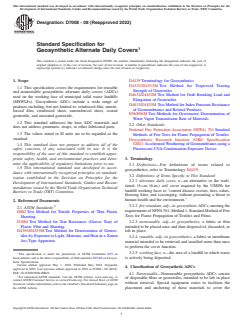
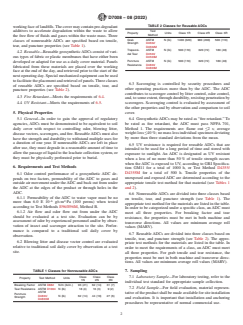
This specification covers the requirements for reusable and nonreusable geosynthetic alternate daily covers (ADCs) used on the working face of municipal solid waste landfills (MSWLF). Geosynthetic ADCs include a wide range of products including, but not limited to, reinforced film, unreinforced film, reinforced sheet, unreinforced sheet, coated geotextile and uncoated geotextile. Geosynthetic ADC are classified as nonreusable geosynthetic ADC, and reusable geosynthetic ADC. The breaking factor, tear resistance, and puncture strength of the nonreusable ADC shall be tested to meet the requirements prescribed. The grab strength, trapezoidal tear, and puncture resistance of the reusable ADC shall be tested to meet the requirements prescribed.
SCOPE
1.1 This specification covers the requirements for reusable and nonreusable geosynthetic alternate daily covers (ADCs) used on the working face of municipal solid waste landfills (MSWLFs). Geosynthetic ADCs include a wide range of products including, but not limited to: reinforced film, unreinforced film, reinforced sheet, unreinforced sheet, coated geotextile, and uncoated geotextile.
1.2 This standard addresses the base ADC materials and does not address grommets, straps, or other fabricated parts.
1.3 The values stated in SI units are to be regarded as the standard.
1.4 This standard does not purport to address all of the safety concerns, if any, associated with its use. It is the responsibility of the user of this standard to establish appropriate safety, health, and environmental practices and determine the applicability of regulatory limitations prior to use.
1.5 This international standard was developed in accordance with internationally recognized principles on standardization established in the Decision on Principles for the Development of International Standards, Guides and Recommendations issued by the World Trade Organization Technical Barriers to Trade (TBT) Committee.
- Status
- Published
- Publication Date
- 30-Apr-2022
- Technical Committee
- D35 - Geosynthetics
- Drafting Committee
- D35.06 - Geosynthetic Specifications


Overview
ASTM D7008-08(2022) is the internationally recognized standard specification for geosynthetic alternate daily covers (ADCs) used on the working face of municipal solid waste landfills (MSWLFs). Developed by ASTM International, this standard outlines the requirements for both reusable and nonreusable geosynthetic ADCs, such as reinforced and unreinforced films and sheets, as well as coated and uncoated geotextiles. The primary function of these covers is to provide an alternative to traditional soil daily covers, effectively controlling odor, litter, disease vectors, scavenging, fire hazards, and environmental risks at landfill sites.
Key Topics
- Types of Geosynthetic ADCs
- Nonreusable ADCs: Disposable materials, such as films and geotextiles, intended to be left in place and degrade or be perforated after use.
- Reusable ADCs: Durable panels or membranes that are retrieved and reused multiple times, providing long-term performance.
- Performance Requirements
- Physical Properties: Covers must meet strict requirements for tensile strength, tear resistance, and puncture strength.
- Odor & Vector Control: ADCs should match or surpass traditional soil in controlling odors, litter, disease vectors, and scavenging, ensuring environmental and public health protection.
- Fire Retardance: Geosynthetic ADCs can be classified as fire retardant if they pass standards like NFPA 701.
- UV Resistance: Required for reusable ADCs exposed to sunlight for extended periods.
- Testing & Classification
- Nonreusable and reusable ADCs are divided into classes based on their measured performance properties.
- Tests referenced include ASTM D882, D4632, D1004, D4833, D4355, and others for assessing material integrity and functional performance.
Applications
- Landfill Operations
ASTM D7008-compliant geosynthetic ADCs are primarily used at the working face of municipal solid waste landfills. They serve as an alternative to the traditional 15-cm (6-in.) soil daily cover, offering practical advantages and efficient waste management. - Environmental Protection
The use of geosynthetic ADCs helps landfill operators:- Control blowing litter and odor
- Reduce disease vector breeding
- Minimize scavenging activity
- Manage fire risks and environmental impact
- Operational Efficiency & Cost Savings
- Reusable ADCs lower material and labor costs over time by enabling repeated use of covers.
- Nonreusable ADCs facilitate efficient daily application and may include pro-degradant additives for fast integration into waste mass.
Related Standards
Users of ASTM D7008 should be aware of the following relevant standards and methods:
- ASTM D4439 - Terminology for Geosynthetics
- ASTM D882 - Tensile Properties of Thin Plastic Sheeting
- ASTM D1004 - Tear Resistance of Plastic Film and Sheeting
- ASTM D4632/D4632M - Grab Breaking Load/Elongation of Geotextiles
- ASTM D4533/D4533M - Trapezoidal Tear Strength of Geotextiles
- ASTM D4833/D4833M - Index Puncture Resistance of Geomembranes
- ASTM D4355/D4355M - Deterioration of Geotextiles by Light, Moisture, and Heat
- ASTM E96/E96M - Water Vapor Transmission of Materials
- NFPA 701 - Fire Propagation Tests for Textiles and Films
- GRI GM11 - Accelerated Weathering Test for Geomembranes
Practical Value
By conforming to ASTM D7008-08(2022), landfill operators and engineers ensure that geosynthetic ADCs provide performance and durability equivalent to or better than traditional soil covers. Compliance facilitates regulatory approval, supports environmental protection, enhances operational efficiency, and helps maintain safe landfill conditions. The standard is an essential reference for manufacturers, landfill managers, and regulatory agencies involved in waste management and geosynthetic product evaluation.
Relations
- Effective Date
- 01-Mar-2024
- Effective Date
- 01-Feb-2024
- Effective Date
- 15-Nov-2023
- Effective Date
- 01-Jun-2020
- Effective Date
- 15-Apr-2018
- Effective Date
- 01-Aug-2017
- Effective Date
- 01-Sep-2015
- Effective Date
- 01-Jul-2015
- Effective Date
- 01-May-2015
- Refers
ASTM D4632/D4632M-15 - Standard Test Method for Grab Breaking Load and Elongation of Geotextiles - Effective Date
- 01-Jan-2015
- Effective Date
- 15-Oct-2014
- Effective Date
- 15-Jul-2014
- Effective Date
- 01-Mar-2014
- Effective Date
- 01-Nov-2013
- Effective Date
- 01-May-2013
Get Certified
Connect with accredited certification bodies for this standard

Control Union Certifications
Global certification for agriculture and sustainability.

Hohenstein Institut
Textile testing and certification.

Bureau Veritas Bangladesh
Bureau Veritas certification services in Bangladesh.
Sponsored listings
Frequently Asked Questions
ASTM D7008-08(2022) is a technical specification published by ASTM International. Its full title is "Standard Specification for Geosynthetic Alternate Daily Covers". This standard covers: ABSTRACT This specification covers the requirements for reusable and nonreusable geosynthetic alternate daily covers (ADCs) used on the working face of municipal solid waste landfills (MSWLF). Geosynthetic ADCs include a wide range of products including, but not limited to, reinforced film, unreinforced film, reinforced sheet, unreinforced sheet, coated geotextile and uncoated geotextile. Geosynthetic ADC are classified as nonreusable geosynthetic ADC, and reusable geosynthetic ADC. The breaking factor, tear resistance, and puncture strength of the nonreusable ADC shall be tested to meet the requirements prescribed. The grab strength, trapezoidal tear, and puncture resistance of the reusable ADC shall be tested to meet the requirements prescribed. SCOPE 1.1 This specification covers the requirements for reusable and nonreusable geosynthetic alternate daily covers (ADCs) used on the working face of municipal solid waste landfills (MSWLFs). Geosynthetic ADCs include a wide range of products including, but not limited to: reinforced film, unreinforced film, reinforced sheet, unreinforced sheet, coated geotextile, and uncoated geotextile. 1.2 This standard addresses the base ADC materials and does not address grommets, straps, or other fabricated parts. 1.3 The values stated in SI units are to be regarded as the standard. 1.4 This standard does not purport to address all of the safety concerns, if any, associated with its use. It is the responsibility of the user of this standard to establish appropriate safety, health, and environmental practices and determine the applicability of regulatory limitations prior to use. 1.5 This international standard was developed in accordance with internationally recognized principles on standardization established in the Decision on Principles for the Development of International Standards, Guides and Recommendations issued by the World Trade Organization Technical Barriers to Trade (TBT) Committee.
ABSTRACT This specification covers the requirements for reusable and nonreusable geosynthetic alternate daily covers (ADCs) used on the working face of municipal solid waste landfills (MSWLF). Geosynthetic ADCs include a wide range of products including, but not limited to, reinforced film, unreinforced film, reinforced sheet, unreinforced sheet, coated geotextile and uncoated geotextile. Geosynthetic ADC are classified as nonreusable geosynthetic ADC, and reusable geosynthetic ADC. The breaking factor, tear resistance, and puncture strength of the nonreusable ADC shall be tested to meet the requirements prescribed. The grab strength, trapezoidal tear, and puncture resistance of the reusable ADC shall be tested to meet the requirements prescribed. SCOPE 1.1 This specification covers the requirements for reusable and nonreusable geosynthetic alternate daily covers (ADCs) used on the working face of municipal solid waste landfills (MSWLFs). Geosynthetic ADCs include a wide range of products including, but not limited to: reinforced film, unreinforced film, reinforced sheet, unreinforced sheet, coated geotextile, and uncoated geotextile. 1.2 This standard addresses the base ADC materials and does not address grommets, straps, or other fabricated parts. 1.3 The values stated in SI units are to be regarded as the standard. 1.4 This standard does not purport to address all of the safety concerns, if any, associated with its use. It is the responsibility of the user of this standard to establish appropriate safety, health, and environmental practices and determine the applicability of regulatory limitations prior to use. 1.5 This international standard was developed in accordance with internationally recognized principles on standardization established in the Decision on Principles for the Development of International Standards, Guides and Recommendations issued by the World Trade Organization Technical Barriers to Trade (TBT) Committee.
ASTM D7008-08(2022) is classified under the following ICS (International Classification for Standards) categories: 59.080.70 - Geotextiles. The ICS classification helps identify the subject area and facilitates finding related standards.
ASTM D7008-08(2022) has the following relationships with other standards: It is inter standard links to ASTM E96/E96M-24, ASTM D4439-24, ASTM E96/E96M-23, ASTM D4833/D4833M-07(2020), ASTM D4439-18, ASTM D4439-17, ASTM D4439-15a, ASTM D4439-15, ASTM E96/E96M-15, ASTM D4632/D4632M-15, ASTM E96/E96M-14, ASTM D4355/D4355M-14, ASTM D4439-14, ASTM E96/E96M-13, ASTM D4632/D4632M-08(2013)e2. Understanding these relationships helps ensure you are using the most current and applicable version of the standard.
ASTM D7008-08(2022) is available in PDF format for immediate download after purchase. The document can be added to your cart and obtained through the secure checkout process. Digital delivery ensures instant access to the complete standard document.
Standards Content (Sample)
This international standard was developed in accordance with internationally recognized principles on standardization established in the Decision on Principles for the
Development of International Standards, Guides and Recommendations issued by the World Trade Organization Technical Barriers to Trade (TBT) Committee.
Designation: D7008 −08 (Reapproved 2022)
Standard Specification for
Geosynthetic Alternate Daily Covers
This standard is issued under the fixed designation D7008; the number immediately following the designation indicates the year of
original adoption or, in the case of revision, the year of last revision. A number in parentheses indicates the year of last reapproval. A
superscript epsilon (´) indicates an editorial change since the last revision or reapproval.
1. Scope D4439 Terminology for Geosynthetics
D4533/D4533M Test Method for Trapezoid Tearing
1.1 This specification covers the requirements for reusable
Strength of Geotextiles
and nonreusable geosynthetic alternate daily covers (ADCs)
D4632/D4632M Test Method for Grab Breaking Load and
used on the working face of municipal solid waste landfills
Elongation of Geotextiles
(MSWLFs). Geosynthetic ADCs include a wide range of
D4833/D4833M Test Method for Index Puncture Resistance
products including, but not limited to: reinforced film, unrein-
of Geomembranes and Related Products
forced film, reinforced sheet, unreinforced sheet, coated
E96/E96M Test Methods for Gravimetric Determination of
geotextile, and uncoated geotextile.
Water Vapor Transmission Rate of Materials
1.2 This standard addresses the base ADC materials and
2.2 Other Standards:
does not address grommets, straps, or other fabricated parts.
National Fire Protection Association (NFPA) 701 Standard
1.3 The values stated in SI units are to be regarded as the
Methods of Fire Tests for Flame Propagation of Textiles
standard.
Geosynthetic Research Institute (GRI) Specification
GM11 Accelerated Weathering of Geomembranes using a
1.4 This standard does not purport to address all of the
safety concerns, if any, associated with its use. It is the Fluorescent UVA-Condensation Exposure Device
responsibility of the user of this standard to establish appro-
priate safety, health, and environmental practices and deter- 3. Terminology
mine the applicability of regulatory limitations prior to use.
3.1 Definitions—For definitions of terms related to
1.5 This international standard was developed in accor-
geosynthetics, refer to Terminology D4439.
dance with internationally recognized principles on standard-
3.2 Definitions of Terms Specific to This Standard:
ization established in the Decision on Principles for the
3.2.1 alternate daily cover, n—an alternative to the tradi-
Development of International Standards, Guides and Recom-
tional 15-cm (6-in.) soil cover required by the USEPA for
mendations issued by the World Trade Organization Technical
landfill working faces to “control disease vectors, fires, odors,
Barriers to Trade (TBT) Committee.
blowing litter, and scavenging, without presenting a threat to
human health and the environment.”
2. Referenced Documents
3.2.2 fire retardant, adj—in geosynthetic ADCs, meeting the
2.1 ASTM Standards:
requirementsofNFPA701,Method1,StandardMethodofFire
D882 Test Method for Tensile Properties of Thin Plastic
Tests for Flame Propagation of Textiles and Films.
Sheeting
D1004 Test Method for Tear Resistance (Graves Tear) of 3.2.3 nonreusable, adj—in geosynthetics, a fabric or film
Plastic Film and Sheeting intended to be placed once and then disposed of, discarded, or
D4355/D4355M Test Method for Deterioration of Geotex- left in place.
tiles by Exposure to Light, Moisture, and Heat in a Xenon
3.2.4 reusable, adj—in geosynthetics, a fabric or membrane
Arc-Type Apparatus
material intended to be retrieved and installed more than once
to perform the cover function.
3.2.5 working face, n—the area of a landfill in which waste
This specification is under the jurisdiction of ASTM Committee D35 on
Geosynthetics and is the direct responsibility of Subcommittee D35.06 on Geosyn- is actively being deposited.
thetic Specifications.
Current edition approved May 1, 2022. Published May 2022. Originally
4. Classification of Geosynthetic ADCs
approved in 2003. Last previous edition approved in 2018 as D7008 – 08 (2018).
DOI: 10.1520/D7008-08R22.
4.1 Nonreusable—Nonreusable geosynthetic ADCs consist
For referenced ASTM standards, visit the ASTM website, www.astm.org, or
of disposable films or geotextiles, intended to be left in place
contact ASTM Customer Service at service@astm.org. For Annual Book of ASTM
without retrieval. Special equipment exists to facilitate the
Standards volume information, refer to the standard’s Document Summary page on
the ASTM website. placement and anchoring of these materials to cover the
Copyright © ASTM International, 100 Barr Harbor Drive, PO Box C700, West Conshohocken, PA 19428-2959. United States
D7008 − 08 (2022)
TABLE 2 Classes for Reusable ADCs
workingfaceoflandfills.Thecovermaycontainpro-degradant
additives to accelerate degradation within the waste to allow Test
Property Units Class 1R Class 2R Class 3R
Method
the free flow of fluids and gases within the waste mass. Three
Grab ASTM N (lb) 1400 (320) 900 (200) 500 (110)
classes of nonreusable ADCs are specified based on tensile,
Strength D4632/
tear, and puncture properties (see Table 1).
D4632M
Trapezoi- ASTM N (lb) 500 (110) 320 (72) 180 (40)
4.2 Reusable—Reusable geosyntheticADCs consist of vari-
dal Tear D4533/
ous types of fabric or plastic membranes that have either been
D4533M
Puncture ASTM N (lb) 500 (110) 320 (72) 180 (40)
developed or adapted for use as a daily cover material. Panels
Resistance D4833/
fabricated from these materials are placed over the working
D4833M
face at the end of the day, and retrieved prior to the start of the
next operating day. Special mechanized equipment can be used
tofacilitatetheplacementandretr
...