

ASTM D2421-21e1
(Practice)Standard Practice for Interconversion of Analysis of C5 and Lighter Hydrocarbons to Gas-Volume, Liquid-Volume, or Mass Basis
General Information
- Abstract
SIGNIFICANCE AND USE
3.1 For custody transfer and other purposes, it is frequently necessary to convert a component analysis of light hydrocarbon mixture from one basis (either gas volume, liquid volume, or mass) to another.
3.2 The component distribution data of light hydrocarbon mixtures can be used to calculate physical properties such as relative density, vapor-pressure, and calorific value. Consistent and accurate conversion data are extremely important when calculating vapor, liquid, or mass equivalence.
SCOPE
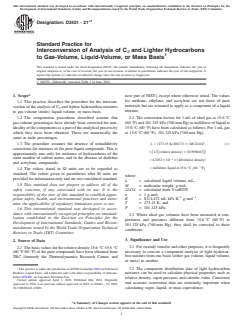
1.1 This practice describes the procedure for the interconversion of the analysis of C5 and lighter hydrocarbon mixtures to gas-volume (mole), liquid-volume, or mass basis.
1.2 The computation procedures described assume that gas-volume percentages have already been corrected for nonideality of the components as a part of the analytical process by which they have been obtained. These are numerically the same as mole percentages.
1.3 The procedure assumes the absence of nonadditivity corrections for mixtures of the pure liquid compounds. This is approximately true only for mixtures of hydrocarbons of the same number of carbon atoms, and in the absence of diolefins and acetylenic compounds.
1.4 The values stated in SI units are to be regarded as standard. The values given in parentheses after SI units are provided for information only and are not considered standard.
1.5 This standard does not purport to address all of the safety concerns, if any, associated with its use. It is the responsibility of the user of this standard to establish appropriate safety, health, and environmental practices and determine the applicability of regulatory limitations prior to use.
1.6 This international standard was developed in accordance with internationally recognized principles on standardization established in the Decision on Principles for the Development of International Standards, Guides and Recommendations issued by the World Trade Organization Technical Barriers to Trade (TBT) Committee.
- Status
- Published
- Publication Date
- 31-Mar-2021
- Technical Committee
- D02 - Petroleum Products, Liquid Fuels, and Lubricants
- Drafting Committee
- D02.H0 - Liquefied Petroleum Gas
Overview
ASTM D2421-21e1 is an internationally recognized standard developed by ASTM International that outlines the procedure for the interconversion of analytical data for C5 and lighter hydrocarbon mixtures. It details the methodology for converting component analysis from one measurement basis-gas volume (mole), liquid volume, or mass-to another. These conversions are essential for the accurate calculation and reporting of hydrocarbon composition in various sectors, including custody transfer, process operations, and quality control of petroleum products, liquefied petroleum gases (LPG), and natural gas liquids (NGLs).
The standard ensures consistent, reliable, and precise conversions, which are foundational for critical calculations such as relative density, vapor pressure, and calorific value. Accurate interconversion supports operational efficiency and regulatory compliance across the hydrocarbon industry.
Key Topics
- Interconversion Methods:
- Procedures for translating analytical data among gas-volume, liquid-volume, and mass bases.
- Application of specific conversion factors and equations for each hydrocarbon component.
- Use of SI units as standard for reporting.
- Underlying Assumptions:
- Gas volume percentages have been corrected for non-ideal behavior (aligning with mole percentages).
- Calculations assume mixtures predominantly contain components with an equal number of carbon atoms and minimal diolefins or acetylenic compounds.
- Calculation Procedures:
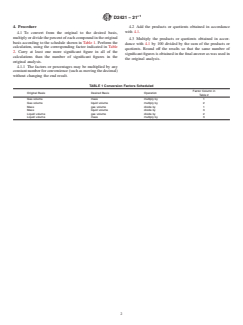
- Detailed steps for multiplying or dividing the percent composition by established factors.
- Rounding and error distribution to maintain analytical significance.
- Data Requirements:
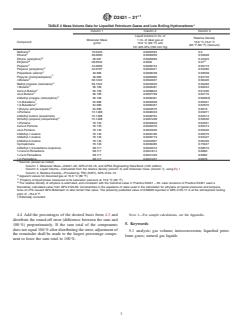
- Use of accurate molecular mass, relative density, and conversion factors for each compound.
- Correction of measured volumes to standard temperature and pressure conditions (15.6 °C and 101.325 kPa).
- Safety and Regulatory Considerations:
- Users are responsible for addressing safety, health, and environmental concerns as well as regulatory applicability.
Applications
The ASTM D2421-21e1 standard is widely applied in:
- Custody Transfer: Ensures precise communication of hydrocarbon composition and value during transaction, transport, or storage of LPG and NGLs.
- Process Operations: Facilitates operational decisions by providing conversion methodologies needed for process design, simulation, and reporting.
- Quality Control: Supports laboratories and production units in producing analysis reports suitable for different requirements-whether gas, liquid, or mass basis.
- Physical Property Calculations: Aids in the determination of vital properties such as calorific value, relative density, and vapor pressure for mixture characterization.
Industries relying on this standard include oil and gas refineries, petrochemical plants, and any operation dealing with storage, shipment, or sale of light hydrocarbon gases and liquids.
Related Standards
- ASTM D2597: Standard Practice for Calculation of Volume and Weight of Industrial Gases
- GPA 2145: Table of Physical Constants of Paraffin Hydrocarbons and Other Components of Natural Gas
- ASTM D3588: Standard Practice for Calculating Heat Value, Compressibility Factor, and Relative Density of Gaseous Fuels
- ISO 6976: Natural gas - Calculation of calorific values, density, relative density, and Wobbe index from composition
By adhering to ASTM D2421-21e1 and related standards, industry professionals ensure analytical consistency and regulatory compliance for the handling and exchange of hydrocarbon mixtures. This standard underpins accurate measurement and reporting, ultimately supporting commercial transparency and technical integrity in the global hydrocarbon market.
Get Certified
Connect with accredited certification bodies for this standard

Element Materials Technology
Materials testing and product certification.

ABS Group Brazil
ABS Group certification services in Brazil.

ABS Quality Evaluations Inc.
American Bureau of Shipping quality certification.
Sponsored listings
Frequently Asked Questions
ASTM D2421-21e1 is a standard published by ASTM International. Its full title is "Standard Practice for Interconversion of Analysis of C<emph type="ital"><inf>5</inf ></emph> and Lighter Hydrocarbons to Gas-Volume, Liquid-Volume, or Mass Basis". This standard covers: SIGNIFICANCE AND USE 3.1 For custody transfer and other purposes, it is frequently necessary to convert a component analysis of light hydrocarbon mixture from one basis (either gas volume, liquid volume, or mass) to another. 3.2 The component distribution data of light hydrocarbon mixtures can be used to calculate physical properties such as relative density, vapor-pressure, and calorific value. Consistent and accurate conversion data are extremely important when calculating vapor, liquid, or mass equivalence. SCOPE 1.1 This practice describes the procedure for the interconversion of the analysis of C5 and lighter hydrocarbon mixtures to gas-volume (mole), liquid-volume, or mass basis. 1.2 The computation procedures described assume that gas-volume percentages have already been corrected for nonideality of the components as a part of the analytical process by which they have been obtained. These are numerically the same as mole percentages. 1.3 The procedure assumes the absence of nonadditivity corrections for mixtures of the pure liquid compounds. This is approximately true only for mixtures of hydrocarbons of the same number of carbon atoms, and in the absence of diolefins and acetylenic compounds. 1.4 The values stated in SI units are to be regarded as standard. The values given in parentheses after SI units are provided for information only and are not considered standard. 1.5 This standard does not purport to address all of the safety concerns, if any, associated with its use. It is the responsibility of the user of this standard to establish appropriate safety, health, and environmental practices and determine the applicability of regulatory limitations prior to use. 1.6 This international standard was developed in accordance with internationally recognized principles on standardization established in the Decision on Principles for the Development of International Standards, Guides and Recommendations issued by the World Trade Organization Technical Barriers to Trade (TBT) Committee.
SIGNIFICANCE AND USE 3.1 For custody transfer and other purposes, it is frequently necessary to convert a component analysis of light hydrocarbon mixture from one basis (either gas volume, liquid volume, or mass) to another. 3.2 The component distribution data of light hydrocarbon mixtures can be used to calculate physical properties such as relative density, vapor-pressure, and calorific value. Consistent and accurate conversion data are extremely important when calculating vapor, liquid, or mass equivalence. SCOPE 1.1 This practice describes the procedure for the interconversion of the analysis of C5 and lighter hydrocarbon mixtures to gas-volume (mole), liquid-volume, or mass basis. 1.2 The computation procedures described assume that gas-volume percentages have already been corrected for nonideality of the components as a part of the analytical process by which they have been obtained. These are numerically the same as mole percentages. 1.3 The procedure assumes the absence of nonadditivity corrections for mixtures of the pure liquid compounds. This is approximately true only for mixtures of hydrocarbons of the same number of carbon atoms, and in the absence of diolefins and acetylenic compounds. 1.4 The values stated in SI units are to be regarded as standard. The values given in parentheses after SI units are provided for information only and are not considered standard. 1.5 This standard does not purport to address all of the safety concerns, if any, associated with its use. It is the responsibility of the user of this standard to establish appropriate safety, health, and environmental practices and determine the applicability of regulatory limitations prior to use. 1.6 This international standard was developed in accordance with internationally recognized principles on standardization established in the Decision on Principles for the Development of International Standards, Guides and Recommendations issued by the World Trade Organization Technical Barriers to Trade (TBT) Committee.
ASTM D2421-21e1 is classified under the following ICS (International Classification for Standards) categories: 75.080 - Petroleum products in general. The ICS classification helps identify the subject area and facilitates finding related standards.
ASTM D2421-21e1 is available in PDF format for immediate download after purchase. The document can be added to your cart and obtained through the secure checkout process. Digital delivery ensures instant access to the complete standard document.
Standards Content (Sample)
This international standard was developed in accordance with internationally recognized principles on standardization established in the Decision on Principles for the
Development of International Standards, Guides and Recommendations issued by the World Trade Organization Technical Barriers to Trade (TBT) Committee.
´1
Designation: D2421 − 21
Standard Practice for
Interconversion of Analysis of C and Lighter Hydrocarbons
to Gas-Volume, Liquid-Volume, or Mass Basis
This standard is issued under the fixed designation D2421; the number immediately following the designation indicates the year of
original adoption or, in the case of revision, the year of last revision. A number in parentheses indicates the year of last reapproval. A
superscript epsilon (´) indicates an editorial change since the last revision or reapproval.
ε NOTE—Editorially corrected Table 2 in June 2021.
1. Scope* now part of NIST), except where otherwise noted. The values
for methane, ethylene, and acetylene are not those of pure
1.1 This practice describes the procedure for the intercon-
materials but are assumed to apply as a component of a liquid
version of the analysis of C and lighter hydrocarbon mixtures
mixture.
to gas-volume (mole), liquid-volume, or mass basis.
2.2 The conversion factors for 1 mL of ideal gas at 15.6 °C
1.2 The computation procedures described assume that
(60 °F) and 101.325 kPa (760 mm Hg) to millilitres of liquid at
gas-volume percentages have already been corrected for non-
15.6 °C (60 °F) have been calculated as follows: For 1 mL gas
idealityofthecomponentsasapartoftheanalyticalprocessby
which they have been obtained. These are numerically the at 15.6 °C (60 °F), 101.325 kPa (760 mm Hg),
same as mole percentages.
1.3 The procedure assumes the absence of nonadditivity L 5 ~273.15 K/288.71! 3 ~M/22414! (1)
corrections for mixtures of the pure liquid compounds. This is
3 1/ relative density 3 0.999016
@ @~ ! ~ !##
approximately true only for mixtures of hydrocarbons of the
same number of carbon atoms, and in the absence of diolefins
54.2252 310 3 M/relative density
~ !
and acetylenic compounds.
5millilitres liquid at 15.6 °C 60 °F
~ !
1.4 The values stated in SI units are to be regarded as
standard. The values given in parentheses after SI units are
where:
provided for information only and are not considered standard.
L = calculated liquid volume, mL,
1.5 This standard does not purport to address all of the
M = molecular weight, g-mol,
safety concerns, if any, associated with its use. It is the
22414 = calculated from V=nRT/P,
responsibility of the user of this standard to establish appro- n = 1 g-mol,
–1 –1
priate safety, health, and environmental practices and deter- R = 8314.472 mL kPa K g-mol ,
T = 273.15 K, and
mine the applicability of regulatory limitations prior to use.
P = 101.325 kPa.
1.6 This international standard was developed in accor-
dance with internationally recognized principles on standard-
2.3 Where ideal gas volumes have been measured at tem-
ization established in the Decision on Principles for the
peratures and pressures different from 15.6 °C (60 °F) at
Development of International Standards, Guides and Recom-
101.325 kPa (760 mm Hg), they shall be corrected to these
mendations issued by the World Trade Organization Technical
conditions.
Barriers to Trade (TBT) Committee.
3. Significance and Use
2. Source of Data
3.1 For custody transfer and other purposes, it is frequently
2.1 Thebasicvaluesfortherelativedensity15.6 °C⁄15.6 °C
necessary to convert a component analysis of light hydrocar-
(60 °F⁄60 °F) of the pure compounds have been obtained from
bon mixture from one basis (either gas volume, liquid volume,
TRC (formerly the Thermodynamics Research Center, and
or mass) to another.
3.2 The component distribution data of light hydrocarbon
This practice is under the jurisdiction of ASTM Committee D02 on Petroleum
Products, Liquid Fuels, and Lubricants and is the direct responsibility of Subcom-
mixtures can be used to calculate physical properties such as
mittee D02.H0 on Liquefied Petroleum Gas.
relative density, vapor-pressure, and calorific value. Consistent
Current edition approved April 1, 2021. Published May 2021. Originally
and accurate conversion data are extremely important when
approved in 1965. Last previous edition approved in 2019 as D2421 – 19. DOI:
10.1520/D2421-21E01. calculating vapor, liquid, or mass equivalence.
*A Summary of Changes section appears at the end of this standard
Copyright © ASTM International, 100 Barr Harbor Drive, PO Box C700, West Conshohocken, PA 19428-2959. United States
´1
D2421 − 21
4. Procedure 4.2 Add the products or quotients obtained in accordance
with 4.1.
4.1 To convert from the original to the desired basis,
multiplyordividethepercentofeachcompoundintheoriginal
4.3 Multiply the products or quotients obtained in accor-
basis according to the schedule shown in Table 1. Perform the
dance with 4.1 by 100 divided by the sum of the products or
calculation, using the corresponding factor indicated in Table
quotients. Round off the results so that the same number of
2. Carry at least one more significant figure in all of the
significant figures is obtained in the final answer as was used in
calculations than the number of significant figures in the
the original analysis.
original analysis.
4.1.1 The factors or percentages may be multiplied by any
constantnumberforconvenience(suchasmovingthedecimal)
without changing the end result.
TABLE 1 Conversion Factors Scheduled
Factor Column in
Original Basis Desired Basis Operation
Table 2
Gas volume mass multiply by 1
Gas volume liquid volume multiply by 2
Mass gas volume divide by 1
Mass liquid volume divide by 3
Liquid volume gas volume divide by 2
Liquid volume mass multiply by 3
´1
D2421 − 21
A
TABLE 2 Mass-Volume Data for Liquefied Petroleum Gases and Low Boiling Hydrocarbons
Column 1 Column 2 Column 3
Liquid Volume in mL of
Relative Density
Molecular Mass 1 mL of ideal gas at
Compound 15.6 °C ⁄15.6 °C
g/mol 15.6 °C (60 °F) and
(60 °F ⁄60 °F) (Vacuum)
101.325 kPa (760 mm Hg)
B
Methane 16.0425 0.0022594 0.3
C
Ethane 30.0690 0.0035659 0.35628
B
Ethyne (acetylene) 26.037 0.0025993 0.42323
B D
Ethylene 28.0532 0.0032 0.37
C
Propane 44.0956 0.0036734 0.50719
C
Propene (propylene) 42.0797 0.0034021 0.52260
C
Propadiene (allene) 40.065 0.0028438 0.59528
C
Propyne (meth
...