

ASTM B286-20
(Specification)Standard Specification for Copper Conductors for Use in Hookup Wire for Electronic Equipment
General Information
- Abstract
ABSTRACT
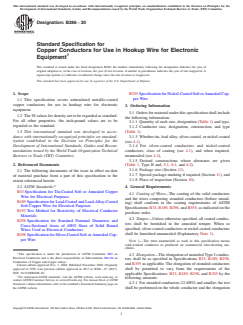
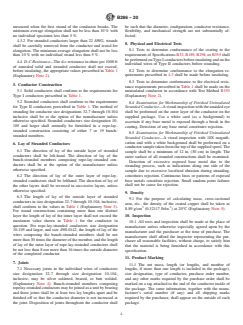
This specification covers uninsulated metallic-coated copper conductors for use in hookup wire for electronic equipment. The coating of the solid conductors and the wires composing stranded conductors shall conform to the coating requirements. Unless otherwise specified, all coated conductors shall be furnished in the annealed temper. The elongation of Type I conductors shall be as specified in the reference material. For Type II stranded conductors 22 AWG and smaller, the test shall be performed on the whole conductor and the elongation measured when the first strand of the conductor breaks. Solid conductors shall conform to the requirements for Type I conductors, while stranded conductors shall conform to the requirements for Type II conductors. The direction and length of lay of the outside layer of stranded conductors are presented. The test methods to determine the conformance to coating, elongation, and electrical resistance requirements are presented in details.
SCOPE
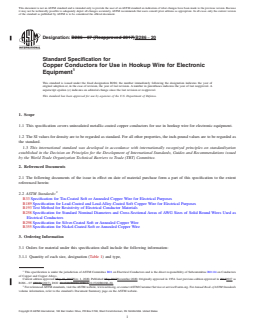
1.1 This specification covers uninsulated metallic-coated copper conductors for use in hookup wire for electronic equipment.
1.2 The SI values for density are to be regarded as standard. For all other properties, the inch-pound values are to be regarded as the standard.
1.3 This international standard was developed in accordance with internationally recognized principles on standardization established in the Decision on Principles for the Development of International Standards, Guides and Recommendations issued by the World Trade Organization Technical Barriers to Trade (TBT) Committee.
- Status
- Published
- Publication Date
- 31-Oct-2020
- Technical Committee
- B01 - Electrical Conductors
- Drafting Committee
- B01.04 - Conductors of Copper and Copper Alloys
Buy Documents
ASTM B286-20 - Standard Specification for Copper Conductors for Use in Hookup Wire for Electronic Equipment
REDLINE ASTM B286-20 - Standard Specification for Copper Conductors for Use in Hookup Wire for Electronic Equipment
Overview
ASTM B286-20: Standard Specification for Copper Conductors for Use in Hookup Wire for Electronic Equipment defines requirements for uninsulated, metallic-coated copper conductors utilized in hookup wire for electronic devices. Developed by ASTM International, this specification establishes essential properties such as conductor construction, coatings, mechanical characteristics, and relevant electrical performance. ASTM B286-20 is intended to ensure reliable performance and safety in electronic equipment wiring, and is widely referenced in quality assurance processes for wire manufacturers, OEMs, and component suppliers.
This standard covers both solid (Type I) and stranded (Type II) copper conductors, addressing their preparation before further insulation and final use. The document outlines acceptance criteria including coating integrity, minimum elongation, electrical resistance, and packaging.
Key Topics
Scope and Applicability
- Applies to uninsulated, metallic-coated copper conductors (solid and stranded types).
- Suitable for use in hookup wire for electronic equipment prior to insulation.
Conductor Coatings
- Specifies requirements for tin, lead alloy, silver, or nickel coatings on copper conductors.
- References ASTM B33, B189, B298, and B355 for coating standards and classes.
- Ensures that coating integrity is maintained both before and after stranding.
Mechanical Properties
- Sets elongation requirements to ensure ductility and avoid breakage during processing.
- Defines standards for solid (Type I) and stranded (Type II) conductors, with different elongation testing methods based on wire size and construction.
Electrical Properties
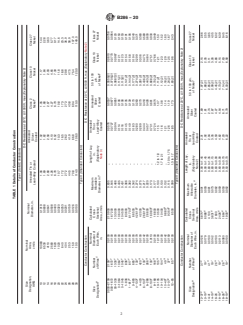
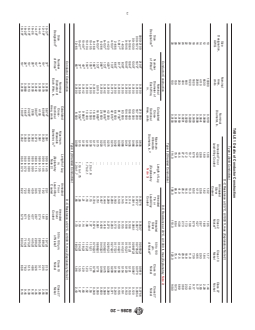
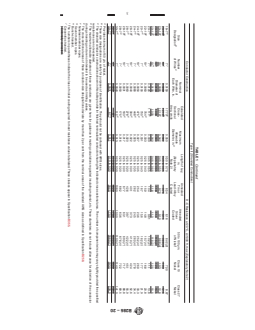
- Establishes maximum allowable direct current (d-c) resistance per 1000 ft, by conductor size and coating type.
- Uses resistance as a primary metric for conductor acceptance before insulation.
Conductor Construction
- Details construction requirements for both solid and stranded conductors, including stranding method and lay direction/length.
- Encourages shorter lay lengths for added flexibility in electronic applications.
Quality Assurance
- Outlines procedures for physical inspection and testing of coating, elongation, and resistance.
- Specifies packaging, marking, and inspection routines to ensure traceability and compliance.
Applications
ASTM B286-20 is commonly used in the manufacturing and quality control of copper hookup wires designed for electronic equipment. Its practical value includes:
- Electronic Equipment Assembly
- Supports the creation of reliable internal wiring for consumer electronics, industrial devices, instruments, and computers.
- Wire and Cable Production
- Used by manufacturers to specify and verify copper conductor quality before applying insulation materials.
- Component Sourcing and Procurement
- Provides standardized requirements for OEMs and procurement specialists to ensure supply chain compliance.
- Testing and Inspection
- Adopted by quality assurance teams to evaluate physical and electrical properties of uninsulated copper conductors.
- Regulatory and Contractual Reference
- Frequently cited in contracts and compliance documents related to electronic assembly and wire product standards.
Related Standards
Familiarity with ASTM B286-20 is enhanced by referencing these associated ASTM standards:
- ASTM B33 - Tin-Coated Soft or Annealed Copper Wire for Electrical Purposes
- ASTM B189 - Lead-Coated and Lead-Alloy-Coated Soft Copper Wire for Electrical Purposes
- ASTM B193 - Test Method for Resistivity of Electrical Conductor Materials
- ASTM B258 - Standard Nominal Diameters and Cross-Sectional Areas of AWG Sizes of Solid Round Wires
- ASTM B298 - Silver-Coated Soft or Annealed Copper Wire
- ASTM B355 - Nickel-Coated Soft or Annealed Copper Wire
These documents provide deeper insights into coating properties, electrical performance, and test methodologies aligned with ASTM B286-20.
Keywords: copper hookup wire, electronic equipment hookup wire, uninsulated copper conductors, conductor coatings, ASTM B286-20.
Relations
- Effective Date
- 01-Jan-2020
- Effective Date
- 01-Oct-2018
- Effective Date
- 01-Apr-2017
- Effective Date
- 01-Oct-2016
- Effective Date
- 01-Apr-2016
- Effective Date
- 01-Sep-2014
- Effective Date
- 01-Apr-2014
- Effective Date
- 15-Nov-2012
- Effective Date
- 01-Apr-2011
- Effective Date
- 01-Oct-2010
- Effective Date
- 01-Apr-2010
- Effective Date
- 01-Sep-2008
- Effective Date
- 01-Sep-2008
- Effective Date
- 15-May-2007
- Effective Date
- 01-Oct-2006
Buy Documents
ASTM B286-20 - Standard Specification for Copper Conductors for Use in Hookup Wire for Electronic Equipment
REDLINE ASTM B286-20 - Standard Specification for Copper Conductors for Use in Hookup Wire for Electronic Equipment
Get Certified
Connect with accredited certification bodies for this standard

IMQ S.p.A. (Certification)
Italian electrical product certification.

SLG Prüf- und Zertifizierungs GmbH
German testing and certification body.

UL Solutions
Global safety science company with testing, inspection and certification.
Sponsored listings
Frequently Asked Questions
ASTM B286-20 is a technical specification published by ASTM International. Its full title is "Standard Specification for Copper Conductors for Use in Hookup Wire for Electronic Equipment". This standard covers: ABSTRACT This specification covers uninsulated metallic-coated copper conductors for use in hookup wire for electronic equipment. The coating of the solid conductors and the wires composing stranded conductors shall conform to the coating requirements. Unless otherwise specified, all coated conductors shall be furnished in the annealed temper. The elongation of Type I conductors shall be as specified in the reference material. For Type II stranded conductors 22 AWG and smaller, the test shall be performed on the whole conductor and the elongation measured when the first strand of the conductor breaks. Solid conductors shall conform to the requirements for Type I conductors, while stranded conductors shall conform to the requirements for Type II conductors. The direction and length of lay of the outside layer of stranded conductors are presented. The test methods to determine the conformance to coating, elongation, and electrical resistance requirements are presented in details. SCOPE 1.1 This specification covers uninsulated metallic-coated copper conductors for use in hookup wire for electronic equipment. 1.2 The SI values for density are to be regarded as standard. For all other properties, the inch-pound values are to be regarded as the standard. 1.3 This international standard was developed in accordance with internationally recognized principles on standardization established in the Decision on Principles for the Development of International Standards, Guides and Recommendations issued by the World Trade Organization Technical Barriers to Trade (TBT) Committee.
ABSTRACT This specification covers uninsulated metallic-coated copper conductors for use in hookup wire for electronic equipment. The coating of the solid conductors and the wires composing stranded conductors shall conform to the coating requirements. Unless otherwise specified, all coated conductors shall be furnished in the annealed temper. The elongation of Type I conductors shall be as specified in the reference material. For Type II stranded conductors 22 AWG and smaller, the test shall be performed on the whole conductor and the elongation measured when the first strand of the conductor breaks. Solid conductors shall conform to the requirements for Type I conductors, while stranded conductors shall conform to the requirements for Type II conductors. The direction and length of lay of the outside layer of stranded conductors are presented. The test methods to determine the conformance to coating, elongation, and electrical resistance requirements are presented in details. SCOPE 1.1 This specification covers uninsulated metallic-coated copper conductors for use in hookup wire for electronic equipment. 1.2 The SI values for density are to be regarded as standard. For all other properties, the inch-pound values are to be regarded as the standard. 1.3 This international standard was developed in accordance with internationally recognized principles on standardization established in the Decision on Principles for the Development of International Standards, Guides and Recommendations issued by the World Trade Organization Technical Barriers to Trade (TBT) Committee.
ASTM B286-20 is classified under the following ICS (International Classification for Standards) categories: 29.060.10 - Wires. The ICS classification helps identify the subject area and facilitates finding related standards.
ASTM B286-20 has the following relationships with other standards: It is inter standard links to ASTM B33-10(2020)e1, ASTM B258-18, ASTM B298-12(2017), ASTM B355-11(2016), ASTM B193-16, ASTM B33-10(2014), ASTM B193-02(2014), ASTM B298-12, ASTM B355-11, ASTM B189-05(2010), ASTM B33-10, ASTM B258-02(2008), ASTM B193-02(2008), ASTM B298-07, ASTM B355-06. Understanding these relationships helps ensure you are using the most current and applicable version of the standard.
ASTM B286-20 is available in PDF format for immediate download after purchase. The document can be added to your cart and obtained through the secure checkout process. Digital delivery ensures instant access to the complete standard document.
Standards Content (Sample)
This international standard was developed in accordance with internationally recognized principles on standardization established in the Decision on Principles for the
Development of International Standards, Guides and Recommendations issued by the World Trade Organization Technical Barriers to Trade (TBT) Committee.
Designation:B286 −20
Standard Specification for
Copper Conductors for Use in Hookup Wire for Electronic
Equipment
This standard is issued under the fixed designation B286; the number immediately following the designation indicates the year of
original adoption or, in the case of revision, the year of last revision. A number in parentheses indicates the year of last reapproval. A
superscript epsilon (´) indicates an editorial change since the last revision or reapproval.
This standard has been approved for use by agencies of the U.S. Department of Defense.
1. Scope B355 SpecificationforNickel-CoatedSoftorAnnealedCop-
per Wire
1.1 This specification covers uninsulated metallic-coated
copper conductors for use in hookup wire for electronic
3. Ordering Information
equipment.
3.1 Orders for material under this specification shall include
1.2 The SI values for density are to be regarded as standard.
the following information:
For all other properties, the inch-pound values are to be
3.1.1 Quantity of each size, designation (Table 1) and type,
regarded as the standard.
3.1.2 Conductor size, designation, construction, and type
1.3 This international standard was developed in accor- (Table 1).
dance with internationally recognized principles on standard- 3.1.3 Whether tin, lead alloy, silver-coated, or nickel-coated
ization established in the Decision on Principles for the (see 4.1).
Development of International Standards, Guides and Recom- 3.1.4 For silver-coated conductors and nickel-coated
mendations issued by the World Trade Organization Technical conductors, class of coating (see 4.1), and when required,
Barriers to Trade (TBT) Committee. unannealed (see 4.2),
3.1.5 Desired constructions where alternates are given
2. Referenced Documents
(Table 1, Type II and, 5.1, 6.1, and 6.2),
3.1.6 Package size (Section 12).
2.1 The following documents of the issue in effect on date
3.1.7 Special package marking if required (Section 11), and
of material purchase form a part of this specification to the
3.1.8 Place of inspection (Section 10).
extent referenced herein:
2.2 ASTM Standards:
4. General Requirements
B33 Specification for Tin-Coated Soft or Annealed Copper
4.1 Coating of Wires—The coating of the solid conductors
Wire for Electrical Purposes
and the wires composing stranded conductors (before strand-
B189 Specification for Lead-Coated and Lead-Alloy-Coated
ing) shall conform to the coating requirements of ASTM
Soft Copper Wire for Electrical Purposes
Specifications B33, B189, B298, and B355, as indicated on the
B193 Test Method for Resistivity of Electrical Conductor
purchase order.
Materials
4.2 Temper—Unless otherwise specified, all coated conduc-
B258 Specification for Standard Nominal Diameters and
tors shall be furnished in the annealed temper. When so
Cross-Sectional Areas of AWG Sizes of Solid Round
specified, silver-coated conductors or nickel-coated conductors
Wires Used as Electrical Conductors
shall be furnished unannealed (Explanatory Note 1).
B298 Specification for Silver-Coated Soft orAnnealed Cop-
per Wire
NOTE 1—The term unannealed as used in this specification means
cold-worked conductor as produced on commercial wire-drawing ma-
chines.
This specification is under the jurisdiction of ASTM Committee B01 on
4.3 Elongation—The elongation of annealedType I conduc-
Electrical Conductors and is the direct responsibility of Subcommittee B01.04 on
tors shall be as specified in Specifications B33, B189, B298,
Conductors of Copper and Copper Alloys.
and B355 as applicable.The elongation of stranded conductors
Current edition approved Nov. 1, 2020. Published November 2020. Originally
shall be permitted to vary from the requirements of the
approved in 1954. Last previous edition approved in 2017 as B286 – 07 (2017).
DOI: 10.1520/B0286-20.
applicable Specifications: B33, B189, B298, and B355 by the
For referenced ASTM standards, visit the ASTM website, www.astm.org, or
following amounts:
contact ASTM Customer Service at service@astm.org. For Annual Book of ASTM
4.3.1 For stranded conductors 22AWG and smaller, the test
Standards volume information, refer to the standard’s Document Summary page on
the ASTM website. shall be performed on the whole conductor and the elongation
Copyright © ASTM International, 100 Barr Harbor Drive, PO Box C700, West Conshohocken, PA 19428-2959. United States
B286−20
TABLE 1 Details of Conductor Construction
Type I (Solid Conductors)
D-C Resistance at 20°C,Ω/1000 ft, max (Explanatory Note 2)
Size Nominal
Nominal
Annealed
Designation, Area,
Annealed Tin or Class 2 Class 10 Class 27
Diameter, in.
Silver
A
AWG cmils
Lead-Alloy Coated Nickel Nickel Nickel
Coated
10 10380 0.1019 1.06 1.02 1.05 1.17 1.44
12 6530 0.0808 1.69 1.62 1.68 1.84 2.28
14 4110 0.0641 2.68 2.58 2.67 2.93 3.63
16 2580 0.0508 4.26 4.10 4.27 4.65 5.77
18 1620 0.0403 6.78 6.52 6.79 7.39 9.17
20 1020 0.0320 10.7 10.3 10.8 11.8 14.6
22 640 0.0253 17.2 16.5 17.3 18.8 23.3
24 404 0.0201 27.2 26.2 27.3 29.8 36.9
26 253 0.0159 44.5 41.9 43.8 47.5 58.9
28 159 0.0126 70.8 66.8 69.4 75.4 107.0
30 100 0.0100 114.0 106.0 110.0 120.0 149.0
Type II (Stranded Conductors)
Conductor Construction D-C Resistance at 20°C,Ω/1000 ft, max (Explanatory Note 2)
Nominal Calculated Length of Lay, Annealed
Maximum Annealed 50 to 100
Size Number Diameter of Cross- in. Tin or Class 10 Class 27
Allowable Silver µin.
B C
Designation of Wires Each Wire, Sectional (Explanatory Lead-Alloy Nickel Nickel
D E
Diameter, in. Coated of Nickel
in. Area, cmils Note 3) Coated
F
0000–2109 2109 0.0100 210 900 0.635 . 0.0576 0.0537 0.0559(2) 0.0610 0.0756
F
000–1672 1672 0.0100 167 200 0.545 . 0.0727 0.0677 0.0705(2) 0.0770 0.0954
F
00–1330 1330 0.0100 133 000 0.486 . 0.0914 0.0851 0.0887(2) 0.0967 0.120
F
0–1064 1064 0.0100 106 400 0.435 . 0.114 0.106 0.111(2) 0.121 0.150
F
0–1045 1045 0.0100 104 500 0.431 . 0.116 0.108 0.113(2) 0.123 0.153
F
1–836 836 0.0100 83 600 0.386 . 0.145 0.135 0.141(2) 0.154 0.191
E F E
1–817 817 0.0100 81 700 0.382 . 0.149 0.139 0.144(2) 0.158 0.195
F
2–665 665 0.0100 66 500 0.342 . 0.183 0.170 0.177(2) 0.194 0.240
E F E
4–133 133 0.0179 42 615 0.274 . 0.280 0.263 0.274(2) 0.299 0.371
G
4–420 420 0.0100 42 000 0.275 . 0.289 0.270 0.281(2) 0.306 0.380
E F E
6–133 133 0.0142 26 818 0.217 . 0.444 0.418 0.436(2) 0.475 0.589
G
6–266 266 0.0100 26 600 0.220 . 0.457 0.426 0.443(2) 0.484 0.600
E F E
8–133 133 0.0113 16 983 0.173 . 0.701 0.661 0.688(2) 0.751 0.930
G
8–168 168 0.0100 16 800 0.177 . 0.724 0.674 0.702(2) 0.766 0.949
G
10–105 105 1.0100 10 500 0.130 1.2 to 1.8 1.15 1.07 1.11(2) 1.21 1.50
H
10–104 104 0.0100 10 400 0.130 1.7 to 2.1 1.16 1.08 1.12(2) 1.23 1.52
E G G
10–49 49 0.0142 9 880 0.132 . 1.21 1.14 1.18(2) 1.29 1.60
E E E
10–37 37 0.0159 9 354 0.115 1.10 to 1.75 1.26 1.19 1.24(2) 1.35 1.67
H
12–65 65 0.0100 6 500 0.099 1.3 to 1.7 1.85 1.73 1.80(2) 1.96 2.43
Type II (Stranded Conductors)
Conductor Construction D-C Resistance at 20°C,Ω/1000 ft, max (Explanatory Note 2)
Calculated Length of Lay, Annealed
Nominal Maximum Annealed
Size Number Cross- in. Tin or 50 to 100 µin. Class 10 Class 27
Diameter of Allowable Silver
B C I
Designation of Wires Sectional (Explanatory Lead-Alloy of Nickel Nickel Nickel
D
Each Wire, in. Diameter, in. Coated
Area, cmils Note 2) Coated
E E E
12–37 37 0.0126 5 874 0.091 0.90 to 1.45 2.01 1.89 1.97(2) 2.15 2.66
E J E
12–19 19 0.0179 6 088 0.093 0.90 to 1.45 1.92 1.81 1.88(2) 2.05 2.55
H
14–41 41 0.0100 4 100 0.081 0.80 to 1.35 2.94 2.74 2.85(2) 3.11 3.85
E J E
14–19 19 0.0142 3 831 0.073 0.80 to 1.15 3.05 2.87 2.99(2) 3.26 4.05
H
16–26 26 0.0100 2 600 0.062 0.60 to 0.90 4.59 4.27 4.45(2) 4.86 6.02
E J E
16–19 19 0.0113 2 426 0.059 0.60 to 0.90 4.82 4.54 4.73(2) 5.15 6.39
E H E
18–26 26 0.0080 1 664 0.050 0.50 to 0.70 7.20 6.71 7.14(4) 7.63 9.45
E J E
18–19 19 0.0100 1 900 0.052 0.50 to 0.70 6.22 5.79 6.03(2) 6.58 8.16
B286−20
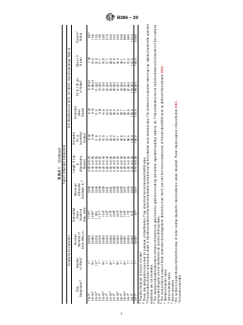
TABLE1 Continued
Type II (Stranded Conductors)
Conductor Construction D-C Resistance at 20°C,Ω/1000 ft, max (Explanatory Note 2)
Calculated Length of Lay, Annealed
Nominal Maximum Annealed
Size Number Cross- in. Tin or 50 to 100 µin. Class 10 Class 27
Diameter of Allowable Silver
B C I
Designation of Wires Sectional (Explanatory Lead-Alloy of Nickel Nickel Nickel
D
Each Wire, in. Diameter, in. Coated
Area, cmils Note 2) Coated
E J E
18–7 7 0.0159 1 770 0.050 0.50 to 0.70 6.54 6.16 6.42(2) 7.00 8.67
E J E
20–19 19 0.0080 1 216 0.042 0.45 to 0.55 9.76 9.10 9.68(4) 10.3 12.8
E H
20–10 10 0.0100 1 000 0.040 0.45 to 0.55 11.8 11.0 11.5(2) 12.5 15.5
E J E
20–7 7 0.0126 1 111 0.039 0.45 to 0.55 10.4 9.81 10.2(2) 11.1 13.8
E J E
22–19 19 0.0063 754 0.033 0.25 to 0.43 15.9 14.8 15.7(4) 16.8 20.8
E J E
22–7 7 0.0100 700 0.031 0.25 to 0.43 16.7 15.6 16.2(2) 17.7 21.9
E J E
24–19 19 0.0050 475 0.027 0.25 to 0.35 25.4 23.6 25.2(4) 26.9 33.3
E J E
24–7 7 0.0080 448 0.025 0.25 to 0.35 26.2 24.5 26.0(4) 27.8 34.4
E J E
26–19 19 0.0040 304 0.022 0.25 to 0.30 40.1 37.3 41.0(7) 42.4 52.6
E J E
26–7 7 0.0063 278 0.020 0.25 to 0.30 42.6 39.7 42.2(4) 45.1 55.9
E J E
28–19 19 0.0031 183 0.017 0.25 to 0.30 67.7 63.1 69.3(7) 71.7 88.8
E J E
28–7 7 0.0050 175 0.016 0.25 to 0.30 68.2 63.6 67.6(4) 72.2 89.5
E J E
30–7 7 0.0040 112 0.013 0.25 to 0.30 108.0 100.0 110.0(7) 114.0 141.0
E J G
32–7 7 0.0031 67 0.011 0.10 to 0.30 182.0 170.0 186.0(7) 193.0 239.0
A
Provides minimum of 50 µin. of nickel.
B
These size designations are solely for purposes of identification. They should not be confused with AWG sizes.
C
The stranded conductor constructions shown in this table provide for finished noninsulated conductors having the indicated cross-sectional area. The number of component wires may vary slightly provided the specified
resistances are not exceeded.
D
The maximum allowable diameters of these conductors are given here for guidance in making calculations regarded insulating material, etc. These diameters do not include allowance for distortion of the conductor
during stranding and are not intended to be used as limiting values.
E
The cross-sectional areas of these conductor-size designations deviate by more than 2 per cent from the nominal areas of the standard AWG sizes as defined in Specification B258.
F
Nineteen member ropes.
G
Seven member ropes.
H
Bunch-stranded.
I
The numbers in parentheses indicate the class of nickel coating required to meet resistance values tabulated. These classes appear in Specification B355.
J
Concentric-stranded.
B286−20
measured when the first strand of the conductor breaks. The be such that the diameter, configuration, conductor resistance,
minimum average elongation shall not be less than 10 % with flexibility, and mechanical strength are not substantially af-
no individual specimen less than 5 %. fected.
4.3.2 For stranded conductors larger than 22 AWG, strands
8. Physical and Electrical Tests
shall be carefully remove
...
This document is not an ASTM standard and is intended only to provide the user of an ASTM standard an indication of what changes have been made to the previous version. Because
it may not be technically possible to adequately depict all changes accurately, ASTM recommends that users consult prior editions as appropriate. In all cases only the current version
of the standard as published by ASTM is to be considered the official document.
Designation: B286 − 07 (Reapproved 2017) B286 − 20
Standard Specification for
Copper Conductors for Use in Hookup Wire for Electronic
Equipment
This standard is issued under the fixed designation B286; the number immediately following the designation indicates the year of
original adoption or, in the case of revision, the year of last revision. A number in parentheses indicates the year of last reapproval. A
superscript epsilon (´) indicates an editorial change since the last revision or reapproval.
This standard has been approved for use by agencies of the U.S. Department of Defense.
1. Scope
1.1 This specification covers uninsulated metallic-coated copper conductors for use in hookup wire for electronic equipment.
1.2 The SI values for density are to be regarded as standard. For all other properties, the inch-pound values are to be regarded as
the standard.
1.3 This international standard was developed in accordance with internationally recognized principles on standardization
established in the Decision on Principles for the Development of International Standards, Guides and Recommendations issued
by the World Trade Organization Technical Barriers to Trade (TBT) Committee.
2. Referenced Documents
2.1 The following documents of the issue in effect on date of material purchase form a part of this specification to the extent
referenced herein:
2.2 ASTM Standards:
B33 Specification for Tin-Coated Soft or Annealed Copper Wire for Electrical Purposes
B189 Specification for Lead-Coated and Lead-Alloy-Coated Soft Copper Wire for Electrical Purposes
B193 Test Method for Resistivity of Electrical Conductor Materials
B258 Specification for Standard Nominal Diameters and Cross-Sectional Areas of AWG Sizes of Solid Round Wires Used as
Electrical Conductors
B298 Specification for Silver-Coated Soft or Annealed Copper Wire
B355 Specification for Nickel-Coated Soft or Annealed Copper Wire
3. Ordering Information
3.1 Orders for material under this specification shall include the following information:
3.1.1 Quantity of each size, designation (Table 1) and type,
This specification is under the jurisdiction of ASTM Committee B01 on Electrical Conductors and is the direct responsibility of Subcommittee B01.04 on Conductors
of Copper and Copper Alloys.
Current edition approved May 15, 2017Nov. 1, 2020. Published May 2017November 2020. Originally approved in 1954. Last previous edition approved in 20122017 as
B286 – 07 (2012).(2017). DOI: 10.1520/B0286-07R17.10.1520/B0286-20.
For referenced ASTM standards, visit the ASTM website, www.astm.org, or contact ASTM Customer Service at service@astm.org. For Annual Book of ASTM Standards
volume information, refer to the standard’s Document Summary page on the ASTM website.
Copyright © ASTM International, 100 Barr Harbor Drive, PO Box C700, West Conshohocken, PA 19428-2959. United States
B286 − 20
TABLE 1 Details of Conductor Construction
Type I (Solid Conductors)
D-C Resistance at 20°C, Ω/1000 ft, max (Explanatory Note 2)
Size Nominal
Nominal
Annealed
Designation, Area,
Annealed Tin or Class 2 Class 10 Class 27
Diameter, in.
Silver
A
AWG cmils
Lead-Alloy Coated Nickel Nickel Nickel
Coated
10 10380 0.1019 1.06 1.02 1.05 1.17 1.44
12 6530 0.0808 1.69 1.62 1.68 1.84 2.28
14 4110 0.0641 2.68 2.58 2.67 2.93 3.63
16 2580 0.0508 4.26 4.10 4.27 4.65 5.77
18 1620 0.0403 6.78 6.52 6.79 7.39 9.17
20 1020 0.0320 10.7 10.3 10.8 11.8 14.6
22 640 0.0253 17.2 16.5 17.3 18.8 23.3
24 404 0.0201 27.2 26.2 27.3 29.8 36.9
26 253 0.0159 44.5 41.9 43.8 47.5 58.9
28 159 0.0126 70.8 66.8 69.4 75.4 107.0
30 100 0.0100 114.0 106.0 110.0 120.0 149.0
Type II (Stranded Conductors)
Conductor Construction D-C Resistance at 20°C, Ω/1000 ft, max (Explanatory Note 2)
Nominal Calculated Length of Lay, Annealed
Maximum Annealed 50 to 100
Size Number Diameter of Cross- in. Tin or Class 10 Class 27
Allowable Silver μin.
B C
Designation of Wires Each Wire, Sectional (Explanatory Lead-Alloy Nickel Nickel
D E
Diameter, in. Coated of Nickel
in. Area, cmils Note 3) Coated
F
0000–2109 2109 0.0100 210 900 0.635 . 0.0576 0.0537 0.0559(2) 0.0610 0.0756
F
000–1672 1672 0.0100 167 200 0.545 . 0.0727 0.0677 0.0705(2) 0.0770 0.0954
F
00–1330 1330 0.0100 133 000 0.486 . 0.0914 0.0851 0.0887(2) 0.0967 0.120
F
0–1064 1064 0.0100 106 400 0.435 . 0.114 0.106 0.111(2) 0.121 0.150
F
0–1045 1045 0.0100 104 500 0.431 . 0.116 0.108 0.113(2) 0.123 0.153
F
1–836 836 0.0100 83 600 0.386 . 0.145 0.135 0.141(2) 0.154 0.191
E F E
1–817 817 0.0100 81 700 0.382 . 0.149 0.139 0.144(2) 0.158 0.195
F
2–665 665 0.0100 66 500 0.342 . 0.183 0.170 0.177(2) 0.194 0.240
E F E
4–133 133 0.0179 42 615 0.274 . 0.280 0.263 0.274(2) 0.299 0.371
G
4–420 420 0.0100 42 000 0.275 . 0.289 0.270 0.281(2) 0.306 0.380
E F E
6–133 133 0.0142 26 818 0.217 . 0.444 0.418 0.436(2) 0.475 0.589
G
6–266 266 0.0100 26 600 0.220 . 0.457 0.426 0.443(2) 0.484 0.600
E F E
8–133 133 0.0113 16 983 0.173 . 0.701 0.661 0.688(2) 0.751 0.930
G
8–168 168 0.0100 16 800 0.177 . 0.724 0.674 0.702(2) 0.766 0.949
G
10–105 105 1.0100 10 500 0.130 1.2 to 1.8 1.15 1.07 1.11(2) 1.21 1.50
H
10–104 104 0.0100 10 400 0.130 1.7 to 2.1 1.16 1.08 1.12(2) 1.23 1.52
E G G
10–49 49 0.0142 9 880 0.132 . 1.21 1.14 1.18(2) 1.29 1.60
E E E
10–37 37 0.0159 9 354 0.115 1.10 to 1.75 1.26 1.19 1.24(2) 1.35 1.67
H
12–65 65 0.0100 6 500 0.099 1.3 to 1.7 1.85 1.73 1.80(2) 1.96 2.43
Type II (Stranded Conductors)
Conductor Construction D-C Resistance at 20°C, Ω/1000 ft, max (Explanatory Note 2)
Calculated Length of Lay, Annealed
Nominal Maximum Annealed
Size Number Cross- in. Tin or 50 to 100 μin. Class 10 Class 27
Diameter of Allowable Silver
B C I
Designation of Wires Sectional (Explanatory Lead-Alloy of Nickel Nickel Nickel
D
Each Wire, in. Diameter, in. Coated
Area, cmils Note 2) Coated
E E E
12–37 37 0.0126 5 874 0.091 0.90 to 1.45 2.01 1.89 1.97(2) 2.15 2.66
E J E
12–19 19 0.0179 6 088 0.093 0.90 to 1.45 1.92 1.81 1.88(2) 2.05 2.55
H
14–41 41 0.0100 4 100 0.081 0.80 to 1.35 2.94 2.74 2.85(2) 3.11 3.85
E J E
14–19 19 0.0142 3 831 0.073 0.80 to 1.15 3.05 2.87 2.99(2) 3.26 4.05
H
16–26 26 0.0100 2 600 0.062 0.60 to 0.90 4.59 4.27 4.45(2) 4.86 6.02
E J E
16–19 19 0.0113 2 426 0.059 0.60 to 0.90 4.82 4.54 4.73(2) 5.15 6.39
E H E
18–26 26 0.0080 1 664 0.050 0.50 to 0.70 7.20 6.71 7.14(4) 7.63 9.45
E J E
18–19 19 0.0100 1 900 0.052 0.50 to 0.70 6.22 5.79 6.03(2) 6.58 8.16
B286 − 20
TABLE 1 Continued
Type II (Stranded Conductors)
Conductor Construction D-C Resistance at 20°C, Ω/1000 ft, max (Explanatory Note 2)
Calculated Length of Lay, Annealed
Nominal Maximum Annealed
Size Number Cross- in. Tin or 50 to 100 μin. Class 10 Class 27
Diameter of Allowable Silver
B C I
Designation of Wires Sectional (Explanatory Lead-Alloy of Nickel Nickel Nickel
D
Each Wire, in. Diameter, in. Coated
Area, cmils Note 2) Coated
E J E
18–7 7 0.0159 1 770 0.050 0.50 to 0.70 6.54 6.16 6.42(2) 7.00 8.67
E J E
20–19 10 0.0080 1 216 0.042 0.45 to 0.55 9.76 9.10 9.68(4) 10.3 12.8
E J E
20–19 19 0.0080 1 216 0.042 0.45 to 0.55 9.76 9.10 9.68(4) 10.3 12.8
H
20–19† 10 0.0100 1 000 0.040 0.45 to 0.55 11.8 11.0 11.5(2) 12.5 15.5
E H
20–10 10 0.0100 1 000 0.040 0.45 to 0.55 11.8 11.0 11.5(2) 12.5 15.5
E J E
20–7 7 0.0126 1 111 0.039 0.45 to 0.55 10.4 9.81 10.2(2) 11.1 13.8
E J E
22–19 19 0.0063 754 0.033 0.25 to 0.43 15.9 14.8 15.7(4) 16.8 20.8
E J E
22–7 7 0.0100 700 0.031 0.25 to 0.43 16.7 15.6 16.2(2) 17.7 21.9
E J E
24–19 19 0.0050 475 0.027 0.25 to 0.35 25.4 23.6 25.2(4) 26.9 33.3
E J E
24–7 7 0.0080 448 0.025 0.25 to 0.35 26.2 24.5 26.0(4) 27.8 34.4
E J E
26–19 19 0.0040 304 0.022 0.25 to 0.30 40.1 37.3 41.0(7) 42.4 52.6
E J E
26–7 7 0.0063 278 0.020 0.25 to 0.30 42.6 39.7 42.2(4) 45.1 55.9
E J E
28–19 19 0.0031 183 0.017 0.25 to 0.30 67.7 63.1 69.3(7) 71.7 88.8
E J E
28–7 7 0.0050 175 0.016 0.25 to 0.30 68.2 63.6 67.6(4) 72.2 89.5
E J E
30–7 7 0.0040 112 0.013 0.25 to 0.30 108.0 100.0 110.0(7) 114.0 141.0
E J g
32–7 7 0.0031 67 0.011 0.10 to 0.30 182.0 170.0 186.0(7) 193.0 239.0
E J G
32–7 7 0.0031 67 0.011 0.10 to 0.30 182.0 170.0 186.0(7) 193.0 239.0
A
Provides minimum of 50 μin. of nickel.
B
These size designations are solely for purposes of identification. They should not be confused with AWG sizes.
C
The stranded conductor constructions shown in this table provide for finished noninsulated conductors having the indicated cross-sectional area. The number of component wires may vary slightly provided the specified
resistances are not exceeded.
D
The maximum allowable diameters of these conductors are given here for guidance in making calculations regarded insulating material, etc. These diameters do not include allowance for distortion of the conductor
during stranding and are not intended to be used as limiting values.
E
The cross-sectional areas of these conductor-size designations deviate by more than 2 per cent from the nominal areas of the standard AWG sizes as defined in Specification B258.
F
Nineteen member ropes.
G
Seven member ropes.
H
Bunch-stranded.
I
The numbers in parentheses indicate the class of nickel coating required to meet resistance values tabulated. These classes appear in Specification B355.
J
Concentric-stranded.
†Editorially corrected.
B286 − 20
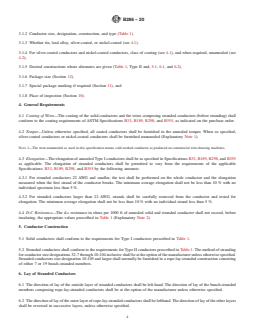
3.1.2 Conductor size, designation, construction, and type (Table 1).
3.1.3 Whether tin, lead alloy, silver-coated, or nickel-coated (see 4.1).
3.1.4 For silver-coated conductors and nickel-coated conductors, class of coating (see 4.1), and when required, unannealed (see
4.2),
3.1.5 Desired constructions where alternates are given (Table 1, Type II and, 5.1, 6.1, and 6.2),
3.1.6 Package size (Section 12).
3.1.7 Special package marking if required (Section 11), and
3.1.8 Place of inspection (Section 10).
4. General Requirements
4.1 Coating of Wires—The coating of the solid conductors and the wires composing stranded conductors (before stranding) shall
conform to the coating requirements of ASTM Specifications B33, B189, B298, and B355, as indicated on the purchase order.
4.2 Temper—Unless otherwise specified, all coated conductors shall be furnished in the annealed temper. When so specified,
silver-coated conductors or nickel-coated conductors shall be furnished unannealed (Explanatory Note 1).
NOTE 1—The term unannealed as used in this specification means cold-worked conductor as produced on commercial wire-drawing machines.
4.3 Elongation—The elongation of annealed Type I conductors shall be as specified in Specifications B33, B189, B298, and B355
as applicable. The elongation of stranded conductors shall be permitted to vary from the requirements of the applicable
Specifications: B33, B189, B298, and B355 by the following amounts:
4.3.1 For stranded conductors 22 AWG and smaller, the test shall be performed on the whole conductor and the elongation
measured when the first strand of the conductor breaks. The minimum average elongation shall not be less than 10 % with no
individual specimen less than 5 %.
4.3.2 For stranded conductors larger than 22 AWG, strands shall be carefully removed from the conductor and tested for
elongation. The minimum av
...