

ASTM C943-17
(Practice)Standard Practice for Making Test Cylinders and Prisms for Determining Strength and Density of Preplaced-Aggregate Concrete in the Laboratory
General Information
- Abstract
SIGNIFICANCE AND USE
5.1 This practice is used for making test cylinders or prisms of PA concrete. Cylinders are used for determining compressive strength and approximate density. Prisms, cut from cylinders, eliminate the surface effect and thus more accurately represent the actual density of PA concrete in place.
SCOPE
1.1 This practice covers procedures for making standard test cylinders used to determine the compressive strength and density of preplaced-aggregate (PA) concrete.
1.2 The values stated in SI units are to be regarded as the standard. The values given in parentheses are for information only.
1.3 This standard does not purport to address all of the safety concerns, if any, associated with its use. It is the responsibility of the user of this standard to establish appropriate safety, health, and environmental practices and determine the applicability of regulatory limitations prior to use.Warning—Fresh hydraulic cementitious mixtures are caustic and may cause chemical burns to skin and tissue upon prolonged exposure.2
1.4 This international standard was developed in accordance with internationally recognized principles on standardization established in the Decision on Principles for the Development of International Standards, Guides and Recommendations issued by the World Trade Organization Technical Barriers to Trade (TBT) Committee.
- Status
- Published
- Publication Date
- 14-Dec-2017
- Technical Committee
- C09 - Concrete and Concrete Aggregates
- Drafting Committee
- C09.41 - Hydraulic Cement Grouts
Buy Documents

ASTM C943-17 - Standard Practice for Making Test Cylinders and Prisms for Determining Strength and Density of Preplaced-Aggregate Concrete in the Laboratory
REDLINE ASTM C943-17 - Standard Practice for Making Test Cylinders and Prisms for Determining Strength and Density of Preplaced-Aggregate Concrete in the Laboratory
Overview
ASTM C943-17: Standard Practice for Making Test Cylinders and Prisms for Determining Strength and Density of Preplaced-Aggregate Concrete in the Laboratory provides a systematic approach for producing test specimens of preplaced-aggregate (PA) concrete. This practice is essential for evaluating the compressive strength and density of PA concrete, which is widely used in specialized construction projects. The standard outlines the procedures for making and curing test cylinders and cutting prisms, ensuring reliable results that reflect the actual properties of PA concrete in practical applications.
Applying the guidelines in ASTM C943-17 helps laboratories, construction companies, and quality assurance professionals achieve greater consistency and accuracy in their concrete testing programs. By following this practice, users can assess the true performance characteristics of preplaced-aggregate concrete before it is employed in the field.
Key Topics
- Test Cylinder Preparation: Describes the materials, equipment, and step-by-step procedures for making standard test cylinders of PA concrete designed to determine compressive strength and density.
- Prism Preparation: Explains the method of cutting prisms from the central portions of hardened cylinders for density measurement, minimizing potential surface effects that could influence accuracy.
- Apparatus and Materials: Outlines the required laboratory equipment such as cylinder molds, grouting apparatus, flow cones, platform scales, and thermometers. Details material requirements for coarse aggregate and grout consistent with referenced ASTM standards.
- Testing Conditions: Establishes standard laboratory temperatures for specimen preparation and mandates proper documentation of ambient conditions when specimens are produced in the field.
- Safety Considerations: Emphasizes the need for appropriate safety, health, and environmental practices when handling hydraulic cementitious materials due to their caustic properties.
- Reporting Requirements: Specifies the essential information that must be documented for each specimen, such as identification, casting environment, aggregate and grout descriptions, and temperature conditions during preparation and curing.
Applications
ASTM C943-17 provides practical value in settings where accurate measurement of the compressive strength and density of preplaced-aggregate concrete is critical:
- Quality Control in Construction: Ensures materials meet project specifications by providing reliable laboratory data before and during construction.
- Research and Development: Supports studies aimed at optimizing PA concrete mixes or evaluating new admixtures and aggregates.
- Specification Compliance: Demonstrates adherence to contract requirements and industry best practices through standardized testing procedures.
- Field Validation: Offers methods for preparing specimens both in the laboratory and on-site, facilitating real-world applicability and verification of concrete performance.
- Accurate Density Determination: The use of prisms cut from cylinder specimens provides a more realistic measurement of in-place density, crucial for structural evaluation.
Related Standards
ASTM C943-17 references and complements a number of other key ASTM standards related to concrete testing, materials, and terminology:
- ASTM C125 - Terminology Relating to Concrete and Concrete Aggregates
- ASTM C192/C192M - Practice for Making and Curing Concrete Test Specimens in the Laboratory
- ASTM C219 - Terminology Relating to Hydraulic Cement
- ASTM C637 - Specification for Aggregates for Radiation-Shielding Concrete
- ASTM C937 - Specification for Grout Fluidifier for Preplaced-Aggregate Concrete
- ASTM C938 - Practice for Proportioning Grout Mixtures for Preplaced-Aggregate Concrete
- ASTM C939/C939M - Test Method for Flow of Grout for Preplaced-Aggregate Concrete (Flow Cone Method)
- ASTM C940 - Test Method for Expansion and Bleeding of Freshly Mixed Grouts for Preplaced-Aggregate Concrete
These related standards provide additional guidance on terminology, materials, testing procedures, and best practices, ensuring comprehensive quality assessment in concrete construction.
By adopting ASTM C943-17, professionals can effectively evaluate the structural integrity of preplaced-aggregate concrete, leading to safer and more reliable construction outcomes. For the most authoritative and up-to-date information, always consult the latest published version from ASTM International.
Relations
- Effective Date
- 15-Dec-2017
- Effective Date
- 01-Apr-2024
- Effective Date
- 01-Aug-2020
- Effective Date
- 01-Apr-2020
- Effective Date
- 01-Jan-2020
- Effective Date
- 15-Dec-2019
- Effective Date
- 15-Nov-2019
- Effective Date
- 01-Jun-2019
- Effective Date
- 01-Jan-2019
- Effective Date
- 01-Oct-2018
- Effective Date
- 01-Jul-2018
- Effective Date
- 01-Jan-2018
- Effective Date
- 15-Dec-2016
- Effective Date
- 01-Feb-2016
- Refers
ASTM C938-16 - Standard Practice for Proportioning Grout Mixtures for Preplaced-Aggregate Concrete - Effective Date
- 01-Feb-2016
Buy Documents
ASTM C943-17 - Standard Practice for Making Test Cylinders and Prisms for Determining Strength and Density of Preplaced-Aggregate Concrete in the Laboratory
REDLINE ASTM C943-17 - Standard Practice for Making Test Cylinders and Prisms for Determining Strength and Density of Preplaced-Aggregate Concrete in the Laboratory
Get Certified
Connect with accredited certification bodies for this standard

DIBt (Deutsches Institut für Bautechnik)
German Institute for Building Technology.
DIN CERTCO
DIN Group product certification.

Aboma Certification B.V.
Specialized in construction, metal, and transport sectors.
Sponsored listings
Frequently Asked Questions
ASTM C943-17 is a standard published by ASTM International. Its full title is "Standard Practice for Making Test Cylinders and Prisms for Determining Strength and Density of Preplaced-Aggregate Concrete in the Laboratory". This standard covers: SIGNIFICANCE AND USE 5.1 This practice is used for making test cylinders or prisms of PA concrete. Cylinders are used for determining compressive strength and approximate density. Prisms, cut from cylinders, eliminate the surface effect and thus more accurately represent the actual density of PA concrete in place. SCOPE 1.1 This practice covers procedures for making standard test cylinders used to determine the compressive strength and density of preplaced-aggregate (PA) concrete. 1.2 The values stated in SI units are to be regarded as the standard. The values given in parentheses are for information only. 1.3 This standard does not purport to address all of the safety concerns, if any, associated with its use. It is the responsibility of the user of this standard to establish appropriate safety, health, and environmental practices and determine the applicability of regulatory limitations prior to use.Warning—Fresh hydraulic cementitious mixtures are caustic and may cause chemical burns to skin and tissue upon prolonged exposure.2 1.4 This international standard was developed in accordance with internationally recognized principles on standardization established in the Decision on Principles for the Development of International Standards, Guides and Recommendations issued by the World Trade Organization Technical Barriers to Trade (TBT) Committee.
SIGNIFICANCE AND USE 5.1 This practice is used for making test cylinders or prisms of PA concrete. Cylinders are used for determining compressive strength and approximate density. Prisms, cut from cylinders, eliminate the surface effect and thus more accurately represent the actual density of PA concrete in place. SCOPE 1.1 This practice covers procedures for making standard test cylinders used to determine the compressive strength and density of preplaced-aggregate (PA) concrete. 1.2 The values stated in SI units are to be regarded as the standard. The values given in parentheses are for information only. 1.3 This standard does not purport to address all of the safety concerns, if any, associated with its use. It is the responsibility of the user of this standard to establish appropriate safety, health, and environmental practices and determine the applicability of regulatory limitations prior to use.Warning—Fresh hydraulic cementitious mixtures are caustic and may cause chemical burns to skin and tissue upon prolonged exposure.2 1.4 This international standard was developed in accordance with internationally recognized principles on standardization established in the Decision on Principles for the Development of International Standards, Guides and Recommendations issued by the World Trade Organization Technical Barriers to Trade (TBT) Committee.
ASTM C943-17 is classified under the following ICS (International Classification for Standards) categories: 91.100.30 - Concrete and concrete products. The ICS classification helps identify the subject area and facilitates finding related standards.
ASTM C943-17 has the following relationships with other standards: It is inter standard links to ASTM C943-10, ASTM C219-24, ASTM C219-20a, ASTM C219-20, ASTM C637-20, ASTM C125-19a, ASTM C219-19a, ASTM C219-19, ASTM C125-19, ASTM C125-18b, ASTM C125-18a, ASTM C125-18, ASTM C125-16, ASTM C939/C939M-16, ASTM C938-16. Understanding these relationships helps ensure you are using the most current and applicable version of the standard.
ASTM C943-17 is available in PDF format for immediate download after purchase. The document can be added to your cart and obtained through the secure checkout process. Digital delivery ensures instant access to the complete standard document.
Standards Content (Sample)
This international standard was developed in accordance with internationally recognized principles on standardization established in the Decision on Principles for the
Development of International Standards, Guides and Recommendations issued by the World Trade Organization Technical Barriers to Trade (TBT) Committee.
Designation: C943 − 17
Standard Practice for
Making Test Cylinders and Prisms for Determining Strength
and Density of Preplaced-Aggregate Concrete in the
Laboratory
This standard is issued under the fixed designation C943; the number immediately following the designation indicates the year of
original adoption or, in the case of revision, the year of last revision. A number in parentheses indicates the year of last reapproval. A
superscript epsilon (´) indicates an editorial change since the last revision or reapproval.
1. Scope* C637 Specification for Aggregates for Radiation-Shielding
Concrete
1.1 Thispracticecoversproceduresformakingstandardtest
C937 Specification for Grout Fluidifier for Preplaced-
cylinders used to determine the compressive strength and
Aggregate Concrete
density of preplaced-aggregate (PA) concrete.
C938 Practice for Proportioning Grout Mixtures for
1.2 The values stated in SI units are to be regarded as the
Preplaced-Aggregate Concrete
standard. The values given in parentheses are for information
C939/C939M Test Method for Flow of Grout for Preplaced-
only.
Aggregate Concrete (Flow Cone Method)
1.3 This standard does not purport to address all of the
C940 Test Method for Expansion and Bleeding of Freshly
safety concerns, if any, associated with its use. It is the Mixed Grouts for Preplaced-Aggregate Concrete in the
responsibility of the user of this standard to establish appro-
Laboratory
priate safety, health, and environmental practices and deter-
3. Terminology
mine the applicability of regulatory limitations prior to
use.Warning—Fresh hydraulic cementitious mixtures are
3.1 Definitions:
caustic and may cause chemical burns to skin and tissue upon
3.1.1 For definitions of terms used in this test method, refer
prolonged exposure.
to Terminologies C125 and C219.
1.4 This international standard was developed in accor-
4. Summary of Practice
dance with internationally recognized principles on standard-
ization established in the Decision on Principles for the
4.1 Coarse aggregate is placed in a standard cylinder mold
Development of International Standards, Guides and Recom-
having end plates to which pipe fittings have been attached.
mendations issued by the World Trade Organization Technical
Grout is pumped into the mold until full. The test cylinder,
Barriers to Trade (TBT) Committee.
demolded after hardening, may be cured and used for deter-
mination of strength or cut into prisms for the determination of
2. Referenced Documents
unit weight.
2.1 ASTM Standards:
5. Significance and Use
C125 Terminology Relating to Concrete and Concrete Ag-
gregates
5.1 This practice is used for making test cylinders or prisms
C192/C192M Practice for Making and Curing Concrete Test
of PA concrete. Cylinders are used for determining compres-
Specimens in the Laboratory
sive strength and approximate density. Prisms, cut from
C219 Terminology Relating to Hydraulic Cement
cylinders, eliminate the surface effect and thus more accurately
represent the actual density of PA concrete in place.
This practice is under the jurisdiction of ASTM Committee C09 on Concrete
6. Apparatus
and Concrete Aggregates and is the direct responsibility of Subcommittee C09.41
on Hydraulic Cement Grouts.
6.1 Cylinder Molds (Fig. 1), cast iron or steel, for making
Current edition approved Dec. 15, 2017. Published January 2018. Originally
150 by 300-mm (6 by 12-in.) cylinders. Base and top plates
approved in 1980. Last previous edition approved in 2010 as C943 – 10. DOI:
shall be arranged for tight assembly to the cylinder.All mating
10.1520/C0943-17.
and inside surfaces shall be machined smooth such that the
Section on Safety Precautions, Manual of Aggregate and Concrete Testing,
Annual Book of ASTM Standards, Vol. 04.02.
assembled mold will be essentially watertight. End plates shall
For referenced ASTM standards, visit the ASTM website, www.astm.org, or
be drilled and tapped at their centers for standard 19 mm
contact ASTM Customer Service at service@astm.org. For Annual Book of ASTM
( ⁄4-in.) pipe nipples.The top end plate shall also be perforated,
Standards volume information, refer to the standard’s Document Summary page on
the ASTM website. as shown in Fig. 2.
*A Summary of Changes section appears at the end of this standard
Copyright © ASTM International, 100 Barr Harbor Drive, PO Box C700, West Conshohocken, PA 19428-2959. United States
C943 − 17
8. Sampling
8.1 Coarse aggregate shall be representative of material
used or to be used in the work or of that tested and stockpiled
for test work.
8.2 Grout to be used in making PA concrete cylinders shall
be typical of the batch from which it is drawn.
9. Preparation and Measurement of Prisms
9.1 When the determination of unit weight is required,
prisms shall be cut from the central portions of the cylinders to
dimensions as close as feasible to 101 by 101 by 254 mm (4 by
4 by 10 in.). Weigh the specimen to an accuracy of at least 1
part in 250. Compute the volume from the averages of two
measurementsofeachdimension,takentothenearest0.25mm
(0.01 in.).
10. Procedure
10.1 Temperature:
10.1.1 When test cylinders are prepared in the laboratory,
bring all materials to and maintain the laboratory in a tempera-
ture range of 23.0 6 2.0°C (73.5 6 3.5°F).
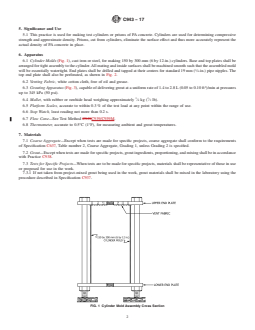
FIG. 1 Cylinder Mold Assembly Cross Section
10.1.2 When test cylinders are prepared in the field, record
ambient temperature in the vicinity of test operation.
10.2 Placeeachcylindermolduprightonitsbottomplateon
a firm, level surface.
6.2 Venting Fabric, white cotton cloth, free of oil and
10.3 Place the coarse aggregate in the mold in three ap-
grease.
proximately equal layers. Consolidate each layer by striking
6.3 Grouting Apparatus (Fig. 3), capable of delivering grout
the mold ten times around its periphery with the mallet. When
at a uniform rate of 1.4 to 2.8 L (0.05 to 0.10 ft )/min at
the mold has
...
This document is not an ASTM standard and is intended only to provide the user of an ASTM standard an indication of what changes have been made to the previous version. Because
it may not be technically possible to adequately depict all changes accurately, ASTM recommends that users consult prior editions as appropriate. In all cases only the current version
of the standard as published by ASTM is to be considered the official document.
Designation: C943 − 10 C943 − 17
Standard Practice for
Making Test Cylinders and Prisms for Determining Strength
and Density of Preplaced-Aggregate Concrete in the
Laboratory
This standard is issued under the fixed designation C943; the number immediately following the designation indicates the year of
original adoption or, in the case of revision, the year of last revision. A number in parentheses indicates the year of last reapproval. A
superscript epsilon (´) indicates an editorial change since the last revision or reapproval.
1. Scope*
1.1 This practice covers procedures for making standard test cylinders used to determine the compressive strength and density
of preplaced-aggregate (PA) concrete.
1.2 The values stated in SI units are to be regarded as the standard. The values given in parentheses are for information only.
1.3 This standard does not purport to address all of the safety concerns, if any, associated with its use. It is the responsibility
of the user of this standard to establish appropriate safety safety, health, and healthenvironmental practices and determine the
applicability of regulatory limitations prior to use.Warning—Fresh hydraulic cementitious mixtures are caustic and may cause
chemical burns to skin and tissue upon prolonged exposure.
1.4 This international standard was developed in accordance with internationally recognized principles on standardization
established in the Decision on Principles for the Development of International Standards, Guides and Recommendations issued
by the World Trade Organization Technical Barriers to Trade (TBT) Committee.
2. Referenced Documents
2.1 ASTM Standards:
C125 Terminology Relating to Concrete and Concrete Aggregates
C192/C192M Practice for Making and Curing Concrete Test Specimens in the Laboratory
C219 Terminology Relating to Hydraulic Cement
C637 Specification for Aggregates for Radiation-Shielding Concrete
C937 Specification for Grout Fluidifier for Preplaced-Aggregate Concrete
C938 Practice for Proportioning Grout Mixtures for Preplaced-Aggregate Concrete
C939C939/C939M Test Method for Flow of Grout for Preplaced-Aggregate Concrete (Flow Cone Method)
C940 Test Method for Expansion and Bleeding of Freshly Mixed Grouts for Preplaced-Aggregate Concrete in the Laboratory
3. Terminology
3.1 Definitions:
3.1.1 For definitions of terms used in this test method, refer to Terminologies C125 and C219.
4. Summary of Practice
4.1 Coarse aggregate is placed in a standard cylinder mold having end plates to which pipe fittings have been attached. Grout
is pumped into the mold until full. The test cylinder, demolded after hardening, may be cured and used for determination of strength
or cut into prisms for the determination of unit weight.
This practice is under the jurisdiction of ASTM Committee C09 on Concrete and Concrete Aggregates and is the direct responsibility of Subcommittee C09.41 on
Hydraulic Cement Grouts.
Current edition approved June 15, 2010Dec. 15, 2017. Published July 2010January 2018. Originally approved in 1980. Last previous edition approved in 20022010 as
C943 – 02.10. DOI: 10.1520/C0943-10.10.1520/C0943-17.
Section on Safety Precautions, Manual of Aggregate and Concrete Testing, Annual Book of ASTM Standards, Vol. 04.02.
For referenced ASTM standards, visit the ASTM website, www.astm.org, or contact ASTM Customer Service at service@astm.org. For Annual Book of ASTM Standards
volume information, refer to the standard’s Document Summary page on the ASTM website.
*A Summary of Changes section appears at the end of this standard
Copyright © ASTM International, 100 Barr Harbor Drive, PO Box C700, West Conshohocken, PA 19428-2959. United States
C943 − 17
5. Significance and Use
5.1 This practice is used for making test cylinders or prisms of PA concrete. Cylinders are used for determining compressive
strength and approximate density. Prisms, cut from cylinders, eliminate the surface effect and thus more accurately represent the
actual density of PA concrete in place.
6. Apparatus
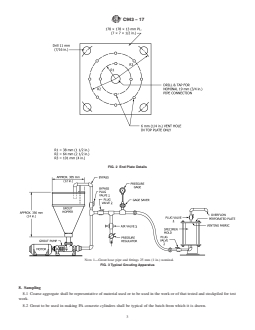
6.1 Cylinder Molds (Fig. 1), cast iron or steel, for making 150 by 300-mm (6 by 12-in.) cylinders. Base and top plates shall be
arranged for tight assembly to the cylinder. All mating and inside surfaces shall be machined smooth such that the assembled mold
will be essentially watertight. End plates shall be drilled and tapped at their centers for standard 19 mm ( ⁄4-in.) pipe nipples. The
top end plate shall also be perforated, as shown in Fig. 2.
6.2 Venting Fabric, white cotton cloth, free of oil and grease.
6.3 Grouting Apparatus (Fig. 3), capable of delivering grout at a uniform rate of 1.4 to 2.8 L (0.05 to 0.10 ft )/min at pressures
up to 345 kPa (50 psi).
1 1
6.4 Mallet, with rubber or rawhide head weighing approximately ⁄4 kg ( ⁄2 lb).
6.5 Platform Scales, accurate to within 0.3 % of the test load at any point within the range of use.
6.6 Stop Watch, least reading not more than 0.2 s.
6.7 Flow Cone—See Test Method C939C939/C939M.
6.8 Thermometer, accurate to 0.5°C (1°F), for measuring ambient and grout temperatures.
7. Materials
7.1 Coarse Aggregate—Except when tests are made for specific projects, coarse aggregate shall conform to the requirements
of Specification C637, Table number 2, Coarse Aggregate, Grading 1, unless Grading 2 is specified.
7.2 Grout—Except when tests are made for specific projects, grout ingredients, proportioning, and mixing shall be in accordance
with Practice C938.
7.3 Tests for Specific Projects—When tests are to be made for specific projects, materials shall be representative of those in use
or proposed for use in the work.
7.3.1 If not taken from project-mixed grout being used in the work, grout materials shall be mixed in the laboratory using the
procedure described in Specification C937.
FIG. 1 Cylinder Mold Assembly Cross Section
C943 − 17
FIG. 2 End Plate Details
NOTE 1—Grout hose pipe and fittings 25 mm (1 in.) nominal.
FIG. 3 Typical Grouting Apparatus
8. Sampling
8.1 Coarse aggregat
...