

ASTM D3165-07(2023)
(Test Method)Standard Test Method for Strength Properties of Adhesives in Shear by Tension Loading of Single-Lap-Joint Laminated Assemblies
General Information
- Abstract
SIGNIFICANCE AND USE
4.1 This test method is useful in that the joint configuration closely simulates the actual joint configuration of many bonded assemblies. Surface preparation of the adherends can affect the apparent shear strength of the adhesive and can be one of the variables under study.
4.2 This test method is also useful as an in-process quality control test for laminated assemblies. In practice the laminated assembly is either made over size and test specimens removed from it or a percentage of the assemblies are destructively tested.
4.3 The misuse of strength values obtained from this test method as design allowable stress values for structural joints could lead to product failure, property damage, and human injury. The apparent shear strength of an adhesive obtained from a given small single-lap specimen may differ from that obtained from a joint made with different adherends or by a different bonding process. The normal variation of temperature and moisture in the service environment causes the adherends and the adhesive to swell and shrink. The adherends and adhesive are likely to have different thermal and moisture coefficients of expansion.
4.3.1 Even in small specimens, short-term environmental changes can induce internal stresses or chemical changes in the adhesive that permanently affect the apparent strength and other mechanical properties of the adhesive. The problem of predicting joint behavior in a changing environment is even more difficult if a different type of adherend is used in a larger structural joint than was used in the small specimen.
4.4 The apparent shear strength measured with a single-lap specimen is not suitable for determining design allowable stresses for designing structural joints that differ in any manner from the joints tested without thorough analysis and understanding of the joint and adhesive behaviors.
4.5 Single-lap tests may be used for comparing and selecting adhesives or bonding processes for susceptibility to fatigue...
SCOPE
1.1 This test method (Note 1) is intended for determining the comparative shear strengths of adhesives in large area joints when tested on a standard single-lap-joint specimen and under specified conditions of preparation and testing. Adhesives respond differently in small versus large area joints (Note 2).
Note 1: While this test method is intended for use in metal-to-metal applications, it may be used for measuring the shear properties of adhesives using plastic adherends, provided consideration is given to the thickness and rigidity of the plastic adherends. Doublers or bonded tabs may be required for plastic adherends to prevent bearing failure in the adherends.
Note 2: This variation can be influenced by adhesive density, flow characteristics, cure rate, gel time, carrier composition, entrapped volatiles, volatiles released during cure, etc. and also by cure cycle variables including: temperature, time, pressure, rise rate to temperature, cool-down rate, etc. In addition to the processing variables joint size changes the level of constraint on the adhesive as well as the influence of induced tensile loads at the edge of the joint during mechanical or thermal loading.
1.2 The values stated in SI units are to be regarded as the standard. The values given in parentheses are for information only.
1.3 This standard does not purport to address all of the safety concerns, if any, associated with its use. It is the responsibility of the user of this standard to establish appropriate safety, health, and environmental practices and determine the applicability of regulatory limitations prior to use.
1.4 This international standard was developed in accordance with internationally recognized principles on standardization established in the Decision on Principles for the Development of International Standards, Guides and Recommendations issued by the World Trade Organization Technical Barriers to Trade (TBT) Committee.
- Status
- Published
- Publication Date
- 31-Dec-2022
- Technical Committee
- D14 - Adhesives
- Drafting Committee
- D14.80 - Metal Bonding Adhesives
Overview
ASTM D3165-07(2023), Standard Test Method for Strength Properties of Adhesives in Shear by Tension Loading of Single-Lap-Joint Laminated Assemblies, provides a consistent approach to evaluating the shear strength of structural adhesives. Developed by ASTM International, this standard outlines precise testing conditions for single-lap-joint specimens, closely simulating actual bonded assemblies used in industry.
This test method is essential for manufacturers, researchers, and quality control teams working with adhesives in laminated assemblies. By applying specific procedures for specimen preparation, conditioning, and tensile testing, ASTM D3165 ensures reproducibility and reliable comparison of adhesive performance under defined conditions.
Key Topics
- Shear Strength Measurement: The standard focuses on determining the comparative shear strength of adhesives in single-lap-joint configurations, a common joint type in structural bonding.
- Applicability to Materials: While primarily intended for metal-to-metal bonding, the method can be adapted for adhesive testing with plastic adherends, with considerations for their thickness and rigidity.
- Specimen Preparation: Detailed guidance is given on preparing test joints and specimens, including recommended material types, surface treatments, and adhesive application methods.
- Influence of Processing Variables: The test addresses how variables such as adhesive cure rate, joint size, temperature, humidity, and surface preparation can impact measured shear strength.
- Cautions in Interpretation: Results from single-lap-joint testing can inform adhesive evaluation but should not be used directly for structural design allowable stresses without thorough analysis.
Applications
ASTM D3165 is widely used in the following areas:
- Adhesive Selection and Comparison: Enables comparative evaluation of different adhesives or bonding processes for their resistance to shear forces.
- Process Development and Quality Control: Serves as a valuable quality control tool during the manufacture of laminated assemblies, ensuring adhesive performance meets required standards.
- Research and Development: Assists in studying adhesive behavior under different environmental conditions and surface preparations, informing product development and process optimization.
- Failure Analysis: The test helps identify cohesive, adhesive, or substrate failures, supporting improvement of adhesives or bonding techniques.
- Adaptability to Plastics: When adapted for plastics, the standard allows for the evaluation of adhesive performance using appropriate test configurations and surface treatments.
Related Standards
For comprehensive adhesive testing and bonding evaluation, the following ASTM standards are often referenced alongside ASTM D3165:
- ASTM D907 - Terminology of Adhesives
- ASTM D2093 - Practice for Preparation of Surfaces of Plastics Prior to Adhesive Bonding
- ASTM D2651 - Guide for Preparation of Metal Surfaces for Adhesive Bonding
- ASTM D3933 - Guide for Preparation of Aluminum Surfaces for Structural Adhesives Bonding
- ASTM D4896 - Guide for Use of Adhesive-Bonded Single Lap-Joint Specimen Test Results
- ASTM E4 - Practices for Force Calibration and Verification of Testing Machines
Summary
ASTM D3165-07(2023) is a reliable standard for testing the strength properties of adhesives in shear by single-lap-joint tension loading. Its robust methodology supports adhesive characterization, quality control, and material comparison for metal and plastic bonded assemblies. By following ASTM guidelines, organizations can ensure consistency, safety, and reliability in their adhesive evaluation processes.
Keywords: ASTM D3165, shear strength, adhesive testing, single-lap joint, laminated assemblies, quality control, adhesive evaluation, bonded assemblies, structural adhesives
Relations
- Effective Date
- 01-Oct-2023
- Refers
ASTM B265-20a - Standard Specification for Titanium and Titanium Alloy Strip, Sheet, and Plate - Effective Date
- 01-Apr-2020
- Effective Date
- 01-Jan-2020
- Effective Date
- 01-Oct-2019
- Effective Date
- 01-Oct-2018
- Effective Date
- 01-Nov-2017
- Effective Date
- 01-Apr-2017
- Effective Date
- 01-May-2016
- Effective Date
- 01-May-2016
- Effective Date
- 01-Nov-2015
- Effective Date
- 01-Jun-2014
- Effective Date
- 01-Oct-2013
- Refers
ASTM B265-13ae1 - Standard Specification for Titanium and Titanium Alloy Strip, Sheet, and Plate - Effective Date
- 01-Jul-2013
- Refers
ASTM B265-13a - Standard Specification for Titanium and Titanium Alloy Strip, Sheet, and Plate - Effective Date
- 01-Jul-2013
- Effective Date
- 01-Jun-2013
Get Certified
Connect with accredited certification bodies for this standard

DIN CERTCO
DIN Group product certification.

Smithers Quality Assessments
US management systems and product certification.
Sponsored listings
Frequently Asked Questions
ASTM D3165-07(2023) is a standard published by ASTM International. Its full title is "Standard Test Method for Strength Properties of Adhesives in Shear by Tension Loading of Single-Lap-Joint Laminated Assemblies". This standard covers: SIGNIFICANCE AND USE 4.1 This test method is useful in that the joint configuration closely simulates the actual joint configuration of many bonded assemblies. Surface preparation of the adherends can affect the apparent shear strength of the adhesive and can be one of the variables under study. 4.2 This test method is also useful as an in-process quality control test for laminated assemblies. In practice the laminated assembly is either made over size and test specimens removed from it or a percentage of the assemblies are destructively tested. 4.3 The misuse of strength values obtained from this test method as design allowable stress values for structural joints could lead to product failure, property damage, and human injury. The apparent shear strength of an adhesive obtained from a given small single-lap specimen may differ from that obtained from a joint made with different adherends or by a different bonding process. The normal variation of temperature and moisture in the service environment causes the adherends and the adhesive to swell and shrink. The adherends and adhesive are likely to have different thermal and moisture coefficients of expansion. 4.3.1 Even in small specimens, short-term environmental changes can induce internal stresses or chemical changes in the adhesive that permanently affect the apparent strength and other mechanical properties of the adhesive. The problem of predicting joint behavior in a changing environment is even more difficult if a different type of adherend is used in a larger structural joint than was used in the small specimen. 4.4 The apparent shear strength measured with a single-lap specimen is not suitable for determining design allowable stresses for designing structural joints that differ in any manner from the joints tested without thorough analysis and understanding of the joint and adhesive behaviors. 4.5 Single-lap tests may be used for comparing and selecting adhesives or bonding processes for susceptibility to fatigue... SCOPE 1.1 This test method (Note 1) is intended for determining the comparative shear strengths of adhesives in large area joints when tested on a standard single-lap-joint specimen and under specified conditions of preparation and testing. Adhesives respond differently in small versus large area joints (Note 2). Note 1: While this test method is intended for use in metal-to-metal applications, it may be used for measuring the shear properties of adhesives using plastic adherends, provided consideration is given to the thickness and rigidity of the plastic adherends. Doublers or bonded tabs may be required for plastic adherends to prevent bearing failure in the adherends. Note 2: This variation can be influenced by adhesive density, flow characteristics, cure rate, gel time, carrier composition, entrapped volatiles, volatiles released during cure, etc. and also by cure cycle variables including: temperature, time, pressure, rise rate to temperature, cool-down rate, etc. In addition to the processing variables joint size changes the level of constraint on the adhesive as well as the influence of induced tensile loads at the edge of the joint during mechanical or thermal loading. 1.2 The values stated in SI units are to be regarded as the standard. The values given in parentheses are for information only. 1.3 This standard does not purport to address all of the safety concerns, if any, associated with its use. It is the responsibility of the user of this standard to establish appropriate safety, health, and environmental practices and determine the applicability of regulatory limitations prior to use. 1.4 This international standard was developed in accordance with internationally recognized principles on standardization established in the Decision on Principles for the Development of International Standards, Guides and Recommendations issued by the World Trade Organization Technical Barriers to Trade (TBT) Committee.
SIGNIFICANCE AND USE 4.1 This test method is useful in that the joint configuration closely simulates the actual joint configuration of many bonded assemblies. Surface preparation of the adherends can affect the apparent shear strength of the adhesive and can be one of the variables under study. 4.2 This test method is also useful as an in-process quality control test for laminated assemblies. In practice the laminated assembly is either made over size and test specimens removed from it or a percentage of the assemblies are destructively tested. 4.3 The misuse of strength values obtained from this test method as design allowable stress values for structural joints could lead to product failure, property damage, and human injury. The apparent shear strength of an adhesive obtained from a given small single-lap specimen may differ from that obtained from a joint made with different adherends or by a different bonding process. The normal variation of temperature and moisture in the service environment causes the adherends and the adhesive to swell and shrink. The adherends and adhesive are likely to have different thermal and moisture coefficients of expansion. 4.3.1 Even in small specimens, short-term environmental changes can induce internal stresses or chemical changes in the adhesive that permanently affect the apparent strength and other mechanical properties of the adhesive. The problem of predicting joint behavior in a changing environment is even more difficult if a different type of adherend is used in a larger structural joint than was used in the small specimen. 4.4 The apparent shear strength measured with a single-lap specimen is not suitable for determining design allowable stresses for designing structural joints that differ in any manner from the joints tested without thorough analysis and understanding of the joint and adhesive behaviors. 4.5 Single-lap tests may be used for comparing and selecting adhesives or bonding processes for susceptibility to fatigue... SCOPE 1.1 This test method (Note 1) is intended for determining the comparative shear strengths of adhesives in large area joints when tested on a standard single-lap-joint specimen and under specified conditions of preparation and testing. Adhesives respond differently in small versus large area joints (Note 2). Note 1: While this test method is intended for use in metal-to-metal applications, it may be used for measuring the shear properties of adhesives using plastic adherends, provided consideration is given to the thickness and rigidity of the plastic adherends. Doublers or bonded tabs may be required for plastic adherends to prevent bearing failure in the adherends. Note 2: This variation can be influenced by adhesive density, flow characteristics, cure rate, gel time, carrier composition, entrapped volatiles, volatiles released during cure, etc. and also by cure cycle variables including: temperature, time, pressure, rise rate to temperature, cool-down rate, etc. In addition to the processing variables joint size changes the level of constraint on the adhesive as well as the influence of induced tensile loads at the edge of the joint during mechanical or thermal loading. 1.2 The values stated in SI units are to be regarded as the standard. The values given in parentheses are for information only. 1.3 This standard does not purport to address all of the safety concerns, if any, associated with its use. It is the responsibility of the user of this standard to establish appropriate safety, health, and environmental practices and determine the applicability of regulatory limitations prior to use. 1.4 This international standard was developed in accordance with internationally recognized principles on standardization established in the Decision on Principles for the Development of International Standards, Guides and Recommendations issued by the World Trade Organization Technical Barriers to Trade (TBT) Committee.
ASTM D3165-07(2023) is classified under the following ICS (International Classification for Standards) categories: 83.180 - Adhesives. The ICS classification helps identify the subject area and facilitates finding related standards.
ASTM D3165-07(2023) has the following relationships with other standards: It is inter standard links to ASTM B36/B36M-23, ASTM B265-20a, ASTM B265-20, ASTM B152/B152M-19, ASTM B36/B36M-18, ASTM D3933-98(2017), ASTM D2093-03(2017), ASTM D2651-01(2016), ASTM D4896-01(2016), ASTM B265-15, ASTM E4-14, ASTM B36/B36M-13, ASTM B265-13ae1, ASTM B265-13a, ASTM B265-13. Understanding these relationships helps ensure you are using the most current and applicable version of the standard.
ASTM D3165-07(2023) is available in PDF format for immediate download after purchase. The document can be added to your cart and obtained through the secure checkout process. Digital delivery ensures instant access to the complete standard document.
Standards Content (Sample)
This international standard was developed in accordance with internationally recognized principles on standardization established in the Decision on Principles for the
Development of International Standards, Guides and Recommendations issued by the World Trade Organization Technical Barriers to Trade (TBT) Committee.
Designation: D3165 − 07 (Reapproved 2023)
Standard Test Method for
Strength Properties of Adhesives in Shear by Tension
Loading of Single-Lap-Joint Laminated Assemblies
This standard is issued under the fixed designation D3165; the number immediately following the designation indicates the year of
original adoption or, in the case of revision, the year of last revision. A number in parentheses indicates the year of last reapproval. A
superscript epsilon (´) indicates an editorial change since the last revision or reapproval.
1. Scope 2. Referenced Documents
2.1 ASTM Standards:
1.1 This test method (Note 1) is intended for determining
A167 Specification for Stainless and Heat-Resisting
the comparative shear strengths of adhesives in large area
Chromium-Nickel Steel Plate, Sheet, and Strip (With-
joints when tested on a standard single-lap-joint specimen and
drawn 2014)
under specified conditions of preparation and testing. Adhe-
A366/A366M Specification for Commercial Steel (CS)
sives respond differently in small versus large area joints (Note
Sheet, Carbon, (0.15 Maximum Percent) Cold-Rolled
2).
(Withdrawn 2000)
NOTE 1—While this test method is intended for use in metal-to-metal
B36/B36M Specification for Brass Plate, Sheet, Strip, And
applications, it may be used for measuring the shear properties of
Rolled Bar
adhesives using plastic adherends, provided consideration is given to the
B152/B152M Specification for Copper Sheet, Strip, Plate,
thickness and rigidity of the plastic adherends. Doublers or bonded tabs
and Rolled Bar
may be required for plastic adherends to prevent bearing failure in the
adherends. B209 Specification for Aluminum and Aluminum-Alloy
Sheet and Plate (Metric) B0209_B0209M
NOTE 2—This variation can be influenced by adhesive density, flow
characteristics, cure rate, gel time, carrier composition, entrapped
B265 Specification for Titanium and Titanium Alloy Strip,
volatiles, volatiles released during cure, etc. and also by cure cycle
Sheet, and Plate
variables including: temperature, time, pressure, rise rate to temperature,
D907 Terminology of Adhesives
cool-down rate, etc. In addition to the processing variables joint size
D2093 Practice for Preparation of Surfaces of Plastics Prior
changes the level of constraint on the adhesive as well as the influence of
to Adhesive Bonding
induced tensile loads at the edge of the joint during mechanical or thermal
loading. D2651 GuideforPreparationofMetalSurfacesforAdhesive
Bonding
1.2 The values stated in SI units are to be regarded as the
D3933 Guide for Preparation of Aluminum Surfaces for
standard. The values given in parentheses are for information
Structural Adhesives Bonding (Phosphoric Acid Anodiz-
only.
ing)
1.3 This standard does not purport to address all of the D4896 Guide for Use ofAdhesive-Bonded Single Lap-Joint
safety concerns, if any, associated with its use. It is the
Specimen Test Results
responsibility of the user of this standard to establish appro- E4 Practices for Force Calibration and Verification of Test-
priate safety, health, and environmental practices and deter- ing Machines
mine the applicability of regulatory limitations prior to use.
3. Terminology
1.4 This international standard was developed in accor-
3.1 Definitions—Many terms in this test method are defined
dance with internationally recognized principles on standard-
in Terminology D907.
ization established in the Decision on Principles for the
Development of International Standards, Guides and Recom-
4. Significance and Use
mendations issued by the World Trade Organization Technical
4.1 This test method is useful in that the joint configuration
Barriers to Trade (TBT) Committee.
closelysimulatestheactualjointconfigurationofmanybonded
1 2
This test method is under the jurisdiction of ASTM Committee D14 on For referenced ASTM standards, visit the ASTM website, www.astm.org, or
Adhesives and is the direct responsibility of Subcommittee D14.80 on Metal contact ASTM Customer Service at service@astm.org. For Annual Book of ASTM
Bonding Adhesives. Standards volume information, refer to the standard’s Document Summary page on
Current edition approved Jan. 1, 2023. Published January 2023. Originally the ASTM website.
approved in 1973. Last previous edition approved in 2014 as D3165 – 07 (2014). The last approved version of this historical standard is referenced on
DOI: 10.1520/D3165-07R23. www.astm.org.
Copyright © ASTM International, 100 Barr Harbor Drive, PO Box C700, West Conshohocken, PA 19428-2959. United States
D3165 − 07 (2023)
assemblies. Surface preparation of the adherends can affect the 4.5 Single-lap tests may be used for comparing and select-
apparent shear strength of the adhesive and can be one of the ing adhesives or bonding processes for susceptibility to fatigue
variables under study.
and environmental changes, but such comparisons must be
made with great caution since different adhesives may respond
4.2 This test method is also useful as an in-process quality
differently in different joints. Review Guide D4896 for further
control test for laminated assemblies. In practice the laminated
discussion of concepts for interpretation of adhesive-bonded
assembly is either made over size and test specimens removed
from it or a percentage of the assemblies are destructively single-lap joint data.
tested.
5. Apparatus
4.3 The misuse of strength values obtained from this test
method as design allowable stress values for structural joints
5.1 Testing Machine, conforming to the requirements of
could lead to product failure, property damage, and human
Practice E4. The testing machine shall be so selected that the
injury. The apparent shear strength of an adhesive obtained
breaking load of the specimens falls between 15 and 85 % of
from a given small single-lap specimen may differ from that
the full-scale capacity. The machine shall be capable of
obtained from a joint made with different adherends or by a
maintaining a rate of loading of 8.3 MPa⁄min to 9.7 MPa/min
different bonding process.The normal variation of temperature
(1200 psi⁄min to 1400 psi/min), or, if the rate is dependent on
and moisture in the service environment causes the adherends
crosshead motion, the machine should be set to approach this
and the adhesive to swell and shrink. The adherends and
rate of loading [approximately 1.27 mm/min (0.05 in./min)
adhesive are likely to have different thermal and moisture
crosshead speed]. It shall be provided with a suitable pair of
coefficients of expansion.
self-aligning grips to hold the specimen. It is recommended
4.3.1 Even in small specimens, short-term environmental
that the jaws of these grips shall engage the outer 25.4 mm (1
changes can induce internal stresses or chemical changes in the
in.) of each end of the test specimen firmly (Note 3). The grips
adhesive that permanently affect the apparent strength and
and attachments shall be so constructed that they will move
other mechanical properties of the adhesive. The problem of
predicting joint behavior in a changing environment is even into alignment with the test specimen as soon as the load is
more difficult if a different type of adherend is used in a larger applied, so that the long axis of the test specimen will coincide
structural joint than was used in the small specimen.
with the direction of the applied pull through the center of the
grip assembly.
4.4 The apparent shear strength measured with a single-lap
specimen is not suitable for determining design allowable
NOTE 3—The length of overlap in the specimen may be varied where
stresses for designing structural joints that differ in any manner
necessary. The length of the specimen between the end of the jaws to the
from the joints tested without thorough analysis and under-
beginning of the lap however, must not be varied. This distance should be
standing of the joint and adhesive behaviors. 63 mm (2.5 in.) in all tests.
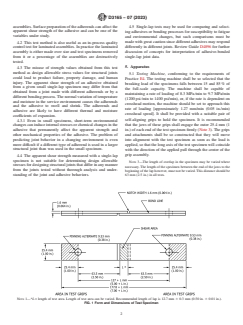
NOTE 1—*L = length of test area. Length of test area can be varied. Recommended length of lap is 12.7 mm 6 0.3 mm (0.50 in. 6 0.01 in.).
FIG. 1 Form and Dimensions of Test Specimen
D3165 − 07 (2023)
NOTE 4—Since it is undesirable to exceed the yield point of the metal
6. Test Specimens
in tension during test, the permissible length of overlap in the specimen
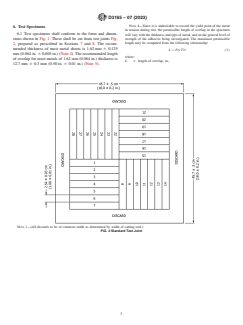
6.1 Test specimens shall conform to the form and dimen-
will vary with the thickness and type of
...