

ASTM C1524-20
(Test Method)Standard Test Method for Water-Extractable Chloride in Aggregate (Soxhlet Method)
General Information
- Abstract
SIGNIFICANCE AND USE
4.1 Water-extractable chloride, when present in sufficient amount, has a potential to initiate or accelerate corrosion of metals, such as steel, embedded in or contacting a cementitious system, such as mortar, grout, or concrete. This test method is applicable when aggregates contain a high background of naturally occurring chloride (see ACI 222.1–96 ). Test Method C1152/C1152M determines acid-soluble chloride and Test Method C1218/C1218M determines water-soluble chloride. Both Test Methods C1152/C1152M and C1218/C1218M pulverize the sample to a fine powder or fine granular material. The Soxhlet method is intended to use nonpulverized material. Results with some aggregates have shown that the Soxhlet procedure extracts an extremely low amount of chloride, with most of it remaining in the rock, and therefore, it is not available for corrosion.
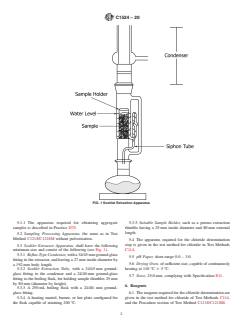
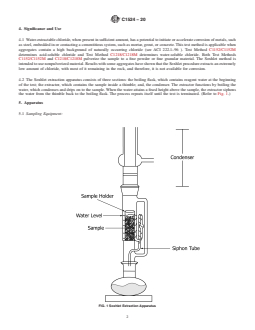
4.2 The Soxhlet extraction apparatus consists of three sections: the boiling flask, which contains reagent water at the beginning of the test; the extractor, which contains the sample inside a thimble; and, the condenser. The extractor functions by boiling the water, which condenses and drips on to the sample. When the water attains a fixed height above the sample, the extractor siphons the water from the thimble back to the boiling flask. The process repeats itself until the test is terminated. (Refer to Fig. 1.)
FIG. 1 Soxhlet Extraction Apparatus
SCOPE
1.1 This test method provides procedures for sampling and analysis of aggregate for water-extractable chloride using a Soxhlet extractor.
Note 1: This test method is to be used when significantly high chloride content has been found in aggregates, concretes, or mortars.
1.2 The values stated in SI units are to be regarded as standard. No other units of measurement are included in this standard.
1.3 This standard does not purport to address all of the safety concerns, if any, associated with its use. It is the responsibility of the user of this standard to establish appropriate safety, health, and environmental practices and determine the applicability of regulatory limitations prior to use.
1.4 This international standard was developed in accordance with internationally recognized principles on standardization established in the Decision on Principles for the Development of International Standards, Guides and Recommendations issued by the World Trade Organization Technical Barriers to Trade (TBT) Committee.
- Status
- Published
- Publication Date
- 14-Dec-2020
- Technical Committee
- C09 - Concrete and Concrete Aggregates
- Drafting Committee
- C09.69 - Miscellaneous Tests
Buy Documents
ASTM C1524-20 - Standard Test Method for Water-Extractable Chloride in Aggregate (Soxhlet Method)
REDLINE ASTM C1524-20 - Standard Test Method for Water-Extractable Chloride in Aggregate (Soxhlet Method)
Overview
ASTM C1524-20: Standard Test Method for Water-Extractable Chloride in Aggregate (Soxhlet Method) provides a procedure for determining the water-extractable (leachable) chloride content in aggregates using the Soxhlet extraction technique. Chloride content is a critical parameter, as elevated levels can initiate or accelerate corrosion of metals (such as reinforcing steel) in contact with cementitious systems including concrete, mortar, and grout. Unlike some alternative test methods, this standard is specifically designed for use with nonpulverized aggregate, offering insight into the amount of chloride actually available to cause corrosion.
This ASTM standard is particularly relevant when aggregates are known or suspected to contain naturally occurring high levels of chloride, and helps differentiate between chloride that is tightly bound within the aggregate (integral) versus chloride that is readily extractable with water under specific conditions.
Key Topics
- Water-Extractable Chloride in Aggregates: Assesses the potential risk associated with the release of chloride ions from aggregates in concrete or other cement-based systems.
- Soxhlet Extraction Method: Utilizes a cycle of boiling and condensation to wash the aggregates with reagent water, extracting any soluble chlorides without pulverizing the sample.
- Corrosion Risk Assessment: Helps determine the contribution of aggregates to corrosion risks in steel-reinforced structures.
- Sample Handling: Describes precise techniques for sampling, reducing, and preparing aggregates for testing to ensure consistent and reliable results.
- Precision and Bias: Highlights the reproducibility of the method within and between laboratories, reinforcing its value in quality control and specification compliance.
Applications
The ASTM C1524-20 standard is widely used in the construction industry, particularly in:
- Quality Control: Construction material suppliers and laboratories use this method to certify aggregate sources, especially where there is concern about high background levels of chloride.
- Infrastructure Projects: Applicable for bridges, highways, marine structures, and buildings where the presence of chlorides in concrete aggregates could jeopardize durability and service life.
- Aggregate Source Evaluation: Supports decisions on the suitability of aggregates for use in reinforced concrete, based on actual extractable chloride content rather than total chloride.
- Regulatory Compliance: Ensures that aggregate materials meet specifications that limit chloride contributions, reducing the risk of early corrosion in reinforcement.
This test method is particularly useful when other methods (such as acid-soluble or water-soluble chloride testing) yield high values due to aggregate pulverization, which may overstate the risk by releasing chlorides that would not be available under actual service conditions.
Related Standards
ASTM C1524-20 works in conjunction with several other important standards aimed at chloride determination and aggregate analysis:
- ASTM C114: Test Methods for Chemical Analysis of Hydraulic Cement
- ASTM C1152/C1152M: Test Method for Acid-Soluble Chloride in Mortar and Concrete
- ASTM C1218/C1218M: Test Method for Water-Soluble Chloride in Mortar and Concrete (uses powdered samples)
- ASTM D75: Practice for Sampling Aggregates
- ASTM D1193: Specification for Reagent Water
- ASTM E11: Specification for Woven Wire Test Sieve Cloth and Test Sieves
- ACI 222.1-96: American Concrete Institute standard for water-soluble chloride in mortar and concrete using the Soxhlet extractor
These referenced standards provide related sampling, chemical analysis, and apparatus requirements to ensure accurate and standardized results.
Keywords: water-extractable chloride, Soxhlet method, aggregate testing, corrosion of reinforcement, concrete durability, ASTM C1524-20, chloride content, construction materials testing, cementitious systems, aggregate evaluation.
Relations
- Effective Date
- 01-Feb-2024
- Effective Date
- 01-Jan-2024
- Effective Date
- 01-Oct-2023
- Effective Date
- 15-Dec-2019
- Effective Date
- 01-Jan-2019
- Effective Date
- 01-Oct-2018
- Effective Date
- 01-Jul-2018
- Effective Date
- 01-Jan-2018
- Effective Date
- 15-Dec-2016
- Effective Date
- 15-Dec-2015
- Effective Date
- 01-Jul-2015
- Effective Date
- 01-Jul-2015
- Effective Date
- 01-Feb-2015
- Effective Date
- 01-Aug-2014
- Effective Date
- 15-Dec-2013
Buy Documents
ASTM C1524-20 - Standard Test Method for Water-Extractable Chloride in Aggregate (Soxhlet Method)
REDLINE ASTM C1524-20 - Standard Test Method for Water-Extractable Chloride in Aggregate (Soxhlet Method)
Get Certified
Connect with accredited certification bodies for this standard

DIBt (Deutsches Institut für Bautechnik)
German Institute for Building Technology.
DIN CERTCO
DIN Group product certification.

Aboma Certification B.V.
Specialized in construction, metal, and transport sectors.
Sponsored listings
Frequently Asked Questions
ASTM C1524-20 is a standard published by ASTM International. Its full title is "Standard Test Method for Water-Extractable Chloride in Aggregate (Soxhlet Method)". This standard covers: SIGNIFICANCE AND USE 4.1 Water-extractable chloride, when present in sufficient amount, has a potential to initiate or accelerate corrosion of metals, such as steel, embedded in or contacting a cementitious system, such as mortar, grout, or concrete. This test method is applicable when aggregates contain a high background of naturally occurring chloride (see ACI 222.1–96 ). Test Method C1152/C1152M determines acid-soluble chloride and Test Method C1218/C1218M determines water-soluble chloride. Both Test Methods C1152/C1152M and C1218/C1218M pulverize the sample to a fine powder or fine granular material. The Soxhlet method is intended to use nonpulverized material. Results with some aggregates have shown that the Soxhlet procedure extracts an extremely low amount of chloride, with most of it remaining in the rock, and therefore, it is not available for corrosion. 4.2 The Soxhlet extraction apparatus consists of three sections: the boiling flask, which contains reagent water at the beginning of the test; the extractor, which contains the sample inside a thimble; and, the condenser. The extractor functions by boiling the water, which condenses and drips on to the sample. When the water attains a fixed height above the sample, the extractor siphons the water from the thimble back to the boiling flask. The process repeats itself until the test is terminated. (Refer to Fig. 1.) FIG. 1 Soxhlet Extraction Apparatus SCOPE 1.1 This test method provides procedures for sampling and analysis of aggregate for water-extractable chloride using a Soxhlet extractor. Note 1: This test method is to be used when significantly high chloride content has been found in aggregates, concretes, or mortars. 1.2 The values stated in SI units are to be regarded as standard. No other units of measurement are included in this standard. 1.3 This standard does not purport to address all of the safety concerns, if any, associated with its use. It is the responsibility of the user of this standard to establish appropriate safety, health, and environmental practices and determine the applicability of regulatory limitations prior to use. 1.4 This international standard was developed in accordance with internationally recognized principles on standardization established in the Decision on Principles for the Development of International Standards, Guides and Recommendations issued by the World Trade Organization Technical Barriers to Trade (TBT) Committee.
SIGNIFICANCE AND USE 4.1 Water-extractable chloride, when present in sufficient amount, has a potential to initiate or accelerate corrosion of metals, such as steel, embedded in or contacting a cementitious system, such as mortar, grout, or concrete. This test method is applicable when aggregates contain a high background of naturally occurring chloride (see ACI 222.1–96 ). Test Method C1152/C1152M determines acid-soluble chloride and Test Method C1218/C1218M determines water-soluble chloride. Both Test Methods C1152/C1152M and C1218/C1218M pulverize the sample to a fine powder or fine granular material. The Soxhlet method is intended to use nonpulverized material. Results with some aggregates have shown that the Soxhlet procedure extracts an extremely low amount of chloride, with most of it remaining in the rock, and therefore, it is not available for corrosion. 4.2 The Soxhlet extraction apparatus consists of three sections: the boiling flask, which contains reagent water at the beginning of the test; the extractor, which contains the sample inside a thimble; and, the condenser. The extractor functions by boiling the water, which condenses and drips on to the sample. When the water attains a fixed height above the sample, the extractor siphons the water from the thimble back to the boiling flask. The process repeats itself until the test is terminated. (Refer to Fig. 1.) FIG. 1 Soxhlet Extraction Apparatus SCOPE 1.1 This test method provides procedures for sampling and analysis of aggregate for water-extractable chloride using a Soxhlet extractor. Note 1: This test method is to be used when significantly high chloride content has been found in aggregates, concretes, or mortars. 1.2 The values stated in SI units are to be regarded as standard. No other units of measurement are included in this standard. 1.3 This standard does not purport to address all of the safety concerns, if any, associated with its use. It is the responsibility of the user of this standard to establish appropriate safety, health, and environmental practices and determine the applicability of regulatory limitations prior to use. 1.4 This international standard was developed in accordance with internationally recognized principles on standardization established in the Decision on Principles for the Development of International Standards, Guides and Recommendations issued by the World Trade Organization Technical Barriers to Trade (TBT) Committee.
ASTM C1524-20 is classified under the following ICS (International Classification for Standards) categories: 91.100.30 - Concrete and concrete products. The ICS classification helps identify the subject area and facilitates finding related standards.
ASTM C1524-20 has the following relationships with other standards: It is inter standard links to ASTM C670-24a, ASTM C670-24, ASTM C114-23, ASTM C125-19a, ASTM C125-19, ASTM C125-18b, ASTM C125-18a, ASTM C125-18, ASTM C125-16, ASTM C125-15b, ASTM C1218/C1218M-15, ASTM C125-15a, ASTM C125-15, ASTM C125-14, ASTM C125-13b. Understanding these relationships helps ensure you are using the most current and applicable version of the standard.
ASTM C1524-20 is available in PDF format for immediate download after purchase. The document can be added to your cart and obtained through the secure checkout process. Digital delivery ensures instant access to the complete standard document.
Standards Content (Sample)
This international standard was developed in accordance with internationally recognized principles on standardization established in the Decision on Principles for the
Development of International Standards, Guides and Recommendations issued by the World Trade Organization Technical Barriers to Trade (TBT) Committee.
Designation: C1524 − 20
Standard Test Method for
Water-Extractable Chloride in Aggregate (Soxhlet Method)
This standard is issued under the fixed designation C1524; the number immediately following the designation indicates the year of
original adoption or, in the case of revision, the year of last revision. A number in parentheses indicates the year of last reapproval. A
superscript epsilon (´) indicates an editorial change since the last revision or reapproval.
1. Scope* D75 Practice for Sampling Aggregates
D1193 Specification for Reagent Water
1.1 This test method provides procedures for sampling and
E11 Specification for Woven Wire Test Sieve Cloth and Test
analysis of aggregate for water-extractable chloride using a
Sieves
Soxhlet extractor.
2.2 American Concrete Institute Standard:
NOTE1—Thistestmethodistobeusedwhensignificantlyhighchloride
ACI 222.1–96 Provisional Standard Test Method for Water-
content has been found in aggregates, concretes, or mortars.
Soluble Chloride Available for Corrosion of Embedded
1.2 The values stated in SI units are to be regarded as
Steel in Mortar and Concrete Using the Soxhlet Extractor
standard. No other units of measurement are included in this
3. Terminology
standard.
3.1 For definitions of terms used in this test method, refer to
1.3 This standard does not purport to address all of the
Terminology C125.
safety concerns, if any, associated with its use. It is the
responsibility of the user of this standard to establish appro-
4. Significance and Use
priate safety, health, and environmental practices and deter-
4.1 Water-extractable chloride, when present in sufficient
mine the applicability of regulatory limitations prior to use.
amount, has a potential to initiate or accelerate corrosion of
1.4 This international standard was developed in accor-
metals, such as steel, embedded in or contacting a cementitious
dance with internationally recognized principles on standard-
system, such as mortar, grout, or concrete. This test method is
ization established in the Decision on Principles for the
applicable when aggregates contain a high background of
Development of International Standards, Guides and Recom-
naturally occurring chloride (seeACI 222.1–96 ). Test Method
mendations issued by the World Trade Organization Technical
C1152/C1152M determines acid-soluble chloride and Test
Barriers to Trade (TBT) Committee.
Method C1218/C1218M determines water-soluble chloride.
Both Test Methods C1152/C1152M and C1218/C1218M pul-
2. Referenced Documents
2 verize the sample to a fine powder or fine granular material.
2.1 ASTM Standards:
The Soxhlet method is intended to use nonpulverized material.
C114 Test Methods for Chemical Analysis of Hydraulic
Results with some aggregates have shown that the Soxhlet
Cement
procedure extracts an extremely low amount of chloride, with
C125 Terminology Relating to Concrete and Concrete Ag-
most of it remaining in the rock, and therefore, it is not
gregates
available for corrosion.
C670 Practice for Preparing Precision and Bias Statements
for Test Methods for Construction Materials 4.2 The Soxhlet extraction apparatus consists of three sec-
C1152/C1152M Test Method for Acid-Soluble Chloride in tions: the boiling flask, which contains reagent water at the
Mortar and Concrete beginning of the test; the extractor, which contains the sample
C1218/C1218M Test Method for Water-Soluble Chloride in insideathimble;and,thecondenser.Theextractorfunctionsby
Mortar and Concrete boiling the water, which condenses and drips on to the sample.
When the water attains a fixed height above the sample, the
extractorsiphonsthewaterfromthethimblebacktotheboiling
This test method is under the jurisdiction of ASTM Committee C09 on
flask. The process repeats itself until the test is terminated.
Concrete and ConcreteAggregates and is the direct responsibility of Subcommittee
(Refer to Fig. 1.)
C09.69 on Miscellaneous Tests.
Current edition approved Dec. 15, 2020. Published February 2021. Originally
5. Apparatus
approved in 2002. Last previous edition approved in 2019 as C1524 – 19. DOI:
10.1520/C1524-20.
5.1 Sampling Equipment:
For referenced ASTM standards, visit the ASTM website, www.astm.org, or
contact ASTM Customer Service at service@astm.org. For Annual Book of ASTM
Standards volume information, refer to the standard’s Document Summary page on Available from American Concrete Institute (ACI), 38800 Country Club Dr.,
the ASTM website. Farmington Hills, MI 48331-3439, http://www.concrete.org.
*A Summary of Changes section appears at the end of this standard
Copyright © ASTM International, 100 Barr Harbor Drive, PO Box C700, West Conshohocken, PA 19428-2959. United States
C1524 − 20
FIG. 1 Soxhlet Extraction Apparatus
5.1.1 The apparatus required for obtaining aggregate 5.3.5 Suitable Sample Holder, such as a porous extraction
samples is described in Practice D75. thimble having a 25 mm inside diameter and 80 mm external
length.
5.2 Sampling Processing Apparatus, the same as in Test
Method C1218/C1218M without pulverization.
5.4 The apparatus required for the chloride determination
step is given in the test method for chloride in Test Methods
5.3 Soxhlet Extractor Apparatus, shall have the following
C114.
minimum size and consist of the following (see Fig. 1).
5.3.1 Reflux-TypeCondenser,witha34/45 mmground-glass
5.5 pH Paper, short-range 0.0 – 3.0.
fitting to the extractor, and having a 27 mm inside diameter by
5.6 Drying Oven, of sufficient size, capable of continuously
a 192 mm body length.
heating at 110 °C 6 5 °C.
5.3.2 Soxhlet Extraction Tube, with a 34/45 mm ground-
glass fitting to the condenser and a 24/40 mm ground-glass
5.7 Sieve, 25.0 mm, complying with Specification E11.
fitting to the boiling flask, for holding sample thimbles 25 mm
by 80 mm (diameter by height).
6. Reagents
5.3.3 A 250 mL boiling flask with a 24/40- mm ground-
glass fitting. 6.1 The reagents required for the chloride determination are
5.3.4 A heating mantel, burner, or hot plate configured for given in the test method for chloride of Test Methods C114,
the flask capable of attaining 200 °C. and the Procedure section of Test Method C1218/C1218M.
C1524 − 20
6.2 Reagent water is either deionized or distilled, conform- boiling flask three times with 10 mL of reagent water, and
ing to the requirements of Specification D1193 for Type III transferring the washings to the beaker.Add 3 mL 6 0.1 mLof
reagent water. nitricacidthathasbeendilutedone-on-onewithwater,andadd
3mL 6 0.1 mL 30 % solution hydrogen peroxide, to the
7. Sample Preparation
extract. Using pH paper, determine the pH of the solution. If
7.1 Preparation: the pH of the solution is more than 2, add additional 1:1 nitric
7.1.1 For Nominal Maximum Aggregate Sizes 25.0 mm or acid until the pH is less than 2. Cover the beaker with a watch
Greater—Use a jaw crusher or hammer, and reduce the sample glass. Add a stirring bar composed of polytetrafluoroethylene
so that the particles pass a 25.0 mm sieve and are representa- (PTFE) and allow to stand for 1 min to 2 min. While stirring,
tive of the sample. Use a sample splitter or use coning and heatthecoveredbeakerrapidlytoboiling.Donotboilformore
quartering to reduce the sample to between 200 g and 500 g. than a few seconds. Remove from the hot plate. Keep the
Do not crush the sample to a powder. Oven dry the reduced beaker covered during heating and digestion to prevent the loss
sample at 110 °C
...
This document is not an ASTM standard and is intended only to provide the user of an ASTM standard an indication of what changes have been made to the previous version. Because
it may not be technically possible to adequately depict all changes accurately, ASTM recommends that users consult prior editions as appropriate. In all cases only the current version
of the standard as published by ASTM is to be considered the official document.
Designation: C1524 − 19 C1524 − 20
Standard Test Method for
Water-Extractable Chloride in Aggregate (Soxhlet Method)
This standard is issued under the fixed designation C1524; the number immediately following the designation indicates the year of
original adoption or, in the case of revision, the year of last revision. A number in parentheses indicates the year of last reapproval. A
superscript epsilon (´) indicates an editorial change since the last revision or reapproval.
1. Scope Scope*
1.1 This test method provides procedures for sampling and analysis of aggregate for water-extractable chloride using a Soxhlet
extractor.
NOTE 1—This test method is to be used when significantly high chloride content has been found in aggregates, concretes, or mortars.
1.2 The values stated in SI units are to be regarded as standard. No other units of measurement are included in this standard.
1.3 This standard does not purport to address all of the safety concerns, if any, associated with its use. It is the responsibility
of the user of this standard to establish appropriate safety, health, and environmental practices and determine the applicability of
regulatory limitations prior to use.
1.4 This international standard was developed in accordance with internationally recognized principles on standardization
established in the Decision on Principles for the Development of International Standards, Guides and Recommendations issued
by the World Trade Organization Technical Barriers to Trade (TBT) Committee.
2. Referenced Documents
2.1 ASTM Standards:
C114 Test Methods for Chemical Analysis of Hydraulic Cement
C125 Terminology Relating to Concrete and Concrete Aggregates
C670 Practice for Preparing Precision and Bias Statements for Test Methods for Construction Materials
C1152/C1152M Test Method for Acid-Soluble Chloride in Mortar and Concrete
C1218/C1218M Test Method for Water-Soluble Chloride in Mortar and Concrete
D75 Practice for Sampling Aggregates
D1193 Specification for Reagent Water
E11 Specification for Woven Wire Test Sieve Cloth and Test Sieves
2.2 American Concrete Institute Standard:
ACI 222.1–96 Provisional Standard Test Method for Water-Soluble Chloride Available for Corrosion of Embedded Steel in
Mortar and Concrete Using the Soxhlet Extractor
3. Terminology
3.1 For definitions of terms used in this test method, refer to Terminology C125.
This test method is under the jurisdiction of ASTM Committee C09 on Concrete and Concrete Aggregates and is the direct responsibility of Subcommittee C09.69 on
Miscellaneous Tests.
Current edition approved Dec. 15, 2019Dec. 15, 2020. Published January 2020February 2021. Originally approved in 2002. Last previous edition approved in 20102019
as C1524 – 02a (2010), which was withdrawn in January 2019 and reinstated in December 2019. DOI: 10.1520/C1524-19.19. DOI: 10.1520/C1524-20.
For referenced ASTM standards, visit the ASTM website, www.astm.org, or contact ASTM Customer Service at service@astm.org. For Annual Book of ASTM Standards
volume information, refer to the standard’s Document Summary page on the ASTM website.
Available from American Concrete Institute (ACI), 38800 Country Club Dr., Farmington Hills, MI 48331-3439, http://www.concrete.org.
*A Summary of Changes section appears at the end of this standard
Copyright © ASTM International, 100 Barr Harbor Drive, PO Box C700, West Conshohocken, PA 19428-2959. United States
C1524 − 20
4. Significance and Use
4.1 Water-extractable chloride, when present in sufficient amount, has a potential to initiate or accelerate corrosion of metals, such
as steel, embedded in or contacting a cementitious system, such as mortar, grout, or concrete. This test method is applicable when
aggregates contain a high background of naturally occurring chloride (see ACI 222.1–96 ). Test Method C1152/C1152M
determines acid-soluble chloride and Test Method C1218/C1218M determines water-soluble chloride. Both Test Methods
C1152/C1152M and C1218/C1218M pulverize the sample to a fine powder or fine granular material. The Soxhlet method is
intended to use nonpulverized material. Results with some aggregates have shown that the Soxhlet procedure extracts an extremely
low amount of chloride, with most of it remaining in the rock, and therefore, it is not available for corrosion.
4.2 The Soxhlet extraction apparatus consists of three sections: the boiling flask, which contains reagent water at the beginning
of the test; the extractor, which contains the sample inside a thimble; and, the condenser. The extractor functions by boiling the
water, which condenses and drips on to the sample. When the water attains a fixed height above the sample, the extractor siphons
the water from the thimble back to the boiling flask. The process repeats itself until the test is terminated. (Refer to Fig. 1.)
5. Apparatus
5.1 Sampling Equipment:
FIG. 1 Soxhlet Extraction Apparatus
C1524 − 20
5.1.1 The apparatus required for obtaining aggregate samples is described in Practice D75.
5.2 Sampling Processing Apparatus, the same as in Test Method C1218/C1218M without pulverization.
5.3 Soxhlet Extractor Apparatus, shall have the following minimum size and consist of the following (see Fig. 1).
5.3.1 Reflux-Type Condenser, with a 34/45 mm ground-glass fitting to the extractor, and having a 27 mm inside diameter by a
192 mm body length.
5.3.2 Soxhlet Extraction Tube, with a 34/45 mm ground-glass fitting to the condenser and a 24/40 mm ground-glass fitting to the
boiling flask, for holding sample thimbles 25 mm by 80 mm (diameter by height).
5.3.3 A 250 mL boiling flask with a 24/40- mm ground-glass fitting.
5.3.4 A heating mantel, burner, or hot plate configured for the flask capable of attaining 200 °C.
5.3.5 Suitable Sample Holder, such as a porous extraction thimble having a 25 mm inside diameter and 80 mm external length.
5.4 The apparatus required for the chloride determination step is given in the test method for chloride in Test Methods C114.
5.5 pH Paper, short-range 0.0 – 3.0.
5.6 Drying Oven, of sufficient size, capable of continuously heating at 110 °C 6 5 °C.
5.7 Sieve, 25.0 mm, complying with Specification E11.
6. Reagents
6.1 The reagents required for the chloride determination are given in the test method for chloride of Test Methods C114, and the
Procedure section of Test Method C1218/C1218M.
6.2 Reagent water is either deionized or distilled, conforming to the requirements of Specification D1193 for Type III reagent
water.
7. Sample Preparation
7.1 Preparation:
7.1.1 For Nominal Maximum Aggregate Sizes 25.0 mm or Greater—Use a jaw crusher or hammer, and reduce the sample so that
the particles pass a 25.0 mm sieve and are representative of the sample. Use a sample splitter or use coning and quartering to reduce
the sample to between 200 g and 500 g. Do not crush the sample to a powder. Oven dry the reduced sample at 110 °C 6 5 °C for
2 h.
7.1.2 For Nominal Maximum Aggregate Sizes Less Than 25.0 mm—Use a sample splitter or use coning and quartering to reduce
the sample to between 200 g and 500 g. Do not crush the sample to a powder. Oven dry the reduced sample at 110 °C 6 5 °C for
2 h.
8. Procedure
8.1 Mix and cone the reduced sample three times before sampling each replicate. Obtain a minimum mass of 30.0 g of the sample
by sampling from at least four points, record the mass to the nearest 0.01 g, and transfer it to the porous sample holder of the
Soxhlet extractor. Place at least 200 mL 61 mL of reagent water in the lower flask. Conduct this procedure in triplicate. Make a
blank determination by using the Soxhlet a
...