

ASTM C143/C143M-20
(Test Method)Standard Test Method for Slump of Hydraulic-Cement Concrete
General Information
- Abstract
SIGNIFICANCE AND USE
4.1 This test method is intended to provide the user with a procedure to determine slump of plastic hydraulic-cement concretes.
Note 1: This test method was originally developed to provide a technique to monitor the consistency of unhardened concrete. Under laboratory conditions, with strict control of all concrete materials, the slump is generally found to increase proportionally with the water content of a given concrete mixture, and thus to be inversely related to concrete strength. Under field conditions, however, such a strength relationship is not clearly and consistently shown. Care should therefore be taken in relating slump results obtained under field conditions to strength.
4.2 This test method is considered applicable to plastic concrete having coarse aggregate up to 11/2 in. [37.5 mm] in size. If the coarse aggregate is larger than 11/2 in. [37.5 mm] in size, the test method is applicable when it is performed on the fraction of concrete passing a 11/2-in. [37.5-mm] sieve, with the larger aggregate being removed in accordance with the section titled “Additional Procedure for Large Maximum Size Aggregate Concrete” in Practice C172/C172M.
4.3 This test method is not considered applicable to non-plastic and non-cohesive concrete.
Note 2: Concretes having slumps less than 1/2 in. [15 mm] may not be adequately plastic and concretes having slumps greater than about 9 in. [230 mm] may not be adequately cohesive for this test to have significance. Caution should be exercised in interpreting such results.
SCOPE
1.1 This test method covers determination of slump of hydraulic-cement concrete, both in the laboratory and in the field.
1.2 The values stated in either SI units or inch-pound units are to be regarded separately as standard. Within the text, the SI units are shown in brackets. The values stated in each system are not necessarily exact equivalents; therefore, to ensure conformance with the standard, each system shall be used independently of the other, and values from the two systems shall not be combined.
1.3 The text of this standard refers to notes and footnotes that provide explanatory material. These notes and footnotes (excluding those in tables and figures) shall not be considered as requirements of this standard.
1.4 This standard does not purport to address all of the safety concerns, if any, associated with its use. It is the responsibility of the user of this standard to establish appropriate safety, health, and environmental practices and determine the applicability of regulatory limitations prior to use. (Warning—Fresh hydraulic cementitious mixtures are caustic and may cause chemical burns to skin and tissue upon prolonged exposure.2)
1.5 This international standard was developed in accordance with internationally recognized principles on standardization established in the Decision on Principles for the Development of International Standards, Guides and Recommendations issued by the World Trade Organization Technical Barriers to Trade (TBT) Committee.
- Status
- Published
- Publication Date
- 31-May-2020
- Technical Committee
- C09 - Concrete and Concrete Aggregates
- Drafting Committee
- C09.60 - Testing Fresh Concrete

Overview
ASTM C143/C143M-20: Standard Test Method for Slump of Hydraulic-Cement Concrete provides a recognized procedure for determining the slump of plastic hydraulic-cement concrete. The slump test measures the consistency and workability of fresh concrete before it sets, making it a fundamental quality control method in concrete construction. The standard is applicable to both laboratory and field settings and serves as a key indicator for monitoring variations in freshly mixed concrete batches.
Key Topics
- Test Method Scope: The standard outlines the process for measuring the slump of hydraulic-cement concrete. It applies to plastic concrete containing coarse aggregate up to 1½ in. [37.5 mm]. For concrete with larger aggregate, the test is performed on the portion passing the 1½-in. sieve, with larger pieces removed as specified in ASTM C172/C172M.
- Applicability: The method is best suited for plastic, cohesive concrete mixes. It is not recommended for non-plastic or non-cohesive mixtures, or for mixes with a slump less than ½ in. [15 mm] or greater than 9 in. [230 mm], as these may not yield meaningful results.
- Units of Measurement: The standard supports both SI and inch-pound units, but each system must be used independently.
- Safety Considerations: Users must adopt proper safety, health, and environmental procedures, as fresh hydraulic cementitious mixtures are caustic and may cause chemical burns upon prolonged exposure.
Applications
- Concrete Consistency Monitoring: The slump test is widely used to assess the workability of concrete at construction sites and in laboratories. Monitoring slump helps verify that the mix delivered meets project specifications and maintains uniform quality batch-to-batch.
- Quality Control and Assurance: By measuring slump, project teams can quickly detect changes in water content or mix proportions that impact concrete's strength and durability. Although, under field conditions, the direct correlation to strength may not always be consistent.
- Batch Adjustments: Significant deviation in targeted slump values can inform the need for onsite adjustments, preventing potential issues with placement or finishing.
- Compliance and Reporting: The method provides standardized results for compliance with contracts, specifications, and regulatory guidelines. Results are reported to the nearest ¼ in. [5 mm].
- Research and Development: The test serves as a reference method in studies requiring control and measurement of concrete consistency.
Related Standards
- ASTM C31/C31M - Making and Curing Concrete Test Specimens in the Field
- ASTM C138/C138M - Density (Unit Weight), Yield, and Air Content of Concrete
- ASTM C172/C172M - Sampling Freshly Mixed Concrete
- ASTM C173/C173M - Air Content of Freshly Mixed Concrete by the Volumetric Method
- ASTM C231/C231M - Air Content of Freshly Mixed Concrete by the Pressure Method
- ASTM C670 - Preparing Precision and Bias Statements for Test Methods for Construction Materials
Practical Value
Using ASTM C143/C143M-20 ensures consistency and reliability in concrete workability evaluation. The standard's internationally recognized procedures provide invaluable support to concrete producers, contractors, inspectors, and engineers seeking to maintain quality and performance on every project. Regular use of the slump test helps identify mix adjustments, prevents costly errors, and supports safe and successful construction outcomes.
Keywords: ASTM C143, concrete slump test, hydraulic-cement concrete, workability, consistency, quality control, construction standards, field testing, ASTM standards.
Relations
- Refers
ASTM C31/C31M-24a - Standard Practice for Making and Curing Concrete Test Specimens in the Field - Effective Date
- 01-Apr-2024
- Effective Date
- 01-Feb-2024
- Effective Date
- 01-Jan-2024
- Effective Date
- 01-Jan-2024
- Refers
ASTM C31/C31M-24 - Standard Practice for Making and Curing Concrete Test Specimens in the Field - Effective Date
- 01-Jan-2024
- Effective Date
- 01-Jan-2024
- Effective Date
- 01-Sep-2023
- Refers
ASTM C31/C31M-18 - Standard Practice for Making and Curing Concrete Test Specimens in the Field - Effective Date
- 01-Jan-2018
- Refers
ASTM C31/C31M-15ae1 - Standard Practice for Making and Curing Concrete Test Specimens in the Field - Effective Date
- 15-Nov-2015
- Effective Date
- 01-Feb-2014
- Effective Date
- 01-Oct-2013
- Effective Date
- 01-Jul-2013
- Effective Date
- 01-Dec-2012
- Refers
ASTM C31/C31M-12 - Standard Practice for Making and Curing Concrete Test Specimens in the Field - Effective Date
- 01-Jul-2012
- Effective Date
- 01-Oct-2010
Get Certified
Connect with accredited certification bodies for this standard

DIBt (Deutsches Institut für Bautechnik)
German Institute for Building Technology.
DIN CERTCO
DIN Group product certification.

Aboma Certification B.V.
Specialized in construction, metal, and transport sectors.
Sponsored listings
Frequently Asked Questions
ASTM C143/C143M-20 is a standard published by ASTM International. Its full title is "Standard Test Method for Slump of Hydraulic-Cement Concrete". This standard covers: SIGNIFICANCE AND USE 4.1 This test method is intended to provide the user with a procedure to determine slump of plastic hydraulic-cement concretes. Note 1: This test method was originally developed to provide a technique to monitor the consistency of unhardened concrete. Under laboratory conditions, with strict control of all concrete materials, the slump is generally found to increase proportionally with the water content of a given concrete mixture, and thus to be inversely related to concrete strength. Under field conditions, however, such a strength relationship is not clearly and consistently shown. Care should therefore be taken in relating slump results obtained under field conditions to strength. 4.2 This test method is considered applicable to plastic concrete having coarse aggregate up to 11/2 in. [37.5 mm] in size. If the coarse aggregate is larger than 11/2 in. [37.5 mm] in size, the test method is applicable when it is performed on the fraction of concrete passing a 11/2-in. [37.5-mm] sieve, with the larger aggregate being removed in accordance with the section titled “Additional Procedure for Large Maximum Size Aggregate Concrete” in Practice C172/C172M. 4.3 This test method is not considered applicable to non-plastic and non-cohesive concrete. Note 2: Concretes having slumps less than 1/2 in. [15 mm] may not be adequately plastic and concretes having slumps greater than about 9 in. [230 mm] may not be adequately cohesive for this test to have significance. Caution should be exercised in interpreting such results. SCOPE 1.1 This test method covers determination of slump of hydraulic-cement concrete, both in the laboratory and in the field. 1.2 The values stated in either SI units or inch-pound units are to be regarded separately as standard. Within the text, the SI units are shown in brackets. The values stated in each system are not necessarily exact equivalents; therefore, to ensure conformance with the standard, each system shall be used independently of the other, and values from the two systems shall not be combined. 1.3 The text of this standard refers to notes and footnotes that provide explanatory material. These notes and footnotes (excluding those in tables and figures) shall not be considered as requirements of this standard. 1.4 This standard does not purport to address all of the safety concerns, if any, associated with its use. It is the responsibility of the user of this standard to establish appropriate safety, health, and environmental practices and determine the applicability of regulatory limitations prior to use. (Warning—Fresh hydraulic cementitious mixtures are caustic and may cause chemical burns to skin and tissue upon prolonged exposure.2) 1.5 This international standard was developed in accordance with internationally recognized principles on standardization established in the Decision on Principles for the Development of International Standards, Guides and Recommendations issued by the World Trade Organization Technical Barriers to Trade (TBT) Committee.
SIGNIFICANCE AND USE 4.1 This test method is intended to provide the user with a procedure to determine slump of plastic hydraulic-cement concretes. Note 1: This test method was originally developed to provide a technique to monitor the consistency of unhardened concrete. Under laboratory conditions, with strict control of all concrete materials, the slump is generally found to increase proportionally with the water content of a given concrete mixture, and thus to be inversely related to concrete strength. Under field conditions, however, such a strength relationship is not clearly and consistently shown. Care should therefore be taken in relating slump results obtained under field conditions to strength. 4.2 This test method is considered applicable to plastic concrete having coarse aggregate up to 11/2 in. [37.5 mm] in size. If the coarse aggregate is larger than 11/2 in. [37.5 mm] in size, the test method is applicable when it is performed on the fraction of concrete passing a 11/2-in. [37.5-mm] sieve, with the larger aggregate being removed in accordance with the section titled “Additional Procedure for Large Maximum Size Aggregate Concrete” in Practice C172/C172M. 4.3 This test method is not considered applicable to non-plastic and non-cohesive concrete. Note 2: Concretes having slumps less than 1/2 in. [15 mm] may not be adequately plastic and concretes having slumps greater than about 9 in. [230 mm] may not be adequately cohesive for this test to have significance. Caution should be exercised in interpreting such results. SCOPE 1.1 This test method covers determination of slump of hydraulic-cement concrete, both in the laboratory and in the field. 1.2 The values stated in either SI units or inch-pound units are to be regarded separately as standard. Within the text, the SI units are shown in brackets. The values stated in each system are not necessarily exact equivalents; therefore, to ensure conformance with the standard, each system shall be used independently of the other, and values from the two systems shall not be combined. 1.3 The text of this standard refers to notes and footnotes that provide explanatory material. These notes and footnotes (excluding those in tables and figures) shall not be considered as requirements of this standard. 1.4 This standard does not purport to address all of the safety concerns, if any, associated with its use. It is the responsibility of the user of this standard to establish appropriate safety, health, and environmental practices and determine the applicability of regulatory limitations prior to use. (Warning—Fresh hydraulic cementitious mixtures are caustic and may cause chemical burns to skin and tissue upon prolonged exposure.2) 1.5 This international standard was developed in accordance with internationally recognized principles on standardization established in the Decision on Principles for the Development of International Standards, Guides and Recommendations issued by the World Trade Organization Technical Barriers to Trade (TBT) Committee.
ASTM C143/C143M-20 is classified under the following ICS (International Classification for Standards) categories: 91.100.30 - Concrete and concrete products. The ICS classification helps identify the subject area and facilitates finding related standards.
ASTM C143/C143M-20 has the following relationships with other standards: It is inter standard links to ASTM C31/C31M-24a, ASTM C670-24a, ASTM C670-24, ASTM C173/C173M-24, ASTM C31/C31M-24, ASTM C231/C231M-24, ASTM C173/C173M-23, ASTM C31/C31M-18, ASTM C31/C31M-15ae1, ASTM C172/C172M-14, ASTM C138/C138M-13a, ASTM C670-13, ASTM C138/C138M-12a, ASTM C31/C31M-12, ASTM C670-10. Understanding these relationships helps ensure you are using the most current and applicable version of the standard.
ASTM C143/C143M-20 is available in PDF format for immediate download after purchase. The document can be added to your cart and obtained through the secure checkout process. Digital delivery ensures instant access to the complete standard document.
Standards Content (Sample)
This international standard was developed in accordance with internationally recognized principles on standardization established in the Decision on Principles for the
Development of International Standards, Guides and Recommendations issued by the World Trade Organization Technical Barriers to Trade (TBT) Committee.
Designation: C143/C143M − 20
Standard Test Method for
Slump of Hydraulic-Cement Concrete
This standard is issued under the fixed designation C143/C143M; the number immediately following the designation indicates the year
of original adoption or, in the case of revision, the year of last revision. A number in parentheses indicates the year of last reapproval.
A superscript epsilon (´) indicates an editorial change since the last revision or reapproval.
This standard has been approved for use by agencies of the U.S. Department of Defense.
1. Scope* 2. Referenced Documents
1.1 This test method covers determination of slump of 2.1 ASTM Standards:
hydraulic-cement concrete, both in the laboratory and in the C31/C31M Practice for Making and Curing Concrete Test
field. Specimens in the Field
C138/C138M Test Method for Density (Unit Weight),Yield,
1.2 The values stated in either SI units or inch-pound units
and Air Content (Gravimetric) of Concrete
are to be regarded separately as standard. Within the text, the
C172/C172M Practice for Sampling Freshly Mixed Con-
SI units are shown in brackets. The values stated in each
crete
system are not necessarily exact equivalents; therefore, to
C173/C173M Test Method forAir Content of Freshly Mixed
ensure conformance with the standard, each system shall be
Concrete by the Volumetric Method
used independently of the other, and values from the two
C231/C231M Test Method forAir Content of Freshly Mixed
systems shall not be combined.
Concrete by the Pressure Method
1.3 The text of this standard refers to notes and footnotes
C670 Practice for Preparing Precision and Bias Statements
that provide explanatory material. These notes and footnotes
for Test Methods for Construction Materials
(excluding those in tables and figures) shall not be considered
D638 Test Method for Tensile Properties of Plastics
as requirements of this standard.
3. Summary of Test Method
1.4 This standard does not purport to address all of the
safety concerns, if any, associated with its use. It is the
3.1 A sample of freshly mixed concrete is placed and
responsibility of the user of this standard to establish appro-
compacted by rodding in a mold shaped as the frustum of a
priate safety, health, and environmental practices and deter-
cone. The mold is raised, and the concrete allowed to subside.
mine the applicability of regulatory limitations prior to use.
The vertical distance between the original and displaced
(Warning—Fresh hydraulic cementitious mixtures are caustic
position of the center of the top surface of the concrete is
and may cause chemical burns to skin and tissue upon
measured and reported as the slump of the concrete.
prolonged exposure. )
4. Significance and Use
1.5 This international standard was developed in accor-
dance with internationally recognized principles on standard-
4.1 This test method is intended to provide the user with a
ization established in the Decision on Principles for the
procedure to determine slump of plastic hydraulic-cement
Development of International Standards, Guides and Recom-
concretes.
mendations issued by the World Trade Organization Technical
NOTE 1—This test method was originally developed to provide a
Barriers to Trade (TBT) Committee.
technique to monitor the consistency of unhardened concrete. Under
laboratory conditions, with strict control of all concrete materials, the
slump is generally found to increase proportionally with the water content
of a given concrete mixture, and thus to be inversely related to concrete
This test method is under the jurisdiction of ASTM Committee C09 on
Concrete and ConcreteAggregates and is the direct responsibility of Subcommittee strength. Under field conditions, however, such a strength relationship is
C09.60 on Testing Fresh Concrete.
CurrenteditionapprovedJune1,2020.PublishedJuly2020.Originallyapproved
in 1922. Last previous edition approved in 2015 as C143/C143M – 15a. DOI: For referenced ASTM standards, visit the ASTM website, www.astm.org, or
10.1520/C0143_C0143M-20. contact ASTM Customer Service at service@astm.org. For Annual Book of ASTM
Section on Safety Precautions, Manual of Aggregate and Concrete Testing, Standards volume information, refer to the standard’s Document Summary page on
Annual Book of ASTM Standards, Vol 04.02. the ASTM website.
*A Summary of Changes section appears at the end of this standard
Copyright © ASTM International, 100 Barr Harbor Drive, PO Box C700, West Conshohocken, PA 19428-2959. United States
C143/C143M − 20
not clearly and consistently shown. Care should therefore be taken in
relating slump results obtained under field conditions to strength.
4.2 This test method is considered applicable to plastic
concrete having coarse aggregate up to 1 ⁄2 in. [37.5 mm] in
size. If the coarse aggregate is larger than 1 ⁄2 in. [37.5 mm] in
size, the test method is applicable when it is performed on the
fractionofconcretepassinga1 ⁄2-in.[37.5-mm]sieve,withthe
larger aggregate being removed in accordance with the section
titled “Additional Procedure for Large Maximum Size Aggre-
gate Concrete” in Practice C172/C172M.
4.3 This test method is not considered applicable to non-
plastic and non-cohesive concrete.
NOTE 2—Concretes having slumps less than ⁄2 in. [15 mm] may not be
adequately plastic and concretes having slumps greater than about 9 in.
[230 mm] may not be adequately cohesive for this test to have signifi-
cance. Caution should be exercised in interpreting such results.
5. Apparatus
5.1 Mold—The test specimen shall be formed in a mold
made of metal or plastic not readily attacked by the cement
paste. The mold shall be sufficiently rigid to maintain the
specified dimensions and tolerances during use, resistant to
impact forces, and shall be non-absorbent. Metal molds shall
have an average thickness of not less than 0.060 in. [1.5 mm]
Dimensional Units
with no individual thickness measurement less than 0.045 in.
1 1 1 1
in. ⁄16 ⁄8 ⁄2 13 3 ⁄8 48 12
[1.15 mm]. Plastic molds shall be ABS plastic or equivalent
mm [2] [3] [15] [25] [75] [80] [100] [200] [300]
(Note 3) with a minimum average wall thickness of 0.125 in.
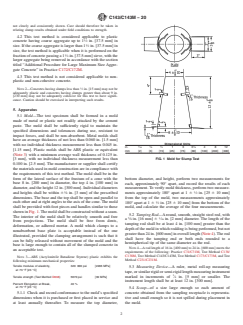
FIG. 1 Mold for Slump Test
[3 mm], with no individual thickness measurement less than
0.100 in. [2.5 mm]. The manufacturer or supplier shall certify
the materials used in mold construction are in compliance with
the requirements of this test method. The mold shall be in the
form of the lateral surface of the frustum of a cone with the
bottom diameter, and height, perform two measurements for
base 8 in. [200 mm] in diameter, the top 4 in. [100 mm] in
each, approximately 90° apart, and record the results of each
diameter, and the height 12 in. [300 mm]. Individual diameters
measurement. To verify mold thickness, perform two measure-
and heights shall be within 6 ⁄8 in. [3 mm] of the prescribed ments approximately 180° apart at 1 6 ⁄2 in. [25 6 10 mm]
dimensions. The base and the top shall be open and parallel to
from the top of the mold, two measurements approximately
each other and at right angles to the axis of the cone. The mold 180° apart at 1 6 ⁄2 in. [25 6 10 mm] from the bottom of the
shall be provided with foot pieces and handles similar to those
mold, and calculate the average of the four measurements.
shown in Fig. 1.The mold shall be constructed without a seam.
5.2 Tamping Rod—Around, smooth, straight steel rod, with
The interior of the mold shall be relatively smooth and free
5 1
a ⁄8 in. [16 mm] 6 ⁄16 in. [2 mm] diameter. The length of the
from projections. The mold shall be free from dents,
tamping rod shall be at least 4 in. [100 mm] greater than the
deformation, or adhered mortar. A mold which clamps to a
depth of the mold in which rodding is being performed, but not
nonabsorbent base plate is acceptable instead of the one
greaterthan24in.[600mm]inoveralllength(Note4).Therod
illustrated, provided the clamping arrangement is such that it
shall have the tamping end or both ends rounded to a
can be fully released without movement of the mold and the
hemispherical tip of the same diameter as the rod.
base is large enough to contain all of the slumped concrete in
NOTE 4—Arod length of 16 in. [400 mm] to 24 in. [600 mm] meets the
an acceptable test.
requirements of the following: Practice C31/C31M, Test Method C138/
C138M, Test Method C143/C143M, Test Method C173/C173M, and Test
NOTE 3—ABS (Acrylonitrile Butadiene Styrene) plastic exhibits the
Method C231/C231M.
following minimum mechanical properties:
Tensile modulus of elasticity, 320 000 psi [2206 MPa]
5.3 Measuring Device—A ruler, metal roll-up measuring
at 73 °F [23 °C]
tape, or similar rigid or semi-rigid length measuring instrument
Tensile strength (Test Method D638) 5670 psi [39 MPa] marked in increments of ⁄4 in. [5 mm] or smaller. The
instrument length shall be at least 12 in. [300 mm].
Percent Elongation at Break, 40 %
at 73 °F [23 °C]
5.4 Scoop—of a size large enough so each amount of
5.1.1 Check and record conformance to the mold’s
...
This document is not an ASTM standard and is intended only to provide the user of an ASTM standard an indication of what changes have been made to the previous version. Because
it may not be technically possible to adequately depict all changes accurately, ASTM recommends that users consult prior editions as appropriate. In all cases only the current version
of the standard as published by ASTM is to be considered the official document.
Designation: C143/C143M − 15a C143/C143M − 20
Standard Test Method for
Slump of Hydraulic-Cement Concrete
This standard is issued under the fixed designation C143/C143M; the number immediately following the designation indicates the year
of original adoption or, in the case of revision, the year of last revision. A number in parentheses indicates the year of last reapproval.
A superscript epsilon (´) indicates an editorial change since the last revision or reapproval.
This standard has been approved for use by agencies of the U.S. Department of Defense.
1. Scope*
1.1 This test method covers determination of slump of hydraulic-cement concrete, both in the laboratory and in the field.
1.2 The values stated in either SI units or inch-pound units are to be regarded separately as standard. Within the text, the SI units
are shown in brackets. The values stated in each system mayare not benecessarily exact equivalents; therefore, to ensure
conformance with the standard, each system shall be used independently of the other. Combiningother, and values from the two
systems may result in non-conformance with the standard.shall not be combined.
1.3 The text of this standard references refers to notes and footnotes whichthat provide explanatory material. These notes and
footnotes (excluding those in tables and figures) shall not be considered as requirements of thethis standard.
1.4 This standard does not purport to address all of the safety concerns, if any, associated with its use. It is the responsibility
of the user of this standard to establish appropriate safety safety, health, and healthenvironmental practices and determine the
applicability of regulatory limitations prior to use. (Warning—Fresh hydraulic cementitious mixtures are caustic and may cause
chemical burns to skin and tissue upon prolonged exposure. )
1.5 This international standard was developed in accordance with internationally recognized principles on standardization
established in the Decision on Principles for the Development of International Standards, Guides and Recommendations issued
by the World Trade Organization Technical Barriers to Trade (TBT) Committee.
2. Referenced Documents
2.1 ASTM Standards:
C31/C31M Practice for Making and Curing Concrete Test Specimens in the Field
C138/C138M Test Method for Density (Unit Weight), Yield, and Air Content (Gravimetric) of Concrete
C172C172/C172M Practice for Sampling Freshly Mixed Concrete
C173/C173M Test Method for Air Content of Freshly Mixed Concrete by the Volumetric Method
C231C231/C231M Test Method for Air Content of Freshly Mixed Concrete by the Pressure Method
C670 Practice for Preparing Precision and Bias Statements for Test Methods for Construction Materials
D638 Test Method for Tensile Properties of Plastics
3. Summary of Test Method
3.1 A sample of freshly mixed concrete is placed and compacted by rodding in a mold shaped as the frustum of a cone. The
mold is raised, and the concrete allowed to subside. The vertical distance between the original and displaced position of the center
of the top surface of the concrete is measured and reported as the slump of the concrete.
4. Significance and Use
4.1 This test method is intended to provide the user with a procedure to determine slump of plastic hydraulic-cement concretes.
NOTE 1—This test method was originally developed to provide a technique to monitor the consistency of unhardened concrete. Under laboratory
This test method is under the jurisdiction of ASTM Committee C09 on Concrete and Concrete Aggregates and is the direct responsibility of Subcommittee C09.60 on
Testing Fresh Concrete.
Current edition approved Dec. 15, 2015June 1, 2020. Published February 2016July 2020. Originally approved in 1922. Last previous edition approved in 2015 as
C143/C143M – 15.C143/C143M – 15a. DOI: 10.1520/C0143_C0143M-15A10.1520/C0143_C0143M-20.
Section on Safety Precautions, Manual of Aggregate and Concrete Testing, Annual Book of ASTM Standards, Vol. 04.02.Section on Safety Precautions, Manual of
Aggregate and Concrete Testing, Annual Book of ASTM Standards, Vol 04.02.
For referenced ASTM standards, visit the ASTM website, www.astm.org, or contact ASTM Customer Service at service@astm.org. For Annual Book of ASTM Standards
volume information, refer to the standard’sstandard’s Document Summary page on the ASTM website.
*A Summary of Changes section appears at the end of this standard
Copyright © ASTM International, 100 Barr Harbor Drive, PO Box C700, West Conshohocken, PA 19428-2959. United States
C143/C143M − 20
conditions, with strict control of all concrete materials, the slump is generally found to increase proportionally with the water content of a given concrete
mixture, and thus to be inversely related to concrete strength. Under field conditions, however, such a strength relationship is not clearly and consistently
shown. Care should therefore be taken in relating slump results obtained under field conditions to strength.
4.2 This test method is considered applicable to plastic concrete having coarse aggregate up to 1 ⁄2 in. [37.5 mm] in size. If the
coarse aggregate is larger than 1 ⁄2 in. [37.5 mm] in size, the test method is applicable when it is performed on the fraction of
concrete passing a 1 ⁄2-in. [37.5-mm] sieve, with the larger aggregate being removed in accordance with the section titled
“Additional Procedure for Large Maximum Size Aggregate Concrete” in Practice C172C172/C172M.
4.3 This test method is not considered applicable to non-plastic and non-cohesive concrete.
NOTE 2—Concretes having slumps less than ⁄2 in. [15 mm] may not be adequately plastic and concretes having slumps greater than about 9 in. [230
mm] may not be adequately cohesive for this test to have significance. Caution should be exercised in interpreting such results.
5. Apparatus
5.1 Mold—The test specimen shall be formed in a mold made of metal or plastic not readily attacked by the cement paste. The
mold shall be sufficiently rigid to maintain the specified dimensions and tolerances during use, resistant to impact forces, and shall
be non-absorbent. Metal molds shall have an average thickness of not less than 0.060 in. [1.5 mm] with no individual thickness
measurement less than 0.045 in. [1.15 mm]. Plastic molds shall be ABS plastic or equivalent (Note 3) with a minimum average
wall thickness of 0.125 in. [3 mm], with no individual thickness measurement less than 0.100 in. [2.5 mm]. The manufacturer or
supplier shall certify the materials used in mold construction are in compliance with the requirements of this test method. The mold
shall be in the form of the lateral surface of the frustum of a cone with the base 8 in. [200 mm] in diameter, the top 4 in. [100
mm] in diameter, and the height 12 in. [300 mm]. Individual diameters and heights shall be within 6 ⁄8 in. [3 mm] of the prescribed
dimensions. The base and the top shall be open and parallel to each other and at right angles to the axis of the cone. The mold
shall be provided with foot pieces and handles similar to those shown in Fig. 1. The mold shall be constructed without a seam.
The interior of the mold shall be relatively smooth and free from projections. The mold shall be free from dents, deformation, or
adhered mortar. A mold which clamps to a nonabsorbent base plate is acceptable instead of the one illustrated, provided the
clamping arrangement is such that it can be fully released without movement of the mold and the base is large enough to contain
all of the slumped concrete in an acceptable test.
NOTE 3—ABS (Acrylonitrile Butadiene Styrene) plastic exhibits the following minimum mechanical properties:
Dimensional Units
1 1 1 1
in. ⁄16 ⁄8 ⁄2 1 3 3 ⁄8 4 8 12
mm [2] [3] [15] [25] [75] [80] [100] [200] [300]
FIG. 1 Mold for Slump Test
C143/C143M − 20
Tensile modulus of elasticity, 320 000 psi [2206 MPa]
at 73 °F [23 °C]
Tensile strength (Test Method D638) 5670 psi [39 MPa]
Percent Elongation at Break, 40%
at 73 °F [23 °C]
Percent Elongation at Break, 40 %
at 73 °F [23 °C]
5.1.1 Check and record conformance to the mold’smold’s specified dimensions when it is purchased or first placed in service
and at least annually thereafter. To measure the top diameter, bottom diameter, and height, perform two measurements for each,
approximately 90° apart, and record the results of each measurement. To verify mold thickness, perform two measurements
approximately 180° apart at 1 6 ⁄2 in. [25 6 10 mm] from the top of the mold, two measurements approximately 180° apart at
1 6 ⁄2 in. [25 6 10 mm] from the bottom of the mold, and calculate the average of the four measurements.
5 1
5.2 Tamping Rod—A round, smooth, straight steel rod, with a ⁄8 in. [16 mm] 6 ⁄16 in. [2 mm] diameter. The length of the
tamping rod shall be at least 4 in. [100 mm] greater than the depth of the mold in which rodding is being performed, but not greater
than 24 in. [600 mm] in overall length (Note 4). The rod shall have the tamping end or both ends rounded to a hemispherical tip
of the same diameter as the rod.
NOTE 4—A rod length of 16 in. [400 mm] to 24 in. [600 mm] meets the requirements of the following: Practice C31/C31M, Test Method
...