

ASTM D4388-20
(Specification)Standard Specification for Nonmetallic Semi-Conducting and Electrically Insulating Rubber Tapes
General Information
- Abstract
ABSTRACT
This specification covers nonmetallic semi-conducting and electrically insulating rubber tapes designed for the splicing and repair of electrical wire and cables operating at specified phase to phase voltages. The tapes, which are classified into five types (Types I, II, III, IV, and V), shall conform to physical property requirements such as tensile strength, elongation at break, dielectric strength, dissipation factor, permittivity, volume resistivity, behavior during fusion test, ozone resistance, heat exposure, and UV resistance.
SCOPE
1.1 This specification covers nonmetallic semi-conducting and electrical insulating tapes designed for the splicing and repair of electrical wire and cables operating at voltages up to 325 kV, phase to phase.
1.2 The SI values are the standard. The values stated in inch-pound units given in parentheses are for information purposes only.
1.3 This international standard was developed in accordance with internationally recognized principles on standardization established in the Decision on Principles for the Development of International Standards, Guides and Recommendations issued by the World Trade Organization Technical Barriers to Trade (TBT) Committee.
- Status
- Published
- Publication Date
- 31-Jul-2020
- Technical Committee
- D09 - Electrical and Electronic Insulating Materials
- Drafting Committee
- D09.07 - Electrical Insulating Materials
Buy Documents


ASTM D4388-20 - Standard Specification for Nonmetallic Semi-Conducting and Electrically Insulating Rubber Tapes
REDLINE ASTM D4388-20 - Standard Specification for Nonmetallic Semi-Conducting and Electrically Insulating Rubber Tapes
Overview
ASTM D4388-20 is the standard specification developed by ASTM International for nonmetallic, semi-conducting, and electrically insulating rubber tapes. These tapes are primarily designed for the splicing and repair of electrical wires and cables operating at voltages up to 325 kV (phase to phase). The standard defines requirements for different types of rubber tapes, ensuring reliable electrical insulation and semi-conductivity in a variety of installation environments.
This standard also prescribes guidelines for the physical properties, classification, packaging, and testing of these specialty tapes, supporting consistent product quality and safety in electrical applications.
Key Topics
Types and Classifications: The standard details five types (I-V) of rubber tapes, each tailored for specific voltage ranges and operational conditions (dry or wet, indoor or outdoor).
- Type I: Low voltage, indoor dry applications
- Type II & III: Medium to high voltage, wet or dry outdoor or indoor use
- Type IV: Nonmetallic semi-conducting tape for shielding joints/terminations
- Type V: High voltage, suitable for wet/dry outdoor use
Physical Property Requirements:
- Tensile Strength & Elongation: Ensures flexibility and mechanical durability during installation and service.
- Dielectric Strength: Provides reliable electrical insulation to prevent breakdown at high voltages.
- Dissipation Factor, Permittivity, Volume Resistivity: Controls electrical performance under varying environmental conditions.
- Fusion, Heat Exposure, Ozone & UV Resistance: Addresses tape longevity and reliability in harsh or outdoor environments.
Dimensional Tolerances: Specifies nominal width, thickness, and length, as well as acceptable deviations, ensuring suitable fit and performance in electrical applications.
Aging and Storage: Recommendations on storage conditions and product shelf life help ensure material performance at the point of use.
Applications
ASTM D4388-20 rubber tapes are essential for critical electrical infrastructure and maintenance tasks, offering value in a range of scenarios:
- Cable Splicing and Repair: Used widely in utilities, industrial facilities, and construction to restore or extend the service life of high-, medium-, or low-voltage cables.
- Electrical Insulation: Provides robust insulation for live electrical conductors in substations, control panels, or field installations.
- Joint and Termination Shielding: Semi-conducting tapes (especially Type IV) serve as shielding against electrical interference for cable joints and terminations.
- Sheath Repair: Suitable for quick on-site repair of damaged cable jackets, restoring protection against moisture and contamination.
- Outdoor and Underground Electrical Work: The ozone and ultraviolet resistance of certain types make them reliable for outdoor exposure and demanding environments.
Following the recommendations of ASTM D4388-20 ensures safety, compliance, and performance in any new installation or maintenance scenario involving electrical tape.
Related Standards
For comprehensive quality assurance and best practices in electrical tape use, the following ASTM standards are often referenced along with ASTM D4388:
- ASTM D4325 - Test Methods for Nonmetallic Semi-Conducting and Electrically Insulating Rubber Tapes: Outlines testing protocols for verifying tape performance.
- ASTM D1711 - Terminology Relating to Electrical Insulation: Provides definitions of terms used throughout ASTM standards covering electrical insulation materials.
ASTM D4388-20 aligns with internationally recognized principles developed by the World Trade Organization Technical Barriers to Trade (TBT) Committee, supporting global acceptance and harmonization in electrical insulation technology.
Keywords: ASTM D4388-20, rubber insulating tape, nonmetallic semi-conducting tape, electrical insulation, cable splicing, dielectric strength, volume resistivity, UV resistance, ozone resistance, electrical repair, insulation standard.
Relations
- Effective Date
- 01-Aug-2020
- Effective Date
- 01-Mar-2024
- Effective Date
- 01-Nov-2015
- Effective Date
- 01-Nov-2014
- Effective Date
- 01-May-2014
- Effective Date
- 01-Nov-2013
- Effective Date
- 01-Nov-2013
- Effective Date
- 01-Aug-2011
- Effective Date
- 01-May-2008
- Effective Date
- 01-May-2008
- Effective Date
- 10-Mar-2002
- Effective Date
- 10-Mar-2002
- Effective Date
- 10-Mar-2002
- Effective Date
- 10-Oct-1999
- Effective Date
- 01-Aug-2020
Buy Documents
ASTM D4388-20 - Standard Specification for Nonmetallic Semi-Conducting and Electrically Insulating Rubber Tapes
REDLINE ASTM D4388-20 - Standard Specification for Nonmetallic Semi-Conducting and Electrically Insulating Rubber Tapes
Get Certified
Connect with accredited certification bodies for this standard

IMQ S.p.A. (Certification)
Italian electrical product certification.

SLG Prüf- und Zertifizierungs GmbH
German testing and certification body.

UL Solutions
Global safety science company with testing, inspection and certification.
Sponsored listings
Frequently Asked Questions
ASTM D4388-20 is a technical specification published by ASTM International. Its full title is "Standard Specification for Nonmetallic Semi-Conducting and Electrically Insulating Rubber Tapes". This standard covers: ABSTRACT This specification covers nonmetallic semi-conducting and electrically insulating rubber tapes designed for the splicing and repair of electrical wire and cables operating at specified phase to phase voltages. The tapes, which are classified into five types (Types I, II, III, IV, and V), shall conform to physical property requirements such as tensile strength, elongation at break, dielectric strength, dissipation factor, permittivity, volume resistivity, behavior during fusion test, ozone resistance, heat exposure, and UV resistance. SCOPE 1.1 This specification covers nonmetallic semi-conducting and electrical insulating tapes designed for the splicing and repair of electrical wire and cables operating at voltages up to 325 kV, phase to phase. 1.2 The SI values are the standard. The values stated in inch-pound units given in parentheses are for information purposes only. 1.3 This international standard was developed in accordance with internationally recognized principles on standardization established in the Decision on Principles for the Development of International Standards, Guides and Recommendations issued by the World Trade Organization Technical Barriers to Trade (TBT) Committee.
ABSTRACT This specification covers nonmetallic semi-conducting and electrically insulating rubber tapes designed for the splicing and repair of electrical wire and cables operating at specified phase to phase voltages. The tapes, which are classified into five types (Types I, II, III, IV, and V), shall conform to physical property requirements such as tensile strength, elongation at break, dielectric strength, dissipation factor, permittivity, volume resistivity, behavior during fusion test, ozone resistance, heat exposure, and UV resistance. SCOPE 1.1 This specification covers nonmetallic semi-conducting and electrical insulating tapes designed for the splicing and repair of electrical wire and cables operating at voltages up to 325 kV, phase to phase. 1.2 The SI values are the standard. The values stated in inch-pound units given in parentheses are for information purposes only. 1.3 This international standard was developed in accordance with internationally recognized principles on standardization established in the Decision on Principles for the Development of International Standards, Guides and Recommendations issued by the World Trade Organization Technical Barriers to Trade (TBT) Committee.
ASTM D4388-20 is classified under the following ICS (International Classification for Standards) categories: 29.035.20 - Plastics and rubber insulating materials. The ICS classification helps identify the subject area and facilitates finding related standards.
ASTM D4388-20 has the following relationships with other standards: It is inter standard links to ASTM D4388-13, ASTM D1711-24, ASTM D1711-15, ASTM D1711-14a, ASTM D1711-14, ASTM D4325-13, ASTM D1711-13, ASTM D1711-11a, ASTM D4325-08, ASTM D1711-08, ASTM D4325-02, ASTM D4325-97, ASTM D1711-02, ASTM D1711-99, ASTM D4325-20. Understanding these relationships helps ensure you are using the most current and applicable version of the standard.
ASTM D4388-20 is available in PDF format for immediate download after purchase. The document can be added to your cart and obtained through the secure checkout process. Digital delivery ensures instant access to the complete standard document.
Standards Content (Sample)
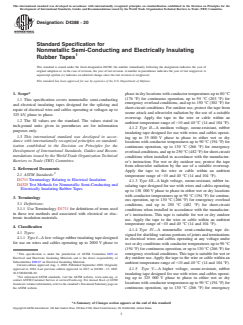
This international standard was developed in accordance with internationally recognized principles on standardization established in the Decision on Principles for the
Development of International Standards, Guides and Recommendations issued by the World Trade Organization Technical Barriers to Trade (TBT) Committee.
Designation:D4388 −20
Standard Specification for
Nonmetallic Semi-Conducting and Electrically Insulating
Rubber Tapes
This standard is issued under the fixed designation D4388; the number immediately following the designation indicates the year of
original adoption or, in the case of revision, the year of last revision.Anumber in parentheses indicates the year of last reapproval.A
superscript epsilon (´) indicates an editorial change since the last revision or reapproval.
This standard has been approved for use by agencies of the U.S. Department of Defense.
1. Scope* phaseindrylocationswithconductortemperaturesupto80°C
(176 °F) for continuous operation, up to 95 °C (203 °F) for
1.1 This specification covers nonmetallic semi-conducting
emergency overload conditions, and up to 150 °C (302 °F) for
and electrical insulating tapes designed for the splicing and
short-circuit conditions. For outdoor use, protect the tape from
repair of electrical wire and cables operating at voltages up to
ozone attack and ultraviolet radiation by the use of a suitable
325 kV, phase to phase.
overwrap. Apply the tape to the wire or cable within an
1.2 The SI values are the standard. The values stated in
ambient temperature range of−10 and 40 °C (14 and 104 °F).
inch-pound units given in parentheses are for information
4.1.2 Type II—A medium voltage, ozone-resistant, rubber
purposes only.
insulating tape designed for use with wires and cables operat-
1.3 This international standard was developed in accor-
ing up to 35 000 V phase to phase in either wet or dry
dance with internationally recognized principles on standard-
locationswithconductortemperaturesupto90°C(194°F)for
ization established in the Decision on Principles for the
continuous operation, up to 130 °C (266 °F) for emergency
Development of International Standards, Guides and Recom-
overloadconditions,andupto250°C(482°F)forshort-circuit
mendations issued by the World Trade Organization Technical
conditions when installed in accordance with the manufactur-
Barriers to Trade (TBT) Committee.
er’s instruction. For wet or dry outdoor use, protect the tape
from ultraviolet radiation by the use of a suitable overwrap.
2. Referenced Documents
Apply the tape to the wire or cable within an ambient
2.1 ASTM Standards:
temperature range of−10 and 40 °C (14 and 104 °F).
D1711Terminology Relating to Electrical Insulation
4.1.3 Type III—A high voltage, ozone-resistant, rubber in-
D4325Test Methods for Nonmetallic Semi-Conducting and
sulating tape designed for use with wires and cables operating
Electrically Insulating Rubber Tapes
up to 138 000 V phase to phase in either wet or dry locations
with conductor temperatures up to 90 °C (194 °F) for continu-
3. Terminology
ous operation, up to 130 °C (266 °F) for emergency overload
3.1 Definitions:
conditions, and up to 250 °C (482 °F) for short-circuit
3.1.1 Use Terminology D1711 for definitions of terms used
conditions when installed in accordance with the manufactur-
in these test methods and associated with electrical or elec-
er’s instructions. This tape is suitable for wet or dry outdoor
tronic insulation materials.
use. Apply the tape to the wire or cable within an ambient
temperature range of−10 and 40 °C (14 and 104 °F).
4. Classification
4.1.4 Type IV—A nonmetallic semi-conducting tape de-
4.1 Types:
signed for shielding various portions of joints and terminations
4.1.1 Type I—Alowvoltagerubberinsulatingtapedesigned
in electrical wires and cables operating at any voltage under
for use on wires and cables operating up to 2000 V phase to
wet or dry conditions with conductor temperatures up to 90 °C
(194°F)forcontinuousoperation,orupto130°C(266°F)for
emergencyoverloadconditions.Thistapeissuitableforwetor
This specification is under the jurisdiction of ASTM Committee D09 on
Electrical and Electronic Insulating Materials and is the direct responsibility of
dry outdoor use.Apply the tape to the wire or cable within an
Subcommittee D09.07 on Electrical Insulating Materials.
ambient temperature range of−10 and 40 °C (14 and 104 °F).
Current edition approved Aug. 1, 2020. Published September 2020. Originally
4.1.5 Type V—A higher voltage, ozone-resistant, rubber
approved in 1984. Last previous edition approved in 2013 as D4388–13. DOI:
10.1520/D4388-20.
insulating tape designed for use with wires and cables operat-
For referenced ASTM standards, visit the ASTM website, www.astm.org, or
ing up to 325 000 V phase to phase in either wet or dry
contact ASTM Customer Service at service@astm.org. For Annual Book of ASTM
locationswithconductortemperaturesupto90°C(194°F)for
Standards volume information, refer to the standard’s Document Summary page on
the ASTM website. continuous operation, up to 130 °C (266 °F) for emergency
*A Summary of Changes section appears at the end of this standard
Copyright © ASTM International, 100 Barr Harbor Drive, PO Box C700, West Conshohocken, PA 19428-2959. United States
D4388−20
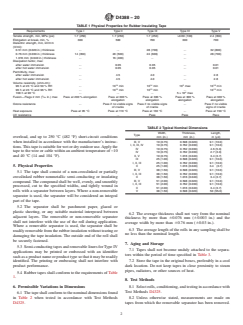
TABLE 1 Physical Properties for Rubber Insulating Tape
Requirements Type I Type II Type III Type IV Type V
Tensile strength, min, MPa (psi) 1.7 (250) 1.7 (250) 1.7 (250) >0.69 (100) 2.4 (350)
Elongation at break, min, % 300 500 700 300 700
Dielectric strength, min, kV/mm
(V/mil):
0.51 mm (0.020 in.) thickness . . 28 (700) . 32 (800)
0.76 mm (0.030 in.) thickness 14 (350) 20 (500) 24 (600) . 28 (700)
1.016 mm (0.040 in.) thickness . 16 (400) . .
Dissipation factor, max:
after water immersion . 0.05 0.05 . 0.01
after hot water immersion . 0.05 0.05 . 0.01
Permittivity, max:
after water immersion . 4.5 4.0 . 2.8
after hot water immersion . 4.5 4.0 . 2.8
Volume resistivity, (ohm-cm):
14 14 3 16
96hat23°Cand 50%RH . 10 min 10 min 10 max 10 min
13 13 15
96hat23°Cand 96%RH . 10 min 10 min . 10 min
168 h at 90 °C . . . 5 × 10 max
Fusion—Flags 2 mm ( ⁄64 in.) max Pass at 200 % elongation Pass at 300 % Pass at 300 % Pass at 300 % Pass at 300 %
elongation elongation elongation elongation
Ozone resistance . Pass if no
...
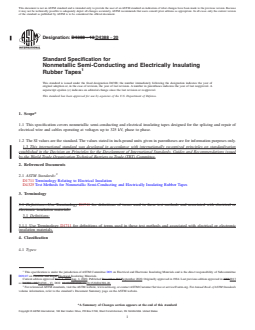
This document is not an ASTM standard and is intended only to provide the user of an ASTM standard an indication of what changes have been made to the previous version. Because
it may not be technically possible to adequately depict all changes accurately, ASTM recommends that users consult prior editions as appropriate. In all cases only the current version
of the standard as published by ASTM is to be considered the official document.
Designation: D4388 − 13 D4388 − 20
Standard Specification for
Nonmetallic Semi-Conducting and Electrically Insulating
Rubber Tapes
This standard is issued under the fixed designation D4388; the number immediately following the designation indicates the year of
original adoption or, in the case of revision, the year of last revision. A number in parentheses indicates the year of last reapproval. A
superscript epsilon (´) indicates an editorial change since the last revision or reapproval.
This standard has been approved for use by agencies of the U.S. Department of Defense.
1. Scope*
1.1 This specification covers nonmetallic semi-conducting and electrical insulating tapes designed for the splicing and repair of
electrical wire and cables operating at voltages up to 325 kV, phase to phase.
1.2 The SI values are the standard. The values stated in inch-pound units given in parentheses are for information purposes only.
1.3 This international standard was developed in accordance with internationally recognized principles on standardization
established in the Decision on Principles for the Development of International Standards, Guides and Recommendations issued
by the World Trade Organization Technical Barriers to Trade (TBT) Committee.
2. Referenced Documents
2.1 ASTM Standards:
D1711 Terminology Relating to Electrical Insulation
D4325 Test Methods for Nonmetallic Semi-Conducting and Electrically Insulating Rubber Tapes
3. Terminology
3.1 Definitions—Use Terminology D1711 for definitions of terms used in these test methods and associated with electrical or
electronic insulation materials.
3.1 Definitions:
3.1.1 Use Terminology D1711 for definitions of terms used in these test methods and associated with electrical or electronic
insulation materials.
4. Classification
4.1 Types:
This specification is under the jurisdiction of ASTM Committee D09 on Electrical and Electronic Insulating Materials and is the direct responsibility of Subcommittee
D09.07 on Flexible and Rigid Electrical Insulating Materials.
Current edition approved Nov. 1, 2013Aug. 1, 2020. Published December 2013September 2020. Originally approved in 1984. Last previous edition approved in 20082013
as D4388 – 08.D4388 – 13. DOI: 10.1520/D4388-13.10.1520/D4388-20.
For referenced ASTM standards, visit the ASTM website, www.astm.org, or contact ASTM Customer Service at service@astm.org. For Annual Book of ASTM Standards
volume information, refer to the standard’s Document Summary page on the ASTM website.
*A Summary of Changes section appears at the end of this standard
Copyright © ASTM International, 100 Barr Harbor Drive, PO Box C700, West Conshohocken, PA 19428-2959. United States
D4388 − 20
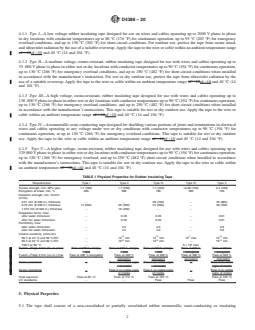
4.1.1 Type I—A low voltage rubber insulating tape designed for use on wires and cables operating up to 2000 V phase to phase
in dry locations with conductor temperatures up to 80 °C (176 °F) for continuous operation, up to 95 °C (203 °F) for emergency
overload conditions, and up to 150 °C (302 °F) for short-circuit conditions. For outdoor use, protect the tape from ozone attack
and ultraviolet radiation by the use of a suitable overwrap. Apply the tape to the wire or cable within an ambient temperature range
of − 10of −10 and 40 °C (14 and 104 °F).
4.1.2 Type II—A medium voltage, ozone-resistant, rubber insulating tape designed for use with wires and cables operating up to
35 000 V phase to phase in either wet or dry locations with conductor temperatures up to 90 °C (194 °F) for continuous operation,
up to 130 °C (266 °F) for emergency overload conditions, and up to 250 °C (482 °F) for short-circuit conditions when installed
in accordance with the manufacturer’s instruction. For wet or dry outdoor use, protect the tape from ultraviolet radiation by the
use of a suitable overwrap. Apply the tape to the wire or cable within an ambient temperature range of − 10of −10 and 40 °C (14
and 104 °F).
4.1.3 Type III—A high voltage, ozone-resistant, rubber insulating tape designed for use with wires and cables operating up to
138 000 V phase to phase in either wet or dry locations with conductor temperatures up to 90 °C (194 °F) for continuous operation,
up to 130 °C (266 °F) for emergency overload conditions, and up to 250 °C (482 °F) for short-circuit conditions when installed
in accordance with the manufacturer’s instructions. This tape is suitable for wet or dry outdoor use. Apply the tape to the wire or
cable within an ambient temperature range of − 10of −10 and 40 °C (14 and 104 °F).
4.1.4 Type IV—A nonmetallic semi-conducting tape designed for shielding various portions of joints and terminations in electrical
wires and cables operating at any voltage under wet or dry conditions with conductor temperatures up to 90 °C (194 °F) for
continuous operation, or up to 130 °C (266 °F) for emergency overload conditions. This tape is suitable for wet or dry outdoor
use. Apply the tape to the wire or cable within an ambient temperature range of − 10of −10 and 40 °C (14 and 104 °F).
4.1.5 Type V—A higher voltage, ozone-resistant, rubber insulating tape designed for use with wires and cables operating up to
325 000 V phase to phase in either wet or dry locations with conductor temperatures up to 90 °C (194 °F) for continuous operation,
up to 130 °C (266 °F) for emergency overload, and up to 250 °C (482 °F) short-circuit conditions when installed in accordance
with the manufacturer’s instructions. This tape is suitable for wet or dry outdoor use. Apply the tape to the wire or cable within
an ambient temperature of − 10of −10 and 40 °C (14 and 104 °F).
TABLE 1 Physical Properties for Rubber Insulating Tape
Requirements Type I Type II Type III Type IV Type V
Tensile strength, min, MPa (psi) 1.7 (250) 1.7 (250) 1.7 (250) >0.69 (100) 2.4 (350)
Elongation at break, min, % 300 500 700 300 700
Dielectric strength, min, kV/mm
(V/mil):
0.51 mm (0.020 in.) thickness . . 28 (700) . 32 (800)
0.76 mm (0.030 in.) thickness 14 (350) 20 (500) 24 (600) . 28 (700)
1.016 mm (0.040 in.) thickness . 16 (400) . .
Dissipation factor, max:
after water immersion . 0.05 0.05 . 0.01
after hot water immersion . 0.05 0.05 . 0.01
Permittivity, max:
after water immersion . 4.5 4.0 . 2.8
after hot water immersion . 4.5 4.0 . 2.8
Volume resistivity, (ohm-cm):
14 14 3 16
96 h at 23 °C and 50 % RH . 10 min 10 min 10 max 10 min
13 13 15
96 h at 23 °C and 96 % RH . 10 min 10 min . 10 min
168 h at 90 °C . . . 5 × 10 max
Fusion—Flags 2 mm ( ⁄64 in.) max Pass at 200 % elonga- Pass at 300 % elonga- Pass at 300 %
...