

ASTM A743/A743M-21
(Specification)Standard Specification for Castings, Iron-Chromium, Iron-Chromium-Nickel, Corrosion Resistant, for General Application
General Information
- Abstract
ABSTRACT
This specification covers iron-chromium and iron-chromium-nickel alloy castings for general corrosion-resistant application. The grades of these castings represent types of alloy castings suitable for broad ranges of application which are intended for a wide variety of corrosion environments. The steel shall be made by the electric furnace process with or without separate refining such as argon-oxygen decarburization. The castings shall be subjected to heat treatment.
SCOPE
1.1 This specification covers iron-chromium and iron-chromium-nickel alloy castings for general corrosion-resistant application. The grades covered by this specification represent types of alloy castings suitable for broad ranges of application which are intended for a wide variety of corrosion environments.
Note 1: For alloy castings for severe corrosion-resistant service, reference should be made to Specification A744/A744M. For general heat-resistant alloy castings, reference should be made to Specification A297/A297M. For nickel alloy castings for corrosion-resistant service, reference should be made to Specification A494/A494M.
1.2 The values stated in either inch-pound units or SI units are to be regarded separately as standard. Within the text, the SI units are shown in brackets. The values stated in each system are not exact equivalents; therefore, each system must be used independently of the other. Combining values from the two systems may result in nonconformance with the specification. Inch-pound units are applicable for material ordered to Specification A743 and SI units for material ordered to Specification A743M.
1.3 This international standard was developed in accordance with internationally recognized principles on standardization established in the Decision on Principles for the Development of International Standards, Guides and Recommendations issued by the World Trade Organization Technical Barriers to Trade (TBT) Committee.
- Status
- Published
- Publication Date
- 28-Feb-2021
- Technical Committee
- A01 - Steel, Stainless Steel and Related Alloys
- Drafting Committee
- A01.18 - Castings
Buy Documents
ASTM A743/A743M-21 - Standard Specification for Castings, Iron-Chromium, Iron-Chromium-Nickel, Corrosion Resistant, for General Application
REDLINE ASTM A743/A743M-21 - Standard Specification for Castings, Iron-Chromium, Iron-Chromium-Nickel, Corrosion Resistant, for General Application
Overview
ASTM A743/A743M-21 is the globally recognized standard specification for iron-chromium and iron-chromium-nickel alloy castings that are corrosion resistant and intended for general applications. Developed by ASTM International, this standard specifies the requirements regarding the chemical composition, mechanical properties, heat treatment, and quality assurance for a broad range of alloy castings. These castings are used in diverse environments where enhanced corrosion resistance is required.
ASTM A743/A743M-21 is applicable to both inch-pound and SI units, accommodating a wide range of users around the world. This specification is widely adopted in the manufacturing, chemical processing, power generation, and related sectors for its reliability and practicality.
Key Topics
- Material Types: Encompasses iron-chromium and iron-chromium-nickel alloy grades, each with specific properties tailored to various corrosion environments.
- Manufacturing Process: Requires steel castings to be produced using electric furnace processing, with optional refining steps such as argon-oxygen decarburization.
- Heat Treatment: Mandates heat treatment of all castings to improve corrosion resistance and mechanical properties; minimum temperatures and procedures are detailed for each grade.
- Mechanical Properties: Specifies minimum tensile strength, yield strength, elongation, and reduction in area for each alloy grade to ensure consistent quality.
- Chemical Composition: Details the elemental composition requirements for each grade, covering carbon, chromium, nickel, molybdenum, nitrogen, and other critical elements.
- Repair and Inspection: Provides guidelines for weld repair, inspection procedures (radiographic, ultrasonic, liquid penetrant, magnetic particle), and post-weld heat treatment.
- Marking and Certification: Requires product identification by ASTM designation, grade symbol, manufacturer's mark, and pattern number to ensure traceability.
Applications
ASTM A743/A743M-21 alloy castings are widely used across industries that demand high corrosion resistance, structural integrity, and versatility, including:
- Chemical Processing: Equipment and components handling corrosive fluids and gases.
- Water Treatment Facilities: Pumps, valves, and pipe fittings in harsh and damp conditions.
- Power Generation: Parts exposed to aggressive environments in fossil, nuclear, and alternative energy plants.
- Food and Beverage Industry: Machinery requiring sanitary and rust-resistant surfaces.
- Mining and Oil & Gas: Components exposed to abrasive and acidic conditions.
- Marine Applications: Castings for structures and equipment in saltwater and humid environments.
The standard ensures that suppliers and manufacturers provide consistent, high-quality corrosion-resistant castings suitable for a variety of general-purpose applications worldwide.
Related Standards
For specialized needs beyond the general use cases covered by ASTM A743/A743M-21, the following related ASTM standards may be applicable:
- ASTM A744/A744M: Corrosion-resistant alloy castings for severe service.
- ASTM A297/A297M: Iron-chromium and iron-chromium-nickel alloy castings for general heat-resistant applications.
- ASTM A494/A494M: Nickel alloy castings for corrosion-resistant service.
- ASTM A781/A781M: Common requirements for steel and alloy castings for general industrial use.
- ASTM A890/A890M: Duplex (austenitic/ferritic) stainless steel castings for enhanced corrosion resistance.
- ASTM A957/A957M: Requirements for investment castings in steel and alloy.
Practical Value
Employing ASTM A743/A743M-21 ensures components meet international standards for performance, safety, and durability in a wide range of corrosion environments. Its adoption supports supply chain confidence, regulatory compliance, and quality assurance in the global marketplace for cast alloy components. Using castings that comply with ASTM standards also improves equipment lifespan, reduces maintenance, and supports sustainable industrial practices.
Keywords: corrosion resistant castings, iron-chromium, iron-chromium-nickel, ASTM A743, stainless steel castings, general application, alloy castings, industrial standards.
Relations
- Effective Date
- 01-Sep-2019
- Effective Date
- 01-Sep-2018
- Effective Date
- 01-Sep-2018
- Effective Date
- 01-Sep-2018
- Effective Date
- 01-Sep-2018
- Effective Date
- 01-Jun-2018
- Effective Date
- 15-May-2018
- Effective Date
- 15-May-2018
- Effective Date
- 01-May-2018
- Effective Date
- 01-Jan-2018
- Effective Date
- 01-Nov-2017
- Effective Date
- 01-May-2017
- Effective Date
- 01-May-2017
- Effective Date
- 15-Mar-2017
- Effective Date
- 01-Dec-2016
Buy Documents
ASTM A743/A743M-21 - Standard Specification for Castings, Iron-Chromium, Iron-Chromium-Nickel, Corrosion Resistant, for General Application
REDLINE ASTM A743/A743M-21 - Standard Specification for Castings, Iron-Chromium, Iron-Chromium-Nickel, Corrosion Resistant, for General Application
Get Certified
Connect with accredited certification bodies for this standard

Element Materials Technology
Materials testing and product certification.

Inštitut za kovinske materiale in tehnologije
Institute of Metals and Technology. Materials testing, metallurgical analysis, NDT.
Sponsored listings
Frequently Asked Questions
ASTM A743/A743M-21 is a technical specification published by ASTM International. Its full title is "Standard Specification for Castings, Iron-Chromium, Iron-Chromium-Nickel, Corrosion Resistant, for General Application". This standard covers: ABSTRACT This specification covers iron-chromium and iron-chromium-nickel alloy castings for general corrosion-resistant application. The grades of these castings represent types of alloy castings suitable for broad ranges of application which are intended for a wide variety of corrosion environments. The steel shall be made by the electric furnace process with or without separate refining such as argon-oxygen decarburization. The castings shall be subjected to heat treatment. SCOPE 1.1 This specification covers iron-chromium and iron-chromium-nickel alloy castings for general corrosion-resistant application. The grades covered by this specification represent types of alloy castings suitable for broad ranges of application which are intended for a wide variety of corrosion environments. Note 1: For alloy castings for severe corrosion-resistant service, reference should be made to Specification A744/A744M. For general heat-resistant alloy castings, reference should be made to Specification A297/A297M. For nickel alloy castings for corrosion-resistant service, reference should be made to Specification A494/A494M. 1.2 The values stated in either inch-pound units or SI units are to be regarded separately as standard. Within the text, the SI units are shown in brackets. The values stated in each system are not exact equivalents; therefore, each system must be used independently of the other. Combining values from the two systems may result in nonconformance with the specification. Inch-pound units are applicable for material ordered to Specification A743 and SI units for material ordered to Specification A743M. 1.3 This international standard was developed in accordance with internationally recognized principles on standardization established in the Decision on Principles for the Development of International Standards, Guides and Recommendations issued by the World Trade Organization Technical Barriers to Trade (TBT) Committee.
ABSTRACT This specification covers iron-chromium and iron-chromium-nickel alloy castings for general corrosion-resistant application. The grades of these castings represent types of alloy castings suitable for broad ranges of application which are intended for a wide variety of corrosion environments. The steel shall be made by the electric furnace process with or without separate refining such as argon-oxygen decarburization. The castings shall be subjected to heat treatment. SCOPE 1.1 This specification covers iron-chromium and iron-chromium-nickel alloy castings for general corrosion-resistant application. The grades covered by this specification represent types of alloy castings suitable for broad ranges of application which are intended for a wide variety of corrosion environments. Note 1: For alloy castings for severe corrosion-resistant service, reference should be made to Specification A744/A744M. For general heat-resistant alloy castings, reference should be made to Specification A297/A297M. For nickel alloy castings for corrosion-resistant service, reference should be made to Specification A494/A494M. 1.2 The values stated in either inch-pound units or SI units are to be regarded separately as standard. Within the text, the SI units are shown in brackets. The values stated in each system are not exact equivalents; therefore, each system must be used independently of the other. Combining values from the two systems may result in nonconformance with the specification. Inch-pound units are applicable for material ordered to Specification A743 and SI units for material ordered to Specification A743M. 1.3 This international standard was developed in accordance with internationally recognized principles on standardization established in the Decision on Principles for the Development of International Standards, Guides and Recommendations issued by the World Trade Organization Technical Barriers to Trade (TBT) Committee.
ASTM A743/A743M-21 is classified under the following ICS (International Classification for Standards) categories: 77.140.80 - Iron and steel castings. The ICS classification helps identify the subject area and facilitates finding related standards.
ASTM A743/A743M-21 has the following relationships with other standards: It is inter standard links to ASTM A297/A297M-19, ASTM A890/A890M-18a, ASTM A494/A494M-18, ASTM A957/A957M-18a, ASTM A781/A781M-18c, ASTM A781/A781M-18b, ASTM A957/A957M-18, ASTM A781/A781M-18a, ASTM A890/A890M-18, ASTM A781/A781M-18, ASTM A494/A494M-17a, ASTM A781/A781M-17, ASTM A297/A297M-17, ASTM A494/A494M-17, ASTM A781/A781M-16. Understanding these relationships helps ensure you are using the most current and applicable version of the standard.
ASTM A743/A743M-21 is available in PDF format for immediate download after purchase. The document can be added to your cart and obtained through the secure checkout process. Digital delivery ensures instant access to the complete standard document.
Standards Content (Sample)
This international standard was developed in accordance with internationally recognized principles on standardization established in the Decision on Principles for the
Development of International Standards, Guides and Recommendations issued by the World Trade Organization Technical Barriers to Trade (TBT) Committee.
Designation: A743/A743M −21
Standard Specification for
Castings, Iron-Chromium, Iron-Chromium-Nickel, Corrosion
Resistant, for General Application
This standard is issued under the fixed designationA743/A743M; the number immediately following the designation indicates the year
of original adoption or, in the case of revision, the year of last revision. A number in parentheses indicates the year of last reapproval.
A superscript epsilon (´) indicates an editorial change since the last revision or reapproval.
This standard has been approved for use by agencies of the U.S. Department of Defense.
1. Scope* Attack in Austenitic Stainless Steels
A297/A297M Specification for Steel Castings, Iron-
1.1 This specification covers iron-chromium and iron-
Chromium and Iron-Chromium-Nickel, Heat Resistant,
chromium-nickel alloy castings for general corrosion-resistant
for General Application
application. The grades covered by this specification represent
A494/A494M Specification for Castings, Nickel and Nickel
types of alloy castings suitable for broad ranges of application
Alloy
which are intended for a wide variety of corrosion environ-
A744/A744M Specification for Castings, Iron-Chromium-
ments.
Nickel, Corrosion Resistant, for Severe Service
NOTE 1—For alloy castings for severe corrosion-resistant service,
A781/A781M Specification for Castings, Steel and Alloy,
reference should be made to Specification A744/A744M. For general
Common Requirements, for General Industrial Use
heat-resistant alloy castings, reference should be made to Specification
A890/A890M Specification for Castings, Iron-Chromium-
A297/A297M. For nickel alloy castings for corrosion-resistant service,
Nickel-Molybdenum Corrosion-Resistant, Duplex
reference should be made to Specification A494/A494M.
(Austenitic/Ferritic) for General Application
1.2 The values stated in either inch-pound units or SI units
A957/A957M Specification for Investment Castings, Steel
are to be regarded separately as standard. Within the text, the
and Alloy, Common Requirements, for General Industrial
SI units are shown in brackets. The values stated in each
Use
system are not exact equivalents; therefore, each system must
be used independently of the other. Combining values from the
3. General Conditions for Delivery
two systems may result in nonconformance with the specifi-
cation. Inch-pound units are applicable for material ordered to
3.1 Except for investment castings, castings furnished to
Specification A743 and SI units for material ordered to
this specification shall conform to the requirements of Speci-
Specification A743M.
fication A781/A781M, including any supplementary require-
ments that are indicated on the purchase order. Failure to
1.3 This international standard was developed in accor-
dance with internationally recognized principles on standard- comply with the general requirements of Specification A781/
A781M constitutes nonconformance with this specification. In
ization established in the Decision on Principles for the
Development of International Standards, Guides and Recom- case of conflict between the requirements of this specification
and Specification A781/A781M, this specification shall pre-
mendations issued by the World Trade Organization Technical
Barriers to Trade (TBT) Committee. vail.
3.2 Steel investment castings furnished to this specification
2. Referenced Documents
shall conform to the requirements of Specification A957/
2.1 ASTM Standards:
A957M, including any supplementary requirements that are
A262 Practices for Detecting Susceptibility to Intergranular
indicated in the purchase order. Failure to comply with the
general requirements of Specification A957/A957M consti-
tutes nonconformance with this specification. In case of con-
This specification is under the jurisdiction ofASTM Committee A01 on Steel,
flict between the requirements of this specification and Speci-
Stainless Steel and Related Alloys and is the direct responsibility of Subcommittee
fication A957/A957M, Specification A957/A957M shall
A01.18 on Castings.
Current edition approved March 1, 2021. Published March 2021. Originally
prevail.
approved in 1977. Last previous edition approved in 2019 as A743/A743M – 19.
DOI: 10.1520/A0743_A0743M-21.
2 4. Ordering Information
For referenced ASTM standards, visit the ASTM website, www.astm.org, or
contact ASTM Customer Service at service@astm.org. For Annual Book of ASTM
4.1 Orders for material to this specification should include
Standards volume information, refer to the standard’s Document Summary page on
the ASTM website. the following, as required, to describe the material adequately:
*A Summary of Changes section appears at the end of this standard
Copyright © ASTM International, 100 Barr Harbor Drive, PO Box C700, West Conshohocken, PA 19428-2959. United States
A743/A743M − 21
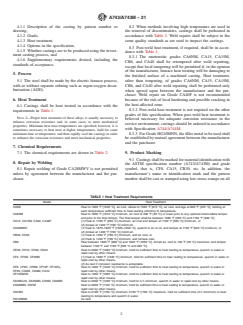
4.1.1 Description of the casting by pattern number or 8.2 When methods involving high temperature are used in
drawing, the removal of discontinuities, castings shall be preheated in
4.1.2 Grade, accordance with Table 3. Weld repairs shall be subject to the
4.1.3 Heat treatment, same quality standards as are used to inspect the castings.
4.1.4 Options in the specification,
8.3 Post-weld heat treatment, if required, shall be in accor-
4.1.5 Whether castings are to be produced using the invest-
dance with Table 1.
ment casting process, and
8.3.1 The martensitic grades CA6NM, CA15, CA15M,
4.1.6 Supplementary requirements desired, including the
CB6, and CA40 shall be retempered after weld repairing,
standards of acceptance.
except that local tempering will be permitted if, in the opinion
of the manufacturer, furnace heat treating will be damaging to
5. Process
the finished surface of a machined casting. Heat treatment,
5.1 The steel shall be made by the electric furnace process,
other than tempering, of grades CA6NM, CA15, CA15M,
with or without separate refining such as argon-oxygen decar- CB6, and CA40 after weld repairing shall be performed only
burization (AOD).
when agreed upon between the manufacturer and the pur-
chaser. Weld repair on Grade CA40F is not recommended
6. Heat Treatment
because of the risk of local hardening and possible cracking in
the heat-affected zone.
6.1 Castings shall be heat treated in accordance with the
8.3.2 Post-weld heat treatment is not required on the other
requirements in Table 1.
grades of this specification. When post-weld heat treatment is
NOTE 2—Proper heat treatment of these alloys is usually necessary to
believed necessary for adequate corrosion resistance in the
enhance corrosion resistance and, in some cases, to meet mechanical
service environment, castings should be ordered in accordance
properties. Minimum heat treat temperatures are specified; however, it is
with Specification A744/A744M.
sometimes necessary to heat treat at higher temperatures, hold for some
minimum time at temperature, and then rapidly cool the castings in order 8.3.3 ForGradeHG10MNN,thefillermetaltobeusedshall
to enhance the corrosion resistance and meet mechanical properties.
be established by mutual agreement between the manufacturer
and the purchaser.
7. Chemical Requirements
7.1 The chemical requirements are shown in Table 2. 9. Product Marking
9.1 Castings shall be marked for material identification with
8. Repair by Welding
the ASTM specification number (A743/A743M) and grade
8.1 Repair welding of Grade CA28MWV is not permitted symbol, that is, CF8, CA15, CB30, etc. In addition, the
unless by agreement between the manufacturer and the pur- manufacturer’s name or identification mark and the pattern
chaser. number shall be cast or stamped using low-stress stamps on all
TABLE 1 Heat Treatment Requirements
Grade Heat Treatment
CA6N Heat to 1900 °F [1040 °C], air cool, reheat to 1500 °F [815 °C], air cool, and age at 800 °F [425 °C], holding at
each temperature sufficient time to heat casting uniformly to temperature.
CA6NM Heat to 1850 °F [1010 °C] minimum, air cool to 200 °F [95 °C] or lower prior to any optional intermediate temper
and prior to the final temper. The final temper shall be between 1050 °F [565 °C] and 1150 °F [620 °C].
CA15, CA15M, CA40, CA40F (1) Heat to 1750 °F [955 °C] minimum, air cool and temper at 1100 °F [595 °C] minimum, or
(2) Anneal at 1450 °F [790 °C] minimum.
CA28MWV (1) Heat to 1875–1925 °F [1025–1050 °C], quench in air or oil, and temper at 1150 °F [620 °C] minimum, or
(2) Anneal at 1400 °F [760 °C] minimum.
CB30, CC50 (1) Heat to 1450 °F [790 °C] minimum, and air cool, or
(2) Heat to 1450 °F [790 °C] minimum, and furnace cool.
CB6 Heat between 1800 °F [980 °C] and 1920 °F [1050 °C], forced air, cool to 120 °F [50 °C] maximum, and temper
between 1100 °F and 1160 °F [595 °C and 625 °C].
CE30, CH10, CH20, CK20 Heat to 2000 °F [1093 °C] minimum, hold for sufficient time to heat casting to temperature, quench in water or
rapid cool by other means.
CF3, CF3M, CF3MN (1) Heat to 1900 °F [1040 °C] minimum, hold for sufficient time to heat casting to temperature, quench in water or
rapid cool by other means.
(2) As cast if corrosion resistance is acceptable.
CF8, CF8C, CF8M, CF16F, CF16Fa, Heat to 1900 °F [1040 °C] minimum, hold for sufficient time to heat casting to temperature, quench in water or
CF20, CG3M, CG8M, CG12 rapid cool by other means.
CF10SMnN Heat to 1950 °F [1065 °C] minimum, hold for sufficient time to heat casting to temperature, quench in water or
rapid cool by other means.
CK3MCuN, CK35MN, CN3M, CN3MN Heat to 2200 °F [1200 °C] minimum, hold for 4 h minimum, quench in water or rapid cool by other means.
CG6MMN, CN7M Heat to 2050 °F [1120 °C] minimum, hold for sufficient time to heat casting to temperature, quench in water or
rapid cool by other means.
CN7MS Heat to 2100 °F [1150 °C] minimum, 2150 °F [1180 °C] maximum, hold for sufficient time (2 h minimum) to heat
casting to temperature and quench in water.
HG10MNN As cast
A743/A743M − 21
A,B
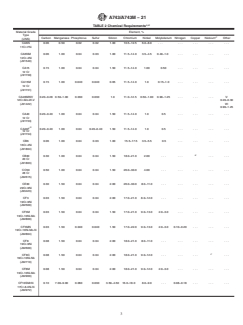
TABLE 2 Chemical Requirements
Material Grade Element, %
Type
C
Carbon Manganese Phosphorus Sulfur Silicon Chromium Nickel Molybdenum Nitrogen Copper Niobium Other
(UNS)
CA6N 0.06 0.50 0.02 0.02 1.00 10.5–12.5 6.0–8.0 . . . . . . . . . . . . . . .
11Cr-7Ni
CA6NM 0.06 1.00 0.04 0.03 1.00 11.5–14.0 3.5–4.5 0.40–1.0 . . . . . . . . . . . .
12Cr-4Ni
(J91540)
CA15 0.15 1.00 0.04 0.04 1.50 11.5–14.0 1.00 0.50 . . . . . . . . . . . .
12 Cr
(J91150)
CA15M 0.15 1.00 0.040 0.040 0.65 11.5–14.0 1.0 0.15–1.0 . . . . . . . . . . . .
12 Cr
(J91151)
CA28MWV 0.20–0.28 0.50–1.00 0.030 0.030 1.0 11.0–12.5 0.50–1.00 0.90–1.25 . . . . . . . . . V:
12Cr-Mo-W-V 0.20–0.30
(J91422) W:
0.90–1.25
CA40 0.20–0.40 1.00 0.04 0.04 1.50 11.5–14.0 1.0 0.5 . . . . . . . . . . . .
12 Cr
(J91153)
D
CA40F 0.20–0.40 1.00 0.04 0.20–0.40 1.50 11.5–14.0 1.0 0.5 . . . . . . . . . . . .
12 Cr
(J91154)
CB6 0.06 1.00 0.04 0.03 1.00 15.5–17.5 3.5–5.5 0.5 . . . . . . . . . . . .
16Cr-4Ni
(J91804)
E
CB30 0.30 1.00 0.04 0.04 1.50 18.0–21.0 2.00 . . . . . . . .
20 Cr
(J91803)
CC50 0.50 1.00 0.04 0.04 1.50 26.0–30.0 4.00 . . . . . . . . . . . . . . .
28 Cr
(J92615)
CE30 0.30 1.50 0.04 0.04 2.00 26.0–30.0 8.0–11.0 . . . . . . . . . . . . . . .
29Cr-9Ni
(J93423)
CF3 0.03 1.50 0.04 0.04 2.00 17.0–21.0 8.0–12.0 . . . . . . . . . . . . . . .
19Cr-9Ni
(J92500)
CF3M 0.03 1.50 0.04 0.04 1.50 17.0–21.0 9.0–13.0 2.0–3.0 . . . . . . . . . . . .
19Cr-10Ni-Mo
(J92800)
CF3MN 0.03 1.50 0.040 0.040 1.50 17.0–22.0 9.0–13.0 2.0–3.0 0.10–0.20 . . . . . . . . .
19Cr-10Ni-Mo-N
(J92804)
CF8 0.08 1.50 0.04 0.04 2.00 18.0–21.0 8.0–11.0 . . . . . . . . . . . . . . .
19Cr-9Ni
(J92600)
F
CF8C 0.08 1.50 0.04 0.04 2.00 18.0–21.0 9.0–12.0 . . . . . . . . . .
19Cr-10Ni-Nb
(J92710)
CF8M 0.08 1.50 0.04 0.04 2.00 18.0–21.0 9.0–12.0 2.0–3.0 . . . . . . . . . . . .
19Cr-10Ni-Mo
(J92900)
CF10SMnN 0.10 7.00–9.00 0.060 0.030 3.50–4.50 16.0–18.0 8.0–9.0 . . . 0.08–0.18 . . . . . . . . .
17Cr-8.4Ni-N
(J92972)
A743/A743M − 21
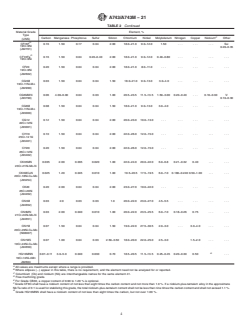
TABLE 2 Continued
Material Grade Element, %
Type
C
Carbon Manganese Phosphorus Sulfur Sil
...
This document is not an ASTM standard and is intended only to provide the user of an ASTM standard an indication of what changes have been made to the previous version. Because
it may not be technically possible to adequately depict all changes accurately, ASTM recommends that users consult prior editions as appropriate. In all cases only the current version
of the standard as published by ASTM is to be considered the official document.
Designation: A743/A743M − 19 A743/A743M − 21
Standard Specification for
Castings, Iron-Chromium, Iron-Chromium-Nickel, Corrosion
Resistant, for General Application
This standard is issued under the fixed designation A743/A743M; the number immediately following the designation indicates the year
of original adoption or, in the case of revision, the year of last revision. A number in parentheses indicates the year of last reapproval.
A superscript epsilon (´) indicates an editorial change since the last revision or reapproval.
This standard has been approved for use by agencies of the U.S. Department of Defense.
1. Scope*
1.1 This specification covers iron-chromium and iron-chromium-nickel alloy castings for general corrosion-resistant application.
The grades covered by this specification represent types of alloy castings suitable for broad ranges of application which are
intended for a wide variety of corrosion environments.
NOTE 1—For alloy castings for severe corrosion-resistant service, reference should be made to Specification A744/A744M. For general heat-resistant alloy
castings, reference should be made to Specification A297/A297M. For nickel alloy castings for corrosion-resistant service, reference should be made to
Specification A494/A494M.
1.2 The values stated in either inch-pound units or SI units are to be regarded separately as standard. Within the text, the SI units
are shown in brackets. The values stated in each system are not exact equivalents; therefore, each system must be used
independently of the other. Combining values from the two systems may result in nonconformance with the specification.
Inch-pound units are applicable for material ordered to Specification A743 and SI units for material ordered to Specification
A743M.
1.3 This international standard was developed in accordance with internationally recognized principles on standardization
established in the Decision on Principles for the Development of International Standards, Guides and Recommendations issued
by the World Trade Organization Technical Barriers to Trade (TBT) Committee.
2. Referenced Documents
2.1 ASTM Standards:
A262 Practices for Detecting Susceptibility to Intergranular Attack in Austenitic Stainless Steels
A297/A297M Specification for Steel Castings, Iron-Chromium and Iron-Chromium-Nickel, Heat Resistant, for General
Application
A494/A494M Specification for Castings, Nickel and Nickel Alloy
A744/A744M Specification for Castings, Iron-Chromium-Nickel, Corrosion Resistant, for Severe Service
A781/A781M Specification for Castings, Steel and Alloy, Common Requirements, for General Industrial Use
A890/A890M Specification for Castings, Iron-Chromium-Nickel-Molybdenum Corrosion-Resistant, Duplex (Austenitic/
Ferritic) for General Application
This specification is under the jurisdiction of ASTM Committee A01 on Steel, Stainless Steel and Related Alloys and is the direct responsibility of Subcommittee A01.18
on Castings.
Current edition approved March 1, 2019March 1, 2021. Published March 2019March 2021. Originally approved in 1977. Last previous edition approved in 20172019 as
A743/A743M – 17.A743/A743M – 19. DOI: 10.1520/A0743_A0743M-19.10.1520/A0743_A0743M-21.
For referenced ASTM standards, visit the ASTM website, www.astm.org, or contact ASTM Customer Service at service@astm.org. For Annual Book of ASTM Standards
volume information, refer to the standard’s Document Summary page on the ASTM website.
*A Summary of Changes section appears at the end of this standard
Copyright © ASTM International, 100 Barr Harbor Drive, PO Box C700, West Conshohocken, PA 19428-2959. United States
A743/A743M − 21
A957/A957M Specification for Investment Castings, Steel and Alloy, Common Requirements, for General Industrial Use
3. General Conditions for Delivery
3.1 Except for investment castings, castings furnished to this specification shall conform to the requirements of Specification
A781/A781M, including any supplementary requirements that are indicated on the purchase order. Failure to comply with the
general requirements of Specification A781/A781M constitutes nonconformance with this specification. In case of conflict between
the requirements of this specification and Specification A781/A781M, this specification shall prevail.
3.2 Steel investment castings furnished to this specification shall conform to the requirements of Specification A957/A957M,
including any supplementary requirements that are indicated in the purchase order. Failure to comply with the general requirements
of Specification A957/A957M constitutes nonconformance with this specification. In case of conflict between the requirements of
this specification and Specification A957/A957M, Specification A957/A957M shall prevail.
4. Ordering Information
4.1 Orders for material to this specification should include the following, as required, to describe the material adequately:
4.1.1 Description of the casting by pattern number or drawing,
4.1.2 Grade,
4.1.3 Heat treatment,
4.1.4 Options in the specification,
4.1.5 Whether castings are to be produced using the investment casting process, and
4.1.6 Supplementary requirements desired, including the standards of acceptance.
5. Process
5.1 The steel shall be made by the electric furnace process, with or without separate refining such as argon-oxygen decarburization
(AOD).
6. Heat Treatment
6.1 Castings shall be heat treated in accordance with the requirements in Table 1.
NOTE 2—Proper heat treatment of these alloys is usually necessary to enhance corrosion resistance and, in some cases, to meet mechanical properties.
Minimum heat treat temperatures are specified; however, it is sometimes necessary to heat treat at higher temperatures, hold for some minimum time at
temperature, and then rapidly cool the castings in order to enhance the corrosion resistance and meet mechanical properties.
7. Chemical Requirements
7.1 The chemical requirements are shown in Table 2.
A,B
TABLE 2 Chemical Requirements
Material Grade Element, %
Type
C
Carbon Manganese Phosphorus Sulfur Silicon Chromium Nickel Molybdenum Nitrogen Copper Niobium Other
(UNS)
CA6N 0.06 0.50 0.02 0.02 1.00 10.5–12.5 6.0–8.0 . . . . . . . . . . . . . . .
11Cr-7Ni
CA6NM 0.06 1.00 0.04 0.03 1.00 11.5–14.0 3.5–4.5 0.40–1.0 . . . . . . . . . . . .
12Cr-4Ni
(J91540)
A743/A743M − 21
TABLE 1 Heat Treatment Requirements
Grade Heat Treatment
CA6N Heat to 1900 °F [1040 °C], air cool, reheat to 1500 °F [815 °C], air cool, and age at 800 °F [425 °C], holding at
each temperature sufficient time to heat casting uniformly to temperature.
CA6NM Heat to 1850 °F [1010 °C] minimum, air cool to 200 °F [95 °C] or lower prior to any optional intermediate temper
and prior to the final temper. The final temper shall be between 1050 °F [565 °C] and 1150 °F [620 °C].
CA15, CA15M, CA40, CA40F (1) Heat to 1750 °F [955 °C] minimum, air cool and temper at 1100 °F [595 °C] minimum, or
(2) Anneal at 1450 °F [790 °C] minimum.
CA28MWV (1) Heat to 1875–1925 °F [1025–1050 °C], quench in air or oil, and temper at 1150 °F [620 °C] minimum, or
(2) Anneal at 1400 °F [760 °C] minimum.
CB30, CC50 (1) Heat to 1450 °F [790 °C] minimum, and air cool, or
(2) Heat to 1450 °F [790 °C] minimum, and furnace cool.
CB6 Heat between 1800 °F [980 °C] and 1920 °F [1050 °C], forced air, cool to 120 °F [50 °C] maximum, and temper
between 1100 °F and 1160 °F [595 °C and 625 °C].
CE30, CH10, CH20, CK20 Heat to 2000 °F [1093 °C] minimum, hold for sufficient time to heat casting to temperature, quench in water or
rapid cool by other means.
CF3, CF3M, CF3MN (1) Heat to 1900 °F [1040 °C] minimum, hold for sufficient time to heat casting to temperature, quench in water or
rapid cool by other means.
(2) As cast if corrosion resistance is acceptable.
CF8, CF8C, CF8M, CF16F, CF16Fa, Heat to 1900 °F [1040 °C] minimum, hold for sufficient time to heat casting to temperature, quench in water or
CF20, CG3M, CG8M, CG12 rapid cool by other means.
CF10SMnN Heat to 1950 °F [1065 °C] minimum, hold for sufficient time to heat casting to temperature, quench in water or
rapid cool by other means.
CK3MCuN, CK35MN, CN3M, CN3MN Heat to 2200 °F [1200 °C] minimum, hold for 4 h minimum, quench in water or rapid cool by other means.
CG6MMN, CN7M Heat to 2050 °F [1120 °C] minimum, hold for sufficient time to heat casting to temperature, quench in water or
rapid cool by other means.
CN7MS Heat to 2100 °F [1150 °C] minimum, 2150 °F [1180 °C] maximum, hold for sufficient time (2 h minimum) to heat
casting to temperature and quench in water.
HG10MNN As cast
TABLE 2 Continued
Material Grade Element, %
Type
C
Carbon Manganese Phosphorus Sulfur Silicon Chromium Nickel Molybdenum Nitrogen Copper Niobium Other
(UNS)
CA15 0.15 1.00 0.04 0.04 1.50 11.5–14.0 1.00 0.50 . . . . . . . . . . . .
12 Cr
(J91150)
CA15M 0.15 1.00 0.040 0.040 0.65 11.5–14.0 1.0 0.15–1.0 . . . . . . . . . . . .
12 Cr
(J91151)
CA28MWV 0.20–0.28 0.50–1.00 0.030 0.030 1.0 11.0–12.5 0.50–1.00 0.90–1.25 . . . . . . . . . V:
12Cr-Mo-W-V 0.20–0.30
(J91422) W:
0.90–1.25
CA40 0.20–0.40 1.00 0.04 0.04 1.50 11.5–14.0 1.0 0.5 . . . . . . . . . . . .
12 Cr
(J91153)
D
CA40F 0.20–0.40 1.00 0.04 0.20–0.40 1.50 11.5–14.0 1.0 0.5 . . . . . . . . . . . .
12 Cr
(J91154)
CB6 0.06 1.00 0.04 0.03 1.00 15.5–17.5 3.5–5.5 0.5 . . . . . . . . . . . .
16Cr-4Ni
(J91804)
E
CB30 0.30 1.00 0.04 0.04 1.50 18.0–21.0 2.00 . . . . . . . . . . . .
20 Cr
(J91803)
CC50 0.50 1.00 0.04 0.04 1.50 26.0–30.0 4.00 . . . . . . . . . . . . . . .
28 Cr
(J92615)
CE30 0.30 1.50 0.04 0.04 2.00 26.0–30.0 8.0–11.0 . . . . . . . . . . . . . . .
29Cr-9Ni
(J93423)
CF3 0.03 1.50 0.04 0.04 2.00 17.0–21.0 8.0–12.0 . . . . . . . . . . . . . . .
19Cr-9Ni
(J92500)
A743/A743M − 21
A,B
TABLE 2 Chemical Requirements
Material Grade Element, %
Type
C
Carbon Manganese Phosphorus Sulfur Silicon Chromium Nickel Molybdenum Nitrogen Copper Niobium Other
(UNS)
CA6N 0.06 0.50 0.02 0.02 1.00 10.5–12.5 6.0–8.0 . . . . . . . . . . . . . . .
11Cr-7Ni
CA6NM 0.06 1.00 0.04 0.03 1.00 11.5–14.0 3.5–4.5 0.40–1.0 . . . . . . . . . . . .
12Cr-4Ni
(J91540)
CA15 0.15 1.00 0.04 0.04 1.50 11.5–14.0 1.00 0.50 . . . . . . . . . . . .
12 Cr
(J91150)
CA15M 0.15 1.00 0.040 0.040 0.65 11.5–14.0 1.0 0.15–1.0 . . . . . . . . . . . .
12 Cr
(J91151)
CA28MWV 0.20–0.28 0.50–1.00 0.030 0.030 1.0 11.0–12.5 0.50–1.00 0.90–1.25 . . . . . . . . . V:
12Cr-Mo-W-V 0.20–0.30
(J91422) W:
0.90–1.25
CA40 0.20–0.40 1.00 0.04 0.04 1.50 11.5–14.0 1.0 0.5 . . . . . . . . . . . .
12 Cr
(J91153)
D
CA40F 0.20–0.40 1.00 0.04 0.20–0.40 1.50 11.5–14.0 1.0 0.5 . . . . . . . . . . . .
12 Cr
(J91154)
CB6 0.06 1.00 0.04 0.03 1.00 15.5–17.5 3.5–5.5 0.5 . . . . . . . . . . . .
16Cr-4Ni
(J91804)
E
CB30 0.30 1.00 0.04 0.04 1.50 18.0–21.0 2.00 . . . . . . . . . . . .
20 Cr
(J91803)
CC50 0.50 1.00 0.04 0.04 1.50 26.0–30.0 4.00 . . . . . . . . . . . . . . .
28 Cr
(J92615)
CE30 0.30 1.50 0.04 0.04 2.00 26.0–30.0 8.0–11.0 . . . . . . . . . . . . . . .
29Cr-9Ni
(J93423)
CF3 0.03 1.50 0.04 0.04 2.00 17.0–21.0 8.0–12.0 . . . . . . . . . . . . . . .
19Cr-9Ni
(J92500)
CF3M 0.03 1.50 0.04 0.04 1.50 17.0–21.0 9.0–13.0 2.0–3.0 . . . . . . . . . . . .
19Cr-10Ni-Mo
(J92800)
CF3MN 0.03 1.50 0.040 0.040 1.50 17.0–22.0 9.0–13.0 2.0–3.0 0.10–0.20 . . . . . . . . .
19Cr-10Ni-Mo-N
(J92804)
CF8 0.08 1.50 0.04 0.04 2.00 18.0–21.0 8.0–11.0 . . . . . . . . . . . . . . .
19Cr-9Ni
(J92600)
F
CF8C 0.08 1.50 0.04 0.04 2.00 18.0–21.0 9.0–12.0 . . . . . . . . . . . .
19Cr-10Ni-Nb
(J92710)
CF8M 0.08 1.50 0.04 0.04 2.00 18.0–21.0 9.0–12.0 2.0–3.0 . . . . . . . . . . . .
19Cr-10Ni-Mo
(J92900)
CF10SMnN 0.10 7.00–9.00 0.060 0.030 3.50–4.50 16.0–18.0 8.0–9.0 . . . 0.08–0.18 . . . . . . . . .
17Cr-8.4Ni-N
(J92972)
A743/A743M − 21
TABLE 2 Continued
Material Grade Element, %
Type
C
Carbon Manganese Phosphorus Sulfur Silicon Chromium Nickel Molybdenum Nitrogen Copper Niobium Other
(UNS)
D
CF16F 0.16 1.50 0.17 0.04 2.00 18.0–21.0 9.0–12.0 1.50 . . . . . . . . . Se:
19Cr-9Ni
0.20–0.35
(J92701)
D
CF16Fa 0.16 1.50 0.04 0.20–0.40 2.00 18.0–21.0 9.0–12.0 0.40–0.80 . . . . . . . . . . . .
19Cr-9Ni
CF20 0.20 1.50 0.04 0.04 2.00 18.0–21.0 8.0–11.0 . . . . . . . . . . . . . . .
19Cr-9Ni
(J92602)
CG3M 0.03 1.50 0.04 0.04 1.50 18.0–21.0 9.0–13.0 3.0–4.0 . . . . . . . . . . . .
19Cr-11Ni-Mo
(J92999)
CG6MMN 0.06 4.00–6.00 0.04 0.03 1.00 20.5–23.5 11.5–13.5 1.50–3.00 0.20–0.40 . . . 0.10–0.30 V:
(J93790) 0.10–0.30
CG8M 0.08 1.50 0.04 0.04 1.50 18.0–21.0 9.0–13.0 3.0–4.0 . . . . . . . . . . . .
19Cr-11Ni-Mo
(J93000)
CG12 0.12 1.50 0.04 0.04 2.00 20.0–23.0 10.0–13.0 . . . . . . . . . . . . . . .
22Cr-12Ni
(J93001)
CH10 0.10 1.50 0.04 0.04 2.00 22.0–26.0 12.0–15.0 . . . . . . . . . . . . . . .
25Cr-12 Ni
(J93401)
CH20 0.20 1.50 0.04 0.04 2.00 22.0–26.0 12.0–15.0 . . . . . . . . . . . . . . .
25Cr-12Ni
(J93402)
CK35MN 0.035 2.00 0.035 0.020 1.00 22.0–24.0 20.0–22.0 6.0–6.8 0.21–0.32 0.40 . . . . . .
23Cr-21Ni-Mo-N
CK3MCuN 0.025 1.20 0.045 0.010 1.00 19.5–20.5 17.5–19.5 6.0–7.0 0.180–0.240 0.50–1.00 . . . . . .
20Cr-18Ni-Cu-Mo
(J93254)
CK20 0.20 2.00 0.04 0.04 2.00 23.0–27.0 19.0–22.0 . . . . . . . . . . . . . . .
25Cr-20Ni
(J94202)
CN3M 0.03 2.0 0.03 0.03 1.0 20.0–22.0 23.0–27.0 4.5–5.5 . . . . . . . . . . . .
(J94652)
CN3MN 0.03 2.00 0.040 0.010 1.00 20.0–22.0 23.5–25.5 6.0–7.0 0.18–0.26 0.75 . . . . . .
21Cr-24Ni-Mo-N
(J94651)
CN7M 0.07 1.50 0.04 0.04 1.50 19.0–22.0 27.5–30.5 2.0–3.0 . . . 3.0–4.0 . . . . . .
20Cr-29Ni-Cu-Mo
(N08007)
CN7MS 0.07 1.00 0.04 0.03 2.50–3.50 18.0–20.0 22.0–25.0 2.5–3.0 1.5–2.0 . . . . . .
19Cr-24Ni-Cu-Mo
(J94650)
G
HG10MNN 0.07–0.11 3.0–5.0 0.040 0.030 0.70 18.5–20.5 11.5–13.5 0.25–0.45 0.20–0.30 0.50 . . .
19Cr-12Ni-4Mn
J92604
A
All values are maximums except where a range is provided.
B
Where ellipses (.) appear in this table, there is no requirement, and the element need not be analyzed for or reported.
C
Columbium (Cb) and niobium (Nb) are interchangeable names for the same element 41.
D
Free machining grade.
E
For Grade CB30, a copper content of 0.90 to 1.20 % is optional.
F
Grade CF8C shall have a niobium content of not less than eight times the carbon content and not more than 1.0 %. If a niobium-plus-tantalum alloy in the approximate
Nb:Ta ratio of 3:1 is used for stabilizing this grade, the total niobium-plus-tantalum content shall not be less than nine times the carbon content and shall not exceed 1.1 %.
G
Grade HG10MNN shall have a niobium content of not less than eight times the carbon, but not over 1.00 %.
A743/A743M − 21
TABLE 2 Continued
Material Grade Element, %
Type
C
Carbon Manganese Phosphorus Sulfur Silicon Chromium Nickel Molybdenum Nitrogen Copper Niobium Other
(UNS)
CF3M 0.03 1.50 0.04 0.04 1.50 17.0–21.0 9.0–13.0 2.0–3.0 . . . . . . . . . . . .
19Cr-10Ni-Mo
(J92800)
CF3MN 0.03 1.50 0.040 0.040 1.50 17.0–22.0 9.0–13.0 2.0–3.0 0.10–0.20 . . . . . . . . .
19Cr-10Ni-Mo-N
(J92804)
CF8 0.08 1.50 0.04 0.04 2.00 18.0–21.0 8.0–11.0 . . . . . . . . . .
...